Electrochemistry
19.1
Electrochemical processes are oxidation-reduction reactions in which:
• the energy released by a spontaneous reaction is converted to electricity or
• electrical energy is used to cause a nonspontaneous reaction to occur
Assigning Oxidation Numbers
The charge the atom would have in a molecule (or an
ionic compound) if electrons were completely transferred. These are somewhat hypothetical, keeps track of electrons.
1. Free elements (uncombined state) or natural state have an oxidation number of zero.
Na, Be, K, Pb, H
2, O
2, P
4=
0
2. In monatomic ions, the oxidation number is equal to the charge on the ion.
Li
+, Li =
+1; Fe
3+, Fe =
+3; O
2-, O =
-2
5. The oxidation number of hydrogen is +1 except when it is bonded to metals in binary compounds. In
these cases, its oxidation number is –1. LiH = H =-1
6. The sum of the oxidation numbers of all the atoms in a molecule or ion is equal to the charge on the
molecule or ion.
HCO
3
-O =
-2
H =
+1
3x(-2) +
1
+
?
= -1
C =
+4
Oxidation numbers ofall the atoms in HCO3- ?
Practice Problems:
Figure out the oxidation numbers of each
element in the following substances:
•Ca(OH)
26. H
2O
•Cl
27. K
2CrO
4•Fe
2+8. PbS
2
•H
2C
2O
49. H
2O
2•MnO
4-10. OF
You Try These:
1. Na
2. Cl
-3. I
24. HNO
35. SnO
26. P
2O
57. NH
4+Electrochemistry Terminology #1
Electrochemistry Terminology #1
Oxidation
Oxidation
–
A process in which an element
attains a more positive oxidation state by
losing e
-(charge increases)
Na(s)
Na
++ e
-
Reduction
Reduction
– A process in which an element
attains a more negative oxidation state by
gaining e
-(charge decreases)
Electrochemistry Terminology #2
Electrochemistry Terminology #2
G
G
ain
ain
E
E
lectrons
lectrons
=
=
R
R
eduction
eduction
An old memory device for oxidation
An old memory device for oxidation
and reduction goes like this…
and reduction goes like this…
LEO
LEO
says
says
GER
GER
L
L
ose
ose
E
E
lectrons
lectrons
=
=
O
O
xidation
xidation
Identifying Redox Rxns
Given: Cu
(s)
+ AgNO
3(aq)
Ag
(s)
+ Cu(NO
3)
2Identify the reduction: (GER)
Ag+
Ag
*Charge on Ag decreased or was reduced
Identify the oxidation: (LEO)
Cu
Cu
2+You Try:
In the following Redox rxns, identify the element
being oxidized and the element being reduced.
(Use the half-reaction notation.)
1.Fe
(s)
+ CuCl
2(aq)
FeCl
2(aq)
+ Cu
(s)
Red: Cu
+2+ 2e
- Cu
Ox: Fe Fe
+2+ 2e
-•Zn(s) + H
2SO
4(aq)
H
2(g)
+ ZnSO
4(aq)
Red: 2H
++ 2e
- H
2-H
2(g) + O
2(g)
H
2O (g)
H
22H
++ 2e
-O
2+ 4e
-2O
2-Oxidation
half-reaction (lose e
-)
Reduction
half-reaction (gain e
-)
Balancing Redox Reactions using the half-reaction method: 1. Always start by assigning oxidation states to each
element in the reaction.
2. Look for differences (which were oxidized/reduced) 3. Separate into half reactions and balance atoms and e
-4. Balance e- and sum together (e- should cancel out!)
0 0
2-Balancing Redox Equations
The oxidation of Fe2+ to Fe3+ by Cr
2O72- in acid solution?
1. Separate the equation into two half-reactions: Red and Ox.
Oxidation:
Cr2O72- Cr3+
+6 +3
Reduction:
Fe+2 2+ Fe+3 3+
2. Balance the atoms other than O and H in each half-reaction in the usual fashion (use coefficients).
Cr2O72- 2Cr3+
Fe2+ + Cr
Balancing Redox Equations
3. For reactions in acid, add H2O to balance O atoms, then H+
to balance H atoms.
Cr2O72- 2Cr3+ + 7H 2O
14H+ + Cr
2O72- 2Cr3+ + 7H2O
4. Add electrons to one side of each half-reaction to balance the charges on the half-reaction (this is ion charges, not
oxidation states! Fe2+ Fe3+ + 1e
-6e- + 14H+ + Cr
2O72- 2Cr3+ + 7H2O
5. If necessary, equalize the number of electrons in the two half-reactions by multiplying the half-reactions by
appropriate coefficients to cancel out electrons.
6Fe2+ 6Fe3+ + 6e
-6e- + 14H+ + Cr
Balancing Redox Equations
6. Add the two half-reactions together and balance the final equation by inspection. The number of electrons on both sides must cancel.
6e- + 14H+ + Cr
2O72- 2Cr3+ + 7H2O
6Fe2+ 6Fe3+ + 6e
-Oxidation:
Reduction:
14H+ + Cr
2O72- + 6Fe2+ 6Fe3+ + 2Cr3+ + 7H2O
7. Verify that the number of atoms and the charges are balanced. (You can do this by inspection)
14x1 – 2 + 6x2 = 24 = 6x3 + 2x3
8. For reactions in basic solutions, add OH- to both sides of
the equation for every H+ that appears in the final equation.
Balance the following Redox rxn
in basic solution:
I
-(aq)
+ MnO
4-
(aq)
I
2(aq)
+ MnO
2(s)
Answer:
6I-(aq)+ 4H
You Try:
Balance the following redox reaction in
acidic solution using the half reaction
method.
Cu
(s)
+ NO
3-(aq)
Cu
2+(aq)
+ NO
2
(g)
Answer:
2NO
3-+ Cu + 4H
+
Cu
2++ 2NO
Electrochemistry Terminology #3
Electrochemistry Terminology #3
Oxidizing agent
Oxidizing agent
The substance that is reduced is
the oxidizing agent
Reducing agent
Reducing agent
Galvanic Cells: http://www.youtube.com/watch?v=C26pH8kC_Wk
spontaneous redox reaction anode
oxidation
Electrochemistry Terminology #4
Electrochemistry Terminology #4
Anode
Anode
The electrode
where
oxidation
occurs
Cathode
Cathode
The electrode
where
reduction
occurs
Memory device:
Memory device:
Red
Red
uction
uction
at the
at the
Cat
Cat
hode
hode
Rxn:
Zn
(s)
+ Cu
2+(aq)
Cu
(s)
+ Zn
2+(aq)
1. To draw cell, first figure out which is oxidized and which is reduced.
1. Remember that
oxidation occurs at anode and
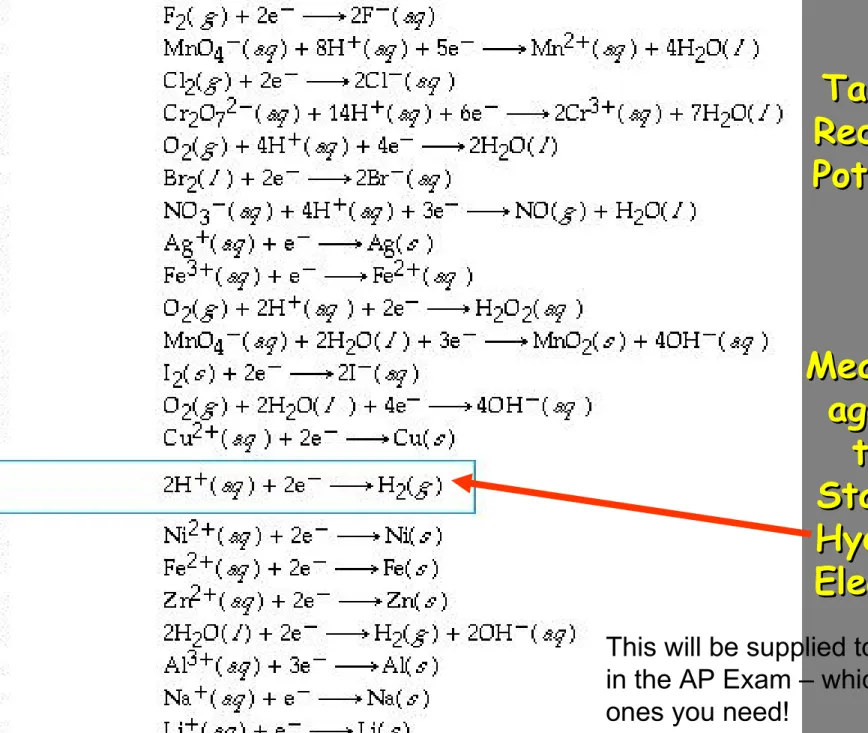
Measuring
Measuring
Standard
Standard
Electrode
Electrode
Potential
Potential
(E°
(E°
cellcell)
)
Potentials are measured against a hydrogen ion
Potentials are measured against a hydrogen ion
reduction reaction, which is arbitrarily
reduction reaction, which is arbitrarily
assigned a potential of
Table of Table of Reduction Reduction Potentials Potentials Measured Measured against against the the Standard Standard Hydrogen Hydrogen Electrode Electrode
Galvanic/Voltaic
Galvanic/Voltaic
(Electrochemical) Cells
(Electrochemical) Cells
Spontaneous redox
processes have:
1. A positive
cell potential, E
02. A negative free
energy change, (-
G)
*All Voltaic cells are
considered
spontaneous
Zn - Cu
Zn - Cu
Galvanic
Galvanic
Cell
Cell
Example
Example
Zn
2++ 2e
-
Zn E = -0.76V
Cu
2++ 2e
-
Cu E = +0.34V
From a table
From a table
of reduction
of reduction
potentials:
potentials:
Zn - Cu
Zn - Cu
Galvanic
Galvanic
Cell
Cell
Cu
2++ 2e
-
Cu E = +0.34V
The
The less positive less positive
reduction potential reduction potential
becomes the becomes the
oxidation
oxidation and and more more positive or higher
positive or higher
reduction potential reduction potential
becomes
becomes reductionreduction
Zn
Zn
2++ 2e
-E = +0.76V
Zn + Cu
2+
Zn
2++ Cu E
0= + 1.10 V
Line
Line
Notation
Notation
Zn(
Zn(
s
s
) | Zn
) | Zn
2+2+(
(
aq
aq
) || Cu
) || Cu
2+2+(
(
aq
aq
) | Cu(
) | Cu(
s
s
)
)
An abbreviated
An abbreviated
representation of
representation of
an electrochemical
an electrochemical
cell
cell
Anode Anode solution solution Anode Anode materialStandard Reduction Potentials
19.3
Pt (s) | H2 (1 atm) | H+ (1 M) || Cu2+ (1 M) | Cu (s)
2e- + Cu2+ (1 M) Cu (s)
H2 (1 atm) 2H+ (1 M) + 2e
-Anode (oxidation):
Cathode (reduction):
H2 (1 atm) + Cu2+ (1 M) Cu (s) + 2H+ (1 M)
E0 = E
cathode - Eanode
cell 0 0
E0 = 0.34 V
cell
Ecell = ECu /Cu2+ – EH /H +
2 0 0 0
0.34 = E0Cu /Cu2+ - 0
19.3
• E0 is for the reaction as
written
• The more positive E0 the
greater the tendency for the substance to be reduced
• The half-cell reactions are reversible
• The sign of E0 changes
when the reaction is reversed
• Changing the stoichiometric coefficients of a half-cell
What is the standard emf of an electrochemical cell made of a Cd electrode in a 1.0 M Cd(NO3)2 solution and a Cr electrode in a 1.0 M Cr(NO3)3 solution?
Cd2+ (aq) + 2e- Cd (s) E0 = -0.40 V
Cr3+ (aq) + 3e- Cr (s) E0 = -0.74 V
Cd is the stronger oxidizer Cd will oxidize Cr
2e- + Cd2+ (1 M) Cd (s)
Cr (s) Cr3+ (1 M) + 3e
-Anode (oxidation):
Cathode (reduction):
2Cr (s) + 3Cd2+ (1 M) 3Cd (s) + 2Cr3+ (1 M)
x 2
x 3
E0 = E
cathode - Eanode cell 0 0
E0 = -0.40 – (-0.74)
cell
E0 = 0.34 V
cell
Calculating
Calculating
G
G
00for a Cell
for a Cell
(a measure of spontaneity)
(a measure of spontaneity)
)
10
.
1
)(
500
96
)(
2
(
0Coulomb
Joules
e
mol
coulombs
e
mol
G
G
G
00= -nFE
= -nFE
00n
n
= moles of electrons in balanced redox equation
= moles of electrons in balanced redox equation
F
F
= Faraday constant = 96,500 coulombs/mol e
= Faraday constant = 96,500 coulombs/mol e
--Zn + Cu
2+
Zn
2++ Cu
E
0= + 1.10 V
kJ
Joules
G
0
212267
212
Spontaneity of Redox Reactions
Will the following reaction occur spontaneously at 250C?
Fe2+ (aq) + Cd (s) Fe (s) + Cd2+ (aq)
2e- + Fe2+ 2Fe
Cd Cd2+ + 2e
-Oxidation:
Reduction:
n = 2
E0 = -0.44
E0 = -0.04 V
G = 7720 J or 7.720 kJ Non-spontaneous
19.5
G
0
nFE
0E0 = 0.40
The Nernst Equation
The Nernst Equation
(not tested this year)
(not tested this year)
)
ln(
0
Q
nF
RT
E
E
Standard potentials assume a concentration of
Standard potentials assume a concentration of
1 M. The Nernst equation allows us to calculate
1 M. The Nernst equation allows us to calculate
potential when the two cells are not 1.0 M.
potential when the two cells are not 1.0 M.
R
R
= 8.31 J/(mol
= 8.31 J/(mol
K)
K)
T
T
= Temperature in K
= Temperature in K
n
n
= moles of electrons in balanced redox equation
= moles of electrons in balanced redox equation
F
-Equilibrium Constants and Cell Potential
Equilibrium Constants and Cell Potential
At equilibrium, forward and reverse
reactions occur at equal rates, therefore:
1.
1.
The battery is
“
dead
”
2. The cell potential,
E
, is zero volts
Use Le Chatelier’s Principal to predict changes in
voltage:
Concentration
Concentration
Cell
Cell
Determine which side undergoes oxidation,
and which side undergoes reduction.
Both sides have the same
components but at different concentrations.
???
Concentration
Concentration
Cell
Cell
Both sides have the same
components but at different concentrations.
The 1.0 M Zn
2+must decrease in concentration, and
the 0.10 M Zn
2+must increase in concentration
Zn
2+(1.0M) + 2e
-
Zn (reduction)
Zn
Zn
2+(0.10M) + 2e
-(oxidation)
??? ??? Cathode Cathode Anode AnodeUse Le Chat to predict:
Given the following voltaic cell:
Ag
++ e
-
Ag
E° = +0.80 V
Cu
2++ 2e
-
Cu
E° = +0.34 V
•Predict the reaction that will occur.
•If water is added to the Cu
2+cell, how will
voltage be affected?
•If Cl
-is added to the Ag
+cell to create AgCl,
how will voltage be affected?
You Try: Predict:
If the reduction of mercury (I) is desired:
Hg
22++ 2e
-
2Hg(s)
E° = +0.80 V
1. Which of the following could be used as
the anode?
Br
2+ 2e
-
2Br
-E° = +1.07 V
Zn
2++ 2e
-
Zn
E° = -0.76 V
•Write the reaction that occurs.
•If water is added to the solution of Hg
22+,
how is voltage affected?
Remember…
Remember…
Galvanic (Electrochemical) Cells
Galvanic (Electrochemical) Cells
Spontaneous redox
processes have:
A positive
cell potential, E
0A negative free
Electrolytic
Electrolytic
Processes
Processes
A negative
cell potential, (-E
0)
A positive free
energy change, (+
G)
Electrolytic
processes are
Why Electrolysis?
• Unlike electrochemical cells that
spontaneously supply energy, electrolysis
uses
energy to cause a non-spontaneous
19.8
Electrolysis is the process in which electrical energy is
used to cause a nonspontaneous chemical reaction to occur.
How to determine what gets reduced or
oxidized by electrolysis in an aqueous
solution
• Metal ions or water can be reduced.
• When electrolysis occurs in aqueous solutions,
if the metal has a reduction potential more
negative (smaller) than -0.8, then only water
is reduced because water has the larger E
ored
.
• Negative ions will be oxidized.
• If there is a mixture of metal ions, the
metals will be reduced in order of
largest E
o redPredicting the Products of
Electrolysis
If there is no water present and you
have a pure molten ionic compound,
then:
–
the cation will be reduced
– (gain electrons/go down in charge)
–
the anion will be oxidized
– (lose electrons/go up in charge)
Na
++ e- Na (
s
)
2Cl
-Cl
Electrolysis and Mass Changes charge (C) = current (A) x time (s)
1 mole e- = 96,500 C
How much Ca will be produced in an electrolytic cell of molten CaCl2 if a current of 0.452 A is passed through the cell for 1.5 hours?
Anode:
Cathode: Ca2+ (l) + 2e- Ca (s)
2Cl- (l) Cl
2 (g) + 2e
-Ca2+ (l) + 2Cl- (l) Ca (s) + Cl
2 (g)
2 mole e- = 1 mole Ca
mol Ca = C
s
1.5 hr x 3600 hrs
96,500 C 1 mol e
-x
2 mol e
-1 mol Ca x
= 0.0126 mol Ca = 0.50 g Ca x 0.452
More Practice:
Calculate the number of grams of aluminum
produced in 2.00 hours by electrolysis of molten
AlCl
3if a current of 12.0 A is applied
.
8.05 g Al
The half-reaction for the formation of magnesium
metal upon electrolysis of molten MgCl
2is: Mg
2++
2e
-
Mg. How many seconds would be required
to produce 25.0 g of Mg from MgCl
2if the current
is 50.0 A?
Electroplating of
Electroplating of
Silver
Silver
Anode reaction
Anode reaction
:
:
Ag
Ag
Ag
Ag
+++ e
+ e
- -Electroplating requirements
Electroplating requirements
:
:
1. Solution of the plating metal
1. Solution of the plating metal
3. Cathode with the object to be plated
3. Cathode with the object to be plated
2. Anode made of the plating metal
2. Anode made of the plating metal
4. Source of current
4. Source of current
Cathode reaction
Cathode reaction
:
:
Ag
Solving an Electroplating Problem
Solving an Electroplating Problem
Q: How many seconds will it take to plate out
Q: How many seconds will it take to plate out
5.0 grams of silver from a solution of AgNO
5.0 grams of silver from a solution of AgNO
33using a 20.0 Ampere current?
using a 20.0 Ampere current?
5.0 g
Ag
Ag
+++ e
+ e
- -
Ag
Ag
1 mol Ag
107.87 g
1 mol e
-1 mol Ag
96 500
C
1 mol e
-1 s
20.0 C
= 2.2 x 10