http://www.sciencepublishinggroup.com/j/jfa doi: 10.11648/j.jfa.20190701.11
ISSN: 2330-7331 (Print); ISSN: 2330-7323 (Online)
Research on Existing Problems and Countermeasures of
Budget Performance Evaluation of Public Institutions in
China from the Perspective of the New Budget Law
Mao Chengyin
Director of Finance Department, Nanjing Institute of Industry Technology, Nanjing, China
Email address:
To cite this article:
Mao Chengyin. Research on Existing Problems and Countermeasures of Budget Performance Evaluation of Public Institutions in China from the Perspective of the New Budget Law. Journal of Finance and Accounting. Vol. 7, No. 1, 2019, pp. 1-8. doi: 10.11648/j.jfa.20190701.11
Received: November 5, 2018; Accepted: December 13, 2018; Published: January 24, 2019
Abstract:
Budget performance management is not only the core element of financial management of public institutions in China, but also an important basis for public institutions to perform their duties. Budget performance evaluation is an important carrier of budget performance management. It assumes the important functions of optimizing resource allocation and controlling cost. Its level is an important indicator to measure the scientific management of public institutions. Strengthening budget management and improving expenditure efficiency and effect are the key points of the new budget law. Combined with the current situation of public institutions in China, this paper analyzes and studies the challenges faced by public institutions and the problems existing in budget performance evaluation after the implementation of the new budget algorithm, and puts forward corresponding countermeasures and Suggestions, hoping to provide important support for strengthening budget management and improving the level of budget management of public institutions in China.Keywords:
Budget Law, Public Institution, Performance Evaluation, Divorced from Reality, Countermeasures1. Introduction
If capital is the blood to nourish and protect the survival and development of the public institutions, the budget will be the heart to organize the blood supply. It is a major part of the governance system of the public institutions [1]. Strengthening budget performance management is the basis for the public institutions to perform their functions and the core elements to enhance financial management, while budget evaluation is an important carrier for budget performance management. Therefore, strengthening the budget performance evaluation of public institutions is crucial for improving the capital use efficiency and effect. It is specially required in the Budget Law implemented on January 1, 2015 that the budget performance management shall be comprehensively strengthened during the budget management of public sectors and the review of budget and final accounts of the National People’s Congress [2]. For example, the budget shall be prepared with reference to the performance evaluation results of relevant expenditures, and relevant performance management targets shall be developed;
the government and institution at each level shall carry out performance evaluation on the performance of budgetary expenditures; the Standing Committee of the National People's Congress shall raise suggestions and comments on the budget performance when issuing the budget and final accounts review report. It can be seen that the budget performance management has run through the whole process of budget preparation, review, execution, supervision and final accounting in the new Budget Law, which shall clarify the performance targets of capital use in the budget preparation, improve the budget execution efficiency and, more importantly, pay attention to the budget execution effect and carry out performance evaluation.
management of public institutions and a key measure for public institutions to strengthen financial management and enhance budget performance.
2. Relevant Concepts of Budget
Evaluation
2.1. Performance Management
Performance management, namely the “target-effect oriented” management, is a management system with the basic links of establishment, execution, evaluation and feedback of performance targets. According to the Interim Measures for Performance Evaluation Management of Fiscal Expenditures issued by the Ministry of Finance, the budget performance evaluation refers to the fair and impartial judgment on the economy, efficiency and effect of the budget completion made by the public institutions through setting a series of evaluation indicators, standards and methods according to the relevant national regulations and their own characteristics [3].
2.2. Budget Performance Evaluation Subject
Budget performance evaluation is a budget management link with total involvement. The budget business management and decision-making body is responsible for listening to the budget decision execution analysis report, as well as reviewing and finalizing the final accounts and performance evaluation report of the institution; the budget business management body is generally responsible for preparing the final report and relevant performance evaluation reports of the institution, and the budget management executing body is responsible for providing relevant data for budget execution. In actual work, the finance department is responsible for developing the relevant performance evaluation system, arranging and guiding the performance evaluation work of the budget department at the same level and the finance department at the lower level, as well as giving opinions and suggestions based on the evaluation results of the budget department at the same level and the finance department at the lower level. The budget department is responsible for formulating the relevant budget performance evaluation system of the department, specifically organizing and implementing the budget performance evaluation work, submitting the evaluation report to the finance department at the same level, and improving the budget management based on the feedbacks from the finance department at the same level [4].
2.3. Budget Evaluation Process
The budget evaluation execution process includes 3 procedures that are establishment of an evaluation system, evaluation on the business departments and preparation of evaluation report. As for the budget performance evaluation of the business departments, the priority is to determine the evaluation objects and select personnel professionally qualified for evaluation accordingly. The second is to
develop an appropriate evaluation plan based on the specific evaluation objects as well as review and verify the budget execution data collected by the business departments. The last is to carry out budget evaluation through comprehensive analysis and conclude the evaluation.
2.4. Budget Performance Evaluation Indicators and Evaluation Methods
As the main tool for budget performance management, the budget performance evaluation indicators are normally divided into two categories, common indicators and individual indicators, and the latter shall be developed in combination with the specific conditions of the public institutions. Performance evaluation methods include comparative method, cost-effectiveness method, minimum cost method, factor analysis method and public evaluation method. As a comprehensive analysis method, the comparative method is to compare budget targets with budget results, comparable historical data with current execution results, department with department, region with region [5]. The cost-effectiveness analysis method refers to a method that the public institutions analyzes and compares the budget expenditure with the performance indicators obtained in a certain period to evaluate the realization degree of the budget targets. Applicable to similar objects that are difficult to measure but comparable with each other, the minimum cost method is to compare the implementation costs of those similar objects. The factor analysis method, also as a comprehensive analysis method, focuses on analyzing the internal and external factors affecting the realization of the budget targets. The public evaluation method is used to evaluate the realization of budget targets through analysis by means of expert evaluation, public questionnaire, sample survey, etc.
2.5. Application of Budget Evaluation Results
After the budget evaluation is completed, the results shall be fed back to the evaluated institutions so that they can improve the management. In the meantime, the evaluation results shall also be used as a reference for the public institutions to arrange the expenditure budget of relevant department of the next year and the overall evaluation on the work completed by the department in the current year. The poor budget execution performance of this department in the previous year will not only appropriately reduce its budget input but also deduct its overall evaluation score of the year. Only in this way can the budget evaluation play the role and realize the incentive function of the budget performance management.
3. Existing Problem of Budget
Performance Evaluation
3.1. Weak Scientificity and Operability of the Current Evaluation Indicators
compliance indicators and fewer quantitative evaluation indicators, output evaluation indicators and result indicators, the performance evaluation has become the budget performance summary or project acceptance procedure, which is difficult to achieve the expected effect of budget performance management and even doubtable for the authenticity of some results [6]. The main reason is the common phenomenon that the public institutions in China choose reporting over management. Even if the budget performance indicators are set, they are mostly perfunctory and ambiguous, and some proxies are barely correlated. When carry out project acceptance, some departments often take the use of the special funds allocated by the finance as an important basis for the acceptance. If the funds planned by the budget are used up, the performance will be good; if the funds are not used up, the performance will be poor. The construction of the Guangzhou subway, which drew wide attention a few years ago, saved RMB 1.8 billion from the budget, however, the project leader Lu Guanglin was criticized instead of being rewarded because of the “leftover funds and poor performance”. Setting such irrational evaluation indicators is undoubtedly to force people to spend extravagantly, which lead to an extremely wrong way. It can be argued that this is why most people today would rather spend all the money than to save it. Under such incorrect incentive, some people would rather spend all the money to "buy" performances, as the money spent can be transformed into favorable GDP figures, while the money saved can be used for nothing but to be turned in. Therefore, some public institutions will quickly spend all the money of this year by the end of the year, and kind of complete an “important task”! Such evaluation is not conducive to the earnest implementation of the relevant regulations about strict economy by public institutions and not conducive to the improvement of the capital use efficiency, which is a practice irresponsible for the money of taxpayers.
3.2. Lack of a Complete Assessment Mechanism Before and During the Project
In the current stage, the expenditure evaluation is normally carried out by public institutions in China after the project, and the mechanism of analysis before the project and tracking during the project commonly practiced internationally has not yet been adopted. Although China's public investment department has also proposed to track and manage the whole process of approval, construction, completion and acceptance for national key investment projects, no applicable expenditure performance evaluation method has ever been issued so far [7]. Without effective institutional guarantee and legal restraints, the problems are always found through performance evaluation after "rice has been cooked ", and funds have been wasted. Even if the evaluation results can be effectively used, it is only a remedy.
3.3. Contradiction of Paying More Attention to Output Results than Input Control Exists in the Current Evaluation System
At present, the exploration for data collection mechanism
related to budget performance evaluation indicators in China has been just started. There is neither standard evaluation value measurement and database construction nor uniform standards, and it is in the primary static evaluation management stage. The evaluation mainly focuses on the expenditure results to see whether the expenditures have met the set targets. Without necessary dynamic management, including the evaluation of the whole process of input, procedures and efficiency, such evaluation is difficult to achieve the corresponding effect. In the course of budget preparation, all institutions tend to maximize their budgets, and most of them compete for project approval in order to get more budgets, and find different reasons and make up multiple projects to obtain enough funds and try to get the greatest capital control right. The result is that there are actually no projects despite those projects and funds in the budget sheet, and the purpose is to get more convenience for offsetting over-expenditure with the project funds. In actual implementation, some institutions use the funds inconformity with the budget, and embezzle and occupy projects funds, so that the project budget fails.
4. Countermeasures and Suggestions for
Improving the Budget Performance
Evaluation of Public Institutions in
China
Budget performance evaluation is an important link of the budget performance management of public institutions. In view of the above problems, it is urgent to systematically deepen relevant reforms, improve the mechanisms, and enhance the effect.
4.1. Establish a Scientific Performance Evaluation Index System for Public Institutions
investment, actual expenditures, accounting information quality and financial management status, while the latter mainly includes secondary indicators such as business performance targets, completion degree and organization & management level. Based on the principle of "80-20 rule", the weight of the two types of indicators is 20% and 80% respectively. There are four evaluation grades, which are excellent (≥90 points), good (80-90 points), qualified (60-80
points) and unqualified (≤ 60 points). The scientificity of
the budget performance evaluation index system shall be enhanced in the following two ways:
4.1.1. Reasonably
Determine the budget evaluation indicator system and establish key control points and principles. Three points shall be paid attention to when determining the key points of the evaluation indicators: The first is to properly choose the the evaluation indicators. Its overall design shall be systematic, comprehensive and scientific, with strong purpose, objectivity and operability, which can reflect the substantial performance [9]. The second is to specify the connotation of the evaluation indicators which shall embody economy, effectiveness and efficiency. Among them, economy is to obtain a certain public service (product) at the lowest cost; efficiency is the unit output cost comparison between similar tasks; and effectiveness is the degree of achieving the expected targets or effect after the implementation of the plan. The third is to reveal the essence of performance, that is, to examine the performance concerning three questions through the comparison between the capital investment and expenditure effect: 1) Is it necessary (target)? 2) How much does it cost (budget)? 3) Is it worth spending the money (evaluation)?
Determining the evaluation indicators shall adhere to the following principles: (1) scientific norms. Setting the evaluation indicators shall stick to the scientific attitude, strictly follow the established procedures, and adopt the scientific methods to ensure that the evaluation indicators are both scientific and comprehensive and practical and feasible. (2) Openness and fairness. The special nature of the public institutions requires that their performance evaluation and indicator determination shall be objective and fair and shall accept public supervision. (3) Cost-benefit comparison. It shall ensure that the cost of accounting information supply in performance evaluation is no greater than the benefit obtained thereby. When determining the evaluation indicators of a public institution, the relationship between the cost of certain evaluation indicators and the benefit generated by service performance evaluation must be considered: when the benefit generated by performance evaluation of a certain service of a public institution is greater than the cost of using that indicator for evaluation, the indicator shall be chosen, or it should be abandoned. (4) Grading and classification. It is divided into project evaluation, department (institution) evaluation and comprehensive evaluation by grade; or service, safety, education, sports, science and technology, culture and entertainment, health care, social security,
environmental protection, agricultural and aquatic products by category. Comprehensively, it can be divided into national, provincial and local evaluation.
4.1.2. Specifically
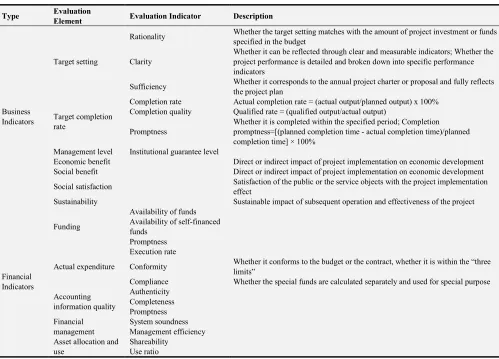
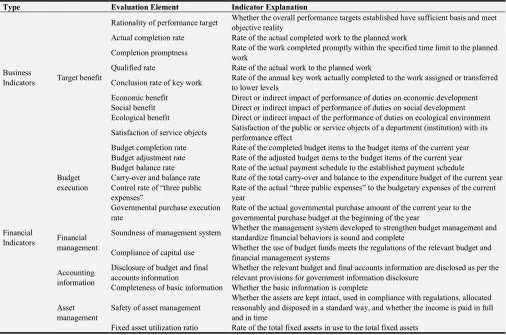
Refine and improve of the budget performance evaluation indicators of public institutions. According to the difference between the subject and object of the budgetary expenditure evaluation of the public institutions, it can be set at three levels of project budget performance evaluation indicators, departmental budget performance evaluation indicators and departmental integrated budget and final accounts evaluation indicators [10]. This paper has improved the budget performance evaluation indicators at those three levels and designed different budget performance evaluation index systems, with details shown in the three attached tables: Table 1 shows the indicators used to evaluate the project budget performance, Table 2 shows the indicators used to evaluate the departmental budget performance, and Table 3 shows the indicators used to evaluate the departmental budget and final accounts.
4.2. Deepen the Budget Preparation and Implement Management Reform for the Improvement of the Performance Evaluation Mechanism of Public Institutions
The first is to refine the budget preparation. The budget preparation method shall be further established and improved for the implementation of the budget performance management of public institutions. The key is to refine the preparation of performance-target-oriented project budget and the budget performance indicators of each project, which can not only promote the budget execution, but also provide basis for the performance evaluation of the budget execution results, so that the evaluation can be based on detailed indicators.
The second is to strengthen budget execution management. A budget execution tracking and accountability system and a regular budget execution reminding and notification system shall be established, and any deviation from the target found during the budget execution shall be corrected. Because, if the budget execution deviates from the expected targets, the valuation with the budget performance indicators designed based on the budget targets will be less scientific.
4.3. Reform the Current Special Fund Investment System
establishing a special project, one regulation shall be developed for each special project, in which the scope of use, execution term, allocation method, application procedures, performance targets, management responsibilities, information disclosure and accountability shall be clearly specified, and the management responsibilities of the people in charge shall be strictly provided. In the meantime, a regular credit evaluation mechanism and a corresponding withdrawal mechanism for special funds shall be established to regularly sort out, integrate and standardize the special projects. The second is to investment business development by comprehensively adopting the measures of equity participation guarantee, financial discount and subsidies replaced with rewards, accelerate the implementation of investment mode with government as the lead and the cooperation of government and social capital, leverage the funds of enterprises, banks and society, and form the
multi-channel and diversified business development investment pattern [11].
4.4. Accelerate and Push the Accounting System Reform of Public Institutions
The current cash basis in the Accounting System of Public Institutions shall be changed to the accrual basis, in combination with the accounting reform of the government. The funds of the public institutions are financial funds and the funds of taxpayers, so it is more necessary to strengthen the cost accounting. By taking the budget performance management as the starting point and the accrual basis as the foundation, a target-task-performance-correlated evaluation mechanism shall be established by the principle of matching administrative rights and responsibilities, financial
Table 1. Project Budget Performance Evaluation Indicators of Public Institution.
Type Evaluation
Element Evaluation Indicator Description
Business Indicators
Target setting
Rationality Whether the target setting matches with the amount of project investment or funds specified in the budget
Clarity
Whether it can be reflected through clear and measurable indicators; Whether the project performance is detailed and broken down into specific performance indicators
Sufficiency Whether it corresponds to the annual project charter or proposal and fully reflects the project plan
Target completion rate
Completion rate Actual completion rate = (actual output/planned output) x 100% Completion quality Qualified rate = (qualified output/actual output)
Promptness
Whether it is completed within the specified period; Completion promptness=[(planned completion time - actual completion time)/planned completion time] × 100%
Management level Institutional guarantee level
Economic benefit Direct or indirect impact of project implementation on economic development Social benefit Direct or indirect impact of project implementation on economic development
Social satisfaction Satisfaction of the public or the service objects with the project implementation effect
Sustainability Sustainable impact of subsequent operation and effectiveness of the project
Financial Indicators
Funding
Availability of funds Availability of self-financed funds
Promptness
Actual expenditure
Execution rate
Conformity Whether it conforms to the budget or the contract, whether it is within the “three limits”
Compliance Whether the special funds are calculated separately and used for special purpose
Accounting information quality
Authenticity Completeness Promptness Financial
management
System soundness Management efficiency Asset allocation and
use
Shareability Use ratio
Authority and accountability to discard the extensive funds management mode, scientifically calculate the cost of each item, analyze and evaluate the social and economic benefits of various budget items, correctly reflect the actual costs of the public institutions during the budget period, and set up an incentive and constraint mechanism for use of funds by combining with the evaluation indicators like cash flow introduction. The reform of the accounting system of public
Table 2. Departmental Budget Performance Evaluation Index of Public Institution.
Type Evaluation Element Indicator Explanation
Business
Indicators Target benefit
Rationality of performance target Whether the overall performance targets established have sufficient basis and meet objective reality
Actual completion rate Rate of the actual completed work to the planned work
Completion promptness Rate of the work completed promptly within the specified time limit to the planned work
Qualified rate Rate of the actual work to the planned work
Conclusion rate of key work Rate of the annual key work actually completed to the work assigned or transferred to lower levels
Economic benefit Direct or indirect impact of performance of duties on economic development Social benefit Direct or indirect impact of performance of duties on social development Ecological benefit Direct or indirect impact of the performance of duties on ecological environment
Satisfaction of service objects Satisfaction of the public or service objects of a department (institution) with its performance effect
Financial Indicators
Budget execution
Budget completion rate Rate of the completed budget items to the budget items of the current year Budget adjustment rate Rate of the adjusted budget items to the budget items of the current year Budget balance rate Rate of the actual payment schedule to the established payment schedule
Carry-over and balance rate Rate of the total carry-over and balance to the expenditure budget of the current year Control rate of “three public
expenses”
Rate of the actual “three public expenses” to the budgetary expenses of the current year
Governmental purchase execution rate
Rate of the actual governmental purchase amount of the current year to the governmental purchase budget at the beginning of the year
Financial management
Soundness of management system Whether the management system developed to strengthen budget management and standardize financial behaviors is sound and complete
Compliance of capital use Whether the use of budget funds meets the regulations of the relevant budget and financial management systems
Accounting information
Disclosure of budget and final accounts information
Whether the relevant budget and final accounts information are disclosed as per the relevant provisions for government information disclosure
Completeness of basic information Whether the basic information is complete
Asset management
Safety of asset management
Whether the assets are kept intact, used in compliance with regulations, allocated reasonably and disposed in a standard way, and whether the income is paid in full and in time
Fixed asset utilization ratio Rate of the total fixed assets in use to the total fixed assets
4.5. Strengthen the Supervision and Review of the Full-covered Budget and Increase Budget Transparency
To strengthen the review and supervision of the full-covered budget of public institutions: the first shall focus on pushing the disclosure of budget and final accounts of the public institutions, the "three public expenses", training fees and conference expenses to the public, and further standardize the disclosure procedures and contents [13]. The higher transparency
To standardize the operation and management of public institutions, promote their savings in administrative costs, and control corruption from the source. The second shall vigorously drive the disclosure of budget and final accounts
of major projects, and long-term disclose of the audit results to the public for social supervision. The third shall enhance the supervision force and scope of the full-covered budget, and incorporate all funds into standard regulation scope. The fourth shall expand the disclosure of the audit results of the financial budget of public institutions, and open to the public for social supervision by referring to the practice of listed companies. It shall implement the rectification measures for those issues revealed during patrol inspection and auditing, cooperate with the discipline inspection and supervision departments to build a comprehensive budget accountability mechanism, and provide a strong guarantee for budget performance evaluation.
Table 3. Final Accounts Evaluation Indicators of Administrative Institutions.
Evaluation Indicators
Indicator Description
(Result×100%) Evaluation Standard
Grade 1 Indicators Grade 3 Indicators
Name Weight Name Weight
Budget preparation and implementation status
80
Rate of difference between financial appropriation and income [14]
15
(Final accounts - budget at the beginning of the year) / budget at the beginning of the year
If the difference rate = 0, full score will be given; if the difference rate (absolute value) > 0, 1 point will be deducted for every 5% (including 5%) increased until the score is deducted to 0
Rate of difference between non-financial appropriation and income
10
(Final accounts - budget at the beginning of the year) / budget at the beginning of the year
Evaluation Indicators
Indicator Description
(Result×100%) Evaluation Standard
Grade 1 Indicators Grade 3 Indicators
Name Weight Name Weight
deducted to 0
Rate of difference between carry-over and balance at the beginning of the year
10
(Final accounts - budget at the beginning of the year) / budget at the beginning of the year
If the difference rate = 0, full score will be given; if the difference rate (absolute value) > 0, 1 point will be deducted for every 10% (including 10%) increased until the score is deducted to 0
Basic expenditure
difference rate 12
(Final accounts - budget at the beginning of the year) / budget at the beginning of the year
If the difference rate = 0, full score will be given; if the difference rate (absolute value) > 0, 1 point will be deducted for every 5% (including 5%) increased until the score is deducted to 0
Year-on-year change rate of financial appropriation carry-over and balance
15
(Amount at the end of the current year – amount at the end of the previous year) / amount at the end of the previous year
If the change rate <0, full score will be given; if the change rate≥0, 1 point will be deducted for every 5% (including 5%) increased until the score is deducted to 0
Proportion of carry-over and balance of the financial appropriation items to the capital source
5
Year-end carry-over and balance of financial appropriation items/ (carry-over and balance of the financial appropriation items at the beginning of the year + financial appropriation items of the current year)
If the proportion =0, full score will be given; if the proportion﹥0, 1 point will be deducted for every 1% (including 1%) increased until the score is deducted to 0
Proportion of funds for in-service staff and retired staff to the project expenditure
13
(Wage and welfare expenditure + retirement fee (for cadres who joined the communist party before October 1, 1949) + retirement fee + housing reform expenditure) / total project expenditure
If the proportion =0, full score will be given; if the proportion﹥0, 1 point will be deducted for every 1% (including 1%) increased until the score is deducted to 0
Financial status 20
Change rate of asset
receivables and payables 10
Receivables + prepayments + other receivables: (amount at the end of the current year - amount at the end of the previous year) / amount at the end of the previous year
If the change rate <0, full score will be given; if the change rate≥0, 1 point will be deducted for every 5% (including 5%) increased until the score is deducted to 0
Change rate of debt
receivables and payables 7
Payables + deposits received + other payables + long-term payables: (amount at the end of the current year - amount at the end of the previous year) / amount at the end of the previous year
If the change rate <0, full score will be given; if the change rate≥0, 1 point will be deducted for every 5% (including 5%) increased until the score is deducted to 0
Change rate of borrowings of public institutions
3
Short-term borrowings + long-term borrowings: (amount at the end of the current year - amount at the end of the previous year) / amount at the end of the previous year
If the change rate <0, full score will be given; if the change rate≥0, 1 point will be deducted for every 5% (including 5%) increased until the score is deducted to 0
Total 100 100
5. Conclusion
In a word, strengthening the budget evaluation of public institutions conforms to the direction of the reform of budget management system [15]. It will become an important means to improve the quality and efficiency of administrative institutions and to reform the stock. Implementing budget evaluation can solve the problems of irrational expenditure structure, scattered distribution of funds, slow expenditure progress, weak supervision of funds and poor performance in use of public institutions. And so on. It demonstrates a new pattern of management, which is guided by open norms and
fair efficiency, guided by improving efficiency and reducing costs, aimed at optimizing resource allocation and adjusting expenditure structure, guaranteed by performance accountability, and influenced the governance behavior of public institutions in an all-round way, so as to promote the management of public institutions with the purpose of pragmatism and efficiency.
Foundation Project
Transition and Innovation of Universities in the New Era" (2018SJZDI208).
References
[1] Wu Xun, Research on Budget Performance Evaluation Rules of Administrative Institutions during Transition Period [J], Accounting and Finance, 2010(6) 54-56.
[2] Yan Rong, Research on Budgetary Expenditure Performance Evaluation of Public Institutions [J], New Economy, 2015 (1) 31.
[3] Wang Shujie, Theory and Practice of Financial Performance Evaluation [M].
[4] Wu Yanfang, Performance Evaluation Management of Public Institutions under the Decision-making Cost Method [J], Friends of Accounting, 2016 (9) 77-80.
[5] Yang Danfang, Lu Kaibo, Zeng Junping, 2015 China Financial Transparency Report [R], Journal of Shanghai University of Finance and Economics, 2015 (5) 4-12.
[6] Mao Chengyin, Ren Lanqing. On the Budget Evaluation of Public Institutions in China from the Perspective of Performance [J]. Monthly Journal of Finance and Accounting, 2017 (01): 26-33.
[7] Huang Jin. A Preliminary Study on the Construction of Evaluation Index System of University Budget Performance [J]. Journal of Fuzhou University (Philosophy and Social Sciences Edition), 2016, 30 (05): 59-62.
[8] Li Xiaofeng. Research on Strengthening Budget Management and Performance Evaluation in Administrative Institutions [J]. Assets and Finance of Administrative Institutions, 2014 (33): 21-22.
[9] Zheng Yanqiu. Establishment of Budget Performance Evaluation System for Public Institutions [J]. Accounting Communications, 2011 (29): 75-76.
[10] Zhang Aimei. Experience and Enlightenment of Budget
Performance Evaluation in US, UK and Australia [J]. Heilongjiang Finance, 2015 (12): 65-66.
[11] Ma GuoXian. On Budget Performance Evaluation and Performance Indicators Construction [N]. China Finance and Economics, 2013-12-05 (002).
[12] Wang Shuhui, Zhou Zhao, Hu Jingnan, Li Hui. Establishment of the Performance Evaluation Index System of Financial Project Expenditure in Performance Budget [J]. Financial Research, 2011 (05): 18-21.
[13] Ma Guo Xian. Budget Performance Evaluation and Performance Management Research [J]. Financial Supervision, 2011 (01): 18-22.
[14] Zhang Xiaolan, Wu Xun. Implementation Framework of Budget Performance Evaluation for Performance Budget [J]. Business Research, 2009 (11): 76-79.
[15] Song Laizhong. Evaluation Method of Budget Expenditure Performance in Budget Performance Evaluation System [J]. Education Finance Research, 2008 (02): 12-15.