Int. J. Hum. Capital Urban Manage., 4(4): 321-330, Autumn 2019
*Corresponding Author:
Email: [email protected] Tel.: +9821 66566260
Fax: +982166566270
International Journal of Human Capital in Urban Management
(IJHCUM)
Homepage: http://www.ijhcum.net/
REVIEW PAPER
Knowledge production through collaborative management research
S.S. Mousavi1*, A.A. Moradi2, S. Alipour3, M. Nasr Zadeh3, A. Khazaei11Department of Environment and Sustainable Development, Municipality of Tehran, Tehran, Iran
2Department of Plan and Budget of Municipality of Tehran, Tehran, Iran
3Waste Management Organization of Municipality of Tehran, Tehran, Iran
Recently, literature around the theme of collaborative management research has grown considerably. According to the definition of collaborative management research, two components are connected to each other in this context; managers of organizations and academic researchers. In literature, many authors claim that the relationship between these two components could lead to significant advantages for both of them. On the one hand, managers can learn more about new methods of handling complex systems, and on the other hand, researchers can have a chance to recognize new theories and develop their knowledge through this collaboration. Some authors argue that collaborative research not only leads to an increase in knowledge production, but also encourages knowledge sharing among the participating researchers. Therefore, knowledge production is an important issue in collaborative management research. In literature, many authors claim that the quality of knowledge production through collaborative research is higher than in non-collaborative cases. With the view of making collaborative management research more valuable, knowledge production could play an important role in three issues related to enriching collaborative management research; namely rigor, reflection and relevance. The issue of knowledge production has been a controversial and much disputed subject within the field of collaborative management research. In this paper, some studies are reviewed in order to find out the effect of collaborative management research on knowledge production. Moreover, the pattern of collaboration in knowledge production is also discussed.
©2019 IJHCUM. All rights reserved.
ARTICLE INFO Article History:
Received 28 May 2019 Revised 1 August 2019 Accepted 22 September 2019
Keywords:
Academic Community Collective Research Knowledge Production Management
ABSTRACT
INTRODUCTION
Nowadays, competition is growing and large organizations are becoming more complex and global
(Hassard and Morris, 2018). As a result, organizations need to adopt and employ some new management methods and tools. This situation has created some
difficulties for managers, so they have to keep informed about current knowledge related to management tools and techniques (Dingsayr,
2019; Hamdoun et al., 2018). The most important
reference point for organization leaders’ learning is experience, however, this factor cannot meet their needs independently (Sidani and Reese, 2018).
Therefore, acquiring current knowledge is one of the crucial factors that managers need to consider
322 (Kim, 2019). Following this point, it is clear that managers should have close connection with knowledge producers (Degama et al., 2019). It has
been mentioned that the most common producers of knowledge are academic communities (Cohen, 2019). Looking from another direction, the most challenging issue that academic communities face is the gap between theoretical science and practice
(Mazur and Kubai, 2019), whilst recently; managers have been looking for knowledge that is practical and could solve the organizational challenges
(Newman et al., 2016). The knowledge produced by researchers is not getting any further than publication in journals, because of the lack of close relationship between academic communities and practitioners (Newman et al., 2016). Therefore, it cannot provide useful solutions to the problems of society. Additionally, the lack of close relationship between researchers and organizations results in limiting the field of study in which the researchers are working (Newman et al., 2016). At present, in order to improve their academic status, researchers just need to publish novice papers containing some original laboratory work, integrated with a review of past research and published articles (Nave and Ferreira, 2019). This kind of knowledge is just theoretical in nature, and does not provide practical possibilities which can be used by organizations
(Davis and Guthrie, 2015), therefore, it is necessary for academic communities to look for practical solutions. On the one hand, organizations need to
be able to use the theoretical knowledge produced by researchers in a practical way, implementing it to address their problems (Leino et al., 2018)while on the other hand, researchers themselves need to benefit from the further scope for research which can be identified by the organizations, which will in turn help them to improve the quality of their studies
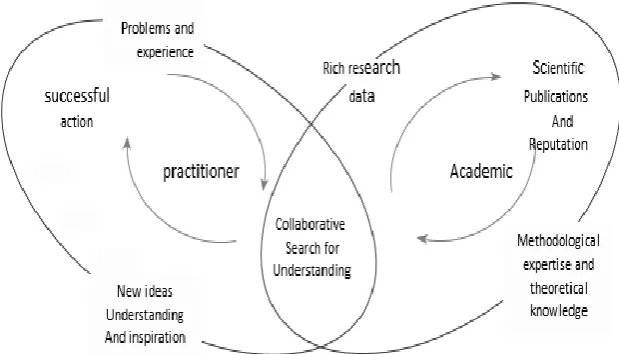
(Martensson, 2016). The solution proposed here is to provide a proper framework for collaboration between researchers and organizations (Hassard and Morris, 2018). The model that is selected to work on in this paper has been adapted from the Werr and Greiner model (Werr and Greiner, 2008) as follows
(Fig. 1).
As can be seen from this model, during the process of cooperation the two sides benefit from each other. For example on one side, the researcher puts his theoretical knowledge and research methodologies into this context of cooperation, and as a result acquires rich research data to publish in scientific papers and build up his academic reputation, On the other side, on the part of the organization, putting their problems and experience in this context has the potential to produce new ideas, understanding and inspiration by which their practical needs may be met. In the current study, using this framework (Fig. 1), some distinguished cases which show the advantages of collaboration for the two components of this framework, organizations and academic researchers are discussed. The current study was undertaken in Tehran in 2018.
Fig. 1: Relationship between Academic Community and Organization (Werr and Greiner, 2008)
323
Int. J. Hum. Capital Urban Manage., 4(4): 321-330, Autumn 2019
MATERIALS AND METHODS
A systematic search of the literature was conducted to derive relevant studies regarding the study objectives. To meet the objectives, following keywords were selected; collaborative research, knowledge production, relationship between researchers and organizations. Following the keywords selection, the academic databases of Google Scholar, Web of Knowledge, Science Direct, and Springer, were searched. Additionally, several peer-reviewed journals were specifically reviewed. The search of literature provided 20 studies. By reviewing the studies, finally, seven case studies were selected. In the following section, each case will be analyzed separately to show how;
The process of collaboration formed at the initial
stage;
The collaboration process itself;
The results of the collaboration framework for each
part.
Case 1
Petro –Canada is the largest oil company in the north of Canada. The managers of this company were seeking to develop and implement a holistic approach to corporate all business activities within the company, but in a way that every part has their own functional activity separately (Mirvis, 2007). Investment and Health, Safety and Environment (HSE) managers stated that their own activities of each subordinate unit can affect on the internal and external reporting of the company. But they mentioned that, activities of units are not coordinated and concentrated in a strategic way. It meant the activities throughout the company were not integrated completely with each other’s. Also, these managers pointed out that the relationship among units was more personally rather than a comprehensive management system. This problem also was reported in the same way by other subsidiary managers. These dilemmas eventually transferred to Boston College. And they asked the college to find a solution which would integrate the activities throughout the company. On the other hand, an Executive Forum on Corporate Citizenship (EFCC) which was hosted by Boston College was developing and improving a theory of corporate citizenship in companies. Therefore, the starter of collaborative research was Boston College. A research team was
formed by members of companies and researchers of Boston College. The executive managers of this company had problems in their divisions, so it was resulted in high motivation for them to participate actively in this research plan. During the joint meetings, managers of various units expressed their problems at workplace and transferred their experiences to the research community. On the other side, researchers visited workplace and conducted some interviews. The research center at Boston College held 10 conferences in partnership with the organization for better understanding the challenges and obstacles. Exchanging of information between organization and college was done during meetings as well. The research period lasted three years.
Finally the results of this study, which were based on collaboration, were as follows:
For organizations;
Creation of activities integrating process for all the organizations under study;
Providing benchmark models;
Innovation of new methods for integrating activities. For researchers:
Developing the theory and model of integrating activities in organizations;
Knowledge production due to experience of organizations;
Publishing several academic papers and a number of book chapters.
Case 2
researchers to improve the organization performance. A team of researchers and members of the organization were formed to collect data and analyze the organization challenges. After a two–year period of collaboration, in 2004, the researchers developed and implemented a software. The software was used by organization to support the changes which had been implemented on the organization.
The organization needed something to support the changes itself that were implemented at the organization. On the other side, the researchers required a field to test and develop their own invention of software.
The results of this collaboration for the two components; researchers and organization, in this study were as follows:
The part of the organization includes;
There was an increase in organizational capability through continuous learning due to the collabo-rative research.
The facilitation occurred in organizational productivity and effectiveness.
There is an increase in sale.
The organization used the invented software for two years in some parts of their own departments. The part of the researchers includes;
Developing and implementing software process; Confirming the software platform as a tool for
increasing strategic alignment;
Proving the software platform as a powerful management tool for future applications.
Case 3
Because of improvement in the quality and an increase in drug utilization; sustainable transformation in the health care industry is needed. Health care companies are looking for development of their potentialities for future changes (Stebbins, 2008; Iordanou, 2019). A well-known company for health maintenance decided to take place some changes in its divisions. This case explains how the participatory action research (PAR) was resulted in the creation of learning mechanism at Kaiser Company (Stebbins, 2009). Two change efforts involving interventions were taken place at this company. The first case was held at the start-up phase of the forum (learning mechanism) network and the second case was taken place later. In the literature have mentioned that, PAR approach has been accepted as a framework
for organization development (Rosskam, 2018).
One of the most important aspects of this approach (PAR) is focusing on the active role of organization during the change and research process. Also the collaborating of researchers during the change process is required. This circumstance initiated the process of collaboration between researcher and organization. The first organization development and action research at the Kaiser Company was started in 1977 through a research contract with Texas University. First, members of the organization and researchers were formed an exploratory and temporary team. The team conducted a survey of all aspects of the organization. The results of this survey were as follows:
Creation a scientific framework for future studies. Extensive changes were occurred at Kaiser Company On the other hand, it was resulted in several PhD
theses, several technical reports and some academic papers.
Following the acceptable changes, manager agreed to continue this collaborative research at all divisions. In the beginning of first intervention which was carried out during 1977 up to 1981, the company was facing with some problems such as; inappropriate labor/ management partnership, high level of job stress, confliction between management and unions. After intervention with researchers help, the following results were obtained;
Creation of new communication channels to resolve conflict;
Generation some learning mechanism at organization; A local communication forum created at all medical
centers.
The next interventional study was occurred during 2011 to 2014. Because of the great growth during past years, the company was now expected to be able to provide their services throughout the world. Therefore, some problems were existed at this time. For instance; centralization of decision-making, high cost pressures, problems related to employees, pressure for changing to an enterprise system. Finally, again the following results due to researchers helps were achieved;
Creation of learning mechanisms as a complimentary path for organization’s changes programs;
Building new communication ways for the labor/ management partnership improvement;
325
Int. J. Hum. Capital Urban Manage., 4(4): 321-330, Autumn 2019
quality and decreasing work-related stress subjects.
As Stebbins et al., (2008) report, “over 35 years (1977-2012) collaboration between the organization and academic communities, researchers published 8 book chapters and several academic papers on topics such as; work-based learning, learning in network organizations, structural learning mechanisms, long-term insider action research, sustainable work systems and collaborative management research.”
Case 4
A fashion design industry in Italy was selected to investigate the design of creative process by establishing the joint cooperation project between academic community and the industry (Radaelli et al., 2014). Due to the theoretical knowledge and scientific background that researchers had, they found some gaps in the creativity of the collective level in literature. So researchers decided to use the intervention research (IR) technique; one of the methods of Collaborative Management Research
(CMR) (Shani et al., 2007; Schumacher, 2018), to understand the collective creativity model of organizations. Following this step, the researchers started looking for an organization which would use the established theories-in-use in its creative processes and would like to improve more their own process. According to these two points, a research proposal was provided and presented to the organization manager. Therefore, the process of collaboration between the researcher and the organization was started. Meanwhile, for the process of solving problem, proposing the suggestions and tracking the progress; a team involving researchers and members of the organization was formed. The transfer of knowledge from researchers and experience from the member of the organization resulted in finding proper analysis of problems and solutions. Qualitative Methods: Interview and Observation, and Quantitative Method: Survey, were used to collect data. Both the researchers and the members of the organization played an active role in this process. All the data collected were analyzed by the team member during meeting to improve the pointed model. This study had two steps. First, is being involved on exploring the creativity definition and its key principals for improving the financial performance of the organization. While the second,
is being involved at recognizing a practical model for
designing and managing parameters to sustain the
creativity at the organization.
This resulted to a master student’s thesis and some papers for the researchers which were held at academic conferences. While, for the organization resulted in structural changes at some parts. For instance, the formation of four parts at design department and these changes resulted in generating some creative solution for each product. Following the acceptable results of the collaboration process between the researchers and the organization, the manager accepted to push forward the collaboration and move on to the second phase. The results of this stage were also a PhD and a master thesis for researchers and for the organization were consisted of alternative designs and other changes which resulted in performance improvement of the organization. In this case it is clear how the process of collaboration between researchers and organization with result from each component can get benefit from this process concurrently.
Case 5
Through conferences held at Copenhagen Business School and Virginia University, representatives of the Danish-based pharmaceutical company called Nova Nordisk, a global pioneer in the treatment of diabetes, became familiar with the problem of Corporate Branding among their competitors. Also, researchers were seeking to implement and develop the corporate branding model. They asked companies which were interested in developing their branding to participate in a research project. As a result, the researchers initiated a collaborative research project. A number of companies from all parts of the world participated in this study. These included: Novo Nordisk, LEGO, ING, NISSAN, TELEFONICA, and JOHNSON & JOHNSON. The initial description of the collaboration, which highlighted educational, practical and research schemes for members, was stated by Mirvis (2007) as follows;
Form a network of executives involved in corporate brand development and execution who lead the corporate branding efforts for their companies and who were committed to developing the best corporate branding practices in the world through the exchange of ideas and experiences (practice agenda);
to implement brand vision as it moves from strategy into practice, and gather personal brand experience stories from key stakeholders (research agenda);
Disseminate the knowledge this initiative produces by, for example, publishing a book of corporate brand management cases, co teaching students in the classroom, being involved in an interactive Web site (educational agenda).
The duration of the study was three years. At meetings, which were held in the form of seminars, the experiences and opinions of the organizations’ managers on one side, and theories and ideas from researchers on the other side, were discussed. The researchers also went into the organizations to come face-to-face with the variety of processes and challenges in the workplace. In addition, researchers conducted several interviews with different people within the organizations. Finally, the results of this collaborative research were auctioned as follows; Three corporate-wide brands were launched by
members;
The researchers were able to document the paradoxes of brand management, which meant they could develop their theory of corporate branding; Case studies conducted by researchers relating to
various companies led to the publication of a number of academic papers, and were also utilized in teaching students on their university courses.
Case 6
The sustainability consortium, as a part of the Society for Organizational Learning (SOL) was constituted in 1999 (Senge and Scharmer, 2008). This
society is a voluntary association which has been formed out of a dozen independent organizations that are interested in holding a broader business mandate. The initial idea for the formation of the sustainability consortium started in 1996 through several meetings between these organizations and some researchers from MIT University. In the end, the British Petroleum Company, as a pioneer of this consortium, held a number of separate meetings with other companies and researchers which caused the sustainability consortium to be launched. Members were invited to join this Consortium not because of their sustainability work, but because of their experience in managing organizational learning tools to lead change (Senge et al., 2008). Most
of the organizations within this Consortium were
globally well-known companies, such as; FORD, GM, NIKE, SHELL and BP. Goals for the creation of this Consortium were considered from two sides:
From the organization’s perspective, in relation to using organizational learning tools for sustainability; From the academic community’s perspective,
for better understanding sustainability within organizations.
With these two points of view in mind, the collaborative process was constituted between researchers at MIT University and members of the organizations. During this collaborative process, most efforts were made by the organizations. In fact, the initiators of this process were the organizations, and they were also responsible for setting the goals and the policy for the collaborative project. Researchers took a consultancy role in this process. Their responsibilities were:
Studying the Consortium and its functions; Holding the meetings and collating the learning. During this collaborative research, researchers and organizations worked on common issues such as toxicity of raw materials, air pollution and waste
treatment.
Researchers were involved in all meetings between organizations, and when topics were disputed, they were able to propose new solutions which promoted agreement within the organizations to focus on these suggestions and continue their activities. The results of this collaborative research were as follows:
From the organization’s perspective:
Better understanding of implementing sustainability within organizations
The execution of a number of collaborative projects From the researchers’ perspective:
Publication of a book chapter entitled “Learning for Sustainability” by one of the MIT researchers who had participated at this collaborative research
Best-practice examples, insights into research, and an environment for putting research into practice
Case 7
This case study relates to a polypropylene-producing company in Canada, named Shell. Within this company, a participative Socio Technical System (STS) design was implemented in a real-life situation
(Kolodny and Halpern, 2008). To implement the
327
Int. J. Hum. Capital Urban Manage., 4(4): 321-330, Autumn 2019
Toronto University and Wharton School selected for their PhD thesis subjects, STS design at the Shell Company. A collaborative research process between the academic community and the organization was initiated. Before implementing STS, the purpose-formed steering committee visited similar settings in Europe and North America for more than one year and provided technical reports. Researchers had technical information about organizational analysis and participative STS design. Therefore, they could propose some appropriate solutions during the STS implementation. However, the final decisions were made after discussion in the steering committee. During the process of STS implementation, researchers had conducted a number of training workshops on the subject of STS principles and design methods, for members of the steering committee. A comprehensive description of the STS design process was published by one of the researchers, Norman Halpern, and this reported that the Shell Company had implemented the best practice in STS design in manufacturing systems in the world [26]. The close and stable relationship between the academic community and the organization in this case led to following results;
From the organization’s perspective:
STS was implemented in a real-life context, because they applied both technical and social aspects concurrently;
STS implementation at this firm became a benchmarking model for other companies.
It was demonstrated that, due to proper implementation of STS at this company, financial performance and working conditions were significantly improved.
From the researchers’ perspective:
Two of the researchers were able to write their PhD dissertations as a result of participation in this collaborative research process;
Researchers were able to conduct a number of workshops and seminars in the process of this case study.
Several academic papers and book chapters were published by researchers as a result of knowledge production through this case study.
DISCUSSION
The main assumption of this review was the knowledge production issue through collaborative
research. Although a number of literature has been carried out on the relationship between organizations and academic communities, the debate about knowledge production has gained fresh prominence with many arguing through this collaborative process
(Literat et al., 2018; Heaton, 2015). It has been mentioned that knowledge production can occur in various ways, including reflective practice, reshaping and merging of current knowledge (Mügge, 2018).
However, it is a general consensus that research is the main source through which knowledge is being produced (Simon et al., 2018). Indeed, most authors discuss knowledge production in relation to industrial innovation and research (Aeberhard and Rist, 2009; Oygür, 2018). On the other hand it has been stated that the main sources of knowledge production are researchers at academic communities. Therefore, it can be concluded that academic researchers are the source of knowledge production, through conducting their research. This produced knowledge is being used by other groups (consultants, industries, society). As stated by Onyancha and Maluleka (2011) “Research can be classified as basic or applied, disciplinary or interdisciplinary, sole or collaborative, or industry- or university-based”. As can be seen, one aspect of research is the collaborative type, and it is clear that the amount of knowledge produced through this type is greater than that produced through the
others (Sooryamoorthy, 2009; Coghlan et al., 2019).
In addition, the quality of knowledge produced from this source is higher than that produced from other types of research (Gurukkal, 2019). Other
advantages of a collaborative research process are the transfer of technical knowledge, and the sharing of knowledge, techniques, and skills. Communication between researchers through this kind of research can result in further scientific production (Wine, 2018).Moreover, it has been reported that citation of extracts from collaborative research exceeds the rate of citation from other types of research (Ayre et al., 2018). Regarding these issues, this review article focuses on seven cases which were conducted based on a collaborative research process. The framework used is based on the Werr and Greiner model
as 4 and 3, the researchers acted as initiator for the collaborative process. Normally, in these cases, researchers had to seek an organization to develop and improve their ideas and theories. However, in other cases (i.e.1, 2, 5, 6, 7), due to internal problems within organizations, they had to start the collaborative process to solve these problems by taking help from external sources (researchers). The second issue which is discussed in the current study is the collaboration process itself. For example, in the case 4, the academic researchers prepared a research proposal and then presented it to the practitioner. After approval of the proposal, they started the project. But in case 7, the majority of the steps of the collaborative process were conducted by the organization. In this case, researchers were included as consultants on the project. In other cases surveyed here, usually subsets of members of the organization and researchers formed teams, to divide the duties, and reported back to the meetings to exchange their ideas and suggestions and to reach an agreement on challenging topics. Finally, the third issue discussed in this paper is the result of a collaborative research process. In this part, on the one hand finding a solution for the organization’s challenges and on the other hand knowledge production were the disputed points. As can be seen from the reviewed cases, after ending the collaborative process, organizations were able to meet their needs, and researchers could publish a number of books and papers, and write their PhD and Master’s theses. Unfortunately, research to date has tended to focus less on the subject of knowledge production and more on the number of published contributions through collaborative research (Quintanilha and Cardoso, 2018). However, researchers and organizations would be more motivated if it could be focused on and show the importance of knowledge production. On the other hand, it has been said that knowledge produced by the collaborative research process is likely to be more actionable than that produced by other types of research (Nordentoft and Olesen, 2018). So in this
way, the gaps between science and practice may be reduced.
CONCLUSION
The objective of this review paper was an emphasis on knowledge produced through collaborative research between researchers and organizations.
Seven case studies which described the collaboration process between academic communities and organizations were selected.
Three topics were considered in each case, illustrating: How the process of collaboration was formed in the
initial stages;
How the collaboration process itself proceeded; What the results of this collaboration framework
were, with a focus on knowledge production. The issue of knowledge production has been a controversial and much disputed subject within the field of collaborative research. Therefore, to develop a full picture of knowledge production through collaborative research, additional studies are recommended.
ACKNOWLEGEMENT
The authors appreciate and are thankful to the editorial office and the committee members of IJHCUM for their efforts and time during the publication procedure.
CONFLICT OF INTREST
The authors declare that there are no conflicts of interest regarding the publication of this manuscript. In addition, the ethical issues; including plagiarism, informed consent, misconduct, data fabrication and/ or falsification, double publication and/or submission, redundancy have been completely observed by the
authors.
REFERENCES
Aeberhard, A.; Rist, S., (2009). Transdisciplinary co-production of knowledge in the development of organic agriculture in Switzerland. Ecol. Econ., 68(4): 1171-1181 (11 pages).
Ayre, M.; Wallis, P.; Daniell, K., (2018). Learning from collaborative research on sustainably managing fresh water: implications for ethical research–practice engagement. Ecol. Soc., 23(1): 6
Cohen, S., (2019). The role of universities in setting the knowledge economy agenda.
Degama, N.; RSTA Elias, S.; Peticca-Harris, A., (2019). The good academic: re-imagining good research in organization and management studies. Qualitative research in organizations and management: Int. J., 14(1): 2-9 (8 pages).
Coghlan, D.; Shani, A.B.; Dahm, P.C., (2019). Knowledge production in organization development: An Interiority-based Perspective. J. Change Manage., 1-18 (18 pages).
329
Int. J. Hum. Capital Urban Manage., 4(4): 321-330, Autumn 2019
organisations. arXiv preprint arXiv:1903.11854.
Davis, M.H.; Guthrie, J.T., (2015). Measuring reading comprehension of content area texts using an assessment of knowledge organization. J. of Educational Research, 108(2):
148-164 (17 pages).
gurukkal, R., (2019). History and theory of knowledge production: An introductory outline.
Hamdoun, M.; Jabbour, C.J.C.; Othman, H.B., (2018). Knowledge transfer and organizational innovation: Impacts of quality and environmental management. J. Cleaner Prod., 193: 759-770
(12 pages)
Hassard, J.; Morris, J., (2018). Contrived competition and manufactured uncertainty: Understanding managerial job insecurity narratives in large corporations. Work, Employment Soc., 32(3): 564-580 (16 pages).
Heaton, J.; Day, J.; Britten, N., (2015). Collaborative research and the co-production of knowledge for practice: an illustrative case study. Implement. Sci., 11(1): 20.
Kim, S.S., (2019). The role of knowledge and organizational support in explaining managers’ active risk management behavior. J. Enterp. Infor. Manage., 32(2): 345-363 (19 pages).
Iordanou, K., (2019). Involving patients in research? Responsible research and innovation in small-and medium-sized European health care enterprises. Camb. Q. Healthc. Ethic., 28(1):
144-152 (9 pages).
Kolodny, H.; Halpern, N., (2008). From collaborative design to collaborative research: A sociotechnical journey. Handb. Coll. Manage. Res., 261-274 (14 pages).
Leino, H.; Santaoja, M.; Laine, M., (2018). Researchers as knowledge brokers: Translating knowledge or co-producing legitimacy? An urban infill case from Finland. Int. Plan. Stud., 23(2):119-129 (11 pages).
Literat, I.; Conover, A.; Herbert-Wasson, E.; Kirsch Page, K.; Riina-Ferrie, J.; Stephens, R.; Thanapornsangsuth, S.; Vasudevan, L., (2018). Toward multimodal inquiry: opportunities, challenges and implications of multimodality for research and scholarship. High. Educ. Res. Deve., 37(3): 565-578 (14 pages).
Martensson, P.; Fors, U.; Wallin, S.B.; Zander, U.; Nilsson, G.H., (2016). Evaluating research: A multidisciplinary approach to assessing research practice and quality. Res. Policy, 45(3):
593-603 (11 pages).
Mazur, A.; Kubai, O., (2019). Scientific-methodological and practical principles of regional economic systems integration. Baltic J. Econ. Stud., 5(2): 117-123 (7 pages).
Mirvis, P.H., (2007). Academic-practitioner learning forums. Handb. Coll. Manage. Res., 201.
Mügge, L.; Montoya, C.; Emejulu, A.; Weldon, S.L., (2018). Intersectionality and the politics of knowledge production. Eur. J. Polit. Gender, 1(1-2): 17-36 (20 pages).
Nave, A.; Ferreira, J., (2019). Corporate social responsibility strategies: Past research and future challenges. Corp. Soc. Resp. Environ. Manage.
Newman, J.; Cherney, A.; Head, B.W., (2016). Do policy makers use academic research? Reexamining the “two communities” theory of research utilization. Pub. Admin. Rev., 76(1): 24-32(9
pages).
Nordentoft, H.M.; Olesen, B.R., (2018). A critical reflexive perspective on othering in collaborative knowledge production. Qual. Res. J., 18(1): 55-66 (11 pages).
Olascoaga, E.; Kur, E.D., (2007). Dynamic strategic alignment. Handb. Coll. Manage. Res., 243.
Onyancha, O.B.; Maluleka, J.R., (2011). Knowledge production through collaborative research in sub-Saharan Africa: how much do countries contribute to each other’s knowledge output and citation impact? Scientometrics, 87(2): 315-336
(22 pages).
Oygür, I., (2018). The machineries of user knowledge production. Desgn Stud., 54: 23-49 (27 pages).
Quintanilha, T.L., Cardoso, G., (2018). The impact factor as a legitimator of the scientific knowledge produced: a review of the literature. JANUS. NET. E- J. Int. Relat., 9: 32-44 (13pages).
Radaelli, G.; Guerci, M.; Cirella, S.; Shani, A.B., (2014). Intervention research as management research in practice: learning from a case in the fashion design industry. Brit. J. Manage. 25(2):
35-351(17 pages).
Rosskam, E., (2018). Using participatory action research methodology to improve worker health. In Unhealthy Work,
211-228 (18 pages).
Senge, P.M.; Smith, B.; Kruschwitz, N.; Laur, J.; Schley, S., (2008). The necessary revolution: How individuals and organizations are working together to create a sustainable world. Crown Business.
Shani, A.B.; Mohrman, S.A.; Pasmore, W.A.; Stymne, B.; Adler, N. eds., (2007). Handbook of collaborative management research. Sage Publications.
Sidani, Y.; Reese, S., (2018). A journey of collaborative learning organization research: Interview with Victoria Marsick and Karen Watkins. Lear. Org., 25(3): 199-209 (11 pages).
Simon, D.; Palmer, H.; Riise, J.; Smit, W.; Valencia, S., (2018). The challenges of transdisciplinary knowledge production: from unilocal to comparative research. Environ. Urbanization, 30(2):
481-500 (20 pages).
Sooryamoorthy, R., (2009). Collaboration and publication: How collaborative are scientists in South Africa? Scientometrics, 80(2): 419-439 (21 pages).
Stebbins, M.W.; Valenzuela, J.L.; Shani, A.B.; Mohrman, S.A.; Pasmore, W.A.; Stymne, B.; Adler, N., (2008). Collaborative research in pharmacy operations: The Kaiser-Permanente experience. Handb. Coll. Manage. Res., 487-508 (22 pages).
Stebbins, M.W.; Valenzuela, J.L.; Coget, J.F., (2009). Long-term insider action research: Three decades of work at Kaiser Permanente. Res. Org. change Dev., 37-75 (39 pages). Emerald
Group Publishing Limited
Werr, A.; Greiner, L., (2008). Collaboration and the production of management knowledge in research, consulting, and management practice. Handb. Coll. Manage. Res., 93-117(25
pages).
COPYRIGHTS
Copyright for this article is retained by the author(s), with publication rights granted to the IJHCUM Journal. This is an open-access article distributed under the terms and conditions of the Creative Commons Attribution License (http://creativecommons.org/licenses/by/4.0/).
HOW TO CITE THIS ARTICLE
Mousavi, S.S.; Moradi, A.S.; Alipour, S.; Nasr Zadeh, M.; Khazaei, A., (2019). Knowledge production through collaborative management research. Int. J. Hum. Capital Urban Manage., 4(4): 321-330.
DOI:10.22034/IJHCUM.2019.04.08