ISSN 0975-928X
Research Article
Genetic architecture of yield and yield attributing traits of bitter gourd
K. Radha Rani1*, K. Ravinder Reddy2 , Ch. Surrender Raju3 and M. H. V. Bhave4
1,2&4
College of Horticulture, Rajendranagar, Hyderabad 3
Rice Section, ARI, Rajendranagar, Hyderabad *Email: [email protected]
(Received: 27 Oct 2012; Accepted: 05 Jun 2013)
Abstract
A study was conducted during summer 2011 to study the genetic architecture of yield and yield attributing traits in bitter gourd by using diallel analysis. The results revealed the predominant role of non-additive gene action in the inheritance of yield and yield attributing characters except days to 1st male and female flower appearance. Further degree of dominance (H/D)1/2 was more than unity indicating the over dominance. The proportion of dominant and recessive genes (KD/Kr) in the parents was observed to be > 1 indicating the influence of recessive genes. Heritability (narrow sense) showed moderate values (> 0.50) for number of fruits/vine, average fruit weight, fruit girth, number of seeds/fruit, days to 1st male and female flower appearance suggesting selection methods for improvement of these characters. Low heritability estimate for yield and remaining characters like fruit length, plant height, number of laterals/vine, node number at 1st male and female flower appearance, sex ratio, pulp thickness and fruit length indicated that these characters were more prone to environmental fluctuations and need to be tested under diverse environments for effective selection.
Key words: bitter gourd, genetic architecture, degree of dominance, heritability
Introduction
Bitter gourd (Momordica charantia L.) is an important cucurbitaceous vegetable grown throughout India for its tender fruits. The bitter gourd occupies 6.76 million hectare area with an annual production of 101.43 million tonnes in India (Rai and Pandey, 2007). Employment of appropriate breeding methodology for achieving desired improvement in the crop depends on nature and degree of gene action present in that crop. Though a wide range of genetic variability is present in this crop for yield and other related characters, a very little attempt has been done on gene action of yield and yield attributing characters. Since, the genetic architecture and pattern of inheritance of characters are important considerations while determining the breeding procedure, the present investigation was undertaken to estimate the nature of gene action of yield and its component characters in this crop.
Material and methods
Eight genetically diverse genotypes viz., 033227, 044417, 044438, 045339, IC-085622, IC-470550, IC-470558 and IC-470560 were crossed in diallel mating design excluding reciprocals. The resultant 28 F1 crosses along with eight parents were evaluated at Model orchard, College of Horticulture, Rajendranagar, Hyderabad from February 2011 to May 2011 in a randomized block design with three replications. The seeds were sown in rows at a distance of 0.5m between plants and 2.0m between rows. Recommended agronomic package of practices were followed throughout growth period. Observations were recorded on 10 randomly selectedplants from each cross and parent for fifteen characters viz., vine length (m), number of laterals/vine, internodal
length (cm), days to 1st male flower appearance, days to 1st female flower appeared, node number at which 1st male flower appeared, node number at which 1st female flower appearance, sex ratio (male to female), number of fruits/vine, average fruit weight (g), fruit length (cm), fruit girth (cm), pulp thickness (cm), number of seeds/fruit and yield/vine (kg). The genetic parameters estimated according to method suggested by Hayman (1954).
Results and discussion
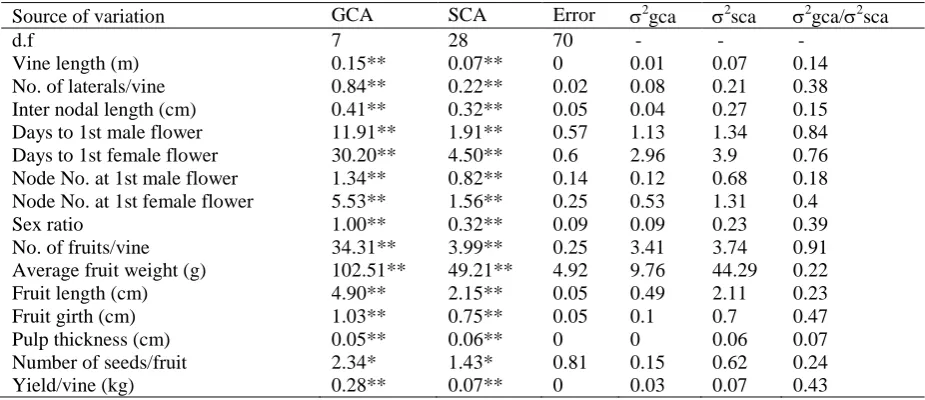
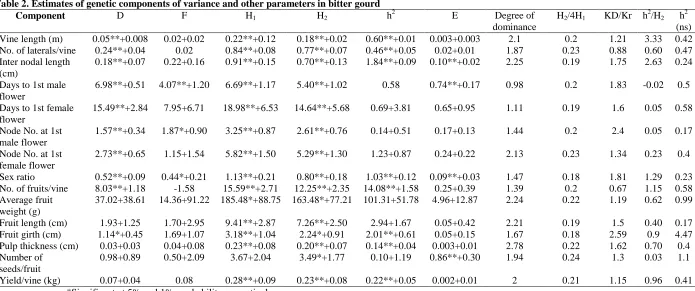
The analysis of variance showed highly significant difference for all the characters studied, indicating presence of considerable genetic diversity among the parents and crosses (Table 1). Components of variance due to genetic and environmental factors and various ratios of these parameters were presented in Table 2.
ISSN 0975-928X
estimated value of h2/H2 (3.33) in parents indicated that 3 -4 group of genes showed degree of dominance for this character. The narrow sense heritability (0.42) was less than 0.50 indicating non-additive gene action. These results were in consonance with the work of Devadas (1993), Mishra et al. (1998) and Rajeshwari and Natarajan (2002) in bitter gourd; Singh et al. (2000) in bottle gourd.
The estimates of D, H1, H2 and h2 for number of laterals/vine were highly significant while F and E were non-significant. The higher value of H (0.84) than D (0.24) indicated preponderance of non-additive gene action. Negative value of F indicated that the recessive alleles were more in the parents. The mean degree of dominance (1.87) was found to be more than one indicating over dominance. The value of H2/4H1 (0.23) was less than 0.25 suggesting the genes with positive and negative effects were asymmetrically distributed among the parents. The proportion of dominant and recessive genes (KD/Kr) was 0.88 and the number of groups of genes (h2/H2) was 0.60 which controlled the character and exhibited dominance. Narrow sense heritability being 0.47 indicated non-additive gene action.
Internodal length recorded significant additive and dominance components but, the magnitude of dominance (0.91) was higher than additive (0.18) component. The ‘F’ value (0.22) was not significant but positive. The mean value of degree of dominance (2.25) was observed to be more than one indicating over dominance. The genes with positive and negative effects were asymmetrically distributed among the parents as the ratio of H2/4H1 (0.19) showed less than 0.25. The KD/Kr ratio recorded more than unity indicating the presence of excessive dominant genes controlling this trait. It was observed that at least 2-3 sets of gene groups exhibited dominance effect.
For days to 1st male flower appearance the estimates of D, H1, H2, F and E were highly significant while h2 was non-significant. The results indicated the equal role of additive and non-additive gene effects in controlling this trait as the additive (6.98) and dominance (6.69) components were almost equal. Significant and positive F value showed dominant alleles were more frequent. The mean value of degree of dominance showed less than one (0.98) indicating partial dominance. The proportion of genes with positive and negative effects (H2/4H1) was 0.20 showing dominance. The ratio of KD/Kr was found to be 1.83 which was more than unity suggesting the presence of excessive dominant genes influencing the trait. The narrow sense heritability (0.34) exhibited predominance of non-additive gene action.Sit and Sirohit (2008) reported the predominant role of
non-additive gene action for this trait in bottle gourd.
Significant values of D, H1and H2 for days to 1st female flower appearance indicated the prevalence of high degree of both additive and non-additive gene effects in the expression of this trait. Highly significant proportion of variances due to non-additive and dominance factor further predicts their role accordingly. The non-significant F value showed ambi-directional dominance. The degree of dominance (1.11) was more than one indicating that genetic control of this character was largely due to dominant gene action. The ratio of H2/4H1 (0.19) was found to be less than expected value (0.25) denoting asymmetry at loci showing dominance. The KD/Kr ratio (1.60) was suggesting that this trait was controlled by more number of dominant genes. The fraction h2/H2 (0.05) indicated that one group of genes controlled the degree of dominance.
The estimates of D, H1 and H2 were highly significant and ‘F’ was significant while E and h2 were non-significant for node at which 1st male flower appeared. The estimated value of H was greater than D which revealed that dominant genes were more than the additive genes. Positive and significant value of F indicated more frequency of dominant alleles. The estimate of mean degree of dominance (1.44) was more than unity showing over dominance. The proportion of genes with positive and negative effects (H2/4H1) was 0.20, which denotes asymmetry at loci. The proportion of dominance and recessive genes (KD/Kr) was 2.40 whereas number of groups of genes exhibiting dominance and controlling character was 0.05. The low value of heritability in narrow sense (0.17) indicated the non-additive type of gene action for expression of this character.
The genetic parameters D, H1 and H2 were highly significant while F was significant for the trait node at which 1st female flower appeared. The value of H1 and H2 were greater than D indicating presence of non-additive gene action. Singh et al. (2006) in bottle gourd also similar to the present findings. The positive and non-significant F value indicated that the dominant alleles were more frequent. Over dominance was predominant for the trait as the mean value of degree of dominance was found to be more than unity (2.13). The proportion of genes with positive and negative effects (H2/4H1) was observed to be less than one in the parents while proportion of dominant and recessive genes among the parents (KD/Kr) were found to be more than one (1.34) suggesting the dominant role of genes. The number of dominant group of genes (h2/H2) appeared to be one.
ISSN 0975-928X
the non-additive gene action was more predominant than additive gene effect. Significant and positive value of F again confirmed the presence of more dominant genes in the parents. Existence of over dominance (1.47) was also indicated by mean degree of dominance. The ratio of H2/4H1 was less (0.18) than expected value (0.25) suggesting asymmetrical distribution of dominant and recessive alleles in the parents. The ratio of KD/Kr (1.81) indicated that sex ratio was controlled by more number of dominant genes. The fraction of h2/H2 (1.29) indicated that two gene groups showed degree of dominance for this trait. The narrow sense heritability was low (0.23) further confirming the role of non-additive gene action. These results on earliness were in consonance with findings of Kumar et al. (2007) in cucumber.
The genetic components of variation viz., D, H1, H2 and h2 for number of fruits/vine were highly significant and estimated F and E were found to be non-significant. The value of H1 was more than D which showed the prevalence of dominant genes. The negative and non-significant value of F indicated that the recessive alleles were more in the parents. The degree of dominance (1.39) revealed the role of over dominance. On the contrary, Sirohi and Choudhary (1983) reported partial dominance to dominance rather than over dominance for this trait in bitter gourd. The proportion of genes with positive and negative effects (H2/4H1) was 0.20 indicating dominance role. The proportion of dominant and recessive genes (KD/Kr) was 0.67 confirming predominance of recessive genes in the parents. The number of groups of genes (h2/H2) controlling this trait was 1.15. Narrow sense heritability (0.70) indicated the additive gene effect.
Only dominance (H1 and H2) component was found significant for average fruit weight indicating preponderance of non-additive gene action. The value of ‘F’ (14.36) was positive but non-significant indicating prevalence of dominant alleles in the parents. This trait was under influence of over dominance as the estimate of degree of dominance (2.24) was more than unity again confirmed the dominance role. Asymmetric proportion of positive and negative genes (0.22) was noticed in the parents. The KD/Kr ratio (1.19) was more than one indicating excessive dominant genes than recessive genes in the parents. This trait was controlled by one group of genes. Low value (0.33) of heritability (narrow sense) indicated the non-additive gene effects. This corroborated the previous findings of Mohanty et al. (1999) in pumpkin; Janakiram and Sirohi (1987) in bottle gourd.
Regarding fruit length, the estimates H1 and H2 were highly significant while other components
like D, F, E, and h2 were non-significant indicating that this trait was strictly under control of non-additive gene action. Further, the positive F value confirmed the presence of dominant alleles in the parents. The mean value of degree of dominance (2.21) was more than unity indicating over dominance. The H2/4H1 ratio (0.19) was found to be less than the expected value (0.25) denoting asymmetry at loci showing dominance. Excessive dominant alleles (1.50) were observed in the parents as the ratio of KD/Kr (1.50) was more than one. Low narrow sense heritability (0.39) confirmed the non-additive gene action for this trait. Similar results were obtained by Janakiram and Sirohi (1987) and Singh et al. (2006) in bottle gourd.
The genetic parameter H1 was highly significant while D and H2 were significant for fruit girth. The value of H1 was greater than D indicating presence of non-additive genes. The positive value of F indicated that the dominant alleles were more frequent in parents. The mean degree of dominance being 1.67 exhibited over dominance. Partial dominance for fruit girth was reported earlier by Rajeshwari and Natarajan (2002) in bitter gourd. The proportion of genes with positive and negative effects (H2/4H1) was 0.18 indicating asymmetry at loci showing dominance. The proportion of dominant and recessive genes (KD/Kr) was 2.59 in the parents whereas the number of dominant gene groups (h2/H2) was 0.90. The narrow sense heritability (0.24) showed preponderance of non-additive type of gene action.
Dominance components of genetic variance (H1 & H2) and h2 were found significant while D, E and F were non-significant for pulp thickness. The ‘F’ value was positive and non-significant indicating presence of more dominant alleles in the parents. The estimate of degree of dominance (2.78) was observed more than one suggesting over dominance.The ratio of H2/4H1 (0.22) observed was less than expected value (0.25) indicating asymmetrical distribution of positive and negative gene effects in the parents. The ratio of KD/Kr was more than one (1.62) indicating excessive dominant alleles in the parents. The gene groups exhibiting dominance (h2/H2) was 0.70. Gopalakrishnan (1986) and Rajeshwari and Natarajan (2002) reported fruit length, fruit girth, fruit weight and flesh thickness were controlled by more than one group in bitter gourd. This trait recorded low narrow sense heritability (0.40) suggesting non-additive dominance.
ISSN 0975-928X
non-additive gene action. The ratio of KD/Kr was found to be more than one (1.30) indicating that excessive dominant alleles were present in the parents. The index of h2/H2 showed that the dominance was due to a single gene. Very low heritability in narrow sense (0.54) indicated the non-additive gene effect for this trait.
Components of variance for yield/vine showed that role of dominance and non-additive gene effects were highly significant and additive gene effects were non-significant. Effect of dominant genes were important than non-additive genes. The F value was non-significant and negative suggesting the ambidirectional dominance. The mean degree of dominance (2.00) indicated presence of over dominance. Proportion of dominant and recessive alleles was less than unity (0.21) revealing asymmetrical distribution of genes among the parents. The KD/Kr ratio (1.15) showed that the yield/vine was controlled by more number of dominant genes. The estimated value (0.96) of the parents (h2/H2) indicated that one group of genes showed degree of dominance for this character. These results are in conformity with the findings of Rajeshwari and Natarajan (2002) in bitter gourd; Sarkar and Sirohi (2006) in cucumber and Sirohi (1994) in pumpkin.
The results of present investigation indicated the predominant role of non-additive gene action in the inheritance of yield and yield attributing characters in bitter gourd with prevalence of over dominance accompanied by low heritability in narrow sense. These findings suggested heterosis breeding might be more useful for improvement of yield and yield components in bitter gourd.
References
Devadas, V.S.1993 Genetic studies on fruit and seed yield and quality in bitter gourd (Momordica charantia L.). Ph.D. Thesis Tamil Nadu Agricultural University, Coimabatore. Gopalakrishanan, R. 1986. Diallel analysis in bitter
gourd (Momordica charantia L). M.Sc.(Hort.) thesis, Tamil Nadu Agriultural University, Coimabatore.
Hayman, B. I. 1954. The theory and analysis of diallel crosses. Genetics, 42:336-52.
Janakiaram, T. and Sirohi, P. S. 1987. Gene action in round-fruited bottle gourd. Veg. Sci.,14 (1):27-32.
Kumar, J., Munshi, A. D., Ravinder Kumar and Sharma, R. 2007. Estimates of gene action in cucumber (Cucumis sativus L.). Veg. Sci.,34(2): 123-126.
Mishra, H. N., Mishra, R. S., Parhi, G. and Mishra, A. N. 1998 Diallel analysis for variability in bitter gourd (Momordica charantia L.). Indian J. Agrl. Sci.,68 (1):18-20.
Mohanty, B. K., Mohanty, S. K. and Mishra, R. S. 1999 Genetics of yield and yield components in pumpkin (Cucurbita moschata Indian J. Agrl. Sci.,69(11): 781-783.
Rajeswari, K. S. and Natarajan, S. 2002. Genetics and inheritance of yield and its components in bitter gourd (Momordica charantia L.). South Indian Hort.,50(1-3): 82-90.
Rai, M. and Pandey, A. K. 2007 Towards a rainbow revolution. The Hindu Survey of Indian Agric.,
pp:187.
Singh, P. K., Kumar, J. C. and Sharma, J. R. 2000 Genetic estimates (gene action) in long-fruited bottle gourd. Veg. Sci.,27(2):162-164. Singh, N. P., Dubey, A. K. and Srivastava, J. P. 2006
Genetic architecture of yield and its component traits in bottle gourd [Lagenaria siceraria ( Molena ) Standl.]. Veg. Sci.,33(2): 188-189.
Sarkar, M. and Sirohi, P. S. 2006 Gene action of quantitative characters including yield in cucumber (Cucumis sativus L.). Indian J. Hort.,63(3): 341-342.
Sirohi, P. S. 1994 Genetic architecture of yield and its components in pumpkin. Veg. Sci., 21(2): 145-147.
Sirohi, P. S. and Choudhary, B. 1983 Diallel analysis for variability in bitter gourd. Indian J. Agril. Sci.,
53(10):880-888.
ISSN 0975-928X
Table 1. Analysis of variance for combining ability and proportionate gene action in bitter gourd
Source of variation GCA SCA Error 2gca 2sca 2gca/2sca
d.f 7 28 70 - - -
Vine length (m) 0.15** 0.07** 0 0.01 0.07 0.14
No. of laterals/vine 0.84** 0.22** 0.02 0.08 0.21 0.38
Inter nodal length (cm) 0.41** 0.32** 0.05 0.04 0.27 0.15
Days to 1st male flower 11.91** 1.91** 0.57 1.13 1.34 0.84
Days to 1st female flower 30.20** 4.50** 0.6 2.96 3.9 0.76
Node No. at 1st male flower 1.34** 0.82** 0.14 0.12 0.68 0.18
Node No. at 1st female flower 5.53** 1.56** 0.25 0.53 1.31 0.4
Sex ratio 1.00** 0.32** 0.09 0.09 0.23 0.39
No. of fruits/vine 34.31** 3.99** 0.25 3.41 3.74 0.91
Average fruit weight (g) 102.51** 49.21** 4.92 9.76 44.29 0.22
Fruit length (cm) 4.90** 2.15** 0.05 0.49 2.11 0.23
Fruit girth (cm) 1.03** 0.75** 0.05 0.1 0.7 0.47
Pulp thickness (cm) 0.05** 0.06** 0 0 0.06 0.07
Number of seeds/fruit 2.34* 1.43* 0.81 0.15 0.62 0.24
Yield/vine (kg) 0.28** 0.07** 0 0.03 0.07 0.43
ISSN 0975-928X
Table 2. Estimates of genetic components of variance and other parameters in bitter gourd
Component D F H1 H2 h2 E Degree of
dominance
H2/4H1 KD/Kr h2/H2 h2 (ns)
Vine length (m) 0.05**+0.008 0.02+0.02 0.22**+0.12 0.18**+0.02 0.60**+0.01 0.003+0.003 2.1 0.2 1.21 3.33 0.42
No. of laterals/vine 0.24**+0.04 0.02 0.84**+0.08 0.77**+0.07 0.46**+0.05 0.02+0.01 1.87 0.23 0.88 0.60 0.47
Inter nodal length (cm)
0.18**+0.07 0.22+0.16 0.91**+0.15 0.70**+0.13 1.84**+0.09 0.10**+0.02 2.25 0.19 1.75 2.63 0.24
Days to 1st male flower
6.98**+0.51 4.07**+1.20 6.69**+1.17 5.40**+1.02 0.58 0.74**+0.17 0.98 0.2 1.83 -0.02 0.5
Days to 1st female flower
15.49**+2.84 7.95+6.71 18.98**+6.53 14.64**+5.68 0.69+3.81 0.65+0.95 1.11 0.19 1.6 0.05 0.58
Node No. at 1st male flower
1.57**+0.34 1.87*+0.90 3.25**+0.87 2.61**+0.76 0.14+0.51 0.17+0.13 1.44 0.2 2.4 0.05 0.17
Node No. at 1st female flower
2.73**+0.65 1.15+1.54 5.82**+1.50 5.29**+1.30 1.23+0.87 0.24+0.22 2.13 0.23 1.34 0.23 0.4
Sex ratio 0.52**+0.09 0.44*+0.21 1.13**+0.21 0.80**+0.18 1.03**+0.12 0.09**+0.03 1.47 0.18 1.81 1.29 0.23
No. of fruits/vine 8.03**+1.18 -1.58 15.59**+2.71 12.25**+2.35 14.08**+1.58 0.25+0.39 1.39 0.2 0.67 1.15 0.58
Average fruit weight (g)
37.02+38.61 14.36+91.22 185.48*+88.75 163.48*+77.21 101.31+51.78 4.96+12.87 2.24 0.22 1.19 0.62 0.99
Fruit length (cm) 1.93+1.25 1.70+2.95 9.41**+2.87 7.26**+2.50 2.94+1.67 0.05+0.42 2.21 0.19 1.5 0.40 0.17
Fruit girth (cm) 1.14*+0.45 1.69+1.07 3.18**+1.04 2.24*+0.91 2.01**+0.61 0.05+0.15 1.67 0.18 2.59 0.9 4.47
Pulp thickness (cm) 0.03+0.03 0.04+0.08 0.23**+0.08 0.20**+0.07 0.14**+0.04 0.003+0.01 2.78 0.22 1.62 0.70 0.4
Number of seeds/fruit
0.98+0.89 0.50+2.09 3.67+2.04 3.49*+1.77 0.10+1.19 0.86**+0.30 1.94 0.24 1.3 0.03 1.1
Yield/vine (kg) 0.07+0.04 0.08 0.28**+0.09 0.23**+0.08 0.22**+0.05 0.002+0.01 2 0.21 1.15 0.96 0.41