Growth: The Relationship Between Metanoia and Additional Language Learning in EAP
Samantha Ranson
University of British Columbia (Okanagan Campus)
Abstract
Taken from ancient Greek philosophy, metanoia refers to a fundamental shift in habits of the mind. Until now, the connection between metanoia and additional language learning has not been fully examined, particularly in higher education contexts. This study explored the
progression of metanoia in the additional language learning of international students enrolled in an English for academic purposes (EAP) program. The research question for this study related to how EAP students experienced metanoia, and what the relationship was with their additional language learning. Employing a socio-cognitive theoretical framework, qualitative research methods were used to combine an online questionnaire (n = 9) and follow-up interviews (n = 5) to collect data. Meaningful responses in the data were coded, and the codes were gathered
together into emergent themes. A major theme emerging from the data in connection to metanoia and additional language learning was that of growth, particularly in terms of confidence,
language learning, younger life, academic skills, organization, tolerance, community, and awareness. This study provides insight into the lives of English language learners in academic settings, and offers suggestions related to fostering an EAP environment that supports English language learning.
Introduction
There is currently an influx of international students learning English as an additional language (EAL) in Canada, with the Government of Canada (2013) publishing a report that stated in 2012 it “was the first time in Canadian history that Canada has welcomed over 100,000 international students, an increase of 60% since 2004” (n.p.). In addition, the Canadian government has recently made initiatives to “double the number of international students choosing Canada by the year 2022 without displacing Canadian students” (Government of Canada, 2014, n.p.). As a result, there are growing numbers of students from non-English speaking backgrounds seeking entry to higher education in Canada. As international students learn English, there are specific moments of achievement which occur within additional language learning, and these moments of sudden transformation can be referred to as moments of metanoia. Moments of metanoia are imperative as they assist in the cultural, social, emotional, and academic transition into Canadian life for international students acquiring EAL.
The relationship between EAL learning and metanoia has not been extensively examined, particularly in higher education settings. The current study explores the role of metanoia in the additional language learning experiences of English for academic purposes (EAP) students. It is proposed within this study that metanoia occurs within EAP learning experiences and
environments, and that learning environments that facilitate and encourage cultural and academic growth (both inside and outside of the EAP classroom) help to create the most ideal situations for metanoia to occur. It appears that EAL students consciously and subconsciously transform
moment of thinking. The data also point to metanoia being impacted by the EAP environment and having a relationship with additional language learning.
Background
A Socio-Cognitive Framework for Additional Language Learning
A socio-cognitive theoretical framework was employed to explore how participants experience metanoia and the nature of the relationship between metanoia and additional language learning for academic purposes. For the purposes of this study, a socio-cognitive framework holds that humans learn via a combination of both social and cognitive factors. For Atkinson (2011), a socio-cognitive approach to additional language acquisition integrates the mind, the body, and the wider world. Additional languages are learned through social action and are embedded in the surrounding environment in which learners find themselves. The social side of this perspective understands language learning to take place through interaction between people who desire to communicate with each other. It involves collaborating with others to create meaning. The social side of this framework is based on the way individuals interact with each other, with languages being learned in a social context (e.g. Vygotsky, 1978). Use of the target language can take place in what Vygotsky (1978) has called the Zone of Proximal Development (ZPD). Vygotsky (1978) defined the ZPD as the metaphorical space between what an individual can do independently and what an individual can learn in collaboration with others. From this perspective, it is through interaction and collaboration that additional language learning takes place.
The second part of this framework can be referred to as cognitive, meaning additional language acquisition also involves an innate human process related to additional language learning. Related to a cognitive perspective, Krashen’s (1982a) maintained that “we acquire [an additional language]…by focusing on meaning” (p. 97). Krashen theorized that the majority of learning takes place from comprehensible input such as listening, reading, or communicating with other individuals in the target additional language (Krashen, 1982a). For Krashen (1982a), “if the input is understood [i.e. comprehensible], and if there is enough of it and if it is somewhat varied, it will contain all the grammatical structures necessary, and expose the language acquirer to everything he [or she] needs” (p. 98). Along with comprehensible input, Krashen (1982b) coined the term the affective filter to describe how students need to proceed in a calm emotional state to acquire an additional language. The affective filter can act as metaphorical block to the model of comprehensible input. By feeling “affected” learners can experience negative emotions such as anxiety, stress, boredom, or other negative attitudes that would inhibit their ability to acquire the target language, possibly resulting in poor additional language learning outcomes.
Thus, additional language acquisition is facilitated when learners interact with willing interlocutors to negotiate meaning (Long, 1996).
What is EAP?
The current study focused on EAL learners in an EAP program on a smaller campus of a research-intensive university in western Canada. To protect the identity of the participants, for the purposes of this study, the campus will be referred to as Pacific Interior University (PIU). In programs such as the EAP program in this study, students have come from other countries to Canada to gain a university education, acclimate to a new culture, and learn an additional
language. EAP programs typically focus on the social, academic, and linguistic demands of post-secondary studies in English and prepare students for the specific needs they will have in order to be successful at university (Hyland & Hamp-Lyons, 2002). The EAP program from which
participants were recruited for the current study was designed for international students from non-English speaking backgrounds who were academically admissible for studies at PIU, but who did not have the English language proficiency evidence otherwise required. EAP programs generally focus on the social, cultural, and academic aspects of studying and living in an English speaking country. The program site for the current study combined English language courses as well as involved students in the wider PIU community. It focused on academic study involving collaborative, experiential, and cross-cultural learning.
What is Metanoia?
In a literary context, metanoia is a Greek term defined as “after thought, change of mind” (Cuddon, 2013, p. 432). Within the context of educational leadership in organizations, it was further defined by Senge (1990) as a process of shifting one’s learning and thought process to reach deeper moments of realization. Therefore, when metanoia was defined for the purposes of this study, it was conceptualized as a mind shift, a moment of realization or an epiphany of an additional language learner. In other words, metanoia was defined as an “aha” moment, a moment in which a learner becomes aware of the evolution of new knowledge in an educational environment. One more way to think about metanoia is as a progression in the learning process. An individual could experience metanoia once, or multiple times throughout his or her life; in addition, metanoia occurs in a variety of different situations, scenarios, and learning
deeper meaning of ‘learning,’ for learning also involves a fundamental shift or movement of mind” (p. 13). To paraphrase, Senge equated learning to be the cause of redefinition of the human identity, to see reality through different lenses. In turn, individuals would become aware and see things that they never thought were possible; they would recreate their identities and gain more awareness of reality and the world. This was another layer added to the definition of
metanoia in the context of additional language learning.
Despite these definitions of metanoia, scholars to date have not made a specific connection between additional language learning and metanoia. In considering a language learning context, such as EAP, metanoia can be conceived as a learning process that occurs quickly and suddenly. This notion is a powerful concept as it is transformative and has the potential to change not only one’s learning abilities and processes but assist in growth while acting as a catalyst for additional language learning. It may be that metanoia involves conscious realization of changes occurring subconsciously. It is possible that when an individual becomes aware of the learning process, it can be a process of discovery and exploration that facilitates additional language learning.
Research Questions
The primary research questions explored in this study are twofold: How do the EAP students in the current study experience metanoia? What is the relationship between the participants’ experiences of metanoia and their experiences related to additional language acquisition?
The Study
The aim of this qualitative study was to explore the relationship between metanoia and additional language learning in EAP settings. The researcher was influenced by the qualitative research tradition, allowing individuals to describe their lives via story and experience (Gay & Mills, 2016). Collins and O’Brien (2011) have defined qualitative research as “a form of social inquiry that takes reality as socially constructed rather than given and where the data are primarily textual rather than numerical” (p. 383). As a result, the participants in this study could interpret questions to have different meanings based on their relationship with English language learning and their personal backgrounds.
Participants
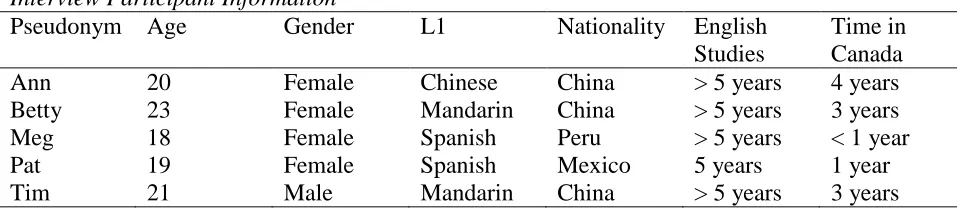
All of the participants in this study had attended the EAP program at PIU. There were nine participants who took part in the online portion of the study and five who participated in the interview section, Table 1 provides demographic information related to the five participants who took part in the interviews. All of the names provided are pseudonyms. The participants were between the ages of 18-23 years of age and were either immigrants or international students from non-English speaking backgrounds. The participants had not achieved PIU’s English language proficiency requirements; however, they did have the academic requirements for their specific programs of study and general admission to PIU. To further meet the English language
Table 1
Interview Participant Information
Pseudonym Age Gender L1 Nationality English
Studies
Time in Canada
Ann 20 Female Chinese China > 5 years 4 years
Betty 23 Female Mandarin China > 5 years 3 years
Meg 18 Female Spanish Peru > 5 years < 1 year
Pat 19 Female Spanish Mexico 5 years 1 year
Tim 21 Male Mandarin China > 5 years 3 years
Procedures
After obtaining a certificate of approval from the appropriate institutional research ethics board, data collection took place via an online questionnaire created with Fluid Surveys (Fluid Surveys, 2015), and semi-structured interviews. The online questionnaire gathered demographic
information as well as participant reflections related to metanoia, experiences as additional language learners, and possible moments of identity change (see Appendix 1). As part of the online questionnaire, participants were further invited to provide their e-mail addresses if they would like to be contacted further for volunteer participation in the follow-up interview portion of the study. The follow-up to the questionnaire was a voluntary open-ended semi-structured interview session. The questions were created specifically in mind to elicit in further detail the opinions, thoughts, emotions, initial reactions, and experiences that create moments of metanoia and how language learning occurs (see Appendix 2). The data were triangulated via comparing the online questionnaire and semi-structured interview results, and the combining of the two to find resulting patterns.
Due to this being a qualitative study that honoured participant perspectives in relation to the topic under investigation, it is important to note that the researcher gathered and interpreted data in as unbiased a manner as possible. Gaining the opinions, observations, and emotions from the point of view of the participants themselves was extremely important to this study. The usage of non-standard English was not changed as this may create a bias, and interpretations of the material could be altered; therefore, exact wording was used from the participants’ interviews.
Relying on a qualitative approach to analyzing the data, the results next reported were found through the coding and categorizing of meaningful data units in the participants’ responses. Participant responses were examined for units of meaning, made up of phrases or sentences that could informatively stand on their own. Each unit of meaning was assigned a descriptive code. Coding was carried out by the researcher, with the researcher’s graduate
Results
Growth
The most predominant and prevalent theme related to metanoia and its relationship with additional language learning throughout the results was growth. The major subthemes noticed throughout the overall category of growth were confidence, language learning, younger life, and academic skills. In addition there were some minor subthemes arising in the data, which included organization, tolerance, community, and awareness. Within this study the overarching theme of growth represents the development or lack thereof mentioned by the students (whether
consciously or subconsciously) about both their personal and academic lives. The majority of the results deal with their university life or their period of life as young adults; however, some of this information is developed around their goals in the future or their experiences in subthemes such as “younger life”. The diagram in Figure 1 represents the theme of growth with its accompanying major and minor subthemes.
Figure 1. Theme 1: Growth major subthemes and minor subthemes.
Confidence. Confidence, as it relates to metanoia and additional language learning was the most prevalent subtheme in the growth category. This subtheme dealt with growth in confidence or lack of confidence with identity; school work; mental, emotional, and physical abilities. The results relate to the importance of confidence to the participants in both an academic learning environment and in a personal environment.
Growth in confidence was most prevalent in Ann’s answers. Ann mentioned the jump between EAP and first year university English. First year university English lowered her
confidence as the instructors had higher expectations, and she was now immersed in a complete university class environment (whereas EAP functions in a much smaller community setting made
Growth
Major Subthemes
Confidence
Language Learning
Younger Life
Academic Skills
Minor Subthemes
Organization
Tolerance
Community
up of only EAP students and the instructors). She mentioned, “when I was in EAP … the
instructor gave me a lot of confident…she encouraged me like to be a better person just learning English.” However she gained confidence in her abilities in first year English classes when she stayed focused, organized, and was able to present and obtain a high mark within her course. These achievements boosted her confidence and provided consistency in what she should expect of both herself and future university courses. Ann used to think that she “never really thought of [herself] as a good student”, constantly comparing herself to her peers and local Canadian English speakers and their level of proficiency. She said, “[I was] really shy and I was quiet…I wasn’t the person like be the leader”. She mentioned how a high school concert and conference not only raised her confidence but helped her gain awareness of her potential. She realized she could be a leader. Her abilities were higher than she realized, and this realization caused a shift in her personality leaning to a gain in confidence and a stronger sense of identity. She mentioned how she had a high language proficiency level (giving her confidence) as she could use English without translating from her native language and could comprehend and take part in advanced language activities (for example reading Shakespeare). As an example of her overall feelings, she said, “I was always really quiet, like always shy. So I think now I became a little bit a little bit more like outgoing, like I can just open my mind a little bit just in order to improve my English.”
The subtheme of changing levels of confidence also came up in Pat’s data. To her,
studying and academics were an extremely large part of her confidence. It was clear in the results that being intelligent or “smart” was related to her confidence. As she began developing skills, such as studying strategies and more time management skills, she felt she was gaining
confidence in her English abilities, including speaking skills. It seemed in the results that she had become much more confident of who she was. For example, she said, “I felt…proud.” She mentioned how studying and being prepared for tests is one of the best ways to gain confidence and achieve goals, equating grades to success and confidence. Transitioning into a different culture was difficult for her; however, now with her newfound confidence, Pat was able to communicate without hesitation and would engage in conversations in places such as restaurants, “I feel more confident and ya I don’t feel that panic.” She even laughed as she spoke this last quote, showing her confidence in her identity and abilities.
In Tim’s results there were also instances related to confidence and growth. EAP and the community made a large impact on his confidence. Tim felt his “personality … is a big change from where I where I started till now…that’s like a personality shift from a little bit shy to like a really outgoing and be confident and talk to people with like no fear.” He said this shift took place due to his experiences in EAP. He mentioned how he experienced a gain in confidence, simultaneously at multiple times:
I feel like it’s like…suddenly everything make makes sense now…It’s more like a small thing that makes sense to me now, and then another thing is that makes sense to me now, and then like…at the end of the day like a lot of things all make sense to me and then like…it just makes sense.
how hard work pays off; an individual gains confidence and joyfulness by getting compliments and realizing the progress they have made in their language learning abilities throughout the year. Lastly, a powerful moment of metanoia as it relates to English language learning was revealed when Tim was unable to fully describe his emotions when he experienced a moment in the community saying he didn’t:
even know like how to talk to…the cashier or how…to say things but I just observe and stuff. And then I realized one day when I just like go to the restaurant I just…like I’m in China so it’s like nothing really surprising or nothing really odd happened and then so it just like it just ya…like the the feeling so I don’t know.
Confidence and growth were also an important theme in relation to metanoia and additional language learning for Meg. Meg emphasized the importance of growth and
communication in gaining confidence. When successfully communicating with a staff member at the university she felt “like I improved my English ya”. Meg mentioned how she felt “in my exams I always like did really good like almost one hundred percent so I think it was like ya like a sign I was good student…like the level of my peers was lower”. She adds to this by mentioning “writing like I usually do good in writing”. In Meg’s opinion, not only are academics important but also competitiveness or getting higher grades than an individual’s peers showcasing an indication of abilities.
The theme of confidence as it relates to growth also recurred in Betty’s results, showing the relationship between metanoia and additional language learning. She put an emphasis on the relationship between academics and a personal interest. For example she felt confident when receiving the challenge of editing other students’ work as it was not only a great learning opportunity but it showed her motivation, her confidence in her abilities, and her interests in editing and writing. Additionally, when living in Canada and learning English, she felt she had gained so much confidence that she wanted to immigrate saying “learning English here actually change my some of my personalities…It makes me more open, more talkative to people, and more brave to speak publicly.… Ya when I when a person is not good at English he or she will be very shy to speak out.” Because of her confidence using English, she said, “I was quite proud of myself entering such a English university because this university is higher rank”. Lastly, the results show she had confidence in her intelligence and abilities stating “when I was in China I was always the top students, highest mark … And when I came here ya I still get a very high mark in EAP course, but I’m not satisfied how it’s a give us the experience because I think it was too simple…Ya too easy for me.” It seemed that Betty’s confidence in her abilities were related to her high marks.
At times, Pat appeared to notice changes in her English language proficiency. She
seemed to realize that she had naturally gained a stronger comprehension of the English language and, related to that increase in proficiency, had developed a stronger ability to time manage. As a result of this, she could comprehend the language at a higher level and mentioned feeling both more efficient and intelligent. Pat gave an example and expressed how she felt. In this instance she referred to “her,” a friend who had spent three years in Canada and three in the United States who Pat asked for advice:
But then I was doing like a homework for the EAP course and then I ask her about a sentence. The meaning of the sentence because I couldn’t understand it, and then she said I don’t understand these word. But then I ask her for another word that I didn’t
understand and then I actually realized that I knew something that she doesn’t, so that’s when I that’s how I felt successful [laughs] because I’m actually learning so ya…. So I feel like I am learning fastly, so ya maybe in two years I will be able to speak like a native speaker.
Not only did she mention that her goal is to a fluent user of English, but she was also able to recognize what she wanted to aspire to, how she wanted to measure her growth, and how she had changed due to such instances as expressed above. Additionally, she later mentioned that
attending EAP courses assisted in the development of her language acquisition abilities. She also discussed how her process for learning English allowed her to grow in a social environment and communicate more effectively in the local culture.
In addition to Pat, Meg also referred to additional language learning in a way that illustrated the concept of metanoia. She felt that EAP had “improved my English skills for sure and then I also could like appreciate other like cultures in my classes.” Here she seemed to indicate that language acquisition created a newfound appreciation in her life of other individuals and cultures; therefore, assisting in both her academic and social life. In the data, she also
mentioned moments where she suddenly realized she had a better comprehension of the English language, explaining it as “I don’t know I was just speaking at that time.” Additionally, there were specific time periods when cultural activities assisted her in comprehending language; for example, when out with her sister in Vancouver there was a “moment like like I realized oh I’m in Canada [laughs], like everyone speaks English and this is different ya…. I was just like a new change in my life that I should be ready for.” Meg was laughing during this part of the interview, as she reflected on how language acquisition had been a type of growth in her life.
Younger Life. Also related to the theme of growth and how it connects to metanoia and additional language learning, the theme of younger life is defined as a way to grow based on reflections related to previous experiences in life. Three participants (Ann, Betty, and Tim) discussed their younger lives, and how they had grown since this previous time period. It appeared in the data that the participants were strongly impacted in their growth by their own personal stories and history. Additionally, it was apparent that the participants used their younger lives as a method of comparison to their contemporary lives.
Ann in particular referred to her younger life, revealing moments of metanoia and additional language learning. Ann had attended a Canadian high school as an international student and described how it impacted her social environment. She described how the lack of multiculturalism in the particular Canadian high school she attended caused her to gain a stronger understanding and appreciation for different cultures when attending EAP and
university stating, “because in my high school there wasn’t like that many international students so I met lots of friend here that were from like different countries.” Further, she mentioned how she felt more at ease staying within her comfort zone in high school, “I kind of prefer like to talking to people having I think my spoken English was okay. But I didn’t really focus on written English which is definitely like more important than speaking English.” She mentioned how she mainly focused on one type of additional language learning (speaking) in high school and now at the university level, she was open to growth and learning new aspects of language (such as writing and challenging her English abilities). Later in her interview, Ann discussed how her experiences in high school, such as attending a special event in Vancouver, allowed her to change as an individual. Ann also reflected on her childhood and life in China, allowing her to measure her growth:
Ya I would say I started learning English like when I was really little like probably grade one or even before so but still since our country’s not like the official language is not English…So even though we can’t like started in English when I was really little but still it’s quite different from China to Canada. So I think when I was in my home country I didn’t really know how to learn English properly. It was okay for me to speak to write but it’s different not enough for me to write a nice essay, be a like nice university student.
Reflecting back on her younger life, Ann was exploring what she saw as differences between Chinese and Canadian cultures and the learning processes within these different countries.
The subtheme of younger life as it relates to metanoia and additional language learning also arose in Betty’s results. She described how her perspective changed based on experiencing what she saw as a cultural shift between Canadian culture and Chinese culture. She described a concept she thought of during her EAP studies that she dubbed the “international citizen
up in China and at that time English was not very popular there”. As Betty reflected on her younger life, there appeared to be a tie between viewpoints and mind shifts, being an outsider, and learning processes.
Academic Skills. Another example of a subtheme related to growth occurred when both Pat and Meg expressed ideas related to the subtheme of academic skills in connection to
metanoia and additional language learning. These participants both put an emphasis on academic skills, which was related to the importance of academics and success in academic growth. Pat described the feeling as “I change even from the first week until now that was from the
beginning and now I think I am improving a lot of academic skills just like writing I feel like I write better.” Pat explained she felt she had changed, grown, and accomplished something throughout the year. She further explained that her comprehension had improved and gave an example:
When I was in my in my theatre course they ask me to do some improvisation [laughs] so I can because I start thinking in English more faster. So sometimes I just…come up with a situation and I think about it quickly so I don’t have to think I don’t have to think that much on the words or whatever I just do it quickly, how can I say I improvise it… I am more like it’s like if a part of me was more aware of the language, but I ya, like I don’t know what I am doing but I do it and then I realize that I did it
It appeared that Pat felt a sense of accomplishment by growing in an academic sense but also could communicate in her class more naturally as a result. Along these lines, Meg also described how improving her academic skills helped her in different aspects of language learning such as writing and listening.
Organization. Organization here is expressed as growth in learning to develop a routine related to metanoia and additional language learning. Tim expressed an experience in which organization was important to his additional language learning and growth. Talking about an incident in a restaurant, Tim mentioned, “just like I just read the menu and then like I talk like feel like there’s no problem nothings strange like just like just like a routine.” For Tim, this experience was an important moment as he came to a realization that everyday life in a Canadian and English-speaking culture had become routine for him.
Tolerance. With the emergence of this theme, tolerance appeared to be the ability to accept others and their opinions even if they were different from a personal view. This concept of tolerance appeared to be something the participants learned within their new educational setting. Pat and Meg each experienced moments that related to the subtheme of tolerance. Both Pat and Meg expressed how their tolerance of other people increased due to the multicultural setting of EAP and Canada. By experiencing a more multicultural environment within Canada, they were both exposed to different cultures and viewpoints, and as a result they felt they had experienced new learning moments that supported their developing English language
proficiency.
Community. The subtheme of community in relation to metanoia and additional
a global citizen, developing her identity as a member of the global community, and gaining a better understanding of this concept via her EAP class. To Meg, the community setting within EAP assisted her in improving her “English skills for sure and then I also could like appreciate other like cultures in my classes.”
Awareness. Awareness appeared to develop as participants gained a greater
understanding of their surroundings; assisting in growth in moments of metanoia and additional language learning. This subtheme particularly arose in both Meg and Ann’s answers. Meg developed a stronger awareness of her surroundings due to her use of the English language. For Ann, she developed an awareness of her downfalls, for example, realizing that her weakness in academics was group work.
Discussion
Personal and Academic Development and Growth Based on Metanoia
Reviewing the data, it appeared that the overall goal of participants was to become good English language learners who would not be held back from success by their language skills while attending an English medium university in Canada.
Confidence was a major subtheme within the overall theme of growth. For example, Time mentioned how hard work and consistency boosted his confidence and motivation to communicate and learn. As his confidence increased, Tim appeared to be having moments of metanoia. As a result, he felt more aware of who he was and his surroundings personally. He felt he had a stronger comprehension of academics, and he felt he was able to communicate more effectively with instructors and other individuals within the English language. All of this awareness was related to a growth in confidence. By gaining awareness and confidence, the participants often grew in positive ways. Metanoia tended to act as a catalyst for confidence, which lead to a concomitant sense of self-awareness. Awareness in turn promoted academic and personal growth.
Participants were experiencing these moments of metanoia both inside and out of the classroom; hence, they also seemed to be growing in a cultural, social, emotional, and academic sense. The accomplishment of communication within another language acted as an enlightening moment, appearing to encourage participants to commit to gaining further awareness and growth. When growth occurs, participants often became effective additional language learners. This sets the proverbial stage for further moments of metanoia to occur and further development in the academic and social lives of the participants.
The Development of Moments of Metanoia
grew were finding sources of comprehensible input (Krashen, 1982b) and meaningful interaction (Long, 1996). By becoming active additional language learners, the participants put themselves in the position to practice and make use of their English skills. At times, the participants were placing themselves in a vulnerable state, but mitigated their anxiety and allowed themselves to engage with other users of the target language. This engagement seemed to support additional language learning. An example of this was when one participant was ordering something at a restaurant. At this point, the participant realized not only had she achieved metanoia, but felt comfortable as if she was speaking within her first language and within her home town. The findings seemed to suggest that communicating with willing interlocutors and observing others in the target language afford additional language learners gains in awareness and confidence, moments of metanoia, and growth in their English language proficiency. These results seem to indicate that EAP programs can foster metanoia through encouraging interaction with other users of the target language, particularly in settings outside of the classroom.
Despite these findings, it is important to take into account that students learn differently and additional language learning is not a consistent learning process. At times, all language learners improve and then decline or worsen at other points, typically while learning something new. Essentially, no one learns language at a consistent and stable rate. There are jumps and dives to the learning pattern (Larsen-Freeman, 1997), Therefore, each participant experienced a varying number of experiences of metanoia, which occurred at different rates in differing environments.
Conclusion
The results for this study seem to show that metanoia is important in relation to the growth of participants within the EAP classroom. It may be that metanoia was important for the
participants as they attempted to reach higher and newfound levels of understanding in their target language. The participants not only became stronger learners, but they also built stronger communities and relationships as a result of experiencing moments of metanoia. The participants also seemed to gain confidence and their identity changed and grew as they went through these moments of epiphany. Overall, metanoia appeared to be an ingredient in the additional language learning process for the participants.
This research addressed an area of education that is little explored: additional language learning in EAP contexts and the relationship with metanoia. To achieve higher levels of thinking and thought processes such as metanoia, the participants seemed to indicate that being taught as whole learners, during which their instructors and institutions pay attention to their cultural, social, emotional, and academic needs, will support their overall growth. As EAL teaching and learning continues to increase in Canadian post-secondary institutions, studies such as this one will become more important so as to gain insight into the minds of English language learners. The results from this study may provide insight into how to improve or change the ever-growing EAP environment.
generalizable claims that go beyond the particular research site and the particular research participants. Furthermore, the researcher comes to this project with EAP teaching experience, and had to actively work to bracket her bias and lessen the influence of her own personal experiences as she was gathering and interpreting the data. Future studies may seek to gain a larger number of participants from a wider range of research sites. For example, more participants completing the online questionnaires may lead to deeper insights. Future studies could also consider the inclusion of frequency counts related to the coding of the data. In addition, the study could be widened beyond the online questionnaire and semi-structured interviews. Focus groups could be held, along with classroom observations, interviews with instructors and other individuals involved with EAP students, and data gathering in the form of students’ academic work could be included to gain a greater understanding of the participants’ experiences.
Acknowledgements
This paper reports findings from my MA thesis (Ranson, 2016). Many thanks go to the participants, my graduate supervisory committee, and the anonymous reviewers.
References
Atkinson, D. (2011). A sociocognitive approach to second language acquisition. In D. Atkinson, (Ed.), Alternative approaches to second language acquisition. New York, NY:
Routledge.
Collins, J. W. & O’Brien, N. P. (2011). Greenwood dictionary of education: Second edition. Greenwood.
Cuddon, J. (2013). Dictionary of literary terms and literary theory. Birchwood, M., Dines, M., Fiske, S., Habib, M. & Velickovic, V. (Eds.). Oxford, UK: Wiley-Blackwell.
English, F.W. (2016). Towards a metanoia of global educational leadership. In R. Papa and F.W. English (Eds.), Educational Leaders without Boarders (pp. 63-81). Switzerland: Springer International Publishing. Retrieved from http://link.springer.com/chapter/10.1007/978-3-319-12358-5_3/fulltext.html
FluidSurveys. (2015). FluidSurveys. Retrieved from www.fluidsurveys.com
Gay, L.R. & Mills, G. E. (2016). Education research: Competencies for analysis and applications. (11th ed.). Boston, MA: Pearson Education, Inc.
Gay, L.R., Mills, G.E., Airasian, P. (2012). Educational research: Competencies for analysis and applications. (10th ed.). Boston, MA: Pearson Education, Inc.
Government of Canada. (2014). Harper government launches comprehensive international education strategy. Foreign Affairs, Trade and Development Canada. Retrieved from
http://www.international.gc.ca/media/comm/news-communiques/2014/01/15a.aspx?lang=eng
Government of Canada. (2013). Canada welcomes record number of international students in 2012. Citizenship and Immigration Canada. Retrieved from
http://news.gc.ca/web/article-en.do?nid=722709#archived\
Hyland, K. & Hamp-Lyons, L. (2002). EAP: Issues and directions. Journal of English for Academic Purposes 1(1), 1-12.
Krashen, S.D. (1982b). Principles and practice in second language acquisition. New York, NY: Pergamon Press. Retrieved from
http://www.sdkrashen.com/content/books/principles_and_practice.pdf
Larsen-Freeman, D. (1997). Chaos/complexity science and second language acquisition. Applied Linguistics 18.2, 141–165.
Long, M. (1996). The role of the linguistic environment in second language acquisition. In W. Ritchie and T. Bhatia (eds.) Handbook of Second Language Acquisition. New York, NY: Academic Press, 413-468.
Ranson, S. (2016). Experiences of metanoia: The relationship between second language acquisition and metanoia. (Master’s Thesis, University of British Columbia, Kelowna, British Columbia, Canada). Retrieved from
https://open.library.ubc.ca/cIRcle/collections/ubctheses/24/items/1.0306926
Senge, P. (1990). Give me a lever long enough…and single-handed I can move the world. In Grogan, M. (Ed.), The Jossey-Bass reader on educational leadership (3-16). United States of America: Jossey-Bass.
Vygotsky, L.S. (1978). Mind in society. Cambridge, MA: MIT Press.
Appendix 1
Section 1: Demographic Questions
1. How many years have you been studying English? 2. How old are you?
3. What is your gender?
4. What your country of origin? (For example, Switzerland)
5. What is your first language? If it is a language with more than one dialect, please state your dialect. (For example, Mandarin)
6. How long have you been living in Canada? Section 2: Short answer questions
1. How has EAP helped you in improving your academic English skills? 2. How has EAP changed how you study English? Please describe.
3. Describe a time that you felt you were really successful at using English on campus.
4. Since arriving in Canada, describe your most memorable moment, either positive or negative, when you were using English.
5. Do you feel like you have ever made any sudden progress learning English during your EAP courses? Please explain.
6. Since arriving in Canada, has there ever been a time when English suddenly made sense to you. If yes, please describe.
7. Since arriving in Canada, has there ever been a time when you surprised yourself with your English abilities. If yes, please describe.
8. Do you have anything else you would like to share? Please use the space below for any additional comments.
Appendix 2
Semi-Structured Interview Questions
2. How has EAP helped you in improving your academic English skills? 3. How has EAP changed how you study English?
4. Describe a time that you felt you were really successful at using English on campus. 5. Since arriving in Canada, describe your most memorable moment, either positive or
negative, when you were using English.
6. Do you feel like you have ever made any sudden progress learning English during your EAP courses? Please explain.
7. Since arriving in Canada, describe a time when English suddenly made sense to you. 8. Since arriving in Canada, describe a time when you surprised yourself with your English
abilities.
9. Is there anything else you would like to share?
The BC TEAL Journal is licensed under a