55 *Corresponding author
E-mail address: [email protected]
optimal artificial neural network (ANN)
Mahdi Karimia,* , Alireza Shooshtaria and Soheil Razavia
a
Mechanical Engineering Department, Bu-Ali Sina University, 65175-38659 Hamedan, Iran
Article info: Abstract
In this paper, nonlinear equations of motion for laminated composite rectangular plates based on the first order shear deformation theory were derived. Using a perturbation method, the nonlinear equation of motion was solved and analytical relations were obtained for natural and nonlinear frequencies. After proving the validity of the obtained analytical relations, as an alternative and simple modeling technique, ANN was also employed to model the laminated rectangular plates and predict effects of different parameters on the natural and nonlinear frequencies of the plates. In this respect, an optimal ANN was selected and trained by training data sets obtained from analytical method and also tested by testing data sets. The obtained results were in good agreement with the analytical and published results.
Received: 10/04/2013 Accepted: 12/04/2014 Online: 11/09/2014
Keywords:
Nonlinear vibration, Simply-supported, Rectangular laminated plates,
Artificial neural Network.
1. Introduction
Composite materials offer higher specific strength and stiffness than conventional materials. Relative lightness of composite materials enables the use of bigger sections that are inherently stiffer and stronger for bending and torsion, which is a considerable advantage for engineering structures. These materials offer outstanding fatigue and durability potentials and are very resistant to environmental conditions such as moisture, chemical attack, and high temperatures. To use these materials efficiently, it is necessary to develop appropriate models capable of accurately predicting their structural and dynamical behaviors [1, 2].
56
18]. Some authors have used various numerical methods for studying the dynamical behavior of plates [19-23]. Many others have used analytical methods to study the vibration of plates [24-31].
Zhang et al. [32] used an artificial neural network to predict the dynamic mechanical properties of PTFE based short carbon fiber reinforced composites. Jodaei et al. [33] employed an optimal ANN method to model the functionally graded annular plates and predict the effects of different parameters on the natural frequency of the plates. They also used an artificial neural network to model the three-dimensional free vibration analysis of functionally graded piezoelectric annular plates [34]. Singh et al. [35] developed a regression based artificial neural network model to find the frequency of annular elliptic and circular plates. Gunes et al. [36, 37] investigated the free vibration behavior of an adhesively bonded functionally graded single lap joint using the finite element method and back-propagation artificial neural network method. Apalak and Yildirim [38] analyzed the first ten natural frequencies and mode shapes of the adhesive joint of an adhesively bonded composite single lap joint with unidirectional laminated narrow plates and subject to clamped-free condition. Rouss et al. [39] designed an experimental set to model a complex nonlinear mechanical system by a multilayer perceptron neural network. Reddy et al. [40] used an artificial neural network to predict the natural frequency of laminated composite plates under clamped boundary condition and applied some finite element software to obtain the required natural frequencies for training and testing the ANN model.
In this paper, the nonlinear equations of motion were derived for laminated composite rectangular plates. Anti-symmetric angle-ply and symmetric cross-ply composite plates were also considered. The boundary condition was taken to be movable simply-supported. Using a simple procedure compared with other analytical studies along with a perturbation method, the nonlinear equation of motion was solved and analytical relations were obtained
for natural and nonlinear frequencies. proving the validity of the obtained analytical relations, as an alternative and simple modeling technique, ANN was also employed to model the laminated rectangular plates and predict effects of different parameters on natural and nonlinear frequencies of the plates. In this respect, an optimal ANN was selected and trained by training data sets obtained from analytical method and also tested by testing data sets. The obtained results were in good agreement with the analytical method and published results.
2. Analytical solution
2. 1. Solving the problem
Equations of motion of rectangular plates, based on the first order shear deformation theory are [41]:
, , 0 0, 1 ,
, , 0 0, 1 ,
, , 0 0 0,
, , 2 , 1 0,
, , 2 , 1 0,
1 2 3 4 5
x x xy y tt x tt
xy x y y tt y tt
x x y y tt
x x xy y x x tt tt
xy x y y y y tt tt
N N I u I
N N I v I
Q Q w q I w
M M Q I I u
M M Q I I v
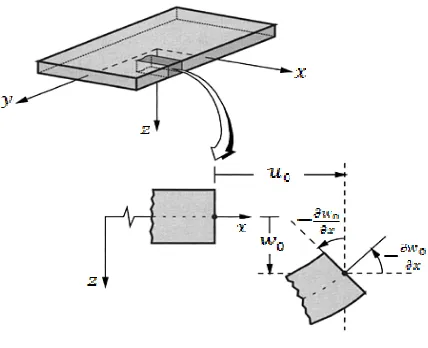
where subscript ‘,’ denotes partial differentiation with respect to the following parameters,u0, v0, and w0 are the displacements of a material point on the mid-surface along x-,
y-, and z- axes, respectively, φx and φy are the rotations of a transverse normal about the y- and
x-axes, respectively (Fig. 1),Nx, Ny, and Nxy are the in-plane force resultants, Qx and Qy are the transverse force resultants, Mx, My, and Mxy are the moments resultants,I0, I1, and I2 are the mass moments of inertia, q is the applied transverse force which is zero in the free vibration, and
w0
is the only nonlinear term in the equations of motion and is in the following form:
w0
N wx 0,x N wxy 0,y
,x N wxy 0,x N wy 0,y
,y
57 The boundary condition is taken to be movable
simply-supported which is expressed by:
, , 0 ,
, , 0 ,
0 0,
0 0,
b
xx xy yy
a
yy xy xx
w w dy x a
w w dx y b
(7)Where a and b are the length and width of the plate, respectively, and ψ is the force function defined by:
, , ,
x yy y xx xy xy
N N N (8) Assuming the density of plate material (ρ0) as an even function of thickness (z) and dealing with thin plates which makes it possible to neglect the in-plane inertia effects (i.e. u0,tt and v0,tt), Eqs. (1-5) are reduced to the following equations, which are written in terms of the displacements and force function [25]:
55 , , 44 , , , ,
, , 2 , , 0
xx x x yy y y yy xx
xx yy xy xy
KA w KA w w
w w q I w
(9)
11 , 12 , 66 , , 55 ,
* * *
61 26 , 16 , 2
x xx y xy x yy y xy x x
xxy yyy x
D D D KA w
B B B I
(10)
12 , 22 , 66 , ,
* * *
44 , 62 16 , 26 , 2
x xy y yy x xy y xx
y y xyy xxx y
D D D
KA w B B B I
(11) along with a compatibility equation in the following form [25, 42]:
* *
22 , 12 66 , 11 , 26 61 ,
* * 2
16 62 , , , ,
2 2
2
xxxx xxyy yyyy xxxy
xyyy xy xx yy
A A A A B B w
B B w w w w
(12) Where K is shear correction factor, Aij are extensional stiffness, Bij are bending-extension-coupling stiffness, and Dij are bending stiffness. Unknown parameters of Eqs. (10-12) are obtained by [41- 43]:
1 1 1
11 12 16
12 22 26
66 16 26
11 12
44 45 44
12 22
45 55 55
66
, ,
0 0 0
0 , 0 0 ,
0 0 0
0
0 0 ,
0
0 0
A A B
A A B
A B B
D D
A A A
D D
A A A
D * * *
A A B A B D D BA B
A B
D
(13)
where, for the symmetric plates, B = 0 must be considered.
For the boundary condition of Eq. (7), a trial function for can be assumed as:
( )sin
sin
w hf t
x a
y b
(14) Where h is thickness of the plate and f(t) is an unknown time function. So, the force function is obtained by substituting Eq. (14) for Eq. (12):
2 2 2 2
2 2
22 11
cos 2 cos 2
32
h f t a b
x a y b
A b A a
(15)
Equations (10 and 11) lead to a set of equations with two unknown parameters which are φx and φy. By solving this set of equations and substituting the obtained parameters (i.e. φx andφy) along with ψ from Eq. (15) for Eq. (9), the following nonlinear partial differential equation is obtained (φx and φy are given in Appendix A):
55 2 6 3 5 44 3 4 1 6
55 2 8 5 7 44 4 7 1 8
2 2 2 2 2 2
55 2 44 2 2 2 2 2
2 2 2
0 2 2 4 1 5
2 0
K A L L L L A L L L L w
x y
K A L L L L A L L L L
x y
K A A
x y y x x y
I L L L L w x y x y t
(16)
Where Li* are partial differential operators given in Appendix A for the anti-symmetric angle-ply laminated rectangular plates.
The Galerkin method is applied by ∫∫AL∙wdxdy= 0, in which A is area of the rectangular plate and L is the left-hand side of Eq. (16); it transforms the nonlinear PDE of Eq. (16) into a nonlinear ODE in terms of f(t). Substitution of the dimensionless time t a2for this
nonlinear ODE results in the following dimensionless nonlinear ODE:
2 2 3 2 2 2 2
, , , 0
f f f f f f f
58
Fig. 1. Generalized displacements of a rectangular plate in the first order shear deformation theory.
where ω is dimensionless natural frequency, α2
is coefficient of nonlinear stiffness term, and β2
and γ2 are coefficients of nonlinear inertia terms. In dimensionless time (τ), Λ = E2h
3 /I0. To solve Eq. (17) by a perturbation method, the nonlinear terms of Eq. (17) are multiplied by a small, dimensionless parameter (ε) which is equated to unity after computations. ε is the order of the amplitude of motion and is used as a bookkeeping device in obtaining the approximate solution. So, the nonlinear terms of Eq. (17) are multiplied by ε to make the use of perturbation method possible:
2 2 3 2 2 2 2
, , ,
f
f
f
f f
f f
(18) According to Nayfeh and Mook [44], the independent time variables are defined by Tn = εnτ, (n = 1,2,…), and f can be approximated by
f(τ,ε) = f0(T0,T1) + εf1(T0,T1). Derivatives with respect to τ in Eq. (18) can be written in terms of partial derivatives of Tn. To this end, it should be noted that d/dτ = D0 + εD1 and d2/dτ2
= D02 + 2εD0D1, where D0 and D1 denote ∂/∂T0 and ∂/∂T1, respectively. Therefore, substitution of these relations for Eq. (18) gives:
2 2
0 0 0 0
D f f
(19)
2 2 2 3
0 1 1 0 1 0 0
2
2 2 2 2
0 0 0 0 0 0
2
D f f D D f f
f D f f D f
(20)
The solution of Eq. (19) is:
0 1 exp 0
f X T i T cc (21) where X is an unknown complex function of T1 and cc denotes the complex conjugate of preceding term.
To have a periodic solution after the substitution of Eq. (21) for Eq. (20), the following is required [44]:
2 2 2 2 2
2i X
3X X
X X
0 (22)
which is called solvability condition. If Eq. (22) is not satisfied, instability occurs and the amplitude of motion grows over time.
By defining X in the polar form (i.e., X = (r/2)exp(is)) and after its substitution in the above equation, the nonlinear frequency is obtained:
2
2
0 2 3
1 4 0
1 2
2 4 2
1 0 0 1 2 3
4
2 2 2
2
16 2 8
1
4 8 8 2 8
NL
NL
r r r
r r r
r r r r r r
r
(23)
where r0 is a constant parameter which shows the dimensionless initial displacement (i.e., r0 ≡
wmax/h). The unknown parameters of Eq. (23) are:
59
2 2 2 2 2 2 2
1 2 1
2 2 2
3 1 4 1
3 , 3 8 ,
,
r r r
r r r r
(24)
2. 2. Validating the analytical solution
For a four-layered cross-ply square plate with the following material properties; E1/E2 = open;
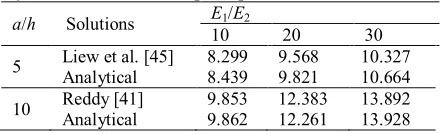
G12 = G13 = 0.6E2; G23 = 0.5E2; ν12 = 0.25, some dimensionless frequencies (ω) are obtained and compared with the results of Liew et al. [45] which is shown in Table 1. It can be observed that, for thinner plates and for plates with low orthotropy degrees (E1/E2 ratios), the obtained frequencies are more accurate. Fundamental frequencies of a four-layered [45°/−45°/45°/−45°] composite plate are compared with some published results which are shown in Table 2. Material properties of the studied plate are: E1 = 40E2, G12 = 0.6E2, ν12 = 0.25, G13 = G23 = 0.5E2. Although the proposed analytical procedure is based on the first order shear deformation theory, according to Table 2, the results are in good agreement with the results of highly accurate higher order shear deformation theory (HSDT) presented by Alibeigloo et al. [46].
Nonlinear frequency ratio (ωNL/ω) of an isotropic square plate is also obtained which is shown in Table 3. Accordingly, the considered analytical approach gives good results for the nonlinear frequency as well. It is also observed that the nonlinear frequency is related to the amplitude of motion in a way that the increase of initial displacement results in higher nonlinear frequencies. So, the validity of the analytical solution is approved and subsequently Eqs. (17 and 23) are used to obtain the required data in training the neural network model.
Table 1. Dimensionless fundamental frequency of a symmetric laminated square plate.
a/h Solutions E1/E2
10 20 30
5 Liew et al. [45] Analytical
8.299 8.439
9.568 9.821
10.327 10.664
10 Reddy [41] Analytical
9.853 9.862
12.383 12.261
13.892 13.928
Table 2. Comparing the dimensionless fundamental frequency of a four-layered rectangular plate.
Method a/b 1 2
Ghosh and Dey [12] HSDT [46] Analytical
a
/
h
10
18.06 17.974 18.044
31.28 33.553 33.496
Ghosh and Dey HSDT Analytical
30
23.28 22.691 22.675
50.89 49.547 49.644
Ghosh and Dey HSDT Analytical
50
23.91 23.296 23.210
53.68 52.254 52.155
Table 3. Nonlinear frequency ratio of isotropic square plates (a/h = 100, ν = 0.3).
r0 0.2 0.6 1.0
Singha and Daripa
[17] 1.00516 1.04559 1.12239
Experimental [21] 1.00634 1.04502 1.11994
Analytical 1.00511 1.04525 1.12197
3. Neural network modeling
3. 1. Constructing the neural network model
The main advantage of ANN is its ability to model a problem using examples, rather than analytical description. Figure 2 shows the basic configuration of a neuron model.
An ANN model needs to be trained from an existing training set including many pairs of input–output elements. One of the most popular learning algorithms is the back-error
propagation algorithm [47], which trains a neural network until the mean square errors between the training output data and the predicted output are minimized.
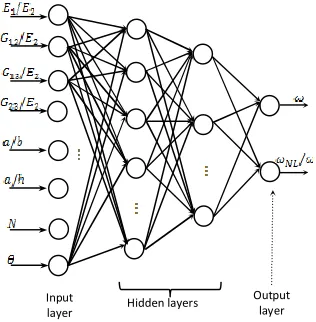
In this study, the proposed ANN model shown in Fig. 3 was trained by the input data obtained from Eqs. (17 and 23). The input layer needs random sets of data including E1/E2, G12/E2,
feed-60
forward, two hidden layer network [36, 47]. The tangent sigmoid transfer function is used as
Fig. 2. A typical neuron model.
the transfer functions. The proposed neural network model was developed in MATLAB environment using the neural network toolbox. The input data set included 1200 patterns based on analytical solution developed in the previous section for a random set of design variables. Random 840 data patterns were used for the training of the neural network model and the remaining 360 patterns were randomly selected to use as validation and testing (180 patterns for each).
Fig. 3. ANN model of the present study.
3. 2. Results of the proposed ANN model
The database in this study included 840 data sets for different plate parameters obtained from the analytical analysis. Results of the
performance of the proposed 8–21–19–2 ANN model are given in Fig. 4, which shows the mean squared error of the network starting at a large value and decreasing to a smaller value. In other words, the network was learning. The plot had three lines, because the whole input and target vectors were randomly divided into three sets. Training on the training vectors continued as long as the training reduced the network's error on the validation vectors.
For a three-layered cross-ply square laminated plate with the following material properties; E1 = 40E2, G12 = G13 = 0.6E2, G23 = 0.5E2, ν12 = 0.25, ω and ωNL/ω were obtained by the ANN model and the results were compared with those of the analytical and previously published ones, which are shown in Table 4 and Fig. 5, respectively .
In Table 5, frequencies of an eight-layered anti-symmetric square composite plate are given. The material properties were the same as the previous case and again the ANN model had
good results compared with others in the literature and the analytical results. Tables 4 and 5 show that the increase of the length-to-thickness ratio increased dimensionless frequency, but decreased nonlinear frequency ratio of rectangular plates. It is observed in Fig. 5 that ANN model predicted the frequencies similar to Nguyen-Van et al. [48] and better than Ferreira et al. [49] which are both based on
In
p
u
t
Fig. 4. Performance of the proposed ANN model.
0 1 2 3 4 5
10-4 10-3 10-2 10-1 100
Best Validation Performance is 0.00019749 at epoch 5
M
e
a
n
S
q
u
a
re
d
E
rr
o
r
(
m
s
e
)
5 Epochs
Train Validation Test Best
Epoch
Hidden layers
Input layer
61 FSDT while the compared results in Table 5,
i.e., Akhras and Li [50] and Reddy and Phan [51] are based on HSDT.
Effects of fiber orientation angle on the natural frequency were studied by the ANN model, the results of which are shown in Table 6 and compared with those of Reddy [41] and Xiang and Kang [52]. It can be observed that, by increasing the fiber orientation angle, the dimensionless frequency of the anti-symmetric rectangular plates increased, because for higher fiber orientation angles, the stiffness of the plate increased and in turn resulted in the increased
natural frequency of the plate.
4. Conclusion
In this study, linear and nonlinear free vibrations of laminated rectangular plates were studied using an analytical method and comparative behavior modeling by ANN. The state variables included a combination of four moduli ratios, aspect ratio, length to thickness ratio, number of layers, and fibers orientation. The convergence and accuracy of the present
Fig. 5. Dimensionless frequencies of a three-layered [0°/90°/0°] cross-ply square plate.
10 20 30 40 50 60 70 80 90 100
14.5 15 15.5 16 16.5 17 17.5 18 18.5 19
a/h
ANN model Reddy [41] Nguyen-Van et al [48] Ferreira et al. [49]
Table 4.Comparing the frequencies of a cross-ply [0°/90°/0°] square plate predicted by ANN model with the analytical solution.
a/h Model ω ωNL/ω
10
Analytical ANN model
14.8253 14.8270
1.2417 1.2337
20
Analytical ANN model
17.5108 17.5396
1.1938 1.1840
25
Analytical ANN model
17.9708 17.9723
1.1853 1.1751
50
Analytical ANN model
18.6474 18.6552
1.1738 1.1602
100
Analytical ANN model
18.8317 18.7359
62
method were validated by comparing the obtained results with those published in the literature. The results demonstrated that ANN can acceptably model the linear and nonlinear behaviors of laminated rectangular plates. It was also seen that:
Higher aspect ratios, length-to-thickness ratios, and moduli ratios increased dimensionless frequency of composite rectangular plates (see Tables 1 and 2). Unlike the linear frequency, nonlinear
frequency was a function of the amplitude of motion which can be observed in Eq. (23) and Table 3.
Length-to-thickness ratio had a minor effect on the nonlinear frequency ratio of composite rectangular plates (see Tables 4 and 5).
Fiber orientation tended to increase the stiffness of the anti-symmetric rectangular plate, which was why dimensionless frequency of a plate with higher fiber orientation angle was higher (see Table 6).
Table 5. Frequencies of an eight-layered
[45°/−45°/…] square laminated plate.
a/h Model ω ωNL/ω
10
Akhras and Li [50] Reddy and Phan [51] Analytical
ANN model
19.264 19.266 19.3422 19.3190
- - 1.0171 1.0161
20
Akhras and Li Reddy and Phan Analytical ANN model
23.238 23.239 23.3135 23.3007
- - 1.0120 1.0142
100
Akhras and Li Reddy and Phan Analytical ANN model
25.175 25.174 25.179 25.1802
- - 1.0104 1.0111
Table 6. Dimensionless frequencies of a six-layered anti-symmetric square plate (a/h = 20).
θ Method ω
30°
Reddy [41]
Xiang and Kang [52] ANN model
21.648 22.2841 22.8018
45°
Reddy
Xiang and Kang ANN model
22.877 23.6072 23.2616
References
[1] B. Harras, R. Benamar and R. G. White, “Experimental and theoretical investigation of the linear and non-linear dynamic behaviour of a Glare 3 hybrid composite panel”, Journal of Sound and vibration, Vol. 252, No. 2, pp. 281-315, (2002).
[2] W. Zhen and C. Wanji, “Free vibration of laminated composite and sandwich plates using global–local higher-order theory”,
Journal of Sound and Vibration, Vol. 298, No. 1-2, pp. 333-349, (2006). [3] M. Malik and C. W. Bert,
“Three-dimensional elasticity solutions for free vibrations of rectangular plates by the differential quadrature method”,
International Journal of Solids and Structures, Vol. 35, No. 3-4, pp. 299-318, (1998).
[4] S. Xiang and K. M. Wang, “Free vibration analysis of symmetric laminated composite plates by trigonometric shear deformation theory and inverse multiquadric RBF”, Thin-Walled Structures, Vol. 47, No. 3, pp. 304-310, (2009).
[5] W. X. Wu, C. Shu and C. M. Wang, “Mesh-free least-squares-based finite difference method for large-amplitude free vibration analysis of arbitrarily shaped thin plates”, Journal of Sound and Vibration, Vol. 317, No. 3-5, pp. 955-974, (2008).
[6] G. R. Liu, X. Zhao, K. Y. Dai, Z. H. Zhong, G. Y. Li and X. Han, “Static and free vibration analysis of laminated composite plates using the conforming radial point interpolation method”,
Composites Science and Technology, Vol. 68, No. 2, pp. 354-366, (2008). [7] M. Ćetković and D. J. Vuksanović,
“Bending, free vibrations and buckling of laminated composite and sandwich plates using a layerwise displacement model”,
63 [8] W. Zhen, Y. K. Cheung, S. H. Lo and W.
Chen, “Effects of higher-order global-local shear deformations on bending, vibration and buckling of multilayered plates”, Composite Structures, Vol. 82, No. 2, pp. 277-289, (2008).
[9] P. Ribeiro and M. Petyt, “Non-linear vibration of composite laminated plates by the hierarchical finite element method”, Composite Structures, Vol. 46, No. 3, pp. 197-208, (1999).
[10] P. Ribeiro, “Forced periodic vibrations of laminated composite plates by a p-version, first order shear deformation, finite element”, Composites Science and Technology, Vol. 66, No. 11-12, pp. 1844-1856, (2006).
[11] J. N. Reddy and W. C. Chao, “Large-deflection and large-amplitude free vibrations of laminated composite-material plates”, Computers & Structures, Vol. 13, No. 1-3, pp. 341-347, (1981).
[12] A. K. Ghosh and S. S. Dey, “Free vibration of laminated composite plates-a simple finite element based on higher order theory”, Computers & Structures, Vol. 52, No. 3, pp. 397-404, (1994). [13] P. Dash and B. N. Singh, “Geometrically
nonlinear bending analysis of laminated composite plate”, Communications in Nonlinear Science and Numerical Simulation, Vol. 15, No. 10, pp. 3170-3181, (2010).
[14] J. S. Chang and Y. P. Huang, “Nonlinear analysis of composite anti-symmetric angle-ply under uniform temperature field”, Computers & Structures, Vol. 40, No. 4, pp. 857-869, (1991).
[15] J. N. Reddy, “Free vibration of anti-symmetric, angle-ply laminated plates including transverse shear deformation by the finite element method”, Journal of Sound and Vibration, Vol. 66, No. 4, pp. 565-576, (1979).
[16] Q. H. Cheng, T. S. Lok and Z. C. Xie, “Geometrically non-linear analysis including shear deformation of composite
laminates”, Thin-Walled Structures, Vol. 35, No. 1, pp. 41-59, (1999).
[17] M. K. Singha and R. Daripa, “Nonlinear vibration and dynamic stability analysis of composite plates”, Journal of Sound and Vibration, Vol. 328, No. 4-5, pp. 541-554, (2009).
[18] M. Taazount, A. Zinai and A. Bouazzouni, “Large free vibration of thin plates: Hierarchic finite Element Method and asymptotic linearization”, European Journal of Mechanics A/Solids, Vol. 28, No. 1, pp. 155-165, (2009).
[19] F. Boumediene, A. Miloudi, J. M. Cadou, L. Duigou and E. H. Boutyour, “Nonlinear forced vibration of damped plates by an asymptotic numerical method”, Computers and Structures, Vol. 87, No. 23-24, pp. 1508-1515, (2009). [20] L. Azrar, E. H. Boutyour and M.
Potier-Ferry, “Non-linear forced vibrations of plates by an asymptotic-numerical method”, Journal of Sound and Vibration, Vol. 252, No. 4, pp. 657-674, (2002).
[21] M. Amabili, “Nonlinear vibrations of rectangular plates with different boundary conditions: theory and experiments”, Computers and Structures, Vol. 82, No. 31-32, pp. 2587-2605, (2004).
[22] M. Amabili and S. Farhadi, “Shear deformable versus classical theories for nonlinear vibrations of rectangular isotropic and laminated composite plates”, Journal of Sound and Vibration, Vol. 320, No. 3, pp. 649-667, (2009). [23] B. Bhushan, G. Singh and G. V. Rao,
“An iteration method for the large amplitude flexural vibration of anti-symmetric cross-ply rectangular plates”,
Composite Structures, Vol. 18, No. 3, pp. 263-282, (1991).
64
Vibration, Vol. 217, No. 3, pp. 467-484, (1998).
[25] A. Shooshtari and S. Razavi, “A closed form solution for linear and nonlinear free vibrations of composite and fiber metal laminated rectangular plates”,
Composite Structures, Vol. 92, No. 11, pp. 2663-2675, (2010).
[26] I. V. Andrianov, V. V. Danishevs’kyy and J. Awrejcewicz, “An artificial small perturbation parameter and nonlinear plate vibrations”, Journal of Sound and Vibration, Vol. 283, No. 3-5, pp. 561-571, (2005).
[27] R. L. Woodcock, R. B. Bhat and I. G. Stiharu, “Effect of ply orientation on the in-plane vibration of single-layer composite plates”, Journal of Sound and Vibration, Vol. 312, No. 1-2, pp. 94-108, (2008).
[28] W. S. Kuo and I. H. Yang, “Generic nonlinear behavior of anti-symmetric angle-ply laminated plates”,
International Journal of Mechanical Sciences, Vol. 31, No. 2, pp. 131-143, (1989).
[29] K. Swaminathan and S. S. Patil, “Analytical solutions using a higher order refined computational model with 12 degrees of freedom for the free vibration analysis of anti-symmetric angle-ply plates”, Composite Structures, Vol. 82, No. 2, pp. 209-216, (2008).
[30] G. Janevski, “Asymptotic solution of nonlinear vibrations of anti-symmetric laminated angle-ply plate”, FME Transactions, Vol. 30, No. 2, pp. 77-84, (2002).
[31] G. Janevski, “Two-frequency nonlinear vibrations of anti-symmetric laminated angle-ply plate”, Factauniversitatis-Series: Mechanics, Automatic Control and Robotics, Vol. 4, No. 1, pp. 345-358, (2004).
[32] Z. Zhang, P. Klein and K. Friedrich, “Dynamic mechanical properties of PTFE based short carbon fiber reinforced composites: experiment and artificial neural network prediction”, Composites
Science and Technology, Vol. 62, No. 7-8, pp. 1001-1009, (2002).
[33] A. Jodaei, M. Jalal and M. H. Yas, “Free vibration analysis of functionally graded annular plates by state-space based differential quadrature method and comparative modeling by ANN”,
Composites: Part B, Vol. 43, No. 2, pp. 340-353, (2012).
[34] A. Jodaei, M. Jalal and M. H. Yas, “Three-dimensional free vibration analysis of functionally graded piezoelectric annular plates via SSDQM and comparative modeling by ANN”,
Mathematical and Computer Modelling, Vol. 57, No. 5-6, pp. 1408-1425, (2013). [35] V. P. Singh, S. Chakraverty, R. K.
Sharma and G. K. Sharma, “Modeling vibration frequencies of annular plates by regression based neural network”,
Applied Soft Computing, Vol. 9, No. 1, pp. 439-447, (2009).
[36] R. Gunes, M. K. Apalak, M. Yildirim and I. Ozkes, “Free vibration analysis of adhesively bonded single lap joints with wide and narrow functionally graded plates”, Composite Structures, Vol. 92, No. 1, pp. 1-17, (2010).
[37] R. Gunes, M. K. Apalak and M. Yildirim, “The free vibration analysis and optimal design of an adhesively bonded functionally graded single lap joint”,
International Journal of Mechanical Sciences, Vol. 49, No. 4, pp. 479-499, (2007).
[38] M. K. Apalak and M. Yildirim, “Free Vibration Analysis and Optimal Design of a Clamped-free Single Lap Joint with Unidirectional Laminated Narrow Plates”, Journal of Thermoplastic Composite Materials, Vol. 22, No. 2, pp. 183-211, (2009).
[39] V. Rouss, W. Charon and G. Cirrincione, “Neural model of the dynamic behaviour of a non-linear mechanical system”,
65 [40] M. R. S. Reddy, B. S. Reddy, V. N.
Reddy and S. Sreenivasulu, “Prediction of Natural Frequency of Laminated Composite Plates Using Artificial Neural Networks”, Engineering, Vol. 4, No. 6, pp. 329-337, (2012).
[41] J. N. Reddy, “Mechanics of laminated composite plates and shells: theory and analysis”, 2nd Edition, CRC Press, (2004).
[42] C. Y. Chia, “Nonlinear Analysis of Plates”, McGraw-Hill, (1980).
[43] R. M. Jones, “Mechanics of composite materials”, 2nd Edition, Taylor Francis Inc., (1999).
[44] A. H. Nayfeh and D. T. Mook, “Nonlinear Oscillations”, John Wiley & Sons Inc., (1995).
[45] K. M. Liew, Y. Q. Huang and J. N. Reddy, “Vibration analysis of symmetrically laminated plates based on FSDT using the moving least squares differential quadrature method”,
Computer Methods in Applied Mechanics and Engineering, Vol. 192, No. 19, pp. 2203-2222, (2003).
[46] A. Alibeigloo, M. Shakeri and M. R. Kari, “Free vibration analysis of anti-symmetric laminated rectangular plates with distributed patch mass using third-order shear deformation theory”, Ocean Engineering, Vol. 35, No. 2, pp. 183-190, (2008).
[47] M. T. Hagan and M. Menhaj, “Training feed-forward networks with the Marquardt algorithm”, IEEE Transactions on Neural Networks, Vol. 5, No. 6, pp. 989-993, (1994).
[48] H. Nguyen-Van, N. Mai-Duy, W. Karunasena and T. Tran-Cong, “Buckling and vibration analysis of laminated composite plate/shell structures via a smoothed quadrilateral flat shell element with in-plane rotations”, Computers and Structures, Vol. 89, No. 7-8, pp. 612-625, (2011).
[49] A. J. M. Ferreira, R. M. N. Jorge and C. M. C. Roque, “Free vibration analysis of symmetric laminated composite plates by FSDT and radial basis functions”,
Computer Methods in Applied Mechanics and Engineering, Vol. 194, No. 39-41, pp. 4265-4278, (2005).
[50] G. Akhras and W. Li, “Static and free vibration analysis of composite plates using spline finite strips with higher-order shear deformation”, Composites: Part B, Vol. 36, No. 6-7, pp. 496-503, (2005).
[51] J. N. Reddy and N. D. Phan, “Stability and vibration of isotropic, orthotropic and laminated plates according to a higher-order shear deformation theory”,
Journal of Sound and Vibration, Vol. 98, No. 2, pp. 157-170, (1985).
[52] X. Song and G. Kang, “Local thin plate spline collocation for free vibration analysis of laminated composite plates”,
European Journal of Mechanics A/Solids, Vol. 33, No. 1, pp. 24-30, (2012).
Appendix A
2
1 66 1 2 3 44
2 2 2
2 66 2 22 2 2 2 44
,
.1
L D D L K A
x y y
L D D I K A A
x y t
2 2 2
4 11 2 66 2 2 2 55
2
5 66 12 6 55
,
, .2
L D D I K A
x y t
L D D L KA A
x y x
3 3
* * * *
7 16 62 2 26 3
3 3
* * * *
8 26 61 2 16 3
,
.3
L B B B
x y x
L B B B A
x y y
* * * * * * * *
2 6 3 5 8 2 1 7
9 * * * * 10 * * * *
2 4 1 5 2 4 1 5
* * * * * * * *
*
3 4 5 6 4 7 5 8
11 * * * * 12 * * * *
2 4 1 5 2 4 1 5
, ,
, .4
L L L L L L L L
L L
L L L L L L L L
L L L L L L L L
L L A
L L L L L L L L
9 10 , 11 12 .5
x L w L y L w L A
For the symmetric plate Bij *
![Table 4.h Model ω analytical solution. Comparing the frequencies of a cross-ply [0°/90°/0°] square plate predicted by ANN model with the a/ ω/ω](https://thumb-us.123doks.com/thumbv2/123dok_us/9969344.1985258/7.595.201.423.275.443/table-model-analytical-solution-comparing-frequencies-square-predicted.webp)