Vol.8 (2018) No. 3
ISSN: 2088-5334
Neutronic Analysis of a Thorium-Fueled Reduced Moderation Boiling
Water Reactor
Dayu Fajrul Falaakh, Alexander Agung
#, Andang Widi Harto
Department of Nuclear Engineering and Engineering Physics, Faculty of Engineering,Universitas Gadjah Mada, Jalan Grafika 2, Yogyakarta, 55281, Indonesia #
E-mail: [email protected]
Abstract— A study about Resource Renewable Boiling Water Reactor (RBWR) core, a reduced moderation boiling water reactor that features the breeding ratio larger than 1 was conducted. This study focuses on the neutronic performances of the core and aims to investigate the core sustainability when using thorium as the main fertile fuel. A fuel-self-sustaining core with high burnup set as the design target. 233U+Th were used as the initial fuel, and the impact of initial fissile (233U) content in the core fissile zone on the core neutronic performances was evaluated. Parameters related to the neutronic performances such as the core burnup, fissile breeding, and fissile inventory ratio (FIR) are considered in this study. From these results, it was confirmed that it is feasible to create a self-sustaining fuel cycle system using thorium fueled RBWR. However, there was a trade-off between the core burnup and fissile breeding that can be a significant challenge in the development of this system. Evaluating the other design variables may be considered to address this challenge. The further study to analyze the safety performances of the core is required to arrive at a safe and reliable reactor system.
Keywords— thorium; reduced moderation; neutronics; SERPENT.
I.INTRODUCTION
Nuclear power is one of the most promising answers to meet the increased expectation for electricity in the world without increasing greenhouse-effect gas emission. On the other hand, to ensure the sustainability of nuclear power, the current open fuel cycle is not sufficient. It is essential to establish a closed fuel cycle, and nuclear recycle system. The generation IV nuclear reactors are expected to play a major role in an open fuel cycle, but they have not been commercialized yet. On the other hand, Light Water Reactor (LWR) is a verified technology and has an outstanding commercial operation record. Thus, the use of LWR to establish a closed fuel cycle is preferable. To achieve a closed fuel cycle, LWR should be designed to be fuel-self-sustaining. A fuel-self-sustaining LWR design is resource Renewable Boiling Water Reactor (RBWR). RBWR features a small pitch-to-diameter ratio (P/D), hexagonal lattice, and large exit void fraction to achieve an epithermal to fast neutron energy spectrum [1, 2, 3].
Hitachi initially developed the RBWR concept was fueled with depleted uranium (DU) as the fertile fuel and transuranium elements (TRUs) that contain fissile plutonium (Puf). It was designed to create a hard spectrum BWR that features fuel sustainability by generating Puf from DU or efficient incineration of radioactive waste from the
long-lived TRUs generated as byproducts of the fission of uranium fuel [2]. However, there are several concerns regarding this TRU-DU fueled RBWR, and one of them is the uncertainty of void reactivity feedback [1] which is a vital safety characteristic of light water moderated reactor.
Another option is replacing the depleted uranium with thorium as the main fertile fuel. Thorium is a promising candidate to be used as nuclear fuel. Thorium based fuel cycle has great potential in improving the sustainability of nuclear energy. Thorium based fuel cycle will indeed produce considerably less plutonium and minor actinides than conventional fuel cycle [4, 5, 6]. Thus, developing the utilization of thorium-based fuel cycle for RBWR will be promising.
233
U has a much flatter fuel reproduction factor with energy in comparison with 239Pu [7]. The fast fission cross section of 232Th has a lower value and higher threshold than that of 238U [2]. Therefore, the void reactivity of RBWR core fueled by Th-233U has the negative spectral component. The Th-233U based fuel cycle also provides more efficient breeding in the epithermal flux spectrum than 233U-239Pu cycle.
characteristics are evaluated by burnup calculations on the core model loaded with all fresh fuel. This study focuses on the neutronic performances of the core and aims to assess the core sustainability when using thorium as the main fertile fuel. The target of a fuel-self-sustaining core design with high burnup was also made.
The impact of the fissile fuel content in the fissile zone on the core neutronic behavior is explored. The parameters related to neutronic behavior such as the core burnup and fissile breeding are considered in this study. Another significant quantity is the fissile inventory ratio (FIR). The FIR for this study is defined as the time-dependent mass of all fissile isotopes and 233Pa contained in the fuel divided by the initial mass of 233U which is the only fissile isotope contained in the initial core. 233Pa has a major role in thorium-based fuel cycle as it accumulates in the fuel due to its half-life of 27 days. Thus, due to the beta decay of 233Pa into 233U, the amount of 233U will continue to increase in the discharged fuel during the cooling period. An extended period of cooling that enables the completion of 233U formation from the beta decay of 233Pa before reprocessing can take place will maximize the sustainability of thorium fuel cycle. The value of FIR represents the core sustainability, and it should be at least 1 to arrive at a fuel-self-sustaining core design.
II.MATERIAL AND METHOD
The neutronic calculations in this study were performed using SERPENT [8, 9], which is a continuous energy Monte Carlo (MC) neutron transport code developed at VTT research center in Finland. In these calculations, the nuclear data library based on the evaluated file ENDF/B-VII were used. The burnup calculation is performed on the Th fueled reduced moderation BWR core by using 3-dimensional calculation model. The major specifications of the calculation model are summarized in Table 1.
TABLEI
SPECIFICATIONS OF THE CALCULATION MODEL
Specification Value
Thermal power, MWth 1000
Core height (Hcore), m 2.4 Core diameter (Dcore), m 4.15 Number of fuel assemblies 282 Number of pins per assembly 217 Fuel rod outer diameter, cm 1.3 Fuel pitch-to-diameter ratio 1.43
Fissile zone length, cm 80
Upper blanket zone length, cm 55 Lower blanket zone length, cm 55
Exit void fraction, % 43
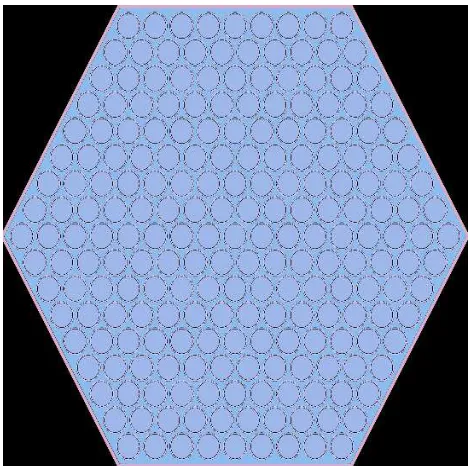
The core model consists of 282 hexagonal fuel assemblies, each of which consists of 217 fuel rods with the outer diameter of 13.0 mm arranged in gaps of 1.3 mm width and the 0.6 mm thick clad which is made of zircaloy. The core has 4.15 m diameter and 1.9 m total height which consists of two 0.55 m high axial blanket zones and an axial fissile zone with 0.8 m high between them. Both blanket zones are made of made of ThO2, and the fissile zone is made
of a mixture of 233UO2 and ThO2. Since a boiling water
cooled reactor has a robust axial variation in the coolant density, the coolant channel of the calculation model is divided into 9 axial zones, and the axial zone-dependent coolant density is calculated based on the assumption of cosine axial power distribution [9]. The exit void fraction is 0.43, inlet water density is approximately 0.74 g/cm3, and water density at the exit is approximately 0.08 g/cm3. Figure 1 shows the cross-sectional of the fuel assembly while Figure 2 shows the cross-sectional view of the core.
The burnup calculation simulates the long-term changes in the composition of nuclear fuel and other materials under irradiation as well as the resulting changes in neutronic properties of the core system [11]. In MC burnup calculation, the entire irradiation period is divided into a number of time steps, and the calculations include two distinct parts: the transport and depletion solver [12]. The transport solver calculates steady-state neutron flux and cross-sections for given material compositions by solving the neutron transport equation. The neutron fluxes and cross sections obtained from transport calculation are then used to compute the neutron-induced reaction rates. The depletion solver calculates material changes over a time-step with fixed microscopic reaction rates; this part requires solving the Bateman depletion equations. These two parts are then combined to a burnup calculation and solved in a sequential manner using so-called predictor-corrector algorithm [12, 13].
In the calculations of this study, the Bateman depletion equations were solved using the matrix exponential method based on the Chebyshev Rational Approximation Method (CRAM) [14,15,16], which is used by default in SERPENT.
Fig 1. Horizontal cross section of RBWR fuel assembly model in SERPENT
(a) (b)
Upper reflector
Upper blanket
Fissile
Lower blanket
L o
Lower reflector Coolant channel
BOS transport solver: calculate flux and cross section based on BOS
composition
Predicted EOS depletion solver: form burnup matrix and solve the
Bateman depletion equations
EOS transport solver: calculate flux and cross section based on EOS
composition
Recalculate flux and cross section by linear interpolation from BOS
and EOS values
Corrected EOS depletion solver: form burnup matrix and solve the
Bateman depletion equations
EOS compositions, proceed to the next depletion step Flux and cross
section from BOS neutronic
P
R
E
D
IC
T
O
R
C
A
L
C
U
L
A
T
IO
N
C
O
R
R
E
C
T
O
R
C
A
L
C
U
L
A
T
IO
N
Fig 2. Horizontal (a) and vertical (b) cross section of RBWR core model in SERPENT
In the burn-up calculation, SERPENT code uses an internal routine for solving a set of Bateman equations, which are formulated as [14]:
= ∑ → − − (1)
0 = , = 1, … ,
where Nj is the atomic density of nuclide j, → is the production rate of nuclide j in decay, transmutation and fission reactions, is the radioactive decay rate of nuclide
j, and is the transmutation rate of nuclide j, including
fission.
In the matrix exponential method [14, 15, 16], the depletion problems are formulated in matrix notation as follows.
′ = , 0 = , (2)
This matrix form has the matrix exponential solution:
= (3)
where ∈ ℝ# is the nuclide concentration vector and
∈ ℝ#×#is the burnup matrix containing the generalized transmutation coefficients characterizing the total production and loss rates of the nuclides in irradiated materials. The nuclides production, as well as loss, can be caused by radioactive decay and neutron-induced reactions. The transmutation coefficients for these reactions can respectively be calculated with the following equations [13]:
%= & %
#%= #%
(4)
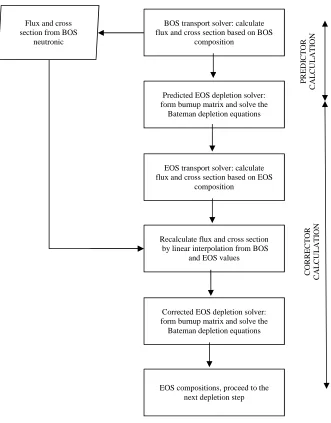
where #%and %are the transmutation coefficients for non-fission and fission neutron-induced reactions. The transmutation coefficients for radioactive decay ( ) are calculated by the multiplication of the decay constant and branching ratio, which along with the fission yields (&) are read from ENDF format data files. The neutron flux ( ) and cross section ( ) are calculated by solving the neutron transport problem. The calculation methodology used in this study can be explained with the flowchart in Figure 3.
The calculations can be divided into two parts. The first part is the predictor calculation, during which the neutron transport equation for the beginning of step (BOS) material compositions is solved to calculate neutron fluxes and cross-sections. These data are then combined with the radioactive decay constants, branching ratios and fission yields which are read from data libraries to calculate the transmutation coefficients that are used to form the burnup matrix. Materials are depleted over the time interval. The depletion problems are solved to obtain predicted material compositions at the end of the step (EOS). The second part is the corrector calculation, in which the EOS material compositions are corrected using the average of BOS and EOS neutron fluxes and cross sections, which corresponds to a linear interpolation between the two points.
III.RESULTS AND DISCUSSION
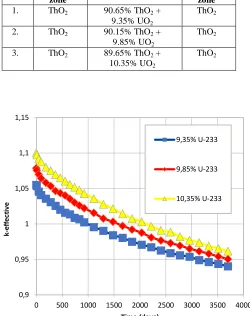
The core burnup calculations were performed to simulate the long-term neutronic behaviors of the core. The total burnup interval in the calculations is 40 MWd/kg, which was divided into some steps with lengths ranged from 0.4 MWd/kg to 2 MWd/kg. The core was initially loaded with all fresh fuel which has uniform composition radially. The fissile zone composition in the initial core is varied to be 9.35% 233Uand 90.65% Th, 9.85% 233Uand 90.15% Th and 10.35% 233Uand 89.65% Th, while the blankets on the top and bottom of it were only loaded with Th. The variation of fuel composition at the beginning of the cycle (BOC) used in this study is shown in Table 3.
TABLEII
SPECIFICATIONS OF THE CALCULATION MODEL
No. Initial loading fuel composition Upper
blanket zone
Fissile zone
Lower blanket
zone
1. ThO2 90.65% ThO2 +
9.35% UO2
ThO2
2. ThO2 90.15% ThO2 +
9.85% UO2
ThO2
3. ThO2 89.65% ThO2 +
10.35% UO2
ThO2
Fig 4. k-eff variation with burnup of RBWR core
Figure 4 shows the variation of effective multiplication factor (keff) versus burnup and time for each initial fuel
composition. If keff value is set to be 1.0 at the end of the
cycle (EOC), the figure indicates that the fuel burnup and cycle duration were extended as the content of 233U in fissile zone increases. The core burnup and cycle duration were respectively about 10 MWd/kg HM and 925 days for 233U content in fissile zone of 9.35%, 16 MWd/kg HM and 1480 days for 233U content of 9.85% in fissile zone, and 22
0,9 0,95 1 1,05 1,1 1,15
0 500 1000 1500 2000 2500 3000 3500 4000
k
-e
ff
e
c
ti
v
e
Time (days)
9,35% U-233
9,85% U-233
10,35% U-233
MWd/kg HM and 2035 days for 233U content of 10.35% in the fissile zone.
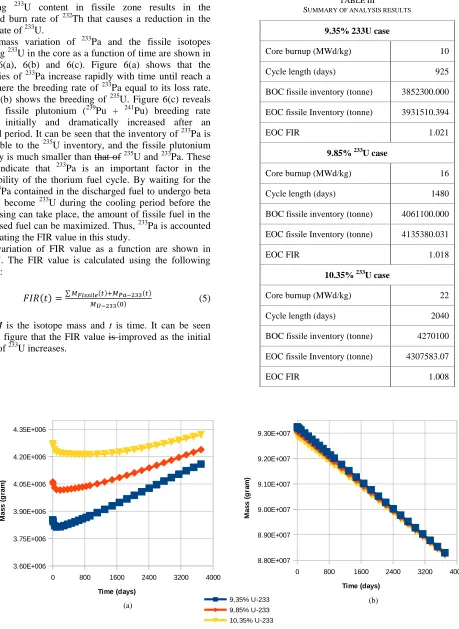
The mass variation of 233U and 232Th in the core as a function of time are shown in Figure 5(a) and 5(b), respectively. Figure 5(a) indicates that after decreasing initially, the inventories of 233U increase when the breeding rate of 233U is larger compared to its burning rate. 232Th transmutation causes the 233U breeding. Figure 5(b) shows the decreased 232Th inventories. It also can be seen that increasing 233U content in fissile zone results in the decreased burn rate of 232Th that causes a reduction in the growth rate of 233U.
The mass variation of 233Pa and the fissile isotopes excluding 233U in the core as a function of time are shown in Figure 6(a), 6(b) and 6(c). Figure 6(a) shows that the inventories of 233Pa increase rapidly with time until reach a point where the breeding rate of 233Pa equal to its loss rate. Figure 6(b) shows the breeding of 235U. Figure 6(c) reveals that the fissile plutonium (239Pu + 241Pu) breeding rate delayed initially and dramatically increased after an extended period. It can be seen that the inventory of 233Pa is comparable to the 235U inventory, and the fissile plutonium inventory is much smaller than that of 235U and 233Pa. These results indicate that 233Pa is an important factor in the sustainability of the thorium fuel cycle. By waiting for the entire 233Pa contained in the discharged fuel to undergo beta decay to become 233U during the cooling period before the reprocessing can take place, the amount of fissile fuel in the reprocessed fuel can be maximized. Thus, 233Pa is accounted in calculating the FIR value in this study.
The variation of FIR value as a function are shown in Figure 7. The FIR value is calculated using the following equation:
'() =∑ *+,--,./ 0*123455
*63455 (5)
where M is the isotope mass and t is time. It can be seen from the figure that the FIR value is improved as the initial content of 233U increases.
The neutronic analysis results of this study for each initial content of 233U are summarized in Table 3. As written in section 1 that the FIR value is required to be at least 1 to achieve a fuel-self-sustaining core design. The FIR value at the EOC for each initial content of 233U is more than 1 which means a fuel-self-sustaining core design is achieved in this study.
TABLEIII
SUMMARY OF ANALYSIS RESULTS
9.35% 233U case
Core burnup (MWd/kg) 10
Cycle length (days) 925
BOC fissile inventory (tonne) 3852300.000
EOC fissile Inventory (tonne) 3931510.394
EOC FIR 1.021
9.85% 233U case
Core burnup (MWd/kg) 16
Cycle length (days) 1480
BOC fissile inventory (tonne) 4061100.000
EOC fissile Inventory (tonne) 4135380.031
EOC FIR 1.018
10.35% 233U case
Core burnup (MWd/kg) 22
Cycle length (days) 2040
BOC fissile inventory (tonne) 4270100
EOC fissile Inventory (tonne) 4307583.07
EOC FIR 1.008
0 800 1600 2400 3200 4000
3.60E+006 3.75E+006 3.90E+006 4.05E+006 4.20E+006 4.35E+006
Time (days)
M
a
s
s
(
g
ra
m
)
0 800 1600 2400 3200 4000
8.80E+007 8.90E+007 9.00E+007 9.10E+007 9.20E+007 9.30E+007
Time (days)
M
a
s
s
(
g
ra
m
)
(b) 9,35% U-233
Fig 7. Variation of fissile inventory ratio (FIR)
Fig 6. (a) Mass variation of 233Pa. (b) Mass variation of 235U. (C) Mass variation of fissile plutonium (239Pu + 241Pu)
0 500 1000 1500 2000 2500 3000 3500 4000
0 10000 20000 30000 40000 50000 60000
Time (days)
M
a
s
s
(
g
ra
m
)
0 500 1000 1500 2000 2500 3000 3500 4000
0 10000 20000 30000 40000 50000 60000 70000
Time (days)
M
a
s
s
(
g
ra
m
)
0 500 1000 1500 2000 2500 3000 3500 4000
0.00 0.50 1.00 1.50 2.00 2.50 3.00 3.50 4.00 4.50
Time (days)
M
a
s
s
(
g
ra
m
)
9,35% U-233 9,85% U-233 10,35% U-233
(a) (b)
(c)
0,95 0,97 0,99 1,01 1,03 1,05 1,07 1,09 1,11 1,13
0 800 1600 2400 3200 4000
F
is
s
il
e
I
n
v
e
n
to
ry
R
a
ti
o
(
F
IR
)
Time (days)
9,35% U-233
9,85% U-233
10,35% U-233
IV.CONCLUSIONS
For the improvement of sustainable nuclear energy, a 1000 MWt thorium fueled reduced moderation boiling water reactor (RBWR) was studied. The core burnup calculations were carried out on this reactor to evaluate the neutronic behavior. The impact of the initial fissile fuel content in the fissile zone on the reactor characteristics related to neutronic behavior such as the core burnup, fissile breeding and fissile inventory ratio (FIR) was analyzed.
The analysis indicated that the change in initial fissile fuel content in the fissile zone resulted in the opposite impact on the core burnup and fissile breeding. The low initial fissile fuel content in the fissile zone led to the low core burnup and high fissile breeding, and the opposite results were obtained with the high initial fissile fuel content in the fissile zone. The initial fissile fuel used in this study was 233U. In all 233U content cases applied in this study, the FIR values of above 1 were obtained. It means that a fuel-self-sustaining system was achieved in this study. The targets of high fuel burnup and fuel-self-sustaining design were achieved with 233U content in the fissile zone of 10.35%. Even though in the 9.35% and 9.85% 233U content cases the FIR values are higher than that in the 10.35% 233U content case, but the fuel burnup of these configurations were smaller than that of the 10.35% configuration.
The results of inventory analysis indicated that 233Pa is a major factor in the fissile breeding of the thorium fuel cycle as it accumulates in the fuel in a considerable amount. By waiting for the entire 233Pa contained in the discharged fuel to undergo a beta decay to become 233U during the cooling period before the reprocessing can take place, the amount of fissile fuel in the reprocessed fuel can be maximized. It also was found that the fissile plutonium (239Pu and 241Pu) inventory in the core was very small and much smaller than that of uranium (233U and 235U) and 233Pa. From this result, there are two possible options for fissile plutonium utilization in the thorium fuel cycle: it can be safely disposed of as waste since its inventory in the discharged fuel is considerably less than that in UO2 spent fuel, or it can be
recycled back to the core along with the uranium fissile. However, to maximize the sustainability and minimize the proliferation and radiotoxicity, recycling back the fissile plutonium to the core is a more likely excellent option.
From these results, it was confirmed that it is feasible to create a self-sustaining fuel cycle system using thorium fueled reduced moderation boiling water reactor (RBWR). However, there is a trade-off between the core burnup and
fissile breeding that can be a significant challenge in the development of this system. Evaluating the other design variables may be considered to address this challenge. The further study to analyze the safety performances of the core is required to arrive at a safe and reliable reactor system.
REFERENCES
[1] F. Ganda, F. J. Arias, J. L. Vujic, and E. Greenspan, “Self-Sustaining Thorium Boiling Water Reactors”, Sustainability, vol. 4, pp. 2472-2497, 2014.
[2] P. M. Gorman, J. L. Vujic, and E. Greenspan, “Trade-Off Studies for the Fuel-Self Sustaining RBWR-Th Core” Nuclear Technology, vol. 191, pp. 282-294, 2015.
[3] T. Hino, M. Ohtsuka, K. Moriya and M. Matsura, “Light Water Reactor System Designed to Minimize Environmental Burden of Radioactive Waste”, Hitachi Review, Vol. 63, No. 9, 2014.
[4] Nuclear Energy Agency, Perspectives on Use of Thorium in the
Nuclear Fuel Cycle, NEA No. 7228, 2015.
[5] H. Y. Choi, and C. J. Park, “Conceptual Design of Thorium Based Epithermal Spectrum Reactor”, Annals of Nuclear Energy, vol. 109, pp. 61-68, 2017.
[6] D. Medina-Castro, P. L. Hernandez-Adame, C. L. de Leon, L. Sajo-Bohus, H. R. Vega-Carrillo, “Designing a Heterogeneous Subcritical Nuclear Reactor with Thorium-Based Fuel”, Annals of Nuclear
Energy, vol. 96, pp. 455-458, 2016.
[7] B. J. Lewis, E. N. Onder, and A. A. Prudil, Fundamentals of Nuclear
Engineering, Chichester, West Sussex, United Kingdom: John Wiley
& Sons, Inc., 2017.
[8] J. Leppӓnen, M. Pusa, T. Viitanen, V. Valtavita, and T. Kaltiaisenaho, “The Serpent Monte Carlo Code: Status, Development and Applications in 2013”, Annals of Nuclear Energy, Vol. 82, pp. 142-150, 2015.
[9] J. Leppänen, M. Pusa, and E. Fridman, “Overview of Methodology for Spatial Homogenization in the Serpent 2 Monte Carlo Code”,
Annals of Nuclear Energy, Vol. 92, pp. 126-136, 2016.
[10] Neil E. Todres and Mujid S. Kazimi, Nuclear System I: Thermal
Hydraulic Fundamentals, 2nd ed., Boca Raton, USA: CRC Press, 2011.
[11] M. Pusa, Numerical Methods for Nuclear Fuel Burnup Calculations, PhD Thesis, Aalto University, 2013.
[12] A. Isolato, Computational Methods for Burnup Calculations with
Monte Carlo Neutronics, PhD thesis, Aalto University, 2013.
[13] D. Kotlyar and E. Shwageraus, “On the Use of Predictor-Corrector Method for Coupled Monte Carlo Burnup Codes”, Annals of Nuclear
Energy, vol. 58, pp. 228-237, 2013.
[14] A. Isotalo and V. Sahlberg, “Comparison of Neutronics-Depletion Coupling Schemes for Burnup Calculations”, Nuclear Science and
Engineering, vol. 179, pp. 434-459, 2015.
[15] M. Pusa, “Higher-Order Chebyshev Rational Approximation Method and Application to Burnup Equations”, Nuclear Science and
Engineering, vol. 182, pp. 297-318, 2017.