Available online: https://edupediapublications.org/journals/index.php/IJR/ P a g e | 2385
Performance Evaluation of OFDM Using BPSK over
Different Fading Channel
Thota Naga Raja & S.V.R.K Rao PhD
1
(M.Tech) Department of ECE(DECS)
_
Godavari Institute of Engineering& Technology
Rajahmundry.
2
Professor & HOD Department of ECE GIER(Autonomous) Rajahmundry.
Abstract:
As developing the interest for high-speed information transmission lead to follow of most capable balance procedure Named as Orthogonal Frequency Division Multiplexing (OFDM) and it is a widely utilized modulation for Fourth Generation (4G) wireless communication system for WI-FI, DVB-T, WI-MAX, LTE. This paper mostly manages how fading impacts the signal by breaking down the OFDM execution under various Channels Such as Additive White Gaussian Noise fading (AWGN), Rayleigh fading and Rician fading channels scenario by utilizing Binary Phase Shift Keying adjustment (BPSK) and also Correlation made for various modulation technique such as QPSK,16QAM., and so on with the end goal of most appropriate modulation technique for OFDM for successful, dependable transmission lastly simulation has been done between Bit Error rates (BER) and Signal to Noise Ratio (SNR)
Keywords
BPSK, OFDM, QAM, BSPK, BER, Signal-to-Noise Ratio, Rayleigh channel, Rician channel, Additive White Gaussian Noise Channel
I.
Introduction
In a mobile Radio propagation, the radio channel is decided basically by its multipath nature. Multiple reflections and sometimes a LOS component of the transmitted signal arrive at the receiver via different propagation paths and, therefore, with unusual time delay and amplitudes. As an effect of this, the received signal of Narrow-Band power fluctuates dramatical way when observed as a function of space or time and frequency. In the past days of mobile systems, the communications engineer focus on the time-variability narrowband channels, which were thus studied widely by that time, transmission bandwidths were very small;
therefore, flat-fading was a significant and reasonable assumption [1]. As the systems have unrolled, demand for higher transmission rates has been expanding, making the channel‟s time dispersion a significant issue. In modulations, information represents on to changes in frequency, phase or amplitude of a carrier signal. Multiplexing deals with sharing of users in available bandwidth (i.e., it deals with distribution of available resource).OFDM is a mix of two strategies, specifically, they are modulation and multiplexing. Within the modulation technique, the given asset bandwidth split among several modulated data sources. Standard modulation techniques such as FM, PM, AM, QPSK, QAM these are all single carrier modulation techniques, to which the sending information modulates over a single carrier. Orthogonal Frequency Division Modulation is a multicarrier modulation technique, which employs a large number of carriers, within the shelter bandwidth to deliver the information from source to destination. Each carrier may employ one of the available digital modulation techniques (BPSK, QPSK, and QAM [2].
Fading characterized as the rapid variance of signal quality in short interval of time. In general transmitted waveform across channel may experience fading due to reason such as Reflection, absorption, attenuation, dispersion time, diffraction, refraction and multiple scattering Rayleigh fading factually can be defined as the deviation of received power when there is no line of sight between transmitter and receiver[4]. For a large number of paths, the central limit theorem can be employed. Consider two Gaussian random variables with the same variance with zero mean 𝑋 ~ 𝑁(0, 𝜎2) and 𝑌~𝑁(0, 𝜎2) whose envelop
follows Rayleigh distribution given by
𝒇 𝒓 = 𝒓
𝝈𝟐𝒆𝒙𝒑(−
𝒓𝟐
Available online: https://edupediapublications.org/journals/index.php/IJR/ P a g e | 2386
BPSK Bit Error Rate For Rayleigh fading channels given,
𝐵𝐸𝑅𝐵𝑃𝑆𝐾 ,𝑅𝑎𝑦𝑙𝑒𝑖𝑔 = 1
2 1 −
𝐸𝑏 𝑁 0
1+𝑁 0𝐸𝑏 … (1.2)
Rician Fading: Rician fading is analagous to Rayleigh fading, aside from that Rician fading a heavy-duty dominant component is existing. This principal component can for instance, be the LOS wave. In Rician fading environment due to this LOS, the Rician K factor representing the ratio of the power of Line-Of-Sight (LOS) and the power of Non-Line-Of-Sight (NLOS) defines in such scenario[14].
𝐾 = 𝑝𝑜𝑤𝑒𝑟 𝑜𝑓 𝐿𝑂𝑆 𝑐𝑜𝑚𝑝𝑜𝑛𝑒𝑛𝑡
𝑝𝑜𝑤𝑒𝑟 𝑜𝑓 𝑁𝐿𝑂𝑆 𝑐𝑜𝑚𝑝𝑜𝑛𝑒𝑛𝑡
The envelope (R) follows a Rician distribution, whose PDF is given by:
𝑓𝑅 𝑟 =𝜎𝑟2𝑒𝑥𝑝 −𝑟2+
𝑠2 2𝜎2 𝐼0(
𝑟𝑠
𝜎2) …... (1.3)
Where 𝐼0 is zero order Bessel function
BER of BPSK Modulation in Rician Fading Channel: The Error probability estimates for linear BPSK signaling in Rician fading channels given as
𝑃𝑏,𝑅𝑖𝑐𝑖𝑎𝑛 =
𝑄1 𝑎, 𝑏 − 1 2 1 +
𝑑
𝑑+1 ex p − 𝑎2+𝑏2
2 𝐼0 𝑎𝑏 . .
(Rao.K.D, 2015)
Where 𝑄1(𝑎, 𝑏) is the Marcum 𝑄 function
𝑎 = 𝑘𝑟
2 1 + 2𝑑 − 2 𝑑 𝑑 + 1
2 𝑑 + 1
𝑏 = 𝑘𝑟
2 1 + 2𝑑 + 2 𝑑 𝑑 + 1
2 𝑑 + 1
𝑄1 𝑎, 𝑏 = 𝑒𝑥𝑝 −𝑎
2+ 𝑏2
2
𝑎
𝑏 𝐼0 𝑎𝑏
∞
𝑙=0
Why OFDM: OFDM is extremely dependable for correspondence over channels with frequency selective fading. It is tough to handle frequency selective fading in the receiver, in which case, the outline of the receiver is hugely complicated. Instead of endeavoring to cross out frequency
selective fading as a whole (which happens when broad bandwidth allocated for the data transmission on a frequency selective fading channel), OFDM diminishes the issue by changing the whole frequency selective fading channel into small flat fading channels. Flat fading is more normal to assault by utilizing simple error correction and equalization scheme[7].
II. SYSTEM MODEL
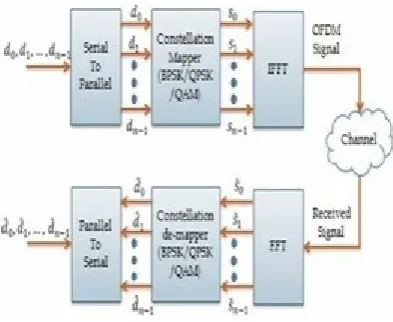
The Architecture of OFDM as shown below
Fig 1.General Architecture of OFDM (Viswanathan)
In this section, we are describing OFDM system the output of the Baseband modulation is data symbols a complex valued term with in-phase and Quadrature-phase components (Viswanathan)
𝑥[𝑛] = 𝑋𝑘𝑒−𝑗 2𝜋𝑘 ∆𝑓 𝑁 𝐼𝐹𝐹𝑇
2
−𝑁 𝐼𝐹𝐹𝑇2
…(2.1) Where 𝑁𝐼𝐹𝐹𝑇 is the size of IFFT and Δ𝑓 is the
subcarrier spacing in Hz .The transmitted signal is influenced by the channel that can be displayed as [𝑛] and the output of the channel represented by
𝑌[𝑛] = [𝑛]𝑥[𝑛] + 𝑤[𝑛] … (2.2)
Where 𝑤[𝑛] is Additive White Gaussian Noise
AWGN at time constant 𝑛.
III. SYSTEM IMPLEMENTATION USING BPSK
Available online: https://edupediapublications.org/journals/index.php/IJR/ P a g e | 2387
𝐵𝐸𝑅𝑚𝑝𝑠𝑘
= 2
𝑚𝑎𝑥 𝑙𝑜𝑔2𝑀, 2
𝑄 2𝐸𝑏𝑙𝑜𝑔2𝑀 𝑁0
𝑠𝑖𝑛 2𝑘 − 1 𝜋
𝑀
𝑚𝑎𝑥 𝑀4,1
𝑘=1
…… (3.1) For BPSK modulation, parameter M=2
𝐵𝐸𝑅𝐵𝑃𝑆𝐾 = 𝑄 2𝐸𝑏
𝑁0
𝐵𝐸𝑅𝐵𝑃𝑆𝐾 ,𝐴𝑊𝐺𝑁 =
1
2𝑒𝑟𝑓𝑐
𝐸𝑏 𝑁0
𝑃𝑏= 1
2 1 +
𝑠𝑛𝑟
1+𝑠𝑛𝑟 ………. (3.2)
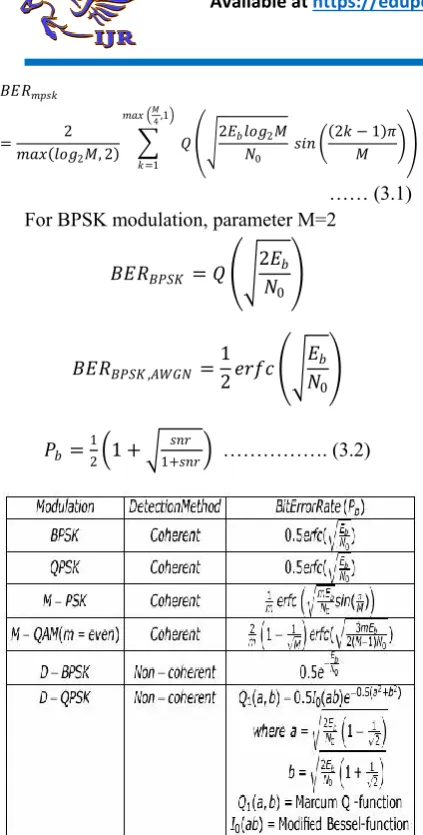
Fig 2 Bit Error Rate for various modulation techniques (Viswanathan)
IV.
Simulation Results
Fig 3.Behavior of OFDM system under fading channel due to distortion
In Fig 3 presents rapid fluctuation of signal due to channel noise and other environmental conditions
Fig 4.Effect of non-linearity due to power amplifier results spectral lifts
Available online: https://edupediapublications.org/journals/index.php/IJR/ P a g e | 2388 Fig 6.Behavior of OFDM under flat fading Rayleigh
channel
Fig 7. Rician fading channel for different values of K-factor
In Fig 7, presents the range of values of K-factor for Rician which can be model the channel condition varies from 𝐾 = ∞ to 𝐾 = 0 . So, the Rician distribution can be used to model the fading scenarios when there is LOS[14].
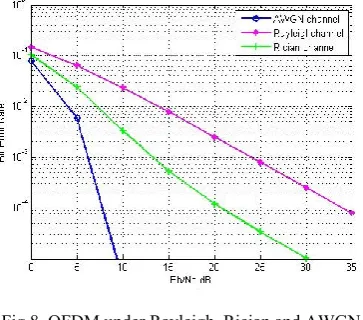
Fig 8. OFDM under Rayleigh, Rician and AWGN channel
Fig 9 .BER & SNR comparison of different modulation techniques
V.
CONCLUSION:
paper accentuated the Behavior of OFDM over AWGN, Rayleigh and Rician fading channel execution are assessed by plotting (SNR) under Bit error rate(BER) and execution correlation made for various modulation techniques. On the off chance that SNR enhanced then BER diminished and observed that Rician Channel performs superior to anything Rayleigh channel and poorer than AWGN. Rician distribution is often depicted in terms of a parameter K, as the parametric value „k‟ increased then the performance quality increased significantly.It can be seen in the Fig 7. In other words, the existence of direct path can reduce the levels of fading in wireless channels. In Fig 9 it is observed that Binary Phase Shift key is better modulation technique for long distance transmission, at the same time 16-QAM is a better choice for Short distance transmission which has the capability to transmit more bits per symbol, in compensation need to increase the acceptable signal to noise ratio.
Available online: https://edupediapublications.org/journals/index.php/IJR/ P a g e | 2389
the comparing measurable circulations (AWGN, Rayleigh, and Rician) an arrangement and utilization of significant parameters in wireless system, for various types of earthbound environment: rural, blended residential, and urban
Reference
[1] Schwartz, M. Information, Transmission, Modulation, and Noise. New York: Mc-Graw Hill.
[2] “Path Loss, Scattering Multipath Delay Statistics in Four European Cities For Digital Cellular and Micro cellular Radio telephone,”. (n.d.). IEEE Transactions on Vehicular Technology , 721–30.
[3] Amoroso, F. (n.d.). Investigation of Signal Variance, Bit Error Rates and Pulse Dispersion for DSPN Signalling in a Mobile Dense Scatterer Ray Tracing Model. Int’l Journal of SatelliteCommunications , 579–88.
[4] Andersen, J. B., Rappaport, T. S., Yoshida, S.,. (n.d.). “Propagation Measurements and Models for Wireless Communications Channels". IEEE Communications Magazine , 42– 49.
[5] Cox, D. C. (1984). 800 MHz Attenuation Measured in and around Suburban Houses. AT&T Bell Laboratory Technical Journal , 921–54.
[6] Empirical Formulae for PropagationLoss in Land Mobile Radio Services. (n.d.). IEEE Trans. on Vehicular Technology , 317–25.
[7] Greenwood. (1994). “Characterization of Mobile Radio Channels,”. In MobileRadio Communications. London: Pentech Press.
[8] Lee, W. C. (1986). Elements of Cellular Mobile Radio Systems. IEEE Transactions on VehicularTechnology , 48–56.
[9] Okumura, Y., et. al.,. (1968). Field Strength and its Variability in VHF and UHF Land Mobile Radio Service.
[10] Proakis, J. G. Digital Communications. New York: McGraw–Hill.
[11] Rao.K.D. (2015). Channel Coding Techniques for Wireless Communications. In
Rao.K.D, Channel Coding Techniques for Wireless Communications (p. 23). http://www.springer.com/978-81-322-2291-0.
[12] Rappaport. (1996). In Wireless Communications. New Jersey: Prentice Hall.
[13] Schilling, D. L. (2001). “Broadband CDMA forPersonal Communications Systems,”. IEEE Communications Magazine , 86–93.
[14] Viswanathan, M. (n.d.). gaussian waves. Retrieved from www.gaussianwaves.com: https://www.gaussianwaves.com/2011/06/introduc tion-to-ofdm-orthogonal-frequency-division-multiplexing-part-3/
About Supervisor :