Vol.8 (2018) No. 3
ISSN: 2088-5334
Conversion of Polypropylene Plastic Waste Into Liquid Fuel with
Catalytic Cracking Process Using Al2O3 as Catalyst
Devi Rachmadena, Muhammad Faizal, Muhammad Said
Chemical Engineering Department, Faculty of Engineering, Sriwijaya University, Palembang 30139, Indonesia E-mail: [email protected], [email protected]
Abstract– Approximately 129 million tons of plastic are produced each year, and from that amount, almost entirely produced from
petroleum, while the needs on fuel oil (BBM) is continuously increasing, leading to the depletion of oil and gas reserves. However, besides the problem of raw materials derived from petroleum, the use of conventional plastic as packaging material facing various environmental problems, such as cannot be recycled and cannot be degraded naturally by the environment, causing a pile of plastic waste that causes environmental pollution. Thus, it is crucial to find a solution that can solve both problems. One method of processing plastic waste is to convert it into hydrocarbon fuels. Conversion of plastic waste can be done with the catalytic cracking process which is often used because it utilizes a catalyst to reduce the high temperatures used in the thermal cracking process and save on energy consumption. In this research, the raw material that was used was polypropylene in the form of mineral water cups, and the catalyst used was Al2O3. The purpose of this research was to observe the effect of the cracking process’ length of time, catalyst weight (% catalyst) and range of temperature towards the mass, characteristics, and composition of the product. The length of the cracking time was varied into 20, 40 and 60 minutes, while the % catalyst was varied into 4%, 6%, and 8%, and the operating temperature was varied into 150, 200, 300 and 350oC. From the research, the highest mass of liquid product was obtained at the variation of 350oC, 4% of catalyst for 60 minutes, with the value of 87.3 gr, with a total yield of 17.5%. While the characteristics were 0.762 gr/mL for density, 0.778 for Spgr and 50.4 for oAPI Gravity. As for the other products from different variations had lower mass and yield of liquid, but the characteristics were still in gasoline range’s characteristics. Two samples were analyzed by its composition, and although showed the different value of percentage, both also showed that the liquid product was included into gasoline range (C5-C12).
Keywords– plastic waste; polypropylene; catalytic cracking process; Al2O3 catalyst
I. INTRODUCTION
Community needs on fuel oil (BBM) which is derived from fossil fuels continually increasing. It leads to the depletion of oil and gas reserves. World oil reserves at the end of 2014 amounted to 1700.1 billion barrels, while Indonesia only has proven oil reserves of 3.7 billion barrels and the number is only 0.2% of the total oil reserves in the world [1]. Total oil production of 852 thousand barrels/day by consumption of 1.641 million barrels/day. From the above data, it can be seen that there is a gap between production and consumption [2].
Today, approximately 129 million tons of plastic are produced each year, and from that amount, almost entirely produced from petroleum. To produce the required amount of plastic, it needs approximately 12 million barrel of petroleum per year. This amount reaches 8% of the total oil produced [3]. Plastics are macromolecules, formed by polymerization and have the ability to be shaped by the application of the reasonable amount of heat and pressure or some other form of force [4]. Thus, humanity has to rely on
the alternate/renewable energy sources like biomass, hydropower, geothermal energy, wind energy, solar energy, nuclear energy and others. Waste plastic to liquid fuel is also an alternate energy source path, which can contribute to depletion of fossil fuel as in this process liquid. Fuel with similar properties as that of petrol fuels is obtained [5].
can increase greenhouse gas emissions and contribute to global warming.
One method of processing plastic waste that remains is to convert plastic waste into hydrocarbon fuels. This is because the plastic raw materials derived from petroleum derivatives so that it can be returned to hydrocarbons as necessary fuel. Conversion of plastic waste can be done with the cracking process, namely the termination of the reaction the C – C of the carbon chain length and weight of large molecules into short carbon chain with a small molecular weight [7]. Catalytic Cracking is a cracking method which is often used because it utilizes a catalyst to reduce the high temperatures used in the thermal cracking process and save on energy consumption. In the catalytic cracking process, the catalyst used is a solid catalyst (heterogeneous) [2].
The types of plastic that are most widely used is polypropylene (PP) and polyethylene terephthalate (PET/HDPE). Polypropylene (PP) is a thermoplastic polymer that is made by the chemical industry and is used in the various application, such as plastic bags, plastic cups, buckets, and bottles. Polypropylene is more heat resistant, hard, flexible and translucent. Polypropylene can undergo chain degradation when exposed to ultra-violet radiation from the sun. PP and PET plastic types are usually encountered in a glass and a bottle of mineral water [3].
Many substances can be used as a catalyst, and one of them is Aluminum Oxide (Al2O3). Aluminum Oxide has advantages such as its thermal, chemical and physical properties when compared with several ceramic materials. Chemical and thermal stability, relatively good strength, thermal and electrical insulation characteristics combined with availability in abundance have made Aluminum Oxide attractive for engineering applications, and also it has relatively low cost than any other type of catalysts. Another useful property of the material is its high melting point, which is above 2000oC and very suitable for this kind of process (cracking) which needs a relatively high temperature. Those were the reasons for doing this research, where PP was used as a raw material which underwent the catalytic cracking process using an Al2O3 catalyst.
The variable used in this research was cracking process’ length of time, catalyst weight (% catalyst) and range of temperature towards the mass and characteristics of the product, and also the composition of the fuel oil product. The purpose of this research was to study the effect of catalyst percentage and the cracking process’ length of time towards the mass and characteristics of the product and also to produce fuel oil product which has a similar composition with gasoline and analyzed using Gas Chromatography-Mass Spectrometry (GC-MS). As for the benefit of this research were to provide benefits regarding producing a type of fuel oil that can be used as petroleum substitute, resolve the fossil fuel energy crisis and enhance the environment’s quality by decreasing the amount of plastic waste that has been a considerable concern because of its undegradable characteristics. The table below explained the Comparison of Gasoline From Waste Plastics With Regular Gasoline:
TABLE I
COMPARISON OF GASOLINE FROM WASTE PLASTICS WITH REGULAR GASOLINE
No Specifications Regular Gasoline
Gasoline from Plastic Wastes
1
Density at 15oC
(g/mL) 0.71-0.77 0.7453
2
Specific gravity at
15oC 0.7528 0.7365
3
Gross calorific
value 11210 11262
4 Net calorif value 10460 10498
5 API Gravity 50.46 60.65
6 Pour point < -20oC < -20oC
7 Cloud point < -20oC < -20oC
8 Octane Rating 83 95
9 Mileage 44.4 44.0
10
Time for 0 - 60
kph 22.5 sec 18.1 sec
11
Co % at 400
rmp/hc 2.8 3.5
12
Comments on
engine noise more less
II. MATERIAL AND METHOD
A. Time and Place of Research
This research was conducted from August 2016 until December 2016 at the Energy Laboratory State Polytechnic of Sriwijaya. Analysis of fuel oil’s characteristics will be conducted in the Gadjah Mada University’s Organic Laboratory.
B. Equipment and Materials
Equipment used in this research were Catalytic Cracking Unit, Beaker Glass, Analytical Scale, measurement glass, measurement pipette, spatula, scissors, pycnometer, Gas Chromatography-Mass Spectrometry, furnace, and crucible. As for the material used were Polypropylene (PP) type of plastics in the form of mineral water cups and Aluminum Oxide (Al2O3). Initial raw materials (PP) were collected from Plastic’s Recycle place in Plaju, while the Al2O3 catalyst is supplied by PT Bratachem with purity of ≥ 99%.
C. Research Procedure
Fig. 1 Flowchart Diagram of Polypropylene Conversion Process into Fuel
III.RESULTS AND DISCUSSIONS
A. The product of Catalytic Cracking Process
The products obtained were in the form of liquid, gas and solid. For all of those variations, the mass of the products can be seen in the table below.
All of the products then being analyzed by their characteristics, which lead to the selection of one product that had the closest value to gasoline’s characteristic. The characteristic analysis of the products can be seen in table 3.
TABLE III
MASS OF PRODUCT FROM POLYPROPYLENE’S CATALYTIC CRACKING PROCESS
TABLE IIIII
CHEMICAL PROPERTIES OF PRODUCTS
% Catalyst
Operating Temperature
(oC)
Length of Cracking Time (minute)
Analyzed Parameters
Density (gr/mL)
Spgr oAPI Gravity
Standard Characteristics of Gasoline 0,71-0,77
0,7528 50,46
- 250
20 40 60
0.725 0.734 0.753
0.739 0.749 0.768
59.8 57.4 52.7 4
6 8
250 20
0.761 0.767 0.744
0.777 0.783 0.759
50.6 49.3 54.9 4
6 8
250 40
0.762 0.751 0.767
0.777 0.766 0.783
50.5 53.1 49.2
4 6 8
250 60
0.762 0.753 0.760
0.778 0.769 0.776
50.4 52,5 50.9
The purpose of this research was to obtain a liquid product that has similar characteristics with gasoline so that it can be used as gasoline’s substitute to help the energy crisis issues. Three essential characteristics of gasoline were density, Spgr, and oAPI gravity, because they define a specific type of a substance. Just like density which describes that every substance has its value of density no matter how much the volume or the mass is, the density value will be still the same; any other characteristics also have a special relation to the quality of the fuel. The density range for gasoline was 0.71-0.77 g/mL, as for spgr was 0.7528 and 50.46 for oAPI gravity. From table 19, it can be seen that for each time of variation, the best characteristics were 4% of catalyst for all time variation (20, 40 and 60 minutes). However, from all three of them, a variation which
% Catalyst
Operating Temperature
(oC)
Length of Cracking Time (minute)
Liquid (g)
Gas (g)
Solid (g)
20
40
60
28.7 335.8 135.5
- 250 31.2 338.6 130.2
34.1 343.6 122.3
4
20
51.4 338.7 109.9
6 250 43.1 336.7 120.2
8 32.5 336.0 131.5
4
40
66.2 333.7 100.1
6 250 51.3 338.4 110.3
8 36.3 337.6 126.1
4 72.8 333.0 94.2
6 250 60 59.3 337.4 103.3
8 38.7 335.6 125.7
4 150
60 54.9 337.8 107.3
4 200 65.5 332.6 101.9
4 300 73.0 335.7 92.8
4 350 87.3 333.8 78.9
Activation of Al2O3
catalyst by calcinating it at
temperature of 300oC for 3 hours
Polypropylene in the form of mineral
water cups
Size reduction
500 g of little pieces Polypropylene
Al2O3 with
percentage of 4%, 6% and 8%
Mixed and then enters the reactor at temperature of 250oC with 3 different time
of process (20, 40 and 60 minutes)
The fuel oil produced will be collected and kept for further analysis using Gas Chromatography-Mass Spectrometry
(GC-MS) Fuel oil
produced the best characteristics was a variation of 60 minutes time of cracking process and 4% of the catalyst. From that result, then this variation was further used to be varied by the operating temperature, which was 150, 200, 300 and 350oC. The characteristics of the product from the process using a different range of temperature can be seen in table 4.
TABLE IVV
CHEMICAL PROPERTIES OF PRODUCT USING DIFFERENT RANGES OF TEMPERATURE
B. Conversion and Yield Percentage of Product
From the product’s mass data, the conversion and yield percentage can be calculated. The calculation result can be seen in table 5 below.
TABLE V
PERCENTAGE OF CONVERSION AND YIELD OF PRODUCTS
% Cata
lyst
Operating
Temp (oC) Length of Cracking Time (minute)
% Conv.
% Yield
Liquid Solid Gas
- 250
20 40 60 72.9 73.9 75.5 5.7 6.2 6.8 27.1 26.0 24.5 67.1 67.7 68.7 4 6 8
250 20
78.0 75.9 73.7 10.3 8.6 6.5 21.9 24.0 26.3 67.7 67.3 67.2 4 6 8
250 40
79.9 77.9 74.8 13.2 10.3 7.3 20.0 22.1 25.2 66.7 67.6 67.5 4 6 8
250 60
81.2 79.3 74.9 14.6 11.9 7.7 18.8 20.7 25.1 66.6 67.5 67.1 4 4 4 4 150 200 300 350 60 78.5 79.6 81.4 84.2 10.9 13.1 14.8 17.5 21.5 20.4 15.8 18.6 67.6 66.5 66.7 66.8
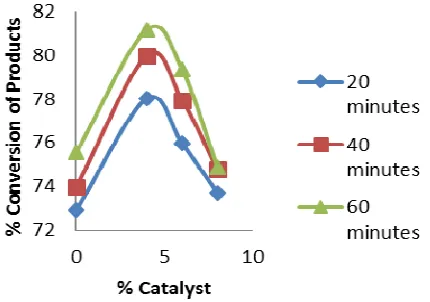
From the data above, it can be seen that for operating temperature of 250oC without a catalyst, the highest conversion was at 60 minutes time of cracking process, as much as 75.5%. As for the other variation using the same operating temperature of 250oC with different percentage of catalyst, it can be concluded that the conversion percentage of products were rising as long as the length of the cracking time, so in this case, 60 minutes were the best time of cracking process. For a variation of 4% catalyst, the conversion percentage reached the highest value of 81.2%, while when using 6% catalyst, the product’s conversion reached 79.3% of value and the last variation of 8% catalyst got the highest conversion of 74.9% of value. The
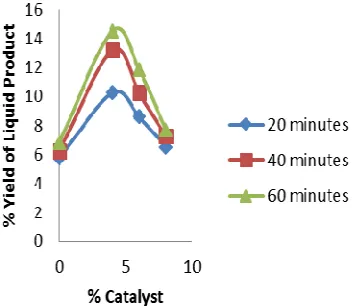
experiments using different ranges of temperature obtained the highest value of product’s conversion as much as 84.2% at a temperature of 350oC. So was the yield percentage of the liquid product. The primary focus of this research was to obtain a liquid product that can be used as gasoline’s substitute, so it was important to narrow the discussion around the liquid product but without ignoring the other products (gas) and residue (solid) because all of them were related. The highest yield of liquid for without catalyst process was 6.8%, and for 4% catalyst, it was obtained as much as 14.6% of the liquid product. As for variations of 6% and 8% of catalyst decreased respectively, as much as 11.9% and 7.7%. At the range temperature of 350oC, using 4% catalyst for 60 minutes, it reached the highest value of 17.5%.
C. The Effect of Length of Cracking Time and Percentage of Catalyst Towards Conversion Percentage of Products
The effect of the length of cracking time and percentage of catalyst towards the conversion percentage of products can be seen in the chart below.
Fig. 2 Effect of The Length of Cracking Time and % Catalyst Towards % Conversion of Product
From Fig. 2, it can be seen that the effect of cracking time towards conversion percentage of products was increasing the value of the conversion. If the time of cracking process was longer, then the conversion percentage was higher also. Reference [9] stated that the longer the reactant was reacted, the product that was produced was higher also, that was because the reactant would be cracked entirely along with the increasing of time. So, 60 minutes was the best time for cracking process of polypropylene, because the longer the process was going, the more significant part of the raw material that was converted into product. While for the effect of catalyst, it can be seen that cracking process without catalyst had the lowest value of the conversion. It was because cracking process without catalyst presence was called as thermal cracking (thermal pyrolysis) and the thermal pyrolysis requires high temperatures, which often results in products with low quality.
This method can be improved by the addition of catalysts, which will reduce the temperature and reaction time and allow the production of hydrocarbons with a higher added value. On the other hand, the catalyzed pyrolysis promotes these decomposition reactions at lower temperatures and shorter times, because of the presence of catalysts that assist Length of Cracking Time (minute) Operating Temperature
(oC)
% Catalyst
Analyzed Parameters
Density (gr/mL)
in the process. Thus, the catalytic pyrolysis presents some advantages over thermal, such as lower energy consumption and product formation with a narrower distribution of the number of carbon atoms, which may be directed to aromatic hydrocarbons with light and high market value [10].
It was proved in this experiment, where the product’s conversion was higher in the presence of a catalyst, compared to the one which used no catalyst. However, it also can be seen that 4% catalyst variation reached the highest conversion of product. Theoretically, the catalyst can enhance the cracking reaction of the pyrolysis gas, but when the amount of catalyst was too much, the presence of catalyst could reduce the liquid fraction and increased the gaseous fraction [11], while the purpose of this research was to obtain a liquid fuel. An experiment using Polypropylene with Activated Carbon catalyst also revealed that using too much catalyst could make the product distribution almost like a process without using catalyst, especially on a higher temperature [12],. That is why, in the chart, it can be seen that product conversion from cracking process using 6 and 8% of catalyst kept decreasing. So the maximum percentage of Al2O3 for the catalytic cracking process using Polypropylene as a raw material was 4%.
Furthermore, the effect of cracking time and percentage of catalyst towards the yield percentage of liquid product showed the same pattern with the conversion percentage of product, because surely they were all related, where the higher liquid product was produced, the conversion percentage will be higher also. The effect of cracking time and catalyst percentage towards liquid product’s yield percentage can be seen in figure 3.
Fig. 3 Effect of The Length of Cracking Time and % Catalyst Towards % Yield of Liquid Product
From Fig. 3, it can be seen that yield of liquid product kept increasing along with the increasing of time, showed that the increase of time had a linear relationship towards the liquid product’s yield caused by the more prominent part of the raw material that was cracked. As for the effect of catalyst, Anggoro (2008) in Reference [9] stated that the higher the catalyst percentage was, the yield of proda cut will be higher also, but in an absolute limit, it will decrease eventually. This was because not all the pores in the catalyst were used to decompose plastic’s molecules into a simpler compound. Thus, in this experiment, the best selection for the time of cracking process and percentage of the catalyst
using Polypropylene as raw material and Al2O3 catalyst was 60 minutes of the process using 4% of catalyst addition.
D. Effect of Temperature Towards Conversion and Yield Percentage of Products
There were some reasons for selecting the temperature of 250oC for the first nine trials of this cracking process experiment. Pyrolysis, cracking or devolatilization was a material fractionation process by temperature [13]. Pyrolysis process was started at around 230oC of temperature when the components were stabilized thermally, and volatile matters of the plastic waste will be broken down and vaporize together with the other components. For Polypropylene, Reference [14] researched thermal cracking using Polypropylene (without the presence of a catalyst), and the process’ temperature was 500oC. While Reference [12] started the experiment at a temperature of 200oC, then varied into 250oC where the results showed an increasing value of the liquid product, also using Polypropylene as the raw material and activated carbon as a catalyst, which the presence of catalyst tend to lower the temperature of the process. That is why the temperature of 250oC was selected as a fixed variable because it was slightly more than the initially started temperature of pyrolysis process and temperature where the yield of the product started to increase in Reference [12] experiment. It can be seen that how much product that can be produced in temperature of 250oC with other moving variable such as time of cracking and percentage of the catalyst.
After using 250oC as fixed variables with other moving variables obtained the best product, it was again varied by the temperature, because in some researches, it was said that for Polypropylene, the temperature at more than 250oC could increase the yield of liquid product. However, in this experiment, two lower temperature than 250oC was also used, to see their effect on the production of liquid fuel. So the experiment was held using variant temperature of 150, 200, 300 and 350oC, with fixed variable of 60 minutes cracking time and 4% of the catalyst. The effect of temperature towards conversion and yield of liquid product percentage was shown in Fig. 4 and Fig. 5.
Fig. 5 Effect of Various Temperature Towards % Yield of Liquid Products
Fig. 4 and Fig. 5 showed that those two charts had the same trend, where the higher the temperature of the process was, the conversion and yield percentage of the product were higher also. It also can be seen that at a temperature of 350oC, the conversion and yield of the liquid product had not seemed to decrease, which showed that 350oC was not the temperature limit of the process. Discussing the limit of the process’ temperature, some researches showed different trends.
Reference [15] who was using Polypropylene with Ni-Mo/ZA catalyst varied the temperature of the process into 350, 400 and 450oC, and the results showed that at a temperature of 400oC, the yield of product was increased and then decreased at a temperature of 450oC. Setiadi and Fitria (2006) in Wulandari (2015), stated that temperature had an essential effect towards the reaction rate of cracking process. Thermodynamically, the chemical balance will be achieved faster at high temperature, while in kinetics, the reaction rate will increase along with the increasing of temperature. However, when the reaction temperature was increased beyond its optimum temperature, the decreasing of product’s conversion percentage will occur (liquid product), and the gas production will increase.
In the other hand, Reference [3] did a research using Polypropylene and NiO/ɣ-Al2O3 with temperature variation of 400, 450 and 500oC concluded that the highest yield of product was obtained at temperature of 500oC, but Reference [16], using PETE as raw material and pure Al2O3 catalyst showed that the range of temperature of 200-400oC with maximum yield of product was reached at temperature of 400oC. The process’ temperature of cracking process using Polypropylene and Al2O3 catalyst can be higher than 350oC, but it can not be done in this research due to the compatibility of the equipment (catalytic cracking unit). However, still, using 350oC as temperature obtained a respectively good conversion and yield of product, which also the best among all of the variations in this research.
A. Product’s Composition of Polypropylene’s Catalytic Cracking Process
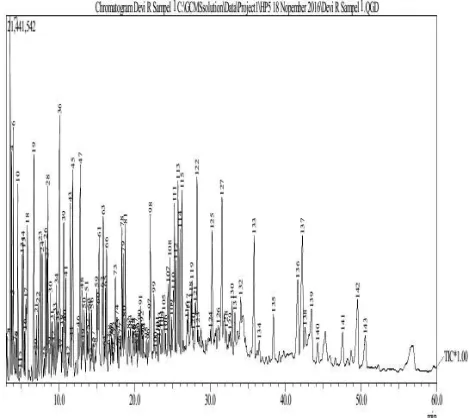
The composition of the product was related to the quality of the product itself. The primary purpose of this research was to obtain a liquid product that had similar characteristics with gasoline. The determination of this composition was done by using the GC-MS instrument. The liquid product has been classified into three groups i.e, the gasoline fraction ( C5 – C12), diesel fuel fraction (C13 – C20) and heavy oil (>C20). From 2 samples, one sample was product that had the highest liquid yield and the best characteristics, which was from catalytic cracking process with variation of 60 minutes of cracking time, 350oC of temperature and 4% catalyst addition, while the second sample was product that had the lowest liquid yield with lower quality of characteristics. The result of the best liquid product’s GC-MS analysis could be seen in Fig. 6, while the other can be seen in Fig. 7.
Fig. 6 GC-MS Analysis of Liquid Product with Variation of 350oC, 4% of Catalyst and 60 minutes of Cracking Time
Fig. 7 GC-MS Analysis of Liquid Product with Variation of 250oC, 8% of Catalyst and 20 minutes of Cracking Time
range (C5-C12) and only slightest amount of other compounds, and also a little amount of diesel range (C13-C20). This is due to high temperature that was used in the process, which optimized the cracking process of the raw material, resulting in the high products of gasoline.
IV.CONCLUSIONS
Polypropylene plastic wastes conversion to liquid fuel oil by a catalytic cracking process using Al2O3 catalyst experiment is intended to find the optimum condition for producing a liquid product which has similar characteristics to gasoline. There are some factors to be considered to achieve that goal; among them are the length of cracking time, catalyst addition and optimum operating condition.
From the experiment conducted, it can be concluded that: The variation of cracking time, catalyst percentage and operating temperature influence the yield of a liquid product as the primary purpose of research. The optimum conditions for catalytic cracking of polypropylene with Al2O3 catalyst are at 60 minutes of the process, the temperature of 350oC with 4% catalyst addition, which produced 17,5% yield of liquid product. The highest percent composition of gasoline range (C5-C12) was 80.93% respectively at a temperature of 350oC
REFERENCES
[1] Dudley, Bob. 2015. BP Statistical Review of World Energy, A Review, 64th Edition.
[2] Wahyudi, Ekky, Zultiniar, and Edy Saputra, “Pengolahan Sampah Plastik Polypropylene (PP) Menjadi Bahan Bakar Minyak dengan Metode Perengkahan Katalitik Menggunakan Katalis Sintetis,” Jurnal Rekayasa Kimia dan Lingkungan Vol. 11, No.1, pp. 17 - 23, June. 2016.
[3] Nugraha, Mahendra Fajri, Arifuddin Wahyudi and Ignatius Gunardi, “Pembuatan Fuel Dari Liquid Hasil Pyrolisis Plastik Polipropilen Melalui Proses Reforming Dengan Katalis Nio/Γ-Al2O3,” Jurusan Teknik Kimia, Fakultas Teknologi Industri, Institut Teknologi Sepuluh Nopember (ITS). Surabaya. 2013.
[4] Das, Sarthak and Saurabh Pandey, “Pyrolysis And Catalytic Cracking of Municipal Plastic Waste For Recovery of Gasoline Range Hydrocarbons. Department of Chemical Engineering National Institute Of Technology. Rourkela. 2007.
[5] Gaurav, Madhukar M, Arunkumar K.N., N. S. Lingegowda, “Conversion of LDPE Plastic Waste Into Liquid Fuel By Thermal Degradation,” International Journal of Mechanical And Production Engineering, ISSN: 2320-2092, Volume 2, Issue 4. 2014.
[6] Badan Pengelolaan Lingkungan Hidup Daerah (BPLHD). 2014. Data Sampah Plastik Indonesia. Indonesia.
[7] Sibarani, Kezia Landia, “Preparasi, Karakterisasi, dan Uji Aktifitas Katalis Ni-Cr/ Zeolite Alam Pada Proses Perengkahan Limbah Plastik Menjadi Fraksi Bensin,” Fakultas Matematika dan Ilmu Pengetahuan Alam Program Studi Teknik Kimia Universitas Indonesia. Depok. 2012.
[8] Raja, Antony and Advaith Murali, “Conversion of Plastic Wastes Into Fuels,” Journal of Materials Science and Engineering, Formerly part of Journal of Materials Science and Engineering, ISSN 1934-8959, pp. 86-89. 2010.
[9] Miskah, Siti, Niken Puteri Gumay, and Ovia Yuliani, “Pengolahan Limbah Plastik Menjadi Bahan Bakar Cair Dengan Proses Catalytic Cracking,” Program Studi Teknik Kimia Fakultas Teknik Universitas Sriwijaya. Palembang, Indonesia. 2013.
[10] Almeida, Débora, and Maria de Fátima Marques, “Thermal and Catalytic Pyrolysis of Plastic Waste,” Polimeros, vol. 26, no. 1, March. 2016.
[11] Syamsiro, Mochamad, et al., “Fuel Oil Production from Municipal Plastic Wastes in Sequential Pyrolysis and Catalytic Reforming Reactors,” in Conference and Exhibition Indonesia Renewable Energy & Energy Conservation, Energy Procedia 47, 2014, p. 180 – 188.
[12] Nazif, Rio, Erlangga Wicaksana, and Halimatuddahliana, “Pengaruh Suhu Pyrolisis dan Jumlah Katalis Karbon Aktif Terhadap Yield dan Kualitas Bahan Bakar Cair Dari Limbah Plastik Jenis Polypropylene,” USU’s Chemical Engineering Journal, Vol. 5, No. 3, September. 2016.
[13] Ramadhan, Aprian dan Munawar Ali, “Pengolahan Sampah Plastik Menjadi Minyak Menggunakan Proses Pirolisis,” Progdi Teknik Lingkungan, Fakultas Teknik Sipil dan Perencanaan Universitas Pembangunan Nasional “Veteran.” Jawa Timur, Indonesia. 2012. [14] Sarker, Moinuddin, Mohammmad Mamunor Rashid, Muhammad
Sadikur Rahman andMohammed Molla, “Alternative Diesel Grade Fuel Transformed from Polypropylene (PP) Municipal Waste Plastic Using Thermal Cracking with Fractional Column Distillation,” Energy and Power Engineering, vol. 4, pp. 165-172, May. 2012. [15] Wulandari, Fika Hesti and Sri Wahyuni, “Konversi Katalitik
Polipropilen Menjadi Fraksi Bahan Bakar Cair Menggunakan Katalis Ni-Mo/ZA,” Indonesian Journal of Chemical Science, vol. 4, May. 2015.