Volume 52
Issue 2 2015 Article 2
6-1-2015
Delaware’s Familiarity
Delaware’s Familiarity
Brian J. Broughman
Darian M. Ibrahim
Follow this and additional works at: https://digital.sandiego.edu/sdlr
Part of the Business Organizations Law Commons
Recommended Citation Recommended Citation
Delaware’s Familiarity
BRIAN J. BROUGHMAN*
DARIAN M. IBRAHIM**
TABLE OF CONTENTS
I. INTRODUCTION ...274
II. THEORETICAL ASPECTS OF FAMILIARITY...277
A. Theory: Familiarity Versus Network Externalities ...278
B. Numeric Example: Familiarity Versus Network Externalities...281
C. Hypotheses...287
III. EMPIRICAL SUPPORT FOR FAMILIARITY ...290
A. Summary of Dataset...291
B. Results: State of Incorporation ...292
C. Results: Investor Familiarity and Network Externalities...294
1. Findings Related to Investor Familiarity...296
2. Findings Related to Network Externalities and Substantive Law Quality ...298
3. Lingua Franca or Signaling?...299
IV. IMPLICATIONS...300
A. Normative Implications of Delaware’s Familiarity: Positives...300
1. Lowering Transaction Costs of Financing...300
a. Reducing Legal Costs ...301
b. Menu-Based Contracting ...301
2. Reducing Asymmetric Information...302
* © 2015 Brian J. Broughman. Associate Dean for Research and Professor of Law, Indiana University Maurer School of Law.
** © 2015 Darian M. Ibrahim. Professor, William & Mary Law School. We thank Steven
M
workshops at USC, Willi helpful comments and suggestion
arkets Davidoff
Seminar a
, Jesse Fried t the Ohio am & , S Jo Mar tate s nathan . M y, Florid o Lips ritz Coll a on, State, e and p ge of and Ri L arti a c w, chm ip and ants
B. Normative Implications of Delaware’s Familiarity:
Negatives ... 303
1. Suboptimal Tipping ... 303
2. Path Dependence and Increased Switching Costs ... 304
C. How Other States Might Still Compete With Delaware ... 306
D. Even Without Effective State Competition, Will Delaware Law Become Suboptimal? ... 308
V. CONCLUSION ... 309
VI. APPENDIX: VARIABLE DEFINITIONS FOR TABLE 5 ... 311
I. INTRODUCTION
We all type on the “QWERTY” keyboard, even though it is inefficient.1 Microsoft advertises that its BING search engine is superior to Google in a side by side comparison,2 yet when the Authors, and probably our readers, do an Internet search, we use Google. Even closer to home for lawyers is when a form document includes a boilerplate provision. We rarely question or change it, we have seen the provision a hundred times and understand its consequences—so why fix what is not broken?
These examples and countless others illustrate the central theme in this Article—that sometimes a product, in our case a body of law, is chosen not necessarily for its superiority, but rather because we are familiar with it. There may be more efficient computer keyboards, search engines, and boilerplate provisions at hand; however, we like the tried and true methods—the ones we are familiar with. This is true in everyday life, and as we attempt to show in this Article, it is also true when corporations choose to be governed by one body of law over another, with potentially millions of dollars on the line.3
1. See generally Paul A. David, Clio and the Economics of QWERTY, 75 AM. ECON. REV. 332, 332–33 (1985) (discussing the development of the QWERTY typewriter
keyboard and the more efficient typewriter keyboards developed after it). See also Brett H. McDonnell, Getting Stuck Between Bottom and Top: State Competition for Corporate Charters in the Presence of Network Effects, 31 HOFSTRA L. REV. 681, 705 (2003) (citing Paul David’s work for the proposition that QWERTY was initially adopted precisely because it was slower, which helped early typewriters avoid jamming). But see S.J. Liebowitz & Stephen E. Margolis, The Fable of the Keys, 33 J.L. & ECON. 1, 2 (1990) (disputing the idea that QWERTY is inefficient).
2. Mike Nichols, Take the Bing It On Challenge!, BING BLOGS (Sept. 6, 2012), http://blogs.bing.com/search/2012/09/06/take-the-bing-it-on-challenge/ [http://perma.cc/D5 VN-XTX7].
One of the enduring topics of interest in corporate law is why the tiny state of Delaware dominates the market for incorporations, especially incorporations of the most powerful and profitable firms.4 The “internal affairs” rule allows corporations to choose which state’s law will govern their corporate affairs, whether or not the corporation has ties to that state.5 Voluminous literature on the topic largely credits Delaware’s dominance in attracting incorporations to factors relating to the inherent quality of its corporate law and the business expertise of its judges who hear corporate law disputes. Another strand of literature credits Delaware’s network effects. Either way, Delaware is no doubt winning the “race” for incorporations, long beating other states,6 and holding the federal government at bay as well.7
The cause and normative implications of Delaware’s success, however, are hotly debated. Under the “race-to-the-top” view, Delaware prevails because it provides a body of corporate law that maximizes shareholder value.8 In comparison, under the “race-to-the-bottom” view, Delaware dominates the market for corporate charters by offering laws that favor senior management and other insiders at shareholders’ expense.9 Both
4. Lucian Arye Bebchuk & Assaf Hamdani, Vigorous Race or Leisurely Walk: Reconsidering the Competition over Corporate Charters, 112 YALE L.J. 553, 578 (2002) (reporting that 58% of public companies are incorporated in Delaware); Lucian Arye Bebchuk & Alma Cohen, Firms’ Decisions Where To Incorporate, 46 J.L. & ECON. 383, 391 tbl.2 (2003).
5. ERIN A. O’HARA & LARRY E. RIBSTEIN, THE LAW MARKET 107 (2009). 6. See Mark J. Roe, Is Delaware’s Corporate Law Too Big to Fail?, 74 BROOK. L. REV. 75, 77 (2008) (“[T]he idea of the race [between states] being a strong one has worn thin in recent academic work.”).
7. See generally Mark J. Roe, Delaware’s Politics, 118 HARV. L. REV. 2491, 2494 (2005) [hereinafter Roe, Delaware’s Politics] (analyzing Delaware’s autonomy in structuring its corporate law with regards to potential federal intervention); Mark J. Roe, Delaware’s Competition, 117 HARV. L. REV. 588, 592 (2003) [hereinafter Roe, Delaware’s Competition] (arguing that any “race” is between Delaware and the federal government rather than Delaware and other states).
8. The classical race-to-the-top works include Ralph K. Winter, Jr., State Law, Shareholder Protection, and the Theory of the Corporation, 6 J. LEGAL STUD. 251, 254– 66 (1977); Roberta Romano, Law as a Product: Some Pieces of the Incorporation Puzzle, 1 J.L. ECON. & ORG. 225 (1985); FRANK H. EASTERBROOK & DANIEL R. FISCHEL, THE
ECONOMIC STRUCTURE OF CORPORATE LAW 212–27 (1991); and ROBERTA ROMANO, THE
GENIUS OF AMERICAN CORPORATE LAW 14–31 (1993).
9. The classical race-to-the-bottom works include William L. Cary, Federalism and Corporate Law: Reflections upon Delaware, 83 YALE L.J. 663, 663–68 (1974); Lucian Arye Bebchuk, Federalism and the Corporation: The Desirable Limits on State Competition in Corporate Law, 105 HARV. L. REV. 1435 (1992); Oren Bar-Gill et al., The
sides of the debate focus on the substantive features of Delaware corporate law, the difference being whether Delaware law is thought to benefit shareholders or benefit management at shareholders’ expense.
This Article is not another race-to-the-top versus race-to-the-bottom story. Instead, it demonstrates something new—while Delaware may have begun its ascent to the top of the corporate law hierarchy by offering more desirable law than its leading competitor,10 it stays there as much because it is familiar to business parties as for its substantive virtues.11 In this respect, we attempt to show Delaware’s resemblance to the aforementioned QWERTY keyboard, Google search engine, and form document’s boilerplate provision.
This Article builds on our prior empirical research showing that, everything else equal, start-up firms12 financed by out-of-state investors are more likely to incorporate in Delaware.13 We argue that this finding is due to out-of-state investors’ familiarity with Delaware corporate law, and relative lack of familiarity with the corporate law of the start-up’s
10. New Jersey led the state race for incorporations until 1913, when Woodrow Wilson (then New Jersey’s Governor) advocated the “Seven Sisters Act,” which prohibited corporations from owning stock in other corporations. These new restrictions in New Jersey’s corporate law—not found in Delaware’s corporate law—led to Delaware taking the lead in the incorporations race—a lead it has never relinquished. See Christopher Grandy, New Jersey Corporate Chartermongering, 1875–1929, 49 J. ECON. HIST. 677, 677–78 (1989) (recounting these historical events in New Jersey); McDonnell, supra note 1, at 727–32.
11. An important work related to our own is William J. Carney, George B. Shepherd & Joanna Shepherd Bailey, Lawyers, Ignorance, and the Dominance of Delaware Corporate Law, 2 HARV. BUS. L. REV. 123 (2012). Professors Carney, Shepherd & Bailey survey corporate attorneys regarding factors influencing choice of domicile and find that that lawyers believe one advantage of Delaware relative to their home state corporate law is that more investors across the country are familiar with Delaware than with their home-state corporate law. Id. at 137–38. Our contribution is consistent with their results, but in addition provides a theory to distinguish familiarity from network externalities, and reports empirical data showing that investor familiarity can influence choice of domicile. Id. at 677–78.
12. For a better idea of what we mean by “start-ups,” as opposed to so-called “lifestyle” small businesses, see Darian M. Ibrahim, The (Not So) Puzzling Behavior of Angel Investors, 61 VAND. L. REV. 1405, 1406 (2008) (noting start-ups are “high-risk, high-growth” companies funded by angel investors and venture capitalists).
home state. In the current project, we extend our prior research by (i) developing an informal model distinguishing investor familiarity from related economic theories of network effects and learning effects, (ii) showing that our data are more consistent with familiarity than with these alternative explanations, and (iii) discussing normative implications of the familiarity effect for corporate choice of domicile. Since our prior work was written primarily for economists, this Article publicizes our empirical findings to legal scholars and practitioners. In addition, the normative implications of our findings should be of great interest to scholars following the corporate federalism debate.
The remainder of the Article proceeds as follows. In Part II, the Article provides a theory for how investor familiarity impacts a private firm’s choice of domicile and uses a numeric example to distinguish familiarity from related economic theories of network effects and learning effects. Part III discusses the results of our prior study testing for a familiarity effect and recaps those findings, including new regression results showing familiarity’s role as a dominant explanation for Delaware’s dominance, contrasting familiarity’s effect with that of substantive law quality and network effects. Part IV explores normatively what our familiarity findings might mean for state competition and the overall quality of Delaware law. Part V offers a brief conclusion.
II. THEORETICAL ASPECTS OF FAMILIARITY
What does it mean to suggest that Delaware law is “familiar” to investors? We have already given some examples that attempt to illustrate familiarity’s role in decisions we all make on a day-to-day basis, for example, the QWERTY keyboard. Perhaps a closer analogy is the use of English as a common language, or lingua franca, in international business deals.14 For instance, if a party from Japan wants to contract with a party from France and neither speaks the other’s language, this could present a hurdle to closing the deal. It would at least increase the deal’s transaction costs as one party would have to hire a translator to help overcome the language barrier. However, the ability to settle on English as a language familiar to both parties, even though it is neither party’s native tongue, can
14. See Broughman, Fried & Ibrahim, supra note 13, at 866; John F. Coyle, Rethinking the Commercial Law Treaty, 45 GA. L. REV. 343, 366 (2011) (showing substantive treaties
overcome that hurdle and allow for the contract’s execution.15 English, being a universal language, serves as a lingua franca for the Japanese and French investors.16 As demonstrated in this Article, we believe that Delaware law serves the same lingua franca function for investors from different American states. Delaware is the universal language of corporate law.17
A. Theory: Familiarity Versus Network Externalities
Our theory of familiarity is straightforward. Business parties are familiar with a body of law if they have studied it and used it in the past. Familiarity relates to a party’s own knowledge and comfort with a particular body of law.
Familiarity with a particular body of law can impact contract negotiations by lowering transaction costs. For example, if an entrepreneur seeking external financing incorporates in a state that provides corporate law familiar to her prospective investors, this will make it easier for such investors to evaluate the terms of financing. By contrast, investors may be reluctant to negotiate a financing contract if they are unfamiliar with the relevant body of corporate law. If asked to do so, the investors are likely to demand a lower price for the firm’s shares (i) to protect them from potential opportunism18 or (ii) to compensate for the cost of learning
15. ANNA MAURANEN & ELINA RANTA, ENGLISH AS A LINGUA FRANCA: STUDIES AND FINDINGS, 1 (2009) (“English has established its position as the global lingua franca
beyond any doubt . . . .”); Coyle, supra note 14, at 367 (“There is no doubt that a substantive treaty is capable of serving as a common language to persons from different legal backgrounds.”); Tsedal Neeley, Global Business Speaks English: Why You Need Language Strategy Now, HARV. BUS. REV. 117, 117 (May 2012) (“Ready or not, English is now the global language of business.”).
16. Hyejin Ku & Asaf Zussman, Lingua Franca: The Role of English in International Trade, 75 J. ECON. BEHAV. & ORG. 250, 258–59 (2010); Julie M. Spanbauer & Katerina P. Lewinbuk, Embracing Diversity Through a Multicultural Approach to Legal Education, 1 CHARLOTTE L. REV. 223, 223 (2009) (“As a result of globalization, the English language is fast becoming ‘a global lingua franca.’). See also Coyle, supra note 14, at 367 (“It is possible, in other words, for the national law of a particular state to serve as a lingua franca that reduces transaction costs in transactions touching on multiple jurisdictions.”).
17. Robert Daines, The Incorporation Choices of IPO Firms, 77 N.Y.U. L. REV. 1559, 1581 (2002) (“Delaware is . . . much like a common language and such lawyers are ‘bilingual,’ speaking Delaware law plus the local dialect.”).
a new body of law.19 Everything else equal, by selecting a familiar body of corporate law an entrepreneur can lower her cost of capital.
Concepts related to familiarity in the economics literature need to be distinguished. For example, “network effects” and “learning effects,” collectively thought of as “network externalities,” can also enhance the value of a product beyond that product’s substantive merits.20 In our case the “product” is Delaware corporate law.21 Delaware law benefits from learning effects due to the sheer number of firms previously incorporated in Delaware and the body of law that has resulted.22 Delaware law also benefits from network effects because the more incorporations it attracts now and in the future, the more corporate law it will produce going forward. Like the telephone, the more that parties use Delaware corporate law, the more value it has.23
Network effects and learning effects are closely related, the difference being temporal.24 Learning effects focus on past use, while network effects focus on contemporaneous and future use.25 If we do attempt to parse them out, learning effects may be the easiest to see in the incorporations context. For decades, Delaware has attracted the majority of public incorporations and as a result had developed substantial legal precedent.26
19. See, e.g., Ola Bengtsson & Dan Bernhardt, Different Problem, Same Solution: Contract-Specialization in Venture Capital, 23 J. ECON. & MGMT. STRATEGY 396, 416 (2014). In many cases this cost may simply represent heightened legal fees. The investor’s lawyer will charge more to do legal work using an unfamiliar body of corporate law.
20. Michael Klausner, Corporations, Corporate Law, and Networks of Contracts, 81 VA. L. REV. 757, 763 (1995) (“When a product exhibits network externalities, the basic market model of microeconomics does not apply. That model, which links individual value-maximizing behavior with social optimality, does not take account of the interdependence in value that network externalities create.”).
21. Id. at 775 (noting that a body of law can be a product).
22. In another illustration of learning effects, Charles Goetz and Robert Scott have examined implied versus express contract terms. Because judicial precedents have incorporated implied terms into contracts over the years, future parties benefit from the learning effects of those terms. The parties, in fact, favor those implicit terms over terms that are explicit but less often used. Charles J. Goetz & Robert E. Scott, The Limits of Expanded Choice: An Analysis of the Interactions Between Express and Implied Contract Terms, 73 CAL. L. REV. 261, 289 (1985).
23. See Klausner, supra note 20, at 772 (noting that the telephone’s value as a product increases with each new user).
24. See Mark A. Lemley & David McGowan, Legal Implications of Network Economic Effects, 86 CALIF. L. REV. 479, 569 (1998).
25. See id.
For these reasons it is likely that investors have previous experience with Delaware corporate law. This predictability enhances Delaware’s attractiveness to business parties regardless of its substantive virtues.27 Simply knowing what the law is, and how to plan in accordance with that law, adds value above the content of that law.28
Network effects are perhaps less obvious. Michael Klausner observes that the “quality of a state’s future case law depends on the number and diversity of lawsuits brought before its courts. These factors in turn depend on the number of firms incorporated in a state.”29 Thus, it is not simply what Delaware has done in the past, but what it will continue to do in the future. Because a new firm knows that Delaware is where most firms incorporate, it expects “ex ante to benefit from judicial interpretations involving other firms, and from the development of legal expertise in the future.”30
By contrast, an explanation of a particular firm’s choice of domicile, our familiarity, or lingua franca, does not consider the total number of firms incorporated in Delaware, or even the total number of business parties familiar with Delaware law. Rather, our focus is only on the parties at the bargaining table. If a private firm is receiving financing from a group of investors who are unfamiliar with the firm’s home-state corporate law, but are familiar with Delaware law, then this firm will be relatively more likely to domicile in Delaware. The key issue is the relative familiarity of the parties at the bargaining table.
27. See, e.g., McDonnell, supra note 1, at 681, 686, 701.
28. Brett McDonnell believes that learning effects help Delaware but do not pose a substantial barrier to competing states. He observes that other states can promise to copy Delaware precedents wholesale, thus negating Delaware’s learning effects advantage. McDonnell, supra note 1, at 702 (“[S]tates can match the learning effects gained by a leading state’s case law by adopting wholesale the existing case law of that state.”). This is debatable, however, as other courts without Delaware’s expert judges might not get the copying right. For example, in Hilton Hotels Corp. v. ITT Corp., 978 F. Supp. 1342 (D. Nev. 1997), Nevada courts attempted to apply the Unocal standard of Delaware takeover law, and held that the target company did not have reasonable grounds for believing a threat to corporate policy existed. Id. at 1348 (citing Unocal Corp. v. Mesa Petroleum Co., 493 A.2d 946, 953, 955 (Del. 1985)) (but holding that “ITT has shown no real harm to corporate policy or effectiveness”). But that Unocal prong is almost always satisfied when Delaware courts hear a Unocal case. Robert B. Thompson & D. Gordon Smith, Toward a New Theory of the Shareholder Role: “Sacred Space” in Corporate Takeovers, 80 TEX. L. REV. 261, 293 n.160 (2001) (citing Hilton Hotels for the proposition that
“[i]nterestingly, courts outside Delaware that adopt the Unocal standards seem more inclined to take the first prong seriously”); Troy A. Paredes, The Firm and the Nature of Control: Toward a Theory of Takeover Law, 29 J. CORP. L. 103, 167 (2003) (“There is almost no meaningful judicial review under Unocal’s threat prong [in Delaware].”).
To be sure, the reason investors and their lawyers are familiar with Delaware law may be driven in large part by network and learning effects. To illustrate, a law school professor may choose to emphasize Delaware law in her corporations class not because of its inherent quality, but rather because so many firms are already incorporated there. Put another way, the professor wants her students to be able to take advantage of the positive network externalities associated with Delaware incorporation.31 Similarly, the fact that a large number of firms are already incorporated in Delaware increases the likelihood that that an investor or lawyer will gain familiarity with Delaware simply through practice.32 In this respect, familiarity is at least to some extent derivative of learning and network effects.33 In the current project, we do not address why Delaware became the lingua franca for corporate law. Rather, our claim here is that widespread investor and lawyer familiarity with Delaware law has an independent effect on choice of domicile apart from any network benefits associated with Delaware incorporation.
The following numeric example illustrates the impact of investor familiarity on choice of domicile. We use this example to clarify our distinction between investor familiarity and network and learning effects.
B. Numeric Example: Familiarity Versus Network Externalities
Consider an entrepreneur seeking external financing for a new business (Startup) located in Virginia. Startup will be structured as a corporate entity. To attract financing, Startup must provide terms, including state of domicile, acceptable to an investor. Consistent with numerous empirical studies, we assume that Startup will incorporate either in its home state of Virginia or in Delaware.34
Indeed, Startup’s choice of domicile can be understood as a term in the financing contract. Investors sometimes explicitly bargain over legal domicile by including it in the financing term sheet negotiated with the
31. See id. at 840, 851.
32. See McDonnell, supra note 1, at 704; Broughman, Ibrahim & Fried, supra note 13, at 866–67.
33. See Broughman, Fried & Ibrahim, supra note 13, at 867.
entrepreneur,35 or by requesting that the firm reincorporate to a jurisdiction that is more acceptable to the investor.36 Even if domicile is not explicitly bargained over, perhaps because the entrepreneur incorporated the business prior to financing, the entrepreneur is likely to consider the interests of prospective investors when choosing where to incorporate.
Since it arises out of a voluntary contract, the parties have an incentive to choose the body of corporate law which provides the greatest net benefit to all contracting parties.37 Proponents of the race-to-the-top view may argue this “contractarian” understanding of choice of domicile reinforces the view that Delaware’s success is due to the high quality of its substantive law.38 Everything else equal, we agree the higher quality corporate law is more likely to be selected. It should be noted, however, that the “net benefit” of a given body of corporate law is not based solely on the quality of the substantive law, but also includes other factors such as: (i) the franchise tax charged by the state, (ii) the investors’ relative familiarity with the law, and (iii) network externalities created by other firms domiciling in the state.39
Putting this altogether suggests the entrepreneur and prospective investors will select the body of corporate law that maximizes the following equation:
Net benefit = law quality – franchise tax – unfamiliarity cost + network ext. + ε
“Unfamiliarity cost” represents the aggregate cost for all contract parties, including investors, to adequately inform themselves regarding the relevant state’s corporate law. If parties are already familiar with the state’s corporate law, then unfamiliarity cost equals zero. “Network externalities” represents various benefits that arise based on the number of other firms incorporated in the state. The term “ε” is a random error term that is meant to capture idiosyncratic reasons parties sometimes choose one state over another. This error term effectively transforms the above equation into a predicted likelihood that Delaware, as opposed to the home
35. To illustrate, the state of incorporation is one of the first terms listed in the National Venture Capital Association (NVCA) model term sheet. Model Legal Documents, Term Sheet, NAT’L VENTURE CAPITAL ASS’N, http://nvca.org/resources/model-legal documents/ [http://perma.cc/WJ4M-Y393] (last visited May 20, 2015).
36. Reincorporation is fairly inexpensive for a small, private firm. It is more costly for larger businesses and for firms that have already gone public. See, e.g., Bernard S. Black, Is Corporate Law Trivial? A Political and Economic Analysis, 84 NW. U. L. REV. 542, 558, 586–87 (1990).
37. See Klausner, supra note 20, at 758.
38. See Winter, supra note 8, at 256, 290; Romano, Law as a Product, supra note 8, at 279–81.
state, will be selected as the state of incorporation. Thus, even if all defined terms in the above equation suggest that Delaware will provide higher net benefit for a particular firm, the error term implies that there is still some chance that the firm may nonetheless domicile in its home state.
To give some content to unfamiliarity cost, we make three foundational assumptions. First, we assume each investor is familiar, either directly or through their legal counsel,40 with the investor’s home-state corporate law. Given the prevalence of home-state incorporation for small businesses,41 local investors and their legal counsel will likely have at least some experience with the corporate law of their home state. This is especially true if, as is typically the case, the investor is represented by an in-state attorney.42 Lawyers have several avenues for becoming familiar with their home-state law. In chronological order, lawyers become familiar with home-state law through some combination of the following: 1) they studied home-state corporate law in law school—if they attended an in state school; 2) they passed the home state bar exam, which tests corporate law; and 3) they have practical experience counseling clients on home-state law. For all of these reasons, we believe business parties located in a particular state will be familiar with that state’s corporate law.
Our second foundational assumption is investors and their lawyers are familiar with Delaware corporate law. The majority of publicly traded firms are incorporated in Delaware,43 and consequently investors are likely to have had experience investing in Delaware firms. Indeed, in a recent
40. Lawyers are likely to handle legal issues associated with an equity investment, and thus an investor’s lawyer may be more involved in negotiating the state of incorporation issue than the investor itself. See Teresa A. Sullivan, Elizabeth Warren & Jay Lawrence Westbrook, The Persistence of Local Legal Culture: Twenty Years of Evidence from the Federal Bankruptcy Courts, 17 HARV. J.L. & PUB. POL’Y. 801, 840 (1994) (finding that a debtor’s choice of Chapter 7 or Chapter 13 bankruptcy is clearly influenced by her attorney’s preference). By talking to lawyers at national law firms who counsel VCs, we found that the sophisticated VCs were as involved in the domicile decision as the lawyers. It stands to reason that the non-sophisticated VCs may defer to their attorneys more, although we have no proof of this.
41. See Dammann & Schundeln, supra note 28, at 84.
42. In connection with our empirical paper, we interviewed several VCs about their choice of attorney in start-up financing matters. We asked them whether they used an in state and out-of-state attorney, and from those who responded, the answer was unanimously in state attorney. Admittedly this is a small sample size, less than ten VCs, but nonetheless offers support for the assumption that VCs use in-state attorneys to counsel them in connection with start-up financings.
survey, lawyers involved in initial public offerings (IPOs) overwhelmingly report that one benefit of Delaware relative to the issuer’s home-state corporate law is that investors are familiar with Delaware law.44 Equally importantly, lawyers in all states become familiar with Delaware law. Regardless of school attended, most American law students study Delaware corporate law in law school.45 Furthermore, it is rational for a business lawyer to focus on Delaware law.46 As Rob Daines observes, business “lawyers . . . are likely to know Delaware law. Focusing on one national standard allows them to economize on the need to keep up to date with developments in multiple jurisdictions.”47
Our third foundational assumption is that investors and their lawyers are less likely to be familiar with the corporate law of a third state; in other words, one that is neither the investor’s home state nor Delaware. Unless the lawyers went to law school in the third state, they likely did not learn the third state’s law in school.48 Additionally, unless they passed the bar in the third state, which is unlikely if not routinely practicing there, they did not learn the state’s corporate law for a bar exam. And if they do not regularly practice or invest in that state, they did not gain comfort with that state’s law through experience. This unfamiliarity with third state law suggests that the value of Delaware incorporation, as a lingua franca, increases when a firm receives financing from out-of-state investors.49
Returning to our numeric example, we can now model unfamiliarity cost. Because all parties are expected to be familiar with Delaware corporate law, if Startup incorporates in Delaware unfamiliarity cost equals zero.
44. Carney, Shepherd & Bailey, supra note 11, at 143 (reporting that 92% of underwriters’ lawyers, and 83% of issuers’ lawyers, agreed with the statement: “Delaware is a better place than my state to incorporate for public companies because investors are more familiar with Delaware law”).
45. Delaware corporate law is the cornerstone of public corporation legal study. See Daines, supra note 17, at 1581 (“Some lawyers also know Delaware law, as it is something of a national standard, frequently taught in law schools. In particular, lawyers specializing in large, complicated transactions, . . . or who have a multistate practice, are likely to know Delaware law.”).
46. McDonnell, supra note 1, at 704 (“Corporate lawyers across the country tend to be familiar with Delaware because of the state’s prominence. They can thus provide advice on Delaware law more cheaply, having to do less research.”).
47. Daines, supra note 17, at 1581.
48. Although if the corporate law course contrasted Delaware with the Model Business Corporation Act (MBCA), and the state is an MBCA-adopting state, then the lawyers have at least some education in MBCA, and thus the third state’s, law.
By contrast if Startup incorporates in its home state, this will introduce transaction costs for each out-of-state investor financing the firm. Consequently, if Startup is incorporated in Virginia, out-of-state investors may have trouble evaluating the financing contract and will likely demand a lower price per share to compensate for the cost of learning Virginia law. That is, their lawyers are likely to charge higher legal fees to negotiate a deal in an unfamiliar body of law. To reflect this concern, we assume that if Startup incorporates in Virginia it will face additional transaction, or unfamiliarity, costs equal to two for each out-of-state investor.50
Now we can complete the net benefit equation by providing values for law quality, franchise tax, and network externalities. The values suggested below are merely for illustrative purposes. Importantly, our analysis does not depend on the magnitude of these costs and benefits, these of course could be debated. All that matters for purposes of our lingua franca hypothesis is that unfamiliarity cost increases with the number of out-of state investors, and that this cost is sufficiently large that it may cause some firms which otherwise may have domiciled in their home state to instead select Delaware.
To illustrate this point assume that law quality equals eighteen for Delaware and equals twenty for Virginia. In other words, assume for argument’s sake that Virginia offers higher quality corporate law than Delaware. Even with this assumption, the analysis below suggests that some firms may rationally choose to incorporate in Delaware for familiarity reasons.
Delaware has the highest franchise tax fees among U.S. states.51 This cost differential is even greater for a firm headquartered outside Delaware choosing between Delaware and home-state domicile. In such case, if the firm incorporates in Delaware, in addition to paying Delaware franchise tax, the firm will also have to pay a foreign qualification fee to its home state and it will have to appoint an agent for service of process in Delaware. To capture this effect we assume that Delaware’s franchise tax lowers net benefit by five, while Virginia’s franchise tax only lowers net benefit by one.
50. Our analysis does not depend on the magnitude of this cost. What matters is that the presence of an unfamiliarity cost decreases net benefit.
Finally, we consider network externalities, both the network effects and learning effects previously discussed.52 In our example, Delaware has a clear advantage. More than half of all publicly held businesses domicile in Delaware. This large network of Delaware firms reduces uncertainty in the interpretation of Delaware law and provides Startup with more case law—a large network means that more cases are litigated—and better availability of legal services in the future, particularly when compared to Virginia, where the incorporation network is considerably smaller. We assume Startup would receive a network externality benefit equal to four by incorporating in Delaware, and a benefit equal to one if it were to incorporate in Virginia.
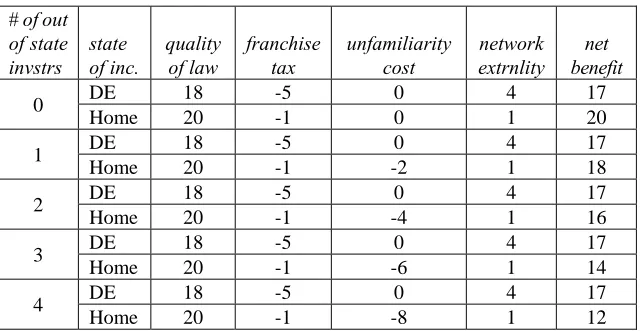
TABLE 1: STARTUP SCENARIOS
# of out of state invstrs
state of inc.
quality of law
franchise tax
unfamiliarity cost
network extrnlity
net benefit
0 DE 18 -5 0 4 17
Home 20 -1 0 1 20
1 DE 18 -5 0 4 17
Home 20 -1 -2 1 18
2 DE 18 -5 0 4 17
Home 20 -1 -4 1 16
3 DE 18 -5 0 4 17
Home 20 -1 -6 1 14
4 DE 18 -5 0 4 17
Home 20 -1 -8 1 12
Table 1 summarizes the above costs and benefit considerations for Startup. The first column lists the number of out-of-state investors financing Startup. The last column compares the net benefit of Delaware domicile to home-state domicile depending on the number of out-of-state investors. Each additional out-of-state investor decreases the net benefit of home-state domicile, but has no effect on the benefit provided by Delaware law. To illustrate, if Startup is financed entirely by in-state parties, it will likely incorporate in its home state (because 20 > 17). But if Startup receives financing from two or more out-of-state investors, it will likely switch to Delaware (because 16 < 17). Note that the number of in-state investors has no effect on the decision, since they are assumed to be equally familiar with both their home-state and Delaware law. By
contrast, the number of out-of-state investors matters greatly, because each lowers the net benefit of home-state domicile by two.
To be sure, we do not mean to imply that all firms with two or more out-of-state investors will domicile in Delaware, nor do we mean to suggest that no firms with less out-of-state investors will choose Delaware. There are certainly idiosyncratic reasons, captured by our error term , that may cause a specific firm to favor its home state over Delaware or vice versa. Rather, our point is simply that the relative benefit of Delaware as compared to home-state domicile increases with the number of out-of state investors, and thus we would expect greater likelihood of Delaware domicile as the number of out-of-state parties financing a firm increases.
C. Hypotheses
The above example illustrates several points. First, even though Delaware charges higher franchise tax fees and Delaware law is assumed to be of lower quality than Virginia,53 Delaware may nonetheless provide a greater net benefit because these costs are counterbalanced by (i) out of-state investors’ unfamiliarity with Virginia law, and (ii) large positive network externalities associated with Delaware domicile.
Second, network benefits and widespread familiarity with Delaware law may help explain why the state can charge high franchise tax fees. In contrast to some authors who implicitly assume that Delaware’s high franchise tax fees are evidence of its high-quality law,54 our analysis suggests that network externalities and widespread legal familiarity give Delaware a type of monopoly power, allowing it to charge higher franchise tax fees than the inherent quality of its law might suggest.55
53. Note if we instead assume that Delaware provides the same quality (or better) law than Virginia, the only change is that it takes less out-of-state investors to cause a firm to switch to Delaware. The unfamiliarity cost associated with home-state domicile remains a factor pushing firms toward Delaware and away from home-state domicile. Idiosyncratic reasons () may still cause some firms to domicile in their home state, even if Delaware’s quality of law were set sufficiently high that the numeric example would suggest that Delaware has a higher expected net benefit than Virginia even absent out-of state investors. The likelihood of Delaware domicile still increases relative to Virginia with the number of out of state investors.
Third, the numeric example also helps explain the bimodal choice in selecting state of incorporation. If a business were to select anything other than (i) Delaware or (ii) home state domicile, the parties would likely encounter even larger unfamiliarity costs. Domiciling in a third state would mean that all parties, both in state and out, would likely be unfamiliar with the relevant law.
Fourth, the above example illustrates that familiarity is conceptually distinct from network benefits. The unfamiliarity cost term is based on the number of out-of-state investors financing Startup, while the network externality term is based on the total number of firms incorporated in the relevant state. Even if there are no out-of-state investors, and all parties are perfectly familiar with home-state law (in other words, unfamiliarity cost equals zero), Delaware corporate law still provides greater network benefits than the home state. By incorporating in Delaware, Startup would have access to more case law, better legal services, and could take advantage of drafting efficiencies from past use of Delaware law. These network benefits arise regardless of the familiarity of the specific investors providing financing.
Putting this altogether, our analysis yields testable predictions regarding investor familiarity and network externalities. Our investor familiarity hypothesis is as follows: the likelihood that a firm will incorporate in Delaware increases with the number of out-of-state investors financing the firm. The more out-of-state investors, the more likely such investors share in common only a familiarity with Delaware corporate law, as opposed to home-state law or third-state law. In short, Delaware law is needed as a lingua franca that investors from various states all “speak,” since they do not all speak home-state, or third-state, law.
Our hypothesis should be especially true if the out-of-state investors have not previously financed a firm incorporated in Startup’s home state. Investors who have previously financed a business incorporated in a third state, one that is neither the business party’s home state nor Delaware, may gain some familiarity with that third state’s law through their past experience. To illustrate, an investor from Texas may have previously financed a firm incorporated in California. In doing so, the investor may have learned a bit about California corporate law causing him to be more familiar with California than a typical out-of-state party. To be sure, the Texas investor may not be as familiar with California law as a party actually located in California, but he may have become sufficiently comfortable with California law that he is somewhat more willing to finance another
firm domiciled in California in the future. To use our language metaphor, the investor may have working knowledge of California corporate law but not native-level fluency. This form of partial fluency suggests that some out-of-state investors—those with past exposure to the home-state law— may have less need for Delaware to serve as a lingua franca. Thus we can restate our lingua-franca hypothesis: All else being equal, the likelihood that a firm will incorporate in—or reincorporate in—Delaware as opposed to its home state increases with the number of out-of-state investors financing the firm, especially if such out-of-state investors have no past experience working with the firm’s home-state corporate law.
Although our Article is focused on investor familiarity as a new explanation for Delaware’s continued success in attracting corporate charters, our analysis also suggests a straightforward network effects hypothesis: All else being equal, the likelihood that a firm will incorporate in Delaware as opposed to its home state decreases with the total number of other firms incorporated in the firm’s home-state. If the home-state also has a large network of incorporations, then the network benefit associated with Delaware will be somewhat less critical, because the home state also provides a meaningful network benefit.56
Importantly, our familiarity and network externality hypotheses run orthogonal to the leading explanation for Delaware’s dominance to date— its substantive quality. Broadly this includes the merits and predictability of the Delaware General Corporation Law (DGCL) and its substantial case law,57 the flexibility of that law,58 and the expertise of the Delaware
56. The Model Business Corporation Act (MBCA) also provides a type of network benefit to the states that adopt it. By incorporating in a state that has adopted the MBCA, a firm can take advantage of a larger body of case law interpreting the MBCA code. See McDonnell, supra note 1, at 731 (“The MBCA makes it easier for states with limited resources and few corporations to update their corporate laws, a hard technical task. It thereby puts some more pressure on Delaware to improve its laws, as other states look more attractive than they would without the MBCA.”).
57. Kahan & Kamar, supra note 41, at 1212 (“Delaware boasts a well-developed corporate case law. Because many corporate disputes arise under Delaware law, Delaware’s case law is more developed than the case law of other states.”).
Chancery Court and Delaware Supreme Court to hand down new decisions.59 We attempt to test both Delaware’s familiarity and, separately, its substantive virtues, to determine their relative importance in explaining Delaware’s continued success in attracting incorporations.
III. EMPIRICAL SUPPORT FOR FAMILIARITY
We now use data from our prior empirical study to test the familiarity and network externality hypotheses.60 Data are from 1850 U.S. start-up firms financed by venture capital (VC).61
VC-backed start-ups provide a desirable empirical setting, as they exhibit heterogeneity regarding investor location.62 Some VC-backed start-ups receive out-of-state financing, while others are funded primarily by in-state investors. Furthermore, because VC-backed start-ups are financed in stages,63 there is also heterogeneity over time in the mix of in-state and out-of-state investors. For example, an early VC round may include only in-state investors, but in a subsequent round the same firm may receive funding from out-of-state VC investors. This variation allows us to test the importance of investor familiarity as a determinant of incorporation choice in our regression analysis.
It is difficult to think of another type of firm that exhibits the sufficient in-state versus out-of-state investor heterogeneity necessary to test a
for Corporate Law, 42 U. RICH. L. REV. 1129, 1159 n.140 (2008) (crediting the “flexibility of the Delaware Model” as “leav[ing] room for economically useful innovation and creativity”).
59. Kahan & Kamar, supra note 41, at 1212 (noting that the quality of its courts is “where Delaware really shines” and observing that “[m]embers of the [Chancery] court . . . have ample opportunity to develop expertise on matters of Delaware corporate law and have developed a national reputation for handling cases expeditiously”); McDonnell, supra note 1, at 703 (“[Delaware courts “] are able to decide cases quickly and in a well-considered way.”).
60. See generally Broughman, Fried & Ibrahim, supra note 13.
61. See id. at 871. Data were collected primarily from the VentureXpert database maintained by Thomson Financial to collect our data. For our parameters, we chose start ups that received their first VC financing round during the three-year period from January 1, 2000, to December 31, 2002. Due to staged financing, choosing this early timeframe for the initial VC round gives the start-up time to obtain follow-on rounds in subsequent years before we collected our data. Importantly, while a start-up may begin by incorporating in one state, its domicile may be changed mid-stream by reincorporating into another state, often in connection with a new VC round. There may be selection bias in our timeframe given the dot.com bust of the late 1990s, but we hoped to capture start-ups initially funded after the bust and with sufficient time to reincorporate before we collected data. For more details on how the dataset was put together see our earlier paper. Id. at 871–72.
62. Id. at 868.
familiarity hypothesis. Public corporations, almost by definition, are largely owned by out-of-state investors. Conversely, closely-held lifestyle firms are mostly owned by in-state investors.64 In fact, the difficulty of testing the familiarity hypothesis among non-VC-backed start-ups may explain its absence in the otherwise voluminous incorporations literature.
A. Summary of Dataset
Our sample, collected from VentureXpert, consists of U.S.-based start ups that received their first VC financing round during the three-year period from January 1, 2000, to December 31, 2002, and received at least $5 million in total VC financing.65 We then used Lexis-Nexis public records data and the Delaware Secretary of State’s webpage to match each start up in our sample with incorporation records from the relevant secretary of state.66 This gave us a sample of 1850 start-up firms.67
These 1850 start-ups each received, on average, $36.8 million in VC financing—over 3.6 rounds of financing. Emphasizing the risk inherent in start-up firms, approximately one third of the firms in our sample had achieved a successful exit by 2008, either via an IPO or a merger & acquisition (M&A) sale. The remaining sample firms have either gone out of business or are active. Readers interested in more background on the firms in our database should see the original empirical paper.68
64. Jens Dammann & Matthias Schündeln, Where Are Limited Liability Companies Formed? An Empirical Analysis, 55 J. L. & ECON. 741, 743 (2012); Dammann & Schündeln,
supra note 28, at 84–85.
65. See Broughman, Fried & Ibrahim, supra note 13, at 871–72.
66. Broughman, Fried & Ibrahim, supra note 13, at 872 n.8 (“Lexis-Nexis public records data includes domicile data (via secretary-of-state filings) for locally domiciled firms of all states except Delaware. Information about Delaware domicile was obtained from (a) doing-business forms filed by Delaware-domiciled firms in their home states and (b) the Delaware’s Secretary of State webpage (https://delecorp.delaware.gov/tin/GIName Search.jsp).”). Corporate law is more important to us than other business associations law such as limited liability company law, because VC-backed start-ups are generally organized as corporations. See Joseph Bankman, The Structure of Silicon Valley Start-ups, 41 UCLA L. REV. 1737, 1739–40 (1994); Victor Fleischer, The Rational Exuberance of Structuring
Venture Capital Start-ups, 57 TAX L. REV. 137, 137 (2003).
B. Results: State of Incorporation
First, we found that the race for VC-backed start-up charters is a “bimodal” race between Delaware and the start-up’s home state.69 Only a small percentage of start-ups in our sample chose to incorporate or reincorporate in a state that was not either Delaware or the start-up’s home state.70 This result supports the prior literature claiming that national competition among states for incorporations is largely a myth.71
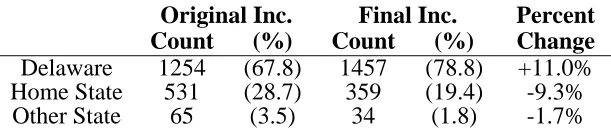
Second, in this bimodal race, Delaware beats the home state handily. Almost sixty-eight percent (67.8%) of start-ups chose Delaware as their initial state of incorporation, versus twenty-nine percent (28.7%) who chose their home state. Reincorporation figures are even more striking. A total of 212 firms in our sample changed legal domicile by reincorporating in connection with a new round of financing. When reincorporation occurs it is almost always into Delaware and away from the firm’s home state or another third state. Indeed, ninety-five percent of reincorporations—205 out of 212—in our sample were in Delaware.72 When incorporations and reincorporations are combined to tally final state of domicile, 1457 start ups—79% of the sample—chose Delaware. The particulars of these results are detailed in Table 2 below.
TABLE 2: STATE OF INCORPORATION (N=1850)
Original Inc.
Count
(%)
Final Inc.
Count
(%)
Percent
Change
Delaware
1254
(67.8)
1457
(78.8)
+11.0%
Home State
531
(28.7)
359
(19.4)
-9.3%
Other State
65
(3.5)
34
(1.8)
-1.7%
Third, out-of-state investors have more impact on choice of domicile than in-state investors. As seen in Tables 3 and 4 below, the likelihood of Delaware incorporation increases with the number of out-of-state VC investors. For example, in the first round [Table 3], firms receiving exclusively in-state financing incorporate in Delaware with 64% to 71% likelihood, compared to 72% to 82% for firms that received first round financing from two out-of-state investors. The effect is even more pronounced
69. This confirms Rob Daines’ findings in his study of IPO firms. Daines, supra note 17, at 1562.
70. The third-state total domicile percentage was 1.8%. See infra Table 2. 71. See Kahan & Kamar, supra note 3, at 748.
in later round financing where “[m]oving from one out-of-state investor to four or more out-of-state investors is associated with an approximate 17% increase in the probability of Delaware incorporation.”73 Adding out-of-state VCs suggests greater need for a lingua franca, and thus for Delaware corporate law. This result is consistent with our familiarity hypothesis.
TABLE 3: DELAWARE INCORPORATION IN FIRST-ROUND FINANCING
Number of Out-of-State Investors
0 1 2
3+
Number of
In-State Investors
0 73.4% 78.7%
93.1%
1 63.6% 73.3% 82.0%
84.2%
2 68.9% 81.2% 72.2%
87.5%
3+ 70.8% 79.5% 72.8%
100%
Percent Delaware Incorporation
TABLE 4: DELAWARE INCORPORATION IN FOLLOW-ON ROUND FINANCING
Number of Out-of-State Investors
0 1 2 3
4+
Number of
In-State Investors
0 77.6% 81.9% 79.8%
92.2%
1 67.2% 72.1% 73.8% 82.6% 92.0%
2 65.8% 71.1% 86.2% 83.8% 92.3%
3 69.8% 79.2% 80.8% 81.5% 93.1%
4+ 66.0% 77.8% 77.6% 81.5% 94.4%
Percent Delaware Incorporation
By contrast, the number of in-state investors has little effect on choice of domicile. For example, in later round financing going from one to four or more in-state investors only increases the likelihood of Delaware incorporation by approximately 2%. Out-of-state VCs need Delaware because they are unfamiliar with home state law, whereas in-state investors have no similar need to incorporate in Delaware. In-state VCs are already familiar with both home-state law and with Delaware. Absent other considerations, in-state investors appear to be largely indifferent between Delaware and home-state law.74
C. Results: Investor Familiarity and Network Externalities
To test the familiarity and network externality hypotheses we estimate the likelihood of Delaware incorporation at the first round of VC financing:
Delaware = α+ βi*[Familiarity Variables] + βj*[Network Ext. Variables] + β*X+ ε
In this equation βi and βj are coefficient estimates for variables used to measure investor familiarity and network externalities; X is a vector of other included control variables; and ε is the error term. Delaware equals one if the firm is incorporated in Delaware and zero otherwise.
For investor familiarity, our primary explanatory variable is Out-of-State Investors. We predict that the likelihood of Delaware incorporation will increase with the number of out-of-state investors. Next we define Local Exposure as the number of out-of-state investors who have previously financed a firm incorporated in the start-up’s home state. Such investors have at least some familiarity with the local dialect—home-state law—and thus we predict that the likelihood of Delaware incorporation will decrease with local exposure.
As stated, network externalities do not depend on the specific investors providing financing, but rather on the total number of other firms incorporated in the state. To operationalize this, we define State Inc. Count as the total number of publicly held firms incorporated in the start-up’s home state, and we predict that the likelihood of Delaware incorporation will decrease with State Inc. Count. Finally, we also record whether the start-up is located in a state that has adopted, at least in part, the Model Business Corporation Act (MBCA state). The MBCA provides a type of network benefit. By incorporating in a state that has adopted the MBCA, a firm can take advantage of a larger body of case law interpreting the MBCA code,75 and thus we would expect less demand for Delaware if the start up’s home state has adopted the MBCA.
We also control for various firm-level and state-level variables that may affect a start-up’s state of incorporation. The Appendix at the end of this Article defines all variables used in the regression analysis. Table 5 presents regression results, reporting logit marginal effects estimated with all variables at their mean values.
TABLE 5: STATE OF INCORPORATION AT THE FIRST ROUND OF VC FINANCING
This table reports marginal effects based on logit estimates evaluated at the mean of each variable. All variables are defined as of the first round of VC financing. The dependent variable is Delaware, which equals one if the firm was incorporated in Delaware, and zero otherwise. All
explanatory variables are defined in the Appendix. Standard errors, clustered at the state level and calculated via the delta-method, are reported in parentheses to the right of each coefficient estimate. We use a two-sided test for statistical significance (* = 10% and ** = 1% significance).
Logit Marginal Effects
(Dependent Variable = Delaware)
Model 1
Model 2
Familiarity Variables
Out-of-State Investors
.0872**
(.010)
.0812**
(.011)
Local Exposure
-.0594*
(.033)
-.0433
(.029)
Network Ext.
Variables
State Inc. Count
.0003
(.001)
-.0004
(.001)
MBCA state
.0382
(.098)
.0169
(.084)
Other Control
Variables
In-State Investors
.0127
(.011)
.0166*
(.009)
Investment ($M)
.0018
(.001)
.0016
(.001)
VC Reputation
-.0026**
(.001)
-.0028** (.001)
Judicial Quality
-.1263
(.134)
Flexibility
-.0646
(.056)
Franchise Tax
.0000
(.000)
West of Mississippi
-.1715** (.061)
Sector Dummies
Yes
Yes
Year Dummies
Yes
Yes
Observations
1789
1789
Pseudo R-squared
.063
.083
1. Findings Related to Investor Familiarity
over Delaware. These results show that once an out-of-state VC becomes familiar with a home state’s law, it is more likely to use that law again in the future—this is exactly what our familiarity hypothesis predicts.
Beyond statistical significance, note that the magnitude of the familiarity effect is large. Most start-up firms incorporate in Delaware regardless if they receive out-of-state financing. For example, holding all other variables at their mean value, we find that firms with zero out-of-state investors still choose Delaware at their first round of financing with approximately 68% probability. However, if we increase the number of out-of-state investors from zero to two, the likelihood of Delaware incorporation rises to approximately 82% and the likelihood of home-state domicile nearly falls in half—from 32% to 18%.
Our finding regarding the importance of investor familiarity is robust to alternative econometric specifications and does not appear to be driven by unobserved heterogeneity, specifically, endogenous selection of firms that receive in-state versus out-of-state financing. In our prior study, we considered two identification strategies to address potential endogeneity concerns. First, we took advantage of the longitudinal variation in our data to see if the arrival of out-of-state investors in a follow-on round of financing caused firms originally incorporated in their home states to reincorporate in Delaware.76 Using a first differences regression approach— designed to eliminate bias due to unobserved traits of each firm—we found that each additional out-of-state investor had a statistically significant impact on reincorporation, increasing the likelihood of reincorporation into Delaware by approximately four to five percentage points. Second, we used a VC fixed-effect regression model to isolate variation within each VC’s portfolio of investments.77 We found, consistent with familiarity, that a given VC is more likely to choose Delaware domicile when investing out-of-state than when the same VC invests in its home state.78 Collectively, these findings from our prior study provide further support for the familiarity hypothesis. We refer interested readers to that article for further details.
76. Broughman, Fried & Ibrahim, supra note 13, at 884–86. 77. Id.
2. Findings Related to Network Externalities and Substantive Law Quality
By contrast, we do not find a statistically significant result for network externalities. The coefficient estimates reported in Table 5 for both State Inc. Count and MBCA State are small in magnitude and insignificant. The fact that we control for network externalities in these regressions reaffirms our view that investor familiarity is an independent consideration causing firms to migrate to Delaware.
This does not, however, mean network externalities are irrelevant. There are at least two reasons that network externalities may still have an important impact on choice of domicile and do not show up in our regression results. First, as we have discussed,79 familiarity is likely derivative of network effects at least in an historic sense. So, it may be that network effects originally caused investors and lawyers to become familiar with Delaware, but today familiarity appears to have an independent effect on choice of domicile.
Second, the regression analysis above only compares the relative network effect associated with states other than Delaware. Technically, the variable State Inc. Count looks at the number of publicly held firms incorporated in the start-up’s home state. In our sample, however, there are no firms headquartered in Delaware, and consequently we are left comparing the network value of non-Delaware states. Put another way, our results suggest that the fact that more publicly held firms are incorporated in New York than, Virginia for example, does not give New York a significant network advantage relative to Virginia. It may be that no network other than Delaware is great enough to make any real difference. However, as with network externalities, although it was not a statistically significant result, we find that states with a high-quality judiciary and more flexible corporate law are somewhat more likely to retain their in-state start-ups.80 These results are consistent with Marcel Kahan’s study of public firms.81
The only other variables with statistically significant effects on incorporation choice are VC reputation and West of the Mississippi.82 We find that start
79. See supra notes 27–28 and accompanying text.
80. The lack of statistical significance here may be due to the fact that we cluster our standard errors at the state level, making it more difficult to find significant results for such state-level variables.
81. Marcel Kahan, The Demand for Corporate Law: Statutory Flexibility, Judicial Quality, or Takeover Protection?, 22 J.L. ECON. & ORG. 340, 341 (2006).
ups financed by older, more reputable VC firms are less likely to incorporate in Delaware, and start-ups headquartered west of the Mississippi River are also less likely to incorporate in Delaware. This does not mean that other explanations for incorporation choice are not meaningful or accurate. This issue is addressed further in Part III, Section 3 below.
3. Lingua Franca or Signaling?
Finally, it could be that business parties are choosing Delaware law not because it serves as a lingua franca, but to signal something about the start-up. While familiarity gets at a party’s internal reasons for choosing Delaware because they know it, signaling would look at the party’s external reasons for choosing Delaware because others know it. A party might favor Delaware incorporation because it brands the start-up as high-quality. In this sense, signaling is akin to network externalities. Signaling and network externalities both focus on other users. But while network externalities are concerned with other firms in the network, signaling is concerned with the investors in those firms.
While we could not determine a suitable way to test a signaling hypothesis using our data, it is certainly possible that parties chose Delaware in an attempt to signal their corporate quality. However, as a theoretical matter, several factors cut against a signaling explanation for Delaware’s dominance. First, if signaling was the primary story, start-ups funded by mostly in-state VCs would mostly need that signal to combat their regionalness. Yet these start-ups are more likely to choose home-state domicile than Delaware domicile. Second, Michal Barzuza suggests that Delaware law, which is neither the laxest or strictest corporate law, provides at best a “noisy” signal to investors, not a strong, positive one.83 Third, a signal must be costly to be effective, and Delaware incorporation is not significantly costly for private firms due to the way franchise taxes are calculated
attorneys, who hail from multiple offices in different states. Conversely, regional firms have less heterogeneity in lawyer location, and thus all of their lawyers are more likely to know local law. Michal Barzuza, Market Segmentation: The Rise of Nevada as a Liability-Free Jurisdiction, 98 VA. L. REV. 935, 976 (2012) (“Local lawyers tend to advise the firms they represent to incorporate in their home states. National firms, on the other hand, tend to recommend incorporation in Delaware.”); McDonnell, supra note 1, at 712 (it may be “that lawyers in smaller firms servicing smaller businesses are less familiar with Delaware and more familiar with local law”)
there.84 Although Delaware franchise taxes are costly for public corporations, they are smaller for private start-ups.85 Finally, the entrepreneurship literature suggests that there are better signals for start-up quality than legal domicile, including patent portfolios and willingness to give the VCs preferred stock as opposed to the entrepreneur’s common stock.86
IV. IMPLICATIONS
We find that business parties choose Delaware corporate law for its familiarity as much as for its quality. We do not suggest that the two— familiarity and substantive virtues—are mutually exclusive. Delaware law likely became familiar to parties due to its high quality, and thus more frequent use. The same is true of network externalities. But familiarity as an alternative, independent explanation of Delaware’s dominance, leads to interesting potential ramifications. In this Part we examine the normative implications of our familiarity explanation, a topic left largely unaddressed in our prior empirical paper.
A. Normative Implications of Delaware’s Familiarity: Positives
1. Lowering Transaction Costs of Financing
The most important advantage of Delaware’s familiarity is its ability to lower transaction costs when investors fund start-ups. Delaware’s advantage in lowering transaction costs for public corporations has been observed by Marcel Kahan and Ehud Kamar, who note that “[t]he extensiveness and familiarity of Delaware case law reduces the cost of planning transactions for Delaware corporations, obtaining legal advice for them, and assessing their value.”87 More in tune with our focus on firm financing, Klausner observes that Delaware’s superior ability to provide judicial interpretation of legal terms may reduce a corporation’s cost of capital.88
84. See Kahan & Kamar, supra note 41, at 1223, 1227 (finding that Delaware assesses minimal franchise taxes on non-public corporations, as low as $30 per year).
85. See id. Of course, incorporating in Delaware is more costly than incorporating in home state, as previously discussed. See supra note 41 and accompanying text.
86. See Darian M. Ibrahim, Financing the Next Silicon Valley, 87 WASH. U. L. REV. 717, 750 (2010) (“[P]rivate VCs look to a start-up’s patent portfolio as a proxy for its quality.”); id. at 751–52 (“By selling preferred stock to private VCs while holding common stock themselves, entrepreneurs signal their belief that the value of the start-up will exceed the amount of the VC’s preference.”).
87. Marcel Kahan & Ehud Kamar, The Myth of State Competition in Corporate Law, 55 STAN. L. REV. 679, 725 (2002).