Correlations of Biomechanical Characteristics with Ball Speed in Penalty Corner Push-In
Effect of Game Specific Training and Vision Training on Selected Skill Performance Variables
among Tennis Players
M.Gopi1 & Dr. M.Rajkumar2
1Ph.D., Research Scholar, Department of Physical Education, Bharathiar University, Coimbatore, Tamilnadu, India. 2Professor, Department of Physical Education, Bharathiar University, Coimbatore, Tamilnadu, India.
Received 25th November 2018, Accepted 10th December 2018
Abstract
The purpose of the study was to find out the effect of game specific training and vision training on selected skill performance variables among tennis players. To achieve the purpose of the present study, Forty five male tennis players were randomly selected from Tiruvannamalai district, Tamilnadu, were randomly selected their age ranged between 18 to 25 years. The groups were assigned as Experimental Group I, Experimental Group II and Experimental Group III in an equivalent manner. Experimental Group I was exposed to game specific training, Experimental Group II was exposed to vision training and Experimental Group III was exposed to combined training. The duration of experimental period was 12 weeks. Analysis of Covariance (ANCOVA) was used to find out the significance among the mean differences, whenever the ‘F’ ratio for adjusted test was found to be significant, scheffe’s post hoc test was used. In all cases 0.05 level of significance was fixed to test hypotheses. The combined training had registered significant improvement on selected skill performance variables namely service and forehand drive than the other two experimental groups.
Keywords: Game Specific, Vision Training, Skill performance, Tennis.
© Copy Right, IJRRAS, 2018. All Rights Reserved.
Introduction
Visual training is a kind of physical therapy or rehabilitative therapy for the brain and eyes. It is a progressive program, meaning that the beginning exercises are the easiest, gradually becoming more difficult, so that the flexibility and co-ordination of the eye muscles is improved. Students of vision training learn to control, their eye muscles and are able to overcome many kinds of vision impairment which involve the muscles of the eyes. It involves improving visual skills such as eye teaming, depth perception, tracking and vision-body (eye-hand) co-ordination. All practitioners, those who provide vision therapy as well as those who do not should be acknowledgeable about certain aspects of the use of vision in sports performance. Some practitioners offer only elementary visual concentration exercises (“focus on the ball”) many players and coaches are aware of and utilize some of the techniques that involve visualization (Gregg, 1987).
New vision training methods and more effective practical application may make it possible to enhance vision for sports to levels as yet unknown. Vision enhancement training to some degree goes beyond what might be called the “usual” vision training procedures and encompasses visualization, developing perceptive set
Correspondence
M.Gopi
Email:[email protected]; Ph. +9198949 41708
visual concentration, and similar terms that relate to translating visual skills and visualization into an actual sports performance. The enhancement of visual cognitive functions those are critical for visual decision making during competition in the area of training that is by far the most ambiguous for the sports vision specialist. Although it is easy to conceptualize the nature of these skills, it is very difficult to isolate them for measurement in order to assess or improve efficiency of training, sport psychologist and sports vision specialists use methods designed to improve visual imagery ability, often with good success based upon subjective feedback from the athlete.
Tennis is spontaneous situational game. Most real deal play situations have deficit of time and information. Tennis players must make proper decisions and effectively perform mental skills within that time. Situational thinking becomes the most important tennis skill. Many tennis players with good physical abilities get tired quickly at the game. Most of them believe that they need to focus more and more on their skill performance conditioning. A tennis player with a significant level of visual thinking ability can demonstrate stable individual tennis technique for a longer time. Many athletes need excellent vision to perform well in their sports, and now many are adding something new to their practice regimens: vision training. The idea has been around for years, but only recently have studies hinted that it might really work. Vision training actually has little to do with improving
International
44 International Journal of Recent Research and Applied Studies, Volume 5, Issue 12 (11) December 2018
eyesight. The techniques, a form of perceptual learning, are intended to improve the ability to process what is seen. There is no doubt that performance in sport is linked to cognitive and perceptual skills as well as motor and physical abilities. Over the last years, perceptual skills have received considerable research interest within the sports domain, especially the comparison between expert and novice performances (Memmert et al., 2009).
Methodology
The purpose of the study was to find out the effect of game specific training and vision training on selected skill performance variables among tennis players. To achieve the purpose of the present study, Forty five male tennis players were randomly selected
from Tiruvannamalai district, Tamilnadu, were randomly selected their age ranged between 18 to 25 years. The groups were assigned as Experimental Group I, Experimental Group II and Experimental Group III in an equivalent manner. Experimental Group I was exposed to game specific training, Experimental Group II was exposed to vision training and Experimental Group III was exposed to combined training. The duration of experimental period was 12 weeks. Analysis of Covariance (ANCOVA) was used to find out the significance among the mean differences, whenever the „F‟ ratio for adjusted test was found to be significant, scheffe‟s post hoc test was used. In all cases 0.05 level of significance was fixed to test hypotheses.
Results
Table 1
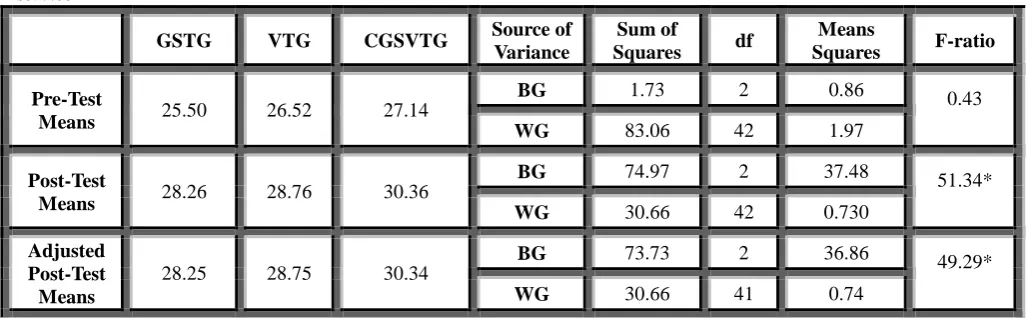
Computation of analysis of covariance of mean of game specific training, vision training and combined training group on service
GSTG VTG CGSVTG Source of Variance
Sum of
Squares df
Means
Squares F-ratio
Pre-Test
Means 25.50 26.52 27.14
BG 1.73 2 0.86 0.43
WG 83.06 42 1.97
Post-Test
Means 28.26 28.76 30.36
BG 74.97 2 37.48 51.34*
WG 30.66 42 0.730
Adjusted Post-Test Means
28.25 28.75 30.34
BG 73.73 2 36.86 49.29*
WG 30.66 41 0.74
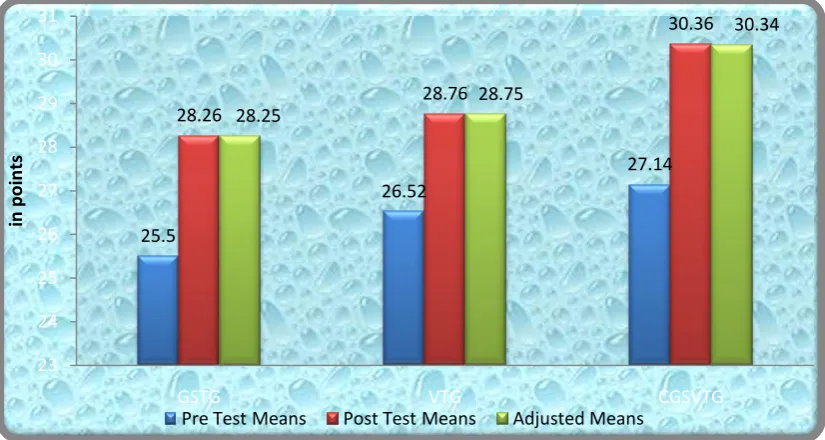
An examination of table - 1 indicated that the pre test means of game specific training, vision training and combined training group were 25.50, 26.52 and 27.14 respectively. The obtained F-ratio for the pre-test was 0.43 and the table F-ratio was 3.22. Hence the pre-test mean F-ratio was insignificant at 0.05 level of confidence for the degree of freedom 2 and 42. This proved that there were no significant difference between the experimental and combined training group indicating that the process of randomization of the groups was perfect while assigning the subjects to groups. The post-test means of the game specific training, vision training and combined training group were 28.26, 28.76 and 30.36 respectively. The obtained F-ratio for the post-test
Table 2
The scheffe’s test for the differences between the adjusted post test paired means on service
Adjusted Post-test means
Mean Difference Required CI GSTG VTG CGSVTG
28.25 28.75 --- 0.50
1.22 28.25 --- 30.34 2.09*
--- 28.75 30.34 1.59* * Significant at 0.05 level of confidence
The multiple comparisons showed in Table 2 proved that there existed significant differences between the adjusted means of vision training with combined training group (2.09), game specific training with
combined training group (1.59). There was no significant difference between game specific training and vision training (0.50) at 0.05 level of confidence with the confidence interval value of 1.22.
Figure I
Pre post and adjusted post test differences of the, game specific training, vision training and combined training group on service
Table 3
Computation of analysis of covariance of mean of game specific training, vision training and combined training group on forehand drive
GSTG VTG CGSVTG Source of Variance
Sum of
Squares df
Means
Squares F-ratio
Pre-Test
Means 33.87 34.67 33.28
BG 0.13 2 0.06 0.09
WG 29.06 42 0.69
Post-Test
Means 36.22 36.82 39.45
BG 92.31 2 46.15 49.28*
WG 39.33 42 0.93
Adjusted Post-Test Means
36.22 36.81 39.44
BG 92.30 2 46.15 48.12*
WG 39.32 41 0.95
25.5
26.52
27.14 28.26
28.76
30.36
28.25
28.75
30.34
23 24 25 26 27 28 29 30 31
GSTG VTG CGSVTG
in
p
o
in
ts
46 International Journal of Recent Research and Applied Studies, Volume 5, Issue 12 (11) December 2018
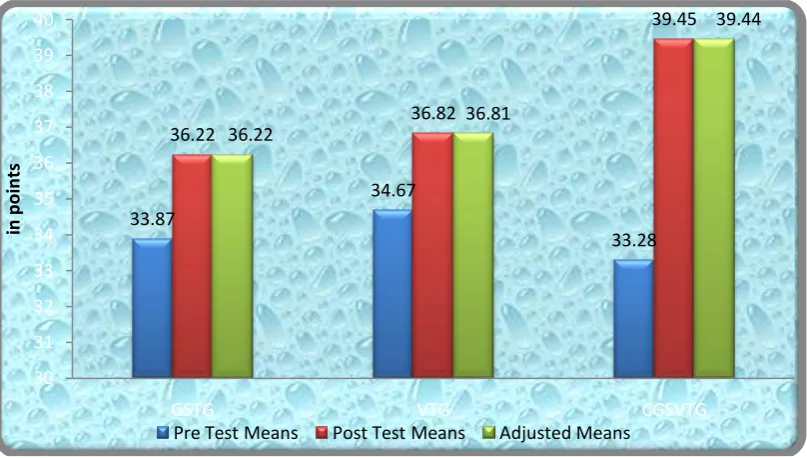
An examination of table - 3 indicated that the pre test means of game specific training, vision training and combined training group were 33.87, 34.67 and 33.28 respectively. The obtained F-ratio for the pre-test was 0.09 and the table F-ratio was 3.22. Hence the pre-test mean F-ratio was insignificant at 0.05 level of confidence for the degree of freedom 2 and 42. This proved that there were no significant difference between the experimental and combined training group indicating that the process of randomization of the groups was perfect while assigning the subjects to groups.
The post-test means of the game specific training, vision training and combined training group were 36.22, 36.82 and 39.45 respectively. The obtained F-ratio for the post-test was 49.28 and the table F-ratio
was 3.22. Hence the post-test mean F-ratio was significant at 0.05 level of confidence for the degree of freedom 2 and 42. This proved that the differences between the post test means of the subjects were significant.
The adjusted post-test means of the game specific training, vision training and combined training group were 36.22, 36.81 and 39.44 respectively. The obtained F-ratio for the adjusted post-test means was 48.12 and the table F-ratio was 3.23. Hence the adjusted post-test mean F-ratio was significant at 0.05 level of confidence for the degree of freedom 2 and 41. This proved that there was a significant difference among the means due to the experimental trainings on forehand drive.
Table 4
The scheffe’s test for the differences between the adjusted post test paired means on forehand drive
Adjusted Post-test means
Mean Difference Required CI GSTG VTG CGSVTG
36.22 36.81 --- 0.59
0.90 36.22 --- 39.44 3.22*
--- 36.81 39.44 2.63* * Significant at 0.05 level of confidence
The multiple comparisons showed in Table 4 proved that there existed significant differences between the adjusted means of vision training with combined training group (3.22), game specific training with
combined training group (2.63). There was no significant difference between game specific training and vision training (0.59) at 0.05 level of confidence with the confidence interval value of 0.90.
Figure II
Pre post and adjusted post test differences of the, game specific training, vision training and combined training group on forehand drive
33.87
34.67
33.28 36.22
36.82
39.45
36.22
36.81
39.44
30 31 32 33 34 35 36 37 38 39 40
GSTG VTG CGSVTG
in
p
o
in
ts
Conclusion
From the analysis of the data, the following conclusions were drawn:
1. The game specific training had registered significant improvement on selected skill performance variables namely service and forehand drive after undergoing game specific training for a period of twelve weeks.
2. The vision training had registered significant improvement on selected skill performance variables namely service and forehand drive after undergoing vision training for a period of twelve weeks.
3. The combined training had registered significant improvement on selected skill performance variables namely service and forehand drive after undergoing combined training for a period of twelve weeks.
4. The combined training had registered significant improvement on selected skill performance variables namely service and forehand drive than the other two experimental groups.
References
1. Baiget, E., Fernandez-Fernandez, J., Iglesias, X. & Rodriguez, F.A. (2015). Tennis Play Intensity Distribution and Relation with Aerobic Fitness in Competitive Players. PLoS ONE 10(6): e0131304.
2. Barber-Westin, S.D., Hermet, A. & Noyes, F.R. (2015) A Six-Week Neuromuscular and Performance Training Program Improves Speed, Agility, Dynamic Balance, and Core Endurance in Junior Tennis Players. J Athl Enhancement 4:1.
3. Barrow, M. H., & McGee, R. (1979). A Practical approach to Measurement in Physical Education. Philadelphia: Lea & Febiger. 4. Baumgartner, T, A., Andrew, S. J., Matthew, T.
M., & David, A. R. (2003). Measurement for Evaluation in Physical Education & Exercise Science. New York: Mc-Graw Hill.
5. Bender, R.S (1984). The effects a vision training program has on the ball – handling skills of children with visually – related learning disabilities. Completed research, 27. 178.
6. Beverley C A, Bath P A, & Booth A (2004). Health information needs of visually impaired people: a systematic review of literature. School of Health and related research. Health & social care in the community, 12:1, 1-24.
7. Bonsel, S, K., Feltgen, N., Burau, H., Hansen, L. & Bach, M. (2006). Visual acuities “hand motion “and “counting fingers” can be
quantified with the Frieburg visual acuity test. Invest Ophthalmol Vis Sci. 47(3):1236-40. 8. Bressan, E.S. (2003). Effects of visual skills
training, vision coaching and sports vision dynamics on the performance of a sport skill. African Journal of Physical, Health Education, Recreation and Dance 9(1), 20-31.
9. Justyna Krzepota, Teresa Zwierko, Lidia Puchalska-Niedbal, Mikolaj Markiewicz, Beata Florkiewicz,& Wojciech Lubiński (2015). The Efficiency of a Visual Skills Training Program on Visual Search Performance. J Hum Kinet. 46: 231–240.
10. Khanal, S. (2015). Impact of Visual Skills Training on Sports Performance: Current and Future Perspectives. Advances in Ophthalmology & Visual System, 2(1), 00032. 11. Kilit, B. & Arslan, E. (2018). Effects of
high-intensity interval training vs. on-court tennis training in young tennis players. J Strength Cond Res.
12. Paul Maman, Shukla Gaurang & Sandhu J. S. (2011). The effect of vision training on performance in tennis players. Serbian Journal of Sports Sciences, 5(1): 11-16
13. Paul, M., Biswas, S. K. & Sandhu, J. S. (2011). Role of sports vision and eye hand coordination training in performance of table tennis players. Brazilian Journal of Biomotricity, 5, 2, 106-116.
14. Pialoux, V., Genevois, C., Capoen, A., Forbes, S.C., Thomas, J. & Rogowski, I. (2015). Playing vs. Nonplaying Aerobic Training in Tennis: Physiological and Performance Outcomes. PLoS ONE 10(3).
15. Playersi Gurhan Suna & Mehmet Kumartasli (2017). Investigating Aerobic, Anaerobic Combine Technical Trainings' Effects on Performance in Tennis. Universal Journal of Educational Research 5(1): 113-120.
16. Terraza-Rebollo, M., Baiget, E., Corbi, F. & Planas Anzano, A. (2017). Effects of Strength Training on Hitting Speed in Young Tennis Players. Revista Internacional de Medicina y Ciencias de la Actividad Física y el Deporte. 17 (66). 349-366.
17. Ueda, Y. (2004). Psychological changes during rehabilitation for newly visually impaired people. Shinrigaku Kenkyu. 75(1):1-8.
18. Van Dyke, J. (1985). Heart rate response and oxygen up take during exercise in righted blind folded, and visually impaired subjects. Completed research, 27, 56.