P
age
16
A Comparative Study of Psychosocial Problems Orphans and Non–
orphans
Rachna Mishra* & Dr. (Sr.) Marion, Mathew C.J.**
*Research Scholar Allahabad School of Education SHUATS, Prayagraj **Professor and Head Allahabad School of Education SHUATS, Prayagraj
ABSTRACT
Present study titled “A Comparative Study of Psychosocial Problems Orphans and Non–
orphans” conducted on secondary school male and female students. Descriptive survey method
was implied to collect the data of the study. Two hundred forty secondary school students have been selected by using random sampling technique as a sample of the study. These orphan and non-orphan are selected so that they represent the whole city. The data was collected through a questionnaire of Psycho-social problem scale 2000 (Constructed by Dr. P. J. Jacob & Benson. N.) for assessing the various problems viz., Problems on Self-esteem, Recognition and Approval, Love and Affection, Security, Independence, Creative Expression, New Expression, Dealing with others, Achievement, Isolation, Financial problems, Problem in dealing with opposite sex, Problem in dealing with Authorities, Problem in relation with Anxiety and Problem in relation with Emotional maternity. Descriptive and Inferential statistics have been used for analyzing and interpreting the data and its findings are concluded as: statistically significant difference in the ‘Love and Affection, Security, Independence, Creative Expression, New Expression, Dealing with others, Achievement, Isolation, Financial problems, Problem in dealing with opposite sex, Problem in dealing with Authorities, Problem in relation with Anxiety and Problem in relation with Emotional maternity component of psychological problems among orphan and non-orphan students of UP Board secondary school of Lucknow. The direction of difference for these aspects was in favour of orphan.
KEYWORDS: Achievement, Isolation, Financial
INTRODUCTION
P
age
17
from a grown up person? Never! A child's love cannot be equated to any other person's love however hard we try.
P
age
18
STATEMENT OF THE PROBLEM
A Comparative Study of Psychosocial Problems of Orphans and Non-Orphans.
OBJECTIVE OF THE STUDY
1. To compare the orphans and the non–orphans with respect to selected various psychosocial problems and general achievement.
2. To find out the correlation between the psycho-social problems and General Achievement of orphan and non-orphan students.
HYPOTHESIS OF THE STUDY
1. There will be no significant difference between the orphans and non-orphans with respect to the selected psychosocial problems and general achievement.
2. There is no Correlation between various Psychosocial Problems and General
Achievement of the Orphan and Non-Orphan.
RESEARCH METHOD
The present study belongs to the category of survey research method.
Population, Sample and Sampling Technique
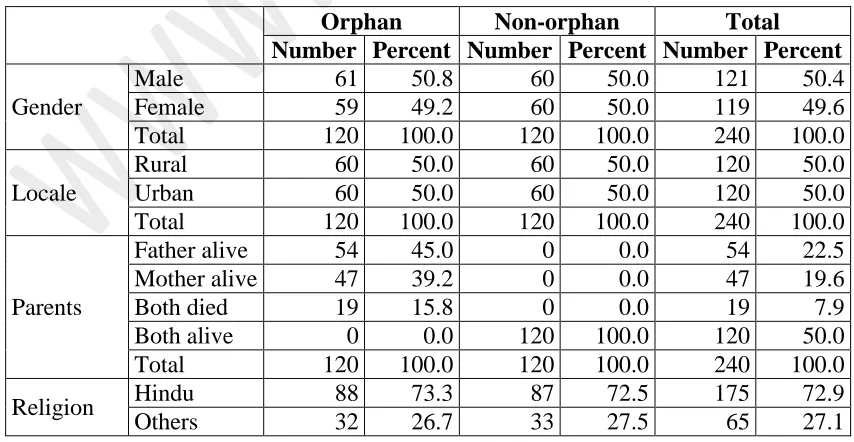
The populations of the study are five hundred orphan and non-orphan students from orphanages of Lucknow district. The sample of the study is 120 orphans and 120 non-orphans in Lucknow district. Sample was selected randomly. Distribution of the sample is shown in the following table 1.
Table 1: Distribution of Selected Orphan and Non-orphan Students
Orphan Non-orphan Total Number Percent Number Percent Number Percent
Gender
Male 61 50.8 60 50.0 121 50.4
Female 59 49.2 60 50.0 119 49.6
Total 120 100.0 120 100.0 240 100.0
Locale
Rural 60 50.0 60 50.0 120 50.0
Urban 60 50.0 60 50.0 120 50.0
Total 120 100.0 120 100.0 240 100.0
Parents
Father alive 54 45.0 0 0.0 54 22.5
Mother alive 47 39.2 0 0.0 47 19.6
Both died 19 15.8 0 0.0 19 7.9
Both alive 0 0.0 120 100.0 120 50.0
Total 120 100.0 120 100.0 240 100.0
P
age
19
Total 120 100.0 120 100.0 240 100.0
Castes
SC 20 16.7 18 15.0 38 15.8
OBC 49 40.8 50 41.7 99 41.3
General 51 42.5 52 43.3 103 42.9
Total 120 100.0 120 100.0 240 100.0
Types of family
Nuclear 46 38.3 48 40.0 94 39.2
Joint 74 61.7 72 60.0 146 60.8
Total 120 100.0 120 100.0 240 100.0
Size of family
Upto Five 47 39.2 51 42.5 98 40.8
Six to Eight 59 49.2 57 47.5 116 48.3
Above eight 14 11.7 12 10.0 26 10.8
Total 120 100.0 120 100.0 240 100.0
Source: Field Survey 2018.
Tool Used
Psycho-social problem scale 2000 (Constructed by Dr. P. J. Jacob & Benson. N.) for assessing the various problems viz., Problems on Self-esteem, Recognition and Approval, Love and Affection, Security, Independence, Creative Expression, New Expression, Dealing with others, Achievement, Isolation, Financial problems, Problem in dealing with opposite sex, Problem in dealing with Authorities, Problem in relation with Anxiety and Problem in relation with Emotional maternity.
Statistics used in Data Analyses
Mean, Standard Deviation, t-value and co-efficient of correlation is used in the data analysis of the study.
ANALYSIS AND INTERPRETATION OF DATA
Objective 1: Comparison of orphans and non–orphans with respect to selected various psychosocial problems and general achievement
Hypothesis 1: There is no significant difference between orphans and non–orphans with respect to selected various psychosocial problems and general achievement
P age
20
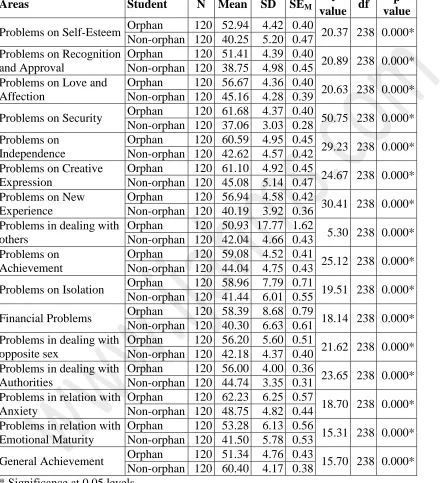
Table 2: Mean, SD and t-value on various Psychosocial Problems and General Achievement of Orphan and Non-orphan
Areas Student N Mean SD SEM t
value df
p value
Problems on Self-Esteem Orphan 120 52.94 4.42 0.40 20.37 238 0.000*
Non-orphan 120 40.25 5.20 0.47 Problems on Recognition
and Approval
Orphan 120 51.41 4.39 0.40
20.89 238 0.000* Non-orphan 120 38.75 4.98 0.45
Problems on Love and Affection
Orphan 120 56.67 4.36 0.40
20.63 238 0.000* Non-orphan 120 45.16 4.28 0.39
Problems on Security Orphan 120 61.68 4.37 0.40 50.75 238 0.000*
Non-orphan 120 37.06 3.03 0.28 Problems on
Independence
Orphan 120 60.59 4.95 0.45
29.23 238 0.000* Non-orphan 120 42.62 4.57 0.42
Problems on Creative Expression
Orphan 120 61.10 4.92 0.45
24.67 238 0.000* Non-orphan 120 45.08 5.14 0.47
Problems on New Experience
Orphan 120 56.94 4.58 0.42
30.41 238 0.000* Non-orphan 120 40.19 3.92 0.36
Problems in dealing with others
Orphan 120 50.93 17.77 1.62
5.30 238 0.000* Non-orphan 120 42.04 4.66 0.43
Problems on Achievement
Orphan 120 59.08 4.52 0.41
25.12 238 0.000* Non-orphan 120 44.04 4.75 0.43
Problems on Isolation Orphan 120 58.96 7.79 0.71 19.51 238 0.000*
Non-orphan 120 41.44 6.01 0.55
Financial Problems Orphan 120 58.39 8.68 0.79 18.14 238 0.000*
Non-orphan 120 40.30 6.63 0.61 Problems in dealing with
opposite sex
Orphan 120 56.20 5.60 0.51
21.62 238 0.000* Non-orphan 120 42.18 4.37 0.40
Problems in dealing with Authorities
Orphan 120 56.00 4.00 0.36
23.65 238 0.000* Non-orphan 120 44.74 3.35 0.31
Problems in relation with Anxiety
Orphan 120 62.23 6.25 0.57
18.70 238 0.000* Non-orphan 120 48.75 4.82 0.44
Problems in relation with Emotional Maturity
Orphan 120 53.28 6.13 0.56
15.31 238 0.000* Non-orphan 120 41.50 5.78 0.53
General Achievement Orphan 120 51.34 4.76 0.43 15.70 238 0.000*
Non-orphan 120 60.40 4.17 0.38 * Significance at 0.05 levels.
Source: Field Survey 2018.
P
age
21
5.20; 0.47 and the calculated t-value 20.37 is greater than the table value 1.96 at .05 significance level and p-value is 0.0, which is less than 0.05. We can say there is statistically significant difference in the ‘Problems on Recognition and Approval’ among orphan and non-orphan students of UP Board secondary school of Lucknow. The direction of difference was in favour of orphan. Thus, our prefixed hypothesis is rejected and alternate hypothesis was accepted.
The observation of the above table also indicates the mean, SD and standard error of mean of the orphan and non-orphan students of UP Board schools of Lucknow are 51.41; 4.39; 0.40 & 38.75; 4.98; 0.45 and the calculated t-value 20.89 is greater than the table value 1.96 at .05 significance level and p-value is 0.0, which is less than 0.05. We can say there is statistically significant difference in the ‘Problems on Love and Affection’ among orphan and non-orphan students of UP Board secondary school of Lucknow. The direction of difference was in favour of orphan. Thus, our null hypothesis is rejected.
P
age
22
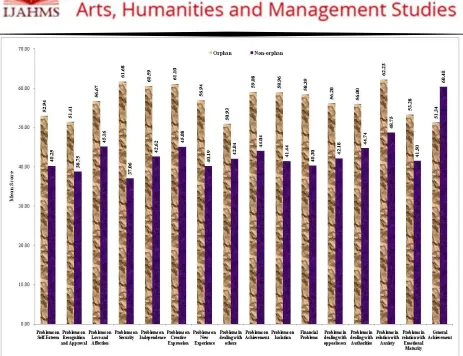
Figure 1: Comparison of orphans and non–orphans with respect to selected various psychosocial problems and general achievement
Objective 2: To find out the correlation between the psycho-social problems and General Achievement of orphan and non-orphan students
Hypothesis 2: There is no Correlation between various Psychosocial Problems and General Achievement of the Orphan and Non-Orphan
The second objective of the study was to find out the correlation between the psycho-social problems and General Achievement of orphan and non-orphan students. To find the answer of this issue data was analyses with the help of the coefficient of correlation statistics. The details of coefficient of correlation on various psychosocial problems (viz., Problems on Self-esteem, Recognition and Approval, Love and Affection, Security, Independence, Creative Expression, New Expression, Dealing with others, Achievement, Isolation, Financial problems, Problem in dealing with opposite sex, Problem in dealing with Authorities, Problem in relation with Anxiety and Problem in relation with Emotional maternity) and General Achievement of the Orphan and Non-Orphan Students in the table 3.
P age
23
Correlation between Student r-value p-value
General Achievement and Problems on Self-Esteem Orphan -0.049 0.592
Non-Orphan -.283** 0.002
General Achievement and Problems on Recognition and Approval
Orphan -0.062 0.498
Non-Orphan -.273** 0.003
General Achievement and Problems on Love and Affection
Orphan .290** 0.001
Non-Orphan .405** 0.000
General Achievement and Problems on Security Orphan .295** 0.001
Non-Orphan .349** 0.000
General Achievement and Problems on Independence
Orphan .404** 0.000
Non-Orphan .309** 0.001
General Achievement and Problems on Creative Expression
Orphan .331** 0.000
Non-Orphan .330** 0.000
General Achievement and Problems on New Experience
Orphan .340** 0.000
Non-Orphan .327** 0.000
General Achievement and Problems in dealing with others
Orphan .443** 0.000
Non-Orphan .578** 0.000
General Achievement and Problems on Achievement
Orphan .359** 0.000
Non-Orphan .588** 0.000
General Achievement and Problems on Isolation Orphan .473** 0.000
Non-Orphan .741** 0.000
General Achievement and Financial Problems Orphan .538** 0.000
Non-Orphan .607** 0.000
General Achievement and Problems in dealing with opposite sex
Orphan .463** 0.000
Non-Orphan .550** 0.000
General Achievement and Problems in dealing with Authorities
Orphan .445** 0.000
Non-Orphan .650** 0.000
General Achievement and Problems in relation with Anxiety
Orphan .445** 0.000
Non-Orphan .598** 0.000
General Achievement and Problems in relation with Emotional Maturity
Orphan .545** 0.000
Non-Orphan .584** 0.000
**. Correlation is significant at the 0.01 level (2-tailed). *. Correlation is significant at the 0.05 level (2-tailed).
Observation of the above table indicates that coefficients of correlation of General Achievement with Problems on Self-Esteem and Problems on Recognition and Approval of orphan and non-orphan is -0.049 ,-.283** &-0.062 and -.273**. it is clear from the coefficient of correlation that General Achievement with Problems on Self-Esteem and Problems on Recognition and Approval of non orphan is negatively and significantly correlated, and for orphan coefficient of correlation was negative but not significant.
P
age
24
dealing with Authorities, Problem in relation with Anxiety and Problem in relation with Emotional maternity of orphan and non orphan were significant and positive. it can be concluded that Love and Affection, Security, Independence, Creative Expression, New Expression, Dealing with others, Achievement, Isolation, Financial problems, Problem in dealing with opposite sex, Problem in dealing with Authorities, Problem in relation with Anxiety and Problem in relation with Emotional maternity component of Psychosocial component help in increasing academic achievement of orphan and non orphan.
FINDINGS OF THE STUDY
Statistically significant difference in the ‘Love and Affection, Security, Independence, Creative Expression, New Expression, Dealing with others, Achievement, Isolation, Financial problems, Problem in dealing with opposite sex, Problem in dealing with Authorities, Problem in relation with Anxiety and Problem in relation with Emotional maternity component of psychological problems among orphan and non-orphan students of UP Board secondary school of Lucknow was found. The direction of difference for these aspects was in favour of orphan.
It can be concluded that Love and Affection, Security, Independence, Creative Expression, New Expression, Dealing with others, Achievement, Isolation, Financial problems, Problem in dealing with opposite sex, Problem in dealing with Authorities, Problem in relation with Anxiety and Problem in relation with Emotional maternity component of Psychosocial component help in increasing academic achievement of orphan and non orphan.
REFERENCES
i. Abraham. Mercy (1984). A study of certain psycho-social correlates of mental health
status of university entrants of Kerala. Ph.D. Thesis, University of Kerala.
ii. Ackerman, N.W. (1958). The psychodynamics of Family Life. New York: Basic Books.
iii. Ackerman, N.W., & Lakos, M.H. (1959). The treatment of a child and family. In Barton A (Ed.), Case studies in counselling and psychotherapy. New York: Englewood Cliffs, Prentice Hall.
iv. Anderson, John E. (1 955). The psychology of development and personal adjustment. New York: Henry Hcllt and Company.
v. Bender, L. (1947). Psychopathic behaviour disorders in children. In R. Linder, & R. Seiger (Eds.). Handbook of correctional psychology. New York: Philosophical Library.
vi. Benjamin, Spock (1970). The assault of childhood. London: Ran Gollancz of Ltd. Biswas, M. (1980). Mentally retarded and normal children-Comparative study of their fami!y conditions. Fourth survey of research in education, Vol. I., New Delhi: NCERT.
P
age
25
viii. Chang, Alice F, Berger, Stephen, E., & Chang, Betty (1981). The relationship of student self esteem and teacher empathy to classroom learning, psychology: A Quarterly Journal
of Human Behaviour, 18 (4): 21-29.
ix. Chauhan, S.S. (1 979). Advanced educational psychology. New Delhi: Vikas Publishing House Pvt. Ltd.
x. Dewar, Diana (1968). Orphans of the living. A study of Bastardry. London: Hutchinson and Co. Ltd.
xi. Diwan, Paras & Diwan, Peeyushi (1 994). Children and legal protection. New Delhi: Deep and Deep Publications.
xii. Linda, R. Kragler, Robert, D. (1984). A systematic developmental approach for
identification, assessment and intervention of psycho-social problems in children. Paper