The Thirty-Third AAAI Conference on Artificial Intelligence (AAAI-19)
Argumentation for Explainable Scheduling
Kristijonas ˇ
Cyras, Dimitrios Letsios, Ruth Misener, Francesca Toni
Imperial College London, London, UKAbstract
Mathematical optimization offers highly-effective tools for finding solutions for problems with well-defined goals, no-tably scheduling. However, optimization solvers are often unexplainable black boxes whose solutions are inaccessible to users and which users cannot interact with. We define a novel paradigm using argumentation to empower the inter-action between optimization solvers and users, supported by tractable explanations which certify or refute solutions. A so-lution can be from a solver or of interest to a user (in the context of ’what-if’ scenarios). Specifically, we define argu-mentative and natural language explanations for why a sched-ule is (not) feasible, (not) efficient or (not) satisfying fixed user decisions, based on models of the fundamental makespan scheduling problem in terms of abstract argumentation frame-works (AFs). We define three types of AFs, whose stable extensions are in one-to-one correspondence with schedules that are feasible, efficient and satisfying fixed decisions, re-spectively. We extract the argumentative explanations from these AFs and the natural language explanations from the ar-gumentative ones.
1
Introduction
Computational optimization empowers effective decision making. Given a mathematical optimization model with well-defined numerical variables, objective function(s), and constraints, a solver generates an efficient and ideally opti-mal solution. If the model and solver are correct, then imple-menting the optimal solution can have major benefits. But how can we explain the optimal solutions to a user? Cur-rently, solvers express necessary and sufficient optimality conditions with formal mathematics, so users often consider the optimization solver as an unexplainable black box.
Explainable scheduling is a critical application (Sacchi et al. 2015) and our test bed forexplainable optimization. Consider the fundamental makespan scheduling problem, a discrete optimization problem for effective resource allo-cation (Graham 1969). This problem arises in for example nurse rostering where staff of different skill qualification cat-egories, e.g. Registered Nurse, Nurse’s Aide, need to be as-signed to shifts (Warner and Prawda 1972). In the planning period, staff are scheduled, e.g. for the next 4 weeks (Burke
Copyright c2019, Association for the Advancement of Artificial Intelligence (www.aaai.org). All rights reserved.
ArgOpt: Explainable Scheduling Layers
Optimization SolverSolution Argumentation User Queries
Explanations
Figure 1: ArgOpt produces explanations about solutions generated by an optimization solver to the makespan scheduling problem.Argumentationis an intermediate layer between theoptimization solverand theuser. The optimiza-tion solver passes the computed soluoptimiza-tion to the argumenta-tion layer. The user interacts with the argumentaargumenta-tion layer to obtain argumentative and natural language explanations.
et al. 2004). But nursing personnel, hospital managers, or patients may inquire about the fairness or optimality of the schedule and possible changes. Further, when unexpected events occur, e.g. staff illness or an unusually high influx of patients, feasible schedules must be recovered (Moz and Vaz Pato 2007). We take the first steps towards enabling users to interact with, and obtain explanations from, optimal scheduling in general and nurse rostering in particular.
This paper proposes a novel paradigm (that we call Ar-gOpt) for explaining why a solution is (not) good by lever-aging abstract argumentation (AA) as an intermediate layer between the user and optimization software. Argumenta-tion is highly suitable for explaining reasoning and deci-sions (Moulin et al. 2002; Atkinson et al. 2017) with ar-gumentative explanations proposed in various settings, see e.g. (Garc´ıa et al. 2013; Fan and Toni 2015; ˇCyras et al. 2018; Zeng et al. 2018). We show how AA offers compu-tational optimization an accessible knowledge representa-tion tool, namely AA frameworks (AFs), for modeling op-timization problems. These AFs are constructed automati-cally given a scheduling problem instance and possibly fixed user decisions, allow formal explanation definitions and en-able efficient generation of natural language explanations. Figure 1 illustrates ArgOpt.
ad-mit simple natural language interpretations. To build trust, explanations should be associated with a formal representa-tion providing interpretable certificates on why the explana-tion is valid and how it is generated. For tractability, we im-plement polynomial explainability and thereby achieve both computational tractability, i.e. quick generation of results, and cognitive tractability, i.e. clear user explanations. Our explanation-generating engine has a modular structure for generating different types of explanations.
Given a problem instance, we construct AFs to explain problem instance solutions. We map decisions (schedule as-signments) to arguments and capture feasibility and optimal-ity conditions via attacks. We then extract from AFs argu-mentative explanations pertaining to the decisions and the related conditions, which can in turn be rendered in natural language. ArgOpt comprising an optimization solver and an argumentation layer can thereby justify its solutions against proposed solutions and effectively perform human-AI interaction for efficient decision making. We may de-rive explanations on potential infeasibilities and weak so-lutions. Overall, explainability enables the decision maker to (i) check feasibility of possible solutions, (ii) perform what-if analysis for scenarios, and (iii) recover feasible so-lutions after various disturbances.
2
Background
2.1
Makespan Scheduling
An instance I of the makespan scheduling problem, e.g. (Graham 1969; Leung 2004; Brucker 2007), is a pair
(M,J), whereJ ={1, . . . ,n}is a set ofn independentjobs with a vector~p={p1, . . . ,pn} of processing times which have to be executed by a setM={1, . . . ,m}of mparallel identical machines. Job j∈ J must be processed by exactly one machinei∈ Mfor pj units of time non-preemptively, i.e. in a single continuous interval without interruptions. Each machine may process at most one job per time. The objective is to find a minimum makespan schedule, i.e. to minimize the last machine completion time. In the nurse rostering example, each task (or job) needs to be assigned a specific nurse (or machine). In this simple setting, each task is assigned to just one nurse and we aim for all staff to complete as soon as possible.
In a standard mixed integer linear programming formula-tion, binary decision variable xi,j is 1 if job j∈ J is exe-cuted by machinei∈ Mand 0 otherwise. Thus, a schedule of (M,J) can be seen as an m×n matrix S∈ {0,1}m×n with entriesxi,j∈ {0,1}representing job assignments to ma-chines, fori∈ Mand j∈ J.
Given a schedule S, let Ci be the completion time of machinei∈ M inS and letCmax=max16i6m{Ci} be the makespan. The problem is formally described by Equa-tions (1a)–(1e) (next column). Expression (1a) minimizes makespan. Constraints (1b) are the makespan definition. Constraints (1c) allow a machine to execute at most one job per time. Constraints (1d) assign each job to exactly one machine. An optimal schedule satisfies all Constraints (1b)– (1d) and minimizes makespan objective Expression (1a).
min Cmax,Ci,xi,j
Cmax (1a)
Cmax>Ci i∈ M (1b)
Ci= n
∑
j=1
xi,j·pj i∈ M (1c)
m
∑
i=1
xi,j=1 j∈ J (1d)
xi,j∈ {0,1} j∈ J,i∈ M (1e)
In the nurse rostering example, this formulation allows to deal with skill qualifications, e.g. to limit tasks assigned to nurses. More elaborate nurse rostering incorporates contrac-tual obligations, e.g. assigning a nurse the correct number of shifts per week, and allows holiday, e.g. avoiding jobs for a nurse in a given week.
This paper assumes an instance I = (M,J) of a makespan scheduling problem with M={1, . . . ,m} and
J ={1, . . . ,n}, form,n>1, unless stated otherwise.
2.2
Abstract Argumentation (AA)
We give essential background on Abstract Argumentation (AA) following its original definition in (Dung 1995).
AnAA framework(AF) is a directed graph(Args, )with
• a setArgsofarguments, and
• a binaryattackrelation overArgs.
Fora,b∈Args,a bmeans that aattacks b, anda6 b
means thatadoes not attackb. With an abuse of notation, we extend the attack notation to sets of arguments as follows. ForA⊆Argsandb∈Args:
• A biff∃a∈Awitha b;
• b Aiff∃a∈Awithb a.
A setE⊆Argsof arguments, also called anextension, is
• conflict-freeiffE6 E;
• stableiffEis conflict-free and∀b∈Args\E,E b. While finding stable extensions of a given AF is NP-hard, verifying if a given extension is stable is polynomial (in the number of arguments) (Dunne and Wooldridge 2009).
3
Setting the Ground for ArgOpt
Within the makespan scheduling problem, we identify three dimensions, namely schedule feasibility, schedule effi-ciency and accommodating fixed user decisions within schedules, formally defined below. Our novel paradigm Ar-gOpt focuses on explaining why a given schedule:• isfeasibleor not,
• isefficientor not,
• satisfies fixed user decisionsor not.
Feasibility simply amounts to dropping the makespan minimization objective:
Definition 3.1. A schedule isfeasibleiff it meets constraints (1b) – (1d).
It can be shown that this notion of feasibility amounts to assigning each job to exactly one machine:
(Full version of the paper with proofs can be found at http: //arxiv.org/abs/1811.05437.)
Feasibility is polynomial, whereas finding optimal solu-tions for the makespan scheduling problem is strongly NP-hard (Garey and Johnson 1979). A standard, less drastic ap-proach in optimization to deal with intractability is approxi-mation algorithms, e.g. the common longest processing time first heuristic (Graham 1969) produces a 4/3-approximate schedule, namely attaining makespan a constant factor far from the optimal. In this vein, we define efficiency as fea-sibility and satisfaction of the single and pairwise exchange properties that guarantee approximately optimal schedules.
Definition 3.2. ScheduleSsatisfies thesingleandpairwise exchange propertiesiff for everycriticaljob j∈ J such that xi,j=1 andCi=Cmax, it respectively holds that, fori06=i, • Single Exchange Property(SEP):Ci−Ci0 6pj;
• Pairwise Exchange Property (PEP): for any job j0 6= j withxi0,j0 =1, ifpj>pj0, thenCi+pj0 6Ci0+pj.
SisefficientiffSis feasible and satisfies both SEP and PEP.
SEP concerns improving a schedule by a single exchange of any critical job between machines. PEP concerns pairwise exchanges of critical jobs with other jobs on other machines. SEP and PEP are necessary optimality conditions (but not sufficient; see e.g. the list-scheduling algorithm tightness analysis in (Williamson and Shmoys 2011)).
Lemma 3.2. Every optimal schedule satisfies SEP and PEP.
The overall setting for explanation is as follows. An op-timization solver recommends an optimal schedule S∗ for the given instanceI of the makespan scheduling problem. The user inquires whether another scheduleScould be used instead.Sexpresses changes toS∗within ‘what-if’ scenar-ios (e.g. ‘what if this job were assigned to that machine in-stead’?) IfSis also optimal, then the answer is positive and a certifiable explanation as to why this is so may be pro-vided. Else, ifSis (provably) not optimal, then the answer is negative and an explanation is generated as to why.
In addition, we envisage that a user may fix some deci-sions, i.e. (non-)assignments of jobs to machines originally unbeknownst to the scheduler, e.g. that a nurse is absent or lacks necessary skills for a task, or that a nurse volunteers for a task, and may want to find out whether and whySsatisfies or violates these decisions.
Definition 3.3. Let
• negative fixed decisionsbeD−=M−× J−⊆ M × J;
• positive fixed decisionsbeD+=M+× J+⊆ M × J; • fixed decisionsbeD= (D−,D+)such thatD−∩D+=/0
and@(i,j),(k,j)∈D+withi6=k. We say that scheduleSsatisfies
• D−iff(i,j)∈D−impliesxi,j=0; • D+iff(i,j)∈D+impliesxi,j=1;
• D= (D−,D+)iffSsatisfies bothD−andD+.
SviolatesD−,D+,Diff it does not satisfyD−,D+,D, resp.
Negative (resp. positive) fixed decisions insist on which jobs cannot (resp. must) be done on which machines. Fixed decisions consist of compatible negative and positive fixed decisions, where the positive fixed decisions, if any, are fea-sible in that no two machines are asked to do the same job.
Note that capturing fixed decisions allows us to capture various phenomena, such as (in the running example):
• nurseifalling ill, withD−i ={(i,j) : j∈ J };
• cancelled job j, withD−j ={(i,j) : i∈ M}.
These may be particularly useful in a dynamic setting, where fixed decisions need to be taken into account after having executed some part of the schedule.
In summary, feasibility is a basic constraint; efficiency concerns schedule-specific optimality conditions; fixed user decisions pertain to schedule-specific feasibility while dis-regarding optimality.
Our paradigm ArgOpt is driven by the following desider-ata (where ‘good’ stands for any amongst feasible, efficient or satisfying fixed decisions):
• soundness and completeness of explanations, in the sense that, given scheduleS, there exists an explanation as to whySis (not) ‘good’ iffSis (not) ‘good’;
• computational tractability, in the sense that explaining whether and why scheduleSis (not) ‘good’ can be per-formed in polynomial time in the size of the makespan scheduling problem instanceI;
• cognitive tractability, in the sense that each explanation pertaining to scheduleSand presented to the user should be polynomial in the size ofS.
Tractability is crucial to ensure that explaining results in a low construction overhead, an essential property of expla-nations (Sørmo, Cassens, and Aamodt 2005). We have re-stricted attention to feasible and efficient (rather than op-timal) solutions because answering and explaining why an arbitrary schedule is optimal in polynomial time is ruled out due to NP-hardness of makespan scheduling, unless P=NP.
We choose argumentation as the underlying technology for ArgOpt as it serves us well to fulfil the above desiderata:
• argumentation affords knowledge representation tools, such as AFs, for providing sound and complete counter-parts for a diverse range of problems, e.g. games (Dung 1995), and it has long been identified as suitable for ex-plaining, see e.g. (Moulin et al. 2002; Atkinson et al. 2017); we define counterparts for determining ‘good’ schedules (see Section 4) and build upon these for defin-ing sound and complete explanations (see Section 5);
• argumentation enables tractable specifications of the op-timization problems we consider and tractable generation of explanations (see Section 5);
• cognitively tractable explanations can be extracted from AFs, acting as certificates as to why a schedule is (not) ‘good’ (see Section 5).
4
Argumentation for Optimization
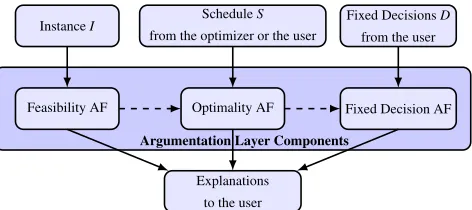
We approach the issue of explaining, using AA, whether and why the solutions to the makespan scheduling problem are ‘good’ in three steps, as illustrated in Figure 2.InstanceI ScheduleS from the optimizer or the user
Fixed DecisionsD from the user
Argumentation Layer Components
Feasibility AF Optimality AF Fixed Decision AF
Explanations to the user
Figure 2: Argumentation layer components in ArgOpt: (i) the feasibility AF(ArgsF, F)takes an instanceIand ex-plains whether a given schedule forIis feasible; (ii) the op-timality AF(ArgsS, S)takes the instanceIrepresented via
(ArgsF, F)and a scheduleS forI, and explains whether Sis efficient; (iii) the fixed decision AF(ArgsD, D)takes either (ArgsF, F) with a schedule or (ArgsS, S), some fixed decisionsDand explains whether the schedule satis-fies these decisions.
into a schedule-specific AF by modifying the attack rela-tion, so that the schedule satisfying optimality conditions equates to the corresponding extension being stable. Lastly, we capture fixed decisions for a specific schedule in the ab-sence of optimality considerations, in the sense of mapping the fixed decisions into an AF by modifying the attacks, so that the schedule satisfying fixed decisions equates to the corresponding extension being stable.
The design of the proposed AFs incorporates tractabil-ity. First, the mappings from the makespan scheduling prob-lem to AA are polynomial. Second, explaining whether and why a given schedule is feasible and/or efficient (optimality) and/or satisfies fixed user decisions amounts toverifyingif the corresponding stable extension is stable in the relevant AF; this problem is also polynomial.
We chose stable extensions as the underlying seman-tics for the following reasons. 1. The makespan schedul-ing problem requires all jobs to be assigned, so we need a “global” semantics (Dung 1995) and stable semantics is one such. 2. Verification of stable extensions is polynomial, allowing us to meet the computational tractability desider-atum. 3. Other semantics are either non-global (e.g. the grounded extension) or have non-polynomial verification (e.g.coNP-complete for preferred extensions).
4.1
Feasibility
We model the feasibility space of makespan scheduling in AA to be able to explain why a user’s proposed schedule is or not feasible. We do this by mapping assignment vari-ables (binary decisions) to arguments and capturing feasibil-ity constraints via attacks. Specifically, argumentai,jstands for an assignment of job j∈ J to machinei∈ M. Attacks among arguments model pairwise incompatible decisions:
ai,j andak,l attacking each other models the incompatibil-ity of assignmentsai,j andak,l. Intuitively, the attack rela-tion encodes different machines competing for the same job. Formally:
Definition 4.1. Thefeasibility AF(ArgsF, F)is given by • ArgsF={ai,j : i∈ M,j∈ J },
• ai,j Fak,l iff i6=kand j=l.
The following definition formalizes a natural bijective mapping between schedules and extensions.
Definition 4.2. Let (ArgsF, F)be the feasibility AF. A scheduleSand an extensionE⊆ArgsF arecorresponding, denotedS≈E, when the following invariant holds:
xi,j=1 iffai,j∈E.
With this correspondence, the feasibility AF encodes ex-actly the feasibility of the makespan scheduling problem, in that feasible schedules coincide with stable extensions:
Theorem 4.1. Let (ArgsF, F) be the feasibility AF. For any S≈E, S is feasible iff E is stable.
Proof. LetEbe a stable extension of(ArgsF, F). To prove that the corresponding schedule S is feasible, we need to show that Equation 1d holds:∑mi=1xi,j=1 for any j∈ J.
Asxi,j∈ {0,1} ∀i,j, we have∑mi=1xi,j∈N∪ {0}. Suppose
for a contradiction that for some j∈ Jwe have∑mi=1xi,j6=1. a) First assume∑mi=1xi,j>1. Thenai,j,ak,j∈E for some i6=k. But then ai,j F ak,j, whenceE is not conflict-free. This contradictsEbeing stable.
b) Now assume ∑mi=1xi,j =0. Thenai,j 6∈E ∀i∈ M. By definition of F, we then haveE6 Fai,jfor anyi∈ M. In particular,E6 Fa1,j. This contradictsEbeing stable. We next prove that if S is a feasible schedule, then the corresponding extensionEis stable in(ArgsF, F).
We have∑mi=1xi,j=1 for any j∈ J becauseSis feasible. This means that for every j∈ J,E contains one and only oneai,j for somei∈ M. Thus, by definition of F, E is conflict-free. Moreover, for any j∈ J,ai,j∈Eattacks every otherak,jwithk6=i. Hence,Eis stable in(ArgsF, F).
Example 4.3. LetM={1,2},J ={1,2}, e.g. 2 nurses for 2 tasks. Figure 3a) depicts the feasibility AF(ArgsF, F). It has 4 stable extensions:{a1,1,a1,2},{a1,1,a2,2},{a2,1,a1,2}, {a2,1,a2,2}. They correspond to the 4 feasible(M,J) ros-tering schedules where each task is completed by 1 nurse.
Finally, note that constructing the feasibility AF, as well as verifying if a given schedule is feasible, is polynomial:
Lemma 4.2. The feasibility AF(ArgsF, F) can be con-structed in O(nm2) time. Verifying whether an extension E⊆ArgsF is stable can be done in O(n2m2)time.
4.2
Optimality Conditions
We model optimality conditions in AA to be able to explain why a user’s proposed schedule is or not efficient. Lemma 3.2 implies that if a feasible schedule S can be improved by making a single exchange, i.e.Sviolates SEP, thenSis not optimal. Likewise, Lemma 3.2 implies that if a feasible scheduleScan be improved by making a pairwise exchange, i.e.Sviolates PEP, thenSis not optimal.
a) a1,1 a1,2
a2,1 a2,2
b) a1,1 a1,2 a1,3
a2,1 a2,2 a2,3
c) a1,1 a1,2
a2,1 a2,2
d) a1,1 a1,2
a2,1 a2,2
e) a1,1 a1,2
a2,1 a2,2
Figure 3: In all graphs depicting AFs, nodes hold arguments and edges hold attacks and (dashed) non-attacks. a) Feasibility AF of Example 4.3. b) Optimality AF of Example 4.5; (dashed) box highlights the extension (and the corresponding schedule) in question; in Example 5.7, the non-attack (dashed) explains why the schedule is not near-optimal, particularly violates SEP. c) Fixed decision AF of Example 4.7; the box indicates the unique stable extension. d) Feasibility AF with non-attacks (dashed) explaining why the schedule of Example 5.6 (the corresponding extension of which is highlighted in the (dotted) box) is not feasible. e) Fixed decision AF with the non-attack (dashed) explaining why the schedule of Example 5.8 (the corresponding extension of which is highlighted in the (dotted) box) violates fixed decisions.
Ci=Cmax) and all the associatedcritical jobs j(such that xi,j =1). Then, for any (critical) pair (i,j)and any other machinei06=i, ifCi>Ci0+pj, thenSviolates SEP and can be improved by making the single exchange of moving job jfrom machineito machinei0. We model this byremoving the attack ai,j F ai0,j from (ArgsF, F), and this repre-sents that machineishould not be competing for job jwith machinei0. Similarly, for any (critical) pair (i,j) and any other machine i06=i assigned some other job j0 6= j with pj>pj0, ifCi+pj0>Ci0+pj, thenSviolates PEP and can be improved by a pairwise exchange of j and j0 fromito i0. We model this byaddingan attack fromai0,j0 toai,j in
(ArgsF, F), and this represents that assigning j0toi0 con-flicts with assigning jtoibecause the latter is less efficient.
Definition 4.4. Let(ArgsF, F)be the feasibility AF andS a schedule. Theoptimality AF(ArgsS, S)is given by • ArgsS=ArgsF,
• S=
F\{(ai,j,ai0,j) : Ci=Cmax,xi,j=1,Ci>Ci0+pj}
∪ {(ai0,j0,ai,j) : Ci=Cmax,xi,j=1,xi0,j0=1,i06=i,j06=j,
pj>pj0,Ci+pj0>Ci0+pj}.
We say that(ArgsF, F)isunderlying(ArgsS, S).
To determine whether the user’s proposed schedule is ef-ficient we just need to check if the corresponding extension is stable in the optimality AF:
Theorem 4.3. Let (ArgsF, F)be the feasibility AF, S a schedule and S≈E. Let(ArgsS, S)be the optimality AF. Then E is stable in(ArgsS, S)iff S is feasible and satisfies both SEP and PEP.
Proof. LetE be stable in(ArgsS, S). Then E is conflict-free in(ArgsF, F), because the attacks removed to capture SEP only make asymmetric attacks symmetric, and the tacks added to capture PEP are among arguments not at-tacking each other in (ArgsF, F). For the same reason E is also stable in (ArgsF, F). Hence, S is feasible, by Theorem 4.1. Moreover, as E is stable, ∀j ∈ J we find
ai,j ∈E with ai,j Sai0,j ∀i06=i. This means no attacks were removed from F to obtain S, so, in particular, Ci=Cmax,xi,j=1,Ci>Ci0+pjcannot hold for any(i,i0,j). Hence,S satisfies SEP. Similarly, asE is conflict-free, we have that Ci=Cmax,xi,j=1,xi0,j0 =1,i06=i,j0 6= j,pj >
pj0,Ci+pj0 >Ci0+pj cannot all hold for any (i,i0,j,j0).
Hence,Ssatisfies PEP.
IfSis feasible, thenEis stable in(ArgsF, F). IfS satis-fies SEP and PEP, then S= F. So ifSis feasible and sat-isfies SEP and PEP, thenEis stable in(ArgsS, S)too.
Example 4.5. LetM={1,2},J={1,2,3}andp1=p3= 1, p2=2. Let scheduleSbe given byx1,1=x1,2=x2,3=1 andx2,1=x2,2=x1,3=0, e.g. nurse 1 completes jobs 1 and 2, and nurse 2 does job 3.Sis feasible withC1=x1,1p1+ x1,2p2+x1,3p3=3 andC2=1. So nurse 1 is critical, i.e. serves the longest shift, and both jobs 1 and 2 are critical. SinceC1=3>2=1+1=C2+p1andC1+p3=4>3= C2+p2, scheduleSviolates SEP and PEP.
So, given the feasibility AF (ArgsF, F), construct the optimality AF(ArgsS, S)specific toSwith:
• ArgsS=ArgsF={ai,j : i∈ {1,2}, j∈ {1,2,3}}, • S={(ai,j,ai,l) : j6=l} \ {(a1,1,a2,1)} ∪ {(a2,3,a1,2)}. Figure 3b) depicts the resulting(ArgsS, S). The extension
{a1,1,a1,2,a2,3} ≈Sis not stable in(ArgsS, S)because (i) it has conflicta2,3 Sa1,2and (ii) it does not attacka2,1.
As for feasibility, constructing the optimality AF, as well as verifying if a given schedule is efficient, is polynomial: Lemma 4.4. Given a schedule S, the optimality AF
(ArgsS, S)can be constructed in O(nm2)time. Verifying whether an extension E⊆ArgsS, such that E≈S, is stable can be done in O(n2m2)time.
4.3
Fixed User Decisions
We model fixed user decisions to be able to explain why a given schedule satisfies or violates the given fixed decisions. We do this, given either a feasibility or an optimality AF, by modifying the attacks in the (underlying) feasibility AF. Specifically, a negative decision induces a self-attack on the respective argument, whereas a positive decision results in removal of all the attacks on the respective argument. Definition 4.6. Let(ArgsF, F)be the feasibility AF, pos-sibly underlying a given optimality AF(ArgsS, S), and let D= (D−,D+) be fixed decisions. The fixed decision AF
(ArgsD, D)is given by
• ArgsD=ArgsF,
Fixed decisions thus result in the respective arguments be-ing self-attacked or unattacked. This yields the followbe-ing.
Theorem 4.5. Let S be a schedule, (ArgsF, F)the fea-sibility AF, possibly underlying a given optimality AF
(ArgsS, S), E ≈S, D a fixed decision, (ArgsD, D)the fixed decision AF. Then S is feasible and satisfies D iff E is stable in(ArgsD, D).
Example 4.7. In Example 4.3, letD−={(2,2)}andD+= {(1,1)}, e.g. nurse 2 cannot do job 2 and nurse 1 must do job 1. ThenD= (D−,D+). The fixed decision AF(ArgsD, D)
is depicted in Figure 3c). It has a unique stable extension
{a1,1,a1,2}, which corresponds to the unique feasible sched-ule satisfyingD, in which nurse 1 is assigned both jobs.
Clearly, modeling fixed decisions is polynomial:
Lemma 4.6. Given a schedule S, the fixed decision AF
(ArgsD, D)can be constructed in O(n2m2)time. Verifying whether the extension E⊆ArgsD, such that E≈S, is stable can be done in O(n2m2)time.
Efficiently capturing feasibility constraints, optimality conditions and fixed decisions in AA allows us to provide tractable explanations refuting or certifying ‘goodness’ of the schedules generated by the optimization solver or else proposed by the user. We do this next.
5
Explanations
We here formally define argumentative explanations as to why a given schedule is not ‘good’. We define two types of explanations: in terms ofattacksandnon-attacksin AFs.
At a high-level, if a given scheduleSis not feasible, ef-ficient or violates fixed decisions, the formal argumenta-tive explanations allow to identify which assignments, rep-resented by arguments, are responsible. In addition, exis-tence or non-exisexis-tence of attacks with respect to the iden-tified arguments determines the reasons as represented by the attack relationships of different AFs: feasibility, opti-mality and fixed decisions. Thus identified assignments and reasons allow to instantiate argumentative explanations with templated natural language generated (NLG) explanations to be given to the user, e.g. as in (Zhong et al. 2019). Further, ifSis ‘good’ as far as AFs can model, an NLG explanation can be given relating to the properties satisfied byS.
5.1
Explanations via Attacks
Explanations via attacksconcern schedule feasibility, pair-wise exchanges and negative fixed decisions. We focus on attacks among arguments in the extensionEcorresponding to a given scheduleS. These attacks makeE non-conflict-free and hence not stable, and arise wheneverSis not feasi-ble due to some job assigned to more than one machine, or violates either PEP or negative fixed decisions. We exploit this to define argumentative explanations for whyS is not feasible, not efficient or violates fixed decisions.
Definition 5.1. LetSbe a schedule,E≈Sand(Args, )∈ {(ArgsF, F),(ArgsS, S),(ArgsD, D)}. We say that an attacka bwitha,b∈E explains why S:
• is not feasible, when(a,b)∈ F;
• is not efficient, when(a,b)∈ S\ F;
• violates fixed decisions, when(a,b)∈ D\ F. So, if a given scheduleS(i) is either not feasible due to some job assigned to more than one machine ( F), (ii) or is not efficient due to some improving pairwise exchange ( S\ F), (iii) or assigns some job contrary to a nega-tive fixed decision ( D\ F), then the particular reason together with the relevant assignments is indicated. This al-lows to give an NLG explanation via template
S{ •is not feasible;•is not efficient;•violates fixed decisions}because attackai,j ak,lshows that{ •two machinesiandkare assigned the same job j=l;•S can be improved by swapping jobs jandlon machines iandk;•jobi=kis assigned to machine j=lcontrary to the negative fixed decision(i,j)}
with cases chosen and indices i,j,k,l instantiated accord-ingly. We exemplify this in the three settings next.
Example 5.2. In Example 4.3, let scheduleS be given by x1,1=x2,1=1 andx1,2=x2,2=0.Sis not feasible, because job 1 is assigned to 2 machines (e.g. nurses). We haveS≈ E={a1,1,a2,1}. Any of the attacksa1,1 a2,1anda2,1
a1,1in the feasibility AF(ArgsF, F) = (Args, )explains whySis not feasible: see Figure 3a). One NLG explanation is:Sis not feasible because attacka1,1 a2,1shows that two machines (e.g. nurses) 1 and 2 are assigned the same job 1. Example 5.3. In Example 4.5, the attack a2,3 a1,2 in the optimality AF (ArgsS, S) = (Args, ) explains why S≈ {a1,1,a1,2,a2,3}is not efficient, particularly as it violates PEP: see Figure 3b). The NLG explanation:Sis not efficient because attacka2,3 a1,1shows thatScan be improved by swapping jobs 3 and 2 between machines 2 and 1.
Example 5.4. In Example 4.7, the self-attacka2,2 a2,2 in the fixed decision AF(ArgsD, D) = (Args, )explains whyS≈ {a1,1,a2,2}violates the negative fixed decisionD− represented by the self-attack: see Figure 3c). The NLG ex-planation is:Sviolates fixed decisions because attacka2,2
a2,2shows that job 2 is assigned to machine (e.g. nurse) 2 contrary to the negative fixed decision(2,2).
5.2
Explanations via Non-Attacks
Explanations via non-attacks concern schedule feasibility, single exchanges and positive fixed decisions. We here fo-cus on arguments outside the extension which are not at-tacked by the extensionEcorresponding to a given schedule S. Such non-attacks result inE being not stable, and arise wheneverSis not feasible due to some unassigned job, or vi-olates either SEP or positive fixed decisions. As in the case of explanations via attacks, we exploit this to define argu-mentative explanations for whySis not feasible, not efficient or violates fixed decisions.
Definition 5.5. LetSbe a schedule,E≈Sand(Args, )∈ {(ArgsF, F),(ArgsS, S),(ArgsD, D)}. We say that a non-attack E6 bwithb6∈E explains why S:
• is not feasible, when = F;
• is not efficient, when = Sandb SE;
As with explanations via attacks, if a given schedule is not ‘good’, then the particular reason together with the rel-evant assignments is indicated. This allows to give an NLG explanation via template
S{ •is not feasible;•is not efficient;•violates fixed decisions} because non-attackE 6 ak,l shows that{ •joblis not scheduled;•Scan be improved by moving joblto machinek;•joblis not assigned to machinek contrary to the positive fixed decision(k,l)}
with cases chosen and indicesi,j,k,l instantiated accord-ingly. We exemplify this in the three settings next.
Example 5.6. In Example 4.3, let scheduleS be given by x1,1=1 andx1,2=x2,1=x2,2=0. We haveS≈E={a1,1}. Both non-attacks E6 a1,2 andE 6 a2,2in the feasibility AF(ArgsF, F) = (Args, )explain whySis not feasible: see Figure 3d). One NLG explanation is:Sis not feasible be-cause non-attackE6 a1,2shows that job 2 is not scheduled. Example 5.7. In Example 4.5, the non-attackE6 a2,1in the optimality AF(ArgsS, S) = (Args, )explains whyS is not efficient, as it violates SEP: see Figure 3b). The NLG explanation is:Sis not efficient because non-attackE6 a2,1 shows that the longest completion (e.g. shift) time can be reduced by moving job 1 to machine (e.g. nurse) 2.
Example 5.8. In Example 4.7, let scheduleS be given by x1,2=x2,1=1,x1,1=x2,2=0. Then{a1,2,a2,1}=E≈S. In the fixed decision AF(ArgsD, D) = (Args, ), the non-attackE6 a1,1 explains whyS violates the positive fixed decisionD+ represented by the unattacked argument a1,1: see Figure 3e). The NLG explanation is:Sviolates fixed de-cisions because non-attackE6 a1,1shows that job 1 is not assigned to machine (e.g. nurse) 1 contrary to the positive fixed decision(1,1).
5.3
Desiderata for ArgOpt
We now show that our argumentative explanations meet the desiderata stated in Section 3.
Theorem 5.1. Let S be a schedule, E≈S and(Args, )∈ {(ArgsF, F),(ArgsS, S),(ArgsD, D)}.
• S is not feasible / is not efficient / violates fixed deci-sions, respectively, iff: either there is an attacka bwith
a,b∈E or there is a non-attack E6 bwithb6∈E, ex-plaining why S is not feasible / is not efficient / violates fixed decisions, respectively.
• Explaining why S is not feasible / is not efficient / violates fixed decisions can be done in O(n2m2)time.
• Each explanation is polynomial in the size of S.
This result shows that ArgOpt meets the desiderata of soundness and completeness, computational and cognitive tractability. Theorem 5.1 also implies that we can provide explanations if and when the given scheduleSis ‘good’. In-deed, ifSis feasible / efficient / satisfies fixed decisions, then the corresponding extensionEis acertificatein the feasibil-ity / optimalfeasibil-ity / fixed decision AF to the ‘goodness’ ofS. This certificate can help the user understand the accompa-nying NLG explanations as to why the schedule is ‘good’.
For instance, consider the fixed decision AF and its unique stable extensionE={a1,1,a1,2}as in Figure 3c).Ecertifies
that scheduleS≈E where nurse 1 does both jobs 1 and 2 is feasible and meets the fixed decisions: nurse 1 is assigned job 1 because of e.g. a manager request, as per the positive fixed decision(1,1)represented by the unattacked argument
a1,1; similarly, nurse 1 is assigned job 2 because e.g. nurse 2 is unqualified, as per the negative fixed decision(2,2) rep-resented by the self-attacking argumenta2,2.
6
Related Work
To the best of our knowledge, there are no works concern-ing either explainable schedulconcern-ing or integratconcern-ing argumenta-tion and optimizaargumenta-tion to explain the latter. Some preliminary works consider explainable planning, e.g. (Fox, Long, and Magazzeni 2017), which is generally different from schedul-ing. Argumentation can also be used for making and ex-plaining decisions, e.g. (Amgoud and Prade 2009; Zeng et al. 2018), but mainly in multicriteria decision making which is a different setting from ours. Integration-wise, abduction is used for scheduling, as in e.g. (Kakas and Michael 2001; Bernard, Borillo, and Gaume 1991), but not for the purpose of explaining. Optimization can be used to implement argu-mentation solvers, e.g. by mapping AFs to constraint satis-faction problems (Bistarelli and Santini 2010), which is op-posite to using argumentation to supplement optimization.
Argumentation-based explanations in the literature are by and large formalized as (sub-)graphs/trees within AFs, see e.g. (Garc´ıa et al. 2013; Fan and Toni 2015; ˇCyras et al. 2018; Rago, Cocarascu, and Toni 2018; Zeng et al. 2018). There the user needs to follow the reasoning chains repre-sented by the graphs to deduce the reasons for why a particu-lar argument (representing e.g. a statement, a decision, a rec-ommendation) is acceptable. In contrast, our argumentative explanations consist of at most two decision points (argu-ments) and the associated relationship ((non-)attack). They can thus be seen as paths of length 1 that pinpoint exactly which decisions violate which properties for a given sched-ule and optimization considerations, without the need to fol-low possibly lengthy chains of arguments. Our explanations are thus cognitively tractable. They can also be efficiently generated and afford natural language interpretations.
Other graph-based models could be used to explain deci-sions of, in particular, machine learning classifiers, e.g. or-dered decision diagrams as in (Shih, Choi, and Darwiche 2018) and decision trees as in (Frosst and Hinton 2017). Moreover, natural language explanations could also be used for explanations, e.g. via counterfactual statements for ma-chine learning predictions (Sokol and Flach 2018). We leave the study of relationships and formal comparison to such ap-proaches for future work.
argumen-tation frameworks. These proposed argumentative explana-tions justify whether and why a given schedule is ‘good’ in those dimensions. We also establish the soundness and com-pleteness of argumentative explanations, prove that they can be efficiently extracted and show how argumentative expla-nations can give rise to natural language explaexpla-nations.
This work explicitly incorporates an example that assigns jobs to specific nurses. Each job is completed exactly once and the goal is that everyone gets to leave work as quickly as possible. Ourfixed decisionsetting also recognizes that some nurses have (or lack) particular skills and therefore cer-tain nurses cannot be assigned cercer-tain jobs. But we could in-corporate more modeling requirements into this framework, e.g. introduce constraints incorporating contractual obliga-tions such as a number of shifts per week or design the so-lution so that it is more robust to uncertainty (Letsios and Misener 2018). Moreover, we have shown how to incorpo-rate explanations for some necessary optimality conditions, but we could also develop intuitive explanations for other optimality concepts such as fractional relaxations or cutting planes. We leave these extensions for future work.
Acknowledgements The authors were funded by the EP-SRC project EP/P029558/1 ROAD2H, except for Dim-itrios Letsios who was funded by the EPSRC project EP/M028240/1Uncertainty-Aware Planning and Schedul-ing in the Process Industries.
Data access statement: No new data was collected in the course of this research.
References
Amgoud, L., and Prade, H. 2009. Using Arguments for Making and Explaining Decisions.Artif. Intell.(3-4):413–436.
Atkinson, K.; Baroni, P.; Giacomin, M.; Hunter, A.; Prakken, H.; Reed, C.; Simari, G. R.; Thimm, M.; and Villata, S. 2017. Towards Artificial Argumentation.AI Mag.38(3):25–36.
Bernard, D.; Borillo, M.; and Gaume, B. 1991. From event cal-culus to the scheduling problem. semantics of action and temporal reasoning in aircraft maintenance.Appl. Intell.1(3):195–221. Bistarelli, S., and Santini, F. 2010. A Common Computational Framework for Semiring-based Argumentation System. In Coelho, H.; Studer, R.; and Wooldridge, M., eds.,19th European Confer-ence on Artificial IntelligConfer-ence, 131–136.
Brucker, P. 2007.Scheduling Algorithms (5th Ed.). Springer. Burke, E. K.; De Causmaecker, P.; Berghe, G. V.; and Van Lan-deghem, H. 2004. The state of the art of nurse rostering. J. Scheduling7(6):441–499.
ˇ
Cyras, K.; Fan, X.; Schulz, C.; and Toni, F. 2018. Assumption-Based Argumentation: Disputes, Explanations, Preferences. In Ba-roni, P.; Gabbay, D. M.; Giacomin, M.; and van der Torre, L., eds., Handbook Of Formal Argumentation. College Publications. Dung, P. M. 1995. On the Acceptability of Arguments and its Fun-damental Role in Nonmonotonic Reasoning, Logic Programming and n-person Games.Artif. Intell.77:321–357.
Dunne, P. E., and Wooldridge, M. 2009. Complexity of Abstract Argumentation. In Simari, G. R., and Rahwan, I., eds., Argumen-tation in Artificial Intelligence. Springer. 85–104.
Fan, X., and Toni, F. 2015. On Computing Explanations in Argu-mentation. In Bonet, B., and Koenig, S., eds.,29th AAAI Confer-ence on Artificial IntelligConfer-ence, 1496–1502.
Fox, M.; Long, D.; and Magazzeni, D. 2017. Explainable Planning. In Aha, D. W.; Darrell, T.; Pazzani, M.; Reid, D.; Sammut, C.; and Stone, P., eds.,1st Workshop on Explainable Artificial Intelligence. Frosst, N., and Hinton, G. E. 2017. Distilling a neural network into a soft decision tree. In1st International Workshop on Comprehen-sibility and Explanation in AI and ML.
Garc´ıa, A. J.; Ches˜nevar, C.; Rotstein, N.; and Simari, G. R. 2013. Formalizing Dialectical Explanation Support for Argument-Based Reasoning in Knowledge-Based Systems. J. Exp. Syst. Appl. 40:3233–3247.
Garey, M. R., and Johnson, D. S. 1979.Computers and Intractabil-ity: A Guide to the Theory of NP-Completeness. W. H. Freeman. Graham, R. L. 1969. Bounds on multiprocessing timing anomalies. SIAM J. Appl. Math.17(2):416–429.
Kakas, A. C., and Michael, A. 2001. An abductive-based scheduler for air-crew assignment. Appl. Artif. Intell.15(3):333–360. Letsios, D., and Misener, R. 2018. Exact lexicographic scheduling and approximate rescheduling. arXiv preprint arXiv:1805.03437. Leung, J. Y., ed. 2004. Handbook of Scheduling - Algorithms, Models, and Performance Analysis. Chapman and Hall - CRC. Moulin, B.; Irandoust, H.; B´elanger, M.; and Desbordes, G. 2002. Explanation and Argumentation Capabilities: Towards the Creation of More Persuasive Agents.Artif. Intell. Rev.17(3):169–222. Moz, M., and Vaz Pato, M. 2007. A genetic algorithm approach to a nurse rerostering problem. Comput. Oper. Res.34(3):667–691. Logistics of Health Care Management.
Rago, A.; Cocarascu, O.; and Toni, F. 2018. Argumentation-Based Recommendations: Fantastic Explanations and How to Find Them. In 27th International Joint Conference on Artificial Intelligence, 1949–1955.
Sacchi, L.; Rubrichi, S.; Rognoni, C.; Panzarasa, S.; Parimbelli, E.; Mazzanti, A.; Napolitano, C.; Priori, S. G.; and Quaglini, S. 2015. From Decision to Shared-decision: Introducing Patients’ Preferences Into Clinical Decision Analysis. Artif. Intell. in Med. 65(1):19–28.
Shih, A.; Choi, A.; and Darwiche, A. 2018. A Symbolic Approach to Explaining Bayesian Network Classifiers. In27th International Joint Conference on Artificial Intelligence, 5103–5111.
Sokol, K., and Flach, P. 2018. Conversational Explanations of Machine Learning Predictions Through Class-contrastive Counter-factual Statements. In27th International Joint Conference on Ar-tificial Intelligence, 5785–5786.
Sørmo, F.; Cassens, J.; and Aamodt, A. 2005. Explanation in Case-Based Reasoning–Perspectives and Goals. Artif. Intell. Rev. 24(2):109–143.
Warner, D. M., and Prawda, J. 1972. A mathematical programming model for scheduling nursing personnel in a hospital.Manag. Sci. 19:411–422.
Williamson, D. P., and Shmoys, D. B. 2011. The Design of Ap-proximation Algorithms. Cambridge University Press.
Zeng, Z.; Fan, X.; Miao, C.; Leung, C.; Jing Jih, C.; and Yew Soon, O. 2018. Context-based and Explainable Decision Making with Argumentation. In17th International Conference on Autonomous Agents and MultiAgent Systems, 1114–1122.