PREDICTORS OF ENGAGEMENT WITH SUPPORT
SERVICES IN A SAMPLE OF UK VICTIMS OF VIOLENT
CRIME
Michelle Lowe, V. J. Willan, Roxanne Khan, Matthew Brooks, Phaedra Robinson, Nicola
Graham-Kevan, Rachel Stokes, May Irving, Marta Karwacka & Joanne Bryce, University of
Central Lancashire
Abstract
Research suggests that engagement with support services after criminal victimisation is low. With this in mind, this study investigated predictors of engagement with Victim Support, in a sample of victims of violent crime. All violent crimes recorded by Lancashire Constabulary for two postcode areas (PR1 and PR2), who were referred to Victim Support (Preston) between April 2013 and September 2013 (n=869) were assessed, with a follow-up undertaken in 2014. Two percent of victims booked or attended a face-to-face meeting with Victim Support, and just over one fifth engaged over the telephone on at least one occasion across a range of support options at the initial data collection point. Engagement with Victim Support was not significantly related to future victimisation. When revictimisation since the first data collection period was inspected against demographic and crime-related variables, previous victimisation, regardless of the type of crime experienced, was the strongest predictor of being victimised again. This was despite the fact that such victims were more likely to be identified as high risk, and actively engaged with Victim Support at the initial time of victimisation. Suggestions for further research are made in light of the changes generally to victim services in the UK.
Keywords
Introduction
One of the major developments in United Kingdom criminal justice in the last 40 years has been the shift toward the needs of victims as a primary focus (Burrows, 2014), with an escalation of services funded by central government (Spalek, 2005). Despite such commitments, current research suggests that confidence and engagement with the Criminal Justice System and victim support services generally, is less than satisfactory (Bradford, Jackson & Stanko, 2009). More work is needed to explore factors that disengage victims from reporting crime and receiving support after victimisation.
Victim support services have an important role in the care of crime victims. Victim Support is a large independent charity that has offered services to victims and witnesses of crime, and their families, in England and Wales over the last 40 years. Most victims of violent crime who report a victimisation experience to the police are referred to Victim Support as a formal form of support service (Victim Support, Personal Communication, 2013). Victim Support provide face-to-face and telephone help, including emotional support, advice on personal safety and other practical issues, support throughout the Criminal Justice process and advocacy. According to their website, in 2013, Victim Support was aided by approximately 1,400 staff and 4,300 volunteer workers. It currently operates a dedicated Homicide Service, which supports people bereaved through murder and manslaughter, and more than 100 projects throughout the UK tackling, for example, domestic violence, antisocial behaviour, racial, homophobic and disablement hate crime, and a national telephone support service that operates six days per week. The have also developed partnerships with other organisations, such as those concerned with health, children, women's rights, racial equality, the police, and local authorities (Spalek, 2005). Bradford (2011) showed that Victim Support engagement increased levels of confidence and perceptions of the effectiveness of the Criminal Justice System by providing victims with a voice and a sense that someone is listening and taking their concerns seriously.
secondary victimisation, which are as difficult to cope with as the effects of the victimisation experience itself (e.g. Walker, Archer & Davies, 2005). Engaging with victim support services, especially those that are seen as being aligned to criminal justice services, may be particular difficult if secondary victimisation is feared.
In extension, Zarafonitou (2011) proffered a political viewpoint about victim service disengagement, such that victims may believe that formal support services (such as Victim Support) are government-backed and as such, perceived negatively. This then drives those that feel they do need help after victimisation towards informal support systems, such as online support groups, which tend to be accessed more readily than formal ones (AuCoin & Beauchamp, 2004). Despite informal services being of use to some victims, formal support services like Victim Support, have advantages because they offer a variety of services within one organisation.
It has been acknowledged for many years that criminal victimisation is clustered, with some individuals and crimes committed within certain locations accounting for a disproportionate amount of victimisation (Outlaw, Ruback & Britt, 2002). For example, victims who live in high-density areas that are socially disorganised tend to have higher revictimisation rates; as do those with personal demographics like being male, being of a minority status, having witnessed violence in the past, and having risky routines and lifestyles (c.f. Cohen & Felson, 1979; see Outlaw et al., 2002 for a discussion). Moreover, we know that victimisation experiences early in life can make individuals vulnerable to revictimisation, sometimes of multiple types of crimes, later in life (e.g. Gold, Sinclair & Balge, 1999; Messman-Moore & Long, 2003), creating a cycle of victimisation experiences that is difficult to break.
The costs of revictimisation to the police, victim support services, and to society in general are many, with interventions being difficult, time-consuming and expensive to implement (Outlaw et al., 2002). Costs to the victim are also high. Being repeatedly victimised is a risk factor for complex trauma and increased vulnerability in the long term, which Winkel, Blaauw, Sheridan and Baldry (2003) found frequently not detected, and thus not supported, by victim support services. Such untreated complex trauma has many hidden costs to policing, medical and other services in the future. As early as 1992, Farrell indicated that victim support services tended to respond to crime as single, discrete events, rather than as one experience amongst others that the victim may have reported previously. Although knowledge about revictimisation has increased across services, still, in the UK there is a general pattern of assessing individual victimisation events as stand-alone entities. Investigating the causes of revictimisation to increasing service engagement, in hope of reducing revictimisation in future, is a key target among UK policing services. The current research is timely in this regard. Specifically, the current study investigated predictors of service use at Victim Support, in a sample of UK victims of violent crime within one location (Preston, Lancashire) measured over one six-month time period (April 2013-September 2013) with a 12 month follow up, to investigate further victimisation experiences and offences.
criminal offences, and some offenders having been violently victimised (Schreck, Ousey, Fisher & Wilcox, 2012). Jennings, Piquero and Reingle (2011) reviewed 37 studies that spanned five decades (1958-2011) and found robust victim-offender overlaps in 31 of the studies. Findings were consistent regardless of historical and cross cultural samples, and regardless of the method of assessment or statistical techniques used to generate results. The victim-offender overlap was particularly apparent in domestic violence cases and in mental health populations. Recognising that victims and offenders are often the same individuals, with the same problems and risk factors, can assist service criminal justice providers who work with victims and offenders (Jennings, Higgins, Tewksbury, Gover, & Piquero, 2010). However, it is not yet known how the victim-offender overlap relates to the engagement with victim support service use after violent crime and whether engagement with victim support services (in this instance, Victim Support) can reduce both victimisation and offending in the future. This study investigates this possibility.
Preston, a city in the North West of England was chosen for this study for several reasons. It has a diverse population and relatively high level of social problems (Evans, 2012). In 2010, Preston was measured as the 59th most deprived area in the UK, out of a figure of 326 (Rogers, 2011). It has a higher rate of teenage pregnancy and unemployment than the North West region overall, and a higher violent crime rate than Lancashire generally. Between May 2013 and May 2014, 528 violent crimes were recorded in the city centre alone. This comprised 14.3 percent of all crimes in the area, the second-highest crime-group after anti-social behaviours (UK Crime Statistics, Lancashire Constabulary 2014). Preston’s relatively young and diverse population (Evans, 2012), coupled with the relative deprivation of the area and the consequent need to reduce violent crime and anti-social behaviour make it an ideal location to study crime prevention issues.
In this study, all violent crime cases recorded at Lancashire Constabulary and Victim Support were assessed within the allocated six-month time-period. Due to the potential high number of cases, only two postcodes were included; these were PR1, which covers the whole of Preston city centre and immediate surrounds, and PR2, which is a suburban area including a number of large housing estates. This study addressed two research questions: 1. the impact of engaging with Victim Support in terms of whether this reduces victimisation in the future; 2. the predictive ability of number of previous victimisations and offences, previous crime types, and demographic variables to predict those most likely to (a) fail to effectively engage with available services, and (b) be most vulnerable to future victimisation.
Method
Sample characteristics
2013. Updated data inputting of victimisation and offending events was then conducted for all cases in October 2014. The updated victimisation and offending data referred to events between October 1st 2013 and September 30th 2014.
The mean age of victims at the initial data collection point was 32.4 years (range: 16-90 years). Over a third of victims were aged 16-24 (n=300; 35.3%) at the time of victimisation. The majority of victims were White (n=664; 76.4%), followed by Asian (n=153; 17.6%), Black (n=17; 2.0%), Mixed (n=16; 1.8%) and other ethnicities (n=19; 2.2%). Victims were mostly either British or EU nationals (n=762; 88.1%), with a further 4.2 percent (n=36) as EEA (i.e. European Economic Area) member; and 7.7 percent (n=67) of other non EU or EEA nationalities. In total, 198 different occupations were recorded. For cases where occupational status was known (n=638; 73.5%), the victim was employed or in education in two-thirds of cases (n=421; 48.5%), unemployed in 22.6 percent of cases (n=196) and retired in the remaining cases (n=21; 2.4%). For cases referred to Victim Support, 627 victimisations (72.2%) occurred within PR1 and the remaining 242 victimisations (27.8%) in PR2.
Procedure
The police and Victim Support databases were accessed to identify and collate victim demographics, vulnerability factors, crime characteristics (victim and offending history) and support types for all violent crimes recorded for victims aged 16 and over within the allocated timeframes as described above. A total of 87 variables were identified (43 from police; 44 from Victim Support). A coding manual was produced to ensure that all researchers involved in the project coded variables identically. Following the identification of variables, data were inputted and collated into a single statistical database (SPSS v.22). A final database of 869 cases was produced where sufficient data could be utilised for further analysis and the index victimisation had occurred in either of the two defined postcodes (PR1 or PR2).
Victim demographics and vulnerability factors
The following factors were selected for inclusion in the analysis: victim gender, age, ethnicity, immigration status, known practical and psychological vulnerability factors (such as being physically disabled in the case of the former, and learning difficulties or mental health issues in the latter), risk factors found at the crime scene (e.g. victim intoxication), and location of index incident (PR1 or PR2).
Crime characteristics
Physical Assault, Major (46.7%; n=405); 3) Harassment and Hate Crime, Minor (16.2%; n=141); 4) Harassment and Hate Crime, Major (0.9%; n=8), and 5) Robbery (6.0%; n=52). Please note that in some analyses, empty cells meant that crime-types had to be collapsed further into just minor and major crimes.
There were three categories relating to the outcome of the victimisation case: 1) Restorative Justice; 2) Positive Outcome; and 3) Negative Outcome (e.g. Case cancelled, No crime, Prosecution not possible, Case closed). Victim-offender relationship was initially measured on six levels, reduced to four (plus unknown): Unknown, Stranger, Acquaintance, Ex-Partner, and Family/Partner.
Results Initial contacting
Victims were contacted by Victim Support (Preston), using the following methods of communication: telephone (45.6%), letter (54.0%), and text message (0.5%). An inspection of descriptive statistics shows that 23.5% (n=204) responded to this initial attempt at contact for needs assessment, therefore the majority of victims (n=665, 76.5%) were not contactable at this early stage and consequently no further engagement was possible. Once successful contact was achieved, the following face-to-face services were offered: Emotional Support, Personal Safety, Practical Support, CJS Support, Advocacy, and Further Support. A large proportion of victims did not book (97.1%) or attend (97.6%) appointments to access these resources, and those that did only attended one appointment (2.0%). Only one case was recorded as ‘ongoing’, the remaining cases were classified as ‘Complete’ (n=868).
Whilst it is apparent that victims do not attend the face-to-face sessions, a sizable proportion of victims (n=183) received support via the telephone only, as opposed to attending the centre, which included: Emotional Support (n=29); Personal Safety Support (n=16); Practical Support (n=32); Criminal Justice (n=28); Advocacy Support (n=14); Further Support (n=16). When the sample of victims who received telephone support only were combined with face-to-face session attendees, an independent samples t-test showed that revictimisation rates since the initial data collection point were not significantly affected by whether the victim engaged with services (telephone and/or attendance) or not; t (867)=.63, p=.529.
Analysis
The first research question investigated the impact of service engagement and whether this reduced victimisation in the future. The total number of face-to-face sessions attended at Victim Support was not significantly related to total revictimisations since the initial data collection point (two-tailed Pearson’s r=.06, p=.082), therefore not related to a reduced risk of future victimisation.
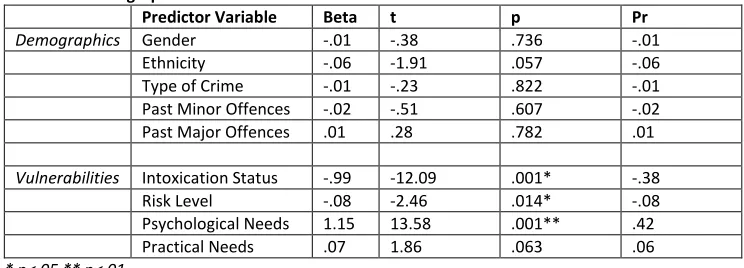
a) In the following analysis, the total number of appointments attended was considered a suitable indication of engagement and subsequently used as a measure of Engagement with Services. The Engagement with Services scores ranged from 0 to 4 appointments (M=.03, SD=.27). A statistical technique called Standard Multiple Regression was utilised to investigate what victim and crime characteristics might most likely predict service engagement. Possible predictors comprised: Gender, Ethnicity, Type of Crime, the victim’s Intoxication Status (at time of crime), Risk Level, Psychological and Practical needs. The victims’ past offending history for minor and major crimes were also included. The full results are presented in Table 1 below:
Table 1: Standard Multiple Regression to Test Engagement with Services and the Predictive Value for Victim Demographics and Vulnerabilities
Predictor Variable Beta t p Pr
Demographics Gender -.01 -.38 .736 -.01
Ethnicity -.06 -1.91 .057 -.06 Type of Crime -.01 -.23 .822 -.01 Past Minor Offences -.02 -.51 .607 -.02 Past Major Offences .01 .28 .782 .01
Vulnerabilities Intoxication Status -.99 -12.09 .001* -.38 Risk Level -.08 -2.46 .014* -.08 Psychological Needs 1.15 13.58 .001** .42 Practical Needs .07 1.86 .063 .06
* p<.05 ** p<.01
Results of the Multiple Regression model were significant, indicating that the predictors included had some relevance to whether or not victims engaged with services, F (9, 858)=38.59, p<.001, R2=.29 (Adj. R2=.28). In particular, the extent to which the victim was classified as having Psychological (β=1.15, p<.001), and marginally Practical Needs (β=.07, p=.063), reliably predicted an increased number of sessions attended at Victim Support. Likewise, other vulnerability factors included in the model were significant predictors of service engagement, i.e. Intoxication Status (β=-.99, p<.001) and Risk Level (β=-.08, p=.014), such that victims intoxicated on drugs or alcohol at the time of the index victimisation were subsequently less likely to engage with Victim Support than those not intoxicated. However, the majority of the sample were victims of threat and/or assault (Major and Minor; 46.7% and 30.2% respectively), whilst sober (n=665, 76.5%), and as such most victims were not considered ‘vulnerable’ at the time of the offence. Interestingly however, victims classified as low risk were likely to attend more sessions at Victim Support than those classified as high risk. Indeed, risk levels were deemed ‘Unknown’ for 84.4% of victims who did not engage. Thus, results relating to risk and vulnerability levels need to be interpreted with caution.
Victim Support M=.12, SD=.33) than those with minor (M=.02, SD=.24) and no injuries (M=.03, SD=.27).
b) A further standard Multiple Regression was conducted. In this analysis, possible predictor variables of the number of revictimisation experiences since the initial data collection point were investigated. Predictors comprised: Gender, Ethnicity, Relationship Association, Past Victimisation Rates, Past Offending Rates, Risk level, and Engagement with Services (total number of sessions attended).
The overall Multiple Regression model was significant, F (8, 797)=18.26 p<.001, R2=.16 (Adj. R2=.15). Three significant predictors emerged: 1. Past Victimisation Rates (β=.36, p<.001; pr=.36), 2. Engagement with Services (β=.07, p=.024; pr=.08), and, 3. Risk Level (β=.09, p=.049; pr=.07). Concluding from these results, it is particularly clear that previous victims were more likely to be revictimised in the future, even if they were recorded as high risk and were actively engaging with Victim Support at the time of the initial data recording.
Victim demographics, gender (β=-.04, p=.317) and ethnicity (β=.01, p=.821), did not significantly predict future revictimisation. Likewise, crime demographics such as type of crime (β=.00, p=.940) and relationship association between victim and offender (β=.06, p=.194) did not significantly predict future revictimisation. In addition, prior offending behaviour by the victim did not significantly predict future revictimisation (β=-.02, p=.640. The full Multiple Regression results are presented in Table 2 below.
Table 2: Standard Multiple Regression to Test Repeat Victimisation Rates and the Predictive Value for Victim Demographics and Past Offending
Predictor Variable Beta t p Pr
Gender -.04 -1.00 .317 -.04
Ethnicity .01 .23 .821 .01
Relationship .06 1.30 .194 .05
Crime Type .00 .08 .940 -.02
PVR .36 11.00 .001** .37
POR -.02 -.47 .640 -.02
Risk Level .09 1.97 .049* .07
ES .07 2.25 .024* .08
* p<.05 ** p<.01
Discussion
Grove, Farrell, Farrington & Johnson, 2012; Mayhew & Reilly, 2008; McCart et al., 2010; Sims et al., 2005; Steel, Blakeborough & Nicholas, 2011) and highlights important issues for victim support services and the police to consider. How these findings relate to the existing knowledge-base and their implications will be explored next.
One example of how the development of specialist victim services have failed to show reductions in repeated victimisation is the study of the successfulness of Multi-Agency Risk Assessment Conferences (MARACs) in England and Wales. MARACs were established in 2003 and are attended by relevant professional agencies (e.g. police and victim support agencies) to assess how best to manage ‘high risk’ victims of domestic violence. Despite approximately 270 MARACs in operation, reports suggest the evidence for their effectiveness at reducing revictimisation is untenable (see Steel et al., 2011 for further discussion). Moreover, in a systematic review of 31 studies on repeat victimisation, Grove et al. (2012) stated that preventing revictimisation was possible through appropriately-tailored situational crime prevention strategies. However, this did not include advice and education for crime victims alone: this method was not effective. Grove et al. noted an urgent need for further research into crime prevention for repeat victimisation across different crime-types with a focus upon the most victimised sub-groups, including what they called 'near repeats' (similar crimes, often committed nearby, soon after, against similar targets).
At the moment, in the UK, considering cases that might be considered near-repeats and cases that are deemed 'lower risk', is not a priority for specialist services. Taking domestic violence as the key example, a report by journalist, Nushra Mansuri, for the UK newspaper, The Guardian, in December 2014, highlighted the need for specialist service provision that is equipped to handle all victims that need it. In only providing specialist support via MARACs to those deemed to be in the top 10 percent of victims at risk of serious harm or domestic homicide, the vast majority of domestic violence victims are denied specialist help. It is unknown how many victims denied specialist services go on to be further victimised, continuing the cycle of revictimisation. Whilst it is accepted that services do not have limitless funds, it is clear that current practices are far from perfect and new ways need to be considered to better allocate resources to service all victims that do come forward. As the findings from the current study show that previous victimisation strongly predicts future victimisation, it is vital for services to consider interventions as early as possible in the victimisation-cycle, not just at the point from which a case is deemed high-risk.
not use such services (Sims, Yost & Abbott, 2006). It could be similarly in the UK Victim Support services are not creating improvements in psychological functioning that might reduce the risk of future victimisation.
As previously stated, the systematic review by Grove et al. (2012) found that advice-giving or education about crime did not reduce the chance of a victim being revictimised. The example they gave was one of sexual victimisation prevention schemes that aimed to educate repeat victims with advice about how to avoid or manage risky situations that could lead to future revictimisation. They noted that a key problem with education is that it may change attitudes but not the ability to change behaviour. A similar effect may have occurred in the current sample, such that advice from Victim Support may have positive attitudinal benefits, or may benefit engaging victims in some practical ways - but these alone not sufficient to prevent further victimisation.
Additionally, current findings showed that most willing to engage with Victim Support on a face-to-face basis, were those victims already considered physically and psychologically vulnerable, and those with serious physical injuries as a result of their victimisation. This may be because these victims were more aware of their need for support, or indeed, genuinely more in need of it than other victims. Victims not seriously injured during their victimisation experience may feel that their plight is trivial and that follow-up support is not needed. Victims in previous studies have shown the same post-victimisation reactions with conviction that they can cope with recovering on their own (e.g. Jaycox, Marshall & Schnell, 2004), therefore this finding is not unusual or unexpected.
Somewhat worryingly however, victims who were intoxicated on alcohol and/or drugs at the time of the initial victimisation incident were particularly not likely to engage with Victim Support. This could signify that vulnerable victims who do need emotional and practical support are not being reached by a service that could help them. In order to increase the use of Victim Support by vulnerable crime victims, it is necessary to put greater emphasis on highlighting to the public about what services are offered, with services that can meet the needs of specific victim groups, and if necessary, broadening the types of services provided to victims (c.f. Sims et al., 2005). In relation to the broadening of services, it has been known for over a decade that services that offer support to victims of crime tend to ignore symptomology that occurs in the months after a victimisation experience (Winkel et al., 2003). As such, one additional service that Victim Support could offer is specifically for chronic stress after criminal victimisation and/or to develop closer links with services that can provide this service for victims who require it. Interestingly, those victims recorded as high risk by the police were less likely to seek Victim Support help than those recorded as low risk. High risk victims are likely to be already receiving support from a number of other specialised services, such as those provided by domestic violence organisations and hence do not need additional support, but the data available to the authors at the time of data collection did not provide this information so could not be assessed further.
potential success of engagement. Psychological measures of sense of empowerment, or an increase in resiliency, may be more valuable indicators of success or recovery from an individual victim perspective than purely numeric measures. It was not possible to measure resiliency, empowerment, or other similar concepts in this study, because these variables were not recorded in the data. Using non-psychological, criminal justice data is always going to have limited scope for psychological investigation. That said, having a numeric measure of revictimisation and an investigation of its predictors, plus the data for subsequent victimisations as recorded in the follow-up data collection, is useful information for the police, service providers and future funders of victim services in Lancashire and beyond.
Within the UK at the current time, the future of victim services in general is being evaluated. The commissioning of referral services is transferring from the Ministry of Justice to localised Police and Crime Commissioners (PCCs) in April 2015. In some areas of the UK this transition has already begun. PCCs are in the process of identifying the highest quality, most cost-effective services. Understanding the ongoing needs of victims - which are often complex and long-standing - will identify gaps in existing services and areas where improvements and cost efficiencies can be made. In Lancashire, North West England, where this particular study was conducted, the change to PCC control has been under-way since October 2014 (Lancashire Constabulary, Personal Communication, 2014).
References
AuCoin, K., Beauchamp, D. (2007). Impacts and Consequences of Victimisation, GSS 2004. Canadian Centre for Justice Statistics. Retrieved 22nd August 2014, from
http://publications.gc.ca/Collection-R/Statcan/85-002-XIE/85-002-XIE2007001.pdf Bradford, B., Jackson, J. and Stanko, E. (2009) Contact and confidence: revisiting the
impact of public encounters with the police. Policing and Society, 19, 20-46 Burrows, J. (2014). Victim awareness. Re-examining a probation fundamental. The
Probation Journal, 61, 113-116
Cohen, L. E. and Felson, M. (1979). Social change and crime rates: A routine activities approach. American Sociological Review, 44, 588-608
Davies, M and Rogers, P. (2006). Perceptions of male victims in depicted sexual assaults: A review of the literature. Aggression and Violent Behaviour, A Review Journal, 11, 357-367
Davies, M. and Hudson, J. (2011). Judgements toward male and transgendered victims in a depicted stranger rape. Journal of Homosexuality, 58, 237–247
Evans, J. (2012). Lancashire’s Population, 2011. Lancashire County Council. Retrieved 26th July 2014, from
http://www.lancashire.gov.uk/corporate/web/?siteid=6120&pageid=39945&e=e
Farrell, G. (1992). Multiple Victimisation: Its Extent and Significance. International Review of Victimology, 2, 85-102
Gold, S. R., Sinclair, B. B. and Balge, K. A. (1999). Risk of sexual revictimisation: A theoretical model. Aggression and Violent Behavior, 4, 457-470
Grove, L.E., Farrell, G., Farrington, D.P. and Johnson, S.D. (2012). Preventing repeat victimization: A systematic review. Stockholm Sweden: Brottsf ̈orebyggande r ̊adet/The Swedish National Council for Crime Prevention
Harris, R.J. and Cook, C.A. (1994). Attributions about spouse abuse: It matters who the batterers and victims are. Sex Roles, 30, 553-565
Jaycox, L. H., Marshall, G. N., and Schell, T. (2004). Use of mental health services by men injured through community violence. Psychiatric Services, 55, 415-420.
Jennings, W.G., Higgins, G.E., Tewksbury, R. Gover, A.R. and Piquero, A.R. (2010). A Longitudinal Assessment of the Victim–Offender Overlap. Journal of Interpersonal Violence, 25(12) 2147–2174
Jennings, W.G., Piquero, A.R. and Reingle, J.M. (2011). On the overlap between victimization and offending: A review of the literature. Aggression and Violent Behavior, 17, 16-26
Laing, T. and Davies, M. (2011). Fear of crime in a UK sample of gay and heterosexual men. Journal of Aggression, Conflict and Peace Research, 3, 25-31
Lancashire Constabulary (2014). Crime statistics. Lancashire Constabulary. Retrieved on 26th July 2014, from
http://www.ukcrimestats.com/Police_Force/Lancashire_Constabulary
Locke, L.M. and Richman, C.L. (1999). Attitudes Toward Domestic Violence: Race and Gender Issues. Sex Roles, 40, 227-247
McCart, M., Smith, D., and Sawyer, G. (2010). Help seeking among victims of crime: A review of the empirical literature. Journal of Traumatic Stress, 23, 198-206.
http://www.theguardian.com/social-care-network/2014/dec/05/domestic-violence-abuse-services-austerity
Mayhew, P. and Reilly, J. (2008). Victims’ experiences and needs: Findings from the New Zealand Crime and Safety Survey 2006. Wellington: Ministry of Justice.
Messman-Moore, T. L. and Long, P. J. (2003). The role of childhood sexual abuse sequelae in the sexual revictimisation of women: An empirical review and theoretical
reformulation. Clinical Psychology Review, 23, 537-571
Ministry of Justice (2013). Transforming Justice: A Revolution in the Way We Manage Offenders. London: Stationery Office.
Outlaw, M., Ruback, B. and Britt, C. (2002). Repeat and multiple victimisations: The role of individual and contextual factors. Violence and Victims, 17, 187-204
Ringham, L., and Salisbury, H. (2004). Support for victims of crime: Findings from the 2002/2003 British Crime Survey. London: Home Office.
Rogers, P. Titterington, L and Davies, M. (2009). Attributions of Blame and Credibility in a Hypothetical Child Sexual Abuse Case: Roles of Victim Disability, Victim Resistance and Respondent Gender. International Journal of Disability, Development and Education, 56, 205-228
Rogers, S. (2011, March 29). Indices of multiple deprivation: Find the poorest place in England. The Guardian. Retrieved on 28th July 2014 from
http://www.theguardian.com/news/datablog/2011/mar/29/indices-multiple-deprivation-poverty-england#data
Schreck, C.J., Ousey, G.C., Fisher, B.S., and Wilcox, P. (2012). Examining What Makes Violent Crime Victims Unique: Extending Statistical Methods for Studying Specialization to the Analysis of Crime Victims. Journal of Quantitive Criminology, 28, 651-671 Sims, B., Yost, B., and Abbott, C. (2005). Use and nonuse of victim services programs:
implications from a statewide survey of crime victims. Criminology and Public Policy, 4, 361-384.
Sims, B., Yost, B., and Abbott, C. (2006). The Efficacy of Victim Services Programs.
Alleviating the Psychological Suffering of Crime Victims? Criminal Justice Policy Review, 17(4), 387-406
Spalek, B. (2005). Crime Victims: Theory, Policy and Practice. London: Palgrave Macmillan Steel, N., Blakeborough, L., and Nicholas, S. (2011). Supporting high-risk victims of
domestic violence: A review of multi-agency risk assessment conferences (MARACs). (Research Report 55 Summary). London: Home Office.
Victim Support (2013). Victim Support Website Retrieved on 5th August 2014 from
https://www.victimsupport.org.uk/what-we-do/who-we-are
Walker, J., Archer, J., and Davies, M. (2005). Effects of rape on male survivors: A descriptive analysis. Archives of Sexual Behavior, 34, 69-80
Winkel, F., W., Blaauw, E., Sheridan, L. and Baldry, A. C. (2003). Repeat criminal victimisation and vulnerability for coping failure: A prospective examination of a potential risk factor. Psychology, Crime and Law, 9, 87-95