314
Volume-4, Issue-1, February-2014, ISSN No.: 2250-0758
International Journal of Engineering and Management Research
Available at:
www.ijemr.net
Page Number: 314-318
Inferences on Operating Characteristics of the Queue in General Earlang
Queuing System Model
P. K. Guptaand Jaideep Goel
1
Department of Statistics, D.A.V. (P.G.) College, Muzaffarnagar, (U.P.), INDIA
2Forest Department (U.P.), Rana Pratap Marg, Lucknow, (U.P.), INDIA
ABSTRACT
Various queues system have been analysed in respect of their characteristics using the corresponding probability mass function (p.m.f.). Traffic intensity define as the ratio of the arrival rate to the service rate is an important concept. This ratio is also known as availability ratio in reliability theory. Various inference procedures on the queue characteristics are discussed in the present paper.
Keywords--Likelihood Estimator, UMVUE, Bayes Estimate, Prior and Posterior distribution, Queue’s characteristics
I.
INTRODUCTION
In operation research problems involving queues, the investigator must measure the existing system to make an objective assessment of its characteristics and must determine how change may be made to system, what effect of various kind of change in the system characteristics would be and whether in the light of cost incurred in the system change should be made to it. In queuing theory, the traffic intensity define as the ratio of the arrival rate to the survival rate is an important concept and various queue’s characteristics are defined in [Ackoff and Sasieni (1968)] and [Taha (1976)]. In reliability theory, this ratio is also known as the availability ratio. The studies in [Mann et al. (1974)] and [Sinha (1986)] used non-bayesian and bayesian inference techniques for reliability and availability analysis in case of important life time distribution. A queue system may be better designed if the past parametric variations in the parameter of the queue system are also incorporate in the analysis of its characteristics. In addition, while recording arrival and service information over a long period of time, it seems reasonable to assume random variations in the parameter of arrival and service distribution. Thus, the objective can be met with the Bayesian analysis of various queues characteristics. In this regard, the study [Sharma and Kumar (1999)] investigate the statistical inference on
certain operating characteristics of the queue in single server M/M/1 queuing system model. Following the concept, studies like [Apostolakis (1990), Sharma and Krishna (1995), Krishna and Jain (2002), Gupta et.al. (2009)] includes the conceptual framework and methodology for such analysis.
In the present study, the maximum likelihood estimator (MLE), uniformly minimum variance unbiased estimator (UMVUE) and Bayes estimator of and various other queue characteristics in General Earlang queuing system model have been obtained. Furthermore, testing of various estimators of performance measures has been also presented at the end of the paper to demonstrate the estimation technique applied as to showing its practical significance.
II.
STATISTICAL BACKGROUND
(a) The p.m.f. of a General Earlang queue system with poission input and poission out is
!
x
e
P
x
x
;x=0 1, 2 …(1) (1)Here,
(i) Px : The probability that at any time there are x units in
the queue. Thus, the random variable x follow a Poission distribution with parameter
.(ii) : The traffic intensity or service factor.
(b) Based on p.m.f. in (1), various important characteristics of the queue system are
(i) Ls = : Expected queue length
(ii) Lq = +e--1 : Expected length of waiting line
(iii) Qm= P [x >no]
x
!
p
e
xo n
0 x
:The probability of minimumqueue size being no
315
= 1- e- :Utilization of the server
III.
ASSUMPTIONS
(a) Let there be k identical and independent queue system. Also there are xi units in the ith system at any given time
point (i = 1, 2,…, k)
(b) For Bayesian analysis, the investigator’s prior belief about is assumed to be gamma distribution with p.d.f.
1
.
e
.
)!
1
(
)
,
,
(
g
; , > 0 … (2)with mean = / and variance = /2.
IV.
INFERENCES ON OPERATING
QUEUE CHARACTERISTICS
(a) MLE’s
As assumed at any given time, there are xi units
in the ith system (i = 1, 2, …, k). Therefore, the joint p.m.f. of x1, x2, …, xk is given by
!
x
!...
x
!
x
.
e
)
;
x
...
,
x
,
(x
g
k 2 1
y k
-k 2 1
…(3)where
k 1 ix
iy
.Now
log [g (x1, x2, …, xk; )] = 0 gives the M.L.E. of
, say
ˆ
ask
/
y
ˆ
…(4) On using invariance property of MLE’s (i) The MLE of Ls, i.e.L
ˆ
s is
L
ˆ
s
ˆ
y/k
…(5) (ii) Similarly, the MLE of Lq, i.e.L
ˆ
q
L
ˆ
e
1
ˆ
ˆq
1
e
k
y
y/k
…(6)
(iii) The MLE of Qm i.e.
Q
ˆ
m will be! x
) k / y .( e 1
! x
) ˆ .( e 1
Qˆ
x k / y 1 o n
0 x x
ˆ 1 o n
0 x m
…(7)
(iv) Finally, the MLE for say
ˆ
will be
ˆ
1
e
ˆ
1ey/k …(8)(b) UMVUE’s
According to Rao-Blackwell-Lehmann-Scheffe’s theorem [Rohatgi (1985)], If T is a complete sufficient statistics and there exists an unbiased estimate h of , there exists a unique UMVUE of , which is given by E [h/T].In our case, the well known factorization
method shows that the statistics
k1 i
i
x
y
is a sufficientstatistics for . Also, the family of the distribution of y, i.e. Poission () is known to be complete [Rohatgi (1986)].
y!
)
k
.(
e
y]
[Y
P
y
k
; y = 0, 1, 2.. …(9) (9)Also in Poission distribution, we haveE [y(r)] = (k)r
i.e. r
r ) r (
k
y
E
Thus, r
) r (
k
y
is an unbiased estimator of r. Also it is a
function of complete sufficient statistics, so by
Lehmann-Scheffe’s theorem r
) r (
k
y
is the UMVUE of r. Taking
r=1, we get the UMVUE of i.e.
k
y
~
…(10)Further, since Ls = , hence the UMVUE of Ls say
L
s~
is same as the UMVUE of , i.e.
k
y
~
L
~
s
…(11) For < 1, to obtain the UMVUE of Lq, we define
otherwise
:
0
0
x
if
:
1
)
x
(
1
(
x
)]
1
.
P
(x
0)
0.
P
(x
0)
e
[
E
1 1It’s mean,(x) is an unbiased estimator for e-.
Thus by Lehmann-Scheffe’s theorem, E[(x)| y = y] is the UMVUE for e- Thus,
y]
y
|
0
[x
P
]
y
y
|
)
x
(
[
E
1
y
i k
1 i
i k
2 i 1
k
1
1
y
x
P
y
x
P
)
0
x
(
P
316
which is a function of complete sufficient statistics. Thus, it is the UMVUE of e. On using (10),
(12) and [Rohatgi (1985) p. 354], the UMVUE for Lq say
q
L
~
becomes as1
k
1
1
k
y
L
~
yq
…(13)Similarly, for obtaining the UMVUE of the Qm, we
consider a function (X) such that
otherwise
:
0
k
x
if
:
1
)
x
(
1E[(x)] = 1. P (x1 =k) + 0. P(x1 k) =
!
k
.
e
kThus, (x) is an unbiased estimator of
!
k
.
e
k. Also it
is a function of complete sufficient statistics, so E [(x)| Y
= y] is the UMVUE for
!
k
P
.
e
k. Therefore
y
x
P
y
x
k
x
P
x
Y
)
x
(
E
n 1 i i k 2 i i 1 k 1 i i n y nk
1
1
.
k
1
.
n
y
…(14)On using (14) and [Rohatgi (1985), p.354], one gets the UMVUE for Qm i.e.
u y u 1 o n o u m
k
1
1
.
k
1
.
u
y
1
Q
~
…(15)Finally, for obtaining the UMVUE of , we used equation (12) and [Rohatgi (1985), p. 354], the UMVUE of say
~
isy
k
1
1
1
~
…(16)(c) Bayesian Estimation
For Bayes estimation of queues characteristics, let us regard as a random variable with prior distribution defined in (2). Suppose
x
(
x
1,
x
2,...,
x
k)
~
be a random
sample taken from the population (1), then the joint distribution of and the sample can be written as
1 k 2 1 k 1 i i x n
~
x
!
x
!...
x
!
(
1
)!
.
e
.
.
e
)
(
g
).
x
(
L
consider
k 1 ix
iy
, the posterior distribution of , becomes 1 y ) k ( y~ (y 1)!.e . ) k ( x /
…(17)
The posterior distribution of in (17) is the well known gamma distribution with parameters (k + ) and (y + ).
Having obtained the posterior distribution of in (17), the Bayes point estimator say * can be defined as
.e . .d )! 1 y ( ) k ( . ] x | [E (k ) y -1
y
~ *
o
(
k
)
)
y
(
…(18)Further, for < 1, the Bayes estimator of Ls, say
* s
L
is)
k
(
)
(y
]
x
|
L
[
E
L
~ s *s
…(19)Similarly, for < 1, the Bayes estimator of Lq, say
* q
L
is1 ) 1 k ( ) k ( ) k ( ) (y ] x | L [ E L y y ~ q * q …(20)
Also, for < 1, the Bayes estimator of Qm is
] ~ x | Q [ E Q*m m
2 y y ) 1 k .( 2 ) 1 y )( y ( ) 1 k ( ) y ( 1 ) 1 k ( ) k ( 1 …(21) Finally, the Bayes estimator for is
]
~
x
|
[
E
*
y y)
1
k
(
)
k
(
1
…. (22)V.
DISCUSSION AND EXAMPLE
MLE’s for , Ls, Lq, Qm and are given in
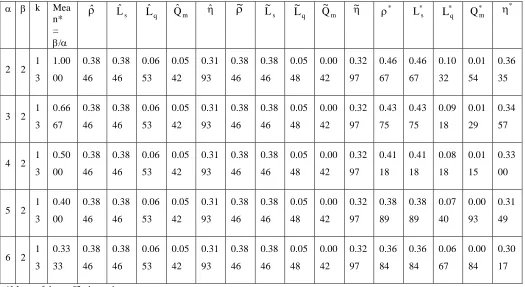
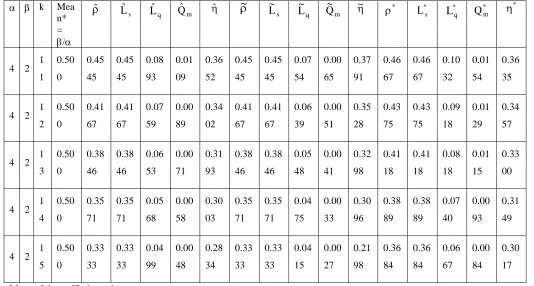
subsection 4 (a). Their corresponding UMVUE’s are obtained in subsection 4 (b). Bayes estimators for these all queues characteristics are obtained in equations (18-22). For analysing the behaviour of these MLE’s, UMVUE’s and Bayes estimators of various queues characteristics, keeping some of the parameters fixed and varying others. On taking k = 13, y = 5, = 2, no= 3 and varying [or
317
estimators are shown in Table 1. Trends in Table-1 clearly reveals that MLE’s and UMVUE’s of all the queue’s characteristics are constant while Bayes estimates of all the characteristics tends to be decreases as mean of the traffic intensity decrease. In yet another example on assuming = 2, = 4, y = 5, no = 3 and varying k [the number of the
system], the trends in various characteristics are summarized in Table -2. Trends in Table-2 highlighted that MLE’s, UMVUE’s and Bayes estimators of all the characteristics tend to be decreased as k increases. Following this pattern, the behavior of all these characteristics with respect to variations in other parameters can be studied, measured and interpreted.
REFERENCES
[1] Ackoff, R.L. and Sasieni, M.W. (1968), “Fundamental of Operations Research”, Wiley Eastern Limited, New York.
[2] Apostolakis, G. (1990), “The Concept of Probability in Safety Assessment of Technological System”, Science, 250, 139-146.
[3] Krishna, H. and Jain, N. (2002), “Classical and Bayes Estimation of Reliability Characteristics of Some System Configurations with Geometric Lifetimes of Components”, IAPQR Transaction, Calcutta, 27 (1).
[4] Mann, N.R., Schafer, R.E. and Singpurwala (1974), “Methods for Statistical Analysis of Reliability and Lifetime Data”, John Wiley and Sons, New York.
[5] P. K. Gupta, Jaideep Goel and R. Kumar(2009), “Posteriror Analysis of The Queue Characteristics in Power Supply System Model”Bulle. Of Allahabad Mathematical Society, Vol.-24, part-2, pp.297-306. [6] Rohatgi, V.K. (1985), “An Introduction to Probability Theory and Mathematical Statistics”, John Wiley and Sons.
[7] Sharma, K.K. and Krishna, H. (1995), “Bayes Estimates of Pointwise and Internal Availability with Type I Censored Samples”, Microelectron Reliab., 35 (1), 33-36. [8] Sharma, K.K. and Kumar, V. (1999), “Inferences on M/M/1: (/FIFO) Queue System”, Opsearch, 36, 1, 26-34. [9] Sinha, S.K. (1986), “Reliability and Life Testing”, Wiley Eastern Limited, New York.
[10] Taha, H.A. (1976), “Operation Research – An Introduction”, Macmillan, New York.
Table 1
Estimates of queue’s characteristics with variations in mean traffic intensity
k Mea n* = /
ˆ
L
ˆ
s qL
ˆ
Q
ˆ
m
ˆ
~
s
L
~
q
L
~
m
Q
~
~
*L
*s *q
L
Q
*m
*2 2 1 3
1.00
00
0.38
46
0.38
46
0.06
53
0.05
42
0.31
93
0.38
46
0.38
46
0.05
48
0.00
42
0.32
97
0.46
67
0.46
67
0.10
32
0.01
54
0.36
35
3 2 1 3
0.66
67
0.38
46
0.38
46
0.06
53
0.05
42
0.31
93
0.38
46
0.38
46
0.05
48
0.00
42
0.32
97
0.43
75
0.43
75
0.09
18
0.01
29
0.34
57
4 2 1 3
0.50
00
0.38
46
0.38
46
0.06
53
0.05
42
0.31
93
0.38
46
0.38
46
0.05
48
0.00
42
0.32
97
0.41
18
0.41
18
0.08
18
0.01
15
0.33
00
5 2 1 3
0.40
00
0.38
46
0.38
46
0.06
53
0.05
42
0.31
93
0.38
46
0.38
46
0.05
48
0.00
42
0.32
97
0.38
89
0.38
89
0.07
40
0.00
93
0.31
49
6 2 1 3
0.33
33
0.38
46
0.38
46
0.06
53
0.05
42
0.31
93
0.38
46
0.38
46
0.05
48
0.00
42
0.32
97
0.36
84
0.36
84
0.06
67
0.00
84
0.30
17
318
Table 2Estimates of queue’s characteristics with variations in k
k Mea n* = /
ˆ
L
ˆ
sL
ˆ
qQ
ˆ
m
ˆ
~
sL
~
q
L
~
m
Q
~
~
*L
*sL
*qQ
*m
*4 2 1 1
0.50
0
0.45
45
0.45
45
0.08
93
0.01
09
0.36
52
0.45
45
0.45
45
0.07
54
0.00
65
0.37
91
0.46
67
0.46
67
0.10
32
0.01
54
0.36
35
4 2 1 2
0.50
0
0.41
67
0.41
67
0.07
59
0.00
89
0.34
02
0.41
67
0.41
67
0.06
39
0.00
51
0.35
28
0.43
75
0.43
75
0.09
18
0.01
29
0.34
57
4 2 1 3
0.50
0
0.38
46
0.38
46
0.06
53
0.00
71
0.31
93
0.38
46
0.38
46
0.05
48
0.00
41
0.32
98
0.41
18
0.41
18
0.08
18
0.01
15
0.33
00
4 2 1 4
0.50
0
0.35
71
0.35
71
0.05
68
0.00
58
0.30
03
0.35
71
0.35
71
0.04
75
0.00
33
0.30
96
0.38
89
0.38
89
0.07
40
0.00
93
0.31
49
4 2 1 5
0.50
0
0.33
33
0.33
33
0.04
99
0.00
48
0.28
34
0.33
33
0.33
33
0.04
15
0.00
27
0.21
98
0.36
84
0.36
84
0.06
67
0.00
84
0.30
17