Research Article
Profile of Women with Late Menstrual Period
Profil Perempuan yang Mengalami keterlambatan Haid
Eka R Gunardi, Anindhita, Fitri Rahardja, Nonny N Handayani
Department of Obstetrics and Gynecology Faculty of Medicine University of Indonesia Dr. Cipto Mangunkusumo General Hospital
Jakarta
INTRODUCTUON
There are quite a numerous of women with late menstrual period who have undergone menstrual induction in Raden Saleh Clinic Jakarta, however there has never been a research about the patient’s profile. Menstrual induction is a human right that still creates a huge dilemma until now. Regarding its sensitive issue, the data about menstrual induc-tion is limited and relatively hard to collect.
Unsafe abortion can threat women’s health. Most of menstrual inductions in Indonesia are done by untrained non-healthcare personnel that lead to complications and even death.1 The incidence of
septic abortion decreased in cities that provide menstrual induction as their healthcare service.2
The objectives of Millennium Development Goals
from WHO are to improve maternal health and to reduce 75% of maternal mortality rate in 1999 -Abstract
Objective: To know the profile of women with late menstrual period in Raden Saleh Clinic Jakarta in 2008 - 2011.
Method: This was a descriptive study with 400 samples from medi-cal records, choosen by random sampling. The data of age, educa-tion, occupaeduca-tion, marital status, residence, religion, parity, age of the youngest kid, cause of pregnancy, attempt to abort, referral, reason to end pregnancy, and contraceptive method post menstrual induc-tion were collected.
Result: The majority of women who underwent menstrual induc-tion were 18 - 35 years old (57.25%), followed by women aged more than 35 years old (40.5%) and below 18 years old (2.25%). Most women were graduated from middle school (51.25%), unemployed (65.25%), and married (90.8%). They mostly came from Jakarta and satellite cities such as Depok, Bogor, Tangerang, and Bekasi, which accounted for 88% clients. Most of them have two children (32.3%) with the youngest kid aged more than 12 months old (60%). The causes of pregnancy were neglecting to use contraception (87.5%), failure of contraception (12%), and sexual assault (0.5%). As much as 44% of the clients had tried to end the pregnancy before they came to Raden Saleh Clinic and 87.5% of all 400 women came with-out referral. The most common reason was having had enough chil-dren in 74% of the women to end the pregnancy, followed by 12.25% of clients who wanted to pursue higher education. After treated by menstrual induction, 75.8% of them used IUD as contra-ception.
Conclusion: Our data showed that mean age of women who were underwent menstrual induction is 32.94 ± 0.35 years old and the main reason to do menstrual induction in this research is the consi-deration of having enough children.
[Indones J Obstet Gynecol 2013; 37-1: 41-5]
Keywords: age, contraception, late menstrual period, menstrual in-duction
Abstrak
Tujuan: Untuk mengetahui profil perempuan dengan keterlambatan haid di Klinik Raden Saleh Jakarta periode 2008 - 2011.
Metode: Studi deskriptif dengan 400 sampel dari rekam medis yang diambil dengan acak. Data yang diambil adalah umur, edukasi, peker-jaan, status perkawinan, tempat tinggal, agama, paritas, umur anak terkecil, penyebab kehamilan, usaha menghentikan kehamilan, ru-jukan, alasan menghentikan kehamilan, dan metode kontrasepsi yang digunakan setelah dilakukan induksi haid.
Hasil: Mayoritas perempuan yang ditatalaksana dengan induksi haid berusia antara 18 - 35 tahun (57,25%), diikuti dengan perempuan berusia lebih dari 35 tahun dan di bawah 18 tahun (2,25%). Keba-nyakan memiliki pendidikan terakhir sekolah menengah (51,25%), ti-dak bekerja (65,25%), dan telah menikah (90,8%). Klien berasal pa-ling banyak dari Jakarta dan daerah satelit, yaitu Depok, Bogor, Tangerang, dan Bekasi, yaitu sebanyak 88%. Profil mengenai anak yang telah dimiliki, yaitu paling banyak telah memiliki dua anak (32,3%) dengan usia anak terkecil lebih dari 12 bulan (60%). Penye-bab kehamilan adalah tidak menggunakan kontrasepsi (87,5%), ke-gagalan kontrasepsi (12%), dan korban perkosaan (0,5%). Sebanyak 44% klien telah melakukan percobaan untuk menghentikan ke-hamilan sebelum datang ke Klinik Raden Saleh dan sebanyak 87,5% datang sendiri tanpa dirujuk. Alasan terbanyak menghentikan ke-hamilan adalah telah cukup memiliki anak, yaitu sebanyak 74%, di-ikuti dengan 12,25% perempuan yang ingin meneruskan pendidikan. Setelah dilakukan induksi haid, 75,8% menggunakan AKDR sebagai kontrasepsi.
Kesimpulan: Data kami menunjukkan usia rerata perempuan yang ditatalaksana dengan induksi haid adalah 32,94 ± 0,35 tahun dan penyebab utamanya adalah telah memiliki cukup anak.
[Maj Obstet Ginekol Indones 2013; 37-1: 41-5]
Kata kunci: induksi haid, kontrasepsi, terlambat haid, usia
2015. Efforts to prevent unsafe abortion are essen-tial to achieve these goals.3
In Indonesia, there are millions of women with unwanted pregnancy each year and most of them choose to end it, although in fact, abortion gener-ally is illegal. In 2000, it is estimated that there are two millions abortions happened in Indonesia and a total of 14 - 16% maternal mortality are caused by unsafe abortion in South East Asia. Menstrual induction has mortality risk of 4/100.000, lower than other obstetrics procedure such as tubectomy (10/100.000) and labor (250/100.000).4
Estima-tion of aborEstima-tion rate based on research conducted in health centers spread across 6 regions in Indo-nesia, including spontaneous abortion whose exact number is still unknown, are as much as 37 abor-tions for every 1000 women in reproductive age (15 - 49 years old). This estimation is quite high compared to another country in Asia, which ap-proximately are 29 abortions for every 1000 women in reproductive age.5
Previous researches prove that most women who underwent abortion or menstrual induction in clinic or hospital have typical profile; they are mar-ried and well educated. Previous researches also indicate that most women who had abortion had actively attempted to prevent their pregnancy. One of the researches said that about 19% of the clients in urban area and 7% of clients in rural area who had abortion used contraception during sexual in-tercourse. In another research, there is a higher proportion of clients: one third of the subjects re-ported failure of contraception. Nevertheless, al-most all of the clients that underwent abortion had unmet need of contraception, because they did not want to have a child right after giving birth nor wanted any more children, but they did not use any contraceptive methods. One of the reasons to end the pregnancy is the clients decide that they already has enough children. Other reason is many unmarried women want to continue their educa-tion before they get married. One research found that only 4% of clients end the pregnancy for health reason.5
Indonesian women with unmet need for contra-ception rarely refuse to use contracontra-ception because the main reason of this unmet need is their hus-bands do not permit them to use it and they often worry about the health risk or adverse effect of us-ing the contraception. A lot of women will have the benefit from the availability of various
contracep-tive methods, the availability of education concern-ing the use and the options of contraceptive me-thod, and also a profound counseling to help wo-men identify the suitable contraception.5
METHODS
This research was held in Raden Saleh Clinic, at Di-vision of Reproductive Health Department of Ob-stetrics and Gynecology, Medical Faculty, Univer-sity of Indonesia, Jakarta. The data obtained from medical record of women with late menstrual pe-riod from 2008 to 2011. Total sample was 400 pa-tients, and this research was conducted from May 1st until 30th, 2012.
Four hundred medical records were taken by random sampling, 100 medical records per year from 2008 to 2011. Collected data was analyzed descriptively using SPSS 17.0.
RESULT
In 2008 - 2011 period, there were 11.693 women with late menstrual period coming to Raden Saleh Clinic (RSC) Jakarta and underwent menstrual in-duction procedure. In this research, based on the sample count, we took the data from 400 women with late menstrual data.
The demographic characteristics of all 400 wo-men with late wo-menstrual period is described based on age, education, occupation, marital status, pa-rity, residence and religion.
Most of the women who came were between 18 - 35 years old (57.25%). The mean age of women who came to RSC and treated with menstrual in-duction in 2008 - 2010 is 32.94 ± 0.35 years old with minimal range 15 years old and maximum range 47 years old. From educational background, most of the women, 205 women (51.25%), were graduated from middle school (Senior high school or its equivalent). The majority occupation from all subjects were housewives, accounted for 261 wo-men (65.25%), 118 wowo-men were private worker, 21 women were state official workers.
(18.3%), 51 women were parity 1 (12.8%), ano-ther 46 women were parity 0 (11.5%).
Most of women (261) have the youngest kid aged > 12 months (maximum age for youngest kid is 17 years old), 79 women with the youngest kid aged 0-6 months, 61 women with the youngest kid aged 7-12 months.
A lot of women (61%) used contraception and 57% of them used modern method. The location of RSC is in Central of Jakarta, majority of women who came to be treated with menstrual induction were from Jakarta, Bogor, Depok, Tangerang and Bekasi (Jabodetabek), which is 352 women (88%) and 48 women (127%) were came from outside Jabodetabek.
Religion of those women are moslem, christian, catholic and buddhist with numbers and percent-age as follows 320 (80%); 42 (10.5%); 27 (6.8%) and 11 (2.8%).
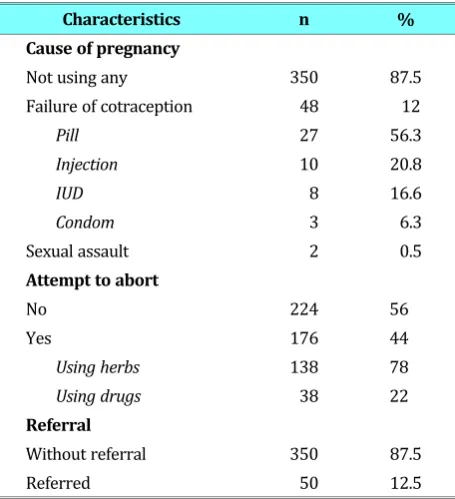
Distribution of the cause of pregnancy, attempt to abort and referral is described below.
Table 1. Distribution of the cause of pregnancy, attempt to abort and referral
Characteristics n %
Cause of pregnancy
Not using any 350 87.5
Failure of cotraception 48 12
Pill 27 56.3
Injection 10 20.8
IUD 8 16.6
Condom 3 6.3
Sexual assault 2 0.5
Attempt to abort
No 224 56
Yes 176 44
Using herbs 138 78
Using drugs 38 22
Referral
Without referral 350 87.5
Referred 50 12.5
In this research from 400 women with late men-strual period that undergone menmen-strual induction, 48 women (12%) have used contraceptive method, yet they failed. The majority of them were using contraceptive pills (56.25 %), the rest were using injection (20.8%), IUD (16.67%), and condom (6.25%).
From 400 respondents, 56% women were not doing any attempt to abort the pregnancy, while the rest did. Most of the women with late mens-trual period was admitted to Raden Saleh Clinic upon self decision (87.5%). There were only 12.5% being referred by health workers.
The reason to end a pregnancy is described in Table 2.
Table 2. The reason to end pregnancy
Reason n %
Enough children 296 74
Continue education 49 12.25
Contraceptive failure 48 12
Chronic disease 5 1.25
Sexual assault 2 0.5
This research showed the most common reason to abort was the couple have had enough children, accounted for 296 women (74%), educational pur-pose as the second most (49; 12.25%) and failure of contraception as the third (48; 12%).
Table 3. Contraceptive method post menstrual induction
Contraception n %
IUD 303 75.8
Pill 48 12
Injection 43 10
Implant 4 1
Tubectomy 2 0.5
After treated with menstrual induction, most of clients preferred to use IUD (303; 75.8%) for con-traception, followed by contraceptive pill (48; 12%) and injection (43; 10.75%) as the second and third choice.
DISCUSSIONS
From marital status, most of women were mar-ried, accounted for 363 women (90.8%, 35 women were unmarried (8.8%) and only 2 women were divorced (0.5%). The greatest part of women with late menstrual period have 2 children, accounted for 129 women (32.3%), 101 women were parity 3 (25.3%), 73 women were parity 4 or more (18.3%), 51 women were parity 1 (12.8%), ano-ther 46 women were parity 0 (11.5%). This proves that in developing country like Indonesia, a lot of pregnancy occurred undesired with unmet need for contraception.
A lot of women (61%) used contraception and 57% of them used modern method, nevertheless nearly 1 of 10 women did not use any contracep-tive method even though they were in reproduc-tive age and did not desire to have more children soon after they gave birth. The amount of unmet need for contraception number in married women tend to be stagnant in anytime this decade.3
In this research from 400 women with late men-strual period that undergone menmen-strual induction, 48 women (12%) have used contraceptive method, yet they failed. Meanwhile 87.5% of respondents not using any contraceptive method, this similar to a research by Serrano.6 Majority of them were
ing contraceptive pills (56.25%), the rest were us-ing injection (20.8%), IUD (16.67%), and condom (6.25%). But it still couldn’t be concluded if it caused by failure of contraception, due to the un-clear exact time they stopped using it. This showed the example of unmet need, where a woman unde-sired to have a child soon as they gave birth or have had enough child but they are not using any contraceptive method. Hussain et al stated that unmet need of cotraception in Indonesia happened due to the lack of access and knowledge of Indo-nesian women which similar to that in Campbodia and Nepal.7 It would be better if we can obtain
de-tailed data of what causing the women not to use contraception. This is suited to a research by Gilda Sedgh and Haley Ball in 2008.3 Most of the women
choose contraceptive pill not to get pregnant, which have high failure rate, 6 - 8 pregnancy per 100 women in first 12 months of usage in typical use and 0.1 pregnancy per 100 women of first 12 months if it used perfect and consistently.8 The
rea-son could be the lack of knowledge about the con-traceptive pill, how to use, and the compliance of clients. In this research there were 2 women as the victims of sexual assault.
From 400 respondents, 56% women were not doing any attempt to abort the pregnancy, while the rest did. This showed that most of the women directly seeked for health personnel to solve her problem. Majority of women who did the attempt try to consume traditional herbs (78%) and the rest used drugs like cytotec, etc. In a research by Affandi et al, most of the women used traditional herbs to release endometrial layer in late mens-trual period, which we found similar.9 None of the
respondents went to have massaged by traditional healer or inserted things into the vagina. The drugs which are used to end pregnancy have to be pre-scribed by doctor, but in fact respondents were easily bought it. Distribution of drugs that can be used for menstrual induction should be monitored. Most of the women with late menstrual period was admitted to Raden Saleh Clinic upon self deci-sion (87.5%). There were only 12.5% being refered by health workers. This showed they knew the place to seek for help in such condition, even-though some health workers still disapprove to re-fer menstrual induction cases.
This research showed the most common reason to abort was the couple have had enough children, accounted for 296 women (74%), educational pur-pose as the second most (49; 12.25%) and failure of contraception as the third (48; 12%).
Women with unmet need can be categorized as: those who want to delay the pregnancy and those who don’t want to have more children. Both groups are in risk of unwanted pregnancy. The choice of contraceptive method is different between those groups. In most countries in Asia, Latin America and Caribbian Island, and North America, there were similar percentages of women with unmet need who want to delay pregnancy or have had enough children. Women with more than three children tend to have higher rate of pregnancy compared to them with 1 - 3 children. This repre-sented higher rate of unmet need of contraception after desired number of child achieved compared to unmet need in delaying pregnancy.7
After treated with menstrual induction, most of clients preferred to use IUD (303; 75.8%) for con-traception, followed by contraceptive pill (48; 12%) and injection (43; 10.75%) as the second and third choice.
The contraception that mostly used are IUD and Injection, which are long term contraception. This is proper in clients with more than 2 children. Meanwhile the second choice for women with lower parity is contraceptive pills.
CONCLUSION
There are 400 subject included in this research with mean age 32.94 ± 0.35 years old (15-47 years old). More than 50% of subject were graduated from middle school (Senior High School or similar). Most of women were housewives in 62.25% and are married (90.8%). Most of women with late menstrual period have had a child (parity =1) with main reason to do menstrual induction in this re-search is having enough children (74%). The most common used contraceptive method after men-strual induction is IUD (75.8%).
SUGGESTION
Unmet need for contraception should have more attention, especially for increasing the quantity and quality of contraception access. We need to
in-crease quantity and quality of health facility and services to give information, educate about contra-ception, and accomodate menstrual induction.
Further research will be needed to evaluate the mechanism of contraceptive failure.
REFERENCES
1. Affandi B. Dampak Abortus terhadap Kesehatan Ibu di In-donesia. Maj Obstet Ginekol Indones, 1999; 23: 119-25 2. Moeloek. The Relation Between Menstrual Regulation
Ser-vice and The Incidence of Septic Abortions in Indonesia. Maj Obstet Ginekol Indones 1999; 23: 167-72
3. Sedgh G, Ball H. Abortion in Indonesia In Brief. Guttmacher Institute. no. 2 seri 2008: 1-3
4. Affandi B, Lubis A, Tafal Z, Brian Z. Profil Remaja Perem-puan Terlambat Haid di Klinik Raden Saleh, Jakarta. Maj Obstet Ginekol Indones 1999; 23: 149-60
5. Sedgh G, Henshaw S, Singh S, Ahman E, Shah IH. Induced abortion: estimated rates and trends worldwide. Lancet 2007; 307: 1338-45
6. Serrano I, Doal Jose L, Lete I. Contraceptive practices of women requesting induced abortion in Spain: A cross-sec-tional multicentre study. The European Journal of Contra-ceptive and Reproductive Health Care, June 2012; 17: 205-11
7. Hussain H, Sedgh G, Bankole A, Singh S. Women with Unmet Need for Contraception in Developing Countries and Their Reasons for Not Using a Method. Occasional Report No. 37, June 2007: 5
8. Buku Panduan Praktis Pelayanan Kontrasepsi. Jakarta. 2004 9. Affandi B, Santoso SSI. Abortus dan Kegagalan Kontrasepsi.
Maj Obstet Ginekol Indones 1999; 23: 145-8