Research Article
Factors Influencing the Knowledge Level of Pap Smear Examination
in Cervical Cancer Patients
Faktor yang Mempengaruhi Tingkat Pengetahuan Penderita Kanker Serviks
tentang Pemeriksaan Pap Smear
Wulan M. Soemardji, Freddy W. Wagey, Bismarck J. Laihad
Oncology Division Department of Obstetrics and Gynecology Faculty of Medicine University of Sam Ratulangi/
Prof. Dr. R.D. Kandou General Hospital Manado
INTRODUCTION
Cervical cancer has the highest maternal mortality rate in developing country. Based on WHO (2005), it is estimated that there are 500,000 new cervical can-cer cases every year in the whole world, and 90% of them were found in developing countries. In Indone-sia, The National Cancer Treatment Committee esti-mated that the incidence of cancer in Indonesia is at least 100 per 100,000 inhabitant every year.1,2
In Prof. Dr. R.D. Kandou General Hospital (2011), the incidence of cervical cancer was 73.7% of all
gynecologic cancer cases (112 cases). Most patients who were admitted was in the advanced stadium, i.e. IIB-IVB (73.2%).3
World Health Organization (WHO) stated that about a third of the case can be cured if it could be diagnosed and treated in early stadium. Cervical cancer was mostly started with pre cancer lesion or cervical intraepithelial neoplacia (CIN) and need 5-15 years to be invasive.1
Pap smear examination is one of the simplest screening test in early detection of cervical cancer, Abstract
Objective: To describe the level of knowledge of Pap smear exami-nation and its influencing factors in cervical cancer patients.
Methods: Patients meeting the inclusion criteria were asked to fill questionnaire. Acquired data will then be processed and analyzed statistically.
Result: This study was performed to 45 cervical cancer patients. We found that the majority of subjects was in the 41-45 years age groups (36%), housewife (87%), graduated junior high school (51%), and lived in Manado city (53.3%). Thirty one patients (69%) had a lack-ing knowledge about Pap smear examination. Among 25 respon-dents (56%) who had received the information before, only 13 re-spondents (52%) had already had their Pap smear examination. This unwillingness to participate in the examination was caused by fear (75%), laziness (8%), no complaint (8%), and no support from the husband (8%). The information factor had the greatest influence on the level of knowledge about Pap smear examination.
Conclusion: The knowledge level of Pap smear is still low and the most influencing factor for this result is the lack of information (p < 0.05).
[Indones J Obstet Gynecol 2012; 36-2: 61-5]
Keywords: cervical cancer patients, information, knowledge, Pap smear
Abstrak
Tujuan: Untuk mengetahui gambaran tingkat pengetahuan pen-derita kanker serviks tentang pemeriksaan Pap smear dan faktor yang mempengaruhinya.
Metode: Subjek penelitian yang memenuhi kriteria inklusi, diminta mengisi kuesioner. Data kemudian akan diproses dan dianalisa secara statistik.
Hasil: Penelitian dilakukan pada 45 penderita kanker serviks. Diperoleh karakteristik responden terbanyak berada pada kelompok umur 41-45 tahun (36%), bekerja sebagai ibu rumah tangga (87%), tingkat pendidikan ≤ SMP dan sederajat (51%), dan berdomisili di kota Manado (53,3%). Sebanyak 31 orang (69%) memiliki pengeta-huan kurang tentang pemeriksaan Pap smear. Dari 25 responden (56%) yang pernah memperoleh informasi, hanya 13 responden (52%) yang pernah melakukan pemeriksaan Pap smear. Alasan tidak melakukan pemeriksaan adalah takut (75%), malas (8%), tidak ada keluhan (8%), dan tidak ada dukungan suami (8%). Faktor informasi mempengaruhi tingkat pengetahuan tentang pemeriksaan Pap smear.
Kesimpulan: Pengetahuan penderita kanker serviks tentang pe-meriksaan Pap smear masih kurang dan faktor informasi mempe-ngaruhi tingkat pengetahuan tersebut (p < 0,05).
[Maj Obstet Ginekol Indones 2012; 36-2: 61-5]
Kata kunci: informasi, Pap smear, penderita kanker serviks, pengeta-huan
as well as the cheapest and most practical test. Pap smear is proved to be able to decrease invasive cer-vical cancer incident in developed countries. Mor-tality rate of cervical cancer in developed countries decreased almost 50 - 60% by the implementation of new policy of periodic Pap smear examination in cervical cancer screening guidelines.4,5
Based on the importance of Pap smear described above, we tried to evaluate the level of knowledge of Pap smear examination and its influencing factor in cervical cancer patients.
METHODS
This study used analytic descriptive study method (comparative categories). This study was per-formed in Obstetrics and Gynecology Department of Prof. Dr. R.D. Kandou General Hospital in Manado. Data was obtained from May through Au-gust 2012. The independent variables were: knowledge, information; and the dependent vari-able was Pap smear knowledge. Subject was cervi-cal cancer patient who agree to participate in this study by signing informed consent. We established the level of knowledge by scoring the subjects re-sponse and processed it into a categorical data. The level of knowledge was considered as good if the respondent had 75-100% of the correct answer, sufficient if the respondent had 55-75% of correct answer, and lacking if the correct answers were less than 55%.6
Data was taken by using questionnaire which consist of questions that were needed to assess the knowledge level of Pap smear examination. To test the validity and reliability of the questionnaire we performed a pre sampling test which included 15 cervical cancer patients in Prof. Dr. R.D. Kandou General Hospital in Manado. Data preparation was performed after the questionnaire was filled, which included editing, verification and coding of the an-swer. The data would then be processed by using SPSS for Windows version 20.0.
RESULT
In Table 1, it is showed that the majority of respon-dents were 41 - 45 years old (36%), housewives (87%), junior high school (51%) and a citizen of Manado city (53.3%). The majority of respondent had never had Pap smear examination (71%).
Table 1. Respondent characteristic
Characteristics Number %
Age (years) ≤ 35
36-40 41-45 46-50 51-55 56-60 > 60
3 7 16 6 4 5 4
7 16 36 13 9 11 9
Occupation
Private worker Government employee Entrepreneur
Housewife
1 2 3 39
2 4 7 87
Education
≤ Junior high school ≥ Senior high school
23
22 5149
Domicile
Manado City Out of Manado
24 21
53.3 46.7
Pap smear examination
Had been performed Never been performed
13 32
29 71
Table 2. Respondent distribution based on information about Pap smear examination.
Information Number %
Had been informed
by Electronic media by Health official by Community/family
3 19 3
7 42 7
Never been informed 20 44
Total 45 100
Table 3. Distribution of respondent knowledge level about Pap smear examination.
Level of Knowledge Number %
Lack 31 69
Sufficient 9 20
Good 5 11
Total 45 100
In Table 3, it is showed that the knowledge level of Pap smear examination is lacking because the majority of subjects (85.7%) had less than 55% correct answers, while only 20% had sufficient level of knowledge and 11% had good level of knowledge.
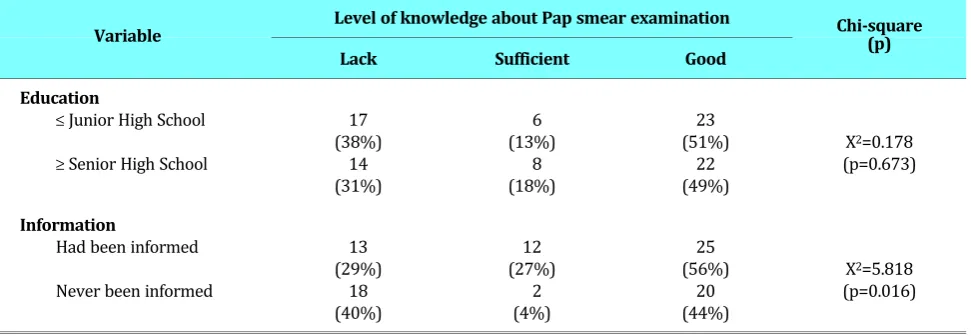
Table 4 showed that there was a relationship be-tween education background with the level of knowledge about Pap smear examination. Only 18% of respondents with sufficient knowledge about Pap smear had already graduated senior high school. Meanwhile, most respondent with lack of knowledge level about Pap smear examination (38%) only finished junior high school education program. We then analyzed the data with chi-square, and we found that there was no significant relationship between education background with the level of knowledge about Pap smear examina-tion (p = 0.673, α = 0.05).
Table 4 showed that only 12 patients (27%) with sufficient knowledge level had ever received infor-mation about Pap smear examination, and most pa-tients had never received information about Pap smear examination (40%). After performing an
analysis with chi-square, we found that there was a significant relationship between information and level of knowledge of Pap smear examination (p = 0.016 < α = 0.05).
DISCUSSION
In this study, we found that most patients were 41-45 years old (36%). Ruindungan et al found that most cervical cancer patients was 46-50 years old and most of them was diagnosed with cervical can-cer on stadium II B (73.21%). Othman N.H et al performed a study about cervical cancer in Malay-sia and found that most patients diagnosed with cervical cancer were between 44-55 years old and admitted to hospital in advanced stadium. Accord-ing to WHO (2006), women who were 40-45 years old have the highest risk for cervical cancer.2,3,7
Table 1 showed that most respondents were housewives (87%) and most of them lived in Manado city (53.3%). Area of living and occupation has a great influence to experience, information and knowledge. Individual who live in city surely has easier access to information.8
This study showed that the knowledge level of cervical cancer patients about Pap smear examina-tion is mostly lacking (Table 3). Study of cervical cancer patients in Malaysia also found a lack of knowledge about Pap smear examination. Study performed by Moegni et al in Obstetrics and Gyne-cology Department of RSUPN-CM found that 75.5% respondent has a lack of knowledge about Pap smear examination. Meanwhile study performed by Bakheit N.M and Haroon A.I.B in Arabic popu-lation found a different result i.e. 84% respondents
Table 4. Relationship between level of education back ground and information with level of knowledge about Pap smear examination.
Variable Level of knowledge about Pap smear examination Chi-square(p)
Lack Sufficient Good
Education
≤ Junior High School
≥ Senior High School
17 (38%)
14 (31%)
6 (13%)
8 (18%)
23 (51%)
22 (49%)
X2=0.178
(p=0.673)
Information
Had been informed
Never been informed
13 (29%)
18 (40%)
12 (27%)
2 (4%)
25 (56%)
20 (44%)
X2=5.818
have good knowledge about Pap smear examina-tion. A study performed by Mosavel M et al in South Africa found that 71% respondents know about Pap smear examination benefit and had good knowledge about Pap smear examination.6.7,9,10
The low level of knowledge about Pap smear ex-amination in Indonesia were caused by a lack of information knowledge about cervical cancer. Ka-yika et al found that a third of all respondents did not know about definition, symptoms and risk fac-tors that can be a predisposition of cervical cancer. Thus we should focus on spreading the information about cervical cancer and early detection of cervi-cal cancer as an effort to increase community knowledge. Izza K et al proved that information can make a significant difference in the knowledge and attitude of the respondent about Pap smear exami-nation.11,12
Based on the respondent’s behaviour, study re-sult showed that only 29% had ever had a Pap smear examination eventhough 56% of them had already received information about this from health worker (42%), electronic information (7%), and family/community (7%). The main reason of this was fear (75%), laziness (8%), no complaint (8%), and no support from the husband (8%). The same results was seen in the study performed in Malaysia which showed that most respondent had not had a Pap smear examination for the last 3 years before diagnosed with cervical cancer due to the lack of information about Pap smear examina-tion (36.2%), fear (13.1%), shame (10.4%), the thought that this examination was not important (8.1%), no support from husband (4.5%), and no time (3.6%). About 63.3% of cervical cancer pa-tient had already received information about this examination from health worker (39.4%), friends/ family (10%), and media (5.9%). A different result was found by Kurniawan (2008) who studied 67 commercial sex workers. They found that most of the respondents (89.55%) had already had Pap smear examination in local government clinic and general practitioners.7,13
Changing process or adopting behaviour is a multi factorial process. Educating the individu and community was the initial phase before deciding to adopt or change a behaviour on information of a new thing that been accepted. Health staff has a great influence to form knowledge and behaviour in community. The other reason that people didn’t know where they could have a Pap smear
exami-nation and they are scared of being diagnosed with cancer if they had this examination.8,13
Table 4 showed that 18% of subject senior high school or college had a sufficient knowledge. Level of education can form intellectual, comprehension, critical mind and logic in processing information and a decisiveness in action. Individual with high education background would response more ra-tionally about information and think about the profit from examination. However, high level edu-cation background without any willingness to learn, couldn’t guarantee that someone had a good knowledge. On the contrary, individu with a will-ingness to study and increasing his/her knowledge by getting information, even if he/she had a lower level of education, could had a good knowledge about a subject.13
We found that there was no significant correla-tion between level of knowledge about Pap smear examination with the level of education back-ground. The same result was found by Kayika et al (2007), i.e. level of education back ground did not influence level of knowledge about Pap smear ex-amination. This result differ from the study per-formed by Moreira et al in Brazil, which found that higher level of education would increase the level of knowledge about Pap smear examination.11,14
CONCLUSION
Based on the study results, we can conclude most cervical cancer patients (69%) have a lacking knowledge about Pap smear examination and in-formation vastly influenced level of the knowledge about Pap smear examination (p = 0.016).
It is necessary to increase the efforts to increase community knowledge about Pap smear examina-tion, i.e. by local government clinic informaexamina-tion, general practitioner and electronic information or even communities education program.
REFERENCES
1. WHO. Comprehensive Cervical Cancer Control. Jenewa: 2006
2. Skrining Kanker Serviks dengan IVA dan Model Aplikasi di Lapangan. Divisi Onkologi Ginekologi. Departemen Obstetri dan Ginekologi Fakultas Kedokteran Universitas Indonesia. Jakarta. 2011.
3. Ruindungan S, Laihad B.J. Profil Kanker Ginekologi di RS Pendidikan Kota Manado. 2011.
4. Rasjidi H.I. Manual Prakanker Serviks. Edisi Pertama. Jakarta. Sagung Seto. 2008: 1-54.
5. Manuaba I.B.G. Dasar-dasar Teknik Operasi Ginekologi. Jakarta. ECG. 2005: 100-4.
6. Moegni E.M. Penilaian Pengetahuan, Sikap, dan Perilaku Pasien Poliklinik Kebidanan dan Kandungan RSUPN Dr. Cipto Mangunkusumo tentang Pap smear. In: Maj Obstet Gi-nekol Indones. 2006; 4:213-8.
7. Othman N.H, Devi B. CR, Halimah Y. Cervical Cancer Screen-ing: Patients’ Understanding in Major Hospital in Malaysia. Asian Pasific J Cancer Prevent. 2009; 10:569-74.
8. Notoatmodjo S. Konsep Perilaku Kesehatan. Jakarta. Rineka Cipta. 2003: 121-3.
9. Bakheit N.M, Haroon A.I.B. The Knowledge, attitude and practice of Pap smear among local school teacher in the Sharjah district. Middle East J Fam Med. 2004; 4:4. 10. Mosavel M, Simon C, Oakar C, Meyer S. Cervical cancer
at-titudes and beliefs-A Cape town community responds on world cancer day. J Cancer Educ. 2009; 24(2):114-9. 11. Kayika I.P.G. Pengetahuan, Sikap, dan Perilaku Perempuan
yang Sudah Menikah Mengenai Pap smear dan Faktor-fak-tor yang Berhubungan di Rumah Susun Klender. In: Maj Ke-dok Indones: 2007; 24(7): 37-43.
12. Izza K, Salawati T, Prasida D.W. Perbedaan pengetahuan dan sikap wanita terhadap pemeriksaan Pap smear se-belum dan sesudah penyuluhan tentang Pap smear. 2009. 13. Kurniawan B, Asmika, Sarwono I. Hubungan tingkat
penge-tahuan dengan partisipasi pada pemeriksaan Pap smear pada wanita pekerja seks komersial. Jurnal Kedokteran Brawijaya. 2008; 24(3): 126-34.
14. Moreira E.D, Oliviera B.G, Ferraz F.M, Costa S, Karic G. Knowledge and attitude about human papillomavirus, Pap smears, and cervical cancer among young women in Brazil: Implications for health education and prevention. Int J Gynecol Cancer. 2006; 16(2):599-603.