Kumar et al. World Journal of Pharmaceutical and Life Sciences
HPLC METHOD DEVELOPMENT AND VALIDATION FOR SIMULTANEOUS
ESTIMATION OF AMLODIPINE AND ATENOLOL AND PHARMACEUTICAL
DOSAGE FORM
Dr. G. Pratap Kumar* and Naga Rani Undrakunta
Principal and Professor, MRR College of Pharmacy, Nandigama-521185, Krishna District, Andhra Pradesh.
Article Received on 22/12/2017 Article Revised on 12/01/2018 Article Accepted on 01/01/2018
DRUG PROFILE
Amlodipine
Amlodipine is a long-acting 1,4-dihydropyridine calcium channel blocker. It acts primarily on vascular smooth muscle cells by stabilizing voltage-gated L-type calcium channels in their inactive conformation. By inhibiting the influx of calcium in smooth muscle cells, amlodipine prevents calcium-dependent myocyte contraction and vasoconstriction. A second proposed mechanism for the drug’s vasodilatory effects involves pH-dependent inhibition of calcium influx via inhibition of smooth muscle carbonic anhydrase. Some studies have shown that amlodipine also exerts inhibitory effects on voltage-gated N-type calcium channels. N-type calcium channels located in the central nervous system may be involved in nociceptive signaling and pain sensation. Amlodipine is used to treat hypertension and chronic stable angina.
Mechanism of Action
Amlodipine decreases arterial smooth muscle contractility and subsequent vasoconstriction by inhibiting the influx of calcium ions through L-type calcium channels. Calcium ions entering the cell through these channels bind to calmodulin. Calcium-bound calmodulin then binds to and activates myosin light chain kinase (MLCK). Activated MLCK catalyzes the phosphorylation of the regulatory light chain subunit of myosin, a key step in muscle contraction. Signal
amplification is achieved by calcium-induced calcium release from the sarcoplasmic reticulum through ryanodine receptors. Inhibition of the initial influx of calcium decreases the contractile activity of arterial smooth muscle cells and results in vasodilation. The vasodilatory effects of amlodipine result in an overall decrease in blood pressure. Amlodipine is a long-acting CCB that may be used to treat mild to moderate essential hypertension and exertion-related angina (chronic stable angina). Another possible mechanism is that amlodipine inhibits vascular smooth muscle carbonic anhydrase I activity causing cellular pH increases which may be involved in regulating intracelluar calcium influx through calcium channels.
ATENOLOL
Mechanism of Action
Like metoprolol, atenolol competes with sympathomimetic neurotransmitters such as catecholamines for binding at beta(1)-adrenergic receptors in the heart and vascular smooth muscle, inhibiting sympathetic stimulation. This results in a reduction in resting heart rate, cardiac output, systolic and diastolic blood pressure, and reflex orthostatic hypotension. Higher doses of atenolol also competitively block beta(2)-adrenergic responses in the bronchial and vascular smooth muscles
World Journal of Pharmaceutical and Life Sciences
WJPLS
www.wjpls.org SJIF Impact Factor: 5.088
*Corresponding Author: Dr. G. Pratap Kumar
Principal and Professor, MRR College of Pharmacy, Nandigama-521185, Krishna District, Andhra Pradesh. Email ID: [email protected], [email protected],
ABSTRACT
A Simple, specific and sensitive an isocratic Estimation by RP-HPLC analytical Method were developed and validated for the quantification Amlodipine. And Atenolol Quantification was achieved by using the mobile phase (55 volumes of mixed phosphate buffers ph-4.0: 45 volumes of acetonitrate sonicate for 10 mins for removing gases ). Inertsil BDS C18 250×4.6mm ID, 5μm Particle size was used as stationary phase. The flow rate was 1.0 ml/min. Measurements were made at a isobestic wavelength of 220nm. The average retention times for Atenolol and Amlodipine was found to be 6.060 & 2.593 min. The proposed method was validated for selectivity, precision, linearity and accuracy. The assay methods were found to be linear Atenolol and Amlodipine from 60-140μg/ml & 6-14 μg/ml for respectively. All validation parameters were within the acceptable range. The developed methods were successfully applied to estimate the amount of Atenolol and Amlodipine.
Need For the Study
Analytical Method Development for Pharmaceutical Formulations
Quality investigation plays a very important role in quality specification establishment of chemical drugs. The number of drugs introduced into the market every year .very often there is a time lag from the date of introduction of a drug into the market to the date of its inclusion in pharmacopoeias. Hence, standards and analytical procedures for these drugs may not be available in the pharmacopoeias. It becomes necessary, therefore to develop newer analytical methods for such drugs.
Basic criteria for new method development of drug analysis:
The drug or drug combination may not be official in any pharmacopoeias.
A proper analytical procedure for the drug may not be available in the literature due to patent regulations.
Analytical methods may not be available for the drug in the form of a formulation due to the interference caused by the formulation excipients. Analytical methods for a drug in combination with
other drugs may not be available.
The existing analytical procedures may require expensive reagents and solvents. It may also involve cumbersome extraction and separation procedures and these may not be reliable.
Analytical method development provides the support to track the quality of the product from batch to batch.
Method development involves considerable trial and error procedures. The most difficult problem usually is
where to start, what type of column is worth trying with what kind of mobile phase.
Single dosage forms with combination of drugs are widely used today due to their advantages and their simultaneous estimation of individual component is a challenging task.
METHOD DEVELOPMENT OF ATENOLOL AND AMLODIPINE
Trial - 1
Chromatographic conditions
Mobile phase: Potassium phosphate buffer: Methanol Ratio: 55:45
Column: Zodiac C18 (250×4.6× 5μ) wavelength: 220 nm
Flow rate: 1.0ml/min pH: 5.8
Preparation of standard stock solution of
AMLODIPINE
50mg of AMLODIPINE was weighed in to 500ml volumetric flask and dissolved in Methanol and then dilute up to the mark with methanol and prepare 10 μg/ml of solution by diluting 1ml to 10ml with methanol.
Preparation of mixed standard stock solution
Weigh accurately 5 mg of ATENOLOL and 50 mg of AMLODIPINE in 50 ml of volumetric flask and dissolve in 10ml of mobile phase and make up the volume with mobile phase. From the above stock solution pipette out 1ml of the solution and transfer to 10ml volumetric flask and make up the volume with mobile phase. This solution is used for recording chromatogram.
Result for ATENOLOL and AMLODIPINE by using mobile phase.
S.No. Name Rt (min) Peak Area Asymmetry Efficiency Resolution
1 AMLODIPINE 2.537 334.491 1.538 3133 -
2 ATENOLOL 2.997 3287.075 1.969 2313 2.137
Observation
The Efficiency was satisfactory for both ATENOLOL and AMLODIPINE.
But, Resolution was very low for ATENOLOL and AMLODIPINE. The details are given in table 8.3.1 and figure 8.3.1, Hence it was not taken for optimization.
Trial- 2
Chromatographic conditions
Mobile phase: Triethylamine in water: ACN Ratio: 62:38
Column: ODS Borosil (250×4.6 ×5μ) Wavelength: 220nm
Flow rate: 1.0ml/min pH: 4.0
S.No. Name Rt (min) Peak Area Asymmetry Efficiency Resolution
1 AMLODIPINE 3.677 378.493 1.310 955 -
Observation
The resolution for ATENOLOL and AMLODIPINE were very low and USP plate count was very low for Atenolol.
The details are given in the table 8.3.2 and figure 8.3.2, Hence it was not taken for optimization.
Trial-5: (Optimized)
Chromatographic conditions
Mobile phase: Mixed Phosphate Buffer: ACN Ratio: 55:45
Column: Inertsil BDS C18 column (250×4.6mm× 5μ) Wavelength: 220 nm
Flow rate: 1.0ml/min pH: 5.0
S.No. Name Rt (min) Peak Area Asymmetry Efficiency Resolution
1 AMLODIPINE 2.593 323.207 2.176 5365 -
2 ATENOLOL 6.060 2225.385 1.345 4203 13.450
Observation: The efficiency was good for both ATENOLOL and AMLODIPINE, and the retention time and
resolution was also satisfactory.
Table No.7.9.9.2: Assay Results.
AMLODIPINE (5mg) ATENOLOL (50mg)
Standard Area Sample Area Standard Area Sample Area
Injection-1 312.900 317.362 2148.568 2153.195
Injection-2 320.146 315.955 2146.138 2166.818
Injection-3 315.731 312.02 2150.744 2151.623
Injection-4 316.723 318.27 2160.914 2159.717
Injection-5 316.877 312.645 2181.788 2141.013
Average Area 316.475 315.250 2157.63 2154.473
Tablet average weight 300.2 300.2
Standard weight 5 50
Sample weight 301.2 301.2
Label amount 5 50
std. purity 99.8 99.7
Amount found in mg 4.95 49.61
Assay(%purity) 99.08 99.22
Observation
The amount of AMLODIPINE and ATENOLOL present in the taken dosage form was found to be 99.08% and 99.22% respectively.
METHOD VALIDATION
System suitability
Standard solutions were prepared as per the test method and injected into the chromatographic system. The system suitability parameters like theoretical plates, resolution and asymmetric factor were evaluated.
Results for system suitability of AMLODIPINE(5mg) Table 8.1.1: Injection.
Retention time (min) Peak area Theoretical plates (TP) Tailing factor (TF)
1 2.593 318.648 5365 1.818
2 2.573 319.324 4884 1.835
3 2.563 319.881 5242 1.718
4 2.533 318.495 4671 1.846
5 2.543 319.486 4771 1.756
6 2.567 319.750 5255 1.706
Mean 2.5620 319.264 - -
SD 0.0215 0.573 - -
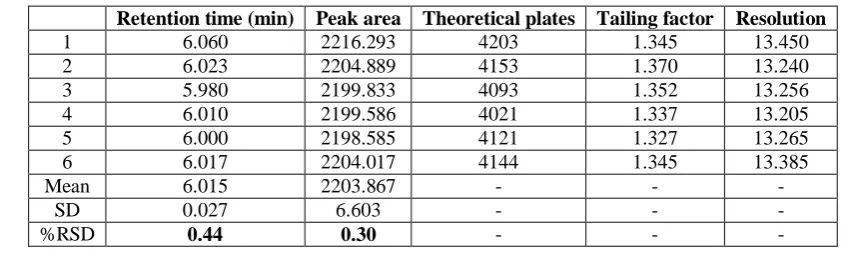
Results for system suitability of ATENOLOL(50mg) Table 8.1.2: Injection.
Retention time (min) Peak area Theoretical plates Tailing factor Resolution
1 6.060 2216.293 4203 1.345 13.450
2 6.023 2204.889 4153 1.370 13.240
3 5.980 2199.833 4093 1.352 13.256
4 6.010 2199.586 4021 1.337 13.205
5 6.000 2198.585 4121 1.327 13.265
6 6.017 2204.017 4144 1.345 13.385
Mean 6.015 2203.867 - - -
SD 0.027 6.603 - - -
%RSD 0.44 0.30 - - -
Acceptance criteria
1. The % RSD for the retention times of AMLODIPINE (5mg) and ATENOLOL (50mg) Peaks from 6 replicate injections of each Standard solution should be not more than 2.0 %
2. The % RSD for the peak area responses of AMLODIPINE (5mg) and ATENOLOL (50mg) peaks from 6 replicate injections of each standard solution should be not more than 2.0%.
3. The number of theoretical plates (N) for the AMLODIPINE (5mg) and ATENOLOL (50mg) peaks is not less than 2000.
4. The Tailing factor (T) for the AMLODIPINE (5mg) and ATENOLOL(50mg) peak is not more than 2.0.
Observation
The % RSD for the retention times and peak area of AMLODIPINE (50mg) and ATENOLOL (5mg) were found to be less than 2%. The plate count and tailing factor results were found to be satisfactory and are found to be within the limit.
DISCUSSION
A simple and selective LC method is described for the determination of AMLODIPINE (5mg) and ATENOLOL (50mg) tablet dosage forms. Chromatographic separation was achieved on a Inertsil BDS C18 column using mobile phase consisting of a mixture of Mixed Phosphate buffer(KH2PO4+K2HPO4) pH:4.0: Acetonitrile (55:45v/v),with detection of 220 nm. Linearity was observed in the range 6-14 μg /ml for AMLODIPINE (r2 =0.9983) and 60-140μg /ml for ATENOLOL(r2 =0.9983) for the amount of drugs estimated by the proposed methods was in good agreement with the label claim.
The proposed methods were validated. The accuracy of the methods was assessed by recovery studies at three different levels. Recovery experiments indicated the absence of interference from commonly encountered pharmaceutical additives. The method was found to be precise as indicated by the repeatability analysis, showing %RSD less than 2. All statistical data proves validity of the methods and can be used for routine analysis of pharmaceutical dosage form.
SUMMARY AND CONCLUSION
S No Parameters Amlodipine(5mg) Atenolol(50mg)
1 Calibration range mcg/ml 5mg 50mg
2 Optimized wavelength 220nm 220nm
3 Mobile phase KH2PO:ACN55:45 KH2PO:ACN55:45
4 Column Inerstsil BDS C18 (250mm 4.6mm 5μ) Inerstsil BDS C18 (250mm 4.6mm 5μ)
5 Retention time 2.593 6.067
6 Regression equvation y* y=25.825X+44.389 y=19.843X+137.21
7 Correlation coefficient (r2) 0.9983 0.9983
8 % Recovery 99.97% 99.18%
9 % RSD 0.84% 0.44%
10 Lod (mcg /ml) 0.4 5.26
11 Loq (mcg/ml) 1.22 15.94
CONCLUSION
From the above experimental results and parameters it was concluded that, this newly developed method for the
bio-REFERENCES
1. The Drugs and Cosmetics Act and Rules, 1940. 2. Methods of Analysis-
http://www.pharmatutor.org/pharma-analysis. 3. Douglas, A.; Skoog, F.; James, H.; Stanley, R. C.
Liquid Chromatography. In Instrumental Analysis, 9th ed.; Cengage Learning India Pvt. Ltd.: New Delhi, 2007; 893-934.
4. Skoog; Holler; Crouch; Liquid Chromatography. In Instrumental Analysis, Cengage Learning India.: New Delhi, 2011; 893.
5. Chatwal, R. G.; Anand, K. S. High Performance Liquid Chromatography. In Instrumental Methods
Of Chemical Analysis, 5th ed.; Himalaya
Publishers.: Mumbai, 2010; 2.570-2.629.
6. Sharma, B. K. High Performance Liquid Chromatography. In Instrumental Methods of Chemical Analysis, 24th ed.; Goel Publishers.: Meerut, 2005; 295- 00.
7. Alfonso, R. G.; Ara, H. D. M.; Glen, R. H.; Thomas, M.; Nicholas, G. P.; Roger, L.S.; Steve, H. W. Chromatography. In Remington: The Science and Practice of Pharmacy, 20th ed.; Lippincott Williams & Wilkins: Philadelphia, 2000; 587.
8. Adsorption Chromatography-
http://www.separationprocesses.com/Adsorption/AD _Chp05a.htm.
9. Adsorption Chromatography-
http://cemca.org/andcollege/andcwebsite/subject01/ CHEtext.pdf.
10. Types of Chromatography-
http://www.separationprocesses.com/Adsorption/AD _Chp05a.htm.
11. Partition Chromatography -
http://media.rsc.org/Modern%20chemical%20techni ques/MCT5%20Chromatography.pdf.
12. Ion Exchange Chromatography –
http://www.gelifesciences.com/webapp/wcs/stores/s ervlet/catalog/en/GELifeSciences-IN/products/ion-exchange-chromatography-iex/.
13. Ion Exchange Chromatography-