169
Copyright © 2011-15. Vandana Publications. All Rights Reserved.
Volume-5, Issue-2, April-2015 International Journal of Engineering and Management Research Page Number: 169-174
Experimental Study on Slurry Infiltrated Fibre Reinforced Concrete with
Partial Replacement of Fly Ash
Aravind.V1, S.Pradeepa2
1
PG Student ( M .Tech Structural Engineering), Department of Civil Engineering, SRM University .INDIA .
2
Assistant Professor Department of Civil Engineering, SRM University .INDIA.
ABSTRACT
The term SIFCON stands for SLURRY INFILTRATED FIBER REINFORCED CONCRETE. It is a relatively a special type of High Volume Fiber reinforced concrete. In this concrete steel fibers are pre-packed into the form moulds as individual fibers sprinkled all over the volume at the rate of 10% and is infiltrated by a low viscosity Cement slurry mortar prepared at the ratio of 1:1. Crimped type Steel Fibers have been used which has a length of 50 mm , diameter 1mm, Aspect ratio 50. Fly ash is used as a partial replacement for cement and is varied at ratio of 30 % and 60 %. The replacement of Fly ash is done for both Conventional Concrete M30 Grade and SIFCON Concrete. The Project eliminates the use of Coarse aggregate as the entire Form work is pre-packed with Fiber matrix thus saving the material for future. Cube, Cylinder and Beam specimens are Cast for the project work. The specimens were cured for 7 and 28 days with Tests being carried out on at regular intervals. The project work focuses on assessment of Compressive, Split tensile and Flexural behaviour of SIFCON in comparison with that of Conventional concrete.
Keywords— SIFCON, STEEL FIBRE, SLURRY, FLY ASH.
I. INTRODUCTION
Concrete is most widely used construction material in the world due to its ability to get cast in any form and shape. It also replaces old construction materials such as brick and stone masonry. The strength and durability of concrete can be changed by making appropriate changes in its ingredients like cement binding material, aggregate and water and by adding some special ingredients. Hence concrete is very well suitable for a wide range of applications.
With the advancement of technology and increased field application of concrete and mortars the
strength, workability, durability and other characteristics of the ordinary concrete is continually undergoing modifications to make it more suitable for any situation. The growth in infrastructure sector led to scarcity of cement because of which the cost of cement increased incrementally. In India, the cost of cement during 1995 was around Rs. 1.25/kg and in 2014 the price increased approximately six times.
In order to combat the scarcity of cement and the increase in cost of concrete under these circumstances the use of recycled solid wastes, agricultural wastes, and industrial by-products like fly ash, blast furnace slag, silica, rise husk, phosphor gypsum, came into use.
170
Copyright © 2011-15. Vandana Publications. All Rights Reserved.
for conventional concrete in beam-column joints subjectedto heavy loads .It is good Retrofitting material.
A. OBJECTIVE:
To study the behaviour of Slurry infiltrated Fiber Reinforced Concrete and Conventional Concrete with partial replacement of cement with Fly ash.
Two different percentages of Fly ash is considered to be replaced in the process.
B. SCOPE
In the study of Slurry infiltrated fiber reinforced concrete with partial replacement of Fly ash, considerable increase in tensile strength and compressive strength of the concrete in comparison with Conventional concrete is to be achieved. Also the Flexural behavior of Prismatic beams in Both Slurry infiltrated fibre concrete and conventional concrete is to be analysed. Cement Slurry is to be prepared. Fly ash is to added at Different percentages of 30% and 60%. The steel Fibre proportion is to be added at the rate of 10 % of volume of the concrete. The Cast specimens are to be cured and the testing are to be done at
intervals od 7 days and 28 days from the date of casting.
II.
MATERIALS
A. CEMENT
The cement used for this study is Portland Pozzolanic Cement is conforming to Indian Standard IS 12269 – 1987 of grade 53.
B. FINE AGGREGATE
The sand is used as fine aggregate and it is collected from nearby area. The sand has been sieved in 4.75 mm sieve.
C. COARSE AGGREGATE
The coarse aggregate is choosen by shape as per IS 2386 (Part I) 1963, surface texture characteritics of aggregate is classified as in IS 383 - 1970.
D. FLY ASH
Fly ash also known as fuel-ash, is one of the residues generated in combustion, and comprises the fine particles that rise with the fuel gases. They are generally used to resist compressive forces and also due to its pozzolanic action the properties of High Performance Concrete , workability, durability, strength, resistance to cracks and permeability can be improved. There are two types of Fly ash , Class C and Class F Fly ash. In this Project work Class C Fly ash which
has more than 20% percentage of lime content is Used .
E. STEEL FIBRE
Steel fiber with Curved surface is made using high-quality low-carbon steel wire. A kind of high-performance steel fiber, with the characteristics of the high tensile strength, good toughness. The product is widely used in concrete strengthening. The preferred type of Fiber used is Crimped Novocon 1050 Fiber. Its dimensions are 50 mm length, 1 mm dia with a aspect ratio of 50. The tensile strength of the material is 1100 Mpa. The density of steel Fiber is 7800 Kg/M3. It is added at the rate of 10% percentage by volume of the Mould. The Steel Fibre is shown in the Fig 1.
FIG 1 – STEEL FIBRE
PREPARATION OF SLURRY INFILTRATED FIBRE REINFORCED CONCRETE.
The Specimens cast are cube, cylinder and beam specimens. Steel and Wooden moulds were prepared for carrying out the work. The moulds were ensured for leakage proof as the slurry tends to leak during casting. The required amount of fibre is calculated and dispersed into the moulds through hand sprinkling. The cement slurry with cement sand and water is prepared in the mixer machine and is Poured into the moulds pre packed with dense fibre matrix.
III.
EXPERIMENTAL STUDY
171
Copyright © 2011-15. Vandana Publications. All Rights Reserved.
Compressive, Tensile and Flexural strength respectively,Both 7 days and 28 days strength were evaluated for all Combinations.
IV. TEST RESULTS AND DISCUSSIONS
A. COMPRESSIVE STRENGTH
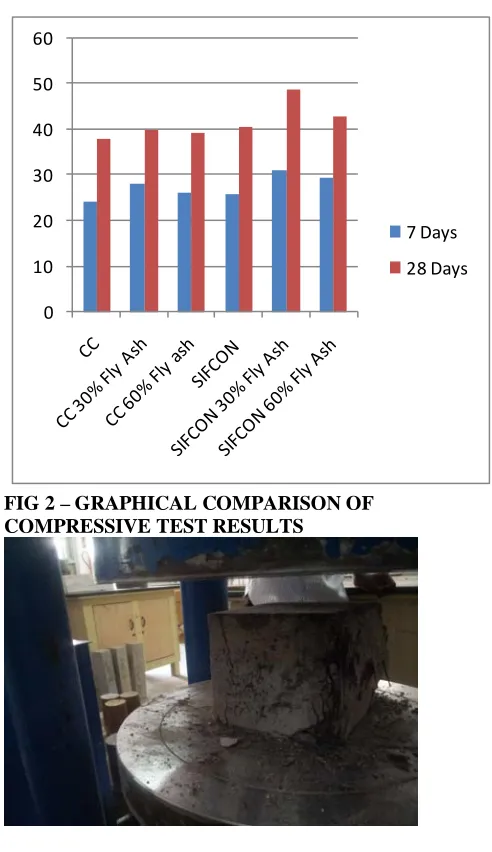
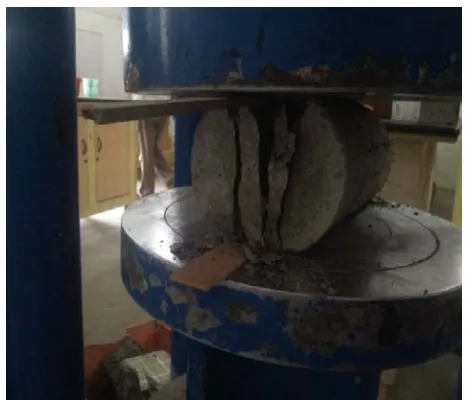
Compression strength test was carried out on Cube specimens of size 100X100X100 mm. The Mould was prepared , lubricated with oil and pre packed with Steel fibre matrix for SIFCON Specimens. For each Test result an average of two specimens was taken into account. The Cube Specimen was tested under a UTM – Universal Testing Machine with a load carrying capacity of 2000 kn. The Formulae derived for calculating Compression strength is = Load / Area. The Test results are shown in Table 1. The graphical representation of results and Testing of Specimens are shown in Fig 2 & 3 respectively.
CONCRETE TYPE
7 DAYS
COMPRESSIVE STRENGTH IN
N/mm
28 DAYS COMPRESSIVE STRENGTH IN
N/mm
2 2
Conventional Concrete with 0% Fly ash.
24.1 38.1
Conventional Concrete with 30% Fly ash.
28.2 40
Conventional Concrete with 60% Fly ash.
26.1 39.2
SIFCON Concrete with 0% Fly ash.
25.9 40.5
SIFCON Concrete with 30% Fly ash.
31.2 48.7
SIFCON Concrete with 60% Fly ash.
29.5 42.8
TABLE 1 – COMPRESIVE STRENGTH TEST RESULTS
0 10 20 30 40 50 60
7 Days 28 Days
FIG 2 – GRAPHICAL COMPARISON OF
COMPRESSIVE TEST RESULTS
FIG 3 – TESTING OF CUBE SPECIMENS
B. SPLIT TENSILE STRENGTH
Split tensile strength test was carried out on Cylinder specimens of size 200X100 mm. The Mould was prepared , lubricated with oil and pre packed with Steel fibre matrix for SIFCON Specimens. For each Test result an average of two specimens was taken into account. The Cylinder Specimen was tested under a UTM – Universal Testing Machine with a load carrying capacity of 2000 kn. The formulae for calculating Split tensile strength of Concrete is Fsp = 2 P / π D L .
172
Copyright © 2011-15. Vandana Publications. All Rights Reserved.
CONCRETE TYPE
7 DAYS SPLIT TENSILE STRENGTH IN
N/mm
28 DAYS SPLIT TENSILE STRENGTH IN
N/mm
2 2
Conventional Concrete with 0% Fly ash.
3.53 3.72
Conventional Concrete with 30% Fly ash.
3.94 5.382
Conventional Concrete with 60% Fly ash.
3.66 4.778
SIFCON Concrete with 0% Fly ash.
5.091 6.056
SIFCON Concrete with 30% Fly ash.
5.45 6.756
SIFCON Concrete with 60% Fly ash.
5.211 6.211
TABLE 2 – SPLIT TENSILE STRENGTH RESULTS
0 1 2 3 4 5 6 7 8
7 Days 28 Days
FIG 4 – GRAPHICAL COMPARISON OF SPLIT
TENSILE STRENGTH RESULTSFIG 5 – TESTING OF CYLINDER SPECIMENS
C. FLEXURAL STRENGTH
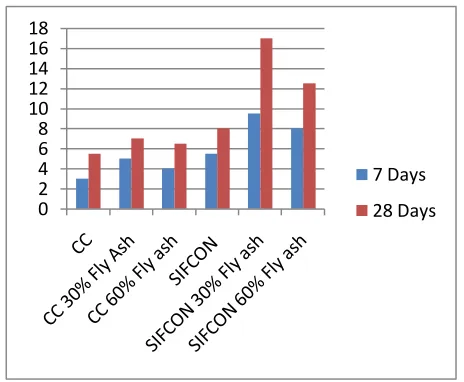
Flexural strength test was carried out on Prismatic beam specimens of size 500X100X100 mm. The Mould was prepared , lubricated with oil and pre packed with Steel fibre matrix for SIFCON Specimens. For each Test result an average of two specimens was taken into account. The Beam Specimen was tested using Two point loading system . The formulae for calculating Flexural strength of Concrete = PL / BD2.
CONCRETE TYPE
. The Test results are shown in Table 3. The graphical representation of results and Testing of Specimens are shown in Fig 6, 7 & 8 respectively.
7 DAYS SPLIT TENSILE STRENGTH IN
N/mm
28 DAYS SPLIT TENSILE STRENGTH IN
N/mm
2 2
Conventional Concrete with 0% Fly ash.
3 5.5
Conventional Concrete with 30% Fly ash.
4.5 7.5
Conventional Concrete with 60% Fly ash.
4 6.5
SIFCON Concrete with 0% Fly ash.
6.5 11
SIFCON Concrete with 30% Fly ash.
173
Copyright © 2011-15. Vandana Publications. All Rights Reserved.
SIFCONConcrete with 60% Fly ash.
8 12.5
TABLE 3 – FLEXURE STRENGTH TEST RESULTS
0 2 4 6 8 10 12 14 16 18
7 Days 28 Days
FIG 6
-
GRAPHICAL COMPARISON OFFLEXURAL STRENGTH RESULTS
FIG 7 - TESTING OF BEAM SPECIMENS
FIG – 8 FAILURE PATTERN OF SIFCON BEAM
V.
CONCLUSION
• As seen from the results above SIFCON Specimens exhibit more strength than that of Normal Conventional Concrete.
• On Comparing the Six different combinations used for the Project work , one Particular Combination, i.e SIFCON Specimen With 10% Steel Fibre and 30% Fly ash exhibits better Compressive, Tensile and Flexural strength than that of remaining combinations.
• Partial replacement of Fly ash with cement at 30% has increased the strength but is observed to drop down when it is replaced at 60%. for both SIFCON and Conventional Concrete specimens. • The Construction cost of SIFCON is relatively
high when compared with normal Conventional concrete, hence it can be used in areas of Blast resistant zone, Earthquake resistant structures, Beam Column joints etc.
REFERENCES
[1] IS 10262: 2009, “Indian Standards guidelines for concrete mix proportioning ( first revision), Bureau of Indian Standards, New delhi.
[2] IS 383: 1970, “Indian standard specification for coarse and fine aggregates from natural sources for concrete ( Second revision),” Bureau of Indian Standards, New delhi. [3] IS 2386: 1963, “Indian standard code for methods of test for aggregate for concrete (Second revision),” Bureau of Indian Standards, New delhi
174
Copyright © 2011-15. Vandana Publications. All Rights Reserved.
[5] Metin Ipek et al (2014) , “ The effect of Pre setting onthe flexure strength and fracture toughness of SIFCON during the setting phase “, Journal of Construction and Building materials, Vol.66, pp.515-521.
[6] Mert Yucel et al (2012), “ Improvement of Self – Compacting Cement Slurry for Autoclaved SIFCON Containing High Volume class C Fly ash ”, Journal of applied Engineering and Technology, Vol.9, pp.39-50. [7] Y.Farnam et al (2010), “Behaviour Of Slurry Infiltrated Fibre Concrete under Triaxial Compression ”, Journal of Cement and Concrete research, Vol.40, pp.71-81.
[8] Lankard D R. (1984) “Slurry Infiltrated Fibre Concrete (SIFCON)” Concrete International, Dec. 1984, pp. 44-47. [9] Naaman, A.E., Wight, J.K., and Abdou, H., “SIFCON Connections for Seismic Resistant Frames”, Steel Reinforced Concrete, Compilation 27, American Concrete Institute, Detroit, Michigan, 1991, pp. 62-67.
[10] PARAMESWARAN (2012) “Studies on Slurry-Infiltrated Fibrous Concrete (SIFCON)”, Structural Engineering Research Center, CSIR Campus, Taramani, Madras-600 113, India.
[11] Balaguru, P.M., and Kendzulak, J. (1987) ‘Mechanical Properties of Slurry Infiltrated Fiber Concrete (SIFCON). Fiber Reinforced Concrete Properties and Applications’, SP-105, American Concrete Institute, Detroit, Michigan, 247-268.