The Thirty-Third AAAI Conference on Artificial Intelligence (AAAI-19)
Relation Structure-Aware Heterogeneous Information Network Embedding
Yuanfu Lu,
1Chuan Shi,
1∗Linmei Hu,
1Zhiyuan Liu
2 1Beijing University of Posts and Telecommunications, Beijing, China2Tsinghua University, Beijing, China
{luyuanfu, shichuan, hulinmei}@bupt.edu.cn, [email protected]
Abstract
Heterogeneous information network (HIN) embedding aims to embed multiple types of nodes into a low-dimensional space. Although most existing HIN embedding methods con-sider heterogeneous relations in HINs, they usually employ one single model for all relations without distinction, which inevitably restricts the capability of network embedding. In this paper, we take the structural characteristics of heteroge-neous relations into consideration and propose a novel Re-lation structure-aware Heterogeneous Information Network Embedding model (RHINE). By exploring the real-world net-works with thorough mathematical analysis, we present two structure-related measures which can consistently distinguish heterogeneous relations into two categories: Affiliation Re-lations (ARs) and Interaction ReRe-lations (IRs). To respect the distinctive characteristics of relations, in our RHINE, we pro-pose different models specifically tailored to handle ARs and IRs, which can better capture the structures and semantics of the networks. At last, we combine and optimize these mod-els in a unified and elegant manner. Extensive experiments on three real-world datasets demonstrate that our model sig-nificantly outperforms the state-of-the-art methods in various tasks, including node clustering, link prediction, and node classification.
1
Introduction
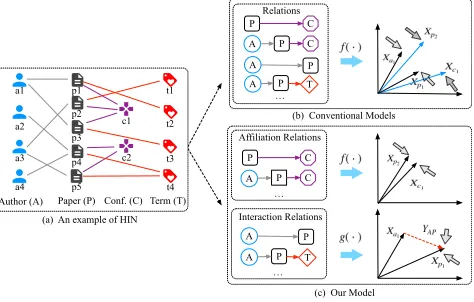
Network embedding has shed a light on the analysis of net-works as it is effective to learn the latent features that encode the properties of a network (Cui et al. 2018; Cai, Zheng, and Chang 2018). Although the state-of-the-arts (Perozzi, Al-Rfou, and Skiena 2014; Grover and Leskovec 2016; Tang et al. 2015; Wang, Cui, and Zhu 2016) have achieved promis-ing performance in many data minpromis-ing tasks, most of them focus on homogeneous networks, which only contain one single type of nodes and edges. In reality, many networks are usually with multiple types of nodes and edges, widely known as heterogeneous information networks (HINs) (Sun et al. 2011; Shi et al. 2017). Taking the DBLP network for example, as shown in Figure 1(a), it contains four types of nodes: Author (A), Paper (P), Conference (C) and Term (T), and multiple types of relations: writing/written relations, and
∗
Corresponding author: Chuan Shi ([email protected]). Copyright c2019, Association for the Advancement of Artificial Intelligence (www.aaai.org). All rights reserved.
(a) An example of HIN a1
a3
Author (A) Paper (P) Conf. (C) a2
a4 p1
p3
p4
p5 p2
c1
c2
Term (T) t1
t2
t3
t4
(c) Our Model Affiliation Relations
…
A P C
P C
Interaction Relations
…
A P
A P T
(b) Conventional Models Relations
A P C
A P
…
A P T
P C
Figure 1: The illustration of an HIN and the compari-son between conventional methods and our method (non-differentiated relations v.s. (non-differentiated relations).
publish/published relations, etc. In addition, there are com-posite relations represented by meta-paths (Sun et al. 2011) such asAPA(co-author relation) andAPC(authors write pa-pers published in conferences), which are widely used to exploit rich semantics in HINs. Thus, compared to homo-geneous networks, HINs fuse more information and contain richer semantics. Directly applying traditional homogeneous models to embed HINs will inevitably lead to reduced per-formance in downstream tasks.
close to each other, as illustrated in Figure 1(b).
However, various relations in an HIN have significantly different structural characteristics, which should be handled with different models. Let’s see a toy example in Figure 1(a). The relations in the network include atomic relations (e.g.,
APandPC) and composite relations (e.g.,APAandAPC). Intuitively,APrelation andPCrelation reveal rather differ-ent characteristics in structure. That is, some authors write some papers in the AP relation, which shows a peer-to-peer structure. While that many papers are published in one conference in thePCrelation reveals the structure of one-centered-by-another. Similarly,APAandAPCindicate peer-to-peer and one-centered-by-another structures respectively. The intuitive examples clearly illustrate that relations in an HIN indeed have different structural characteristics.
It is non-trivial to consider different structural character-istics of relations for HIN embedding, due to the following challenges: (1) How to distinguish the structural character-istics of relations in an HIN? Various relations (atomic re-lations or meta-paths) with different structures are involved in an HIN. Quantitative and explainable criteria are desired to explore the structural characteristics of relations and dis-tinguish them. (2) How to capture the distinctive structural characteristics of different categories of relations? Since the various relations have different structures, modeling them with one single model may lead to some loss of information. We need to specifically design appropriate models which are able to capture their distinctive characteristics. (3) The dif-ferent models for the difdif-ferentiated relations should be easily and smoothly combined to ensure simple optimization in a unified manner.
In this paper, we present a novel model for HIN em-bedding, namedRelation structure-awareHIN Embedding
(RHINE). In specific, we first explore the structural
char-acteristics of relations in HINs with thorough mathematical analysis, and present two structure-related measures which can consistently distinguish the various relations into two categories: Affiliation Relations (ARs) with one-centered-by-another structures and Interaction Relations (IRs) with peer-to-peer structures. In order to capture the distinctive structural characteristics of the relations, we then propose two specifically designed models. For ARs where the nodes share similar properties (Yang and Leskovec 2012), we cal-culate Euclidean distance as the proximity between nodes, so as to make the nodes directly close in the low-dimensional space. On the other hand, for IRs which bridge two compati-ble nodes, we model them as translations between the nodes. Since the two models are consistent in terms of mathemati-cal form, they can be optimized in a unified and elegant way. It is worthwhile to highlight our contributions as follows:
• To the best of our knowledge, we make the first attempt to explore the different structural characteristics of relations in HINs and present two structure-related criteria which can consistently distinguish heterogeneous relations into ARs and IRs.
• We propose a novel relation structure-aware HIN embed-ding model (RHINE), which fully respects the distinctive structural characteristics of ARs and IRs by exploiting
ap-propriate models and combining them in a unified and el-egant manner.
• We conduct comprehensive experiments to evaluate the performance of our model. Experimental results demon-strate that our model significantly outperforms state-of-the-art network embedding models in various tasks.
2
Related Work
Recently, network embedding has attracted considerable at-tention. Inspired by word2vec (Mikolov et al. 2013), random walk based methods (Perozzi, Al-Rfou, and Skiena 2014; Grover and Leskovec 2016) have been proposed to learn rep-resentations of networks by the skip-gram model. After that, several models are designed to better preserve network prop-erties (Tang et al. 2015; Ou et al. 2016; Ribeiro, Saverese, and Figueiredo 2017). Besides, there are some deep neu-ral network based models for network embedding (Wang, Cui, and Zhu 2016; Cao, Lu, and Xu 2016). However, all the aforementioned methods focus only on learning the rep-resentations of homogeneous networks.
Different from homogeneous networks, HINs consist of multiple types of nodes and edges. Several attempts have been done on HIN embedding and achieved promising performance in various tasks (Tang, Qu, and Mei 2015; Shang et al. 2016; Fu, Lee, and Lei 2017; Wang et al. 2018; Shi et al. 2018). PTE (Tang, Qu, and Mei 2015) decomposes an HIN to a set of bipartite networks and then performs net-work embedding individually. ESim (Shang et al. 2016) uti-lizes user-defined meta-paths as guidance to learn node em-beddings. Metapath2vec (Dong, Chawla, and Swami 2017) combines meta-path based random walks and skip-gram model for HIN embedding. HIN2Vec (Fu, Lee, and Lei 2017) learns the embeddings of HINs by conducting multi-ple prediction training tasks jointly. HERec (Shi et al. 2018) filters the node sequences with type constraints and thus cap-tures the semantics of HINs.
All the above-mentioned models deal with all relations in HINs with one single model, neglecting differentiated struc-tures of relations. In this paper, we explore and distinguish the structural characteristics of relations with quantitative analysis. For relations with distinct structural characteris-tics, we propose to handle them with specifically designed models.
3
Preliminaries
In this section, we introduce some basic concepts and for-malize the problem of HIN embedding.
Definition 1. Heterogeneous Information Network (HIN).
An HIN is defined as a graphG= (V, E, T, φ, ϕ), in which
V andEare the sets of nodes and edges, respectively. Each node v and edgeeare associated with their type mapping functionsφ : V → TV andϕ : E → TE, respectively. TV andTE denote the sets of node and edge types, where
|TV|+|TE|>2, andT =TV ∪TE.
Definition2. Meta-path. A meta-pathm∈M is defined as
Table 1: Statistics of the three datasets.tudenotes the type of nodeu,hu, r, viis a node-relation triple.
Datasets Nodes Number of Relations Number of Avg. Degree Avg. Degree Measures Relation Nodes (tu∼tv) Relations oftu oftv D(r) S(r) Category
DBLP Term (T) Paper (P) Author (A) Conference (C) 8,811 14,376 14,475 20 PC APC AP PT APT 14,376 24,495 41,794 88,683 260,605 1.0 2.9 2.8 6.2 18.0 718.8 2089.7 2.9 10.7 29.6 718.8 720.6 1.0 1.7 1.6 0.05 0.085 0.0002 0.0007 0.002 AR AR IR IR IR Yelp User (U) Service (S) Business (B) Star Level (L) Reservation (R) 1,286 2 2,614 9 2 BR BS BL UB BUB 2,614 2,614 2,614 30,838 528,332 1.0 1.0 1.0 23.9 405.3 1307.0 1307.0 290.4 11.8 405.3 1307.0 1307.0 290.4 2.0 1.0 0.5 0.5 0.1 0.009 0.07 AR AR AR IR IR AMiner Paper (P) Author (A) Reference (R) Conference (C) 127,623 164,472 147,251 101 PC APC AP PR APR 127,623 232,659 355,072 392,519 1,084,287 1.0 2.2 2.2 3.1 7.1 1263.6 3515.6 2.8 2.7 7.9 1264.6 1598.0 1.3 1.1 1.1 0.01 0.01 0.00002 0.00002 0.00004 AR AR IR IR IR
oftv1
te1
−→ tv2...
tel
−→tvl+1 (abbreviated astv1tv2...tvl+1),
which describes a composite relation betweenv1andvl+1. Definition3. Node-Relation Triple. In an HING, relations
Rinclude atomic relations (e.g., links) and composite rela-tions (e.g., meta-paths). A node-relation triplehu, r, vi ∈P, describes that two nodesuandvare connected by a relation
r∈R. HerePrepresents the set of all node-relation triples.
Example 1. For example, as shown in Figure 1(a),
ha2, AP C, c2i is a node-relation triple, meaning that a1
writes a paper published inc2.
Definition4. Heterogeneous Information Network
Embed-ding. Given an HING= (V,E,T,φ,ϕ), the goal of HIN embedding is to develop a mapping functionf : V → Rd
that projects each nodev ∈ V to a low-dimensional vector inRd, whered |V|.
4
Structural Characteristics of Relations
In this section, we first describe three real-world HINs and analyze the structural characteristics of relations in HINs. Then we present two structure-related measures which can consistently distinguish various relations quantitatively.4.1
Dataset Description
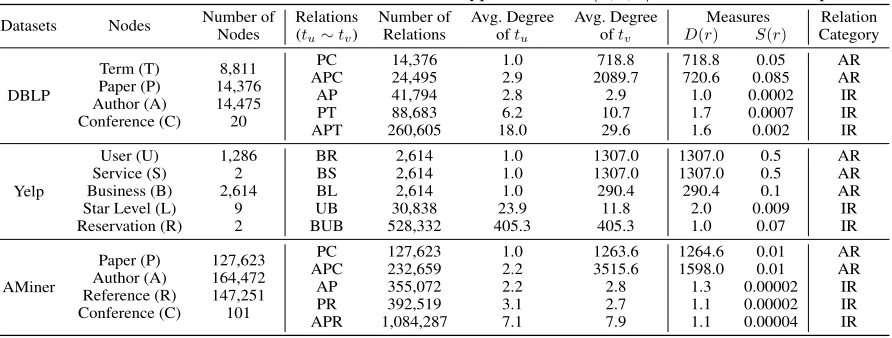
Before analyzing the structural characteristics of relations, we first briefly introduce three datasets used in this paper, including DBLP1, Yelp2and AMiner3(Tang et al. 2008). The detailed statistics of these datasets are illustrated in Table 1. DBLP is an academic network, which contains four types of nodes: author (A), paper (P), conference (C) and term (T). We extract node-relation triples based on the set of relations
{AP, PC, PT, APC, APT}. Yelp is a social network, which
contains five types of nodes: user (U), business (B), reser-vation (R), service (S) and star level (L). We consider the relations {BR, BS, BL, UB, BUB}. AMiner is also an aca-demic network, which contains four types of nodes,
includ-1https://dblp.uni-trier.de
2
https://www.yelp.com/dataset/ 3
https://www.aminer.cn/citation
ing author (A), paper (P), conference (C) and reference (R). We consider the relations {AP, PC, PR, APC, APR}. No-tice that we can actually analyze all the relations based on meta-paths. However, not all meta-paths have a positive ef-fect on embeddings (Sun et al. 2013). Hence, following pre-vious works (Shang et al. 2016; Dong, Chawla, and Swami 2017), we choose the important and meaningful meta-paths.
4.2
Affiliation Relations and Interaction
Relations
In order to explore the structural characteristics of relations, we present mathematical analysis on the above datasets.
Since the degree of nodes can well reflect the structures of networks (Wasserman and Faust 1994), we define a degree-based measureD(r)to explore the distinction of various re-lations in an HIN. Specifically, we compare the average de-grees of two types of nodes connected with the relationr, via dividing the larger one by the smaller one (D(r) ≥1). Formally, given a relationrwith nodesuandv(i.e., node relation triplehu, r, vi),tuandtvare the node types ofuand v, we defineD(r)as follows:
D(r) =max [ ¯dtu,dt¯v]
min [ ¯dtu,dt¯v]
, (1)
wheredt¯u anddt¯v are the average degrees of nodes of the
typestuandtvrespectively.
A large value ofD(r)indicates quite inequivalent struc-tural roles of two types of nodes connected via the relation
r (one-centered-by-another), while a small value of D(r) means compatible structural roles (peer-to-peer). In other words, relations with a large value of D(r) show much stronger affiliation relationships. Nodes connected via such relations share much more similar properties (Faust 1997). While relations with a small value ofD(r)implicate much stronger interaction relationships. Therefore, we call the two categories of relations asAffiliation Relations(ARs) and In-teraction Relations(IRs), respectively.
example. As shown in Table 1, for the relation PC with
D(P C) = 718.8, the average degree of nodes with type P is 1.0 while that of nodes with type C is 718.8. It shows that papers and conferences are structurally inequivalent. Pa-pers are centered by conferences. WhileD(AP) = 1.1 in-dicates that authors and papers are compatible and peer-to-peer in structure. This is consistent with our common sense. Semantically, the relationPC means that‘papers are pub-lished in conferences’, indicating an affiliation relationship. Differently,APmeans that‘authors write papers’, which ex-plicitly describes an interaction relationship.
In fact, we can also define some other measures to cap-ture the structural difference. For example, we compare the relations in terms of sparsity, which can be defined as:
S(r) = Nr
Ntu×Ntv, (2)
whereNr represents the number of relation instances
fol-lowingr.NtuandNtv mean the number of nodes with type
tu andtv, respectively. The measure can also consistently distinguish the relations into two categories: ARs and IRs. The detailed statistics of all the relations in the three HINs are shown in Table 1.
Evidently, Affiliation Relations and Interaction Relations exhibit rather distinct characteristics: (1) ARs indicate one-centered-by-another structures, where the average degrees of the types of end nodes are extremely different. They im-ply an affiliation relationship between nodes. (2) IRs de-scribe peer-to-peer structures, where the average degrees of the types of end nodes are compatible. They suggest an in-teraction relationship between nodes.
5
Relation Structure-Aware HIN Embedding
In this section, we present a novel Relation structure-aware HIN Embedding model (RHINE), which individually han-dles two categories of relations (ARs and IRs) with different models in order to preserve their distinct structural charac-teristics, as illustrated in Figure 1(c).5.1
Basic Idea
Through our exploration with thorough mathematical analy-sis, we find that the heterogeneous relations can be typically divided into ARs and IRs with different structural charac-teristics. In order to respect their distinct characteristics, we need to specifically design different while appropriate mod-els for the different categories of relations.
For ARs, we propose to take Euclidean distance as a metric to measure the proximity of the connected nodes in the low-dimensional space. There are two motivations behind this: (1) First of all, ARs show affiliation struc-tures between nodes, which indicate that nodes connected via such relations share similar properties. (Faust 1997; Yang and Leskovec 2012). Hence, nodes connected via ARs could be directly close to each other in the vector space, which is also consistent with the optimization of Euclidean distance (Danielsson 1980). (2) Additionally, one goal of HIN embedding is to preserve the high-order proximity. Eu-clidean distance can ensure that both first-order and
second-order proximities are preserved as it meets the condition of the triangle inequality (Hsieh et al. 2017).
Different from ARs, IRs indicate strong interaction rela-tionships between compatible nodes, which themselves con-tain important structural information of two nodes. Thus, we propose to explicitly model an IR as a translation be-tween nodes in the low-dimensional vector space. Addition-ally, the translation based distance is consistent with the Euclidean distance in the mathematical form (Bordes et al. 2013). Therefore, they can be smoothly combined in a uni-fied and elegant manner.
5.2
Different Models for ARs and IRs
In this subsection, we introduce two different models ex-ploited in RHINE for ARs and IRs, respectively.
Euclidean Distance for Affiliation Relations Nodes
con-nected via ARs share similar properties (Faust 1997), there-fore nodes could be directly close to each other in the vector space. We take the Euclidean distance as the proximity mea-sure of two nodes connected by an AR.
Formally, given an affiliation node-relation triple
hp, s, qi ∈ PARwheres ∈ RAR is the relation betweenp
andqwith weightwpq, the distance betweenpandqin the
latent vector space is calculated as follows:
f(p, q) =wpq||Xp−Xq||22, (3)
in whichXp ∈RdandXq ∈Rdare the embedding vectors
of pandq, respectively. Asf(p, q)quantifies the distance between pandq in the low-dimensional vector space, we aim to minimizef(p, q)to ensure that nodes connected by an AR should be close to each other. Hence, we define the margin-based loss (Bordes et al. 2013) function as follows:
LEuAR=
X
s∈RAR
X
hp,s,qi∈PAR
X
hp0,s,q0i∈P0
AR
max[0, γ+f(p, q)−f(p0, q0)],
(4)
whereγ >0is a margin hyperparameter.PARis the set of positive affiliation node-relation triples, whilePAR0 is the set of negative affiliation node-relation triples.
Translation-based Distance for Interaction Relations
Interaction Relations demonstrate strong interactions be-tween nodes with compatible structural roles. Thus, different from ARs, we explicitly model IRs as translations between nodes.
Formally, given an interaction node-relation triple
hu, r, vi wherer ∈ RIR with weight wuv, we define the
score function as:
g(u, v) =wuv||Xu+Yr−Xv||, (5)
whereXu andXv are the node embeddings ofuandv
re-spectively, andYr is the embedding of the relationr.
Intu-itively, this score function penalizes deviation of(Xu+Yr)
For each interaction node-relation triplehu, r, vi ∈ PIR, we define the margin-based loss function as follows:
LT rIR= X
r∈RIR
X
hu,r,vi∈PIR
X
hu0,r,v0i∈P0
IR
max[0, γ+g(u, v)−g(u0, v0)] (6)
where PIR is the set of positive interaction node-relation
triples, while PIR0 is the set of negative interaction node-relation triples.
5.3
A Unified Model for HIN Embedding
Finally, we smoothly combine the two models for differ-ent categories of relations by minimizing the following loss function:
L=LEuAR+LT rIR (7)
= X
s∈RAR X
hp,s,qi∈PAR X
hp0,s,q0i∈P0
AR
max[0, γ+f(p, q)−f(p0, q0)]
+ X
r∈RIR X
hu,r,vi∈PIR X
hu0,r,v0i∈PIR0
max[0, γ+g(u, v)−g(u0, v0)]
Sampling Strategy As shown in Table 1, the distributions
of ARs and IRs are quite unbalanced. What’s more, the pro-portion of relations are unbalanced within ARs and IRs. Tra-ditional edge sampling may suffer from under-sampling for relations with a small amount or over-sampling for relations with a large amount. To address the problems, we draw pos-itive samples according to their probability distributions. As for negative samples, we follow previous work (Bordes et al. 2013) to construct a set of negative node-relation triples
P(0u,r,v)={(u0, r, v)|u0 ∈V} ∪ {(u, r, v0)|v0 ∈V}for the positive node-relation triple(u, r, v), where either the head or tail is replaced by a random node, but not both at the same time.
6
Experiments
In this section, we conduct extensive experiments to demon-strate the effectiveness of our model RHINE.
6.1
Datasets
As described in Subsection 4.1, we conduct experiments on three datasets, including DBLP, Yelp and AMiner. The statistics of them are summarized in Table 1.
6.2
Baseline Methods
We compare our proposed model RHINE with six state-of-the-art network embedding methods.
• DeepWalk (Perozzi, Al-Rfou, and Skiena 2014)
per-forms a random walk on networks and then learns low-dimensional node vectors via the skip-gram model.
• LINE(Tang et al. 2015) considers first-order and second-order proximities in networks. We denote the model that only uses first-order or second-order proximity as LINE-1st or LINE-2nd, respectively.
Table 2: Performance Evaluation of Node Clustering.
Methods DBLP Yelp AMiner
DeepWalk 0.3884 0.3043 0.5427 LINE-1st 0.2775 0.3103 0.3736 LINE-2nd 0.4675 0.3593 0.3862 PTE 0.3101 0.3527 0.4089 ESim 0.3449 0.2214 0.3409 HIN2Vec 0.4256 0.3657 0.3948 metapath2vec 0.6065 0.3507 0.5586 RHINE 0.7204 0.3882 0.6024
• PTE (Tang, Qu, and Mei 2015) decomposes an HIN to a set of bipartite networks and then learns the low-dimensional representation of the network.
• ESim(Shang et al. 2016) takes a given set of meta-paths as input to learn a low-dimensional vector space. For a fair comparison, we use the same meta-paths with equal weights in Esim and our model RHINE.
• HIN2Vec(Fu, Lee, and Lei 2017) learns the latent vectors
of nodes and meta-paths in an HIN by conducting multi-ple prediction training tasks jointly.
• Metapath2vec(Dong, Chawla, and Swami 2017)
lever-ages meta-path based random walks and skip-gram model to perform node embedding. We leverage the meta-paths APCPA, UBSBU and APCPA in DBLP, Yelp and AMiner respectively, which perform best in the evaluations.
Parameter Settings For a fair comparison, we set the
em-bedding dimensiond= 100and the size of negative samples
k = 3for all models. For DeepWalk, HIN2Vec and metap-ath2vec, we set the number of walks per nodew = 10, the walk lengthl = 100and the window sizeτ = 5. For our model RHINE, the marginγis set to 1.
6.3
Node Clustering
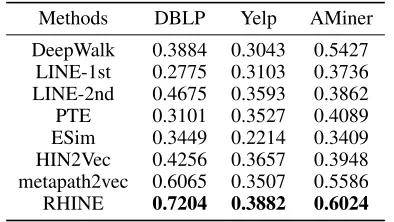
Experimental Settings We leverage K-means to cluster
the nodes and evaluate the results in terms of normalized mutual information (NMI) (Shi et al. 2014).
Results As shown in Table 2, our model RHINE
Table 3: Performance Evaluation of Link Prediction.
Methods DBLP (A-A) DBLP (A-C) Yelp (U-B) AMiner (A-A) AMiner (A-C)
AUC F1 AUC F1 AUC F1 AUC F1 AUC F1
DeepWalk 0.9131 0.8246 0.7634 0.7047 0.8476 0.6397 0.9122 0.8471 0.7701 0.7112 LINE-1st 0.8264 0.7233 0.5335 0.6436 0.5084 0.4379 0.6665 0.6274 0.7574 0.6983 LINE-2nd 0.7448 0.6741 0.8340 0.7396 0.7509 0.6809 0.5808 0.4682 0.7899 0.7177 PTE 0.8853 0.8331 0.8843 0.7720 0.8061 0.7043 0.8119 0.7319 0.8442 0.7587 ESim 0.9077 0.8129 0.7736 0.6795 0.6160 0.4051 0.8970 0.8245 0.8089 0.7392 HIN2Vec 0.9160 0.8475 0.8966 0.7892 0.8653 0.7709 0.9141 0.8566 0.8099 0.7282 metapath2vec 0.9153 0.8431 0.8987 0.8012 0.7818 0.5391 0.9111 0.8530 0.8902 0.8125 RHINE 0.9315 0.8664 0.9148 0.8478 0.8762 0.7912 0.9316 0.8664 0.9173 0.8262
Table 4: Performance Evaluation of Multi-class Classification.
Methods DBLP Yelp AMiner
Macro-F1 Micro-F1 Macro-F1 Micro-F1 Macro-F1 Micro-F1
DeepWalk 0.7475 0.7500 0.6723 0.7012 0.9386 0.9512 LINE-1st 0.8091 0.8250 0.4872 0.6639 0.9494 0.9569 LINE-2nd 0.7559 0.7500 0.5304 0.7377 0.9468 0.9491
PTE 0.8852 0.8750 0.5389 0.7342 0.9791 0.9847
ESim 0.8867 0.8750 0.6836 0.7399 0.9910 0.9948
HIN2Vec 0.8631 0.8500 0.6075 0.7361 0.9962 0.9965
metapath2vec 0.8976 0.9000 0.5337 0.7208 0.9934 0.9936
RHINE 0.9344 0.9250 0.7132 0.7572 0.9884 0.9807
6.4
Link Prediction
Experimental Setting We model the link prediction
prob-lem as a binary classification probprob-lem that aims to predict whether a link exists. In this task, we conduct co-author ( A-A) and author-conference (A-C) link prediction for DBLP and AMiner. For Yelp, we predict user-business (U-B) links which indicate whether a user reviews a business. We first randomly separate the original network into training net-work and testing netnet-work, where the training netnet-work con-tains 80% relations to be predicted (i.e.,A-A,A-CandU-B) and the testing network contains the rest. Then, we train the embedding vectors on the training network and evaluate the prediction performance on the testing network.
Results The results of link prediction task are reported
in Table 3 with respect to AUC and F1 score. It is clear that our model performs better than all baseline methods on three datasets. The reason behind the improvement is that our model based on Euclidean distance modeling relations can capture both the first-order and second-order proximi-ties. In addition, our model RHINE distinguishes multiple types of relations into two categories in terms of their struc-tural characteristics, and thus can learn better embeddings of nodes, which are beneficial for predicting complex relation-ships between two nodes.
6.5
Multi-Class Classification
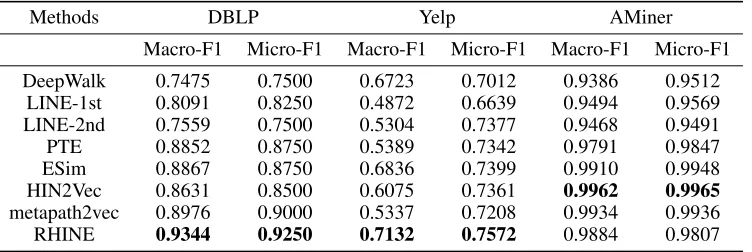
Experimental Setting In this task, we employ the same
labeled data used in the node clustering task. After learning the node vectors, we train a logistic classifier with 80% of
the labeled nodes and test with the remaining data. We use Micro-F1 and Macro-F1 score as the metrics for evaluation (Dong, Chawla, and Swami 2017).
Results We summarize the results of classification in
Ta-ble 4. As we can observe, (1) RHINE achieves better per-formance than all baseline methods on all datasets except Aminer. It improves the performance of node classification by about 4% on both DBLP and Yelp averagely. In terms of AMiner, the RHINE performs slightly worse than ESim, HIN2vec and metapath2vec. This may be caused by over-capturing the information of relationsPRandAPR(R rep-resents references). Since an author may write a paper re-ferring to various fields, these relations may introduce some noise. (2) Although ESim and HIN2Vec can model multiple types of relations in HINs, they fail to perform well in most cases. Our model RHINE achieves good performance due to the respect of distinct characteristics of various relations.
6.6
Comparison of Variant Models
In order to verify the effectiveness of distinguishing the structural characteristics of relations, we design three vari-ant models based on RHINE as follows:
• RHINEEu leverages Euclidean distance to embed HINs
without distinguishing the relations.
• RHINET r models all nodes and relations in HINs with
NMI
0 0.2 0.4 0.6 0.8
(a) Node Clustering on Three Datasets DBLP Yelp AMiner
RHINE_Eu RHINE_Tr RHINE_Re RHINE
M
ac
ro-F
1
0 0.25 0.5 0.75 1
(b) Classification on Three Datasets
DBLP Yelp AMiner
RHINE_Eu RHINE_Tr RHINE_Re RHINE
AUC
0 0.25 0.5 0.75 1
(c) Link Prediction on Three Datasets DBLP(A-C) Yelp(U-B) AMiner(A-C)
RHINE_Eu RHINE_Tr
RHINE_Re RHINE
Figure 2: Performance Evaluation of Variant Models.
(a) DeepWalk (b) metapath2vec (c) RHINE
Figure 3: Visualization of Node Embeddings.
• RHINERe leverages Euclidean distance to model IRs
while translation mechanism for ARs, reversely.
We set the parameters of variant models as the same as those of our proposed model RHINE. The results of the three tasks are shown in Figure 2. It is evident that our model outper-forms RHINEEu and RHINET r, indicating that it is
ben-eficial for learning the representations of nodes by distin-guishing the heterogeneous relations. Besides, we find that RHINET rachieves better performance than RHINEEu. This
is due to the fact that there are generally more peer-to-peer relationships (i.e., IRs) in the networks. Directly making all nodes close to each other leads to much loss of information. Compared with the reverse model RHINERe, RHINE also
achieves better performance on all tasks, which implies that two models for ARs and IRs are well designed to capture their distinctive characteristics.
6.7
Visualization
To understand the representations of the networks intu-itively, we visualize the vectors of nodes (i.e., papers) in DBLP learned with DeepWalk, metapath2vec and RHINE in Figure 3. As we can see, our model clearly clusters the paper nodes into four groups. It demonstrates that our model learns superior node embeddings by distinguishing the het-erogeneous relations in HINs. In contrast, DeepWalk barely splits papers into different groups. Metapath2vec performs better than DeepWalk, but the boundary is blurry.
NMI
0.3 0.4 0.5 0.6 0.7 0.8
#Dimensions
(a) NMI w.r.t #dimensions
10 50 100 200 300
DBLP Yelp AMiner
NMI
0.3 0.4 0.5 0.6 0.7 0.8
#Negative samples
(b) NMI w.r.t #negative samples
1 2 3 5 7
DBLP Yelp AMiner
Figure 4: Parameter Analysis.
6.8
Parameter Analysis
In order to investigate the influences of different parame-ters in our model, we evaluate the RHINE in node clustering task. Specifically, we explore the sensitivity of two parame-ters, including the number of embedding dimensions and the number of negative samples. As shown in Figure 4(a), the performance of our model improves with the increase in the number of dimensions, and then tends to be stable once the dimension of the representation reaches around 100. Simi-larly, Figure 4(b) shows that as the number of negative ex-amples increases, the performance of our model first grows and then becomes stable when the number reaches 3.
7
Conclusion
can consistently distinguish heterogeneous relations into two categories: affiliation relations and interaction relations. To respect the distinctive structures of relations, we pro-pose a novel relation structure-aware HIN embedding model (RHINE), which individually handles these two categories of relations. Experimental results demonstrate that RHINE outperforms state-of-the-art baselines in various tasks. In the future, we will explore other possible measures to differen-tiate relations so that we can better capture the structural in-formation of HINs. In addition, we will exploit deep neural network based models for different relations.
8
Acknowledgments
This work is supported by the National Key Research and Development Program of China (2017YFB0803304), the National Natural Science Foundation of China (No. 61772082, 61806020, 61702296, 61375058), the Beijing Municipal Natural Science Foundation (4182043), and the CCF-Tencent Open Fund.
References
Bordes, A.; Usunier, N.; Garcia-Duran, A.; Weston, J.; and Yakhnenko, O. 2013. Translating embeddings for modeling multi-relational data. InProceedings of NIPS, 2787–2795. Cai, H.; Zheng, V. W.; and Chang, K. 2018. A comprehensive survey of graph embedding: problems, techniques and applica-tions.IEEE Transactions on Knowledge and Data Engineering. Cao, S.; Lu, W.; and Xu, Q. 2016. Deep neural networks for learning graph representations. InProceedings of AAAI, 1145– 1152.
Chang, S.; Han, W.; Tang, J.; Qi, G.-J.; Aggarwal, C. C.; and Huang, T. S. 2015. Heterogeneous network embedding via deep architectures. InProceedings of SIGKDD, 119–128. ACM. Cui, P.; Wang, X.; Pei, J.; and Zhu, W. 2018. A survey on net-work embedding. IEEE Transactions on Knowledge and Data Engineering.
Danielsson, P.-E. 1980. Euclidean distance mapping.Computer
Graphics and image processing14(3):227–248.
Dong, Y.; Chawla, N. V.; and Swami, A. 2017. metapath2vec: Scalable representation learning for heterogeneous networks. In
Proceedings of SIGKDD, 135–144. ACM.
Faust, K. 1997. Centrality in affiliation networks. Social
net-works19(2):157–191.
Fu, T.-y.; Lee, W.-C.; and Lei, Z. 2017. Hin2vec: Explore meta-paths in heterogeneous information networks for representation learning. InProceedings of CIKM, 1797–1806. ACM. Grover, A., and Leskovec, J. 2016. node2vec: Scalable feature learning for networks. InProceedings of SIGKDD, 855–864. ACM.
Han, X.; Shi, C.; Wang, S.; Philip, S. Y.; and Song, L. 2018. Aspect-level deep collaborative filtering via heterogeneous in-formation networks. InProceedings of IJCAI, 3393–3399. Hsieh, C.-K.; Yang, L.; Cui, Y.; Lin, T.-Y.; Belongie, S.; and Estrin, D. 2017. Collaborative metric learning. InProceedings
of WWW, 193–201.
Mikolov, T.; Sutskever, I.; Chen, K.; Corrado, G. S.; and Dean, J. 2013. Distributed representations of words and phrases and their compositionality. InProceedings of NIPS, 3111–3119.
Ou, M.; Cui, P.; Pei, J.; Zhang, Z.; and Zhu, W. 2016. Asym-metric transitivity preserving graph embedding. InProceedings
of SIGKDD, 1105–1114. ACM.
Perozzi, B.; Al-Rfou, R.; and Skiena, S. 2014. Deepwalk: Online learning of social representations. In Proceedings of
SIGKDD, 701–710. ACM.
Ribeiro, L. F.; Saverese, P. H.; and Figueiredo, D. R. 2017. struc2vec: Learning node representations from structural iden-tity. InProceedings of SIGKDD, 385–394. ACM.
Shang, J.; Qu, M.; Liu, J.; Kaplan, L. M.; Han, J.; and Peng, J. 2016. Meta-path guided embedding for similarity search in large-scale heterogeneous information networks.arXiv preprint arXiv:1610.09769.
Shi, C.; Kong, X.; Huang, Y.; Philip, S. Y.; and Wu, B. 2014. Hetesim: A general framework for relevance measure in hetero-geneous networks.IEEE Transactions on Knowledge and Data
Engineering26(10):2479–2492.
Shi, C.; Li, Y.; Zhang, J.; Sun, Y.; and Philip, S. Y. 2017. A survey of heterogeneous information network analysis. IEEE
Transactions on Knowledge and Data Engineering29(1):17–
37.
Shi, C.; Hu, B.; Zhao, X.; and Yu, P. 2018. Heterogeneous information network embedding for recommendation. IEEE
Transactions on Knowledge and Data Engineering.
Sun, Y.; Han, J.; Yan, X.; Yu, P. S.; and Wu, T. 2011. Path-sim: Meta path-based top-k similarity search in heterogeneous information networks.Proceedings of VLDB4(11):992–1003. Sun, Y.; Norick, B.; Han, J.; Yan, X.; Yu, P. S.; and Yu, X. 2013. Pathselclus: Integrating meta-path selection with user-guided object clustering in heterogeneous information net-works. ACM Transactions on Knowledge Discovery from Data
(TKDD)7(3):11.
Tang, J.; Zhang, J.; Yao, L.; Li, J.; Zhang, L.; and Su, Z. 2008. Arnetminer: extraction and mining of academic social networks. In Proceedings of the 14th ACM SIGKDD inter-national conference on Knowledge discovery and data mining, 990–998. ACM.
Tang, J.; Qu, M.; Wang, M.; Zhang, M.; Yan, J.; and Mei, Q. 2015. Line: Large-scale information network embedding. In
Proceedings of WWW, 1067–1077.
Tang, J.; Qu, M.; and Mei, Q. 2015. Pte: Predictive text em-bedding through large-scale heterogeneous text networks. In
Proceedings of SIGKDD, 1165–1174. ACM.
Wang, H.; Zhang, F.; Hou, M.; Xie, X.; Guo, M.; and Liu, Q. 2018. Shine: signed heterogeneous information network embedding for sentiment link prediction. In Proceedings of WSDM, 592–600. ACM.
Wang, D.; Cui, P.; and Zhu, W. 2016. Structural deep network embedding. InProceedings of SIGKDD, 1225–1234. ACM. Wasserman, S., and Faust, K. 1994. Social network analy-sis: Methods and applications, volume 8. Cambridge university press.
Xu, L.; Wei, X.; Cao, J.; and Yu, P. S. 2017. Embedding of embedding (eoe): Joint embedding for coupled heterogeneous networks. InProceedings of WSDM, 741–749. ACM.
Yang, J., and Leskovec, J. 2012. Community-affiliation graph model for overlapping network community detection. In