The Thirty-Third AAAI Conference on Artificial Intelligence (AAAI-19)
Learning Multi-Task Communication
with Message Passing for Sequence Learning
Pengfei Liu,
†‡Jie Fu,
‡∗Yue Dong,
‡]∗Xipeng Qiu,
†Jackie Chi Kit Cheung
‡] †School of Computer Science, Fudan University, Shanghai Insitute of Intelligent Electroics & Systems‡MILA]McGill University
{pfliu14,xpqiu}@fudan.edu.cn, [email protected],[email protected],[email protected]
Abstract
We present two architectures for multi-task learning with neu-ral sequence models. Our approach allows the relationships between different tasks to be learned dynamically, rather than using an ad-hoc pre-defined structure as in previous work. We adopt the idea from message-passing graph neural networks,
and propose a generalgraph multi-task learningframework
in which different tasks can communicate with each other in an effective and interpretable way. We conduct extensive ex-periments in text classification and sequence labelling to eval-uate our approach on multi-task learning and transfer learn-ing. The empirical results show that our models not only out-perform competitive baselines, but also learn interpretable and transferable patterns across tasks.
Introduction
Neural multi-task learning models have driven state-of-the-art results to new levels in a number of language process-ing tasks, rangprocess-ing from part-of-speech (POS) taggprocess-ing (Yang, Salakhutdinov, and Cohen 2016, Søgaard and Goldberg 2016), parsing (Peng, Thomson, and Smith 2017, Guo et al. 2016), text classification (Liu, Qiu, and Huang 2016, Liu, Qiu, and Huang 2017) to machine translation (Luong et al. 2015, Firat, Cho, and Bengio 2016).
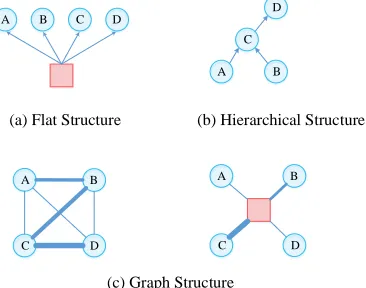
Multi-task learning utilizes the correlation between re-lated tasks to improve the performance of each task. In prac-tice, existing work often models task relatedness by simply defining shared common parameters over some pre-defined task structures. Figure 1-(a,b) shows two typical pre-defined topology structures which have been popular. A flat structure (Collobert and Weston 2008) assumes that all tasks jointly share a hidden space, while a hierarchical structure (Søgaard and Goldberg 2016, Hashimoto et al. 2017) specifies a par-tial order of the direction of information flow between tasks. There are two major limitations to the above approaches. First, static pre-defined structures represent a strong assump-tion about the nature of the interacassump-tion between tasks, re-stricting the model’s capacity to make use of shared infor-mation. For example, the structure in 1(a) does not allow the model to explicitly learn the strength of relatedness be-tween tasks. This restriction prevents the model from fully
∗
These two authors contributed equally
Copyright c2019, Association for the Advancement of Artificial
Intelligence (www.aaai.org). All rights reserved.
(a) Flat Structure
A B C D
C
A B
D
A B
C D
A B
C D
(b) Hierarchical Structure
(c) Graph Structure
Figure 1: Different topology structures for multi-task learn-ing. Each blue circle represents a task (A, B, C, D), while the red box denotes a virtual node, which stores shared infor-mation and facilitates communication. The boldness of the line indicates the strength of the relationships. The directed edges define the direction of information flow. For example, in sub-figure (b), task C receives information from task A, but not vice versa.
utilizing and handling the complexity of the data (Li and Tian 2015). Note that the strength of relatedness between tasks is itself not static but subject to change, depending on the data samples at hand. Second, these models are not interpretable to researchers and system developers, mean-ing that we learn little about what kinds of patterns have been shared besides the parameters themselves. Previous non-neural-network models (Bakker and Heskes 2003, Kim and Xing 2010, Chen et al. 2010) have demonstrated the im-portance of learning inter-task relationships for multi-task learning. However, there is little work giving an in-depth analysis in the neural setting.
The above issues motivate the following research ques-tions: 1) How can we explicitly model complex relationships between different tasks? 2) Can we design models that learn interpretable shared structures?
inspiration from the idea of message passing (Berendsen, van der Spoel, and van Drunen 1995, Serlet, Boynton, and Tevanian 1996, Gilmer et al. 2017, Kipf and Welling 2016), designing two methods for communication between tasks, in which messages can be passed between any two nodes in a direct or an indirect way (Figure 1-(c)). Importantly, the strength of the relatedness is learned dynamically, rather than being pre-specified, which allows tasks to selectively share information when needed.
We evaluate our proposed models on two types of se-quence learning tasks, text classification and sese-quence tag-ging, both well-studied NLP tasks (Li and Zong 2008, Liu, Qiu, and Huang 2017, Yang, Salakhutdinov, and Cohen 2016). Moreover, we conduct experiments in both the multi-task setting and in the transfer learning setting to demon-strate that the shared knowledge learned by our models can be useful for new tasks. Our experimental results not only show the effectiveness of our methods in terms of reduced error rates, but also provide good interpretablility of the shared knowledge.
The contributions of this paper can be summarized as fol-lows:
1. We explore the problem of learning the relationship be-tween multiple tasks and formulate this problem as mes-sage passing over a graph neural network.
2. We present a state-of-the-art approach that allows multi-ple tasks to communicate dynamically rather than follow-ing a pre-defined structure.
3. Different from traditional black-box learned models, this paper makes a step towards learningtransferableand in-terpretable representations, which enables us to know what types of patterns are shared.
Message Passing Framework for Multi-task
Communication
We propose to use graph neural networks with mes-sage passing to deal with the problem of multi-task se-quence learning. Two well-studied sese-quence learning tasks, text classification and sequence tagging, are used in our experiments. We denote the text sequence as X = {x1, x2, . . . , xT} and the output as Y. In text
classifica-tion, Y is a single label; whereas in sequence labelling, Y ={y1, y2, . . . , yT}is a sequence.
Assuming that there areKrelated tasks, we refer toDk
as a dataset withNksamples for taskk. Specifically,
Dk ={(X
(k)
i , Y
(k)
i )} Nk
i=1, (1)
whereXi(k)andYi(k)denote a sentence and a correspond-ing label sequence for task k, respectively. The goal is to learn a neural network to estimate the conditional probabil-ityP(Y|X).
Generally, when combining multi-task learning with se-quence learning, two kinds of interactions should be mod-elled: the first is the interactions between different words within a sentence, and the other is the interactions across different tasks.
For the first type of interaction (interaction of words within a sentence), many models have been proposed by applying a composition function in order to obtain rep-resentation of the sentence. Typical choices for defining the composition function include recurrent neural networks (Hochreiter and Schmidhuber 1997), convolutional neural networks (Kalchbrenner, Grefenstette, and Blunsom 2014), and tree-structured neural networks (Tai, Socher, and Man-ning 2015). In this paper, we adopt the LSTM architecture to learn the dependencies within a sentence, due to their im-pressive performance on many NLP tasks (Cheng, Dong, and Lapata 2016). Formally, we refer to htas the hidden
state of the word at timet,wt. Then,htcan be computed as:
ht=LSTM(xt,ht−1, θ). (2)
Here, theθrepresents all the parameters of LSTM.
For the second type of interaction (interaction across dif-ferent tasks), we propose to conceptualize tasks and their interactions as a graph, and utilize message passing mech-anisms to allow them to communicate. Our framework is inspired by the idea of message passing, which is used ubiq-uitously in modern computer software (Berendsen, van der Spoel, and van Drunen 1995) and programming languages (Serlet, Boynton, and Tevanian 1996). The general idea of this framework is that we provide a graph network that al-lows different tasks to cooperate and interact with one an-other. Below, we describe our conceptualization of the graph construction process, then we describe the message passing mechanism used for inter-task communication.
Formally, a graph Gcan be defined as an ordered pair G = (V, E), whereV is a set of nodes{V1, . . . , Vm}and
E is a set of edges. In this work, we use directed graphs to model the communication flows between tasks and an edge is therefore defined as an ordered set of two nodes
(Vi, Vj), i6=j.
In our models, we represent each task as a node. In addi-tion, we allow virtual nodes to be introduced. These virtual nodes do not correspond to a task. Rather, their purpose is to facilitate communication among different tasks. Intuitively, the virtual node functions as a mailbox, storing messages from other nodes and distributing them as needed.
Tasks and virtual nodes are connected by weighted edges, which represent communication between different nodes. Previous flat and hierarchical architectures for multi-task learning can be considered as graphs with fixed edge con-nections. Our models dynamically learn the weight of each edge, which allows the models to adjust the strength of the communication signals.
Message Passing
In our graph structures, we use directed edges to model the communication between tasks. In other words, nodes com-municate with each other by sending and receiving mes-sages over edges. Given a sentence with a sequence of words
(wk
1, ..., wkT)from taskk, we user k
t to represent the
aggre-gated messagesthat the word of task kat time steptcan get, and we usehk
t to denote the task-dependent hidden
(a) DC-MTL (b) IC-MTL
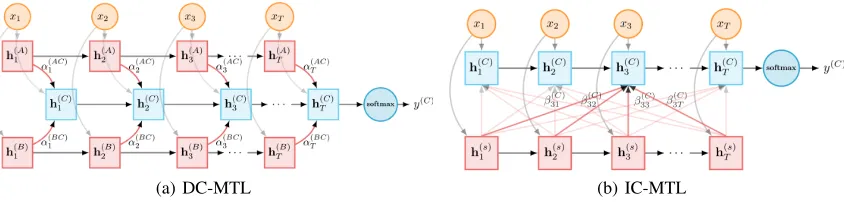
Figure 2: Two frameworks for multi-task communication. (a) shows how task A and B send information to task C. Here, we only present the information flow relating to task C and omit some edges for easy understanding. (b) shows how the mailbox (shared layer) sends information to task C. Theαandβvalues correspond to the edge weights.αcontrols the strength of the association from a word in a source task to a word in the target task whileβ controls the amount of information we should take from the shared layer. For example,βC
32can be understood as: to compute the hidden stateh3of task C, the amount of
information should be taken from the second hidden state of shared layers isβ32C.
Below, we propose two basic communication architec-tures for message passing, which differ according to whether they allow direct communication between any pair of tasks (DC-MTL), or whether the communication is mediated by an intermediate virtual node (IC-MTL).
1. Direct Communication for Multi-Task Learning (DC-MTL):in this model, each node can directly send (or receive) messages to (or from) any other nodes. Specifi-cally, as shown in Fig.2-(a), we first assign each task a task-dependent LSTM layer. Each sentence in taskkcan be passed to all the other task-dependent LSTMs1to get corre-sponding representationsh(ti),i= 1...K,i6=k. Then, these messages will be aggregated as:
r(tk)= X i=1...Ks.t.i6=k
α(ti→k)h(ti) (3)
Here,α(tki) is a scalar, which controls the relatedness be-tween two taskskandi, and can be dynamically computed as:
s(ti→k)=f(x(tk),h(t−k)1,h(ti)) (4)
=u(s)tanh(W(s)[xt,h
(k)
t−1,h (i)
t ]) (5)
whereu(s)andW(s)are learnable parameters. And the
re-latedness scores will be normalized into a probability distri-bution:
αt= softmax(st) (6)
2. Indirect Communciation for Multi-Task Learning (IC-MTL): the potential limitation of our proposed DC-MTL model lies in its computational cost, because the num-ber of pairwise interactions grows quadratically with the number of tasks. Inspired by the mailbox idea used in the traditional message passing paradigm (Netzer and Miller 1995), we introduce an extra virtual node into our graph to address this problem. In this setting, messages are not sent
1
At training time, the loss is only calculated and used to com-pute the gradient for the task from which the sentence is drawn.
directly from one node to another, but are bridged by the vir-tual node. Intuitively, the virvir-tual node stores the shared mes-sages across all the tasks; different tasks can put mesmes-sages into this global space, then other tasks can take out the use-ful messages for themselves from the same space. Fig.2-(b) shows how one task collects information from the mailbox (shared layer).
In details, we introduce an extra LSTM to act as the vir-tual node, whose parameters are shared across tasks. Given a sentence from taskk, its information can be written into the shared LSTM by the following operation:
h(ts)=LSTM(x(tk),h(ts−)1, θ(s)), (7) whereθ(s)denotes the parameters are shared across all the
tasks.
Then, the aggregated messages at timetcan be read from the shared LSTM:
r(tk)= T
X
i=1
βt(→k)ih(is), (8)
whereT denotes the length of the sentence andβt(→k)iis used to retrieval useful messages from the shared LSTM, which can be computed in a similar fashion to Equations 5 and 6.
Once the graphs and message passing between the nodes are defined, the next question to ask is how to update the task-dependent representationh(tk)for nodekusing the cur-rent input informationxtand the aggregated messagesr
(k)
t .
We employ a gating unit that allows the model to decide how many aggregated messages should be used for the target tasks, which avoids unnecessary information redundancy. Formally, theh(tk)can be computed as:
h(tk)=LSTM†(xt,h
(k)
t−1,r (k)
t , θ
(k), θ(s)).
(9) The function LSTM† is the same as Eq.2 except that we replace the memory update step of the inner function in Eq.2 with the following equation:
ht=ottanh(ct+gt(W
(s)
whereW(fs)is a parameter matrix, andgtis a fusion gate
that selects the aggregated messages.gtis computed as
fol-lows:
gt=σ(W(rs)r
(k)
t +W
(s)
c ct), (11)
whereW(rs)andW
(s)
c are parameter matrices.
Task-dependent Layers
Given a sentenceXfrom taskkwith its labelY (noteY is either a classification label or sequential labels) and its fea-ture vectorh(k)emitted by the two communication methods
above, we can adapt our models to different tasks by using different task-specific layers. We call the task-specific layer as the OUTPUT-LAYER. For text classification tasks, the commonly used OUTPUT-LAYERis a softmax layer, while for sequence labelling tasks, it can be a conditional random field (CRF) layer. Finally, the output probability P(Y|X)
can be computed as:
P(Y|X) =OUTPUT-LAYER(X,h(Tk), θ(k)). (12) Then, we can maximize the above probability to optimize the parameters of each task:
Lk(X, Y, θ(k), θ(s)) =−P(Y|X). (13)
Once the loss function for a specific task is defined, we could compute the overall loss for our multi-task models as the following:
L=
K
X
k=1
λkLk(X, Y, θ(k), θ(s)) (14)
whereλk is the weight for task k. The parameters of the
whole network are trained over all datasets and the overall training procedure is presented in Algorithm 1.
Experiments and Results
In this section, we describe our hyperparameter settings and present the empirical performance of our proposed models on two types of multi-task learning datasets, first on text classification, then on sequence tagging. Each dataset con-tains several related tasks.
Hyperparameters
The word embeddings for all of the models are initialized with the 200-dimensional GloVe vectors (840B token ver-sion (Pennington, Socher, and Manning 2014)). The other parameters are initialized by randomly sampling from the uniform distribution of [−0.1,0.1]. The mini-batch size is set to 8.
For each task, we take the hyperparameters which achieve the best performance on the development set via a grid search over combinations of the hidden size[100,200,300]
andl2 regularization [0.0,5E −5,1E −5]. Additionally,
for text classification tasks, we set an equal lambda for each task; while for tagging tasks, we run a grid search of lambda in the range of [1,0.8,0.5] and take the hyperparameters which achieve the best performance on the development set.
Algorithm 1Training Process for Multi-task Learning over Graph Structures
Require: A set of training tasks {DTi}K
i=1, whereTi is drawn
fromp(T)
1: InitializeΘ :={θ(s), θ(k)}
2: whilenot donedo
3: forTk∼p(T)do
4: Sample a batch of samplesBTk
={X, Y} ∈ DTk 5: //Message Passing
6: ifDirect-Communicationthen
7: forTj∼p(T)do .Tk6=Tj
8: h(tj→k)=LSTM(BTk,h
t−1, θ(k))
9: end for
10: r(tk)=
P jα
(j→k)
t h
(j)
t .Aggregating
11: else ifIndirect-Communicationthen
12: h(ts)=LSTM(B
Tk,h(s) t−1, θ
(s) )
13: r(tk)=
PT i=1β
(k) i→th
(s)
i .Aggregating
14: end if
15: //Node Updating
16: h(tk)=LSTM†(xt,h(tk−)1,r (k) t , θ
(k), θ(s))
17: //Task-dependent Output
18: P(Y|X) =OUTPUT-LAYER(X,h(Tk), θ(k))
19: end for 20: end while
Based on the validation performance, we choose the size of hidden state as200andl2as 0.0. We apply stochastic
gradi-ent descgradi-ent with the diagonal variant of AdaDelta for opti-mization (Zeiler 2012).
Text Classification
To investigate the effectiveness of multi-task learning, we experimented with 16 different text classification tasks in-volving different popular review corpora, such as books, ap-parel and movie (Liu, Qiu, and Huang 2017). Each sub-task aims at predicting a correct sentiment label (positive or neg-ative) for a given sentence. All the datasets in each task are partitioned into training, validating, and testing with the pro-portions of 1400, 200 and 400 samples respectively.
We choose several relevant and representative models as baselines.
• MT-CNN: This model is proposed by (Collobert and We-ston 2008) with a convolutional layer, in which lookup-tables are shared partially while other layers are task-specific.
• FS-MTL: Fully shared multi-task learning framework. Different tasks fully share a neural layer (LSTM). • SP-MTL: Shared-private multi-task learning framework
with adversarial learning (Liu, Qiu, and Huang 2017). Different tasks not only have common layers to share in-formation, but have their own private layers.
Task Single Task Multiple Tasks Transfer
Avg. MT-CNN FS-MTL SP-MTL DC-MTL* IC-MTL* SP-MTL IC-MTL*
Books 19.2 15.5(−3.7) 17.5(−1.7) 16.0(−3.2) 13.3(−5.9) 13.8(−5.4) 16.3(−2.9) 14.5(−4.7)
Electronics 21.4 16.8(−4.6) 14.3(−7.1) 13.2(−8.2) 11.5(−9.9) 11.5(−9.9) 16.8(−4.6) 13.8(−7.6)
DVD 19.9 16.0(−3.9) 16.5(−3.4) 14.5(−5.4) 13.5(−6.4) 12.0(−7.9) 14.3(−5.6) 14.0(−5.9)
Kitchen 20.1 16.8(−3.3) 14.0(−6.1) 13.8(−6.3) 12.3(−7.8) 11.8(−8.3) 15.0(−5.1) 12.8(−7.3)
Apparel 15.7 16.3(+0.6) 15.5(−0.2) 13.0(−2.7) 13.0(−2.7) 12.5(−3.2) 13.8(−1.9) 13.5(−2.2)
Camera 14.6 14.0(−0.6) 13.5(−1.1) 10.8(−3.8) 10.5(−4.1) 11.0(−3.6) 10.3(−4.3) 11.0(−3.6)
Health 17.8 12.8(−5.0) 12.0(−5.8) 11.8(−6.0) 10.5(−7.3) 10.5(−7.3) 13.5(−4.3) 11.0(−6.8)
Music 23.0 16.3(−6.7) 18.8(−4.2) 17.5(−5.5) 14.8(−8.2) 14.3(−8.7) 18.3(−4.7) 14.8(−8.2)
Toys 16.3 10.8(−5.5) 15.5(−0.8) 12.0(−4.3) 11.0(−5.3) 10.8(−5.5) 11.8(−4.5) 10.8(−5.5)
Video 17.0 18.5(+1.5) 16.3(−0.7) 15.5(−1.5) 13.0(−4.0) 14.0(−3.0) 14.8(−2.2) 13.5(−3.5)
Baby 15.9 12.3(−3.6) 12.0(−3.9) 11.8(−4.1) 10.8(−5.1) 11.3(−4.6) 12.0(−3.9) 11.5(−4.4)
Magazines 10.5 12.3(+1.8) 7.5(−3.0) 7.8(−2.7) 8.0(−2.5) 7.8(−2.7) 9.5(−1.0) 8.8(−1.7)
Software 14.7 13.5(−1.2) 13.8(−0.9) 12.8(−1.9) 10.3(−4.4) 12.8(−1.9) 11.8(−2.9) 11.0(−3.7)
Sports 17.3 16.0(−1.3) 14.5(−2.8) 14.3(−3.0) 12.3(−5.0) 13.3(−4.0) 13.5(−3.8) 12.8(−4.5)
IMDB 17.3 13.8(−3.5) 17.5(+0.2) 14.5(−2.8) 13.0(−4.3) 13.5(−3.8) 13.3(−4.0) 13.3(−4.0)
MR 26.9 25.5(−1.4) 25.3(−1.6) 23.3(−3.6) 21.5(−5.4) 22.0(−4.9) 23.5(−3.4) 22.8(−4.1)
AVG 18.0 15.5(−2.5) 15.3(−2.7) 13.9(−4.1) 12.5(−5.5) 12.7(−5.3) 14.3(−3.7) 13.1(−4.9)
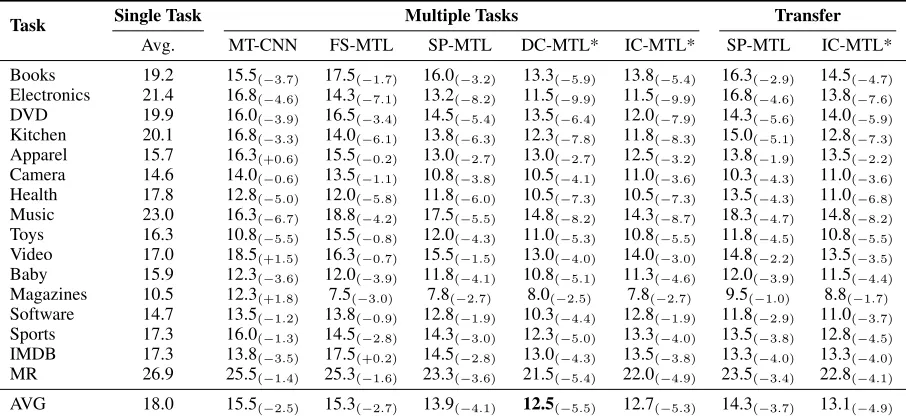
Table 1: Text classification error rates of our models on 16 datasets against typical baselines. The smaller values indicate better performances. The column ofSingle Task(Avg.) gives the average error rates of vanilla LSTM, bidirectional LSTM, and stacked LSTM while the column ofMultiple Tasksshows the results achieved by corresponding multi-task models. The Transfercolumn lists the results of different models on transfer learning. “*” indicates our proposed models. The numbers in brackets represent the improvements relative to the average performance (Avg.) of three single task baselines.
also the necessary baselines for IC-MTL, since the combi-nation of shared and private layers in IC-MTL is similar to two-layer LSTM.
Table 1 shows the overall results on the 16 different tasks under three settings: single task, multiple task, and transfer learning. Generally, we can see that almost all tasks benefit from multi-task learning, which boosts the performance by a large margin. Specifically, DC-MTL achieves the best per-formance, surpassing SP-MTL by 1.4%, which suggests that explicit communication makes it easier to shared informa-tion. Although the improvement of IC-MTL is not as large as DC-MTL, IC-MTL is efficient to train. Additionally, the comparison between IC-MTL and SP-MTL shows the effec-tiveness of selectively sharing schema. Moreover, we may further improve our models by incorporating the adversar-ial training mechanism introduced in SP-MTL, as it is an orthogonal innovation to our methods.
Evaluation on Transfer Learning:We next present the potential of our methods on transfer learning, as we expect that the shared knowledge learned by our model architec-tures can be useful for new tasks. In particular, the virtual node in the IC-MTL model can condense shared informa-tion into a common space after multi-task learning, which allows us to transfer this knowledge to new tasks. In order to test the transferability of the shared knowledge learned by IC-MTL, we design an experiment following the super-vised pre-training paradigm. Specifically, we adopt a 16-fold “leave-one-task-out” paradigm; we take turns choosing 15
tasks to train our model via multi-task learning, then the learned shared layer is transferred to a second network that is used to test on the remainingtarget taskk. The parameters of the transferred layer are kept frozen, and the remaining
parameters of the new network are randomly initialized. Table 1 shows these results in the “Transfer” column, in which the task in each row is regarded as the target task. We observe that our model achieves a 4.9% average im-provement in terms of the error rate over the single tasking setting (13.1 vs. 18.0), surpassing SP-MTL by1.2%in av-erage (13.1 vs. 14.3). This improvement suggests that our retrieval method with the selective mechanism (the attention layer in eq. 8) is more efficient in finding the relevant infor-mation from the shared space compared to SP-MTL, which reads the shared information without any selective mecha-nism and ignores the relationship between tasks.
Sequence Tagging
In this section, we present the results of our models on the second task of sequence tagging. We conducted exper-iments by following the same settings as (Yang, Salakhut-dinov, and Cohen 2016). We use the following benchmark datasets in our experiments: Penn Treebank (PTB) POS tag-ging, CoNLL 2000 chunking, CoNLL 2003 English NER. The statistics of the datasets are described in Table 3.
It is not a very flexible plastic and breaks easily , I think the full ads on website give an wrong imply
camera toys electronics magazine imdb book
The strength of this movie lies primarily in its aesthetic quality , not the name-brand director
music MR imdb sports kitchen apparel
(a) Kitchen Task
(b) Video Task
Figure 3: Illustrations of the most relevant tasks (top 3) for each word in “Kitchen” and “Video” tasks. Here we choose some typical words to visualize in blue. And the orange words represent the relevant tasks.
Interpretable Sub-Structures Explanations
Short-term Interpretable phrases to be
shared across tasks
Long-term
Interpretable sentence patterns, they usually determine the sentence meanings.
Table 2: Multiple interpretable sub-structures learned by shared layers. “senti-words” refers to “boring, interesting, amazing” etc. “adv-words” refers to “easily, fine, great” etc. “adj-words” refers to “stable, great, fantastic” etc. These structures show that short-term and long-term dependencies between different words can be learned, which usually control the sentiment of corresponding sentences.
Dataset Task Training Dev. Test
CoNLL 2000 Chunking 211,727 - 47,377
CoNLL 2003 NER 204,567 51,578 46,666
PTB POS 912,344 131,768 129,654
Table 3: The sizes of the sequence labelling datasets in our experiments, in terms of the number of tokens.
Model CoNLL2000 CoNLL2003 PTB
LSTM + CRF 94.46 90.10 97.55
MT-CNN 94.32 89.59 97.29
FS-MTL 95.41 90.94 97.55
SP-MTL∗ 95.27 90.90 97.49
DC-MTL 95.49 91.25 97.61
IC-MTL 95.61 91.47 97.69
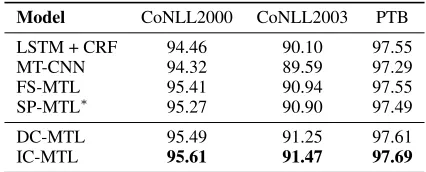
Table 4: Performance of different models on Chunking, NER, and POS respectively. All the results without marks are reported in the corresponding paper. LSTM+ CRF: Pro-posed by (Huang, Xu, and Yu 2015). MT-CNN: ProPro-posed by (Collobert and Weston 2008). FS-MTL: Proposed by (Yang, Salakhutdinov, and Cohen 2016).
Discussion and Qualitative Analysis
In order to obtain more insights and detailed interpretability of how messages are passed between tasks in our proposed models, we design a series of experiments targeting the fol-lowing aspects:1. Can the relationship between different tasks be learned by DC-MTL?
2. Are there interpretable structures that the shared layer in IC-MTL can learn? Are these shared patterns similar to linguistic structures, and can they be transferred for other tasks?
Explicit Relationship Learning To answer the first ques-tion, we visualize the weightαtof DC-MTL in equation 3.
As each task can receive messages from any other task in DC-MTL,αtdirectly indicates the relevance of other tasks
those words express sentiment. For example, in the CAM -ERA and TOYStasks, “breaks easily” is usually used to express negative sentiment, while the word “ads” often appears in the MAGAZINE task to express negative senti-ment. Figure 3-(b) shows a similar case on “quality” and “name-brand”.
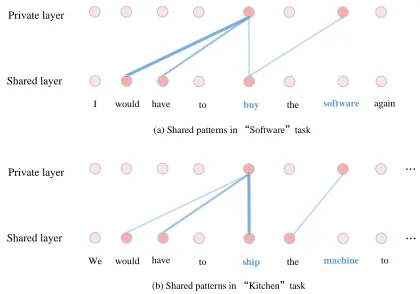
Interpretable Structure Learning To answer the second question, we visualizeβ in equation 8 inside the IC-MTL model. As different tasks can read information from shared layers in IC-MTL, visualizingβ allows us to analyze what kinds of sentence structures are shared. Specifically, each wordwt(k)can receive shared messages:w1(s)...w(Ts)and the amount of messages is controlled by the scoresβ. To illus-trate the interpretable structures learned by the shared layer in IC-MTL, we randomly sample several examples from dif-ferent tasks and visualize their shared structures. Three ran-dom sampled cases are described as in Figure 4.
From the experiments we conducted in visulizingβin IC-MTL, we observed the following:
• The proposed model can not only utilize the shared information across different tasks, but can tell us what kinds of features are shared. As shown in Ta-ble 2, the short-term and long-term dependencies be-tween different words can be captured. For example, the word “movie” is prone to connecting to emotional words, such as “boring, amazing, exciting” while “products” is more likely to make friends with “stable, great, fantastic”.
• Comparing Figure 4-(b) and (c), we can see how task SOFTWARE borrows useful information from task KITCHEN. Concretely, the sentence “I would have to buy the software again” in the task “Software” has negative emotion. In this sentence, the key pattern is “would have”, which does not appear too much in the training set of SOFTWARE. Fortunately, the training samples in the task KITCHENprovide more hints about this pattern.
• As shown in Figure 4-(a) and (b), the shared layer has learned an informative sentence pattern “would have to ...” from the training set of task KITCHEN. This pattern is useful for the sentiment prediction of another task SOFTWARE, which suggests that we can analyze the sharabla patterns in an interpretable way for IC-MTL model.
Related Work
Neural network-based multi-task frameworks have achieved success on many NLP tasks, such as POS tagging (Yang, Salakhutdinov, and Cohen 2016, Søgaard and Goldberg 2016), parsing (Peng, Thomson, and Smith 2017, Guo et al. 2016), machine translation (Dong et al. 2015, Luong et al. 2015, Firat, Cho, and Bengio 2016), and text classifi-cation (Liu, Qiu, and Huang 2016, Liu, Qiu, and Huang 2017). However, previous work does not focus on explicitly modelling the relationships between different tasks. These models are often trained with an opaque neural component,
I would have to buy the software again Shared layer
Private layer
We would have to ship the machine to Shared layer
Private layer
... ...
(a) Shared patterns in “Software”task
(b) Shared patterns in “Kitchen”task
Figure 4: Illustrations of the learned patterns captured by the shared layer under different tasks. The boldness of the line indicates the strengthβof the relationship. The first sentence comes from the development set of task SOFTWAREwhile the second one belongs to the training set of task KITCHEN. We choose three typical words “buy”, “software” and “machine” to visualize in these sampled sentences.
which makes it hard to understand what kind of knowledge is shared. By contrast, in this paper, we propose to explicitly learn the communication between different tasks, and learn some interpretable shared structures.
Before the bloom of neural-based models, non-neural multi-task learning methods have also been proposed to model the relationships between tasks. For example, (Bakker and Heskes 2003) learn to cluster tasks by using Bayesian approaches. (Kim and Xing 2010) utilizes a given tree structure to design a regularizer, while (Chen et al. 2010) learns a structured multi-task problem over a given graph. These models adopt complex learning strategies and introduce a priori information between different tasks, which are usually not suitable for sequence modelling. In this pa-per, we provide a new perspective on how to model the rela-tionships using distributed graph models andmessage pass-ing, which can be learned dynamically rather than following a pre-defined structure.
The technique of message passing is used ubiquitously in computer software (Berendsen, van der Spoel, and van Drunen 1995) and programming languages (Serlet, Boyn-ton, and Tevanian 1996). Recently, there has also been growing interest in developing graph neural networks (Kipf and Welling 2016) or neural message passing algorithms (Gilmer et al. 2017) for learning representations of irregular graph-structured data. In this paper, we formulate multi-task learning as a communication problem over graph structures, allowing different tasks to communicate via message pass-ing.
Conclusion and Outlook
We have explored the problem of learning the relationships between multiple tasks, formulating the problem as message passing over a graph neural network. Our proposed methods explicitly model the relationships between different tasks and achieve improved performance in several multi-task and transfer learning settings. We also show that we can extract interpretable shared patterns from the outputs of our models. From our experiments, we believe that learning interpretable shared structures is a promising direction, which is also very useful for knowledge transfer.
Acknowledgments
The authors wish to thank the anonymous reviewers for their helpful comments. This work was partially funded by Na-tional Natural Science Foundation of China (No. 61751201, 61672162), STCSM (No.16JC1420401, No.17JC1404100), and Natural Sciences and Engineering Research Council of Canada (NSERC).
References
Bakker, B., and Heskes, T. 2003. Task clustering and gating for bayesian multitask learning. JMLR4(May):83–99. Berendsen, H. J.; van der Spoel, D.; and van Drunen, R. 1995. Gromacs: a message-passing parallel molecular dy-namics implementation. Computer Physics Communica-tions91(1-3):43–56.
Chen, X.; Kim, S.; Lin, Q.; Carbonell, J. G.; and Xing, E. P. 2010. Graph-structured multi-task regression and an efficient optimization method for general fused lasso. stat 1050:20.
Cheng, J.; Dong, L.; and Lapata, M. 2016. Long short-term memory-networks for machine reading. InProceedings of the 2016 Conference on EMNLP, 551–561.
Collobert, R., and Weston, J. 2008. A unified architecture for natural language processing: Deep neural networks with multitask learning. InProceedings of ICML.
Dong, D.; Wu, H.; He, W.; Yu, D.; and Wang, H. 2015. Multi-task learning for multiple language translation. In Proceedings of the ACL.
Firat, O.; Cho, K.; and Bengio, Y. 2016. Multi-way, mul-tilingual neural machine translation with a shared attention mechanism. InProceedings of NAACL-HLT, 866–875. Gilmer, J.; Schoenholz, S. S.; Riley, P. F.; Vinyals, O.; and Dahl, G. E. 2017. Neural message passing for quantum chemistry. InICML, 1263–1272.
Guo, J.; Che, W.; Wang, H.; and Liu, T. 2016. Exploit-ing multi-typed treebanks for parsExploit-ing with deep multi-task learning.arXiv preprint arXiv:1606.01161.
Hashimoto, K.; Tsuruoka, Y.; Socher, R.; et al. 2017. A joint many-task model: Growing a neural network for mul-tiple nlp tasks. InProceedings of the 2017 Conference on EMNLP, 1923–1933.
Hochreiter, S., and Schmidhuber, J. 1997. Long short-term memory.Neural computation9(8):1735–1780.
Huang, Z.; Xu, W.; and Yu, K. 2015. Bidirectional lstm-crf models for sequence tagging. arXiv preprint arXiv:1508.01991.
Kalchbrenner, N.; Grefenstette, E.; and Blunsom, P. 2014. A convolutional neural network for modelling sentences. In Proceedings of ACL.
Kim, S., and Xing, E. P. 2010. Tree-guided group lasso for multi-task regression with structured sparsity.
Kipf, T. N., and Welling, M. 2016. Semi-supervised classi-fication with graph convolutional networks. arXiv preprint arXiv:1609.02907.
Li, Y., and Tian, X. 2015. Graph-based multi-task learning. InCommunication Technology (ICCT), 2015 IEEE 16th In-ternational Conference on, 730–733. IEEE.
Li, S., and Zong, C. 2008. Multi-domain sentiment classifi-cation. InProceedings of the ACL, 257–260.
Liu, P., and Huang, X. 2018. Meta-learning multi-task com-munication. arXiv preprint arXiv:1810.09988.
Liu, P.; Qiu, X.; and Huang, X. 2016. Recurrent neural network for text classification with multi-task learning. In Proceedings of IJCAI.
Liu, P.; Qiu, X.; and Huang, X. 2017. Adversarial multi-task learning for text classification. In Proceedings of the 55th Annual Meeting of ACL, volume 1, 1–10.
Luong, M.-T.; Le, Q. V.; Sutskever, I.; Vinyals, O.; and Kaiser, L. 2015. Multi-task sequence to sequence learning. arXiv preprint arXiv:1511.06114.
Netzer, R. H., and Miller, B. P. 1995. Optimal tracing and re-play for debugging message-passing parallel programs. The Journal of Supercomputing8(4):371–388.
Peng, H.; Thomson, S.; and Smith, N. A. 2017. Deep multi-task learning for semantic dependency parsing. In Proceed-ings of the 55th ACL, volume 1, 2037–2048.
Pennington, J.; Socher, R.; and Manning, C. D. 2014. Glove: Global vectors for word representation. Proceedings of the EMNLP12:1532–1543.
Serlet, B.; Boynton, L.; and Tevanian, A. 1996. Method for providing automatic and dynamic translation into opera-tion system message passing using proxy objects. US Patent 5,481,721.
Søgaard, A., and Goldberg, Y. 2016. Deep multi-task learn-ing with low level tasks supervised at lower layers. In Pro-ceedings of ACL.
Tai, K. S.; Socher, R.; and Manning, C. D. 2015. Im-proved semantic representations from tree-structured long short-term memory networks. In Proceedings of the 53rd ACL, 1556–1566.
Yang, Z.; Salakhutdinov, R.; and Cohen, W. 2016. Multi-task cross-lingual sequence tagging from scratch. arXiv preprint arXiv:1603.06270.