!
!∀ #∃ %&
∋())∗∗)+∗,−∗
Keynote Presentation for BCUC e-Learning Conference, 7 June 2007
Sean Wellington
Address for correspondence: Sout hampt on Solent Universit y, East Park Terrace, Sout hampt on, Hampshire, SO14 0YN, UK. Tel: +44 (0)23 8031 9826; Fax: +44 (0)23 8033
4441; E-mail: sean.wellingt on@solent .ac.uk.
Introduction
I am delight ed t o be at t his e-Learning conf erence. It is import ant t hat inst it ut ions
employ e-Learning in ways t hat are inclusive and educat ionally inf ormed. Conf erences
such as t his one provide a valuable opport unit y f or pract it ioners, t echnologist s and
st udent s t o come t oget her and share ideas about ways of creat ively using t his excit ing
t echnology.
I am aware t hat t his conf erence has been held previously at t he Universit y College and t his
demonst rat es t he commit ment of t he universit y communit y t o engage f ully wit h t he
development of e-Learning. The programme t oday includes a range of t opics including
assessment , course design, blended learning and immersive learning environment s.
Communicat ions and informat ion t echnology (C&IT) has t he pot ent ial t o signif icant ly
change higher educat ion pract ice. The Int ernet provides high-speed communicat ion and
access t o knowledge produced around t he globe, at least f or t hose who can underst and
t he language of publicat ion (oft en English) and afford subscript ions t o online dat abases.
In t his present at ion I will examine some of t he challenges and opport unit ies present ed by
e-Learning. I will also say somet hing about t he work we are doing at Sout hampt on Solent
Universit y, where we launch a new VLE, Moodle (branded locally as MyCourse), for t he
st art of t he 2007/ 08 academic year1.
e-Learning and UK Higher Education
Init iat ives t o encourage t he adopt ion of e-Learning have occurred during a period of
dramat ic increase in st udent numbers, accompanied by a reduct ion in real t erms of t he
unit of resource provided by t he st at e. HEFCE st rat egy has sought t o promot e e-Learning
in order t o:
• meet t he great er diversit y of st udent needs
• increase flexibilit y of provision
• enhance t he capacit y for int egrat ing st udy wit h work and leisure t hrough
work-based and home-work-based learning
• develop approaches t o individualised support for planning and recording
achievement s. (HEFCE, 2005)
While t he HEFCE St rat egic Plan for 2006-11 st at es:
Our goal is t o help universit ies and colleges t o use new t echnology t o enhance
learning and t eaching as effect ively as t hey can, so t hat it becomes a normal
part of t heir act ivit ies. (HEFCE, 2007)
Virt ual learning environment s have been a part icular cat alyst f or t he use of t echnology in
educat ion. ‘ Pract it ioners found t hem accessible because t hey are aligned wit h t heir
exist ing pract ice in t erms of preparat ion, delivery and assessment ’ (Conole, 2006, p. 82).
Universit ies have been quick t o adopt virt ual learning environment s despit e t he high cost s,
complexit ies and risks involved (Coat es, James and Baldwin, 2005) and ‘ lit t le evidence of
educat ional research underpinning t he high expect at ions creat ed by t heir market ing’
(Clegg, Hudson and St eel, 2003, p. 47).
The f ollowing reasons can be ident if ied f or t he widespread and increasing use of VLEs:
• Improve t he efficiency of t eaching – A plat form f or delivering large-scale
resource-based learning. The upf ront capit al invest ment required can be balanced against
benefit s such as reduced physical space demands.
• Enrich st udent learning - online modes can allows st udent s t o access a wide range
of learning resources and mat erials.
• St udent expect at ions - st udent s arrive at universit y wit h increasingly sophist icat ed
expect at ions and t echnological skills.
• Compet it ion bet ween inst it ut ions - many universit ies have seen virt ual learning
environment s as a way of adding value t o t heir t radit ional campus-based
• Opport unit y t o cont rol and regulat e t eaching - t he virt ual learning environment
provides new opport unit y for qualit y assurance and cont rol. (Coat es, James and
Baldwin, 2005)
John Biggs (2003), in a t ext book used by many universit y learning and t eaching
development programmes, claims t hat ‘ many people see ET [educat ional t echnology] as a
fool-proof delivery syst em t hat obviat es t he need for expert , reflect ive t eaching and can
be run by t echnocrat s rat her t han educat ors’ (p. 225). Indeed, many syst ems have been
used f or cont ent delivery, where knowledge is t reat ed as a ‘ commodit y’ t o be packaged
and exploit ed (De Vit a and Case, 2003).
Students
Many of our st udent s are younger t han t he personal comput er (invent ed in t he early
1980s). St udent s t oday have skills, compet encies and expect at ions very dif ferent t o t hose
we from a different generat ion had all t hose years ago. These at t ribut es - The
Informat ion Age Mindset - were discussed by Jason Frand (2000) in an excellent art icle
published in Oct ober 2000. The charact erist ics ident ified by Frand include:
• Comput ers aren't t echnology - t echnology is somet hing t hat wasn't around when
you were born.
• Nint endo over logic – problem-solving st rat egies of t en rely heavily on
experiment at ion. In comput er games you rarely analyse all t he possible
consequences before act ing!
• Mult i-t asking way of lif e – many young people seem accust omed t o processing
simult aneously different t asks and mult iple inf ormat ion st reams.
• Typing rat her t han handwrit ing – of fice product ivit y t ools such as word processors
and spreadsheet s are now t he pref erred way of working f or many of us.
• St aying connect ed – t hrough social net working sit es, inst ant messenger, t ext
messages and somet imes email (email is not an immediat e f orm of communicat ion
unless you are subst ant ially based at a comput er or have a mobile device). (Frand,
2000)
Analysis of t he 2005 Nat ional St udent Survey result s suggest s t hat t eaching had by f ar t he
Thus, t he st udent s who f elt t hat ‘ St af f are good at explaining t hings’ , ‘ St af f
have made t he subj ect int erest ing’ , ‘ St aff are ent husiast ic about what t hey are
t eaching’ and t hat ‘ The course is int ellect ually st imulat ing’ , were t he st udent s
who were most sat isfied wit h t he qualit y of t heir courses. (HEFCE, 2006)
Research and Teaching
The relat ionship bet ween t eaching and research is highly cont est ed, part icularly in a mass
syst em of higher educat ion where init iat ives t o increase part icipat ion and widen access
challenge not ions of t he universit y as an elit e inst it ut ion.
It is not t he int ent ion of t his present at ion t o explore t he ‘ myt hs’ (Hughes, 2005) and
possible relat ionships bet ween t eaching and research. Indeed, research by Angela Brew
(2006, pp. 39-43) suggest s t hat academic st aff hold a range of views:
• St udent s as ‘ audience’ f or st af f research
• St udent s (and st af f) learning t hrough research
• The scholarship of learning and t eaching (st aff researching t heir own t eaching)
The concept of ‘ scholarship’ is oft en used in an at t empt t o explain t he research-t eaching
nexus and build a ‘ bridge’ bet ween t eaching and research.
Southampton Solent University
Sout hampt on Solent Universit y is a t eaching-led inst it ut ion, wit h key st rat egic priorit ies
relat ed t o learning and t eaching, knowledge t ransfer, communit y engagement and
advanced scholarship.
e-Learning is an int egral part of t he Universit y’ s St rat egy f or Learning, Teaching and
Curriculum Development . Key obj ect ives include:
• t o provide t he opport unit y t o all st udent s t o engage wit h t heir course of st udy
on-line t hrough t he use of t he virt ual learning environment
• t o support t he f urt her development of scholarly approaches t o t eaching and
learning, seeking more product ive and closer links bet ween curriculum
development and delivery and t he advanced scholarship act ivit ies of st af f (SSU,
The def init ion of ‘ Advanced Scholarship’ adopt ed by t he Universit y is deliberat ely
inclusive, embracing subj ect -based research and ot her areas of high-level int ellect ual,
creat ive and professional endeavour (SSU, 2004b).
[Advanced Scholarship] is most simply and broadly defined as t he creat ion of
new knowledge, or t he crit ical reint erpret at ion, applicat ion and t ransf er of
exist ing knowledge. In est ablished usage wit hin higher educat ion, advanced
scholarship is universit y-level act ivit y inf ormed by, at , or ext ending t he
forefront of t he academic discipline or area of professional pract ice. It is
charact erised by disciplined inquiry, which addresses and seeks t o resolve
significant t heoret ical and pract ical problems. (SSU, 2004a)
Most import ant ly, Advanced Scholarship is also expect ed t o enhance t he qualit y of t he
st udent learning experience. ‘ It must have demonst rat ed links wit h st udent learning,
t eaching, or t he f urt herance of higher educat ion pract ice if it is t o be properly valued’
(SSU, 2004a).
To be considered as Advanced Scholarship an act ivit y must meet t he f ollowing crit eria:
i. result s in a visible out put in t he public domain;
ii. carries peer est eem; and
iii. cont ains an aspect of innovat ion/ originalit y (SSU, 2004a).
Advanced Scholarship embraces subj ect and pedagogic research, creat ive product ion,
knowledge t ransfer, communit y engagement , HE act ivit ies (for example research degree
supervisor or examiner) and act ive involvement wit h a professional body. It is t he ‘ glue’
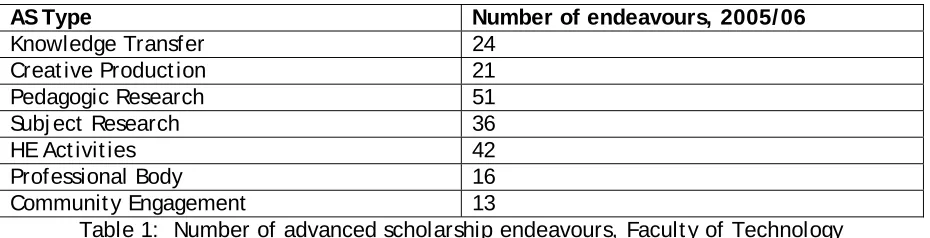
t hat helps t o int egrat e t eaching wit h subj ect and pedagogic research. As an example,
Table 1 summarises t he Advanced Scholarship act ivit ies of all f ull-t ime academic st af f in
t he Facult y of Technology during 2005/ 06. A t ot al of 66 st af f were employed during t he
report ing period and 53 st aff (78.8%) recorded one or more Advanced Scholarship
endeavours.
Advanced Scholarship is applicable t o a wide range of act ivit ies and subj ect disciplines.
This inclusive approach facilit at es research-enhanced t eaching, wit h st af f pedagogic and
subj ect research cont ribut ing t o t he enhancement of academic pract ice and t he st udent
AS Type Number of endeavours, 2005/ 06
Knowledge Transfer 24
Creat ive Product ion 21
Pedagogic Research 51
Subj ect Research 36
HE Act ivit ies 42
Professional Body 16
Communit y Engagement 13
Table 1: Number of advanced scholarship endeavours, Facult y of Technology
At Sout hampt on Solent Universit y we launch a new VLE, MyCourse (based on Moodle), for
t he st art of t he 2007/ 08 academic year. This will replace t he LearnWise syst em in use at
t he Universit y since 2001/ 02. Some pilot unit s were present ed on MyCourse during
2006/ 07. The small t eam of educat ional developers is current ly running t raining courses
f or st aff and will migrat e all cont ent from LearnWise over t he summer (LearnWise will be
left in place unt il aft er summer ref errals have been complet ed).
The VLE has been mainly used t o complement t radit ional forms of learning and t eaching.
All new academic programmes are expect ed t o include at least one blended learning unit .
Some courses delivered solely by e-Leaning have not been ent irely successful, a problem
not unique t o Sout hampt on Solent Universit y.
Conclusions
The following implicat ions for policy and pract ice can be ident ified:
• Adopt a holist ic approach, ensuring alignment of key inst it ut ional st rat egies (for
example learning & t eaching, research and st aff development ).
• Fost er an inclusive, scholarly approach t o t eaching t hat is sensit ive t o genuine
disciplinary and cult ural dif ferences. Ensure pedagogies promot e act ive
engagement wit h learning – st udent s want an int ellect ually st imulat ing course wit h
good t eaching by ent husiast ic st af f .
• Recognise t hat e-Learning places new demands on st udent s and st aff.
• Provide appropriat e st aff development and support f or online pedagogies.
• Innovat e t hought f ully – it is not f air t o st udent s t o want only int roduce t he lat est
feat ures of our VLE j ust because we can, part icularly when t he educat ional
• Ensure qualit y assurance mechanisms are fit -for-purpose, in part icular t o allow
st udent s t o f eedback t heir views and invest igat e t he effect s on st udent
engagement and achievement .
The key challenge for inst it ut ions is t o employ e-Learning in ways t hat genuinely improve
st udent learning opport unit ies and cont inue t o provide t eaching perceived t o be of high
qualit y by st udent s. The development of e-Learning must also make ef f ect ive use of
scarce resources, part icularly as st udent s may increasingly demand improved facilit ies and
References
Biggs, J. (2003), Teaching f or Qual it y Learning at Universit y. (2 ed.). Maidenhead: Societ y for Research int o Higher Educat ion/ Open Universit y Press.
Brew, A. (2006), Research and Teaching: Beyond t he Divide. Basingst oke: Palgrave Macmillan.
Clegg, S., Hudson, A. and St eel, J. (2003), 'The Emperor's New Clot hes: globalisat ion and e-learning in Higher Educat ion'. Brit ish Journal of Sociol ogy of Educat ion, 24 (1), 39-53.
Coat es, H., James, R. and Baldwin, G. (2005), 'A Crit ical Examinat ion of t he Effect s of Learning Management Syst ems on Universit y Teaching and Learning'. Tert iary Educat ion and Management , 11, 19-36.
Conole, G. (2006), 'What Impact are Technologies Having and How are They Changing Pract ice?' In I. McNay (ed.), Beyond Mass Higher Educat ion: Buil ding on Experience (pp. 81-95). Maidenhead: Societ y for Research int o Higher Educat ion/ Open Universit y Press.
De Vit a, G. and Case, P. (2003), 'Ret hinking t he Int ernat ionalisat ion Agenda in UK Higher Educat ion'. Journal of Furt her and Higher Educat ion, 27 (4), 383-398.
Frand, J. L. (2000), 'The Informat ion-Age Mindset : Changes in St udent s and Implicat ions for Higher Educat ion'. Educause Review, 35 (5), 14-24.
HEFCE. (2005), HEFCE st rat egy f or e-l earning (2005/ 12). Brist ol: Higher Educat ion Funding Council for England.
HEFCE. (2006), The Nat ional St udent Survey 2005 (A report t o HEFCE by Paul a Surridge). Brist ol: Higher Educat ion Funding Council for England.
HEFCE. (2007), St rat egic pl an 2006-11: Updat ed April 2007 (2007/ 09). Brist ol: Higher Educat ion Funding Council for England.
Hughes, M. (2005), 'The Myt hology of Research and Teaching Relat ionships in Universit ies'. In R. Barnet t (ed.), Reshaping t he Universit y: New Rel at ionships bet ween Research, Schol arship and
Teaching (pp. 14-26). Maidenhead: Societ y for Research int o Higher Educat ion/ Open Universit y
Press.
SSU. (2002), St rat egy f or Learning, Teaching and Curricul um Devel opment : St age 2. Sout hampt on: Sout hampt on Solent Universit y.
SSU. (2004a), Advanced Schol arship Pol icy and Indicat ive List . Sout hampt on: Sout hampt on Solent Universit y.
SSU. (2004b), Advanced Schol arship St rat egy. Sout hampt on: Sout hampt on Solent Universit y.
Wellingt on, S. (2007), Widening t he Nexus: From T-R t o T-T-R, Paper present ed t o t he Int ernat ional