Mixed Burst Error Correcting Codes
Amita SethiResearch Scholar
Department of Mathematics, University of Delhi, Delhi 110007
Abstract — In this paper, we construct codes which are an improvement on the previously known block-wise burst error correcting codes in terms of their error correcting capabilities. Along with different bursts in different sub-blocks, the given codes also correct overlapping bursts of a given length in two consecutive sub-blocks of a code word. Such codes are called mixed burst correcting (mbc) codes.
Keywords — mixed burst, fixed burst, overlapping burst, error pattern-syndromes, parity check matrix.
I. INTRODUCTION
Burst is the most common error in many communication systems and block-wise burst error correcting codes are developed to deal with such errors. Correcting burst error in blocks has an additional benefit as one knows the pattern of errors in each sub-block and when we consider error correction in such a system, we correct errors which occur in the same sub-block.
Most of the studies in burst error correcting codes are with respect to the usual definition of burst according to which „A burst of length b is a vector whose all the non zero components are confined to some b consecutive positions, the first and last of which is non zero’.
There is another definition of burst due to Chein and Tang [2] with a modification due to Dass [3], known as CTD-burst, according to which
“A CTD-burst is a vector whose all the non zero components are confined to some
b -consecutive positions, the first of which is non zero”.
According to this definition, (10000000) is a burst of length 8 whereas (0001000) will be a burst of length at most 4. This definition has been found very useful in error analysis experiments on telephone lines [1] and in channels where error normally do not occur near the end of a vector particularly when the burst length is large.
Such block wise burst error correcting codes were first introduced by Dass and Tyagi [4]. Recently, Tyagi and Sethi [6], have generalized this idea to three sub-blocks of length n n1, 2 and n n3, 1 n2 n3n and named them as
1 2 3
1 2 3
(nb,nb,nb) linear codes, some of which turn out to be byte oriented [5].
Definition. An (n1b1,n2b2,n3b3) code is an
nn1n2n3,k
code that correct all bursts oflength b1 (fixed) in the first sub-block of length
1,
n all bursts of length b2 (fixed) in the second
sub-block of length n2 and all bursts of length b3(fixed) in the third sub-block of length n3.
In this communication, we modify
1 2 3
1 2 3
(nb,nb ,nb ) codes as mixed burst correcting codes, (mbc-codes) in such a way that along with fixed bursts of length
1
b ,b2 and b3, the modified codes also correct over all burst of length b(fixed) in two consecutive sub-blocks, thereby improving upon their error correcting capabilities. The paper is divided into two sections. In section II, we present necessary condition where as in section III we give sufficient condition.
II. NECESSARY CONDITION
Theorem 1. The number of parity check digits required for an (n n1 n2 n k3, ) linear code that
correct all fixed bursts of length b1,b2 and b3 in first n1, next n2 and last n3-components along with
the overlapping burst of length b b, b1 b2 and
2 3
bb b ( b b1 b2, bb2b3 only when , 1, 2
i i
n b i nibi, i1, 2 ), in any two consecutive sub-blocks, is at least
1
3 2
1 2
2 3
1 1 1
1 1
2 2 3 3
2 2
1 2 1 2
2 2
2 3 2 3
1
1 1
1 1
1
1 1 2
2 1
1 1 2 .
2
n k
b
b b
b b b b
q
n b q
q
n b q n b q
q q b b b b b b
q q b b b b b b
(1)
Proof.The theorem is proved by enumerating
(i) all the error patterns of length b1(fixed) in first n1-components;
(ii) all the error patterns of length b2(fixed) in next n2-components;
(iii) all the error patterns of length b3(fixed) in
(iv) all bursts of length b(fixed) in the first two sub-blocks of length n1 and n2; and
(v) all bursts of length b(fixed) in the last two sub-blocks of length n2 and n3.
The number of error pattern in (i) to (iii) comes out to be
1 2
3
1 1
1 1 2 2
1 3 3
( 1)[( 1) ( 1)
( 1) ]
b b
b
q n b q n b q
n b q
(2)
as shown in Tyagi and Sethi [6].Therefore, we need to calculate number of error patterns in (iv) and (v).
In (iv), since burst error b(fixed) is of the type that part of it that lies in the first n1-digits is a burst
of length b1(fixed) and remaining part in next n2 digits is a burst of length b2(fixed), therefore, the
starting positions of such a burst in the first n1 digits
can be and
n1
b b2
1
the last startingposition can be (n1 b1 1) th component. To enumerate the number of such vectors assume that the burst starts from the
jth
component. Obviously1 ( 2) 1 1 1
n b b j n b . (3)
This burst may continue up to (b j 1) th component where
1 1 2
b n j n . (4)
The number of bursts of length b1(fixed) starting
from the j component is th
1 1
( 1) b
q q . (5)
where as the number of bursts of length b2(fixed) in
a vector of length (b n 1 j 1) is
2 1
2 1
(b b n j q)( 1)qb . (6) So, the total number of bursts under category (iv) starting from the j component is th
2 1 2 22 1 1
b b
b b n j q q . (7)
Thus, the total number of bursts under category (iv) for all possible values of j is.
1 1 1 2
1 2
1 2 2
2 1 1
( 1) ( )
n b b b
j n b b
q q b b n j
(8)
1 2 2
2
1 2 1 2
1
( 1) ( 1)( 2)
2
b b
q q b b b b b b
. (9)
Similarly, the total number of bursts under category (v) is
2 3 2
2
2 3 2 3
1
( 1) ( 1)( 2)
2
b b
q q b b b b b b
.
(10) Since all these error vectors in (2), (9) and (10) should have different syndromes for error correction, therefore, the total number of cosets qn k should be at least as large as the number of error patterns
(including the pattern of all zeros) and therefore we must have
1 (2) (9) (10)
n k
q
i.e.
1
3 2
1 2 2 3
1 1 1
1 1
2 2 3 3
2 2
1 2 1 2
2 2
2 3 2 3
1
1 1
1 1
1
1 1 2
2 1
1 1 2 .
2
n k
b
b b
b b b b
q
n b q
q
n b q n b q
q q b b b b b b
q q b b b b b b
Incidentally, it can be shown that the result applies to non-linear codes also.
Discussion. If there is no overlapping burst of length b, the condition reduces to upper bound given by Tyagi and Sethi [6] i.e.
1 2
3
1 1
1 1 2 2
1 3 3
1 ( 1)[( 1) ( 1)
( 1) ].
b b
n k
b
q q n b q n b q
n b q
II.2. Sufficient Condition
Theorem 2. Given positive integers b b1, 2 and b3; there will always exists an
1 2 3
1 2 3
(nb,nb ,nb) ( , ) n k linear code that correct all fixed bursts of length
1
b (fixed), b2 (fixed) and b3 (fixed) in the first
1,
n next n2 and last n3 digits and all the overlapping bursts of length b (fixed) ( b b1 b2 and
2 3,
b b b b b1 b2 b2 b3only when ni bi,
1
i to
2
) in any two consecutive sub-blocks, satisfying the inequality.3 1 3 1
3 3
[1 ( 2 1)( 1) ]
b b
n k
q q n b q q
3
2 2
2 3
1
1 1
2 2 3 3
2 2
2 3 2 3
[1 ( 2 1)( 1) ( 1)( 1) 1
( 1) ( 1)( 2)] 2
b
b b
b b
q n b q q n b q q q q b b b b b b
1 1
3 2
2 3
1 1
3 2 1
1 1
2 2 3 3
2 2
2 3 2 3
1 ( 2 1)( 1)
( 1)( 1) ( 1)( 1)
1
( 1) ( 1)( 2)
2
b b
b b
b b
q k n n b q q
n b q q n b q q
q q b b b b b b
1 2 2
2
1 2 1 2
1
( 1) ( 1)( 2)
2
b b
q q b b b b b b
. (11) Proof. The existence of such a code is shown here by constructing an appropriate (n k) n parity check matrix Hfor the desired code. If H1' denotes the number of columns of the parity check matrix
matrix
H'
in the last n3-digits, then the matrix H' may be expressed as H' [ H3'H2'H1']. Then the required matrix H may be obtained from H' by reversing the order of its columns. i.e.1 2 3
' [ ' ' '].
H H H H
Select any non zero (n-k) -tuple as the first column of H'
(
in H3'). Subsequent columns are added to H' such that after having selected n31 columns3
1, 2,..., n 1
h h h a column hn3 is added
provided that
3 3 3 3 3 3 3
3 3
1 1 1 1
1 1
( )
( )
n n b n b n n
i i i b i b
h u h u h
v h v h
(12)
where either all vi are not zero or if vs is the last
non zero coefficient then b3 s n3b3.
This construction assures that the code which is the null space of the finally constructed matrix H
will be capable of correcting all bursts of length
3
b (fixed) in the third sub-block of length n3. To choose the vi is equivalent to enumerating the
number of bursts of length b3(fixed) in an (n3b3) tuple.
3 1
3 3
(n 2b 1)(q1)qb. (13) Thus, the total number of columns to which
3
n
h
cannot be equal is3 1 3 1
3 3
[1 ( 2 1)( 1) ]
b b
q n b q q . (14)
Now, we shall add ( 3 1) , ( 3 2)
th th
n n columns
of H' (in H2'). We wish to assure that the code so constructed is capable of correcting all bursts of length b2(fixed) in the second sub-block of length
2,
n along with an overlap burst of length
1 2
( )
b b b b in (n1n2)components. As the first requirement, the general th
t column 3
(tn) to be added should not be a linear combination of the immediate proceeding
2 1
b columns
2 1.... 1
t b t
h h together with any b2
consecutive amongst
3 1, 3 2, ..., 2
n n t b
h h h i.e
2 2
2 2
1 1 1 1
1 1
( )
( )
t t b t b t t
r r r b r b
h u h u b
v h h h
. (15)
Where hr amongst hn31,hn32,,ht b2 and either all
the vr are zero or if vt is the last non-zero
coefficient, then b2 t t n3 b2.
The ut in (15) can obviously be selected in
2 1
b
q ways.
Using the ut in (15) is equivalent to choosing the
number of bursts of length b2(fixed) in a vector of length t n3 b2. Their number is
2 1
3 2
( 2 1)( 1) b
t n b q q
. (16)
Second requirement is that
t
thcolumn should also not be a linear combination of the immediately proceeding b21 columns ht b 2 1,,ht12 3
(t b 1 n 1) together with any b3 consecutive
columns from amongst
3
1, 2 1 n.
h hh
i.e.
2 2
3 3
1 1 1 1
1 1
( )
( )
t t b t b t t
i i i b i b
h u h u h
v h v h
(17)
where all the vi are not zero, and if vs is the last
non-zero coefficient, then b3 s. The number of
ways in which the coefficient. ut in (17) can be
selected in qb21 ways, choosing the coefficient
i
v
in (17) is equivalent to enumerating the bursts of length b3 (fixed) in a vector of length n3. Their number is3 1
3 3
( 1)( 1) b
n b q q . (18) (18)
Third requirementis that the th
t column should also
not be a linear combination of the immediately proceeding b2 1 columns ht b 2 1ht b 2 2ht1
together with any b3b2 consecutive columns
amongst
3 3 3 3
1, 2, , n 1, n , n 1, , n t1.
h h h h h h i.e
2 2
1 1 1 1 1
1 1 1
( )
( )
t b t b t t
j j j j j j b
h u h u h
v h v h v h
(19)
where jn3 (b b2) 1, ,n3 b3 1 , and all '
j
v s are not zero and if vs is the last non zero
coefficient, then b1 b2 s. The number of ways in which the coefficient ut in (19) can be selected is
2 3 2.
b b
q Choosing the coefficient vj in (19) is
equivalent to enumerating the burst of length b(fix)
in a vector of length
n
3
n b b
2,
2n
2,
Their number is3 3 2 3
3 2
1 2 2
2 3
( ) 1
( 1) ( ( ) )
n b b b
j n b b
q q j b b n
i.e.2 3 2
2
2 3 2 3
1
( 1) ( ( ) 1)( ( ) 2). 2
b b
q q b b b b b b
(20) So, the total number of combination to which ht
cannot be equal is (16) + (18) + (20) i.e.
2 2
3 2 3
1
3 2
1
1 3 3
2 2
2 3 2 3
1 2 1 1
1 1 1
1 1 2 .
2
b b
b b b
t n b q q q
n b q q
q q b b b b b b
2 2
3 2 3
1
2 2
1
1 3 3
2 2
2 3 2 3
1 2 1 1 1 1 1
1 1 2 .
2
b b
b b b
n b q q q
n b q q
q q b b b b b b
(22) The first requirement assures that in the code which is the null space of the final constructed matrix H. The syndromes of any two bursts each of which is of length b2 (fixed) are not equal, the second requirement assures that the syndrome of two bursts, one of which is the burst of length b2(fixed) in the sub-block of length n2 and the other bursts of length
3
b (fixed) in the sub-block of length n3 are different and the third requirement assures that the syndromes of two bursts, one of which is a burst of length b2 in
the sub-block of length n2 and the other burst of length b fixed in two consecutive sub-blocks of length n2 and n3,are different.
Now we shall start adding
3 2
(n n 1) ,th ( 3 2 2) , , th
n n columns of H'
(in H1' ), we wish to assure that the code so constructed is capable of correcting all bursts of length
b
1(fixed) in the first sub-block of length n1. For this, we lay down the following requirements.As the first requirement, the general th
k column
3 2
(kn n ) to be added should not be a linear combination of the immediately preceding b11
columns hk b 1 1,,hk1, (k b 1 1 n3n21)
together with any b1 consecutive columns from amongst
3 2 1, , ,
n n k b
h h i.e
1 1
1 1
1 1 1 1
1 1
( )
( )
k k b k b k k
r r r b r b
h u h u h
v h v h
(23)
where hr are amongst hn3 n2 1,hn3 n2 2,,hk b1, and
either all the vr are zero or if vk is the last non-zero
coefficient, then
1 ( 3 2) 1
b k k n n b.
The uk in (23) can obviously be selected in
1 1
b
q
ways. Choosing vr in (23) is equivalent to choosing
the number of bursts of length b1(fixed) in a vector of length k(n3n2)b1. Their number is
1 1
3 2 1
1 ( 2 1)( 1) b .
k n n b q q
(24)
The second requirement is that the th
k
column should also not be a linear combination of the immediately preceding
1 1, , 1
k b k
h h
1 3 2
(k b 1 n n 1) together with any
2
b consecutive columns from amongst
3 1, , 3 2
n n n
h h i.e.
1 1
2 2
1 1 1 1
1 1
( )
( )
k k b k b k k
i i i b i b
h u h u h
v h v h
(25)
where all the vi are not zero and if vs is the last non
zero coefficient, then b2 s. The number of ways in which the coefficient uk in (25) can be selected is
2 1.
b
q Choosing the coefficient vi in (25) is
equivalent to enumerating the bursts of length b2 (fixed) in a vector of length n2 This number is
2 1
2 2
( 1)( 1) b .
n b q q
(26)
The third requirement is that the th
k column should also not be a linear combination of the immediately preceding b11 columns
1 1, , 1
k b k
h h (k b 1 1 n3n21) together with
any b3 consecutive columns from amongst
3
1, 2,..., n
h h h i.e.
1 1
3 3
1 1 1 1
1 1
( )
( )
k k b k b k k
i i i b i b
h u h u h
v h v h
(27)
where all the v si ' are not zero, and if vs is the last
non zero coefficient, then b3 s. The number of ways in which the coefficient uk in (27). Can be
selected is qb31. Choosing the coefficient
i
v in (27)
is equivalent to enumerating the bursts of length b3
(fixed) in a vector of length
n
3.
Their number is3 1
3 3
(
n
b
1)(
q
1)
q
b.
(28)
The fourth requirement is the
k
thcolumn should also not be a linear combination of the immediately preceding b11 columns hk b 1 1,,hk11 3 2
(k b 1 n n 1) together with any
2 3
b b consecutive columns from amongst
3 2
1, 2, n n.
h h h i.e
1 1 1 1 1 1
1 1
( )
( )
k k b k b k k
j j j b j b
h u h u h
u h v h
(29)
where
3 ( 2) 1, 3 ( 2) 2, , 3 3 1.
jn b b n b b n b
Also all vi are not zero and if vs is the last non zero
coefficient, then b3b2 s, the number of ways in which the coefficient uk in (29) can be selected is
3 2 2.
b b
q Choosing the burst of length b3b2(fixed)
in a vector of length n3n2. Their number is
3 3 2 3
3 2
1 2 2
2 3 ( ) 1
( 1) ( ( ) )
n b b b
j n b b
q q j b b n
i.e.
2 3 2
2
2 3 2 3
1
( 1) ( ( ) 1)( ( ) 2)
2
b b
(30)
The fifth requirement is that the th
k column should also not be a linear combination of the immediately preceding b11 columns hk b 1 1,,hk1
1 3 2
(k b 1 n n 1) together with any b1b2
consecutive columns from amongst
3 1, 3 2, , 3 2, 3 2 1, , 3 2 1
n n n n n n n n k
h h h h h
i.e.
1 1 1 1 1 1
1 1
( )
( )
k k b k b k k
j j j b j b
h u h u h
v h v h
(31) where
2 ( 1) 1, 2 ( 1) 2, , 2 2 1.
jn b b n b b n b
where all vj 's are non zero and if vs is the last non
zero coefficient then b1b2s. The number of
ways in which the coefficient uk in (31) can be
selected is qb1 b2 2. Choosing the coefficient
j
v
in (31) is equivalent to enumerating the bursts of length1 2
b b fixed in a vector n1n2. Their number is
2 2 1 2
2 1
1 2 2
2 2
( ) 1
( 1) ( ( ) )
n b b b
j n b b
q q j b b n
i.e.
1 2 2
2
1 2 1 2
1
( 1) ( ( ) 1)( ( ) 2)
2
b b
q q b b b b b b .
(32) So, the total number of combination to which hk can not to equal is (24)+ (26) + (28) + (30) + (32) i.e.
1
1 2
3 1 2
2 3
1
3 2 1
1 1
2 2
1 3 3
2 2
1 2 1 2
2 2
2 3 2 3
1 2 1 1
1 1
1 1
1
1 1 2
2 1
1 1 2 .
2
b
b b
b b b
b b
k n n b q q
q n b q q
n b q q
q q b b b b b b
q q b b b b b b
(33) The first requirement assures that in the code, which is the null space of the final constructed matrix H, the syndromes of any two bursts, each of which is of length b1 (fixed) are not equal, the second requirement assures that the syndromes of two bursts, one of which is a bursts of length b1(fixed) in the
sub-block of length n1 and the other is a burst of length b2 in the sub-block of length n2, are different, the third requirement assures that the syndromes of two bursts, one of which is a burst of length b1 (fixed) in the sub-block of length n1, and other is a burst of length b3(fixed) in the sub-block
of length b3(fixed) in the sub-block of length n3, are different, the fourth requirement assures that the two syndromes of two bursts, one of which is a burst
of length
b
1(fixed) in the sub-block of lengthn
1 and the other is a burst of length b(fixed) in twoconsecutive sub-blocks of length
n
2 and n3 are different, and the fifth requirement assures that the syndromes of two bursts, one of which is a burst of length b1(fixed) in the sub-block of length n1 and the other is the burst of length b in two consecutive sub-blocks of length n1and n2, are different.At worst of all these linear combination considered in (14), (22) and (33) may be distinct, thus while choosing the 3th
n column, we must have
(14)
n k
q ; (34) (35)
while choosing the ( 3 2) th
n n column, we must have
(22)
n k
q ; (35) (36)
where as while choosing the th
n column
3 2 1
(n n n) we must have
33n k
q . (36) (37)
However, the requisite matrix H' can be completed if qn k max
34 , 35 , 36 ,
which is expression (11).The required parity check matrix
1 2 3 1 2
[ ' ' '] [ , , n]
H H H H h h h is then obtained from H' [ H3'H2'H1'] [ h h hn n1 n2,,h h2 1] by reversing its columns altogether i.e. hj becomes
1. n j
h
DISCUSSION
We present here different possible cases based on the length of the burst and size of the sub-blocks viz. (1) b1b2b3; n1n2 n3; i.e. the length of
bursts as well as sub-blocks is same.
(2) b1b2 b3; n1n2 n3; i.e. the length of bursts is equal but the size of two sub-blocks is different.
(3) b1b2 b3; n1n2n3; i.e. the length of bursts is equal but the sub-blocks are of different size.
(4) b1b2b3,n1n2n3; i.e. the length of bursts is same only in two sub-blocks whereas size of sub-blocks is same.
(5) b1b2b3,n1n2n3; i.e. the length of two burst as well as sub-blocks is same. (6) b1b2b3,n1n2 n3; the length of two
bursts are same but the size of all sub-blocks are different.
Example 1. For n1n2n3N, b1b2b3 b', the given bound in (1) can be expressed as
3 ' 1
2 2( ' 1)
2 1 3( ' 1)
( 1) ( 2 ' 1)( 2 ' 2)
N K b
b
q N b
q q b b b b
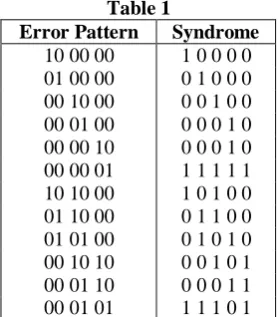
(37) For N2,b' 1, b3, we have obtained (6,1)- code that can correct all single errors in all the sub-blocks and a burst of length 3 simultaneously in two consecutive sub-blocks. For this the following matrix
1
1 0 0 0 0 1
0 1 0 0 0 1
0 0 1 0 0 1
0 0 0 1 0 1
0 0 0 0 1 1
H
may be considered as parity check matrix. It can be verified in the following table that the code is a mbc- code.
Table 1
Error Pattern Syndrome
10 00 00 1 0 0 0 0 01 00 00 0 1 0 0 0 00 10 00 0 0 1 0 0 00 01 00 0 0 0 1 0 00 00 10 0 0 0 1 0 00 00 01 1 1 1 1 1 10 10 00 1 0 1 0 0 01 10 00 0 1 1 0 0 01 01 00 0 1 0 1 0 00 10 10 0 0 1 0 1 00 01 10 0 0 0 1 1 00 01 01 1 1 1 0 1
Case 2. If b1b2 b3b', Nn1n2n3, then the bound in (1) can be expressed as
3
' 1
1 3 3
2 2( ' 1)
2 1 2( ' 1)( 1) ( 1)( 1)
( 1) ( 2 ' 1)( 2 ' 2)
n k b
b b
N b q q n b q q
q q b b b b
(38) For N3, n34,b'2,b5 we have the following parity check matrix for a (10,4) linear code
2
0 1 0 0 0 0 1 0 0 0 0 0 1 0 0 0 0 1 0 0 0 1 1 0 0 0 0 0 1 0 1 0 1 0 0 1 0 0 0 1 0 1 0 1 0 0 0 0 0 0 0 0 1 0 1 0 0 0 0 0 H
It can be verified from the following error-pattern syndrome table that the code is a mbc-code
Table 2
Error Pattern Syndrome
100 000 0000 000100
110 000 0000 101110
010 000 0000 101010
011 000 0000 110111
000 100 0000 000010
000 110 0000 000011
000 010 0000 000001
000 011 0000 000101
000 000 1000 100000
000 000 1100 110000
000 000 0100 010000
000 000 0110 011000
000 000 0010 001000
000 000 0011 001100
100 100 0000 000110
100 110 0000 000111
110 100 0000 101100
110 110 0000 101101
010 100 0000 101000
010 110 0000 101001
011 100 0000 110101
011 110 0000 110100
010 010 0000 101011
010 011 0000 101111
011 010 0000 110110
011 011 0000 110010
000 100 1000 100010
000 100 1100 110010
000 110 1000 100011
000 110 1100 110011
000 010 1000 100001
000 010 1100 110001
000 011 1000 100101
000 011 1100 110101
000 010 0100 010001
000 010 0110 011001
000 011 0100 010101
000 011 0110 011101
Case 3. For n1n2 n3, b1b2b3b', the inequality (1) can be expressed as
' 1
2 2( ' 1)
2 1 2 ( 3 ' 3)
( 1) ( 2 ' 1)
( 2 ' 2)
n k b
b
n b
q q b b
b b
. (39)
In this case, for N9, b1b2b3 1, b3, we have obtained a (9, 4) code that may correct all single errors in all the three sub-blocks together with the bursts of length 3(fix) simultaneously in the vector of length n1n2 and n2n3.
3
1 1 0 0 0 1 0 0 0
0 1 0 1 0 0 0 0 1
1 1 1 0 0 0 0 1 0
1 1 0 0 0 0 1 0 0
1 1 1 1 1 0 0 0 0
H
It can be verified that the code so constructed is a (9, 4) mbc-code.
Case 4. If b1b2 b3b n', 1n2n3 N, then equality (1) can be expressed as
1 1
1 ' 1
1 ' 2 2
1 1
2 2( ' 1)
1 ( 1) ( 1) 2( 1)( ' 1)
1
( 1) ( ' 1)( ' 2)
2 1
( 1) ( 2 ' 1)( 2 ' 2)
2
n k
b b
b b b
q
q q N b q N b q
q q b b b b b b
q q b b b b
(40) For N3,b11, 'b 2,b4 , the parity check matrix for the code (9, 4) may be given as
4
0 1 1 1 0 0 1 0 0 0 1 0 1 0 0 0 1 0 1 0 1 1 0 0 0 0 1 1 1 0 1 0 1 0 0 0 1 0 1 1 1 0 0 0 0 H
It can be verified that the code so constructed is a (9,4) mbc-code.
Case 5. Ifb' b1 b2 b3, Nn1n2n3, then the bound given in (1) can be expressed as
3
' 1
2 2( ' 1)
' 2 2
3 3
2 1 2( 1)( ' 1) 1
( 1) ( 2 ' 1)( 2 ' 2) 2
1
( 1) ( ' 1)( ' 2) 2
n k b
b b b
q N b q
q q b b b b q q b b b b b b
(41) For N2, n3 3, b' 1, b32, b3, it can be verified from the following parity check matrix
5
1 1 0 0 1 0 0
0 1 0 0 0 1 0
1 1 0 0 0 0 1
0 1 0 1 0 0 0
1 1 1 0 0 0 0
H
that the code so constructed is a (7,2) mbc-code.
Case 6. Ifb' b1 b2b3, n1n3n3, then the inequality (1) can be expressed as.
3
3
' 1 1
' 1 2
1 3 3
2 2( ' 1)
' 2 2
3 3
2 1 ( 1)( ' 1) ( 1)( ' 1) ( 1)( 1)
1
( 1) ( 2 ' 1)( 2 ' 2) 2
1
( 1) ( ' 1)( ' 2) 2
n k b
b b b b b
q n b q q n b q q n b q
q q b b b b q q b b b b b b
(42) For n12, n23,n3 4,b' 1, b32, b3, the (9,4) code obtained from the following parity check matrix
6
0 1 1 1 0 1 0 0 0 0 1 0 1 0 0 1 0 0 0 1 1 1 0 0 0 1 0 1 1 0 0 0 0 0 0 1
0 0 1 1 1 0 0 0 0 H
is a mbc-code.
III. OPEN PROBLEMS AND REMARKS
In this paper, we have obtained lower and upper bounds on the number of parity-check digits for
1 2 3
1 2 3
(nb,nb,nb) mbc-linear codes, which corrects burst in three different sub-blocks of a codeword. We have shown the existence of linear codes for different values of the parameters
1, 2, 3, , ,1 2, 3,
n n n k b b b b b1 b2 b2 b3 by
constructing appropriate parity check matrices following the synthesis procedure outlined in the proof of Theorem 1. However, the problem needs further investigation to
(1) find the possibilities of the existence of mbc- linear codes in non-binary case;
(2) find the possibilities of the existence of mbc-optimal codes in binary and non-binary cases.
ACKNOWLEDGEMENT
The author is thankful to Prof. B.K. Dass, Head, Department of Mathematics, University of Delhi, and Dr. Vinod Tyagi, Assoc. Professor, Shyam Lal College(eve) for revising the contents of this paper.
REFERENCES
[1] M.A. Alexander, R.M. Cryb and D.W. Nast, “Capabilities of the telephone network for data transmission”, Bell. System Tech. J., vol. 39, no. 3., 1960.
[2] R.T. Chien and D.T. Tang, “On definition of a burst”, IBM J. Res. Development, vol. 9, no. 4, 292-293, 1965.
[3] B.K. Dass, “On a Burst error correcting codes”, J. Info. Optimization Sciences, vol. 1, 291-295, 1980.
[4] B.K. Dass and V. Tyagi, “Bounds on block wise burst error correcting linear codes”, J. Information Sciences, vol. 20, 157-164, 1980. [5] T. Etzion, “Constructions for perfect 2-burst correcting codes”, IEEE
Transactions on Information Theory, vol. 47, no. 6, 253-255, 2001. [6] V. Tyagi and A. Sethi, “
1 2 3
1 2 3
(nb,nb,nb) linear codes over GF(2)”,