A New Approach to Solve Transportation
Problems with the Max Min Total
Opportunity Cost Method
Sushma Duraphe
1, Sarla Raigar
2*1 Department of Mathematics, Govt. M.V.M. Bhopal, India
2* Research Scholar, Department of Mathematics, Govt. M.V.M. Bhopal, India ABSTRACT: In this paper, we are trying to find
the optimum solution of a transportation problem and is to minimize the cost. The current new algorithmic approach to solve the transportation problem is based upon the Total Opportunity Cost (TOC) of a transportation table (TT) and maximum minimum penalty approach. The most attractive feature of this method is that it requires very simple arithmetical and logical calculation, which compared to the existing method an optimal solution and illustrated with numerical example.
KEYWORD: Transportation, Minimization costs, Sources supply, Demand, TOC,Current Method. 1. INTRODUCTION A transportation problem has been widely studied in computer science and Operation Research. It is one of the fundamental problems of network flow problem which is usually use to minimize the transportation cost for industries with number of destination while satisfying the supply limit and earliest and most important applications of linear programming problem. It was first studied by F.L. Hitchcock in 1941[5] , then separately by T.C. Koopmans in 1947, and finally placed in framework of linear programming and solved by simplex method by G.B. Dantzing in 1951[4]. The Simplex method is not suitable for the Transportation problem especially for large scale transportation problem due to its special structure of model in 1954 charnes and cooper [3] was developed Stepping Stone method.
A balanced condition (total demand is equal to total supply) is assumed. Then finding an optimal schedule of shipment of the commodity with the satisfaction of demands at each destination is the main goal of the problems. The first stage the (IBFS) was obtained by opting any of the available methods such as North West Corner, Matrix Minima Method or LCM, and Vogel’s Approximation Method, etc. Then in the next and
optimal solution, it’s a much easier approach to propose for finding an optimal solution and very easy computations.
In last few year Abdual Quddoos et.al [2] and sudhaker et.al [10] proposed two different method in 2012respectively, for finding an optimal solution. Prof. Reena G. Patel et. al [6,7] and A. Amaravathy et.al [1] developed the method is very helpful as having less computations and also required the short time of period for getting the optimal solution.
Besides the covenantal methods many researchers has provide many method a better of a transportation problem. Some of the important related works the current research has deal with are:.‘Transportation Problem using Stepping Stone Method and its Application’[8]by Prof. Urvashikumari D. Patel et.al Hence the another method consider averages of total cost along each row and each column which is totally new concept.[9] In general we try to minimize total transportation cost for the commodities transporting from source to destination.
In this paper we introduce Method for solving transportation problem which is very simple, easy to understand and helpful for decision making and it gives minimum solution of transportation problem. The method developed here ensures a solution which is very closer to the optimal solution.
2. Algorithm of Current Method:-
Step 1:- Examine whether the transportation problem is balanced or not. If it is balanced then go to next step.
Step 3:- Apply the same operation on each of the columns and place them on the right-bottom of the corresponding element.
Step 4:- Adding the opportunity cost in each cell along each row and the opportunity cost in each cell along each column and putting the summation value in the corresponding cell.
Step 5:- Find the difference between maximum and minimum in each row and each column which is called as row penalty and as column penalty and write it in the side and bottom.
Step 6:- From that select the maximum value. From the selected row/column we need to allocate the minimum of supply/demand in the minimum
element of the row or column. Eliminate by deleting the columns or rows corresponding to where the supply or demand is satisfied.
Step 7:- If obtained condition in step 6 is contrary, that is if there is tie in maximum value select that value which has least element. If there is tie in the least element then allocate the least element which has minimum supply/ demand.
Step 8:- Repeating the step 5 to step 7 until satisfaction of all the supply and demand is met.
Step 9:-Now total minimum cost is calculated as sum of the product of cost and corresponding allocate value of supply/demand.
3. Numerical Example
Example 3.1. Illustrate
Table 1
D1 D2 D3 D4 Supply
S1 9 8 5 7 12
S2 4 6 8 7 14
S3 5 8 9 5 16
Demand 8 18 13 3
Solution : since Σai = Σbj = 42
The given transportation problem is balanced; therefore exist a basic feasible solution to Current Method problem.
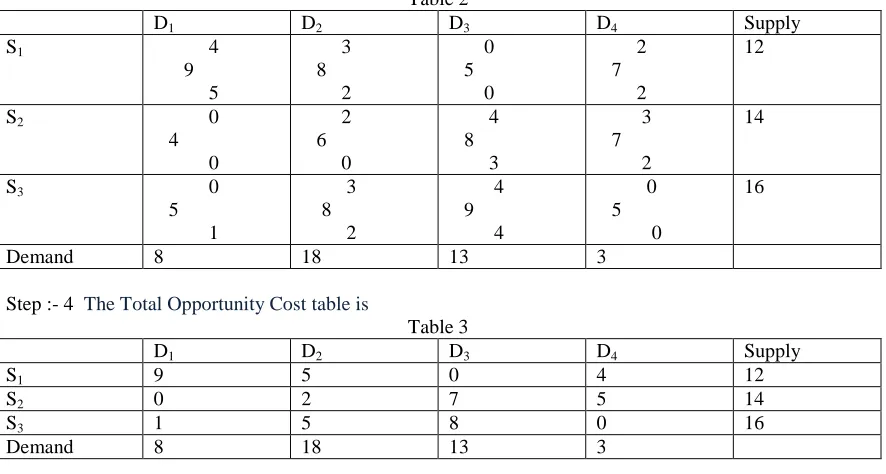
Step :- 2 and 3 The row differences and column differences are:
Table 2
D1 D2 D3 D4 Supply
S1 4
9 5
3 8 2
0 5 0
2 7 2
12
S2 0
4 0
2 6 0
4 8 3
3 7 2
14
S3 0
5 1
3 8 2
4 9 4
0 5 0
16
Demand 8 18 13 3
Step :- 4 The Total Opportunity Cost table is
Table 3
D1 D2 D3 D4 Supply
S1 9 5 0 4 12
S2 0 2 7 5 14
S3 1 5 8 0 16
Step :- 5 The difference between maximum and minimum in each row and each column
Table 4
D1 D2 D3 D4 Supply Row Penalty
S1
9 5
12
0 4
12 (9) (9) - -
S2 8
0 6
2 7 5
14 , 6 (7) (5) (5) (5)
S3
1
12
5
1
8 3
0
16 , 13 (8) (8) (8) (3)
Demand 8 18
12
13
1
3
Column
Penalty
(9)
-
-
-
(3)
(3)
(3)
(3)
(8)
(8)
(1)
(1)
(5)
(5)
(5)
-
Therefore, the allocation in the original TT is
Table 5
D1 D2 D3 D4 Supply
S1
9 8
12
5 7
12
S2 8
4
6
6 8 7
14
S3
5
12 8
1
9
3
5
16
Demand 8 18 13 3
The transportation cost is: Z = 12*5 + 8*4 + 6*6 + 12* 8 + 1*9 + 3*5= 248/-
Example 3.1. Illustrate
Table 6
D1 D2 D3 Supply
S1 3 3 5 9
S2 6 5 4 8
S3 6 10 7 10
Demand 7 12 8
Solution : since Σai = Σbj = 27
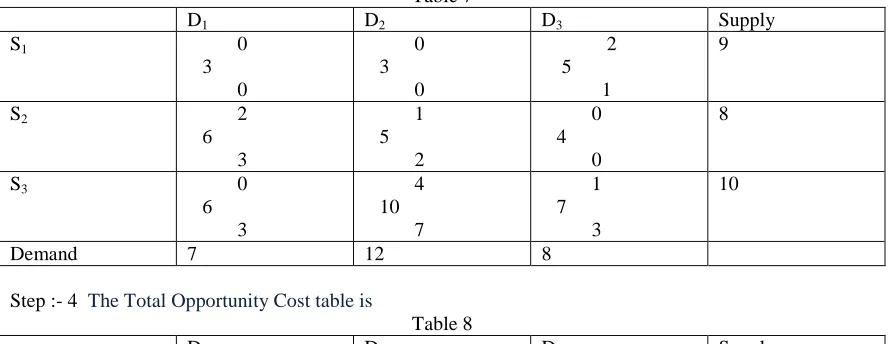
Step :- 2 and 3 The row differences and column differences are::
Table 7
D1 D2 D3 Supply
S1 0
3 0
0 3 0
2 5 1
9
S2 2
6 3
1 5 2
0 4 0
8
S3 0
6 3
4 10 7
1 7 3
10
Demand 7 12 8
Step :- 4 The Total Opportunity Cost table is
Table 8
D1 D2 D3 Supply
S1 0 0 3 9
S2 5 3 0 8
S3 3 11 4 10
Demand 7 12 8
Step :- 5 The difference between maximum and minimum in each row and each column
Table 9
D1 D2 D3 Supply Row Penalty
S1
0
9
0 3
9 (3) -
S2
5
3 3
5 0
8 , 5 (5) (5) (5)
S3 7
3 11
3 4
10 (8) (8) (1)
Demand 7 12
3
8 3 Column Penalty (5)
(2) (2)
(11) (8) -
(4) (4) (4)
Therefore, the allocation in the original TT are
Table 10
D1 D2 D3 Supply
S1
3
9
3 5
9
S2
6
3
5
5
4
8
S3 7
6 10
3
7
10
Demand 7 12 8
125/-Comparison of the numerical results:-
Comparison of the numerical results which are obtain from the example is shown in the following table
Table 11
Method Example 3.1 Example 3.2
Current Method 248 125
North West Corner Rule 320 143
Matrix Minima Method 248 159
VAM 248 143
MODI- Method 240 125
4 CONCLUSION:- The current method is an
attractive method which is very simple, easy to understand and gives result exactly or even lesser to VAM method. The solution obtained by the current method is near modi method.
5. REFERENCES:-
[1] A. Amaravathy, K. Thiagarajan and S. Vimala (2016), MDMA Method-An Optimal Solution for Transportation Problem, Middle-East Journal of Scientific Research Vol.24 Issue 12, pp. 3706-3710.
[2] Abdual Quddoos, Shakeel Javaid, M.M. Khalid.(2012), A New Method for Finding an Optimal Solution for
Transportation Problems, International Journal on
Computer Science and Engineering vol. 4,Issue7, pp. 1271-1274.
[3] Charnes, Cooper (1954).The Stepping-Stone method for
explaining linear programming. Calculation in
transportation problems. Management Science 1(1)49-69.
[4] G.B.Dantzig (1951) Application of the simplex method to a transportation problem, Activity Analysis of production and allocation. (T.C. Koopmans ed.)Wiley, new York, pp 359-373.
[5] Hitchcock FL (1941).The distribution of a product from
several sources to Numerous localities, Journal Of
Mathematical Physics20 1941 224-230.
[6] Prof. Reena. G. Patel, Dr. P.H. Bhathawala. (2014), The New Global Approach to a Transportation Problem,
International Journal of Engineering Technology,
Management and Applied Science, vol. 2 Issue3, pp. 109-113.
[7] Prof. Reena. G. Patel, Dr. P.H. Bhathawala. (2016), An Innovative Approach to Optimum Solution of a
Transportation Problem, International Journal of
Innovative Research in Science, Engineering Technology, vol. 5 Issue 4, pp. 5695-5700.
[8] Prof. Urvashikumari D.Patel, Prof. Dhavalkumar H.Patel, prof. Ravi C. Bhavsar (2017), Transportation Problem Using Stepping Stone Method and its Application. International Journal of Advanced Research in Electrical, Electronics and Instrumentation Engineering,Vol 6,Issue 1, pp. 46-50.
[9] S.M. Abul Kalam Azad, Md. Bellel Hossain, Md. Mizanur Rahman(2017),An Algorithmic Approach to Solve Transportation Problems With The Average Total Opportunity Cost Method, International Journal of Scientific and Research Publications, Vol. 7, Issue 2, pp. 266-270.
[10] Sudhakar VJ, Arunnsankar N, Karpagam T (2012),A new