ADVANCED VISUALISATION TECHNOLOGIES AS A TOOL IN THE AREA OF
AUTOMOTIVE ENGINEERING
Ass. Prof. Tashko Rizov PhD., Prof. Milan Kjosevski PhD., Prof. Risto Tashevski PhD.
[email protected], [email protected], [email protected]
Faculty of Mechanical Engineering – Skopje, Macedonia
Abstract: The advanced technologies find their application in many areas of todays’ human life. This provides the engineers with a new
ability in the area of technical visualization in different formal or informal engineering processes. Augmented and virtual reality are visualization technologies in which the virtual objects are combined with the real ones and coexist in the same space, or completely substitute the reality with computer modelled environment. In their nature, these technologies open up opportunities for their application in various processes in the area of automotive engineering. In this stage of development of these visualization technologies, initial steps have to be made for their use in engineering tasks in the area of automotive engineering. Real expectations exist that these technologies can serve as additional tools in the processes like vehicle approval or vehicle maintenance, or as an additional tool in the hands of the experts that make the crash forensics. This paper presents the results of conducted research in the direction of use of technical solutions for visualization of vehicles in different areas of the automotive engineering, presenting their positive characteristics along with their limitations.
Keywords: ADVANCED VISUALISATION TECHNOLOGIES, AUGMENTED REALITY, VIRTUAL REALITY, AUTOMOTIVE
ENGINEERING.
1. Introduction
The advanced technologies find their application in many areas of todays’ human life. Augmented and virtual reality are visualization technologies in which the virtual objects are combined with the real ones and coexist in the same space, or completely substitute the reality with computer modelled environment. In their nature, these technologies open up opportunities for their application in the processes of crash forensics.
The advanced visualization technologies became part of the forensics process very soon after their deployment. Their use in the forensics process has been well accepted and appreciated. Based upon factual data, forensic animations can reproduce the scene and demonstrate the activity and location of vehicles, objects, and involved persons at various points in time using 3D modeled scenes and objects, 3D animations and recently augmented and virtual reality. This ability to model and visualize in 3D, has enabled the users to observe the scene from various viewpoints such as the driver’s view, the victim’s view or the witness’ view. The advanced visualization techniques for reconstruction of crime scenes are replacing the traditional illustrations, photographs, and verbal descriptions, and they are becoming popular in today’s forensics [1].
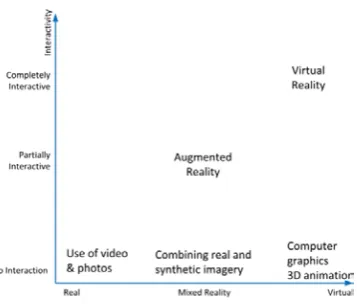
Fig. 1 Visualization techniques and their level of interactivity (Source: M.
Ma, et al. 2010).
The diagram in Fig.1 presents the key difference between AR/VR and other visualization techniques and that is the level of interactivity. The use of visualization techniques like videos and photos use only real object while computer graphics and 3D animation use only virtual object. By combining the real and synthetic imagery a mixed reality is created. In all these three cases there is no user interactivity. VR and AR provide an interactive real-time 3D graphical environment that responds to user actions such as moving around the virtual world or maneuvering virtual objects. VR⁄AR can put the user in the driver’s seat for accident reconstructions and allow the user to observe a scene from a desired point of view, which is impossible in film or photos. A VR⁄AR user can also, for example, play the various roles in an accident like perpetrator or witness to experience the reconstruction of the incident.
2. Augmented Reality
Augmented Reality (AR) is a variation of Virtual Environments (VE), or Virtual Reality as it is more commonly called. VE technologies completely immerse a user inside a synthetic environment. While immersed, the user cannot see the real world around him. In contrast, AR allows the user to see the real world, with virtual objects superimposed upon or composited with the real world. Therefore, AR supplements reality, rather than completely replacing it. Ideally, it would appear to the user that the virtual and real objects coexisted in the same space. Azuma [4] gives a more comprehensive definition of AR as a system that has the following characteristics: (1) combines real and virtual world, (2) interactive in real time and (3) registered in 3D. Augmented Reality enhances a user's perception of and interaction with the real world. The virtual objects display information that the users cannot directly detect with their own senses. The information conveyed by the virtual objects helps a user perform real-world tasks.
Augmented Reality might apply to all senses, not just sight. So far, researchers have focused on blending real and virtual images and graphics. However, AR could be extended to include sound, smell or tactile [5].
advantages and disadvantages [3].
Fig. 2 Milgram’s Reality - Virtuality continuum. (source: Azuma 1997)
In the optical case, the virtual image is projected at some distance away from the user. This distance may be adjustable, although it can be fixed if the display is mounted to the user. Therefore, while the real objects are at varying distances from the user, the virtual objects are all projected to the same distance. If the virtual and real distances are not matched for the particular objects that the user is looking at, it may not be possible to clearly view both simultaneously.
A key measure of AR systems is how realistically they integrate augmentations with the real world. The software must derive real world coordinates, independent from the camera, from camera images. That process is called image registration. Image registration is one of the most basic problems currently limiting Augmented Reality applications. The objects in the real and virtual worlds must be properly aligned with respect to each other, or the illusion that the two worlds coexist will be compromised. More seriously, many applications demand accurate registration. Without accurate registration, Augmented Reality will not be accepted in many applications. Registration errors are difficult to adequately control because of the high accuracy requirements and the numerous sources of error. These sources of error can be divided into two types: static and dynamic. Static errors are the ones that cause registration errors even when the user's viewpoint and the objects in the environment remain completely still. Dynamic errors are the ones that have no effect until either the viewpoint or the objects begin moving [8].
AR is made possible by performing four basic and distinct tasks, and combining the output in a useful way. (1) Scene capture: First, the reality that should be augmented is captured using either a video-capture device such as a camera, or a see-through device such as a head-mounted display. (2) Scene identification: Secondly, the captured reality must be scanned to define the exact position where the virtual content should be embedded. This position could be identified either by markers (visual tags) or by tracking technologies such as GPS, sensors, infrared, or laser. (3) Scene processing: As the scene becomes clearly recognized and identified, the corresponding virtual content is requested, typically from the Internet or from any kind of database. (4) Scene visualization: Finally, the AR system produces a mixed image of the real space as well as the virtual content [6].
The application of AR for presenting models in 3D can be part of all areas of engineering where virtual three-dimensional models are used in the process of engineering design. Anyhow, the most common use of AR is in the areas of mechanical engineering, architecture and for the needs of the educational processes in engineering [5].
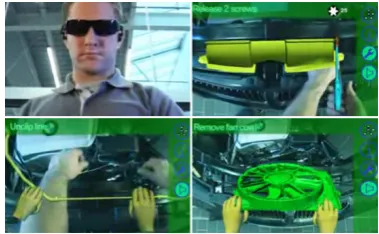
Fig. 3 Visual instruction manual for vehicles maintenance in BMW (source:
BMW AG).
One of the areas in which the use of AR is very common is the assembly procedures of machines and devices (Fig. 3). Instead of operators reading the operations sequence from fixed displays, which might result in fixed positions in an assembly line, augmented reality can be easily moved through the complete facility using a laptop, tablet or a smartphone. The most important that a good AR system offers to the industrial market is the connection with optical or mechanical sensors, like optical or mechanical measuring devices. In that way, users (operators) have the ability to transfer the acquired data at one post to the next and to superimpose them on the existing CAD drawings of the part augmenting the view of the user and providing valuable information at the right time.
Numerous companies from the automotive industry have developed and deployed solutions based on Augmented Reality. Toyota in partnership with the Copenhagen Institute for Interactive Design has developed a solution for entertainment of the backseat passengers. General Motors developed a concept for enhancing the driver’s view of the road by placing virtual lines on the road edges helping the driver maintain the desired route in low visibility conditions. Mercedes has developed AR based applications for choosing the details like color, bumpers, alloy wheels and interior of their A-class and presenting a 3D model of the selection.
Fig. 4 View of Augmented Reality based solution for acquiring data elements in the vehicle approval process.
With the advancement of the software tools for design and development of AR solutions, the development process of such solutions is no more task for a complete R&D department of a big automotive companies. Nowadays, this is possible for a small team or even a single developer. The authors of this paper have developed a solution for a visual step-by-step solution for assisting the operators in the process of acquiring data element in the process of vehicle approval (Fig. 4). The implementation of the developed solution resulted in lowering the lead time of the operation [10].
3. Analysis of existing technical solutions for
visualization of vehicles in the process of crash
forensics
The technical solutions for visualization of vehicles in the process of crash forensics have not been fully adopted according the development of the software and hardware used in these visualization solutions. In the beginning, the use of technical solutions for visualization in the process of crash forensics was in line with the development of visualization solutions based on computer graphics and animation. The use of technical solutions based on 3D modelling and Virtual Reality in the process of crash forensics was lacking behind of the development of these technical solutions. This was mainly due to the fact that the learning curve required to master the technology was too long. The development of Augmented Reality as a visualization technology has progressed rapidly in the last 10 years. However, its use in the process of crash forensics is still very limited.
these technologies (Fig. 5). In the United Kingdom, computer records are acceptable as evidence if they can be proved to be correct and accurate [2]. This leads to the significance of introducing dynamic simulation (a.k.a. physically based simulation) to forensic animation, because dynamic simulation is capable of accurate modeling of objects and human motions based on Newton’s laws of motion [1].
a) b)
Fig. 5 Computer Graphics Animation results from a CAD software using
dynamics simulation to determine the motion of objects in an accident; a) what the perpetrator described, b) what the software simulate based on evidence and marks on the vehicle. (Source: Advanced Symtech; 2015).
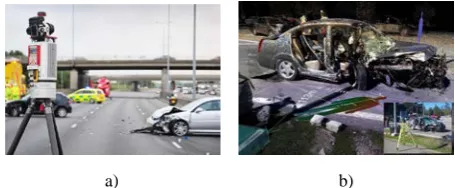
One more very important technology that supported the adoption progress of the visualization technologies in the forensics process is the use of laser scanning (Fig. 6). The laser scanning devices offer the possibility to acquire a huge number of accurate measures from an accident scene providing the technicians with the ability to acquire the measures and leave the incident site very fast. After scanning the site, the acquired data are introduced to a CAD software in order to create a 3D model of the accident and complete the crash forensics process. The main barriers of this technology are the very high price of the laser scanning equipment, the accuracy and portability of the equipment and again the learning curve of the technicians for mastering this technique.
a) b)
Fig. 6 Laser Scanning of a crash site. a) Scanning an accident site, b)
Measuring important distances using CAD software based on the data acquired by laser scanning. (Source: MAPTEK; 2016).
Vehicular accident reconstruction work often focuses on estimating the speeds of crashed vehicles. Vehicle velocities are often estimated by correlating the crush deformation of a crashed vehicle with vehicle speeds using stiffness coefficients determined from crash tests. Vehicle crush is determined by measuring the crashed vehicle and comparing these dimensions with a reference vehicle, the exemplar. Other methods include measuring the length of skid marks, vehicle displacement and other accident geometry [7].
Standard practice in most police departments today is to measure accident scenes and vehicle crush manually using calipers and tape measures. This is time-consuming, slow, sometimes dangerous and often limited to a few tens of measurements. Slow is a big problem in areas of congested traffic. Closing a lane to measure accident sites often leaves the driving public stuck in traffic, which can lead to collateral incidents. The police officer in charge at the scene sometimes has to make a tough call to balance the requirement to take sufficient measurements for evidence against minimizing disruption to the driving public [7].
4. Possible technical solutions for visualization of
vehicles in the process of crash forensics based on
Augmented Reality
This paper presents the results of conducted research in the direction of use of technical solutions for visualization of vehicles in the process of crash forensics, presenting their positive characteristics along with their limitations. The focus of the research was to determine if the technical solutions for visualization based on AR and VR can help collecting the necessary data on faster, more precise and reliable way, and provide additional information valuable in the process of forensics.
The concept idea for use of AR based solution is to eliminate the use of expensive equipment and to foster the rising performances of the all present hand-held devices (smart phones and tablets). The mid and high-end range hand held devices are equipped with sufficient processing power along with sensors with satisfactory accuracy (GPS sensor, infrared, gyroscope etc.). This provides an opportunity to move the technical solutions for visualization of vehicles from laboratories to the actual incident scene and from the expensive equipment to the hand-held devices.
Using the software application for mobile devices Augment, the crash site reality can be augmented by adding a 3D CAD model of the same vehicle overlaying the crashed one as presented in Fig.3. This results in enriching the sight of an expert assisting him/her in visualization of the level of deformation on the crashed vehicle by comparing it to the original shape and dimensions of the same type of vehicle.
The application was tested using a real crashed vehicle and a CAD model of the same type acquired through the Google Warehouse database of 3D models. The next step was to adjust the CAD model by setting the correct scale of the model and the appropriate coordinate system. Next, the CAD model of the vehicle was uploaded to the servers of Augment in order to later use it in their application for hand-held devices. For the purpose of this research, as a test specimen a crashed vehicle available at a local dealership was selected. The specimen vehicle is moved from the original crash site and the front bumper is removed, but these parameters are considered to be not important for the goal of the test and that is to analyze the applicability of the solution. On a regular iPad tablet the Augment app was installed and logged in to the previously made account where the CAD model was uploaded. At the location of the crashed vehicle, the CAD model was loaded to the iPad. The back faced camera of the iPad displays the video feed of the crashed vehicle and its surrounding to the screen of the tablet. The previously loaded CAD model is overlaid on the real view of the crashed car resulting in an Augmented Reality as shown on Fig.7.
processes. The downside on the hardware side is the lack of ability to make measures using the software application, measuring for instance distances or angles between the real objects and the CAD model. The current generation of hand-held devices is not equipped with such sensors to measure depth. Nevertheless, this is the case of the devices used by general population. Already today on the market devices that have this technology incorporated exist, like Google's Project Tango, Structure's Sensor for iPad or Microsoft's Kinect.
Fig. 7 Visual presentation of vehicles in the process of crash
forensics using Augmented Reality.
5. Possible technical solutions for visualization of
vehicles in the process of crash forensics based on
Virtual Reality
The concept idea for use of VR based solution is to overcome the downside of the AR based solution for making measures in the process of crash forensics. Instead of using a high-end laser scanning equipment, this research investigates the possibilities of using a hand held scanning device – Google's Project Tango. This device, similar to its rivals, is equipped with a stereo camera (4 MP 2mm RGB-IR pixel sensor and 1 MP front facing with fixed focus), motion tracking camera with 3D depth sensing ability. This device incorporates all necessary sensors and processing capabilities under one chassis making it ideal for this application.
Fig. 8 Visual presentation of vehicles in the process of crash
forensics using Virtual Reality.
Using the Tango tablet the crashed vehicle is being scanned and a 3D CAD model is exported. The scan was done on the same specimen vehicle at a local dealership. The ability to export .OBJ file types provides the opportunity to use different types of software applications. For the purpose of this research the Autodesk's software 3ds Max was used. The .obj file from the scanned crashed vehicle is imported in 3ds Max and overlaid on the CAD model of the vehicle as presented in Fig. 8.
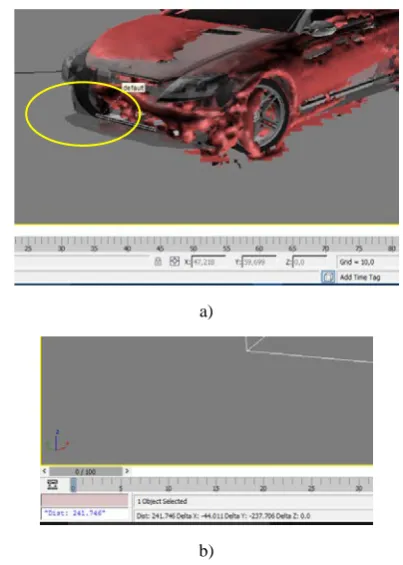
This provides the same visualization and comparing capabilities like the AR solution. In addition, this solution provides the ability to make accurate measures between the elements in the scene (distances and angles). Like presented in Fig. 9a, the displacement between two points can be easily and accurately measured. The displacement of a point from the CAD model of the vehicle and the same point selected from the crashed vehicle is presented by all three axes relative to a same Cartesian coordinate system. For the purpose of this research, related to the characteristics of the crash, as point of interest the front lateral beam of the chassis
understructure was selected. The tested VR solution provides the ability to measure the displacement according the x, y and z axes of all points of this element from its original position to its deformed position after the crash. This task is conducted in a form of a dialogue where after starting the command of the “Measure” tool, the software asks the user to select the first point by clicking on one of the models, then selecting the second point while presenting a dashed line between the two selections illustrating the measured distance. The result is presented on the command line (Fig.9 b.).
a)
b)
Fig. 9 Visual Reality based solution’s ability to make measures
of distance between objects. a) Selecting points to measure distance; b) Displacement of the selected points by all three axes.
The main downside of such solution is the accuracy of the scanned crashed vehicle. The selected vehicle did not have significant damage, so the faces of its shape acquired with the Tango tablet were accurate enough and easy to recognize. But if the crashed vehicle has significant damage than the level of accuracy provided with this hardware is not going to be sufficient. Additional techniques can be introduced for improving the scan quality like use of markers, limiting the reflection of the surfaces and securing the adequate level of light.
6. Conclusions
The presented technical solutions for visualization of vehicles in the process of crash forensics based on Augmented Reality and Virtual Reality impose as possible additional tool for the experts. They are reliable and easy accessible, with short learning curve. At this point, they can be perceived as assistance to the process only if they are used by experienced forensics experts with broad understanding of vehicle dynamics and mechanics.
7. References
[1] Minhua Ma; Huiru Zheng; Harjinder Lallie: Virtual Reality and 3D Animation in Forensic Visualization; J Forensic Sci, September 2010, Vol. 55, No. 5.
[2] Burton AM, Schofield D, Goodwin LM: Gate of global perception: Forensic graphics for evidence presentation; Proceedings of the 13th Annual ACM International Conference on Multimedia; 2005 Nov 6–11; Singapore. New York, NY: Association for Computing Machinery, 2005; pg. 103–11.
[3] Sutherland Ivan E.: A Head-Mounted Three-Dimensional Display; Harvard University, 1968.
[4] Azuma R.: A Survey of Augmented Reality, Teleoperators and Virtual Environments, August 1997, USA, pp. 355–385.
[5] Tashko Rizov, Elena Dimova Rizova: Augmented Reality As a Teaching Tool in Higher Education; International Journal of Cognitive Research in Science, Engineering and Education (IJCRSEE) Volume: 3 Issue: 1 Pages: 7-15, 2015.
[6] DHL Customer Solutions & Innovation: Augmented Reality in Logistics – Changing the way we see logistics a DHL perspective; 2014.
[7] Sean Higgins: Laser Scanning for Accident Reconstruction; SPAR 3D, 2004.
[8] Petar Pejić, Tashko Rizov, Sonja Krasić, Risto Tashevski: Presentation of Existing Architectural Objects Using Augmented Reality: Case study - Ada Bridge, Belgrade, Serbia; South East European Journal of Architecture and Design Volume 2015; Article ID 10011, 2016.
[9] Azuma R. T.; Predictive Tracking for Augmented Reality; Chapel Hill, North Carolina, USA: University of North Carolina, 1995.