The Thirty-Third AAAI Conference on Artificial Intelligence (AAAI-19)
Deep Interest Evolution Network for Click-Through Rate Prediction
Guorui Zhou,
*Na Mou,
†Ying Fan, Qi Pi, Weijie Bian,
Chang Zhou, Xiaoqiang Zhu, Kun Gai
Alibaba Inc, Beijing, China
{guorui.xgr, mouna.mn, fanying.fy, piqi.pq, weijie.bwj, ericzhou.zc, xiaoqiang.zxq, jingshi.gk}@alibaba-inc.com
Abstract
Click-through rate (CTR) prediction, whose goal is to esti-mate the probability of a user clicking on the item, has be-come one of the core tasks in the advertising system. For CTR prediction model, it is necessary to capture the latent user interest behind the user behavior data. Besides, consid-ering the changing of the external environment and the in-ternal cognition, user interest evolves over time dynamically. There are several CTR prediction methods for interest mod-eling, while most of them regard the representation of behav-ior as the interest directly, and lack specially modeling for latent interest behind the concrete behavior. Moreover, little work considers the changing trend of the interest. In this pa-per, we propose a novel model, named Deep Interest Evolu-tion Network (DIEN), for CTR predicEvolu-tion. Specifically, we design interest extractor layer to capture temporal interests from history behavior sequence. At this layer, we introduce an auxiliary loss to supervise interest extracting at each step. As user interests are diverse, especially in the e-commerce system, we propose interest evolving layer to capture inter-est evolving process that is relative to the target item. At in-terest evolving layer, attention mechanism is embedded into the sequential structure novelly, and the effects of relative in-terests are strengthened during interest evolution. In the ex-periments on both public and industrial datasets, DIEN sig-nificantly outperforms the state-of-the-art solutions. Notably, DIEN has been deployed in the display advertisement system of Taobao, and obtained 20.7% improvement on CTR.
Introduction
Cost per click (CPC) billing is one of the commonest billing forms in the advertising system, where advertisers are charged for each click on their advertisement. In CPC adver-tising system, the performance of click-through rate (CTR) prediction not only influences the final revenue of whole platform, but also impacts user experience and satisfaction. Modeling CTR prediction has drawn more and more atten-tion from the communities of academia and industry.
In most non-searching e-commerce scenes, users do not express their current intention actively. Designing model to
*Corresponding author is Guorui Zhou.
†This author is the one who did the really hard
work for Online Testing. The source code is available at https://github.com/mouna99/dien.
Copyright © 2019, Association for the Advancement of Artificial Intelligence (www.aaai.org). All rights reserved.
capture user’s interests as well as their dynamics is the key to advance the performance of CTR prediction. Recently, many CTR models transform from traditional methodolo-gies (Friedman 2001; Rendle 2010) to deep CTR mod-els (Guo et al. 2017; Qu et al. 2016; Lian et al. 2018). Most deep CTR models focus on capturing interaction between features from different fields and pay less attention to user interest representation. Deep Interest Network (DIN) (Zhou et al. 2018c) emphasizes that user interests are diverse, it uses attention based model to capture relative interests to tar-get item, and obtains adaptive interest representation. How-ever, most interest models including DIN regard the behav-ior as the interest directly, while latent interest is hard to be fully reflected by explicit behavior. Previous methods ne-glect to dig the true user interest behind behavior. Moreover, user interest keeps evolving, capturing the dynamic of inter-est is important for interinter-est representation.
rela-tive interests’ influence on interest evolution, while weakens irrelative interests’ effect that results from interest drifting. With the introduction of attentional mechanism into update gate, AUGRU can lead to the specific interest evolving pro-cesses for different target items. The main contributions of DIEN are as following:
• We focus on interest evolving phenomenon in e-commerce system, and propose a new structure of net-work to model interest evolving process. The model for interest evolution leads to more expressive interest repre-sentation and more precise CTR prediction.
• Different from taking behaviors as interests directly, we specially design interest extractor layer. Pointing at the problem that hidden state of GRU is less targeted for inter-est representation, we propose one auxiliary loss. Auxil-iary loss uses consecutive behavior to supervise the learn-ing of hidden state at each step. which makes hidden state expressive enough to represent latent interest.
• We design interest evolving layer novelly, where GPU with attentional update gate (AUGRU) strengthens the ef-fect from relevant interests to target item and overcomes the inference from interest drifting.
In the experiments on both public and industrial datasets, DIEN significantly outperforms the state-of-the-art solu-tions. It is notable that DIEN has been deployed in Taobao display advertisement system and obtains significant im-provement under various metrics.
Related Work
By virtue of the strong ability of deep learning on feature representation and combination, recent CTR models trans-form from traditional linear or nonlinear models (Fried-man 2001; Rendle 2010) to deep models. Most deep mod-els follow the structure of Embedding and Multi-ayer Per-ceptron (MLP) (Zhou et al. 2018c). Based on this basic paradigm, more and more models pay attention to the in-teraction between features: Both Wide & Deep (Cheng et al. 2016) and deep FM (Guo et al. 2017) combine low-order and high-order features to improve the power of expression; PNN (Qu et al. 2016) proposes a product layer to capture interactive patterns between interfield categories. However, these methods can not reflect the interest behind data clearly. DIN (Zhou et al. 2018c) introduces the mechanism of at-tention to activate the historical behaviors w.r.t. given target item locally, and captures the diversity characteristic of user interests successfully. However, DIN is weak in capturing the dependencies between sequential behaviors.
In many application domains, user-item interactions can be recorded over time. A number of recent studies show that this information can be used to build richer individual user models and discover additional behavioral patterns. In recommendation system, TDSSM (Song, Elkahky, and He 2016) jointly optimizes long-term and short-term user inter-ests to improve the recommendation quality; DREAM (Yu et al. 2016) uses the structure of recurrent neural net-work (RNN) to investigate the dynamic representation of each user and the global sequential behaviors of
item-purchase history. He and McAuley (2016) build visually-aware recommender system which surfaces products that more closely match users’ and communities’ evolving in-terests. Zhang et al. (2014) measures users’ similarities based on user’s interest sequence, and improves the perfor-mance of collaborative filtering recommendation. Parsana et al. (2018) improves native ads CTR prediction by using large scale event embedding and attentional output of recur-rent networks. ATRank (Zhou et al. 2018a) uses attention-based sequential framework to model heterogeneous behav-iors. Compared to sequence-independent approaches, these methods can significantly improve the prediction accuracy.
However, these traditional RNN based models have some problems. On the one hand, most of them regard hidden states of sequential structure as latent interests directly, while these hidden states lack special supervision for interest representation. On the other hand, most existing RNN based models deal with all dependencies between adjacent behav-iors successively and equally. As we know, not all user’s behaviors are strictly dependent on each adjacent behavior. Each user has diverse interests, and each interest has its own evolving track. For any target item, these models can only obtain one fixed interest evolving track, so these models can be disturbed by interest drifting.
In order to push hidden states of sequential structure to represent latent interests effectively, extra supervision for hidden states should be introdueced. DARNN (Ren et al. 2018) uses click-level sequential prediction, which models the click action at each time when each ad is shown to the user. Besides click action, ranking information can be fur-ther introduced. In recommendation system, ranking loss has been widely used for ranking task (Rendle et al. 2009; Hidasi and Karatzoglou 2017). Similar to these ranking losses, we propose an auxiliary loss for interest learning. At each step, the auxiliary loss uses consecutive clicked item against non-clicked item to supervise the learning of interest representation.
For capturing interest evolving process that is related to target item, we need more flexible sequential learn-ing structure. In the area of question answerlearn-ing (QA), DMN+ (Xiong, Merity, and Socher 2016) uses attention based GRU (AGRU) to push the attention mechanism to be sensitive to both the position and ordering of the inputs facts. In AGRU, the vector of the update gate is replaced by the scalar of attention score simply. This replacement ne-glects the difference between all dimensions of update gates, which contains rich information transmitted from previous sequence. Inspired by the novel sequential structure used in QA, we propose GRU with attentional gate (AUGRU) to activate relative interests during interest evolving. Different from AGRU, attention score in AUGRU acts on the informa-tion computed from update gate. The combinainforma-tion of update gate and attention score pushes the process of evolving more specifically and sensitively.
Deep Interest Evolution Network
model, named BaseModel. Then we show the overall struc-ture of DIEN and introduce the techniques that are used for capturing interests and modeling interest evolution process.
Review of BaseModel
The BaseModel is introduced from the aspects of feature representation, model structure and loss function.
Feature Representation In our online display system, we use four categories of feature:User Profile,User Behavior, AdandContext. It is notable that the ad is also item. For gen-eration, we call the ad as the target item in this paper. Each category of feature has several fields,User Profile’s fields are gender, age and so on; The fields ofUser Behavior’s are the list of uservisited goods id; Ad’s fields are ad id, shop idand so on;Context’s fields aretimeand so on. Fea-ture in each field can be encoded into one-hot vector, e.g., the female feature in the category of User Profile are en-coded as[0,1]. The concat of different fields’ one-hot vec-tors fromUser Profile,User Behavior,AdandContextform
xp,xb,xa,xc, respectively. In sequential CTR model, it’s remarkable that each field contains a list of behaviors, and each behavior corresponds to a one-hot vector, which can be represented byxb = [b1;b2;· · ·;bT] ∈ RK×T,bt ∈
{0,1}K,whereb
tis encoded as one-hot vector and repre-sentst-th behavior,T is the number of user’s history behav-iors,Kis the total number of goods that user can click.
The Structure of BaseModel Most deep CTR models are built on the basic structure of embedding & MLP. The basic structure is composed of several parts:
• Embedding Embedding is the common operation that transforms the large scale sparse feature into low-dimensional dense feature. In the embedding layer, each field of feature is corresponding to one embedding ma-trix, e.g., the embedding matrix of visited goods can be represented by Egoods = [m1;m2;· · ·;mK] ∈
RnE×K,wherem
j ∈RnErepresents a embedding
vec-tor with dimension nE. Especially, for behavior feature
bt, if bt[jt] = 1, then its corresponding embedding vector is mjt, and the ordered embedding vector list
of behaviors for one user can be represented by eb =
[mj1;mj2;· · ·,mjT]. Similarly, ea represents the
con-catenated embedding vectors of fields in the category of advertisement.
• Multilayer Perceptron(MLP) First, the embedding vec-tors from one category are fed into pooling operation. Then all these pooling vectors from different categories are concatenated. At last, the concatenated vector is fed into the following MLP for final prediction.
Loss Function The widely used loss function in deep CTR models is negative log-likelihood function, which uses the label of target item to supervise overall prediction:
Ltarget=−
1
N
N
X
(x,y)∈D
(ylogp(x) + (1−y) log(1−p(x))),
(1)
wherex = [xp,xa,xc,xb] ∈ D, Dis the training set of sizeN.y ∈ {0,1}represents whether the user clicks target item.p(x)is the output of network, which is the predicted probability that the user clicks target item.
Deep Interest Evolution Network
Different from sponsored search, in many e-commerce plat-forms like online display advertisement, users do not show their intention clearly, so capturing user interest and their dynamics is important for CTR prediction. DIEN devotes to capture user interest and models interest evolving process. As shown in Fig. 1, DIEN is composed by several parts. First, all categories of features are transformed by embed-ding layer. Next, DIEN takes two steps to capture interest evolving: interest extractor layer extracts interest sequence based on behavior sequence; interest evolving layer mod-els interest evolving process that is relative to target item. Then final interest’s representation and embedding vectors of ad, user profile, context are concatenated. The concate-nated vector is fed into MLP for final prediction. In the re-maining of this section, we will introduce two core modules of DIEN in detail.
Interest Extractor Layer In e-commerce system, user behavior is the carrier of latent interest, and interest will change after user takes one behavior. At the interest extrac-tor layer, we extract a series of interest states from sequential user behaviors.
The click behaviors of user in e-commerce system are rich, where the length of history behavior sequence is long even in a short period of time, like two weeks. For the bal-ance between efficiency and performbal-ance, we take GRU to model the dependency between behaviors, where the input of GRU is ordered behaviors by their occur time. GRU over-comes the vanishing gradients problem of RNN and is faster than LSTM (Hochreiter and Schmidhuber 1997), which is suitable for e-commerce system. The formulations of GRU are listed as follows:
ut=σ(Wuit+Uuht−1+bu), (2)
rt=σ(Writ+Urht−1+br), (3)
˜
ht= tanh(Whit+rt◦Uhht−1+bh), (4)
ht= (1−ut)◦ht−1+ut◦h˜t, (5)
where σ is the sigmoid activation function, ◦ is element-wise product, Wu, Wr, Wh ∈
RnH×nI, Uz, Ur, Uh ∈
nH×nH,nH is the hidden size, andnI is the input size.
itis the input of GRU,it=eb[t]represents thet-th behav-ior that the user taken,htis thet-th hidden states.
However, the hidden statehtwhich only captures the de-pendency between behaviors can not represent interest ef-fectively. As the click behavior of target item is triggered by final interest, the label used inLtarget only contains the ground truth that supervises final interest’s prediction, while history state ht (t < T)can’t obtain proper supervision. As we all know, interest state at each step leads to consec-utive behavior directly. So we propose auxiliary loss, which uses behaviorbt+1to supervise the learning of interest state
Figure 1: The structure of DIEN. At the behavior layer, behaviors are sorted by time, the embedding layer transforms the one-hot representationb[t]to embedding vectore[t]. Then interest extractor layer extracts each interest stateh[t]with the help of auxiliary loss. At interest evolving layer, AUGRU models the interest evolving process that is relative to target item. The final interest stateh0[T]and embedding vectors of remaining feature are concatenated, and fed into MLP for final CTR prediction.
we also use negative instance that samples from item set ex-cept the clicked item. There are N pairs of behavior em-bedding sequence:{ei
b,ˆeib} ∈ DB, i ∈ 1,2,· · · , N, where ei
b ∈RT×nErepresents the clicked behavior sequence, and
ˆ
ei b ∈R
T×nE represent the negative sample sequence.T is
the number of history behaviors,nEis the dimension of em-bedding,ei
b[t]∈ Grepresents thet-th item’s embedding vec-tor that usericlick,Gis the whole item set.ˆei
b[t]∈ G −e i b[t] represents the embedding of item that samples from the item set except the item clicked by useriatt-th step. Auxiliary loss can be formulated as:
Laux =−
1
N(
N
X
i=1
X
t
logσ(hit,eib[t+ 1]) (6)
+ log(1−σ(hit,ˆeib[t+ 1]))),
where σ(x1,x2) = 1+exp(−1[x1,x2]) is sigmoid activation
function,hi
trepresents thet-th hidden state of GRU for user
i. The global loss we use in our CTR model is:
L=Ltarget+α∗Laux, (7)
whereαis the hyper-parameter which balances the interest representation and CTR prediction.
With the help of auxiliary loss, each hidden state ht is expressive enough to represent interest state after user takes behavior it. The concat of all T interest points
[h1,h2,· · ·,hT]composes the interest sequence that inter-est evolving layer can model interinter-est evolving on.
Overall, the introduction of auxiliary loss has several ad-vantages: from the aspect of interest learning, the intro-duction of auxiliary loss helps each hidden state of GRU
represent interest expressively. As for the optimization of GRU, auxiliary loss reduces the difficulty of back propa-gation when GRU models long history behavior sequence. Last but not the least, auxiliary loss gives more semantic in-formation for the learning of embedding layer, which leads to a better embedding matrix.
Interest Evolving Layer As the joint influence from ex-ternal environment and inex-ternal cognition, different kinds of user interests are evolving over time. Using the interest on clothes as an example, with the changing of population trend and user taste, user’s preference for clothes evolves. The evolving process of the user interest on clothes will di-rectly decides CTR prediction for candidate clothes. The ad-vantages of modeling the evolving process is as follows:
• Interest evolving module could supply the representation of final interest with more relative history information;
• It is better to predict the CTR of target item by following the interest evolution trend.
Notably, interest shows two characteristics during evolving: • As the diversity of interests, interest can drift. The effect of interest drifting on behaviors is that user may interest in kinds of books during a period of time, and need clothes in another time.
the local activation ability of attention mechanism and se-quential learning ability from GRU to model interest evolv-ing. The local activation during each step of GRU can in-tensify relative interest’s effect, and weaken the disturbance from interest drifting, which is helpful for modeling interest evolving process that relative to target item.
Similar to the formulations shown in Eq. (2-5), we usei0t,
h0tto represent the input and hidden state in interest evolving module, where the input of second GRU is the correspond-ing interest state at Interest Extractor Layer:i0t = ht. The last hidden stateh0T represents final interest state.
And the attention function we used in interest evolving module can be formulated as:
at=
exp(htWea)
PT
j=1exp(hjWea)
, (8)
whereeais the concat of embedding vectors from fields in category ad,W ∈RnH×nA,n
His the dimension of hidden state andnAis the dimension of advertisement’s embedding vector. Attention score can reflect the relationship between advertisementeaand inputht, and strong relativeness leads to a large attention score.
Next, we will introduce several approaches that combine the mechanism of attention and GRU to model the process of interest evolution.
• GRU with attentional input (AIGRU)In order to acti-vate relative interests during interest evolution, we pro-pose a naive method, named GRU with attentional in-put (AIGRU). AIGRU uses attention score to affect the input of interest evolving layer. As shown in Eq. (9):
i0t=ht∗at (9)
Wherehtis thet-th hidden state of GRU at interest ex-tractor layer,i0
tis the input of the second GRU which is for interest evolving, and∗means scalar-vector product. In AIGRU, the scale of less related interest can be reduced by the attention score. Ideally, the input value of less re-lated interest can be reduced to zero. However, AIGRU works not very well. Because even zero input can also change the hidden state of GRU, so the less relative inter-ests also affect the learning of interest evolving.
• Attention based GRU(AGRU) In the area of question answering (Xiong, Merity, and Socher 2016), attention based GRU (AGRU) is firstly proposed. After modifying the GRU architecture by embedding information from the attention mechanism, AGRU can extract key information in complex queries effectively. Inspired by the question answering system, we transfer the using of AGRU from extracting key information in query to capture relative in-terest during inin-terest evolving novelly. In detail, AGRU uses the attention score to replace the update gate of GRU, and changes the hidden state directly. Formally:
h0t= (1−at)∗h0t−1+at∗h˜0t, (10)
whereh0t,h0t−1andh˜0tare the hidden state of AGRU. In the scene of interest evolving, AGRU makes use of the attention score to control the update of hidden state di-rectly. AGRU weakens the effect from less related interest
Table 1: The statistics of datasets
Dataset User Goods Categories Samples
Books 603,668 367,982 1,600 603,668 Electronics 192,403 63,001 801 192,403 Industrial dataset 0.8 billion 0.82 billion 18,006 7.0 billion
during interest evolving. The embedding of attention into GRU improves the influence of attention mechanism, and helps AGRU overcome the defects of AIGRU.
• GRU with attentional update gate (AUGRU)Although AGRU can use attention score to control the update of hid-den state directly, it use s a scalar (the attention scoreat) to replace a vector (the update gateut), which ignores the difference of importance among different dimensions. We propose the GRU with attentional update gate (AUGRU) to combine attention mechanism and GRU seamlessly:
˜
u0t=at∗u0t, (11)
h0t= (1−u˜0t)◦h0t−1+u˜0t◦h˜0t, (12)
whereu0tis the original update gate of AUGRU,u˜0tis the attentional update gate we design for AUGRU,h0t,h0t−1, andh˜0tare the hidden states of AUGRU.
In AUGRU, we keep original dimensional information of update gate, which decides the importance of each dimen-sion. Based on the differentiated information, we use at-tention score atto scale all dimensions of update gate, which results that less related interest make less effects on the hidden state. AUGRU avoids the disturbance from interest drifting more effectively, and pushes the relative interest to evolve smoothly.
Experiments
In this section, we compare DIEN with the state of the art on both public and industrial datasets. Besides, we design ex-periments to verify the effect of auxiliary loss and AUGRU, respectively. For observing the process of interest evolving, we show the visualization result of interest hidden states. At last, we share the results and techniques for online serving.
Datasets
We use both public and industrial datasets to verify the effect of DIEN. The statistics of all datasets are shown in Table 1.
public Dataset Amazon Dataset (McAuley et al. 2015) is composed of product reviews and metadata from Amazon. We use two subsets of Amazon dataset: Books and Elec-tronics, to verify the effect of DIEN. In these datasets, we regard reviews as behaviors, and sort the reviews from one user by time. Assuming there areT behaviors of useru, our purpose is to use theT−1behaviors to predict whether user
uwill write reviews that shown inT-th review.
Table 2: Results (AUC) on public datasets
Model Electronics (mean±std) Books (mean±std)
BaseModel(Zhou et al. 2018c) 0.7435±0.00128 0.7686±0.00253
Wide&Deep(Cheng et al. 2016) 0.7456±0.00127 0.7735±0.00051
PNN(Qu et al. 2016) 0.7543±0.00101 0.7799±0.00181
DIN(Zhou et al. 2018c) 0.7603±0.00028 0.7880±0.00216
Two layer GRU Attention 0.7605±0.00059 0.7890±0.00268
DIEN 0.7792±0.00243 0.8453±0.00476
49days as the target item. Each target item and its corre-sponding click behaviors construct one instance. Using one target itemaas example, we set the day thatais clicked as the last day, the behaviors that this user takes in previous14
days as history behaviors. Similarly, the target item in test set is choose from the following one day, and the behaviors are built as same as training data.
Compared Methods
We compare DIEN with some mainstream CTR prediction methods:
• BaseModelBaseModel takes the same setting of embed-ding and MLP with DIEN, and uses sum pooling opera-tion to integrate behavior embeddings.
• Wide&Deep(Cheng et al. 2016) Wide & Deep consists of two parts: its deep model is the same as Base Model, and its wide model is a linear model.
• PNN(Qu et al. 2016) PNN uses a product layer to capture interactive patterns between interfield categories.
• DIN(Zhou et al. 2018c) DIN uses the mechanism of at-tention to activate related user behaviors.
• Two layer GRU AttentionSimilar to (Parsana et al. 2018), we use two layer GRU to model sequential behaviors, and takes an attention layer to active relative behaviors.
Results on Public Datasets
Overall, as shown in Fig. 1, the structure of DIEN consists GRU, AUGRU and auxiliary loss and other normal compo-nents. In public datase. Each experiment is repeated 5 times. From Table 2, we can findWide & Deepwith manually designed features performs not well, while automative inter-action between features (PNN) can improve the performance ofBaseModel. At the same time, the models aiming to cap-ture interests can improve AUC obviously:DINactives the interests that relative to ad,Two layer GRU attentionfurther activates relevant interests in interest sequence, all these ex-plorations obtain positive feedback. DIEN not only captures sequential interests more effectively, but also models the in-terest evolving process that is relative to target item. The modeling for interest evolving helps DIEN obtain better in-terest representation, and capture dynamic of inin-terests pre-cisely, which improves the performance largely.
Results on Industrial Dataset
We further conduct experiments on the dataset of real dis-play advertisement. There are 6 FCN layers used in indus-trial dataset, the dimensions area 600, 400, 300, 200, 80, 2, respectively, the max length of history behaviors is set as50.
As shown in Table 3,Wide & DeepandPNNobtain bet-ter performance than BaseModel. Different from only one category of goods in Amazon dataset, the dataset of on-line advertisement contains all kinds of goods at the same time. Based on this characteristic, attention-based methods improve the performance largely, like DIN. DIEN captures the interest evolving process that is relative to target item, and obtains best performance.
Table 3: Results (AUC) on industrial dataset
Model AUC
BaseModel(Zhou et al. 2018c) 0.6350 Wide&Deep(Cheng et al. 2016) 0.6362 PNN(Qu et al. 2016) 0.6353 DIN(Zhou et al. 2018c) 0.6428 Two layer GRU Attention 0.6457 BaseModel + GRU + AUGRU 0.6493
DIEN 0.6541
Application Study
In this section, we will show the effect of AUGRU and aux-iliary loss, respectively.
Table 4: Effect of AUGRU and auxiliary loss (AUC)
Model Electronics (mean±std) Books (mean±std)
BaseModel 0.7435±0.00128 0.7686±0.00253
Two layer GRU attention 0.7605±0.00059 0.7890±0.00268
BaseModel + GRU + AIGRU 0.7606±0.00061 0.7892±0.00222
BaseModel + GRU + AGRU 0.7628±0.00015 0.7890±0.00268
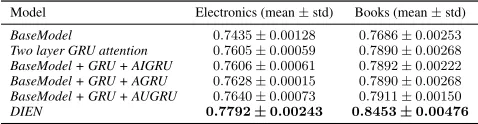
BaseModel + GRU + AUGRU 0.7640±0.00073 0.7911±0.00150
DIEN 0.7792±0.00243 0.8453±0.00476
Effect of GRU with attentional update gate (AUGRU)
Table 4 shows the results of different methods for interest evolving. Compared toBaseMode,Two layer GRU Attention obtains improvement, while the lack for modeling evolution limits its ability.AIGRUtakes the basic idea to model evolv-ing process, though it has advances, the splittevolv-ing of atten-tion and evolving lost informaatten-tion during interest evolving. AGRU further tries to fuse attention and evolution, as we proposed previously, its attention in GRU can’t make fully use the resource of update gate.AUGRUobtains obvious im-provements, which reflects it fuses the attention mechanism and sequential learning ideally, and captures the evolving process of relative interests effectively.
0 50 100 150 200 250 Iter
0.75 1.00 1.25 1.50 1.75 2.00 2.25
Loss
Whole training loss Training auxiliary loss Whole evaluating loss Evaluating auxiliary loss
(a) Books
0 10 20 30 40 50 60 70 80 Iter
0.9 1.0 1.1 1.2 1.3 1.4 1.5 1.6
Loss
Whole training loss Training auxiliary loss Whole evaluating loss Evaluating auxiliary loss
(b) Electronics
Figure 2: Learning curves on public datasets.αis set as1.
As shown in Table 4, auxiliary loss bring great improve-ments for both public datasets, it reflects the importance of supervision information for the learning of sequential in-terests and embedding representation. For industrial dataset shown in Table 3, model with auxiliary loss improves perfor-mance further. However, we can see that the improvement is not as obvious as that in public dataset. The difference de-rives from several aspects. First, for industrial dataset, it has a large number of instances to learn the embedding layer, which makes it earn less from auxiliary loss. Second, dif-ferent from all items from one category in amazon dataset, the behaviors in industrial dataset are clicked goods from all scenes and all catagories in our platform. Our goal is to pre-dict CTR for ad in one scene. The supervision information from auxiliary loss may be heterogeneous from the target item, so the effect of auxiliary loss for the industrial dataset may be less for public datasets, while the effect of AUGRU is magnified.
Visualization of Interest Evolution
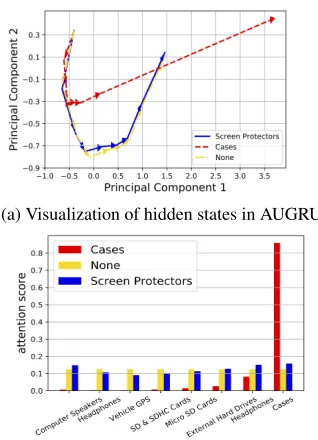
The dynamic of hidden states in AUGRU can reflect the evolving process of interest. In this section, we visualize these hidden states to explore the effect of different target item for interest evolution.
The selective history behaviors are from category Com-puter Speakers, Headphones, Vehicle GPS, SD & SDHC Cards, Micro SD Cards, External Hard Drives, Head-phones, Cases, successively. The hidden states in AUGRU are projected into a two dimension space by principal com-ponent analysis (PCA) (Wold, Esbensen, and Geladi 1987). The projected hidden states are linked in order. The moving routes of hidden states activated by different target item are shown in Fig. 3(a). The yellow curve which is withNone tar-get represents the attention score used in eq. (12) are equal, that is the evolution of interest are not effected by target item. The blue curve shows the hidden states are activated by item from categoryScreen Protectors, which is less related to all history behaviors, so it shows similar route to yellow curve. The red curve shows the hidden states are activated by item from categoryCases, the target item is strong re-lated to the last behavior, which moves a long step shown in Fig. 3(a). Correspondingly, the last behavior obtains a large attention score showed in Fig. 3(b).
(a) Visualization of hidden states in AUGRU
(b) Attention score of different history behaviors
Figure 3: Visualization of interest evolution, (a) The hidden states of AUGRU reduced by PCA into two dimensions. Dif-ferent curves shows the same history behaviors are activated by different target items.Nonemeans interest evolving is not effected by target item. (b) Faced with different target item, attention scores of all history behaviors are shown.
Table 5: Results from Online A/B testing
Model CTR Gain PPC Gain eCPM Gain
BaseModel 0% 0% 0%
DIN (Zhou et al. 2018c) + 8.9% - 2.0% + 6.7% DIEN + 20.7% - 3.0% + 17.1%
Online Serving & A/B testing
From 2018-06-07 to 2018-07-12, online A/B testing was conducted in the display advertising system of Taobao. As shown in Table 5, compared to the BaseModel, DIEN has improved CTR by 20.7% and effective cost per mille (eCPM) by 17.1%. Besides, DIEN has decayed pay per click (PPC) by 3.0%. Now, DIEN has been deployed online and serves the main traffic, which contributes a significant business revenue growth.
take advantage of GPU. iii)Model compressing with Rocket Launching(Zhou et al. 2018b): we use the method proposed in (Zhou et al. 2018b) to train a light network, which has smaller size but performs close to the deeper and more com-plex one. For instance, the dimension of GRU hidden state can be compressed from 108 to 32 with the help of Rocket Launching. With the help of these techniques, latency of DIEN serving can be reduced from 38.2 ms to 6.6 ms and the QPS (Query Per Second) capacity of each worker can be improved to 360.
Conclusion
In this paper, we propose a new structure of deep net-work, namely Deep Interest Evolution Network (DIEN), to model interest evolving process. DIEN improves the perfor-mance of CTR prediction largely in online advertising sys-tem. Specifically, we design interest extractor layer to cap-ture interest sequence particularly, which uses auxiliary loss to provide the interest state with more supervision. Then we propose interest evolving layer, where DIEN uses GRU with attentional update gate (AUGRU) to model the interest evolving process that is relative to target item. With the help of AUGRU, DIEN can overcome the disturbance from inter-est drifting. Modeling for interinter-est evolution helps us capture interest effectively, which further improves the performance of CTR prediction. In future, we will try to construct a more personalized interest model for CTR prediction.
References
Cheng, H.-T.; Koc, L.; Harmsen, J.; Shaked, T.; Chandra, T.; Arad-hye, H.; Anderson, G.; Corrado, G.; Chai, W.; Ispir, M.; et al. 2016. Wide & deep learning for recommender systems. InProceedings of the 1st Workshop on Deep Learning for Recommender Systems, 7–10. ACM.
Chung, J.; Gulcehre, C.; Cho, K.; and Bengio, Y. 2014. Empirical evaluation of gated recurrent neural networks on sequence model-ing.arXiv preprint arXiv:1412.3555.
Friedman, J. H. 2001. Greedy function approximation: a gradient boosting machine.Annals of statistics1189–1232.
Guo, H.; Tang, R.; Ye, Y.; Li, Z.; and He, X. 2017. Deepfm: a factorization-machine based neural network for ctr prediction. In
Proceedings of the 26th International Joint Conference on Artifi-cial Intelligence, 2782–2788.
He, R., and McAuley, J. 2016. Ups and downs: Modeling the visual evolution of fashion trends with one-class collaborative filtering. InProceedings of the 25th international conference on world wide web, 507–517.
Hidasi, B., and Karatzoglou, A. 2017. Recurrent neural net-works with top-k gains for session-based recommendations.arXiv preprint arXiv:1706.03847.
Hochreiter, S., and Schmidhuber, J. 1997. Long short-term mem-ory.Neural computation9(8):1735–1780.
Lian, J.; Zhou, X.; Zhang, F.; Chen, Z.; Xie, X.; and Sun, G. 2018. xdeepfm: Combining explicit and implicit feature interactions for recommender systems. InProceedings of the 24th ACM SIGKDD International Conference on Knowledge Discovery & Data Min-ing.
McAuley, J.; Targett, C.; Shi, Q.; and Van Den Hengel, A. 2015. Image-based recommendations on styles and substitutes. In Pro-ceedings of the 38th International ACM SIGIR Conference on Re-search and Development in Information Retrieval, 43–52. ACM.
Parsana, M.; Poola, K.; Wang, Y.; and Wang, Z. 2018. Improv-ing native ads ctr prediction by large scale event embeddImprov-ing and recurrent networks. arXiv preprint arXiv:1804.09133.
Qu, Y.; Cai, H.; Ren, K.; Zhang, W.; Yu, Y.; Wen, Y.; and Wang, J. 2016. Product-based neural networks for user response predic-tion. InProceedings of the16th International Conference on Data Mining, 1149–1154. IEEE.
Ren, K.; Fang, Y.; Zhang, W.; Liu, S.; Li, J.; Zhang, Y.; Yu, Y.; and Wang, J. 2018. Learning multi-touch conversion attribution with dual-attention mechanisms for online advertising. arXiv preprint arXiv:1808.03737.
Rendle, S.; Freudenthaler, C.; Gantner, Z.; and Schmidt-Thieme, L. 2009. Bpr: Bayesian personalized ranking from implicit feed-back. InProceedings of the twenty-fifth conference on uncertainty in artificial intelligence, 452–461. AUAI Press.
Rendle, S. 2010. Factorization machines. InProceedings of the 10th International Conference on Data Mining, 995–1000. IEEE. Song, Y.; Elkahky, A. M.; and He, X. 2016. Multi-rate deep learn-ing for temporal recommendation. InProceedings of the 39th In-ternational ACM SIGIR conference on Research and Development in Information Retrieval, 909–912. ACM.
Wang, G.; Lin, Y.; and Yi, W. 2010. Kernel fusion: An effective method for better power efficiency on multithreaded gpu. In Pro-ceedings of the 2010 IEEE/ACM Int’L Conference on Green Com-puting and Communications & Int’L Conference on Cyber, Physi-cal and Social Computing, 344–350.
Wold, S.; Esbensen, K.; and Geladi, P. 1987. Principal component analysis. Chemometrics and intelligent laboratory systems 2(1-3):37–52.
Xiong, C.; Merity, S.; and Socher, R. 2016. Dynamic memory networks for visual and textual question answering. InProceedings of the 33rd International Conference on International Conference on Machine Learning, 2397–2406.
Yu, F.; Liu, Q.; Wu, S.; Wang, L.; and Tan, T. 2016. A dynamic recurrent model for next basket recommendation. InProceedings of the 39th International ACM SIGIR conference on Research and Development in Information Retrieval, 729–732. ACM.
Zhang, Y.; Dai, H.; Xu, C.; Feng, J.; Wang, T.; Bian, J.; Wang, B.; and Liu, T.-Y. 2014. Sequential click prediction for sponsored search with recurrent neural networks. InProceedings of the 28th AAAI Conference on Artificial Intelligence, 1369–1375.
Zhou, C.; Bai, J.; Song, J.; Liu, X.; Zhao, Z.; Chen, X.; and Gao, J. 2018a. Atrank: An attention-based user behavior modeling frame-work for recommendation. InProceedings of the 32nd AAAI Con-ference on Artificial Intelligence.
Zhou, G.; Fan, Y.; Cui, R.; Bian, W.; Zhu, X.; and Gai, K. 2018b. Rocket launching: A universal and efficient framework for train-ing well-performtrain-ing light net. InProceedings of the 32nd AAAI Conference on Artificial Intelligence.
![Figure 1: The structure of DIEN. At the behavior layer, behaviors are sorted by time, the embedding layer transforms the one-hot representation b[t] to embedding vector e[t]](https://thumb-us.123doks.com/thumbv2/123dok_us/9693154.1952387/4.612.53.553.50.275/figure-structure-behavior-behaviors-embedding-transforms-representation-embedding.webp)