Part of Speech Annotation of a Turkish-German Code-Switching Corpus
Özlem Çetino˘glu IMS
University of Stuttgart Germany
Ça˘grı Çöltekin Department of Linguistics
University of Tübingen Germany
Abstract
In this paper we describe our efforts on POS annotation of a code-switching cor-pus created from Turkish-German tweets. We use Universal Dependencies (UD) POS tags as our tag set. While the Ger-man parts of the corpus employ UD speci-fications, for the Turkish parts we propose annotation guidelines that adopt UD’s language-general rules when it is appli-cable and adapt its principles to Turkish-specific phenomena when it is not. The re-sulting corpus has POS annotation of 1029 tweets, which is aligned with existing lan-guage identification annotation.
1 Introduction
Multilingual speakers cover a higher percentage of the world population than monolingual speakers (Tucker, 1999). Acting multilingual, that is, mix-ing languages is commonly observed among these multilingual speakers (Auer and Wei, 2007). The definition, types, and use of language mixing have long been studied by researchers, especially from a sociolinguistic perspective (Gumperz, 1964; Sankoff, 1968; Lipski, 1978). Some linguists make distinctions in the terminology according to the level of the language mixing, e.g. use code-mixing for sentence-internal alternations, some others use either code-mixing or code-switching
for all types of mixing (Poplack, 1980; Myers-Scotton, 1997). In this paper we use code-switching (CS) as an umbrella term.
Unlike linguistic studies, computational re-search on code-switching has recently accelerated, although the first theoretical framework to parse code-switched sentences has been proposed by Joshi back in the 80s (Joshi, 1982). Several studies has emerged on word-level language identification (Nguyen and Do˘gruöz, 2013; Das and Gambäck,
2014; cf. Solorio et al., 2014), predicting code-switching points (Solorio and Liu, 2008a; Elfardy et al., 2013), and POS tagging (Solorio and Liu, 2008b; Vyas et al., 2014; Jamatia et al., 2015).
Computational approaches often need anno-tated data. The number of CS corpora annoanno-tated with language identification information has also increased proportional to the interest in the field (Nguyen and Do˘gruöz, 2013; Barman et al., 2014; Das and Gambäck, 2014; Maharjan et al., 2015).
Part of speech (POS) annotation of CS data, on the other hand, is not very common yet. To our knowledge, there are only three code-switching corpora with POS annotation:1 one on Spanish-English (Solorio and Liu, 2008b) and two on Hindi-English (Vyas et al., 2014; Jamatia et al., 2015). These are valuable resources as part of speech tags can provide more insight on the nature of code-switching and pave the way for syntactic annotation.
Here in this work, we present a fourth CS cor-pus annotated with POS information. The corcor-pus contains 1029 Turkish-German tweets, already annotated with language information (Çetino˘glu, 2016). We add the POS tag layer following Uni-versal Dependencies (UD) (Nivre et al., 2016). German is one of the languages UD already cov-ers. Turkish on the other hand is under develop-ment. Therefore, our work also contributes to the discussions on POS tagging and segmentation of Turkish in the UD framework.
The rest of the paper is as follows: We discuss previous annotation efforts in CS and POS anno-tation in social media in Section 2. The data is de-scribed in Section 3 and annotation decisions are explained in Section 4. Processing steps are given 1There are some POS-annotated corpora that contain CS
instances although the intention of collection is different. For instance the KiezDeutsch corpus (Rehbein et al., 2014) has a small number of utterances with Turkish-German CS. Old German Reference Corpus (Dipper et al., 2004) has examples of mixing Old High German and Latin.
in Section 5. We analyse the data and processing in Section 6 and conclude in Section 7.
2 Related Work
Corpora created for studying code-switching com-putationally mostly focus on data annotated with language information. Nguyen and Do˘gruöz (2013) collect Turkish-Dutch posts from an online discussion forum and annotate words as Turkish or Dutch. A small amount of English words are also annotated as Dutch. Punctuation, numbers, emoticons, links, chat language, meta forum tags, proper names are ignored during annotation. Bar-man et al. (2014) create a CS corpus of Bengali-Hindi-English from Facebook comments. They define English, Bengali, Hindi, Mixed tags, and annotate named entities, acronyms, and universal expressions such as symbols, numbers, emoticons as separate tags. The Shared Task on Language Identification in Code-Switched Data also uses so-cial media, namely Twitter, as their main source in collecting code-switching data. They present corpora in pairs Spanish-English, Nepali-English, Mandarin-English, and Modern Standard Arabic-Egyptian Arabic (Maharjan et al., 2015).
POS tagged data sets are fewer as compared to ones annotated with language information. Solorio and Liu (2008b) are the first to annotate POS tags on code-switched data. They recorded conversations between bilingual speakers of Span-ish and EnglSpan-ish. Then they transcribed this data and manually annotated with POS tags. They used a fine-grained tagset which is a combination of En-glish and Spanish TreeTagger (Schmid, 1994) tags (a version of Penn Treebank tag set for English and 75 tags for Spanish). Out of the 922 sentences they collected, 576 are monolingual English. There are 239 switches throughout the conversations, 129 of them are intra-sentential.
Following studies on annotating code-switching data with POS tags come years later. Vyas et al. (2014) chose Facebook celebrity pages and BBC Hindi as their media and collected user posts mixed in English and Hindi. Their annotation is in multiple layers. First the posts were splitted into fragments so that they would have a unique matrix language English or Hindi. Each word in a matrix is identified as English, Hindi, or Other. The POS layer employs 12 Universal POS tags (Petrov et al., 2011) and three additional tags for named en-tities (people, location, organisation). They have
a corpus of 381 posts which corresponds to 4135 words. 17.2% of these posts contains intersenten-tial or intrasentenintersenten-tial code-switching.
Jamatia et al. (2015) utilised both Facebook and Twitter in compiling their English-Hindi data. They divided posts and tweets into utterances and automatically tokenised them. Manual POS an-notation uses a fine-grained tag set which could be mapped to a coarse-grained one. The fine-grained set combines tags developed for Indian languages with Twitter-specific tags from Gimpel et al. (2011). The coarse-grained version retains the Twitter-specific tags and maps the rest to Uni-versal POS tags. The resulting corpus consists of 2583 utterances, with 68.2% being monolingual.
Efforts on POS annotation of social media started with using the Penn TreeBank tag set (Mar-cus et al., 1993) for English (Foster et al., 2011; Petrov and McDonald, 2012). Ritter et al. (2011) extended PTB tagset with Twitter-specific tags for retweets, usernames, hashtags, and URLs. Gim-pel et al. (2011) designed a completely new set tailored to Twitter. For German, Neunerdt et al. (2013) use the standard STTS POS tag set (Schiller et al., 1995) to annotate web comments. Rehbein (2013) adopts the same tag set and intro-duces new tags for usernames, URLs, hashtags, and emoticons for POS tagging German tweets. Similarly for Turkish, Pamay et al. (2015) use the standard POS tag set of Oflazer (1994) and add tags for abbreviations, emoticons, mentions, hash-tags, and URLs to cover the non-canonical content of a web treebank.
3 Data
We use the data that Çetino˘glu (2016) has col-lected on code-switching Turkish-German tweets. It consists of 1029 tweets, each having at least one code-switching point. Tweets are automat-ically collected and manually filtered. Before adding language identification annotation tokeni-sation and normalitokeni-sation is applied based on Turk-ish and German orthography rules.
sym-bols, any other token that do not belong to pre-vious classes). The Shared Task labels the to-kens that belong to a third language as OTHER, Çetino˘glu (2016) introduces the LANG3 tag for them. Additionally, named entities are tagged both as NE as in the Shared Task, and with their lan-guage label TR, DE, or LANG3. MIXED tokens are also marked with the code-switching bound-ary, represented with the symbol ‘§’.
There are 16992 tokens in total, that corre-sponds to 16.51 tokens per tweet. Half of the to-kens are Turkish, it is followed byOTHERand Ger-man, both being around 20%. In 790 tweets, there are more tokens labelled as TR than DE. Details of the data collection, correction, and annotation processes are explained in Çetino˘glu (2016). 4 Annotation Guidelines
The annotation process follows the Universal De-pendencies (Nivre et al., 2016) conventions as much as possible.2 We only use the POS tag la-bels from the UD inventory, and follow the general principles of UD as well as the available language-specific documentation for each language in the corpus. Although we do not explicity annotate in the syntactic level, we have to take into account UD syntax representation, especially for segment-ing Turkish words.
Besides the recent popularity of the UD-based annotations, the major advantage of UD in our work is that the UD guidelines are intended to be as language-general as possible. For a multi-lingual corpus, such as ours, the importance of uniform annotations within the corpus cannot be overstated. The downsides, on the other hand, are potential confusion due to already established an-notation conventions (such as STTS (Schiller et al., 1995) for German), and the fact that UD is an ongoing project, and parts of the formalism is still in development.
In this section we describe the annotation guide-lines we follow briefly, focusing more on the as-pects that differ from UD or the common conven-tions used in relevant monolingual corpora.
4.1 Segmentation
Following Universal Dependencies guidelines, we mark POS tags on syntactic words,3 which re-sults in segmenting some of the surface tokens in
2More specifically we follow UD version 1.2.
3Segmentation is not in the morpheme level, yet
words are not necessarily phonological or orthographic.
both German and Turkish. For German, the only case that require segmentation is the contraction of prepositions and definite articles. For example, the wordzur‘to the’ is tokenised into its parts as
zuandder. The segmentation of Turkish syntac-tic words is more involved, and at present, the UD guidelines for Turkish tokenization are still a mov-ing target. We describe the approach we employed for segmentation of Turkish below.
Turkish is a morphologically complex lan-guage. In addition to a large set of inflectional morphemes that can attach to verbal or nominal stems, some productive (derivational) morphemes may change the POS tag of an already inflected word. In Turkish NLP literature, this phenomenon is addressed with sub-word units that are often called inflectional groups (IGs) (Oflazer, 1999), which correspond to one or more morphemes grouped by derivational boundaries. In this work, we also follow the same convention, however, sim-ilar to Çöltekin (2016), we follow a more conser-vative approach to segmentation in comparison to most earlier work. Instead of segmenting a word into IGs after each derivation, we segment only before the morphemes that introduce a new syn-tactic word, such that parts of the word may carry conflicting morphological features, or participate in separate syntactic relations. In other words, we segment words to avoid potential ambiguous or conflicting morphosyntactic annotations.
An example of this is presented in (1) below,4 which also coincides with an instance of word-internal code switching. As introduced earlier, the symbol ‘§’ indicates the code switching boundary within a word. We mark inflectional group bound-aries with the symbol ‘•’ in the examples.
(1) sabah
morning.NOUN.Sg
Internetseite§-de•ki-ler-i
website.NOUN.Sg-Loc•ki.NOUN-Pl.Acc
ausdrucken
print.VERB.Infed-ece˘g-imdo.VERB-Fut-1Sg
‘I will print the ones from the website in the morning’
The singular German noun Internetseite ‘web-site’ is inflected with the Turkish locative case markerde. This is the code-switching point. The http://universaldependencies.org/u/ overview/tokenization.html
4Notation of examples and gloss descriptions are given in
rest of the word takes Turkish inflectional and derivational suffixes. The partInternetseitede‘on the website’ functions as an adjective when it gets the derivational suffix -ki (e.g. Internetseit-edeki foto ‘the photo on the website’). With a zero derivation, the derived adjectival behaves as a noun, thus can bear a plural suffix and a case marker. In it is final form, the word Internetseit-edekileri ‘the ones on the website’ refers to a set of objects (e.g., documents or pictures) on a web-site. Without segmentation, we cannot represent the fact that there is only one website but multiple items within the website. Similarly, the direct ob-ject of the predicate is the items on the website, not the website (which could have been a direct ob-ject of another predicate). As a result, annotations that allow correct interpretations of words like In-ternetseitedekileri above require further segmen-tation.
Besides the relativiser -ki discussed above, we mark the following suffixes which may introduce similar ambiguous or conflicting morphosyntactic annotations.5
• -lH deriving nouns and adjectives from a noun (N) with the meaning of ‘with N’ ( don-durmalı ‘(the one) with ice cream’, deriv-ing adjectives and nouns from location names with the meaning ‘from N’ (Berlinli‘(the per-son) from Berlin’
• -sHz deriving nouns and adjectives from a noun with the meaning of ‘without N’ (e˘gitimsiz‘(the person)withouteducation’)
• -lHk deriving nouns and adjectives from a noun with the meaning of ‘fit/suitable for N’ (senlik‘fit foryou’)
• -CH deriving nouns and adjectives from a noun with the meaning of ‘preferring N’ (biracı‘(the one) who prefers beer’), as well as mostly lexicalized use of deriving nouns referring to occupations (fizikçi‘physicist’)
• -lA¸s deriving verbs from nouns with the meaning of ‘become N’ (özgürle¸smek‘to be-comefree’)
• Copular suffixes (sizdendi‘(he/she) wasone of you’)
5Capital letters in suffixes denote allomorphs. A = {a,e},
H = {ı,i,u,ü}, C = {c, ç}.
Similar to-ki, the first four suffixes form either adjectives or nouns from nouns. In their adjecti-val use, segmentation is not strictly necessary as the adjectives in Turkish do not inflect. We seg-mented productive uses of these suffixes regard-less of whether they derive nouns or adjectives for the sake of easier and more accurate annotation.
The last two examples in the above list form predicates form nouns and adjectives. When these suffixes are attached to simple nouns or adjectives, one may avoid segmentation. However, the copu-lar suffixes may also attach to subordinate verbs, in which case, the same word carries two predi-cates with potentially conflicting sets of inflections and syntactic relations outside the word. For ex-ample, if we do not segment the copular part of
gördü˘güyüz in (2) below, we cannot identify the facts that the verb gör ‘see’ is inflected for past tense, while the copula is in present tense. Fur-thermore, the subject of the copula is o ‘he/she’, while the subject of the verbgörisbiz‘we’.
(2) Biz
We.PRONo-nunhe/she.PRON-Gen rüya-sı-nda
dream.NOUN-P3S-Loc gör-dü˘gü•yüz
see.VERB-Past-3Sg•VERB-Cop-1Pl ‘We are the ones that he/she saw in his/her dream’
We segment words before productive uses of all of the suffixes listed in this section. However, we do not segment words if they are lexicalised. For example the suffix-siz ‘without’ is segmented in arabasızgidemeyiz‘we cannot go (there)without a car’, but not inevsizler için yardım‘help for the
homeless’.
To decide if a word is lexicalised, we test if the parts of the segmented version can have syn-tactic dependencies. For instance,futbolcu ‘foot-baller’ is lexicalised although it is derived from
futbol ‘football’ with the agentive suffix -CH. In the expression Amerikan futbolcu, Amerikan
can participate in separate syntactic relations. Another difference from the use of IGs in ear-lier Turkish NLP literature is that we do not admit ‘zero derivations’. All tokens correspond to non-empty surface strings. This results in an incon-sistency in the representation of copular suffixes, since a nominal/adjectival predicate in present tense with the third person singular subject does not have a corresponding surface suffix. As a re-sult, the predicate inBen hasta-yım‘I am sick’ is segmented, while the predicateo hasta‘he is sick’ is not segmented. This case poses no problem for our POS annotation purposes, although it would lead inconsistencies in syntactic representation.
4.2 POS Tagging
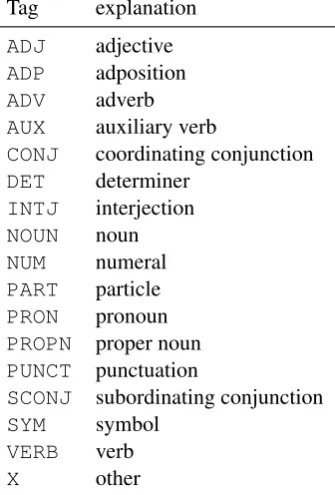
[image:5.595.310.478.69.317.2]For both languages, we follow the Universal De-pendencies POS tag scheme as closely as possi-ble. UD defines a coarse set of 17 tags listed in Table 1. As in segmentation, the German POS tag-ging scheme is better defined and more standard-ised. Despite some existing work, Turkish POS tagging standards for UD is under development.6 As a result, we focus more on some aspects of Turkish POS tagging in our work. Detailed POS tagging guidelines are included in the distribution of the corpus.
Special word and symbol sequences, such as mentions, hashtags and URLs, are also tagged using the UD POS tag set. We tag mentions (always coded as @username) as PROPN. The hashtags are tagged as usual when they are a sin-gle word with a clear POS tag. For example, #Berlin is tagged as PROPN, and #happy is tagged as ADJ. If the hashtag is a multi-word string that cannot be treated as a single word, e.g., #GiveVoiceToCizre, it is tagged as X. We keep multi-word hashtags intact as we prefer to re-tain their hashtag property.
Unintelligible alphanumeric sequences and words from other languages whose POS tag could not be determined by the annotators are also tagged as X. URLs, emoticons and non-alphanumeric tokens are tagged asSYMas per UD specification. We also use the tag SYM for the Twitter tags RE, RT and, the new line represen-tation<NL>.
6The UD version 1.3, which is released while the present
paper was under review, contains a Turkish treebank. How-ever, the treebank is still in development state, and the doc-umentation is mainly based on Çöltekin (2015), which is not (yet) fully complient with the UD.
Tag explanation ADJ adjective ADP adposition ADV adverb AUX auxiliary verb
CONJ coordinating conjunction DET determiner
INTJ interjection NOUN noun NUM numeral PART particle PRON pronoun PROPN proper noun PUNCT punctuation
SCONJ subordinating conjunction SYM symbol
VERB verb
X other
Table 1: Universal dependencies tag set.
All forms of verbs, including verbs that are de-rived into other categories by subordinating suf-fixes are tagged asVERB. This is in line with the UD guidelines, but unlike most Turkish NLP work where subordinate word structures are typically segmented into multiple IGs, and the last IG (the head) is marked as NOUN, ADJ or ADV depend-ing on whether the verbal form is averbal noun,
participle, orconverbrespectively.
Auxiliary verbs are tagged asAUX, and copulars asVERBfor both Turkish and German. Similar to German verbsein‘to be’, the Turkish copulaol‘to be/become’ can act both as an auxiliary (AUX) or as a copula (VERB). Examples (3) and (4) show its verb and auxiliary uses respectively from the corpus we annotated.
(3) Frau
Ms.NOUN.SgGeigerGeiger.§’iPROPN.Sg.Acc gör-dü-m
see.VERB-Past-1Sgçokvery.ADVmutluhappy.ADJ ol-du-m
become.VERB-Past-1Sg
‘I saw Ms Geiger I became very happy.’ (4) Osmanlı
Ottoman.PROPN.Sg hayal-i
daydream.NOUN.Sg-P3S kur-an-lar
tosla-mı¸s
bump.VERB-Evid-Pastol-acakbe.AUX-Fut.3Sg ‘The ones who daydream of Ottomans will have bumped the wall.’
Substantivised adjectivesare marked asADJ. In Turkish it is common to use an adjective as noun with the meaning of ‘the object or person with the property described by the adjective’. We mark ad-jectives asADJregardless of their use. This con-trasts with most Turkish NLP work to date, since these words are typically analyzed as two sepa-rate IGs one of which is introduced by a zero-derivation. In both languages, we also use the tag ADJfor adjectives that are used as predicates.
Multi-word named entitiesare annotated as nor-mal linguistic units. That is, the words that form a multi-word named entity are not marked as PROPNbut as the POS tags they would normally be assigned to. For example in (5) the German wordAufbruchand the Turkish wordDerne˘giare marked as NOUN even though they are part of a multi-word named entity. The original annota-tions (Çetino˘glu, 2016) mark the named entities and language IDs as shown in the third row of (5).
(5) Aufbruch
Emergence.NOUN.Sg NE.DE
Neukölln
Neukölln.PROPN.Sg NE.DE
Derne˘g-i
Society.NOUN-P3S NE.TR
‘Emerging Neukölln Society’
Non-root inflectional groupsin Turkish that are split off from the root part during the segmenta-tion step are assigned POS tags that reflect their function. For example, the IG introduced by the suffix-sizine˘gitim-siz insan‘uneducated person’ is tagged asADJ, while ine˘gitim-sizler ço˘gunlukta
‘uneducated (people) are in majority’ it is tagged asNOUN.
Particles of German separable verbs are, fol-lowing the UD principle, tagged asADP. This is in contrast with the most common tagging scheme, STTS, used in German NLP so far.
5 Processing
The team for segmentation and POS tagging con-sists of four annotators and two researchers. All
annotators are Turkish-German bilingual under-graduate students. Three of them study compu-tational linguistics, and one studies linguistics.
5.1 Segmentation
Before the task, the annotators were not familiar with the idea of segmenting Turkish words into sublexical units. Thus, the training included the concept of inflectional groups and the current take on segmentation through recent work (Nivre et al., 2016; Çöltekin, 2016). For the actual task, they have given segmentation guidelines. They are also told to oversegment rather than underseg-ment in case of doubt. Each tweet is segunderseg-mented by two annotators, and then merged and corrected if necessary, by the researchers. Lexicalised deriva-tions were the source of main conflicts or some-times non-conflicting oversegmentation. This is expectable, as lexicalisation decisions are rather a continuum. The German side of the segmentation was straightforward and on few cases; annotators easily accomplished this part.
5.2 Restoring Language Identification
When the German and Turkish segmentation has altered, language identification assigned to each token should be altered too. We restored language information in a semi-automatic way. There are three possible scenarios of segmentation. First, when a token identified as German is segmented, all segments are German. Second, similarly, a seg-mented Turkish token has Turkish segments.
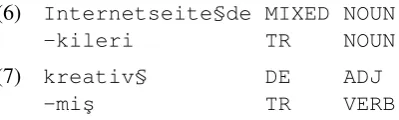
The third scenario is more complex. How the segments of a MIXED token are labelled de-pends on segmentation boundaries. In our cor-pus the mixed words to segment are all examples of German-Turkish code-switching (with a single English-Turkish code-switching example). If the segmentation boundary is after the code-switching boundary as in the earlier Internetseite§de-kileri
(6) Internetseite§de MIXED NOUN
-kileri TR NOUN
(7) kreativ§ DE ADJ
-mi¸s TR VERB
We treated all scenarios automatically, and double-checked the third scenario manually.
5.3 POS Tagging
We started annotator training with existing guide-lines and treebank demos from Universal Depen-dencies.7 We employed two different training sets for POS tagging. As the first set, we gave annota-tors 20 tweets separate from the data set and ask them to annotate 10 of them to have double anno-tation for each. We used these annoanno-tations to dis-cuss confusing points. As the second set we gave each annotator up to 15 phrases that are potentially hard to annotate, and ask them to label and add a source, e.g. one of the UD links, to make sure they are aware of multiple sources. Some of these phrases are later used as examples in annotation guidelines.
All tweets are annotated twice. Each annota-tor is assigned half of the corpus, and each half is annotated by two annotators. The inter-annotator agreement is calculated separately for each half, and then the researchers went through those tweets to resolve conflicts, correct mistakes, and ensure consistency.
6 Analysis
Our annotations are based on the twitter corpus of Çetino˘glu (2016). Originally, the corpus contains 1029 tweets, and 16922 tokens (See Section 3 for more details). After word segmentation, the num-ber of tokens increase to 17274. All tokens are an-notated with a POS tag from the Universal Depen-dencies POS tag inventory, as explained in Sec-tion 5. In this secSec-tion, we provide statistics about the resulting corpora and present some prelimi-nary analyses.
Majority of the segmented tokens are Turkish. In total, 226 Turkish words were segmented. Ex-cept three tokens that were tokenised as three IGs, all multi-IG words consist of two IGs. The re-sulting ratio of IGs per surface word is 1.02 (cf.
7http://universaldependencies.org/u/ pos/index.html
http://universaldependencies.org/de/pos/ index.html
http://bionlp-www.utu.fi/dep_search/
1.20 in METU-Sabancı Treebank (Oflazer et al., 2003)). Besides completely Turkish words, 18 mixed words are segmented into two tokens. 17 of these words are German stems with Turkish suf-fixes, and one is an English word with a Turkish suffix. On the German side, 31 contracted prepo-sition+article combinations were segmented.
The overall inter annotator agreements (IAA) as measured by Cohen’s kappa (Cohen, 1960) be-tween two teams are 78.78 and 77.77 for the first and the second team respectively. The IAA per language differ. For Turkish, the agreement scores are lower, averaging 70.39 for both teams. The low score is partially due to the difficulty of the task in Turkish, which is also accented by the fact that our annotators have not received formal education in Turkish, but in German. However, the overall low score also has to do with the fact that non-linguistic tokens (e.g., punctuation, spe-cial Twitter symbols) are not included in this cal-culation. The common disagreements (that are resolved during correction phase) that stand out are, AUX–VERB, ADJ–ADV,DET–PRON, NOUN– PRON,NOUN–PROPN,INTJ–NOUNand between VERB and ADJ, ADV and NOUN (in subordinate structures). The IAA for German is higher, aver-aging at 74.24. The confusion in German POS tag-ging is almost exclusively between AUX–VERB, ADJ–ADV, NOUN–PROPN, and DET–PRON. The agreement is the lowest for language ID LANG3 (57.92), and highest for OTHER (86.33, non-linguistic tokens, and tokens whose language ID could not be determined).
[image:7.595.85.285.64.124.2]The confusion between DET–PRON is com-mon in both languages, since they share the same frequent word forms. The ADJ–ADV confusion seems to stem from the same reason. Again,AUX– VERB confusion is due to copular and auxiliary use of the same frequent tokens. Most NOUN– PROPN disagreements happen since, following UD, we tag parts of named entities as their respec-tive POS tags, not asPROPN(for an example, see (5) in Section 4). Annotators tend to go against this guideline, and often tag parts of named entities as PROPN. Similarly, the guidelines require that parts of multi-word interjections should be tagged as their base POS tags. For example, the tokens in Allaha ¸sükür ‘Thank God’ should be tagged PROPN and NOUN, while annotators may some-times decide forINTJfor both.
for each label used during language identification. Our total number of tokens per language is slightly different from Çetino˘glu (2016) due to segmenta-tion. Majority of the tokens are Turkish. German follows Turkish after the label OTHER which in-cludes all punctuation, symbols, numbers, URLs and Twitter-specific tokens.
One of the interesting observations in Table 2 is the high proportion of Turkish verbs (25% of all Turkish tokens) in comparison German verbs (15%). The reason for high rate of verbs are par-tially due to the fact that we mark all verbal forms, including all verbs derived into verbal nouns, par-ticiples, or converbs as VERB. However, this is true for both languages. The difference between the ratio of verbs in two languages has to do with the fact that most of the sentence are Turkish sen-tences. As a result, the predicates of main (and subordinate) clauses tend to be in Turkish, where German words are included in the (host) Turkish sentence. This is in line with the finding reported in Çetino˘glu (2016) that most tweets in this cor-pus have a majority of Turkish words. The ratio of nominals (NOUN, PRONandPROPN) are similar, having a distribution of 41% for German, and 40% for Turkish. POS tags with grammatical functions, such asADP,AUX,DETandPART, are proportion-ally higher for German in comparison to Turkish. This is expected, since many of these grammati-cal functions are carried out as morphologigrammati-cal pro-cesses in Turkish.
An interesting aspect of this corpus is rather high rate of MIXED tokens. Table 2 also shows that majority of the MIXED class involvePROPN andNOUNs, which is expected. In cases of mixed nouns or proper nouns, the mixed words are al-most exclusively, DE orLANG3 (mostly English) words affixed by Turkish suffixes, e.g., (8) below. The mixed tokens that include verbs are predom-inantly German words with Turkish copular suf-fixes (9) or sufsuf-fixes that derive verbs from nom-inals, as in -len suffix in (10). In some cases, German infinitives or participles are suffixed with Turkish nominal inflections (11). One last interest-ing case in (12) demonstrates that Turkish deriva-tional suffixes that are normally attached to nouns or adjectives to form verbs may be attached to Ger-man (or, as in the example, English) verbs. In ex-ample (12), the suffix-lu8is attached to an English
8The original surface form of this suffix is -lA (-le/-la), it
undergoes vowel harmony due to following suffix-yor.
verb in a way to allow further verbal inflections. (8) Bak
Look.VERB.Impthat.¸su DETbenimmy.PRON
Lieblingsschwester§-im-a favourite sister.NOUN.Sg-P1S-Dat ‘Look at that favourite sister of mine’ (9) çok
very.ADV
kreativ§•mi¸s
creative.ADJ•Cop.VERB.Evid.Past.3Sg ‘he/she was very creative’
(10) Kopie§-len-ip
copy-Become.VERB-Sub yapı¸s-tır-ıl-mı¸s
paste.VERB-Caus-Pass-Evid.Past.3Sg ‘it was copied and (then) pasted’ (11) ¸su
that.DETkopierencopy.VERB§-i.Inf-Acc icat
invention.NOUN.Sged-endo.VERB-Sub
‘(the person) who invented (that) copying’ (12) Ben
I.PRONaslındain fact.ADV
FB§•lu-lar-ı
FB.PROPN.Sg•From.NOUN-Pl-Acc
follow§•lu-yor-du-m
follow.VERB•Derv-Prog-Past-1Sg
nur
only.ADV
‘In fact, I was only following the ones of/from FB’
Turkish to German word-internal switches seem to predominantly involve introducing German nominals in Turkish host sentences. In 53% of the Turkish to German switches, the German word is NOUN, PROPN orPRON, in contrast to expected 41% in the complete corpus. The switches from German to Turkish does not have a clear pattern. For example, the ratio of Turkish nominals in Ger-man to Turkish switches amount to 40%, exactly as expected from the general corpus distribution. 7 Conclusion
Language ADJ ADP ADV AUX CONJ DET INTJ NOUN NUM PART PRON PROPN PUNCT SCONJ SYM VERB X TOTAL
TR 767 289 1026 112 205 367 293 2563 52 41 691 428 3 40 1 2289 7 9174
DE 365 219 458 112 82 203 108 867 8 47 531 195 1 25 0 581 3 3805
LANG3 14 8 4 1 0 2 10 45 5 1 5 83 0 0 0 9 11 198
MIXED 10 0 1 0 1 0 0 97 0 0 1 73 0 0 0 6 1 190
AMBIG 4 0 1 0 0 0 7 18 0 0 0 11 0 0 0 1 0 42
OTHER 0 0 0 0 0 0 176 8 160 0 0 780 1820 0 820 0 101 3865
TOTAL 1160 516 1490 225 288 572 594 3598 225 89 1228 1570 1824 65 821 2886 123 17274
Table 2: Distribution of POS tag labels for each language identification label.
For POS annotation, we follow Universal De-pendencies tokenisation and POS tagging policies as closely as possible. This requires revisiting to-kenisation and aligning the language identification information with the new tokenisation as the first step.
Universal Dependencies is an evolving project. In its current version, German has a rather stan-dardised tokenisation and less open questions re-garding to POS and syntactic annotation as com-pared to Turkish. UD provides online documenta-tion for German, the one for Turkish is work in progress. While we took the UD specifications as is for German, we developed our own annota-tion guidelines for Turkish, by adopting UD rules where applicable and by proposing our solutions to unresolved cases.
The resulting corpus contains 1029 tweets (17274 tokens) annotated with 7 different lan-guage IDs and 17 different POS tags. An obvi-ous extension is to add morphological features as the next layer. This way we can better describe the distinctions among the words in the same cat-egory. For instance, it would be possible to distin-guish Turkish verbal nouns, participles, and con-verbs that all have the VERB tag. We leave this finer-grained annotation as future work.
Another direction we want to pursue is experi-ments with automatic language identification and POS tagging. For other researcher who would like to conduct similar experiments, the corpus and the annotation guidelines are made available at http://www.ims.uni-stuttgart. de/institut/mitarbeiter/ozlem/ LAW2016.html.9
Acknowledgments
We thank Sevde Ceylan, Hasret el Sanhoury, Esra Soydo˘gan, and Cansu Turgut for the an-9We follow the restrictions of Twitter’s Terms of Service
and distribute the tweet IDs instead of actual tweets. The scripts that combine downloaded tweets with annotations are also provided.
notation processes. This work was funded by the Deutsche Forschungsgemeinschaft (DFG) via SFB 732, project D2.
References
Peter Auer and Li Wei. 2007. Handbook of multilin-gualism and multilingual communication, volume 5. Walter de Gruyter.
Utsab Barman, Amitava Das, Joachim Wagner, and Jennifer Foster. 2014. Code mixing: A challenge for language identification in the language of so-cial media. In Proceedings of the First Workshop on Computational Approaches to Code Switching, pages 13–23, Doha, Qatar, October. Association for Computational Linguistics.
Özlem Çetino˘glu. 2016. A Turkish-German code-switching corpus. In The 10th International Con-ference on Language Resources and Evaluation (LREC-16), Portorož, Slovenia.
Ça˘grı Çöltekin. 2015. A grammar-book treebank of Turkish. In Markus Dickinson, Erhard Hinrichs, Agnieszka Patejuk, and Adam Przepiórkowski, edi-tors,Proceedings of the 14th workshop on Treebanks and Linguistic Theories (TLT 14), pages 35–49. Ça˘grı Çöltekin. 2016. (When) do we need inflectional
groups? InThe First International Conference on Turkic Computational Linguistics, page (to appear). Jacob Cohen. 1960. A coefficient of agreement for nominal scales. Educational and Psychological Measurement, 20:37–46.
Amitava Das and Björn Gambäck. 2014. Identifying languages at the word level in code-mixed indian so-cial media text. InProceedings of the 11th Interna-tional Conference on Natural Language Processing, Goa, India, pages 169–178.
Stefanie Dipper, Lukas Faulstich, Ulf Leser, and Anke Lüdeling. 2004. Challenges in modelling a richly annotated diachronic corpus of German. In Work-shop on XML-based richly annotated corpora, Lis-bon, Portugal, pages 21–29.
Jennifer Foster, Özlem Çetino˘glu, Joachim Wagner, Joseph Le Roux, Joakim Nivre, Deirdre Hogan, and Josef van Genabith. 2011. From news to comment: Resources and benchmarks for parsing the language of web 2.0. InProceedings of 5th International Joint Conference on Natural Language Processing, pages 893–901, Chiang Mai, Thailand, November. Asian Federation of Natural Language Processing. Kevin Gimpel, Nathan Schneider, Brendan O’Connor,
Dipanjan Das, Daniel Mills, Jacob Eisenstein, Michael Heilman, Dani Yogatama, Jeffrey Flani-gan, and Noah A Smith. 2011. Part-of-speech tag-ging for twitter: Annotation, features, and experi-ments. In Proceedings of the 49th Annual Meet-ing of the Association for Computational LMeet-inguis- Linguis-tics: Human Language Technologies: short papers-Volume 2, pages 42–47. Association for Computa-tional Linguistics.
John J. Gumperz. 1964. Linguistic and social interac-tion in two communities. American Anthropologist, 66(6):137–153.
Anupam Jamatia, Björn Gambäck, and Amitava Das. 2015. Part-of-speech tagging for code-mixed english-hindi twitter and facebook chat messages. InProceedings of the International Conference Re-cent Advances in Natural Language Processing, pages 239–248, Hissar, Bulgaria, September. IN-COMA Ltd. Shoumen, BULGARIA.
Aravind K Joshi. 1982. Processing of sentences with intra-sentential code-switching. In Proceedings of the 9th conference on Computational linguistics-Volume 1, pages 145–150. Academia Praha.
John Lipski. 1978. Code-switching and the problem of bilingual competence. Aspects of bilingualism, 250:264.
Suraj Maharjan, Elizabeth Blair, Steven Bethard, and Thamar Solorio. 2015. Developing language-tagged corpora for code-switching tweets. In Pro-ceedings of The 9th Linguistic Annotation Work-shop, pages 72–84, Denver, Colorado, USA, June. Association for Computational Linguistics.
Mitchell P Marcus, Mary Ann Marcinkiewicz, and Beatrice Santorini. 1993. Building a large anno-tated corpus of english: The penn treebank. Compu-tational linguistics, 19(2):313–330.
Carol Myers-Scotton. 1997. Duelling languages: Grammatical structure in codeswitching. Oxford University Press.
Melanie Neunerdt, Bianka Trevisan, Michael Reyer, and Rudolf Mathar. 2013. Part-of-speech tagging for social media texts. InLanguage Processing and Knowledge in the Web, pages 139–150. Springer. Dong Nguyen and A. Seza Do˘gruöz. 2013. Word level
language identification in online multilingual com-munication. InProceedings of the 2013 Conference
on Empirical Methods in Natural Language Pro-cessing, pages 857–862, Seattle, Washington, USA, October. Association for Computational Linguistics. Joakim Nivre, Marie-Catherine de Marneffe, Filip Gin-ter, Yoav Goldberg, Jan Hajiˇc, Christopher Man-ning, Ryan McDonald, Slav Petrov, Sampo Pyysalo, Natalia Silveira, Reut Tsarfaty, and Daniel Zeman. 2016. Universal dependencies v1: A multilingual treebank collection. InProceedings of the Tenth In-ternational Conference on Language Resources and Evaluation (LREC’16), page (accepted).
Kemal Oflazer, Bilge Say, Dilek Zeynep Hakkani-Tür, and Gökhan Tür. 2003. Building a Turkish tree-bank. In Anne Abeille, editor,Building and Exploit-ing Syntactically-annotated Corpora.Kluwer Aca-demic Publishers, Dordrecht.
Kemal Oflazer. 1994. Two-level description of Turk-ish morphology. Literary and Linguistic Comput-ing, 9(2):137–148.
Kemal Oflazer. 1999. Dependency parsing with an ex-tended finite state approach. InProceedings of the 37th annual meeting of the Association for Compu-tational Linguistics on CompuCompu-tational Linguistics, pages 254–260. Association for Computational Lin-guistics.
Tu˘gba Pamay, Umut Sulubacak, Dilara Toruno˘glu-Selamet, and Gül¸sen Eryi˘git. 2015. The annotation process of the itu web treebank. InProceedings of The 9th Linguistic Annotation Workshop, pages 95– 101, Denver, Colorado, USA, June. Association for Computational Linguistics.
Slav Petrov and Ryan McDonald. 2012. Overview of the 2012 shared task on parsing the web. InNotes of the First Workshop on Syntactic Analysis of Non-Canonical Language (SANCL), volume 59.
Slav Petrov, Dipanjan Das, and Ryan McDonald. 2011. A universal part-of-speech tagset. arXiv preprint arXiv:1104.2086.
Shana Poplack. 1980. Sometimes I’ll start a sentence in Spanish y termino en Espanol: toward a typology of code-switching. Linguistics, 18(7-8):581–618. Ines Rehbein, Sören Schalowski, and Heike Wiese.
2014. The KiezDeutsch korpus (KiDKo) release 1.0. In The 9th International Conference on Lan-guage Resources and Evaluation (LREC-14), Reyk-javik, Iceland.
Ines Rehbein. 2013. Fine-grained pos tagging of Ger-man tweets. In Language Processing and Knowl-edge in the Web, pages 162–175. Springer.
Gillian Sankoff. 1968. Social aspects of multilingual-ism in New Guinea. Montreal, McGill U.
Anne Schiller, Simone Teufel, and Christine Thielen. 1995. Guidelines für das tagging deutscher textcor-pora mit stts. Manuscript, Universities of Stuttgart and Tübingen, 66.
Helmut Schmid. 1994. Probabilistic part-of-speech tagging using decision trees. InProceedings of the international conference on new methods in lan-guage processing, volume 12, pages 44–49. Cite-seer.
Thamar Solorio and Yang Liu. 2008a. Learning to predict code-switching points. In Proceedings of the Conference on Empirical Methods in Natural Language Processing, EMNLP ’08, pages 973–981, Stroudsburg, PA, USA. Association for Computa-tional Linguistics.
Thamar Solorio and Yang Liu. 2008b. Part-of-Speech tagging for English-Spanish code-switched text. In Proceedings of the 2008 Conference on Empirical Methods in Natural Language Processing, pages 1051–1060, Honolulu, Hawaii, October. Associa-tion for ComputaAssocia-tional Linguistics.
Thamar Solorio, Elizabeth Blair, Suraj Mahar-jan, Steven Bethard, Mona Diab, Mahmoud Ghoneim, Abdelati Hawwari, Fahad AlGhamdi, Ju-lia Hirschberg, Alison Chang, and Pascale Fung. 2014. Overview for the first shared task on language identification in code-switched data. InProceedings of the First Workshop on Computational Approaches to Code Switching, pages 62–72, Doha, Qatar, Octo-ber. Association for Computational Linguistics. G Richard Tucker. 1999. A global perspective on
bilin-gualism and bilingual education. Georgetown Uni-versity Round Table on Languages and Linguistics, pages 332–340.
Yogarshi Vyas, Spandana Gella, Jatin Sharma, Ka-lika Bali, and Monojit Choudhury. 2014. Pos tag-ging of english-hindi code-mixed social media con-tent. In Proceedings of the 2014 Conference on Empirical Methods in Natural Language Process-ing (EMNLP), pages 974–979, Doha, Qatar, Octo-ber. Association for Computational Linguistics.
Appendix A. Notation of Examples
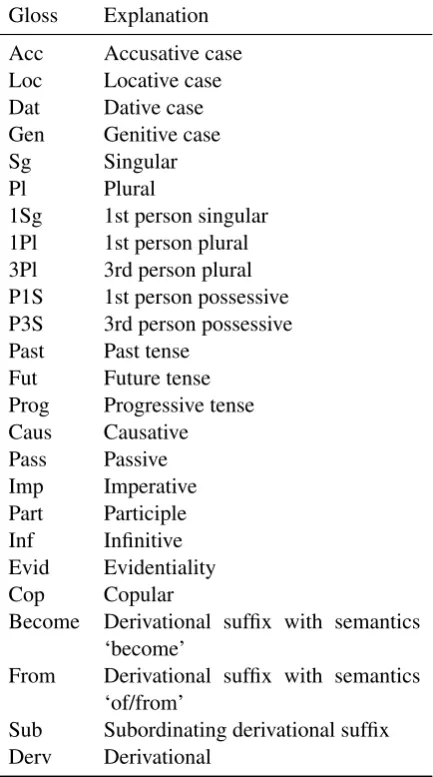
German words are represented in bold and English words in italics in the examples. The POS tags in glosses correspond to the UD tags used in annota-tion. Gloss descriptions are given in Table 3.
Gloss Explanation Acc Accusative case Loc Locative case Dat Dative case Gen Genitive case Sg Singular
Pl Plural
1Sg 1st person singular 1Pl 1st person plural 3Pl 3rd person plural P1S 1st person possessive P3S 3rd person possessive Past Past tense
Fut Future tense Prog Progressive tense Caus Causative Pass Passive Imp Imperative Part Participle Inf Infinitive Evid Evidentiality Cop Copular
Become Derivational suffix with semantics ‘become’
From Derivational suffix with semantics ‘of/from’
[image:11.595.309.526.152.541.2]Sub Subordinating derivational suffix Derv Derivational