The Thirty-Third AAAI Conference on Artificial Intelligence (AAAI-19)
CAMO: A Collaborative Ranking Method for Content Based Recommendation
Chengwei Wang,
1,3Tengfei Zhou,
3Chen Chen,
1,3Tianlei Hu,
1,3,∗Gang Chen
2,31The Key Laboratory of Big Data Intelligent Computing of Zhejiang Province, China
2CAD & CG State Key Lab, Zhejiang University, China
3College of Computer Science and Technology, Zhejiang University, China
{rr, zhoutengfei, cc33, htl, cg}@zju.edu.cn
Abstract
In real-world recommendation tasks, feedback data are usu-ally sparse. Therefore, a recommender’s performance is often determined by how much information that it can extract from textual contents. However, current methods do not make full use of the semantic information. They encode the textual con-tents either by “bag-of-words” technique or Recurrent Neu-ral Network (RNN). The former neglects the order of words while the latter ignores the fact that textual contents can con-tain multiple topics. Besides, there exists a dilemma in de-signing a recommender. On the one hand, we shall use a so-phisticated model to exploit every drop of information in item contents; on the other hand, we shall adopt a simple model to prevent itself from over-fitting when facing the sparse feed-backs. To fill the gaps, we propose a recommender named CAMO1. CAMO employs a multi-layer content encoder for
simultaneously capturing the semantic information of multi-topic and word order. Moreover, CAMO makes use of ad-versarial training to prevent the complex encoder from over-fitting. Extensive empirical studies show that CAMO out-performs state-of-the-art methods in predicting users’ pref-erences.
Introduction
Recommender System (RS) is one of the most important applications of artificial intelligence (Bennett and Lanning 2007; Linden, Smith, and York 2003; Su and Khoshgof-taar 2009). In e-commerce, RS is capable of selecting cus-tomized commodities for users and boosting vendors’ prof-its (Zhu et al. 2014). In online media, RS is able to provide personalized playlists and increase users’ engagement (Bon-nin and Jannach 2013). In information retrieval, RS can be used to filter out users’ unwanted links and improve their searching efficiency (Zhang, Yao, and Sun 2017).
RS aims to mine users’ preferences from their feedbacks, including explicit ratings and implicit clicks (Rendle et al. 2009). Therefore, many methods use feedbacks as the sole data source to train a recommendation model (Mnih and Salakhutdinov 2007; Koren 2008; Koren, Bell, and Volin-sky 2009). However, the feedbacks are often severely sparse
∗
Corresponding author.
Copyright c2019, Association for the Advancement of Artificial Intelligence (www.aaai.org). All rights reserved.
1
CAMO is short for Collaborative rAnking via dynaMic rOut-ing.
in practical applications, which makes such methods pro-duce inferior recommendation results. To enhance the per-formance, many researchers indicate that an item’s con-tent information is capable of boosting model’s expressing power (Kim et al. 2016; Gupta and Varma 2017). Conse-quently, RSs with item content have higher accuracy than their vanilla counterparts (Wang and Blei 2011; Gopalan, Charlin, and Blei 2014).
In this paper, we focus on fusing RS with textual contents. Many Content-Based Recommendation (CBR) approaches have been proposed for exploiting a corpus of textual con-tents. Generally, CBR methods combine a Collaborative Fil-tering (CF) function with an encoder which extracts features from the text (Bansal, Belanger, and McCallum 2016; Chen et al. 2017; Xiaoyan Cai and Yang 2018). Note that these encoders dominate the performance of such methods since they have similar CF architectures. Though abundant litera-ture have comprehensively studied the construction of con-tent encoders (Zhang et al. 2017; Agarwal and Chen 2010; Volkovs, Yu, and Poutanen 2017), we find that there are still significant rooms for improvements.
Firstly, most existing methods fail to simultaneously cap-ture topic semantics and word order information, since they belong to different semantic hierarchies. For topic-aware en-coders, the content features are extracted by models such as Latent Dirichlet Allocation and autoencoder (Liu et al. 2017; Gopalan, Charlin, and Blei 2014; Wang, Wang, and Ye-ung 2015). Since these models are built upon the “bag-of-words” assumption, they are not sensitive to the order of words. For example, “I prefer apple to banana” and “I prefer banana to apple” are semantically equivalent to such methods, which induces serious bias in text under-standing. To catch word order, many researchers use a Re-current Neural Network (RNN) such as Gated ReRe-current Unit (GRU) or Long Short-Term Memory (LSTM) to
en-code content text (Wang, Xingjian, and Yeung 2016;
Bansal, Belanger, and McCallum 2016). However, they treat a document as one sequence of words, which fails to identify the high leveled topic information.
re-duce over-fitting, Wang, Xingjian, and Yeung (2016) injects noises into content corpus. Bansal, Belanger, and McCallum (2016) utilize an extra tag classification task to regularize the complex RNN model. The previous two strategies are not optimal. Injecting noises into content data inevitably con-taminates the raw text, which reduces the quality of content data. Regularization via tag may be impractical in real-world tasks since valuable tags are hard to obtain.
To resolve these difficulties, we propose a CBR method called CAMO. Our main contributions are listed as follows.
• We design a novel neural architecture which extracts both
topic and word order information. The encoder uses a multi-layer structure to mimic the semantic hierarchies. In the lower layer, a GRU is used to exploit word order. In the higher layer, a multi-head attention mechanism is employed to summarize topics.
• A variant of multi-head attention mechanism is devised.
The proposed method uses a dynamic routing protocol to update the attention signal iteratively. Such protocol can allow attention-heads decide the pooling weights of lower-level states according to the predicted output. This allows attention-heads prune unrelated part and attend to active parts of a document.
• We utilize an adversarial training technique to enhance
the generalization power of our content encoder. We view the training process as a minimax game between a content encoder and an opponent generator. The encoder tries to construct a content vector that minimizes the decoding er-ror. The generator produces a document from the content vector and tries to maximize the distance between its out-put and the original document.
Preliminaries and Notations
Consider the following typical CBR scenario for
inferenc-ingmusers’ preferences overnitems. Suppose two kinds of
data are available. One is the content corpusC={docj}nj=1
where each documentdocj contains textual description of
itemj, the other is users’ feedbacksD ={(i, ρ+i , ρ−i )}n
i=1
whereρ+i contains all items labeled with “relevant” by user
iwhileρ−i is comprised of all items labeled with “not
rele-vant”. The goal of CBR is to learn a preference score func-tionf(i, j, docj)which gives higher scores to items inρ+i
and lower scores to items in ρ−i . Formally, the learning
process can be expressed as follows (Christakopoulou and Banerjee 2015).
min
θf
m
X
i=1
X
j∈ρ+i
X
j0∈ρ−
i
l(i, j, j0),Lrank(θf) (1)
whereθf are the parameters off(i, j, docj)andl(i, j, j0) =
−logσ(f(i, j, docj)−f(i, j0, docj0))withσ(·) being the
sigmoid function. The preference score function can be modeled as
f(i, j, docj) =p>i (qj+g(docj)) (2)
wherepiis the latent vector of useri,qjis the latent vector
of item j, andg(·)is a content encoder which mapsdocj
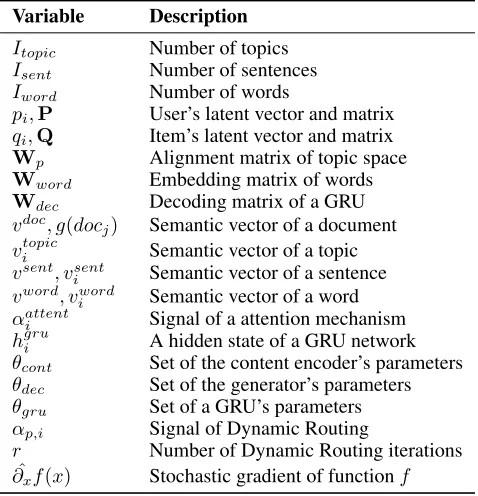
Table 1: Table of notations
Variable Description
Itopic Number of topics
Isent Number of sentences
Iword Number of words
pi,P User’s latent vector and matrix
qi,Q Item’s latent vector and matrix
Wp Alignment matrix of topic space
Wword Embedding matrix of words
Wdec Decoding matrix of a GRU
vdoc, g(doc
j) Semantic vector of a document
vitopic Semantic vector of a topic
vsent, vsent
i Semantic vector of a sentence
vword, vword
i Semantic vector of a word
αattent
i Signal of a attention mechanism
hgrui A hidden state of a GRU network
θcont Set of the content encoder’s parameters
θdec Set of the generator’s parameters
θgru Set of a GRU’s parameters
αp,i Signal of Dynamic Routing
r Number of Dynamic Routing iterations
ˆ
∂xf(x) Stochastic gradient of functionf
into semantic vector. Equation (2) means that the final item
representation is the sum of content vectorg(docj)and
item-specific vectorqj (Bansal, Belanger, and McCallum 2016).
We list the notations used in the paper in Tab. 1.
Methodology
Content Encoder
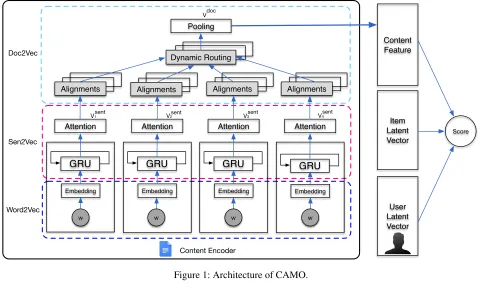
We use a three layer content network to encode semantic information of corpus into Euclidean vectors. The architec-ture of the content network is shown in Fig. 1. From top to bottom, a Doc2Vec layer aggregates sentence vectors into a topic-aware document vector. A Sent2Vec layer pools word vectors into sentence vectors. A Word2Vec layer embeds each word into a semantic space.
Doc2Vec Suppose that documentdocis comprised of
sen-tence vectors{vsent
i } Isent
i=1 and topic vectors{v
topic i }
Itopic
i=1 .
We make two assumptions. Assumption I: document vector
vdocis equal to the average of topic vectorsvtopic
p
vdoc= 1
Itopic Itopic
X
i=1
vtopici . (3)
Assumption II:vtopicp is equal to the weighted mean of
sen-tence vectors
vptopic=
Isent X
i=1
αp,iWpvsenti (4)
where the weightαp,isatisfiesαp,i ≥ 0,Piαp,i = 1, and
Wp is the alignment matrix. The weightαp,i can be
GRU
w
Embedding
GRU
Embedding
GRU
Embedding
GRU
Embedding
Attention Attention Attention Attention
V2sent
V1sent V3sent V4sent
Vdoc
w w w
Alignments Alignments Alignments Alignments
Dynamic Routing Pooling
Content Encoder
Content Feature
Item Latent Vector
User Latent Vector
Score
Sen2Vec
Word2Vec Doc2Vec
Figure 1: Architecture of CAMO.
i. Intuitively, the inner product ofvtopic
p andWpvisentshall
reflect the semantic relativeness of the two object. Thus, we
formulate the probabilityαp,ias follows.
αp,i∝exp((vtopicp )>Wpvisent). (5)
Substitute equation (5) into (4), we obtain the following non-linear equation of topic vector.
vptopic=
PIsent
i=1 exp((v
topic
p )>Wpvisent)Wpvsenti
PIsent
i=1 exp((v
topic
p )>Wpvsenti )
. (6)
The above fixed point equation is of the form x = f(x),
and it can be numerically solved by iteratively calculating
x(t+1)=f(x(t))(Stoer and Bulirsch 2013). In this way, we
get the recurrence for computing the topic vector
h(pt)=
0 t= 0
P
iexp(h
(t−1)>
p Wpvsenti )Wpvsenti
P
iexp(h
(t−1)>
p Wpvsenti )
0< t≤r.
(7) We summarize the Doc2Vec protocol in Alg. 1.
Remark 1 The Doc2Vec protocol can be simplified as the
following formulation.
(
vdoc= 1
Itopic
PItopic
p=1 v
topic p vtopic
p =Vsoftmax(K>W>pqp),1≤p≤Itopic
(8)
whereK = (vsent
1 , vsent2 , . . . , vIsentsent)is the “key matrix”,
qp = h
(r−1)
p is the query vector and V = WpK is the
“value matrix”. Therefore, the Doc2Vec protocol shares the same form of multi-head attention mechanism (Vaswani et al. 2017). The difference between them is that the proposed “query vector” is formed by a dynamic routing method.
Algorithm 1Doc2Vec(vsent
1 , vsent2 , . . . vIsentsent)
1: fort∈ {0,1,2, . . . r}do
2: for all1≤p≤Itopic: update hidden stateh(pt)via equation
(7) 3: end for
4: for all1≤p≤Itopic:vptopic=h (r) p
5: vdoc= 1 Itopic
PItopic
p=1 v topic p
6: return vdoc
Sent2Vec Layer A sentence vector vsent (vsent ∈
{visent}) is generated by the following attention formulation.
vsent=
Iword X
i=1
αattenti hgrui (9)
wherehgrui is the hidden state of a GRU andαattenti is the
attention signal for pooling the GRU’s hidden states. GRU is used to capture the order information of words, its hidden states are given by the following recurrence.
hgrui =
0 i= 0
GRUCell(hgrui−1, viword) i >0 (10)
where the transition functionh0 = GRUCell(h, v)(Chung
et al. 2014) can be formulated as follows.
z=σ(Wzv+Uzh+bz) r=σ(Wrv+Urh+br) h0= (1−z)∗h
with matrixWz,Wr,Wh, matrixUz,Ur,Uh, and vector
bz, br, bhbeing the GRU’s parameters. The attention signal
αattent= (αattent
1 , . . . , αattentIword)
>is given by the following
equation
αattent= softmax(H>GRUhgruI
word) (11)
where matrix HGRU contains the hidden states of GRU
cells.
Word2Vec Layer Letwbe a word belonging to the
vocab-ulary of articles. The vector representationvwordof wordw
is given by
vword=Wword(w,:) (12)
whereWwordis the embedding matrix.
Model Training
Complex models are notorious for their over-fitting in the task of personal recommendation. Such phenomenon will make the proposed model perform inferiorly on the un-recorded data. According to the framework of multi-task learning, constructing an auxiliary learning task for a per-sonal ranking task can greatly reduce the risk of over-fitting (Ruder 2017). Therefore, training a decoder to map
doc-ument vectors {vdoc} back into corpus{doc} is a natural
choice.
vdoc
w
GRU
2
vword1
GRU … GRU
w3 wI
vword2 v
word
word
Iword -1
Figure 2: The generator produces texts fromvdoc.
The Decoding Task Letθcont denote the parameters of
the content network (including the word embedding matrix
Wword, topic alignment matrixWp, and so on). Letθdec
de-note the parameters for the generator of the document vector.
For a documentdoc={wi}, we define the transition
proba-bility of texts as the following softmax distribution
p(wi+1|wi, θcont, θdec) = softmax(Wdechdeci ) (13)
whereWdecis a matrix and hidden states{hdeci }are
gener-ated from a GRU with hidden states given by:
hdeci =
vdoc i= 0
GRUCell(hdeci−1, vwordi ) i >0. (14)
wherevword
i is the word vector ofwi. For the corpusC =
{doc}, the negative log-likelihoodLdeccan be composed as
follows.
Ldec(θcont, θdec) =−
X
doc
X
wi∈doc
logp(widoc+1|wdoci , θcont, θdec).
One can learn the parameters of the decoding task via
min-imizeLdec(·,·).
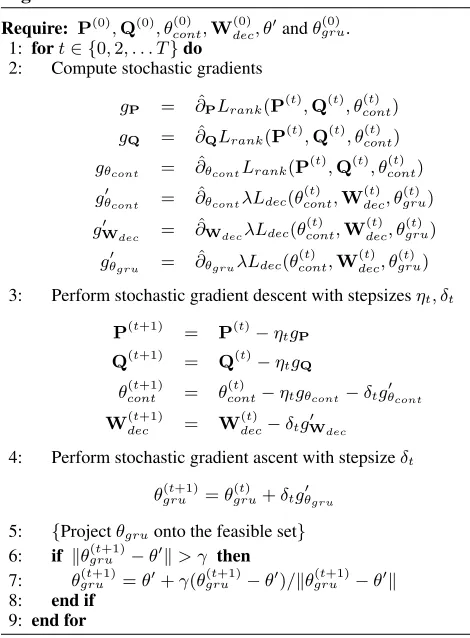
Algorithm 2Alternate Gradient Method
Require: P(0),Q(0), θ(0)cont,W (0) dec, θ
0
andθgru(0).
1: fort∈ {0,2, . . . T}do
2: Compute stochastic gradients
gP = ∂ˆPLrank(P(t),Q(t), θcont(t) )
gQ = ∂ˆQLrank(P(t),Q(t), θ(contt) )
gθcont = ∂ˆθcontLrank(P
(t)
,Q(t), θ(contt) )
gθ0cont = ∂ˆθcontλLdec(θ (t) cont,W
(t) dec, θ
(t) gru)
g0Wdec = ∂ˆWdecλLdec(θ
(t) cont,W
(t) dec, θ
(t) gru)
gθ0gru = ∂ˆθgruλLdec(θ (t) cont,W
(t) dec, θ
(t) gru)
3: Perform stochastic gradient descent with stepsizesηt, δt
P(t+1) = P(t)−ηtgP
Q(t+1) = Q(t)−ηtgQ θ(contt+1) = θ
(t)
cont−ηtgθcont−δtg 0 θcont
Wdec(t+1) = Wdec(t) −δtgW0 dec
4: Perform stochastic gradient ascent with stepsizeδt
θgru(t+1)=θgru(t) +δtg 0 θgru
5: {Projectθgruonto the feasible set}
6: if kθgru(t+1)−θ0k> γ then
7: θgru(t+1)=θ0+γ(θ (t+1)
gru −θ0)/kθ (t+1) gru −θ0k
8: end if
9: end for
Adversarial Training Intuitively, multi-task learning of
collaborative ranking and textual decoding can be expressed as follows.
min P,Q,θcont,θdec
Lrank(P,Q, θcont) +λLdec(θcont, θdec).
(15) However, we find the encoder estimated by equation (15) performs worse than a simple Word2Vec model. Almahairi et al. (2015) also point out this issue. This shows that ex-pression (15) is not suitable for estimating model
parame-ters, since a smallLdec(·)may result from the strong fitting
power of GRU other than the generalization power of the
learned featurevdoc. To rule out the optimistic bias induced
by GRU, we modify the composite loss as follows.
min P,Q,θcont,Wdec
{Lrank(P,Q, θcont)
+λ max
θgru,kθgru−θ0k≤γ
Ldec(θcont,Wdec, θgru)}
(16)
whereθgru is the parameters of the GRU,θ0 is a randomly
generated vector andγis a tuning parameter. Our intuition
is that if the decoding loss is still small for an adversarial constructed GRU, one can infer that even a bad decoder can
not distort the generalization power ofvdoc. The minimax
Experiments
We conduct extensive experiments on benchmark datasets. We use the following state-of-the-art methods as baselines. Note that we do not compare with matrix factorization mod-els such as BPR, WRMF, and FM since it has shown that CML and CDL outperform these models (Hsieh et al. 2017; Wang, Wang, and Yeung 2015).
• CML + Skip-Thought (CMLST). We combine
CML (Hsieh et al. 2017), a metric based collaborative ranking method, with text encoder Skip-Thought (Kiros et al. 2015) to model both users’ feedbacks and content texts.
• CRAE (Wang, Xingjian, and Yeung 2016). CRAE
con-tains a Bayesian matrix factorization model for modeling users’ feedbacks and a Bayesian RNN for encoding con-tent corpus.
• CDL (Wang, Wang, and Yeung 2015). CDL is a joint
probabilistic graphics model that integrates the matrix factorization model with probabilistic autoencoder.
• CDAE (Wu et al. 2016). CDAE is a denoising
autoen-coder for users’ feedbacks.
The codes for CML, Skip-Thought, CDL, and CDAE are downloaded from the homepage of the correspondent author. The codes for the proposed CAMO and CRAE are imple-mented using TensorFlow (Abadi et al. 2016). All the com-pared methods are run on the same machine with i7-5930K CPU, 64GB RAM, and one TITAN Xp GPU.
Datasets
The benchmark datasets include: CiteULike (Wang and Blei 2011), MovPlot1M and MovPlot10M (Liu et al. 2017). Ci-teULike contains users’ bookmarks of scientific articles and paper abstracts. MovPlot1M and MovPlot10M are exten-sions of MovieLens1M and MovieLens10M datasets. Both contain movie ratings and corpus of movie plots. We treat every rated movie as “relevant”. For each “relevant”
user-item pair in all datasets, we sampleN Sitems without
book-marks (or ratings) as “not relevant”. N S is dubbed
nega-tive sampling ratio. The statistics of the datasets are listed in Tab. 2. We randomly select 80% of the observed data as training set and evaluate the models with the remaining 20%.
Table 2: Statistics of the benchmark datasets where #users, #items and #feedbacks are the number of users, items and feedbacks respectively, “avg. words” is average words per document.
Dataset #users #items #feedbacks avg. words
CiteULike 5551 16980 210504 204.9
MovPlot1M 6040 3861 996045 82.19
MovPlot10M 13975 10681 1962580 84.66
Default Hyperparameter Settings
We set all the dimension hyperparameters (e.g. dimensions of the user, item and document latent vectors) of the
consid-ered models to the same valued. We calldmodel’s
dimen-sion and setd= 256for all compared methods by default.
We set negative sampling ratio N S = 6. The default
pa-rameters for CAMO are set as follows: the number of topics
Itopicis set to 10, the number of dynamic routing iterations
ris set to14, and the regularization parameterλis set to 0.2.
Other parameters of baseline methods are set to their default values.
Performance of Each Neural Layer
In this section, we study the influence of semantic vectors constructed by different layers of the proposed encoder. Let
doc be a document containing words {wi}Ii=1word. To show
the impact of Word2Vec layer, we evaluate a Word2Vec variant of CAMO. The variant is constructed by replacing CAMO’s content vectors with the mean of word vectors,
i.e.vdoc = 1
Iword P
iv word
i . Similarly, we build a Sent2Vec
variant of CAMO using the average of sentence vectors as content features. The experimental results are shown in Tab. 3. From the table, we can see that accuracy of Sent2Vec variant is much better than Word2Vec. This can be explained by that Sent2Vec captures the semantic information of word order, while Word2Vec does not. The table also shows that CAMO is more accurate than its Sent2Vec variant. This is because Doc2Vec layer encodes extra topic semantic infor-mation to content features.
Table 3: Performance of CAMO’s different neural layers
Pre@5, Pre@10, Rec@5 and Rec@10 are Precision@5,
Precision@10, Recall@5and Recall@10respectively. MAP
is short for mean average precision. AUC is abbreviated for Area Under the ROC.
CiteULike MAP AUC Pre@5 Pre@10 Rec@5 Rec@10
Word2Vec 0.1340 0.9404 0.1496 0.1218 0.1131 0.1724 Sent2Vec 0.1589 0.9283 0.1730 0.1374 0.1317 0.1930 CAMO 0.1623 0.9540 0.1779 0.1414 0.1357 0.2019
MovPlot1M MAP AUC Pre@5 Pre@10 Rec@5 Rec@10
Word2Vec 0.2145 0.9168 0.3973 0.3418 0.0892 0.1425 Sent2Vec 0.2199 0.9215 0.4059 0.3468 0.0911 0.1474 CAMO 0.2439 0.9296 0.4310 0.3701 0.0995 0.1629
MovPlot10M MAP AUC Pre@5 Pre@10 Rec@5 Rec@10
Word2Vec 0.2360 0.9168 0.3696 0.3174 0.1118 0.1818 Sent2Vec 0.2468 0.9724 0.3852 0.3208 0.1181 0.1917 CAMO 0.2516 0.9737 0.3948 0.3360 0.1216 0.1985
Quantitative Comparison
outperforms the baselines both on AUC and MAP. More-over, users usually check a few top-ranked items in
real-world applications, top-Kevaluation metrics are important
for studying the recommendation performance. Thus, we
measure both Precision@Kand Recall@Kon benchmark
datasets. The results are reported in Fig. 3 where (a1-c1)
record Precision@Kcurves and (a2-c2) contain Recall@K
curves. From Fig. 3 we can see that under differentK, the
proposed CAMO has consistently better results in terms of
both criterions. We find that model dimensiondand negative
sampling ratioN Shave a huge impact on the model’s
per-formance, and hence we analyze different settings of these parameters on testing accuracy. To visualize the impact of them, we report Recall@50 scores of CAMO, CMLST, and CRAE in Fig. 4 and Fig. 5. Both Fig. 4 and Fig. 5 show that
CAMO have better Recall@50than other methods
consis-tently. In summary, all the above quantitative empirical re-sults show the superior performance of CAMO. We attribute the promising empirical results to the encoding and general-ization power of the multi-layer content network of CAMO.
Table 4: Performance of the compared methods.
Method CiteULike MovPlot1M MovPlot10M
AUC MAP AUC MAP AUC MAP
CMLST 0.9354 0.1217 0.9214 0.1881 0.9370 0.1753
CRAE 0.9416 0.0580 0.9157 0.1856 0.9682 0.1585
CDL 0.9120 0.1124 0.9188 0.1432 0.9365 0.1547
CDAE 0.9348 0.1211 0.9210 0.1630 0.9366 0.1712
CAMO 0.9540 0.1623 0.9296 0.2439 0.9737 0.2516
1 5 10 50 100 150 (a1) 0 0.05 0.1 0.15 0.2 0.25 Precision@K
1 5 10 50 100 150 (b1) 0.05 0.1 0.15 0.2 0.25 0.3 0.35 0.4 0.45 0.5 0.55
1 510 50 100 150 (c1) 0.05 0.1 0.15 0.2 0.25 0.3 0.35 0.4 0.45 0.5
CAMO CMLST CRAE CDL
1 5 10 50 100 150 (a2) 0 0.1 0.2 0.3 0.4 0.5 0.6 Recall@K
1 5 10 50 100 150 (b2) 0 0.1 0.2 0.3 0.4 0.5 0.6 0.7
1 510 50 100 150 (c2) 0 0.1 0.2 0.3 0.4 0.5 0.6 0.7
Figure 3: Precision@Kand Recall@Kof compared
meth-ods under different choices ofKwith respect to benchmark
datasets.
Qualitative Comparison
To show CAMO’s topic-aware extracting ability, we visu-alize the content feature of movies for Mov1MPlot dataset. We randomly sample 300 or 400 movies, and plot the corre-sponding features extracted by CAMO via t-SNE algorithm
d=32 d=128 d=512 d=1024 0 0.05 0.1 0.15 0.2 0.25 0.3 0.35 0.4 0.45 recall@50
d=32 d=128 d=512 d=1024 0 0.05 0.1 0.15 0.2 0.25 0.3 0.35 0.4 0.45 CAMO CMLST CDL
d=32 d=128 d=512 d=1024 0 0.1 0.2 0.3 0.4 0.5
(b) MovPlot1M (c) MovPlot10M
(a) CiteULike
Figure 4: Recall@50of compared methods under different
choices of dimension with respect to benchmark datasets.
NS=1 NS=6 NS=14 NS=16 0 0.05 0.1 0.15 0.2 0.25 0.3 0.35 0.4 0.45 recall@50
NS=1 NS=6 NS=14 NS=16 0 0.05 0.1 0.15 0.2 0.25 0.3 0.35 0.4 0.45 CAMO CMLST CDL
NS=1 NS=6 NS=14 NS=16 0 0.1 0.2 0.3 0.4 0.5
(b) MovPlot1M (c) MovPlot10M
(a) CiteULike
Figure 5: Recall@50of compared methods under different
choices of NS with respect to benchmark datasets.
(Maaten and Hinton 2008). In comparison, we also plot con-tent features extracted by CMLST. The visualized results are displayed in Fig. 6. From the figure, we can see that movies are well clustered by CAMO while CMLST seem to confuse horror movies with drama. The better identification power of CAMO results from its topic-aware neural architecture.
To show the embedding capability of CAMO, we ran-domly choose two article from CiteULike and display the top-5 similar papers. The similarity is defined by Euclidean distance. For comparison, the results of CMLST are also recorded. We exhibit the experimental results in Tab. 5. It shows that when queried with paper “Amazon.com Recom-mendations Item-to-Item Collaborative Filtering”, CAMO identifies both recommendation and e-commerce topics, while CMLST ignores the latter. We can also observe that when queried with paper “Towards Real-time Community Detection in Large Networks”, CMLST even contains one irrelevant paper named “Adaptive networks coevolution of disease and topology”, while all results of CAMO are rele-vant. These experimental studies demonstrate CAMO’s em-bedding ability.
Conclusion
-10 -5 0 5 10 (a) CAMO, 300 movies -4
-3 -2 -1 0 1 2 3 4
Drama Sci-Fi Horror Animation Adventure
-20 -15 -10 -5 0 5 10 15 20 (b) CMLST, 300 movies -10
-8 -6 -4 -2 0 2 4 6 8
-10 -5 0 5 10 (c) CAMO, 400 movies -4
-3 -2 -1 0 1 2 3 4 5
-20 -15 -10 -5 0 5 10 15 20 (d) CMLST, 400 movies -10
-8 -6 -4 -2 0 2 4 6 8
Figure 6: Comparison of t-SNE plots.
Table 5: Top-5 similar papers found by using the extracted document vector.
(a) Queried paper: Amazon.com recommendations item-to-item collaborative filtering
CAMO 1. Scalable collaborative filtering using cluster based smoothing 2. Analysis of recommendation algorithms for e-commerce
3. Applying collaborative filtering techniques to movie search for better ranking and browsing 4. Slope one predictors for online rating based collaborative filtering
5. Collaborative filtering by personality diagnosis a hybrid memory and model based approach CMLST
1. Empirical analysis of predictive algorithms for collaborative filtering 2. Item based collaborative filtering recommendation algorithms 3. Improving recommendation lists through topic diversification 4. Recommender systems
5. Toward the next generation of recommender systems a survey of the state-of-the-art and possible extensions
(b) Queried paper:Towards real-time community detection in large networks
CAMO 1. Random hypergraphs and their applications
2. A comparative study of social network models network evolution models and nodal attribute models 3. Line graphs link partitions and overlapping communities
4. Statistical significance of communities in networks 5. Emergence of communities in weighted networks
CMLST 1. Line graphs link partitions and overlapping communities 2. Statistical significance of communities in networks 3. Random hypergraphs and their applications
4. Adaptive networks coevolution of disease and topology 5. The energy landscape of social balance
In the future, we would like to try the following two strate-gies to improve CAMO. Firstly, we would like to incorpo-rate other kinds of content information such as images and videos into the model. Secondly, we will investigate how to use the probabilistic methods to enhance the robustness of CAMO.
Acknowledgments
This research is supported by National Key Research and Development Program (2017YFB1201001).
References
Abadi, M.; Barham, P.; Chen, J.; Chen, Z.; Davis, A.; Dean, J.; Devin, M.; Ghemawat, S.; Irving, G.; Isard, M.; et al.
2016. Tensorflow: a system for large-scale machine
learn-ing. InOSDI, volume 16, 265–283.
Agarwal, D., and Chen, B.-C. 2010. flda: matrix
factoriza-tion through latent dirichlet allocafactoriza-tion. InACM international
conference on Web search and data mining.
Almahairi, A.; Kastner, K.; Cho, K.; and Courville, A. 2015. Learning distributed representations from reviews for
col-laborative filtering. InProceedings of the 9th ACM
Confer-ence on Recommender Systems, 147–154. ACM.
Bansal, T.; Belanger, D.; and McCallum, A. 2016. Ask the gru: Multi-task learning for deep text recommendations. In
Proceedings of the 10th ACM Conference on Recommender Systems, 107–114. ACM.
Bennett, J., and Lanning, S. 2007. The netflix prize. In
Bonnin, G., and Jannach, D. 2013. A comparison of playlist generation strategies for music recommendation and a new
baseline scheme. InWorkshops at the twenty-seventh AAAI
conference on artificial intelligence.
Chen, T.; Sun, Y.; Shi, Y.; and Hong, L. 2017. On sam-pling strategies for neural network-based collaborative
fil-tering. InProceedings of the 23rd ACM SIGKDD
Interna-tional Conference on Knowledge Discovery and Data
Min-ing, 767–776. ACM.
Christakopoulou, K., and Banerjee, A. 2015. Collaborative
ranking with a push at the top. InProceedings of the 24th
International Conference on World Wide Web, 205–215. Chung, J.; Gulcehre, C.; Cho, K.; and Bengio, Y. 2014. Em-pirical evaluation of gated recurrent neural networks on
se-quence modeling. arXiv preprint arXiv:1412.3555.
Gopalan, P. K.; Charlin, L.; and Blei, D. 2014.
Content-based recommendations with poisson factorization. In
Ad-vances in Neural Information Processing Systems, 3176– 3184.
Gupta, S., and Varma, V. 2017. Scientific article recom-mendation by using distributed representations of text and
graph. InProceedings of the 26th International Conference
on World Wide Web Companion, 1267–1268. International World Wide Web Conferences Steering Committee. Hsieh, C.-K.; Yang, L.; Cui, Y.; Lin, T.-Y.; Belongie, S.; and
Estrin, D. 2017. Collaborative metric learning. In
Proceed-ings of the 26th International Conference on World Wide
Web, 193–201. International World Wide Web Conferences
Steering Committee.
Kim, D.; Park, C.; Oh, J.; Lee, S.; and Yu, H. 2016. Con-volutional matrix factorization for document context-aware
recommendation. InProceedings of the 10th ACM
Confer-ence on Recommender Systems, 233–240. ACM.
Kiros, R.; Zhu, Y.; Salakhutdinov, R. R.; Zemel, R.; Urtasun, R.; Torralba, A.; and Fidler, S. 2015. Skip-thought vectors.
Koren, Y.; Bell, R.; and Volinsky, C. 2009. Matrix
fac-torization techniques for recommender systems. Computer
42(8):30–37.
Koren, Y. 2008. Factorization meets the neighborhood: a
multifaceted collaborative filtering model. InProceedings of
the 14th ACM SIGKDD international conference on Knowl-edge discovery and data mining, 426–434. ACM.
Linden, G.; Smith, B.; and York, J. 2003. Amazon. com
rec-ommendations: Item-to-item collaborative filtering.Internet
Computing, IEEE7(1):76–80.
Liu, C.; Jin, T.; Hoi, S. C.; Zhao, P.; and Sun, J. 2017. Collaborative topic regression for online recommender
sys-tems: an online and bayesian approach. Machine Learning
106(5):651–670.
Maaten, L. v. d., and Hinton, G. 2008. Visualizing data using
t-sne. Journal of machine learning research9(Nov):2579–
2605.
Mnih, A., and Salakhutdinov, R. 2007. Probabilistic matrix
factorization. InAdvances in neural information processing
systems, 1257–1264.
Rendle, S.; Freudenthaler, C.; Gantner, Z.; and Schmidt-Thieme, L. 2009. Bpr: Bayesian personalized ranking from
implicit feedback. In Proceedings of the twenty-fifth
con-ference on uncertainty in artificial intelligence, 452–461. AUAI Press.
Ruder, S. 2017. An overview of multi-task learning in deep
neural networks. arXiv preprint arXiv:1706.05098.
Stoer, J., and Bulirsch, R. 2013. Introduction to numerical
analysis, volume 12. Springer Science & Business Media. Su, X., and Khoshgoftaar, T. M. 2009. A survey of
collabo-rative filtering techniques.Advances in artificial intelligence
2009:4.
Vaswani, A.; Shazeer, N.; Parmar, N.; Uszkoreit, J.; Jones, L.; Gomez, A. N.; Kaiser, Ł.; and Polosukhin, I. 2017.
At-tention is all you need. InNIPS, 5998–6008.
Volkovs, M.; Yu, G.; and Poutanen, T. 2017. Dropoutnet:
Addressing cold start in recommender systems. InAdvances
in Neural Information Processing Systems, 4957–4966. Wang, C., and Blei, D. M. 2011. Collaborative topic
model-ing for recommendmodel-ing scientific articles. InProceedings of
the 17th ACM SIGKDD international conference on Knowl-edge discovery and data mining, 448–456. ACM.
Wang, H.; Wang, N.; and Yeung, D.-Y. 2015. Collaborative
deep learning for recommender systems. InProceedings of
the 21th ACM SIGKDD International Conference on Knowl-edge Discovery and Data Mining, 1235–1244. ACM. Wang, H.; Xingjian, S.; and Yeung, D.-Y. 2016. Collabora-tive recurrent autoencoder: recommend while learning to fill
in the blanks. InAdvances in Neural Information Processing
Systems, 415–423.
Wu, Y.; DuBois, C.; Zheng, A. X.; and Ester, M. 2016. Col-laborative denoising auto-encoders for top-n recommender
systems. In Proceedings of the Ninth ACM International
Conference on Web Search and Data Mining, 153–162. ACM.
Xiaoyan Cai, J. H., and Yang, L. 2018. Generative adver-sarial network based heterogeneous bibliographic network representation for personalized citation recommendation. In
AAAI.
Zhang, Y.; Ai, Q.; Chen, X.; and Croft, W. B. 2017. Joint representation learning for top-n recommendation with
het-erogeneous information sources. InProceedings of the 2017
ACM on Conference on Information and Knowledge Man-agement, 1449–1458. ACM.
Zhang, S.; Yao, L.; and Sun, A. 2017. Deep learning based
recommender system: A survey and new perspectives.arXiv
preprint arXiv:1707.07435.
Zhu, T.; Harrington, P.; Li, J.; and Tang, L. 2014. Bundle