R E S E A R C H A R T I C L E
Open Access
Short-term test-retest-reliability of
conditioned pain modulation using the
cold-heat-pain method in healthy subjects
and its correlation to parameters of
standardized quantitative sensory testing
Julia Gehling
1†, Tina Mainka
1,2†, Jan Vollert
1, Esther M. Pogatzki-Zahn
3, Christoph Maier
1and Elena K. Enax-Krumova
4*Abstract
Background:Conditioned Pain Modulation (CPM) is often used to assess human descending pain inhibition. Nine different studies on the test-retest-reliability of different CPM paradigms have been published, but none of them has investigated the commonly used heat-cold-pain method. The results vary widely and therefore, reliability measures cannot be extrapolated from one CPM paradigm to another. Aim of the present study was to analyse the test-retest-reliability of the common heat-cold-pain method and its correlation to pain thresholds. Methods: We tested the short-term test-retest-reliability within 40 ± 19.9 h using a cold-water immersion (10 °C, left hand) as conditioning stimulus (CS) and heat pain (43-49 °C, pain intensity 60 ± 5 on the 101-point numeric rating scale, right forearm) as test stimulus (TS) in 25 healthy right-handed subjects (12females, 31.6 ± 14.1 years). The TS was applied 30s before (TSbefore), during (TSduring) and after (TSafter) the 60s CS. The difference between the pain ratings for TSbeforeand TSduringrepresents the early CPM-effect, between TSbeforeand TSafterthe late CPM-effect. Quantitative sensory testing (QST, DFNS protocol) was performed on both sessions before the CPM assessment. Statistics: paired t-tests, Intraclass correlation coefficient (ICC), standard error of measurement (SEM), smallest real difference (SRD), Pearson’s correlation, Bland-Altman analysis, significance level p< 0.05 with Bonferroni correction for multiple comparisons, when necessary. Results: Pain ratings during CPM correlated significantly (ICC: 0.411…0.962) between both days, though ratings for TSafterwere lower on day 2 (p< 0.005). The early (day 1: 16.7 ± 11.7; day 2: 19.5 ± 11.9; ICC: 0.618, SRD: 20.2) and late (day 1: 1.7 ± 9.2; day 2: 7.6 ± 11.5; ICC: 0.178, SRD: 27.0) CPM effect did not differ significantly between both days. Both early and late CPM-effects did not correlate with the pain thresholds.
Conclusions:The short-term test-retest-reliability of the early CPM-effect using the heat-cold-pain method in healthy subjects achieved satisfying results in terms of the ICC. The SRD of the early CPM effect showed that an individual change of > 20 NRS can be attributed to a real change rather than chance. The late CPM-effect was weaker and not reliable.
Keywords:Conditioned pain modulation, Test-retest reliability, Quantitative sensory test, Heat-cold-pain method, Early CPM effect, Late CPM effect
* Correspondence:[email protected]
†Equal contributors
4Department of Neurology, Berufsgenossenschaftliches Universitätsklinikum Bergmannsheil GmbH, Ruhr-University Bochum, Bürkle-de-la-Camp-Platz 1, 44789 Bochum, Germany
Full list of author information is available at the end of the article
Background
Human pain modulation is of growing interest for pain re-search. The balance between inhibitory and facilitatory pain systems is suggested to be disrupted in several pain syndromes, e.g. fibromyalgia, irritable bowel syndrome or
osteoarthritis [1–3]. Furthermore, ineffective endogenous
analgesia seems to put patients at risk for developing chronic postoperative pain [4, 5].
Experimentally, the descending inhibitory pathways can be assessed using two noxious stimuli [6]. Plenty of paradigms assessing the conditioned pain modulation (CPM) have been described, using thermal, mechanical, electrical or pressure stimuli as test stimulus (TS) and/ or conditioning stimulus (CS) in different combinations. The so-called CPM-effect is typically calculated as the difference between pain ratings of the TS before and the
TS during or- to analyse its persistence - after
applica-tion of the CS [7, 8]. Hitherto, there is no consensus whether a certain CPM protocol is preferable over the others [9].
So far, only few studies have analysed the test-retest-reliability of different CPM paradigms for periods be-tween 15 min and 10 months with sample sizes bebe-tween 12 and 190 subjects, most of them in healthy subjects, using different TS (heat pain, electrical stimulation, pres-sure or ischemia) and CS (hot or cold-water baths,
occlu-sion cuff) [10–18]. However, one study focused on
intra-individual variances of the CPM-effect elicited by different CS in 12 healthy men [17], while another focused on the influence of ongoing pain on the CPM-effect [18], both of them not examining genuine test-retest-reliability. Three further studies analysed additionally gender-specific test-retest-reliability [13, 16, 18]. To sum up, the results re-garding the ICC vary widely between the studies and seem to depend on the used CS and TS and the time interval [7, 16, 17]. For most paradigms and parameters ICC analysis revealed good to excellent test-retest reliability in healthy subjects with some exceptions. Especially for the CPM-effect elicited by cuff occlusion as CS and pressure pain as TS, the ICC revealed poor reliability
(ICC −0.4) over a period of 3 days [10], whereas retest
with the same CPM paradigm within less than 60 min showed good to excellent ICC [10, 15]. Two studies examining the CPM-effect using electrical stimulation
as TS found good test-retest reliability over 1–4 weeks
based on both the nociceptive flexor reflex (NFR) re-sponse and subjective pain ratings [11, 12], but it was poor when calculated based on the electrical pain de-tection threshold [12], though the CPM effect based on subjective pain ratings was more reliable than based on the NFR during innocuous stimulation as control con-dition [11]. The authors concluded that the subjective pain ratings and objective electrophysiological mea-sures reflect different components of the CPM [11, 12].
In contrast, examining the CPM effect in patients with chronic pain over an interval of about 1 week with painful cold stimulus as CS and pressure pain as TS, the test-retest reliability seems to be poor in males, whereas a subanalysis in female patients showed better test-retest reliability according to the ICC [13, 14, 18]. Therefore, extrapolation of reliability measures from one CPM paradigm to another and between different study populations, i.e. healthy subjects vs. patients with chronic pain, seems to be inappropriate. Only two of the above studies reported clinically relevant reliability measures like standard error of measurement and standard real difference [12, 18], though recently a re-view on studies addressing the test-retest reliability of sensory testing demanded for more detailed statistical evaluations of test-retest data, including also assess-ment of agreeassess-ment of the datasets, and more transpar-ent data prestranspar-entation [19].
To prove the value of a testing paradigm for clinical applicability, an analysis of the test-retest reliability in healthy subjects is an essential prerequisite, as the con-founding factors in healthy subjects are less pronounced than in patients with an underlying disease. To our knowledge, a detailed test-retest-reliability analysis in healthy subjects for the commonly used method with tonic heat as TS and tonic cold as CS [7, 20] is still lack-ing, although this protocol seems to provide clinically relevant information and is easily applicable, e.g. without recording EMG activity. This paradigm was recently ap-plied in patients with painful diabetic neuropathy and was able to identify patients with insufficient endogen-ous analgesia who were responders to duloxetine, which is supposed to enhance the function of the descending inhibitory pathways by reuptake inhibition of serotonin and noradrenaline [21]. To evaluate the methodological stability of this CPM paradigm for the clinical practice,
we analysed its short-term test-retest-reliability (24–72 h)
in healthy subjects (primary objective). We analysed the difference between the pain intensity of the TS before and (i) during the simultaneous application of the CS (“early
CPM-effect”) as well as (ii)shortly afterthe application of
the CS (“late CPM-effect”).
Somatosensory function can also be examined by quantitative sensory testing (QST). The QST-protocol of the German Research Network on Neuropathic Pain
(DFNS) is reliable and well validated [22–24]. It
parameters might also indirectly reflect the state of the descending inhibitory pathways. Therefore, we also ana-lysed their correlation to the magnitude of the CPM-effect (secondary objective).
Methods Subjects
The study protocol was in accordance with the latest version of the Declaration of Helsinki and approved by the local eth-ics committee of the Faculty of Medicine, Ruhr-University
Bochum, Germany (Reg. Nr. 4321–12, NCT01618604).
Volunteers were recruited from June 2012 to December 2012 among students, their relatives or employees of the University Hospital Bergmannsheil in Bochum, Germany. Before starting the assessment, the study was described in its entirety to the subjects, who all gave written informed
consent. All subjects received a reimbursement of 70€for
completion of the study. Inclusion criteria were age above 18 years, right-handedness (assessed by the Edinburgh Handedness Inventory [27]), absence of chronic pain, no drug intake, especially no use of analgesic drugs in the last 14 days. Each subject was asked to answer a screening tool for healthy subjects, which has previously been established within the IMI-Europain consortium (www.imi.euro-pa.eu). It comprises the following exclusion criteria: age under 18 years, missing informed consent, insufficient German language skills, current or recent pain, recent in-take of analgesic or other drugs (except contraceptives), consume of alcohol or energy drinks, history of neuro-logical, dermatoneuro-logical, chronic internal or psychiatric dis-eases, abnormal neurological examination, recent sleep restriction or unusual physical exercises, and pregnancy. Relevant depression and anxiety symptoms were addition-ally excluded by applying the Hospital Anxiety and De-pression Scale (HADS) prior to study begin on the first session [28, 29]. Other study-specific exclusion criteria were abnormal results in the baseline quantitative sensory testing (QST) with values outside the 95 % confidence interval for healthy subjects according to the DFNS refer-ence database [24] in order to exclude subjects with inci-dental or subclinical neuropathy.
One female was excluded because of an abnormal side-to-side difference for thermal detection thresholds, in-dicating a unilateral neuropathy. None of the subjects was excluded due to one of the above-mentioned criteria con-cerning the pain ratings during the CPM procedure. Thus, a final sample size of twenty-five subjects (mean age: 31.6 ± 14.3 (21…69) years; 12 females,n= 3 > 40 years; 13 males,
n= 1 > 40 years) was used for further statistical analyses.
Study design
Subjects attended two sessions 24 to 72 h apart. Both sessions were conducted in exactly the same way and were performed in the afternoon (between 4 pm and
7 pm) by the same female examiner (J.G.) in the certified QST laboratory in the University Hospital Bergmannsheil GmbH in Bochum, Germany. On day 1, each subject an-swered the German Version of the Pain Sensitivity Ques-tionnaire (PSQ) [30] to assess self-reported pain sensitivity in relation to daily life situations for correlation with the results of the experimental setting (secondary outcome).
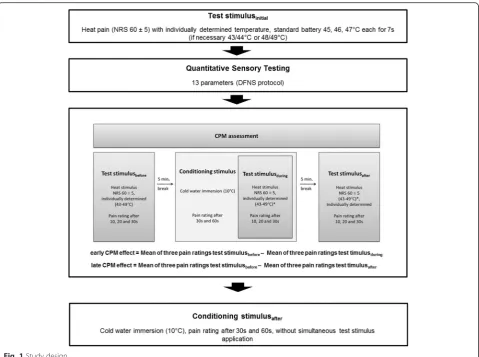
The test procedure is illustrated in Fig. 1. It strictly adhered to a standardized script with standardized in-structions, which were read out to the subjects. The assessment began with the determination of the individual
test stimulus temperature (TSinitial), followed by QST
ac-cording to the protocol of the German Research Network on Neuropathic Pain (DFNS) on the right and left dorsum of the hand, lasting about 60 min. After that, we applied the established CPM paradigm as previously described by Granot et al. [7] with the initially defined test stimulus (TS) and a fixed conditioning stimulus (CS) (details see below). Adverse events were protocolled during the testing proced-ure until 30 min after the end of the testing procedproced-ures.
The protocols for QST and CPM assessment are adapted from Rolke et al. [22] and Granot et al. [7], respectively. DFNS, German Research Network on Neuropathic Pain; NRS, Numerical Rating Scale; QST, quantitative sensory testing; CPM, conditioned pain modulation.
Conditioned pain modulation assessment
Test stimulus calibration
The TSinitial was redefined every day for each subject as
the heat stimulus temperature rated with 60 ± 5 on the
NRS (0–100) [31].
Heat stimuli were set with a thermal sensory testing de-vice (TSA 2001-II, MEDOC, Israel, CoVAS software, ver-sion 3.20) using a thermode with a contact area of 30x30mm and a stimulus ramp of 4 °C/s. First, subjects
rated the pain intensity on the NRS (0–100) during a
standard heat battery consisting of three stimuli (45, 46 and 47 °C) with a duration of 7 s and an inter-stimulus interval of 35 s to determine the individual TS temperature. The heat stimuli were applied on the right volar forearm and the thermode was moved 30 mm prox-imally after the first, and 30 mm distally from the middle of the forearm after the second stimulus to prevent ther-mal sensitization [32]. In case the standard temperatures (45-47 °C) were rated as too painful or not painful enough, two further stimuli of lower or higher temperature, re-spectively, were used (43 and 44 °C or 48 and 49 °C).
Conditioning stimulus
the established protocol by Granot et al. [7] and other studies confirming sufficient induction of a CPM-effect with this type and intensity of the CS [10, 33].
CPM procedure
The individually determined TS temperature,
correspond-ing to a pain intensity of 60 ± 5 on the NRS (0–100) was
applied for 30 s three times during the CPM assessment
as TSbefore, TSduringand TSafteraccording to the protocol
by Granot et al. [7]. Each time, the subjects were asked to rate the heat pain intensity after 10, 20, and 30 s on the
NRS (0–100) (see Fig. 1). Five minutes after the first TS
(TSbefore), subjects were asked to put their hand into the
cold water with spread fingers and without touching the bottom or the walls of the container. Subjects rated the
cold pain intensity after 30 and 60 s (NRS, 0–100). After
30 s immersion of the hand in the cold-water bath, the TS
was applied simultaneously (TSduring) for 30 s. Subjects
rated the pain intensity again with focus on the TS after 10, 20 and 30 s. Pain ratings for the TS after 30s and the CS after 60s were made separately at the same time, con-centrating on the intensity of heat and cold pain,
respectively. Finally, 5 min after termination of the CS, the
TS was applied again for 30 s (TSafter) and its intensity was
rated after 10, 20 and 30 s. 30 min after the TSafter, the CS
was applied again solitarily for 60 s and its intensity was
rated after 30 and 60 s (NRS, 0–100) to analyse distraction
effects during simultaneous application of TS and CS.
Calculation of the early CPM-effect
The extent of the endogeneous analgesia was calculated as the difference between the mean of the three pain ratings
for the TSbefore(after 10, 20 and 30s) and the mean of the
three pain ratings for the TSduring(after 10, 20 and 30s), in
accordance to previous studies [4, 7] and was defined as early CPM-effect [4, 7].
Early CPM−effect ¼ Mean of three pain ratings T Sbefore –Mean of three pain ratings T Sduring:
Calculation of the late CPM-effect
In order to evaluate the 5-min-persistence of the CPM-effect (late CPM-CPM-effect), we furthermore calculated the
difference between the mean of the three pain ratings
for the TSbefore and the mean of the three pain ratings
for the TSafter.
Late CPM−effect ¼ Mean of three pain ratings T Sbefore –Mean of three pain ratings T Safter:
Quantitative sensory testing
In accordance to the protocol of the German Research Network on Neuropathic Pain (DFNS), the QST assess-ment included seven tests measuring 13 parameters [22] and was performed on the left and right dorsum of the hand. Before starting the QST assessment, all subjects became familiarized with the stimuli in an area other than the area to be tested. This standardized test battery consisted of the cold detection threshold (CDT), warm detection threshold (WDT), thermal sensory limen (TSL), paradoxical heat sensations (PHS), cold pain threshold (CPT), heat pain threshold (HPT), mechanical detection threshold (MDT), mechanical pain threshold (MPT), mechanical pain sensitivity (MPS), dynamic mechanical allodynia (DMA), wind-up ratio (WUR), vi-bration detection threshold (VDT) and pressure pain threshold (PPT). For the warm and cold detection the same TSA 2001-II (MEDOC, Israel, Win TSA software, version 5.29) thermal sensory testing device was used as for the CPM assessment (32 °C baseline temperature, stimulus ramp of 1 °C/s, cut-off values 0 °C - 50 °C). The mechanical detection threshold (MDT) was mea-sured using modified von Frey filaments (Optihair2-Set, Marstock Nervtest, Schriesheim, Germany) between 0,25 and 512mN. Modified Pin Pricks (MRC Systems, Heidelberg, Germany) from 8 to 512mN were used for the MPT, WUR and MPS. Light tactile stimuli (cotton wool, brush and Q-tip) were used to assess DMA. The VDT was determined with a Rydel-Seiffer tuning fork (64 Hz, 8/8 scale) that was placed over the ulnar styloid process. The PPT was measured by a pressure algometer placed over the thenar muscle (FDN200, Wagner Instruments,
Greenwich, USA, probe area: 1 cm2, stimulus ramp
0.5 kg/s, 2-20 kg/cm2).
Statistical analysis
All analyses were conducted using SPSS, Version 20 (SPSS, Chicago, IL, USA). Normal distribution of variables was assured using the Kolmogorov-Smirnov test. Within group differences (e.g., pain ratings day 1 vs. day 2) were analysed using paired t-tests. For analysis of the relative test-retest reliability between the two CPM-assessments,
i.e., the degree to which the subjects’ measurements or
scores maintained their position relative to others, we
used indices of agreement, the Pearson’s product–moment
correlation, followed by calculation of the Intraclass
Correlation Coefficient (ICC). To control for bias be-tween measurement on both days, ICC analyses were conducted using a two-way mixed effects model with terms of absolute agreement. The standard error of measurement and its 95 % confidence interval, the smallest real difference (SRD) were calculated as abso-lute measure for the reliability of both the early and late CPM effect (standard error of measurement =
intra-individual standard deviation * √(1-ICC), SRD =
1.96 * standard error of measurement * √2Þ [34]. Both
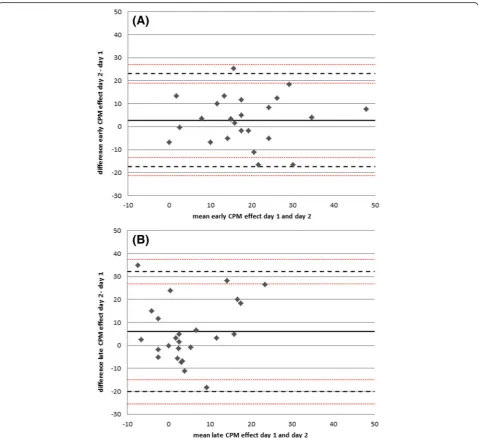
parameters were calculated to reflect the sensitivity of change of the early and late CPM effect. Measuring the magnitude of the CPM effects, it is not only important to calculate the ICC, but also to be able to evaluate changes due to an intervention e.g. a pharmacological treatment. The standard error of measurement indi-cates the expected error between two measurements conducted under the same circumstances in the same subject over a defined period of time, and should not be confused with the standard error of mean (also ab-breviated as SEM). The lower the standard error of measurement, the better the test-retest-reliability [34, 35]. The SRD, as the 95 % confidence interval of the SEM, indicates the change in value that cannot be interpreted as random scatter between two measurements in an individual, but has to be assigned to change of circum-stances, i.e. a treatment or intervention effect. Bland-Altman-plots were conducted as a graphical interpret-ation [36], displaying the relinterpret-ationship between the mean CPM-effect on day 1 and day 2 on the x-axis, and the difference between CPM effects of day 2 and day 1 for each subject on the y-axis, separately for both early and late CPM-effect. An important part of an analysis of reliability is the assessment not only of mean differ-ences, but also of the variance of these differdiffer-ences, as reliability is more important for single subjects than for groups of subjects [37]. In Bland-Altman-plots, both in-dividual effects and effects estimated on the basis of the study group can be seen: the mean difference (i.e. bias) between day 2 - day 1 is marked as a bold line and the estimated 95 % limits of agreement (LoA) as thin lines, and their 95 % confidence intervals as dashed lines. The 95 % LoA represent the range of limits in which 95 % of the data are expected to lie, based on the study population [37], their confidence intervals indicate the level of uncertainty due to the variance in the dataset and the limited number of subjects in the study popula-tion. The lower the limits, the closer the values between both measurements and the better the reliability.
As recommended by Biurrun Manresa et al. [12], the clinical relevance of reliability results can become evi-dent by calculating the estimated samples sizes. There-fore we calculated sample sizes for the early and late
reliability analysis, sample size = number of subjects each receiving different assessments) and parallel (i.e. inter-group reliability analysis, sample size = number of sub-jects for each group) study designs, following the guidelines described by Julious et al. [38]. The calcula-tion is based on the quescalcula-tion how many subjects are needed to treat (e.g. drugs, intervention) to elevate a
former “non responder” (mean CPM effect = 0) to a
“normal responder” (in the case of the present study
population: mean early CPM effect = 18 NRS points, and mean late CPM effect = 4 NRS points, see results). For this purpose, we built four subgroups analysing 25, 50, 75 and finally 100 % success of treatment.
Questionnaire data from the PSQ was correlated with the early and late CPM-effect using the Pearson correl-ation to compare self-reported informcorrel-ation on pain sen-sitivity in daily-life situations and the function of the descending pathways during the experimental setting. Additionally, the HADS scores were correlated with the early and late CPM-effect using the Pearson correlation to assess any association with the magnitude of depres-sion or anxiety scores (within the normal range).
For all analyses comprising QST data, data of the right hand was used. QST raw data was logarithmically trans-formed, except for PHS, CPT, HPT and PPT, as previously described [24]. All parameters (except PHS and DMA) were z-transformed to compare the data independently from age, gender and region, based on the existing DFNS reference data base [24] using the QST data analysis pro-gram eQuiSTA (Casquar GmbH, Bochum, Germany). Test-retest reliability analyses of the QST raw data were performed using the ICC.
Pearson’s product moment correlation was used to
as-sess the association between the QST raw values and the early and the late CPM-effect, respectively. Furthermore, we conducted a median-split analysis, separating sub-groups according to the magnitude of the early and late
CPM-effect (early CPM-effect: < 15 and≥15; late CPM:
effect < 3 and≥3, respectively) and comparing raw data
of each QST-parameter (after log-transformation)
be-tween these subgroups using the Mann–Whitney-U test
in order to detect discrete differences between both sub-groups, which do not appear in the correlation analysis considering the whole group.
Ap-value of 0.05 was considered to be statistically
sig-nificant, and Bonferroni corrections for multiple com-parisons were applied for each test group.
Results
Subjects’characteristics and baseline measures
Measurements were repeated within 40 ± 19.9 h. In all
subjects a TSinitial with a pain rating of 60 ± 5 on the
NRS (0–100) could be determined at both days with a
temperature between 45 and 49 °C. 6 subjects had a
difference of 1 °C in their TSinitialbetween both days. All
subjects could tolerate the 10 °C cold-water bath for 60s. Mild erythema was detected in all subjects in the appli-cation area of the thermode, disappearing within 30 min after testing. Two subjects complained about pain up to the shoulder and one about nausea during the cold-water immersion.
CPM magnitude on day 1 and day 2
On each day, all but one subject (96 %) had an early CPM-effect >0, indicating that the endogenous pain in-hibition during simultaneous cold-water immersion was induced in nearly all subjects. The subject without posi-tive early CPM-effect on both days was not the same. Regarding the whole study group on both days, the pain
rating for the TS before application of the CS (TSbefore)
significantly decreased during the simultaneous CS ap-plication (TSduring,p< 0.01), indicating also a statistically
relevant early CPM-effect (see Fig. 2a). The size of the early CPM-effect was 28 on day 1 and 33 % on day 2.
In contrast, a late CPM-effect > 0 was seen only in 14 subjects on day 1 (56 %) and 16 subjects on day 2 (64 %), indicating that endogenous pain inhibition lasted longer than 5 min after termination of the CS only in part of the subjects. 9 subjects (36 %) showed a late CPM-effect on both days, 4 subjects (16 %) presented no late CPM-effect on both days. The group analysis re-vealed a significant decrease of the pain ratings after CS application (TSbefore vs. TSafter) only on day 2 (p< 0.01,
day 1: p= 0.376; see Fig. 2b). The size of the late
CPM-effect was 3 on day 1 and 15 % on day 2.
Significant correlations between the magnitude of the pain ratings for the cold water immersion (CS) and the resulting CPM effect could not be observed.
Test-retest-reliability of conditioned pain modulation
After Bonferroni correction for multiple testing there were no significant differences between both days
re-garding the reported pain intensities (NRS, 0–100) for
TSinitial, TSbefore, TSduring, CS30s and CS60s, the early
CPM-effect or the late CPM-effect (Table 2). Only the
pain ratings for TSafterwere significantly lower on day 2.
Each of the individual parameters of the CPM protocol demonstrated a significant close to moderate correlation between both days based on the ICC (Table 1). Concern-ing the composite parameters, the correlation of the early CPM-effect between both days was good; however, there was no significant correlation of the late CPM-effect between both days.
For the early CPM-effect the standard error of
meas-urement (SEM) was 7.3 on the 0–100 NRS scale,
a change larger than 20.2 NRS points for the early CPM effect, and 27.0 NRS points for the late CPM effect in an individual case has to be assigned to a real change and not random scatter between measure-ments (Table 2).
Given the fact, that a CPM “non-responder” might
have a CPM effect of 0, and a “normal responder”
might have a mean CPM effect with 18 NRS points
for the early CPM effect, and 4 NRS points for the late CPM effect (Table 2), we calculated hypothetical sample sizes for crossover and parallel designs in terms of successful treatment (Table 3). In case of 50 % treatment success after an intervention, 18 sub-jects are needed to confirm this hypothesis in the crossover design, and 68 subjects in the parallel de-sign for the early CPM effect. For the late CPM effect
the number of subjects needed to confirm such a hy-pothesis is beyond the clinical relevance.
The Bland-Altman Plot for the early CPM effect (Fig. 3a) showed a range for the 95 limits of agreement
(LoA) between −17.4 (95 CI: −21.5…-13.4) NRS points
(0–100) and 23.0 (95 % CI: 19.0…27.1) NRS points. The
late CPM effect (Fig. 3b) showed a range for the 95 LoA
between −20.2 (95 CI: −25.4… -15.0) NRS points and
32.1 (95 % CI: 26.9… 37.3) NRS points (Table 2).
Re-garding the absolute range, the limits for the late CPM effect were approximately 30 % wider than for the early CPM effect. Figure 3a shows all values evenly distributed around the mean difference (bold line = bias), 11/25 subjects are below the mean difference, 14/25 subjects above, indicating no systematic deviation between the measurements, that could be assigned, for example,
to learning effects (correlation r= 0.019, p= 0.928).
The mean early CPM effect between both days ranges
between 0–50 NRS points, the mean difference
be-tween−17 and + 18 NRS points. The range for the mean
late CPM effect between both days is between−8 and 25
NRS points, the mean difference between −19 and +33
NRS points.
The early and late CPM-effect did not correlate
signifi-cantly neither on day 1 (r= 0.330, p= 0.107) nor on day
2 (r= 0.375,p= 0.065).
Quantitative sensory testing
Test-retest reliability of quantitative sensory testing
After z-transformation, all subjects showed QST
param-eters within the normal range between −1.96 and 1.96,
as expected. One male subject (63 years) reported 1 (of 3) paradoxical heat sensations on day 1. None of the subjects had dynamic mechanical allodynia.
In the whole study group, all QST parameters corre-lated significantly between day 1 and day 2 (ICC =
0.450…0.916) except for the cold detection threshold
(CDT, ICC = 0.265).
Correlation of quantitative sensory testing and CPM-effects
There were no significant correlations between the mag-nitude of the early and late CPM-effect and all QST pa-rameters, which were present at both days. After Bonferroni correction, the correlation between the heat pain threshold (HPT) and the late CPM-effect on day 2
was not significant (r=− 0.401, p= 0.047, Table 4).
Table 1Parameters of the Conditioned Pain Modulation (CPM) assessment
t-test (p)a Intraclass correlation coefficientb
day 1 day 2 day 1 vs. day 2
TS temperature rated with NRS 60 (°C) total 47.5 ± 1.1 (45…49) 47.5 ± 1.0 (46…49) 0.999 0.881 (p< 0.001)**
Pain rating of TSinitial total 64.6 ± 6.8 (55…80) 64.6 ± 8.4 (45…80) 0.974 0.679 (p< 0.001)**
Mean of three pain rating of TSbefore total 60.5 ± 7.9 (50…82) 58.4 ± 5.8 (50…70) 0.376 0.411 (p< 0.05)
Pain rating of CS30s total 57.7 ± 17.9 (20…90) 56.7 ± 19.3 (20…88) 0.698 0.765 (p< 0.001)**
Mean of three pain rating of TSduring total 43.7 ± 10.0 (26…62) 38.9 ± 14.3 (10…65) 0.018 0.702 (p< 0.001)**
Pain rating of CS60s total 66.3 ± 20.1 (30…90) 67.5 ± 21.7 (30…95) 0.515 0.906 (p< 0.001)**
Mean of three pain rating of TSafter total 58.8 ± 11.7 (40…82) 50.8 ± 11.7 (23…70) 0.003* 0.480 (p< 0.01)
Pain rating of CS30s after total 57.9 ± 18.5 (15…85) 55.6 ± 19.3 (20…95) 0.282 0.843 (p< 0.001)**
Pain rating of CS60s after total 70.8 ± 19.2 (18…90) 69.5 ± 20.3 (20…95) 0.355 0.946 (p< 0.001)**
Early CPM effect total 16.7 ± 11.7 (−5…44) 19.5 ± 11.9 (−3…52) 0.187 0.618 (p< 0.001)**
Late CPM effect total 1.7 ± 9.2 (−25…18) 7.6 ± 11.5 (−5…37) 0.035 0.178 (p= 0.192)
All values are presented as mean ± SD and range. All data represent pain ratings on the numeric rating scale (NRS, 0–100), unless otherwise indicated.CS
conditioning stimulus,TStest stimulus;CPMconditioned pain modulation. The early CPM effect is calculated as the difference between mean pain ratings of TSbeforeand TSduring. The late CPM effect is calculated as the difference between the mean pain ratings of TSbeforeand TSafter
a
paired t-test CPM-effect day 1 vs. day 2
b
Intraclass Correlation Coefficient (ICC) between CPM parameters day 1 and day 2 *p< 0.005 (after Bonferroni correction)
**p
< 0.005 (after Bonferroni correction)
Table 2Test-retest-reliability analyses for the mean early and late CPM effect (day 1 vs. day 2),n= 25
Mean SD Bland-Altman analysis bias (lower LoA-upper LoA) ICC (95 % CI) SEM SRD
early CPM effect 18.1 11.8 2.8 (−17.4…23.0) 0.618 (0.302-0.811) 7.3 20.2
late CPM effect 4.6 10.7 6.0 (−20.2…32.1) 0.178 (−0.226-0.530) 9.7 27.0
Likewise, median split analyses regarding the early and late CPM-effect revealed no significant differences be-tween all QST parameters, which occurred on both days,
especially regarding the thermal (CPT: p= 0.609…0.936,
HPT: p= 0.344…0.936) and mechanical pain thresholds
(MPT: p= 0.244…0.979, PPT: p= 0.205…0.467) and
parameters of the stimulus–response-function (MPS:
p= 0.046…0.809, WUR, p= 0.470…0.979).
Questionnaires
The scores for the HADS were within the range for
healthy subjects (subscore for anxiety: 3.0 ± 2.2 (0…5);
subscore for depression: 1.4 ± 1.7 (0…5)). The mean PSQ
Table 3Hypothetical sample size calculations for crossover and parallel designs in terms of successful treatment
Patients return to normal CPM effect (rate of treatment success)
Early CPM effect Late CPM effect
Crossover Parallel Crossover Parallel
100 % 6 18 45 176
75 % 10 34 122 484
50 % 18 68 272 542
25 % 84 330 1084 4332
CPMConditioned Pain Modulation. Calculations are based on the question how many subjects are needed to treat to elevate“non responders”to “normal responders”in case of 25/ 50/ 75/ 100 % treatment success. All values are given as the number of subjects for each group
scores (3.4 ± 1.4 (0.6…6.1) were similar to the data for healthy subjects originally reported by the authors (3.6 ± 1.2 [30]).
Regarding the whole study group, no significant corre-lations were found between PSQ, HADS overall score and subscores for anxiety and depression and the early or late CPM-effect.
Discussion
To summarize, we induced endogenous pain inhib-ition with CPM-effect >0 using cold-water immersion as CS in almost all healthy subjects on both days. However, in >1/3 of them it lasted for less than 5 min after the CS termination. The absolute magni-tude of the early CPM-effect (during simultaneous CS application) was similar on both days and was con-sistent with most of the previous studies [20], though in contrast to some others, which reported lower [39, 40] or higher CPM-effects [17, 41, 42]. For the early CPM-effect, the test-retest-reliability within the period of 24-72 h assessed in healthy subjects showed a SEM of about 40 % of the mean and a SRD of 20
(on the NRS 0–100). In contrast, the reliability of the
late CPM-effect, assessed 5 min after CS termination, was rather insufficient, represented in a SRD nearly six times bigger than the mean effect, making the de-tection of a real change between two assessments within a subject nearly impossible and estimated sam-ple sizes for experimental studies rather unrealistic. Neither thermal nor mechanical pain thresholds, nor QST parameters comprising suprathreshold stimuli correlated with either CPM-effect.
Differences between the CPM paradigms regarding the test-re-test-reliability
So far, nine studies have been published analysing the test-retest reliability of different CPM paradigms, than
the one we used [10–18]. Three of them analysed the
re-liability in chronic pain patients or in an experimental pain model for acute musculoskeletal pain [13, 14, 18]. The remaining six studies analysed the test-retest-reliability in healthy subjects using the nociceptive with-drawal reflex (NWR), electric, pressure or heat pain as TS and cold- or hot-water baths and ischemia as CS. Three studies reported similar ICC as in our study ran-ging between 0.54 and 0.69 [10, 11, 15]. However, two studies reported insufficient reliability based on ICC: Biurrun et al. used NWR thresholds, electrical pain thresholds and suprathreshold electrical pain as TS and cold-water bath as CS with ICC of 0.09 to 0.44 within
1–3 weeks for suprathreshold electrical pain [12].
An-other study in healthy females used heat both as TS and CS and achieved ICC = 0.39 for retests over a period of
7–10 months [16]. In contrast, our study concentrated
on the short-term test-retest-reliability, which might explain the better ICC, pointing to a more stable CPM-effect over shorter periods of time. Choosing an ap-propriate time period for reassessment is an important as-pect. While re-assessment over very short time periods of 60 min or less [Cathcard2009; Lewis2012] might be more reliable, very short time periods might be insufficient to expect a real treatment effect when examining e.g. changes in the CPM-effect due to an intervention. On the other hand longer time periods between reassessments implicate changed external conditions which might influ-ence the results, especially when examining patients, also
Table 4Correlational analyses between CPM effects and QST parameters at day 1 and day 2
Pearson’s correlation coefficient
QST vs. early CPM effect day 1 QST vs. early CPM effect day 2 QST vs. late CPM effect day 1 QST vs. late CPM effect day 2
CDT (log) total 0.008 (p= 0.969) −0.080 (p= 0.704) −0.143 (p= 0.497) 0.311 (p= 0.131)
WDT (log) total −0.175 (p= 0.402) −0.017 (p= 0.935) −0.125 (p= 0.553) −0.133 (p= 0.528)
TSL (log) total −0.136 (p= 0.517) −0.096 (p= 0.648) 0.108 (p= 0.608) 0.088 (p= 0.675)
CPT (°C) total 0.059 (p= 0.778) 0.158 (p= 0.449) 0.055 (p= 0.795) 0.349 (p= 0.088)
HPT (°C) total −0.103 (p= 0.624) −0.087 (p= 0.679) 0.065 (p= 0.757) −0.401 (p= 0.047)
MDT (log) total −0.103 (p= 0.624) 0.042 (p= 0.840) 0.057 (p= 0.787) 0.122 (p= 0.561)
MPT (log) total 0.210 (p= 0.314) −0.020 (p= 0.923) 0.203 (p= 0.330) −0.213 (p= 0.308)
MPS (log) total 0.049 (p= 0.815) −0.202 (p= 0.333) −0.142 (p= 0.500) 0.020 (p= 0.926)
WUR (log) total −0.118 (p= 0.574) −0.200 (p= 0.338) −0.042 (p= 0.843) 0.211 (p= 0.312)
VDT (n/8) total 0.317 (p= 0.122) 0.336 (p= 0.100) 0.217 (p= 0.297) −0.129 (p= 0.538)
PPT (log) total −0.085 (p= 0.687) −0.011 (p= 0.959) 0.184 (p= 0.380) −0.337 (p= 0.100)
Correlational analyses between each QST parameter (logarithmically transformed, except forCPTHPT, VDT) and the CPM effect’s magnitude were conducted using Pearson’s Correlation Coefficient for measurements at day 1 and day 2.CDTCold Detection Threshold,CPTCold Pain Threshold,HPTHeat Pain Threshold,MDT Mechanical Detection Threshold,MPSMechanical Pain Sensitivity;MPTMechanical Pain Threshold,PPTPressure Pain Threshold,QSTQuantitative Sensory Testing,
in relatively short term of about 1 week [13, 14] which is pronounced in male patients [13]. There is also some evi-dence, that different CPM paradigms engage different
spinal or supraspinal inhibitory mechanisms [43–45]; e.g.,
the magnitude and stability of CPM-effects with the use of subjectively reported pain intensities was shown to be stronger than objective measures like the NWR [44, 45].
Furthermore, most studies reported only ICC values as
measure for test-retest-reliability [10, 11, 13–16]. One
study showed higher ICC values for the CPM-effect based on subjective pain ratings compared to electro-physiological responses during the NWR (ICC 0.44 vs 0.26, [12]), while another reported similar ICC values over 28 days for both TS (ICC 0.54 vs 0.61, [11]). It has been previously discussed that cognitive influences may represent a stable confounder between test and retest session, thus explaining the slightly better reliability in our study in comparison to a study examining the CPM elicited by the same CS based on electrophysiological measures [12]. Only a few studies conveyed ICC analysis also of the single parameters during CPM assessment, i.e. of CS as well as TS before, during and after CS appli-cation). In terms of the ICC, the pain rating of the CS in our study indicated excellent reliability with higher values (ICC 0.77-0.95) than previously reported when using the same CS in patients with chronic pain (ICC 0.61-0.67) [13] and similar ICC as when heat was used as CS (ICC 0.79) [16]. Though tonic heat has been previ-ously suggested to be more constant and less con-founded by changes in cardiovascular activity in healthy subjects compared with cold water stimuli [11, 46], our results suggest that both conditioning stimuli are at least comparable regarding their retest-reliability. The current evidence suggests that both tonic cold and heat stimuli as CS seem to be superior to cuff occlusion as CS, as the latter was able to induce a reliable CPM effect only up to 60 min, but not over a period of 3 days, [10, 15].
Only two reported SEM and SRD values [12, 18], which allow much more realistic estimation of the clin-ical relevance in terms of evaluating the outcome after intervention based on the CPM-effect. While Biurrun et al. [12] studied a completely different CPM-paradigm with electrical stimulation as TS, Valencia et al. assessed similar protocol as ours with repeatedly applied heat pulses as TS and cold pain as CS and reported a minimal detectable change of about 17 in the healthy cohort for re-test measurement within two minutes independently on the fact whether additionally the healthy subjects ex-perienced exercise induced muscle pain or not [18].
For the first time, we report a smallest real difference for the commonly used protocol within a re-test period of 24-72 h, an interval which might be more relevant in term of evaluation a therapeutic interventions based on the CPM-effect. Our results depict that, using the
presented protocol with respect to the early CPM-effect, a smallest real difference more than 20 points on
the 0–100 NRS between two measurements in a healthy
individual is relevant and can be assigned to change of circumstances, and is not a random scatter. In accord-ance to our findings, in a subgroup of patients with polyneuropathy, who did not have any pain relief after duloxetin treatment, presented with a more efficient CPM already prior to treatment and the CPM-effect changed on average about 10 on a 101-point NRS after treatment [21]. In contrast, in the subgroup of patients with sufficient pain relief after treatment with duloxetin, the change in CPM-effect was on average 15. This repre-sents a value below the calculated SRD in our study and indicates that in pathological states with impaired CPM even smaller changes than in healthy states, might be clinical relevant. On the other hand, it implicates that further studies examining the test-retest-reliability in pa-tients with chronic pain and CPM impairment without intervention between the measurements are needed to strengthen this hypothesis.
Only one study evaluated the reliability of a CPM paradigm by calculating sample sizes for potential exper-iments, thus using a clinically more relevant parameter than the pure calculation of the ICC [12]. Under the ex-perimental conditions described here, the sample sizes and consequently the reliability of the early CPM-effect are certainly acceptable and realistic for experimental or clinical use, especially for a crossover design (Table 3). For example, in case of an intervention, which is intended to normalize the CPM-effect in 50 % of the treated patients, who were previously incapable to acti-vate their CPM, one would need a study sample of at least 18 subjects for crossover and 68 subjects for paral-lel design to detect a significant change after the inter-vention. Such estimations for calculating hypothetical sample sizes should be demanded also for other studies on re-test-reliability, as they provide a much more realis-tic measure for the clinical relevance of the data than statistical measures like the ICC.
Persistence of the CPM effect after termination of the conditioning stimulus
In our study, the late CPM-effect, i.e. endogenous inhib-ition lasting for at least 5 min after CS termination, was smaller than the early CPM-effect, in line with previous studies [8, 41, 47, 48]. It also varied largely between both days, though statistically not significant after Bonferroni
correction, resulting in its insufficient
is simply the result of distraction by the painful cold-water bath. Though, combined distraction and CPM induced greater pain reduction than either alone [49]. Moreover, different extents of cortical activation in frontal and som-atosensory areas were found by distraction and by CPM [50]. Our findings point to an influence of distraction on
CPM, but nevertheless support the existence of a “real”
CPM-effect, which however seems to have a higher inter-individual variability. One study reported no late CPM-effect at all [51], whereas another found greater and longer lasting effects of pain inhibition [52], both assessing the CPM-effect as change in the TS intensity (pain threshold) and not of the pain intensity as in our protocol. These in-consistent findings indicate that the duration of the CPM-effect after CS termination might differ depending on the applied stimuli, but also depending on the chosen read-out, i.e. change in pain intensity of a predefined stimulus or change of pain threshold.
Correlations between CPM and detection/ pain thresholds as well as suprathreshold stimulation
Another objective of the present study was to assess pos-sible correlations between the CPM-effects and parameters of a standardized QST-protocol. Theoretically, subjects can be positioned in a continuum between pro- and
anti-nociception, e.g., a“pro-nociceptive subject” would have a
low CPM-effect and show low pain thresholds and high pain ratings for suprathreshold stimuli in his sensory pro-file [9]. Surprisingly, we found no correlations between QST parameters and the early or late CPM-effect. Previous studies on CPM using pain thresholds as TS showed suffi-cient CPM-effects resulting in pain threshold increase [2, 53, 54]. However, whilst others analysed pain thresh-olds as TS, i.e. read-out for the CPM-effect, we analysed for the first time correlations between the sensory profile and the CPM-magnitude. Despite applying the same stim-uli, our CPM paradigm uses suprathreshold stimstim-uli, whereas during the QST according to the DFNS-protocol mainly subthreshold stimuli are applied, i.e. until the first perception of pain. These thermal and mechanical pain thresholds did not correlate with the early and late CPM-effect. Suprathreshold stimulation within the DFNS-protocol is only conducted using pinpricks assessing the mechanical pain sensitivity and the wind-up ratio, but they were also not associated with the CPM-effects, probably pointing to different neuronal pathways [21, 22, 43, 55]. Given the high reliability of the QST parameters of the DFNS-protocol [23], replicated in this study, the rather large variability of the CPM magnitude seems not to influ-ence the parameters of the sensory profile.
Influencing factors on the magnitude of the CPM-effect
Depression and anxiety have been shown to partly
influ-ence pain thresholds and suprathreshold testing [55–59]
and are linked to neurotransmitters deficiency including serotonin and dopamine, which are also involved in the
de-scending nociceptive inhibitory pathways [60–62]. As
ex-pected, in our sample of heathy subjects all HADS scores were within the normal range [29, 63]. Thus, analysing the relationship between these psychiatric symptoms and CPM was not diagnostically conclusive, though there was no cor-relation with the early or the late CPM-effect. Also the PSQ exploring the perception of potential daily life pain [30] did not correlate with CPM-effects. This was some-how unexpected, as the PSQ score was reported to correl-ate significantly with experimental pain ratings in healthy subjects having similar PSQ scores as our study population [30]. However, because PSQ-score correlates with QST pa-rameters [30] and QST does not correlate with CPM-effects in the present study our results are not unexpected. For pain patients any associations to both psychometric scales should be further explored.
Limitations
In our study, we used an established protocol [7], where-upon the TS calibration was conducted with a 7 s tonic heat stimulus, while the TS during the CPM procedure lasted 30 s. Time is a critical parameter with regard to pain intensity, as either habituation or sensitisation can occur during application of long-lasting stimuli. In fu-ture studies, the same length of TS application for the calibration and during CPM-testing should be consid-ered. Another point was that the CS was not individually calibrated. Though the used cold-water immersion was reported to be a sufficient CS [7, 17], the high variability of the perceived cold pain intensity might account for the lack of individualized CS calibration. As a psycho-physical method, CPM is susceptible to emotional and cognitive factors, such as expectation [64, 65], stress [40] or distraction [40, 49], which might play a role in our study as subjects were not initially familiarized with the CPM procedure. This might explain the higher CPM-effects on day 2, when they were more accustomed to the situation. For future studies, familiarization with the experimental set-up should be obligate. Also experienced and non-experienced subjects should not be included into one study, and information about the familiarization procedures should be reported in detail.
produced significantly more pain reduction than the ha-bituation paradigm and the paradigm involving non-noxious inhibitory control [67]. Granot et al. [7] using the very same CPM protocol as we did, have also found that only immersion of the dominant hand in 12 °C cold and 46.5 °C hot water, but not in the conditions with less painful cold or warm water, elicited a significant CPM-effect comparable to that in our study.
Due to organisational reasons the time interval
be-tween both CPM-assessments ranged bebe-tween 1–3 days.
Thus, possible learning effects might have influenced the results of subjects with 24-h-intervals in-between CPM-assessments differently than those with longer breaks. Our aim was not to analyse gender differences, which explains the comparatively small chosen sample size. The sample variability within the group with subjects be-tween 21 and 69 years, might have been quite high, as it is well known that age and sex can affect attentional processes. Though, to minimize such effects, we comple-mented our analyses for the standard error of measure-ment to compare not only interindividual, but also intraindividual differences. Furthermore we did not spe-cify the menstrual cycle phase in all female subjects. On this issue, there exist divergent opinions: Rezaii et al. showed that female sex hormones modulate CPM [68], while Wilson et al. demonstrated no variations between CPM during the menstrual cycle [16]. Further reliability studies using the heat-cold-pain method for CPM are needed with a larger sample size to analyse gender and differences regarding the retest-reliability and differences during the menstrual cycle, as appropriate. Additionally, the retest-reliability for longer time-intervals such as weeks or months should be also further examined, which are more relevant for follow-ups in chronic pain patients. For principle reasons, the validity of this method in pa-tients cannot be evaluated in healthy subjects. Accord-ingly, also the clinical relevance of the early and especially of the late CPM-effect needs further exploration.
Conclusions
In conclusion, we evaluated the most commonly used method for CPM with heat and cold pain as TS and CS, respectively, demonstrating a sufficient reliability for the early CPM-effect and associated parameters within 48 h, but not for the late CPM-effect. Based on the SRD and SEM as well as considering the above-mentioned limita-tions, sample size calculations for studies using CPM-effect, evaluated during simultaneous application of tonic heat as TS and tonic pain as CS, as a primary outcome are realistic for experimental or clinical use. Based on our hypothetical sample size calculations crossover design should be preferred rather than par-alleled design, due to the high interindividual variabil-ity of endogenous analgesia.
Acknowledgements
We are indebted to the subjects who participated in this study for their consent and cooperation.
Funding
There was no specific funding for this study; this work is part of the doctoral thesis of Julia Gehling. Regarding the publication fees, we acknowledge support by the Open Access Publication Funds of the Ruhr-Universität Bochum.
Availability of data and material
The datasets during and/or analysed during the current study is available from the corresponding author on reasonable request.
Authors’contributions
All authors contributed to the conception and design of the study, collaborated on the statistical analysis of the data, discussed the results, participated in writing the manuscript and approved the final version. JG conducted all study experiments.
Competing interests
The authors declare that they have no competing interests.
Consent for publication
Not applicable.
Ethics approval and consent to participate
The study protocol was in accordance with the latest version of the Declaration of Helsinki and approved by the local ethics committee of the Faculty of Medicine, Ruhr-University Bochum, Germany (Reg. Nr. 4321–12, NCT01618604). Before starting the assessment, the study was described in its entirety to the subjects and they all gave their written informed consent to participate.
Author details
1
Department of Pain Medicine, Berufsgenossenschaftliches Universitätsklinikum Bergmannsheil GmbH, Ruhr-University Bochum, Bürkle-de-la-Camp-Platz 1, 44789 Bochum, Germany.2Department of Neurology, University Medical Center Hamburg-Eppendorf, Martinistraße 52, 20246 Hamburg, Germany.3Department of Anaesthesiology, Intensive Care and Pain Medicine, University Hospital Münster, Albert-Schweitzer-Campus 1, GB A1, 48149 Münster, Germany.4Department of Neurology,
Berufsgenossenschaftliches Universitätsklinikum Bergmannsheil GmbH, Ruhr-University Bochum, Bürkle-de-la-Camp-Platz 1, 44789 Bochum, Germany.
Received: 12 December 2015 Accepted: 27 July 2016
References
1. Chang L. Brain responses to visceral and somatic stimuli in irritable bowel syndrome: a central nervous system disorder? Gastroenterol Clin North Am. 2005;34(2):271–9. doi:10.1016/j.gtc.2005.02.003.
2. Kosek E, Ordeberg G. Lack of pressure pain modulation by heterotopic noxious conditioning stimulation in patients with painful osteoarthritis before, but not following, surgical pain relief. Pain. 2000;88(1):69–78. 3. Staud R, Robinson ME, Vierck Jr CJ, Price DD. Diffuse noxious inhibitory
controls (DNIC) attenuate temporal summation of second pain in normal males but not in normal females or fibromyalgia patients. Pain. 2003;101(1–2):167–74.
4. Yarnitsky D, Crispel Y, Eisenberg E, Granovsky Y, Ben-Nun A, Sprecher E, et al. Prediction of chronic post-operative pain: pre-operative DNIC testing identifies patients at risk. Pain. 2008;138(1):22–8. doi:10.1016/j. pain.2007.10.033.
5. Grosen K, Vase L, Pilegaard HK, Pfeiffer-Jensen M, Drewes AM. Conditioned pain modulation and situational pain catastrophizing as preoperative predictors of pain following chest wall surgery: a prospective observational cohort study. PLoS One. 2014;9(2):e90185. doi:10.1371/journal.pone.0090185. 6. Yarnitsky D, Granot M, Granovsky Y. Pain modulation profile and pain
7. Granot M, Weissman-Fogel I, Crispel Y, Pud D, Granovsky Y, Sprecher E, et al. Determinants of endogenous analgesia magnitude in a diffuse noxious inhibitory control (DNIC) paradigm: do conditioning stimulus painfulness, gender and personality variables matter? Pain. 2008;136(1–2):142–9. doi:10. 1016/j.pain.2007.06.029.
8. Fujii K, Motohashi K, Umino M. Heterotopic ischemic pain attenuates somatosensory evoked potentials induced by electrical tooth stimulation: diffuse noxious inhibitory controls in the trigeminal nerve territory. Eur J Pain. 2006;10(6):495–504. doi:10.1016/j.ejpain.2005.07.002.
9. Yarnitsky D, Bouhassira D, Drewes AM, Fillingim RB, Granot M, Hansson P, et al. Recommendations on practice of conditioned pain modulation (CPM) testing. Eur J Pain. 2014. doi:10.1002/ejp.605.
10. Lewis GN, Heales L, Rice DA, Rome K, McNair PJ. Reliability of the conditioned pain modulation paradigm to assess endogenous inhibitory pain pathways. Pain Res Manag. 2012;17(2):98–102.
11. Jurth C, Rehberg B, von Dincklage F. Reliability of subjective pain ratings and nociceptive flexion reflex responses as measures of conditioned pain modulation. Pain Res Manag. 2014;19(2):93–6.
12. Biurrun Manresa JA, Fritsche R, Vuilleumier PH, Oehler C, Morch CD, Arendt-Nielsen L, et al. Is the conditioned pain modulation paradigm reliable? A test-retest assessment using the nociceptive withdrawal reflex. PLoS One. 2014;9(6):e100241. doi:10.1371/journal.pone.0100241.
13. Martel MO, Wasan AD, Edwards RR. Sex differences in the stability of conditioned pain modulation (CPM) among patients with chronic pain. Pain Med. 2013;14(11):1757–68. doi:10.1111/pme.12220.
14. Olesen SS, van Goor H, Bouwense SA, Wilder-Smith OH, Drewes AM. Reliability of static and dynamic quantitative sensory testing in patients with painful chronic pancreatitis. Reg Anesth Pain Med. 2012;37(5):530–6. doi:10. 1097/AAP.0b013e3182632c40.
15. Cathcart S, Winefield AH, Rolan P, Lushington K. Reliability of temporal summation and diffuse noxious inhibitory control. Pain research & management : the journal of the Canadian Pain Society = journal de la societe canadienne pour le traitement de la douleur. 2009;14(6):433–8. 16. Wilson H, Carvalho B, Granot M, Landau R. Temporal stability of conditioned
pain modulation in healthy women over four menstrual cycles at the follicular and luteal phases. Pain. 2013;154(12):2633–8. doi:10.1016/j.pain. 2013.06.038.
17. Oono Y, Nie H, Matos RL, Wang K, Arendt-Nielsen L. The inter- and intra-individual variance in descending pain modulation evoked by different conditioning stimuli in healthy men. Scandinavian Journal of Pain. 2011;2(4):162–9.
18. Valencia C, Kindler LL, Fillingim RB, George SZ. Stability of conditioned pain modulation in two musculoskeletal pain models: investigating the influence of shoulder pain intensity and gender. BMC Musculoskelet Disord. 2013; 14(1):182. doi:10.1186/1471-2474-14-182.
19. Werner MU, Petersen MA, Bischoff JM. Test-retest studies in quantitative sensory testing: a critical review. Acta Anaesthesiol Scand. 2013;57(8): 957–63. doi:10.1111/aas.12150.
20. Pud D, Granovsky Y, Yarnitsky D. The methodology of experimentally induced diffuse noxious inhibitory control (DNIC)-like effect in humans. Pain. 2009;144(1–2):16–9. doi:10.1016/j.pain.2009.02.015.
21. Yarnitsky D, Granot M, Nahman-Averbuch H, Khamaisi M, Granovsky Y. Conditioned pain modulation predicts duloxetine efficacy in painful diabetic neuropathy. Pain. 2012;153(6):1193–8. doi:10.1016/j.pain.2012. 02.021.
22. Rolke R, Baron R, Maier C, Tolle TR, Treede RD, Beyer A, et al. Quantitative sensory testing in the German Research Network on Neuropathic Pain (DFNS): standardized protocol and reference values. Pain. 2006;123(3):231– 43. doi:10.1016/j.pain.2006.01.041.
23. Geber C, Klein T, Azad S, Birklein F, Gierthmuhlen J, Huge V, et al. Test-retest and interobserver reliability of quantitative sensory testing according to the protocol of the German Research Network on Neuropathic Pain (DFNS): a multi-centre study. Pain. 2011;152(3):548–56. doi:10.1016/j.pain.2010.11.013.
24. Magerl W, Krumova EK, Baron R, Tolle T, Treede RD, Maier C. Reference data for quantitative sensory testing (QST): refined stratification for age and a novel method for statistical comparison of group data. Pain. 2010;151(3): 598–605. doi:10.1016/j.pain.2010.07.026.
25. Ziegler EA, Magerl W, Meyer RA, Treede RD. Secondary hyperalgesia to punctate mechanical stimuli. Central sensitization to a-fibre nociceptor input. Brain. 1999;122(Pt 12):2245–57.
26. Woolf CJ. Central sensitization: implications for the diagnosis and treatment of pain. Pain. 2011;152(3 Suppl):S2–15. doi:10.1016/j.pain.2010.09.030. 27. Oldfield RC. The assessment and analysis of handedness: the Edinburgh
inventory. Neuropsychologia. 1971;9(1):97–113.
28. Herrmann C. International experiences with the hospital anxiety and depression scale–a review of validation data and clinical results. J Psychosom Res. 1997;42(1):17–41.
29. Zigmond AS, Snaith RP. The hospital anxiety and depression scale. Acta Psychiatr Scand. 1983;67(6):361–70.
30. Ruscheweyh R, Marziniak M, Stumpenhorst F, Reinholz J, Knecht S. Pain sensitivity can be assessed by self-rating: development and validation of the pain sensitivity questionnaire. Pain. 2009;146(1–2):65–74. doi:10.1016/j.pain. 2009.06.020.
31. Granot M, Granovsky Y, Sprecher E, Nir RR, Yarnitsky D. Contact heat-evoked temporal summation: tonic versus repetitive-phasic stimulation. Pain. 2006; 122(3):295–305. doi:10.1016/j.pain.2006.02.003.
32. Hollins M, Harper D, Maixner W. Changes in pain from a repetitive thermal stimulus: the roles of adaptation and sensitization. Pain. 2011;152(7):1583–90. doi:10.1016/j.pain.2011.02.049.
33. Tesarz J, Gerhardt A, Schommer K, Treede RD, Eich W. Alterations in endogenous pain modulation in endurance athletes: an experimental study using quantitative sensory testing and the cold-pressor task. Pain. 2013; 154(7):1022–9. doi:10.1016/j.pain.2013.03.014.
34. Weir JP. Quantifying test-retest reliability using the intraclass correlation coefficient and the SEM. J Strength Cond Res. 2005;19(1):231–40. doi:10. 1519/15184.1.
35. Harvill LM. Standard error of measurement. Educ Meas Issues Pract. 1991;10: 33–41.
36. Bland JM, Altman DG. Comparing methods of measurement: why plotting difference against standard method is misleading. Lancet. 1995;346(8982): 1085–7.
37. Grouven U, Bender R, Ziegler A, Lange S. Vergleich von Messmethoden. Dtsch Med Wochenschr. 2007;132:e69–73.
38. Julious SA, Campbell MJ. Tutorial in biostatistics: sample sizes for parallel group clinical trials with binary data. Stat Med. 2012;31(24):2904–36. doi:10. 1002/sim.5381.
39. Edwards RR, Fillingim RB, Ness TJ. Age-related differences in endogenous pain modulation: a comparison of diffuse noxious inhibitory controls in healthy older and younger adults. Pain. 2003;101(1–2):155–65.
40. Quiton RL, Greenspan JD. Sex differences in endogenous pain modulation by distracting and painful conditioning stimulation. Pain. 2007;132 Suppl 1: S134–49. doi:10.1016/j.pain.2007.09.001.
41. Willer JC, De Broucker T, Le Bars D. Encoding of nociceptive thermal stimuli by diffuse noxious inhibitory controls in humans. J Neurophysiol. 1989;62(5): 1028–38.
42. Baad-Hansen L, Poulsen HF, Jensen HM, Svensson P. Lack of sex differences in modulation of experimental intraoral pain by diffuse noxious inhibitory controls (DNIC). Pain. 2005;116(3):359–65. doi:10.1016/j.pain.2005.05.006. 43. Nahman-Averbuch H, Martucci KT, Granovsky Y, Weissman-Fogel I, Yarnitsky
D, Coghill RC. Distinct brain mechanisms support spatial vs temporal filtering of nociceptive information. Pain. 2014;155(12):2491–501. doi:10. 1016/j.pain.2014.07.008.
44. Piche M, Arsenault M, Rainville P. Cerebral and cerebrospinal processes underlying counterirritation analgesia. J Neurosci. 2009;29(45):14236–46. doi: 10.1523/jneurosci.2341-09.2009.
45. Terkelsen AJ, Andersen OK, Hansen PO, Jensen TS. Effects of heterotopic-and segmental counter-stimulation on the nociceptive withdrawal reflex in humans. Acta Physiol Scand. 2001;172(3):211–7. doi:10.1046/j.1365-201x. 2001.00856.x.
46. Streff A, Kuehl LK, Michaux G, Anton F. Differential physiological effects during tonic painful hand immersion tests using hot and ice water. Eur J Pain. 2010;14(3):266–72. doi:10.1016/j.ejpain.2009.05.011.
47. Serrao M, Rossi P, Sandrini G, Parisi L, Amabile GA, Nappi G, et al. Effects of diffuse noxious inhibitory controls on temporal summation of the RIII reflex in humans. Pain. 2004;112(3):353–60. doi:10.1016/j.pain.2004.09.018. 48. Pickering G, Pereira B, Dufour E, Soule S, Dubray C. Impaired modulation of
pain in patients with postherpetic neuralgia. Pain Res Manag. 2014;19(1): e19–23.
50. Moont R, Crispel Y, Lev R, Pud D, Yarnitsky D. Temporal changes in cortical activation during distraction from pain: a comparative LORETA study with conditioned pain modulation. Brain Res. 2012;1435:105–17. doi:10.1016/j. brainres.2011.11.056.
51. Vaegter HB, Handberg G, Graven-Nielsen T. Similarities between exercise-induced hypoalgesia and conditioned pain modulation in humans. Pain. 2014;155(1):158–67. doi:10.1016/j.pain.2013.09.023.
52. Washington LL, Gibson SJ, Helme RD. Age-related differences in the endogenous analgesic response to repeated cold water immersion in human volunteers. Pain. 2000;89(1):89–96.
53. Oono Y, Baad-Hansen L, Wang K, Arendt-Nielsen L, Svensson P. Effect of conditioned pain modulation on trigeminal somatosensory function evaluated by quantitative sensory testing. Pain. 2013. doi:10.1016/j.pain.2013.07.049. 54. Razavi M, Hansson PT, Johansson B, Leffler AS. The influence of intensity
and duration of a painful conditioning stimulation on conditioned pain modulation in volunteers. Eur J Pain. 2013. doi:10.1002/j.1532-2149.2013. 00435.x.
55. Klauenberg S, Maier C, Assion HJ, Hoffmann A, Krumova EK, Magerl W, et al. Depression and changed pain perception: hints for a central disinhibition mechanism. Pain. 2008;140(2):332–43. doi:10.1016/j.pain.2008.09.003. 56. Uhl I, Krumova EK, Regeniter S, Bar KJ, Norra C, Richter H, et al. Association
between wind-up ratio and central serotonergic function in healthy subjects and depressed patients. Neurosci Lett. 2011;504(2):176–80. doi:10. 1016/j.neulet.2011.09.033.
57. Boettger MK, Grossmann D, Bar KJ. Thresholds and perception of cold pain, heat pain, and the thermal grill illusion in patients with major depressive disorder. Psychosom Med. 2013;75(3):281–7. doi:10.1097/PSY.
0b013e3182881a9c.
58. Terhaar J, Boettger MK, Schwier C, Wagner G, Israel AK, Bar KJ. Increased sensitivity to heat pain after sad mood induction in female patients with major depression. Eur J Pain. 2010;14(5):559–63. doi:10.1016/j.ejpain.2009.09. 004.
59. Vidor LP, Torres IL, Medeiros LF, Dussan-Sarria JA, Dall’agnol L, Deitos A, et al. Association of anxiety with intracortical inhibition and descending pain modulation in chronic myofascial pain syndrome. BMC Neurosci. 2014;15:42. doi:10.1186/1471-2202-15-42.
60. Ruhe HG, Mason NS, Schene AH. Mood is indirectly related to serotonin, norepinephrine and dopamine levels in humans: a meta-analysis of monoamine depletion studies. Mol Psychiatry. 2007;12(4):331–59. doi:10. 1038/sj.mp.4001949.
61. Treister R, Pud D, Eisenberg E. The dopamine agonist apomorphine enhances conditioned pain modulation in healthy humans. Neurosci Lett. 2013;548:115–9. doi:10.1016/j.neulet.2013.05.041.
62. Yoshimura M, Furue H. Mechanisms for the anti-nociceptive actions of the descending noradrenergic and serotonergic systems in the spinal cord. J Pharmacol Sci. 2006;101(2):107–17.
63. Bjelland I, Dahl AA, Haug TT, Neckelmann D. The validity of the hospital anxiety and depression scale. An updated literature review. J Psychosom Res. 2002;52(2):69–77.
64. Nir RR, Yarnitsky D, Honigman L, Granot M. Cognitive manipulation targeted at decreasing the conditioning pain perception reduces the efficacy of conditioned pain modulation. Pain. 2012;153(1):170–6. doi:10.1016/j.pain. 2011.10.010.
65. Grashorn W, Sprenger C, Forkmann K, Wrobel N, Bingel U. Age-dependent decline of endogenous pain control: exploring the effect of expectation and depression. PLoS One. 2013;8(9):e75629. doi:10.1371/journal.pone. 0075629.
66. Agostinho CM, Scherens A, Richter H, Schaub C, Rolke R, Treede RD, et al. Habituation and short-term repeatability of thermal testing in healthy human subjects and patients with chronic non-neuropathic pain. Eur J Pain. 2009;13(8):779–85. doi:10.1016/j.ejpain.2008.10.002.
67. Treister R, Eisenberg E, Gershon E, Haddad M, Pud D. Factors affecting - and relationships between-different modes of endogenous pain modulation in healthy volunteers. Eur J Pain. 2010;14(6):608–14. doi:10.1016/j.ejpain.2009. 10.005.
68. Rezaii T, Hirschberg AL, Carlstrom K, Ernberg M. The influence of menstrual phases on pain modulation in healthy women. J Pain. 2012;13(7):646–55. doi:10.1016/j.jpain.2012.04.002.
• We accept pre-submission inquiries
• Our selector tool helps you to find the most relevant journal
• We provide round the clock customer support
• Convenient online submission
• Thorough peer review
• Inclusion in PubMed and all major indexing services
• Maximum visibility for your research
Submit your manuscript at www.biomedcentral.com/submit