in the population sciences published by the Max Planck Institute for Demographic Research Konrad-Zuse Str. 1, D-18057 Rostock · GERMANY www.demographic-research.org
DEMOGRAPHIC RESEARCH
VOLUME 17, ARTICLE 29, PAGES 859-896
PUBLISHED 20 DECEMBER 2007
http://www.demographic-research.org/Volumes/Vol17/29/ DOI: 10.4054/DemRes.2007.17.29
Research Article
First child of immigrant workers and their
descendants in West Germany: Interrelation of
events, disruption, or adaptation?
Nadja Milewski
Special Collection 6: Interdependencies in the Life Course, edited by Hill Kulu and Nadja Milewski.
© 2007 Milewski
This open-access work is published under the terms of the Creative Commons Attribution NonCommercial License 2.0 Germany, which permits use, reproduction & distribution in any medium for non-commercial purposes, provided the original author(s) and source are given credit.
1 Introduction 860
2 Background 861
2.1 Theoretical considerations 861
2.2 The West German context 865
2.2.1 Immigrant workers to West Germany 865
2.2.2 The fertility of immigrant workers in West Germany and in their countries of origin
867
2.3 Working hypotheses 869
2.4 Data, variables, and method 871
2.4.1 Data 871
2.4.2 Covariates 873
2.4.3 Method 877
3 Results 877
4 Discussion 884
5 Acknowledgments 887
First child of immigrant workers and
their descendants in West Germany:
Interrelation of events, disruption, or adaptation?
Nadja Milewski1
Abstract
This paper investigates the impact of immigration on the transition to motherhood among women from Turkey, Italy, Spain, Greece, and the former Yugoslavia in West Germany. A hazard-regression analysis is applied to data of the German Socio-Economic Panel study. We distinguish between the first and second immigrant generation. The results show that the transition rates to a first birth of first-generation immigrants are elevated shortly after they move country. Elevated birth risks that occur shortly following the immigration are traced back to an interrelation of events – these are migration, marriage, and first birth. We do not find evidence of a fertility-disruption effect after immigration. The analysis indicates that second-generation immigrants are more adapted to the lower fertility levels of West Germans than their mothers’ generation is.
1 Nadja Milewski, Institut national d’études démographiques, 133, boulevard Davout, 75020 Paris, France.
1. Introduction
Since the middle of the 20th century, Western Europe has been faced with growing immigration flows. Although social research has focused on the first generation of international migrants, the interplay between international migration and the family dynamics of migrants has not been fully understood.
International migration is associated with a rapid change in the migrants’ environment. This change usually takes place within a much shorter time span than societies alter as a whole. Immigrants have to cope with these changes. Therefore, the study of the demographic behavior of migrants enables us to gain insights into the patterns and speed of the demographic responses of individuals or groups to sudden environmental alterations they are exposed to (Coleman 1994). The life-course approach allows us to analyze the sequencing of several events and therefore to study the short-term as well as the long-term effects of migration on a person’s life. Studies show, for example, that international migration often coincides with a social downward-trend of the migrants as to occupation, income, and housing conditions – just to name a few (Constant and Massey 2005). Internal or international migration and partner selection are frequently interrelated processes (Milewski 2003, Straßburger 2003, Kulu 2006), repeated moves have an impact on the sub-sequent stability of a union (Boyle et al. 2006), and the divorce risk of binational couples is higher than that of married partners who have the same nationality (Roloff 1998). When it comes to fertility, the impact of migration is discussed based on competing hypotheses to address the following questions: Does a migration and its related socio-economic consequences and cultural changes have a depressing impact or the opposite effect, i.e., a stimulating impact on childbearing behavior? Do migrants continue to display the behavior of their old environment or do they adopt the behavior of the new environment? And what are the mechanisms behind the respective behaviors?
The population of the second immigrant generation is growing in European receiving countries; it consists of persons who moved with their immigrant parents to another country when they were a child and it comprises persons born to one or two immigrant parents in a country of destination. Second-generation immigrants have reached family-formation ages; a third generation is rising. ‘Growing up in an immigrant family has always been difficult, as individuals are torn by conflicting social and cultural demands while they face the challenge of entry into an unfamiliar and frequently hostile world’ (Portes and Zhou 1993: 75). Hence, research should consider a comparison between the immigrant generations.
Greece, Italy, and Spain to West Germans. Since women of the second immigrant generation can still be considered to be in their reproductive life span, we do not look at the completed number of children. The focus of this analysis is rather on the transition to a first birth, which allows us to shed light on their fertility behavior. The study contributes to the theoretical framework of the short-term and long-term impact of migration on the fertility of immigrants, compared to persons from the country of destination. It also aims at broadening the understanding of population behavior and changes in behavior in Germany and Western Europe overall since labor migration to West Germany has parallels in other Western European countries.
The present paper begins by introducing the theoretical considerations behind our analysis, and then provides information on the West German context. This is followed by an introduction of the working hypotheses guiding this study as well as of data, methods, and explanatory variables used. The analysis applies intensity regression techniques to the transition to a first birth; its results are discussed in the last section.
2. Background
2.1 Theoretical considerations
Five hypotheses are discussed when analyzing the fertility behavior of international or internal migrants. They refer to timing effects, the socio-demographic characteristics of migrants as well as their living circumstances and cultural factors.
interrupted childbearing in the phase shortly preceding and during the migration (Goldstein and Goldstein 1981, Ford 1990, Toulemon and Mazuy 2004).
2) Interrelation of events: Instead of interpreting elevated birth transition rates shortly after immigration as catching-up behavior, they can be seen as a situation in which several events take place at the same time, namely migration and union formation (Mulder and Wagner 1993). Evidence for this assumption has been presented for international migrants as well as for internal migrants (Andersson 2004, Kulu 2005, Lindstrom and Giorguli Saucedo 2007). One would expect childbearing to start soon after migration and marriage in particular for marriage migrants as a special type of family re-union. This has been proven, for example, for immigrants to the Netherlands (Schoorl 1990, Alders 2000), Canada (Ng and Nault 1997), and the U.S. (Singley and Landale 1998). Single migrants, by contrast, may also have to take into account longer searching time for a future partner. Carlson (1985a) shows elevated marriage ages for first-generation immigrants moving to Australia when they were single, Milewski’s study (2003) yields the same results for first-generation immigrants to Germany. Hence, it is important to consider the partnership status of a migrant. However, once married, the fertility levels of former single migrants do not seem to be influenced by migration (Carlson 1985a). Meanwhile, Ng and Nault (1997) observe lower fertility for some Asian immigrant groups to Canada because of their high share of non-married women.
been found among Norwegians who immigrated to the U.S. a century ago (Gjerde and McCants 1995).
Whereas most of the studies on family dynamics of migrants focus on persons moving from a higher to a lower-fertility context and reveal a convergence between autochthonous and allochthonous residents, a convergence can also be observed for those moving from a low-fertility environment to a higher-fertility one, as is the case for immigrants from the former Soviet-Union states to Israel. Nahmias (2004) explains that this behavior is related to better socio-economic circumstances that are conducive to having more children compared to the country of origin. Hwang and Saenz (1997) also observe increased fertility for immigrants from the People’s Republic of China, where one-child politics dominates fertility behavior, to the U.S.
4) Socialization: This hypothesis emphasizes the role of the migrants’ socialization, focusing on the values, norms, and behavior dominant during a person’s childhood and assuming their continuance during the life course. Accordingly, immigrants follow the fertility patterns as perceived in their country of origin even if they differ from that of the host society. Immigrants from different countries of origin who exhibit different fertility patterns may also show fertility differences in the same country of destination (Schoorl 1990, Alders 2000).
The long-term impact of migration can be observed in the fertility behavior of second-generation immigrants who are exposed to their parents’ behavior, values, and norms as well as to those prevailing in the receiving country. If the environment during childhood and adolescence was dominant in a meaning-giving system, second-generation women who are born in the new destination to immigrant parents would consequently show a behavior as seen at destination and that is different to that of their parents. This has been discussed mainly as the assimilation hypothesis in the U.S. context. Whereas these generational differences have been seen as a continuous process in the past (Gordon 1964, Kahn 1988, Stephen and Bean 1992), research today reveals a more diversified picture. Portes and Zhou (1993) point out that a process of adaptation should be seen as segmented or selective assimilation. In the U.S. context, children of immigrants would remain in their co-ethnic community because this is regarded as the best strategy to capitalize on material and moral resources otherwise not available.
U.S. in terms of a delay of marriage and an increasing share of extra-marital births. However, no common pattern appears for second-generation immigrants to Australia. Immigrants with a background that resembles the Australian one (such as other Anglo-Saxons) show a fertility behavior that is more similar to the Australian fertility behavior than do persons with a background that differs from that of Australians (see also Ford 1990 for the U.S., Ng and Nault 1997 for Canada, Schoenmaeckers, Lodewijckx, and Gadeyne 1998 for Belgium, Khoo et al. 2002).
5) Selection and characteristics: The selection hypothesis predicts convergence of fertility patterns between immigrants and their counterparts in the host society because migrants are assumed to share the fertility intentions of the persons at destination. Therefore, immigrants may have fertility intentions that resemble those of the receiving country rather than those dominant in their country of origin. This selection can result from observed characteristics, such as education, or from unobserved factors, such as social-mobility ambitions or family proneness (Macisco, Bouvier, and Weller 1970, Hwang and Saenz 1997, Kreyenfeld 2002, Kulu 2005). One may consider the hypothesis of interrelated events (marriage and migration) to be part of the selection hypothesis; however, we list it separately here. We argue that the interrelation effect occurs only once, that is shortly after migration, but that the completed fertility differs between migrants and people at destination – not due to adaptive behavior, but due to long-term fertility intentions.
Then again, fertility differentials may be caused by socio-economic differences between migrants from different origins and/or between migrants and people at destination (Coleman 1994, Ng and Nault 1997). For example, a cross-over is observed for Mexican-U.S. migrants. Whereas earlier Mexican emigrant cohorts displayed a lower fertility than the stayers in Mexico, it is today the opposite. ‘Migration increasingly may be selecting women with socio-demographic profiles that are conducive to higher fertility patterns, such as women with a lower educational level from more rural and/or marginalized areas that are characterized by higher fertility norms’ (Frank and Heuveline 2005: 97). A comparatively low socio-economic status may be inherited also by second- and third-generation immigrants, and this can be interpreted by taking a racial-stratification perspective: Differential opportunity structures channel fertility behavior in a way that younger women who face lower opportunity costs because of their lower socio-economic status engage in early and high fertility (Frank and Heuveline 2005).
assumption is: If international migrants aim at gaining citizenship by giving birth in a given country of destination, this would be reflected in relatively high transition rates to a birth soon after arrival. The hypothesis has not received much empirical grounding yet, and the possibility of any link between birth and citizenship may depend on the legal conditions in the respective countries.
2.2 The West German context
2.2.1 Immigrant workers to West Germany
Germany2 has been one of the main countries of destination in Europe (Fassmann and Münz 1994), this despite the fact that politicians for a long time have not acknowledged West Germany to be an immigration country (Höhn 1979, Ronge 1997). Three main types of international migration can be distinguished; these are labor immigration, the immigration of ethnic minorities as well as the migration of refugees and asylum seekers (e.g., Rudolph 2002). Although the stay of immigrants to Germany was to one part intended as a temporary measure only – as with migrant workers – immigrants in fact have shown an increasing tendency to make Germany their centre of living. At the turn of the century, Germany had about 82 million inhabitants, of whom about ten percent were of foreign nationality. The share of persons born abroad of this foreign population was 81 percent (six million people). A total of 1.4 million were born to immigrants to Germany (Münz and Ulrich 2000). However, the number of persons with an immigration background is higher since increasing numbers of naturalization hide the migration background.
The focus of our analysis is on women originating from countries that have provided West Germany with labor migrants since the 1950s. West Germany started recruitment activities in Southern Europe as early as the beginning of the
Wirtschaftswunder. Its first guest-worker treaty was signed with Italy in 1955. Treaties followed with Spain in 1960, Greece in 1960, Turkey in 1961, Morocco in 1963, Portugal in 1964, Tunisia in 1965, and Yugoslavia in 1968. Whereas in 1960 half of the immigrant workers came from Italy, Greece and Spain took over four years later, and then Turkey dominated at the end of the 1960s. ‘Guest workers’ received a working and residence permit for one year. This included a rotation of the recruited workers.
2 In this paper ,‘Germany’ refers to the Federal Republic of Germany as it has been existing since October
Accordingly, the number of immigrants and emigrants was high until the early 1970s. As early as in 1964 (Turkey), the rule of forced rotation was changed gradually to two-year permits and later to five additional two-years if a worker has been employed for five years. However, the rotation model failed – on the immigrants’ side, because the workers tended to stay in West Germany for a longer time than anticipated, on the employers’ side because the training costs for new workers were too high.
The year 1973 marked a turning-point in the guest-worker policies of West Germany and of other Western European countries. A recruitment ban was put into force because of the recession resulting from the OPEC oil embargo and the oil crisis. West Germany supported the return of migrant workers to their country of origin by financial means. This applied to workers from non-member states of the European Communities (EC). Persons stemming from the member states of the European Union (EU) and its predecessor, the EC, have been enjoying freedom of movement since its foundation in 1957; this applies in the main to workers from Italy, Greece, and Spain (Münz and Ulrich 2000, Rudolph 2002).
Mainly as a reaction to the recruitment stop, migrant workers made West Germany their focus of living and brought their families to West Germany, too. Family re-unification was and still is possible after the recruitment stop. It includes spouses and children of persons residing in Germany. Half of the total immigration to West Germany during the 1970s and 1980s involved family members. The stay of immigrant workers became increasingly permanent. Moves were made easier because ‘guest workers’ had been building up social networks consisting of families, associations, and religious communities. A stable immigrant population was being formed (Bade 1994). Up to today, the majority of the foreign population lives in the western part of Germany. Among all foreigners, only about every tenth lives in Eastern Germany and Berlin; the share of the foreign population as to the total population in the five Eastern
Bundesländer is less then three percent each (StaBa 2006). The largest groups of immigrants from non-EU countries living in today’s Germany are people from Turkey as well as the former Yugoslavia and its successor states (Migrationsbericht 2003). As the length of stay inreased, the structure of the foreign population started resembling that of the host society with respect to sex ratio, age structure, and labor-force participation (Bürkner, Heller, and Unrau 1987).
immigrant population in West Germany and German natives shows that immigrants have a lower socio-economic status than West Germans; a downward-trend of international migrants such as this is also observed in other countries of destination (Fassmann 1997, Constant and Massey 2005). This includes education attainment, in the sense that the educational qualification of immigrants is on average lower than that of natives, or immigrants cannot utilize their education to the fullest in the labor market. This disadvantage also continues to their children’s generation. Yet, in general a trend towards higher education is visible among younger cohorts in the last years (Seifert 1997, Fritzsche 2000, Konietzka and Seibert 2003).
2.2.2 The fertility of immigrant workers in West Germany and in their countries of origin
Whereas research focused on issues of structural integration, such as education, the family formation of immigrants to Germany did not receive much attention for long (Vaskovics 1987) and ‘no attempt has been made to analyze the longer trends in guest worker fertility or to link migrant fertility to selectivity or assimilation’ (Kane 1986: 103). This situation has not changed much in the meantime. Most of the studies use nationality as an indicator for classifying someone as an immigrant. Due to naturalization, this may not cover all of the births given by the immigrant population (Straßburger 2000). Only few studies distinguish between migrant generations (Milewski 2003, Straßburger 2003, González-Ferrer 2006 on partner selection) and take the duration of stay into account (Mayer and Riphahn 2000 on fertility). All fertility studies use summary measures, such as the Total Fertility Rate or completed fertility, rarely considering the sequencing of childbearing and migration (Nauck 1987 looks at the role that children who remain in the country of origin play in further childbearing).
who live in Turkey (Münscher 1979, Vaskovics 1987, Schwarz 1996, Roloff 1997, BMFSFJ 2000).
The family patterns of immigrants and West Germans are different in several ways. With more than 20 percent, the level of childlessness is much higher among West German women than it is among the several immigrant groups. The West Germans’ mean age at first birth has increased steadily from 23.7 years for the 1945 birth cohort to 25.4 for the cohort of 1958 and it is higher than that of immigrants. Among West Germans, the two-child family (about 35 percent) is dominant whereas immigrants more often have three and more children (Vaskovics 1987, Roloff 1997, Kreyenfeld 2001).
Marriage is the main partnership type for West German women as well as for immigrant women to West Germany. It is also the most important factor for childbirth, both for West Germans and for immigrants (Carlson 1985b). Compared to the respective levels in the countries of origin, the share of extra-marital births at the total number of births of immigrant women to West Germany is higher, however, and reaches levels similar to those of West Germans (about 12 percent at the beginning of the 1980s). The author traces this back to an ‘overarching structure of social pressure and possibilities’, a structure that defines normative bounds of marriage and childbearing. As social environment changes, fertility behavior changes, too (Carlson 1985b: 111).
As far as further determinants of fertility are concerned, the few studies carried out so far show that the behavior of immigrants and West Germans is affected in a similar manner. The effect on fertility is decreasing when a woman has received secondary education. Women who do not have any religious affiliation have a lower fertility than women who are affiliated with a religious group. Females stemming from rural areas have a higher fertility compared to women originating from cities. In general, fertility declined towards the end of the 20th century (Kane 1986, Mayer and Riphahn 2000).
was 4.2 in 1993, whereas the TFR of women with secondary or higher education was 1.7 (Toros 1994, Hancioglu and Ergöcmen 2004). The median age at first birth increased steadily, from about 21 years for women born in the 1950s to about 23 years for the cohorts of the 1970s (Koc and Özdemir 2004). The changes in fertility levels that Turkey showed in the past four decades were the most substantial alterations among the Mediterranean countries.
Women living in the other countries have remarkably delayed childbearing to higher ages, too. The family size, however, is on average smaller and the share of women remaining childless is higher than in Turkey. Compared to the 1970s, the TFR decreased by about one child on average: in Greece to 1.4, in Italy to 1.3, and in Spain to 1.2 in the mid-1990s. Marriage has been remaining the universal form of partnership and the share of extra-marital births has been at a low level in these regions compared to Central and North European countries. The similarities between Turkey, Greece, Italy, and Spain are usually traced back to a shared inheritance of traditionally patriarchal family structures and the persistence of strong family ties (Hionidou 1995 for Greece, Rosina 2004 and Dalla Zuanna 2004 for Italy, Reher 2004 for Spain, BMFSFJ 2000).
2.3 Working hypotheses
The main research question of this study is: Are transition rates to first birth of immigrant women different from those of West German women? If so, what is the extent to which fertility differentials can be explained by immigrants’ selectivity, duration of stay in Germany, and compositional differences between the immigrant and the native population? What are the factors that play a role in first-birth behavior? We compare immigrant generations, and we investigate whether or not there are differences between national sub-groups.
Our guiding hypotheses are derived from the theoretical framework as follows:
H1) Disruption: For first-generation immigrants, we expect to find a disruption effect of the move on fertility. We hypothesize that the move delays childbearing and/or decreases first-birth intensities of migrant women shortly after immigration.
re-union, with a spouse belonging to the first migrant generation himself in earlier decades. In recent years, union formation may be of particular importance for migration as the number of second-generation immigrants living in Germany has been growing into marriage ages. When male second-generation immigrants marry a partner from the parents’ country of origin, the formation of the conjugal household usually takes place in Germany. Therefore, we think that the birth of a first child would be desirable among immigrant women and their partners in order to complete the union formation. Hence, first-birth intensities are expected to be elevated shortly after the move.
H3) Adaptation: Next, we ask the question whether or not there is an adaptation effect by the duration of stay of first-generation immigrants. The longer immigrants live in the new environment, the more they get to know of the fertility behavior and norms dominant there and the more they are exposed to the socio-economic conditions that structure daily life. Therefore, they may be more likely to behave in a manner similar to natives as their length of stay increased. The adaptive process towards lower fertility may accelerate when a woman with an immigration background is married to a West German man, compared to an immigrant woman who is married to a partner from the same country of origin (Saenz, Hwang, and Aguirre 1994).
H4) Socialization: The women in our study stem from five countries of origin or are born to a parent from either of them: Turkey, Yugoslavia, Greece, Italy, and Spain. A common trait of these countries is that they all experienced fertility decline in the past four decades; however, there are differences in the timing of this decline and in the patterns of fertility. We assume these differences to be reflected in the first-birth intensities of emigrants from these countries to West Germany. Therefore, first-generation immigrant women from Turkey are expected to have higher transition rates than their counterparts from South and South Eastern Europe. This is because women in Turkey enter motherhood earlier and do so more often. In order to see the long-term effects of migration, we compare the first-birth risks of first-generation immigrants to that of the second generation. Second-generation migrants experienced the low-fertility context of West Germany much longer than did their parents’ generation and they are more likely to marry a West German spouse than women of the first immigrant generation are (González-Ferrer 2006). Therefore, we expect that the first-birth intensities of the second generation may be similar to that of West Germans, too, and that they are lower than that of first-generation migrants.
host society. We assume that these differences lead to differences in fertility levels, too. Mainly, we expect to find that higher education has a decreasing impact on childbearing intensities (Mayer and Riphahn 2000). Since second-generation immigrants generally achieve an education that is higher than that of first-generation immigrants, these compositional differences may also cause fertility differentials between the generations.
We do not assume legitimacy to be of major importance for our study population. Legally, German citizenship is not accorded by childbirth. Before 2000, it was based on descent (ius sanguinis)3. An application for naturalization was possible only after the person in question had stayed in Germany for at least 15 years. Hence, most of the immigrant workers who moved to West Germany in the 1950s and 1960s have remained or still remain ‘foreigners’ for a long time. However, not having German citizenship does not necessarily mean that a migrant cannot stay in the country. Migrants from Italy, Spain, and Greece have freedom of movement and residence since they are members of the European Union and therefore do not need that citizenship in order to stay in Germany. Although these rules do not apply to emigrants from Turkey and the former Yugoslavia, women from these countries may nevertheless have a relatively small problem obtaining a residence permit due to the ‘guest-worker’ conditions described above.4
2.4 Data, variables, and method
2.4.1 Data
We use data from the German Socio-Economic Panel (SOEP), carried out by the German Institute for Economic Research, Berlin. Foreigners in West Germany are overrepresented in Sample B. It includes households with a Turkish, Greek, Spanish, Yugoslavian, or Italian household head. The original sample size was 1393. Sample D
3
The Staatsangehörigkeitsrecht was changed in January 1st, 2000. Accordingly, it is possible to apply for German citizenship after having lived in Germany for at least eight years. For the first time, elements of the territorial principle (ius soli) have been introduced into German law: If one of the parents has had an Aufenthaltsberechtigung (right of residence) for longer than eight years or has an unbefristete
Aufenthaltserlaubnis (unlimited residence permit), a child born by foreign parents in Germany is granted German citizenship. If a child is granted the citizenship of the parents in addition to German citizenship, this person has to choose between the two citizenships before reaching age 23 (Angenendt 2002, Dornis 2002).
4 The legal conditions are different for other immigrant groups, though. Investigating the migration strategies
on ‘immigrants’ was started in 1994/95. It includes households in which at least one person has moved from abroad to Germany after 1984. The starting size was 522 households. Sample A, the so-called West German sample, contains households with heads of German nationality. Few of the respondents in Sample A have an immigration background. The initial sample size was 4528 households. In 2002, still almost half of the respondents of the initial sample were re-interviewed. Third persons moving into and children grown-up in an existing SOEP household were added (Haisken-DeNew and Frick 2003).
Respondents have been questioned annually since 1984. We use waves 1984 to 2004. The SOEP also provides retrospective information, such as on births, marriage, immigration, and education. The focus of our study is on women born from 1946 to 1983 and who live in West Germany. In order to distinguish between West Germans and immigrants and their children, we do not use the sample indicator, since we also account for the possibility of naturalization: Women in our sample are considered to be West Germans if they were born in Germany and have reported a German citizenship in each survey year. Accordingly, we define as an immigrant or someone with an immigration background each person who has ever reported having a non-German citizenship and/or was born abroad (no matter whether or not a change of citizenship took place later). All respondents of Samples A, B, and D who can be defined as of Turkish, Yugoslavian (or its successor states), Greek, Italian, Spanish, or West German origin were considered for our analysis.
We construct birth histories for 5261 women in total who are under risk of a first birth in West Germany: 1369 women with an immigration background (558 first generation, 811 second generation) and 3892 non-immigrant West Germans. First-generation immigrants who gave birth to a first child or whose pregnancy started before the immigration are excluded from this analysis.
participating in the educational track. Concerning the second generation, the SOEP does not contain enough information to reconstruct for all respondents whether or not both of their parents are immigrants. Therefore, the group defined as second-generation immigrants includes persons with one or two immigrant parents. We do not distinguish between second-generation immigrants born in Germany and those who moved during childhood, either. This choice is related to the relatively small size of the sample.
Since we are interested in fertility behavior after immigration, we only take into account conceptions that occurred following the move to West Germany. Hence, cases where a birth took place in the same year as immigration are excluded, too. We assume that these pregnancies may be correlated with the anticipation of the move; however, the reason for our sample selection is that the anticipation of a new living environment and the actual experience of being in the new living circumstances may differ from each other. Taken into account only first-generation immigrants coming childless to Germany, the share of women remaining childless is 17.5 percent compared to 21.8 among the second generation and 23.5 among West German women (Kaplan-Meier survival estimates).
2.4.2 Covariates
The covariates capturing migrant-specific characteristics are: migrant generation, country of origin (for immigrants derived from ever reported non-German citizenship), and time since arrival for the first generation. First-generation immigrants start being under risk of a first conception from the date of their arrival in West Germany (the mean age at immigration is about 20 years), second-generation immigrants and West German women are under risk from age 15 onwards.
move (a last category is on women without information on the spouse). By doing so, we account for different forms and phases of migration.
We consider only women who were unmarried or married for the first time at the first birth or at censoring. The number of women who were married more than once before they had their first conception is negligible. In our analysis, they are included with their first marriage. Also, the share of immigrant women living in non-marital unions is inconsiderable. Only less than six percent of first-generation immigrants were not married at the time of censoring, and there is no unmarried mother among the first-generation women in the sample (one percent of the mothers of the second migrant generation are not married, compared to 3.4% of West German mothers). The vast majority of first-generation immigrants, even in the youngest cohorts of the sample, was married at censoring, compared to lower numbers of unmarried women among the second generation and West Germans. This may be an indicator for selection towards family migration of the first generation. The shares of unmarried women are similar among second-generation immigrants and West Germans in each birth cohort.
We can identify the respective partner of the woman since panel data containing information on the household is available from 1983 onwards. In case of subsequent partners, our procedure is the following: Women married only once are related to the partner with whom they shared a household during the panel time. Women who got divorced or widowed before panel time (i.e., before 1983) cannot be linked to the first spouse. Naturally, in case a woman had several partners, we use the information on the partner at the time of pregnancy. However, we include into the analysis the partner’s information for married couples only. We consider this sufficient although the sample’s share of married women of the second immigrant generation is only about 50 percent as extra-marital births are exceptional among these women.
education, and 11.8% of second-generation females (n=96) (2.7% among West Germans, n=104) did not do so. A total of 18.1% of the women of the first migrant generation and 15.4% of second-generation women completed secondary school (compared to every forth West German woman).
Moreover, we reconstruct the employment status of the women as time-varying covariate. The categories are full-time employment, part-time employment, unemployed, and in education. The latter category captures, for example, apprenticeships as well as tertiary education and refers only to those women who have completed school education.
If information on the spouse is available, we include into the analysis the partner’s school degree for all married women and the partner’s country of origin for immigrant women. For the latter, we distinguish between spouses coming from the same country as the women (77.5% of all married immigrant women), spouses from a different country (3.5%), and West German partners (5.5%; missing % are due to missing information on the origin of the spouse). Finally, we control for birth cohort in order to capture period effects if there are any. For sample statistics, see Table 1.
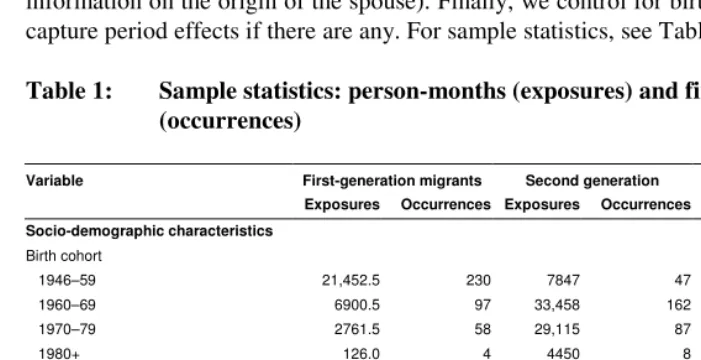
Table 1: Sample statistics: person-months (exposures) and first conceptions (occurrences)
Variable First-generation migrants Second generation West Germans Exposures Occurrences Exposures Occurrences Exposures Occurrences Socio-demographic characteristics
Birth cohort
1946–59 21,452.5 230 7847 47 193,807 972
1960–69 6900.5 97 33,458 162 202,937 753
1970–79 2761.5 58 29,115 87 100,846 271
1980+ 126.0 4 4450 8 16,609 22
Marital status (time-varying)
Unmarried 19,594.5 49 65,188 71 435,262 710
Married 11,646.0 340 9682 233 78,937 1308
School education
No certificate 8131.0 82 6473 28 7507 20
First or other certificate 17,105.0 234 50,705 234 340,776 1601
Second certificate 5752.0 64 16,153 35 158,863 379
In school education 84.0 1 728 1 2501 3
Table1: (Continued)
First-generation migrants Second generation West Germans Exposures Occurences Exposures Occurences Exposures Occurences
Employment (time-varying)
Full-time 13,276.0 119 22,638 143 209,639 1062
Part-time 1271.0 11 2795 11 22,001 101
Unemployed 13,089.5 226 10,093 122 44,705 481
In education or training 1643.0 3 31,633 16 182,574 137
No info 1961.0 30 7711 12 55,280 237
Country of origin n.a.
Turkey 11,186.5 168 27,546 139
Yugoslavia 8608.5 86 12,454 34
Greece 3907.0 37 12,768 37
Italy 4427.5 64 15,678 67
Spain 3111.0 34 6424 27
Migration process n.a. n.a.
Married, spouses migrated together 1429.5 23
Married, spouses migrated separately 5919.0 216
Unmarried at migration 21,103.0 116
Partner, no info 2789.0 34
Spouse’s characteristics
Spouses’ origins
She migrant, he West German 1460.0 13 5225 25 n.a.
Both migrants, from same country 23,525.5 333 26,369 232 n.a.
Both migrants, from different countries 1028.0 9 2156 17 n.a.
She West German/he migrant n.a. n.a. 20,709 112
Both West German n.a. n.a. 262,295 1429
No info on partner 2789.0 34 6906 22 60,862 344
Never married 2438.0 0 34,214 8 170,333 133
Spouse’s school education
No certificate 4927.5 60 2323 24 1779 12
First or other certificate 15,607.0 232 22,039 183 171,505 1056
Second certificate 4688.5 59 7300 57 97,471 427
In education 0.0 0 0 0 108 0
No info 3579.5 38 8994 32 73,003 390
Never married 2438.0 0 34,214 8 170,333 133
Total 31,240.5 389 74,870 304 514,199 2018
2.4.3 Method
We analyze the transition to a first conception that lead to a live birth and apply piecewise linear intensity-regression models as a form of indirect standardization (Hoem 1987, Hoem 1993, Andersson 2004). We use monthly information on births, which we have for births since January 1983. For births occurring before 1983, only yearly data is available. Hence, the births are assumed to occur in June. In order to calculate the transition to a first conception, we backdate the time at birth by nine months. Concerning the date at immigration of first-generation immigrants, we use monthly information. If this is not available, we assume the immigration to have taken place in January of the year reported.
The model can be formalized as follows:
ln µi(t) = y(t) + ∑kzk(uik+t) + ∑jαjxij + ∑lβlwil(t) ,
where ln µi(t) denotes the hazard of a first pregnancy leading to a birth for individual i and y(t) represents the impact of the baseline duration – time since age 15 – on the hazard. The parameter zk(uik+t) expresses the spline representation of the impact of continuously time-varying covariates with the origin uik (duration of stay, duration of marriage). The term wil(t) represents the effect of discretely time-varying variables
(employment). The term xij denotes the effect of time-constant covariates (migrant generation, country of origin, marriage situation at migration, birth cohort, school leaving certificate).
3. Results
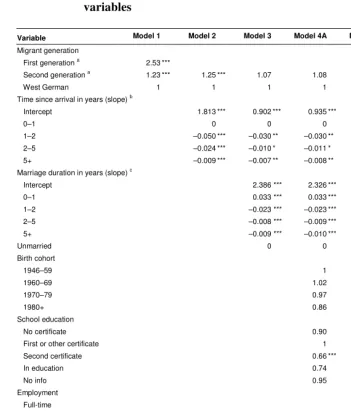
We achieved the results by stepwise modeling. Table 2 presents the estimates of the five main steps of the analysis.
Table 2: Factors influencing the transition to a first child: relative risks for categorical variables and parameter estimates for continuous variables
Variable Model 1 Model 2 Model 3 Model 4A Model 4B Model 5
Migrant generation
First generation a 2.53 ***
Second generation a 1.23 *** 1.25 *** 1.07 1.08 1.06 1.04
West German 1 1 1 1 1 1
Time since arrival in years (slope) b
Intercept 1.813 *** 0.902 *** 0.935 *** 0.652 *** 0.604 ***
0–1 0 0 0 0 0
1–2 –0.050 *** –0.030 ** –0.030 ** –0.023 * –0.021
2–5 –0.024 *** –0.010 * –0.011 * –0.009 –0.010
5+ –0.009 *** –0.007 ** –0.008 ** –0.007 ** –0.007 **
Marriage duration in years (slope) c
Intercept 2.386 *** 2.326 *** 2.190 *** 2.192 ***
0–1 0.033 *** 0.033 *** 0.034 *** 0.034 ***
1–2 –0.023 *** –0.023 *** –0.022 *** –0.022 ***
2–5 –0.008 *** –0.009 *** –0.008 *** –0.008 ***
5+ –0.009 *** –0.010 *** –0.009 *** –0.009 ***
Unmarried 0 0 0 0
Birth cohort
1946–59 1 1 1
1960–69 1.02 1.05 1.05
1970–79 0.97 1.02 1.03
1980+ 0.86 0.98 1.00
School education
No certificate 0.90 0.86 0.81 *
First or other certificate 1 1 1
Second certificate 0.66 *** 0.76 *** 0.75 ***
In education 0.74 0.87 0.91
No info 0.95 0.84 0.84
Employment
Full-time 1 1
Part-time 0.99 0.99
Unemployed 1.65 *** 1.65 ***
In education or training d 0.46 *** 0.47 ***
No info 1.73 *** 1.75 ***
Spouse’s school education e
No certificate 1.40 ***
First or other certificate 1
Second certificate 1.05
In education n.a.
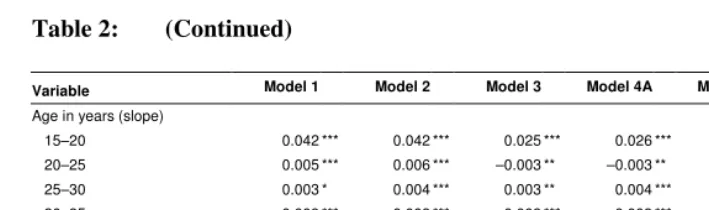
Table 2: (Continued)
Variable Model 1 Model 2 Model 3 Model 4A Model 4B Model 5
Age in years (slope)
15–20 0.042 *** 0.042 *** 0.025 *** 0.026 *** 0.022 *** 0.022 ***
20–25 0.005 *** 0.006 *** –0.003 ** –0.003 ** –0.003 ** –0.003 **
25–30 0.003 * 0.004 *** 0.003 ** 0.004 *** 0.003 *** 0.003 ***
30–35 –0.009 *** –0.008 *** –0.008 *** –0.009 *** –0.009 *** –0.009 ***
35–45 –0.030 *** –0.030 *** –0.027 *** –0.027 *** –0.028 *** –0.028 ***
Constant –7.847 *** –7.896 *** –7.669 *** –7.574 *** –7.366 *** –7.388 ***
Log-likelihood –17,133.71 –17,035.35 –15,336.73 –15,299.74 –15,150.99 –15,143.59
Source: Calculations based on GSOEP, 1984–2004; event: first conception. Significance: '*'=10%; '**'=5%; '***'=1%.
a– Refers to all five countries of origin of immigrants, b– Piece-wise linear spline for first-generation immigrants, c– Piece-wise linear spline for married women, d
– Only for persons who have basic finished school education,
e– Applies only to married women.
Model 5: controlled for spouse's employment.
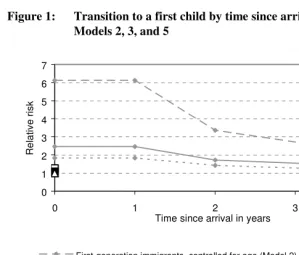
Model 2: The second step in the modeling process replaces the constant risk for first-generation immigrants by a time-varying risk by time since arrival to West Germany. We see a jump in conception risks right after immigration, followed by slightly declining levels. Note that women who were pregnant upon moving to West Germany were excluded from the analysis. Even without them, the effect of arriving in the new country on first-birth behavior is very strong.
Figure 1: Transition to a first child by time since arrival, relative risks – Models 2, 3, and 5
0 1 2 3 4 5 6 7
0 1 2 3 4
Time since arrival in years
R
e
la
ti
v
e
r
is
k
First-generation immigrants, controlled for age (Model 2)
First-generation immigrants, controlled for marriage duration and age (Model 3) First-generation immigrants (Model 5)
Second-generation immigrants, controlled for age (Model 2)
Second-generation immigrants, controlled for marriage duration and age (Model 3) West Germans
Source: Calculations based on GSOEP, 1984–2004.
Model 4 (A and B): The next steps contain the woman’s school education and a period indicator (Model 4A). Neither of them adds much of an explanation to the fertility differentials between first-generation immigrants and West Germans5. For second-generation immigrants, we find the risks slightly enlarging when controlling for birth cohort. This indicates their overrepresentation in cohorts that have a lower fertility. School education matters for the second generation, too. Controlling for this covariate reduces fertility risks and differentials, thus indicating compositional differences (results of stepwise modeling not displayed here). In general, both,
5 We also used (not shown here) an indicator for the immigration cohort of first-generation immigrants. The
immigrant women and West Germans show the same behavior: The first-child risks are significantly lower if a woman has a higher school certificate compared to women who have a first school certificate.
So far, the transition rates for first-generation immigrants remain high shortly after arrival. In model 4B, the employment status is added. This covariate decreases the transition rates of first-generation immigrants by 25 percent. The important status here is unemployment, which increases the transition to motherhood by about 65 percent compared to women who work either full- or part-time. The effect is the same for immigrants and West Germans.
Model 5: This step adds to the analysis the partner’s school education for married women. Controlling for this, first-child risks are slightly reduced for first-generation immigrants; however, adding the partner’s school education does not change the results for the second generation. This indicates that the composition of the first-generation group is different from the one of the second generation, namely that spouses without school leaving certificate are overrepresented in the first immigrant generation. The decrease in fertility differentials is explained by the category of women married to a man who has not obtained any school certificate. Their first-child risk is almost 40 percent higher than that of women with a spouse who has a first school certificate. This model also controls for the employment status of the husband, the latter which, however, does hardly affect the first-birth risks of any of the three groups. It is the employment status of the woman that remains crucial (see Figure 1).
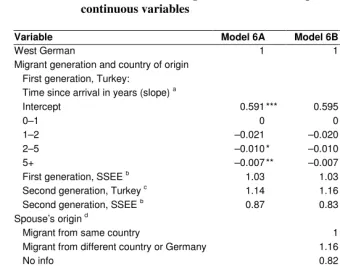
Model 6: Next, we control for three factors that apply to immigrant women only (conditional covariates; see Table 3). Model 6A tests differences by country of origin. Initially, we had run the models testing the effect of each of the countries of origin interacting with the migrant generation compared to West Germans. Then, we made tests to see whether or not there are differences between the migrant groups. We cannot find any differences by country of origin for first-generation immigrants after controlling for the duration of stay and the duration of marriage. For second-generation immigrants and comparing between women of Turkish, Yugoslavian, Greek, Italian, and Spanish descent, we find small differences only for women of Turkish descent. There are no differences between women from the Southern and South Eastern European countries (SSEE). Therefore, we combine the categories of the variable referring to the country of origin: Turkish and Southern/South Eastern European. However, when considering the covariates from the previous models, these differences do not remain significant.
These steps apply to married women only. Neither of them contributes significantly to explaining first-child differentials between the groups, though one may see a slight trend here: First-generation immigrants who moved at a different point in time than their partner have higher transition rates than women who moved with their husband. Women who are married to a husband from a different country or to a West German have elevated transition rates, too (there is probably an overlap with the category for which information on the husband’s immigration history is not available).
Table 3: Migrant-specific factors influencing the transition to a first child: relative risks for categorical variables and parameter estimates for continuous variables
Variable Model 6A Model 6B Model 6C
West German 1 1 1
Migrant generation and country of origin
First generation, Turkey:
Time since arrival in years (slope) a
Intercept 0.591 *** 0.595 *** 0.309
0–1 0 0 0
1–2 –0.021 –0.020 –0.015
2–5 –0.010 * –0.010 –0.007
5+ –0.007 ** –0.007 ** –0.007 **
First generation, SSEE b 1.03 1.03 1.08
Second generation, Turkey c 1.14 1.16 1.21 *
Second generation, SSEE b 0.87 0.83 0.82
Spouse’s origin d
Migrant from same country 1 1
Migrant from different country or Germany 1.16 1.13
No info 0.82 0.64 **
Migration process e
Married, migrated together 1
Married, migration with separation 1.35
Unmarried at migration 1.00
No migration info on partner 2.16 **
Log-likelihood –15,142.76 –15,141.14 –15,136.10
Source: Calculations based on GSOEP, 1984–2004; event: first conception. Significance: '*'=10%; '**'=5%; '***'=1%.
Models 6A-C: controlled for age, birth cohort, school education, employment status of the woman; school education, employment of spouse; marriage duration.
a– Turkish immigrants relative to West German women, piecewise linear spline, b
– SSEE (Southern and South Eastern Europe): Yugoslavia, Greece, Italy, Spain relative to Turkey,
c– Turkish-descent women relative to West Germans, d– applies only to married immigrant women, e– applies only to first-generation immigrants.
4. Discussion
Our analysis focuses on the first-birth behavior of women with an immigration background in West Germany, drawing comparisons to the birth behavior displayed in the host society. We see that it is important to distinguish between the immigrant generations. The first-birth risk of first-generation immigrants who moved to West Germany when childless is 2.5 times higher than the corresponding risk of West Germans. Second-generation immigrants living in Germany have 1.2 times higher transition rates to a first birth compared to natives. The marriage status is the most important covariate for both immigrant generations. It stresses the endogeneity of first marriage and first child (Baizan, Aassve, and Billari 2003).
For first-generation immigrants, we find the hypothesis of interrelated events proven: Migration, marriage, and a first pregnancy follow in short sequence. This effect would even be more pronounced if we included women of the first immigrant generation that had become pregnant shortly before migration, probably in anticipation of the move. Here, marriage duration seems to be a more important factor than the migration background of the partner – it does matter little whether or not the partner immigrated from the same or another country or whether the partner is of West German origin. Birth risks are elevated in the first year following immigration and in the first year of marriage. Taking spatial separation of the spouses into account, higher transition rates to motherhood are observed for immigrants who followed their husband later and for women who moved to West Germany in order to form a household with either a second-generation immigrant or a West German compared to immigrant women who moved with their husband. We conclude that the temporary separation in itself does not trigger the transition to motherhood. Temporary separation can rather be seen as indicating that either of the spouses has been already familiar with the living circumstances at destination. This familiarity may facilitate the decision to have a child compared to couples where both partners have to get used to the new living environment. However, the size of the sample used for this analysis is not large, and accordingly the number of women in a few categories is small. In general, our findings lead to the assumption that childless couples arrange marriage and migration within a narrow time span.
out with immigrants in Germany and with women and men in the respective countries of origin. A child also emphasizes the connection between the two families of origin. It has been shown that second-generation immigrants of Turkish descent see their union as constituting a link between the two families (Straßburger 2003). If a marriage was traditionally arranged by family members, having children soon afterwards may be seen as desirable by the young couple and their relatives. We see this attitude reflected in the transition rates to motherhood, rates that remain slightly elevated for second-generation migrants of Turkish background.
As pointed out, we do not assume German citizenship and the German residence permit to have a direct impact on the fertility of women in the traditional migrant-worker groups. However, there are other (West) German laws that may directly or indirectly affect the childbearing behavior of immigrants. The first is the law on child-care benefit, which is paid in general for two years: Women from EU countries receive the benefit even when they give birth to and raise the child in their country of origin, provided that they previously worked in Germany. This compares to families from non-EU countries that since 1986 only receive child benefits for children born and raised in Germany (Schwarz 1996). Hence, women from Turkey and the former Yugoslavia may postpone childbearing in anticipation of the move. Note that the mean age at immigration of the first-generation immigrants in the sample is about 20 years. Compared to the women in the country of origin, Turkish immigrants for example have postponed first child birth when they moved to West Germany. Almost every second women who lives in Turkey has become a mother by this age.6
The work permit is the second law that is interesting in the context of the fertility behavior of immigrants. Ever since the recruitment policies ended, persons who move to (West) Germany have not been allowed to work immediately7. People coming from EU member-states are not affected by this rule, in contrast to family members of persons from non-EU countries who move to Germany for reasons of family re-union. Since 1974, persons immigrating for reasons of family re-union have not received a work permit in the first years following the immigration (Münscher 1979, Angenendt 2002). Therefore, we may think of the first two or three years following the move as a time of few opportunities, competing with childbearing and child raising; in other words, a good time to have children.
6 If compared to the first-generation immigrants who gave birth before they moved to West Germany, we see
also that immigrants coming without a child are on average about two years older at entry into motherhood. This may indicate that migration postpones childbearing, however, such a comparison is not reasonable since it conditions the emigrants on the later move, and we do not have information on all women in the countries of origin, either.
This is proven by the employment status in our estimation. However, we must be cautious with the interpretation: On the one hand, women of the first migrant generation may anticipate family formation, thus they may not aim to become gainfully employed during the first few years following arrival (endogeneity). On the other hand, unemployment has a fertility increasing impact also on second-generation immigrants and on West Germans (Kreyenfeld 2001). As for a long time the country has encouraged young mothers to stay at home women may regard motherhood as constituing an alternative career in general. Our results stress that immigrants react to similar circumstances in a similar manner to people of the host society. This applies to the impact of education attainment, employment, and union formation on fertility and confirms the hypothesis of adaptation, as it has been found for other countries. Note that these patterns vary between countries. The speed and nature of converging behavior between immigrants and natives also may depend on the degree of similarities or difference between the countries of origin and destination (Carlson 1985b, Nahmias 2004, Andersson and Scott 2005).
The ‘3 pack’ of marriage, migration, and first child implies that labor-migrants are a selected group. Female first-generation migrants moved to West Germany mainly for reasons of family re-union or family formation. Migrants doing so may be prone to have a first child. Unmarried women immigrating to West Germany, by contrast, have lower transition rates to first birth than their counterparts married by the time of the move. The lower transition rates of single migrants may be attributed to the partner-selection process, a process that may take a relatively long time as it takes place in a new living environment, or it may be the result of selection: Single immigrant women may come for different reasons than married women. Consider here, for example, the participation in higher education. Further research, however, should focus on the transitions to subsequent births, too, in order to fully address the question of whether or not immigrants to West Germany are a selected group regarding their fertility (intentions).
As to second-generation immigrants, we suggest that a discussion of their fertility behavior be placed within the context of adaptation rather than socialization. On the one hand, the first-birth risks of the second generation reflect the fertility differences between the respective countries of origin; women of Turkish background in West Germany have higher first-birth risks than women of Southern and South Eastern European background. This can be traced back to the compositional differences of the second immigrant generation in West Germany in their school education and labor-force participation. On the other hand, the differences between second-generation immigrants and West German women are only significant when the marital status is not taken into account. Married women of the second immigrant generation have birth risks similar to those of West Germans, for whom we observe an interrelation of marriage and first child, too. This shows that the second immigrant generation in West Germany is adopting the West German fertility behavior once married. In order to investigate whether or not the socialization background of the immigrant parents affects their children’s family-formation behavior in Germany, one would probably need to analyze the marriage behavior more closely rather than marital childbearing.
Overall, the results indicate that current living circumstances affect fertility decisions, as indicated by the declining birth risks of the first immigrant generation by stay duration and by the lower risks of the second generation. The country of origin does not explain much of the first-birth behavior of immigrants in West Germany. However, since a first child can be seen as the norm in the countries of origin of the women analyzed in this paper and country differences occur mainly in higher parities, further research should study the transition to sub-sequent births as well. It is assumed that socio-economic characteristics and immigration-background variables may have an impact on these transitions different to first birth.
5. Acknowledgments
References
Abadan-Unat, N. 1974. Turkish external migration and social mobility, in P. Benedict, E. Tümertekin and F. Mansur (Eds.), Turkey. Geographic and Social Perspectives. Leiden: E. J. Brill, pp. 362–402.
Alders, M. 2000. Cohort Fertility of Migrant Women in the Netherlands. Developments in Fertility of Women Born in Turkey, Morocco, Suriname, and the Netherlands Antilles and Aruba. Paper for the BSPS-NVD-URU Conference, 31 August – 1 September 2000, Utrecht: Statistics Netherlands.
Andersson, G. 2004. Childbearing after migration: fertility patterns of foreign-born women in Sweden, International Migration Review 38(2): 747–775.
Andersson, G., and K. Scott. 2005. Labour-market status and first-time parenthood: the experience of immigrant women in Sweden, 1981–97, Population Studies 59(1): 21–38.
Angenendt, S. 2002. Einwanderungspolitik und Einwanderungsgesetzgebung in Deutschland 2000–2001. in: K. J. Bade and R. Münz (Hgs.), Migrationsreport 2002. Fakten – Analysen – Perspektiven. Frankfurt/New York: Campus Verlag, pp. 31–59.
Bade, K. J. 1994. Ausländer, Aussiedler, Asyl in der Bundesrepublik Deutschland. 3. Aufl. Hannover: Niedersächsische Landeszentrale für politische Bildung.
Baizan, P., A. Aassve, and F. C. Billari. 2003. Cohabitation, marriage, and first birth: the interrelationship of family formation events in Spain, European Journal of Population 19: 147–169.
Bledsoe, C. 2004. Reproduction at the margins: migration and legitimacy in the new Europe, Demographic Research. Special Collection 3(4): 86–116. www.demographic-research.org/special/3/4.
Bledsoe, C., R. Houle, and P. Sow. 2007. High fertility Gambians in low fertility Spain: the dynamics of child accumulation across transnational space. Demographic Research 16(12): 375–412. www.demographic-research.org/Volumes/Vol16/12/ default.htm.
BMFSFJ – Bundesministerium für Familie, Senioren, Frauen und Jugend. 2000.
Familien ausländischer Herkunft in Deutschland. Leistungen – Belastungen – Herausforderungen.Sechster Familienbericht. Berlin: BMFSFJ.
Bürkner, H.-J., W. Heller, and J. Unrau. 1987. Rückkehrzwänge und Motivstrukturen türkischer Migranten. Zum Problem der Freiwilligkeit von Remigrations-entscheidungen, Zeitschrift für Bevölkerungswissenschaft 13(4): 451–472.
Carlson, E. D. 1985a. The impact of international migration upon timing of marriage and childbearing, Demography 22(1): 61–72.
Carlson, E. 1985b. Increased nonmarital births among foreign women in Germany,
Sociology and Social Research 70(1): 110–111.
Coleman, D. A. 1994. Trends in fertility and intermarriage among immigrant populations in Western Europe as measure of integration, Journal of Biosocial Science 26: 107–136.
Constant, A., and D. S. Massey. 2005. Labor market segmentation and the earnings of German guestworkers, Population Research and Policy Review 24: 489–512.
Dalla Zuanna, G. 2004. The banquet of Aeolus. A familistic interpretation of Italy’s lowest-low fertility, in: G. Dalla Zuanna and G. A. Micheli (Eds.), Strong Family and Low Fertility: A Paradox? New Perspectives in Interpreting Contemporary Family and Reproductive Behavior. Dordrecht (et al.): Kluwer AcademicPublishers, pp. 105–125.
Dornis, C. 2002. Zwei Jahre nach der Reform des Staatsangehörigkeitsrechts – Bilanz und Ausblick, in: K. J. Bade and R. Münz (Hgs.), Migrationsreport 2002. Fakten – Analysen – Perspektiven. Für den Rat für Migration. Frankfurt (et al.): CampusVerlag, pp. 163–177.
Ergöcmen, B. A., and M. A. Eryurt. 2004. Other proximate determinants of fertility, in Hacettepe University Institute of Population Studies, Turkey Demographic and Health Survey, 2003. Ankara:HUIPS, Ministry of Health General Directorate of Mother and Child Health and Family Planning, State Planning Organization and European Union, pp. 89–96.
Fassmann, H. 1997. Is the Austrian labour market ethnically segmented?, European Journal of Population 13: 17–32.
Fassmann, H., and R. Münz. 1994. European East-West migration, 1945–1992,
Fleischer, A. 2007. Illegalisierung, Legalisierung und Familienbildungsprozesse: Am Beispiel Kameruner MigrantInnen in Deutschland. Rostock: Max Planck Institute for Demographic Research WP–2007–011. www.demogr.mpg.de/ papers/working/wp-2007-011.pdf.
Ford, K. 1990. Duration of residence in the United States and the fertility of U.S. immigrants, International Migration Review 24(1): 34–68.
Frank, R., and P. Heuveline. 2005. A cross-over in Mexican and Mexican-American fertility rates: evidence and explanations for an emerging paradox, Demographic Research 12(4): 77–104. www.demographicresearch.org/Volumes/Vol12/4/ default.htm.
Friedlander, D., Z. Eisenbach, and C. Goldscheider. 1980. Family-size limitation and birth spacing: the fertility transition of African and Asian immigrants in Israel,
Population and Development Review 6(4): 581–593.
Friedlander, D., and C. Goldscheider. 1978. Immigration, social change and cohort fertility in Israel, Population Studies 32(2): 299–317.
Fritzsche, Y. 2000. Die quantitative Studie: Stichprobenstruktur und Feldarbeit, in A. Fischer, Y. Fritzsche, W. Fuchs-Heinritz and R. Münchmeier (Hgs.), 13. Shell Jugendstudie, Bd. 1/Quantitative Studie. Opladen: Leske+Budrich, pp. 349–378.
Gjerde, J., and A. McCants. 1995. Fertility, marriage, and culture: demographic processes among Norwegian immigrants to the rural middle West, The Journal of Economic History 55(4): 860–888.
Goldstein, S. 1973. Interrelations between migration and fertility in Thailand,
Demography 10(2): 225–241.
Goldstein, S., and A. Goldstein. 1981. The impact of migration on fertility: an ‘own children’ analysis for Thailand, Population Studies 35(2): 265–284.
González-Ferrer, A. 2006. Who do immigrants marry? Partner choice among single immigrants in Germany, European Sociological Review 22(2): 171–185.
Gordon, M. 1964. Assimilation in American Life. Oxford: Oxford University Press.