in the population sciences published by the Max Planck Institute for Demographic Research Konrad-Zuse Str. 1, D-18057 Rostock · GERMANY www.demographic-research.org
DEMOGRAPHIC RESEARCH
VOLUME 17, ARTICLE 30, PAGES 897-938
PUBLISHED 20 DECEMBER 2007
http://www.demographic-research.org/Volumes/Vol17/30/ DOI: 10.4054/DemRes.2007.17.30
Research Article
Childbearing dynamics of couples in a
universalistic welfare state: The role of
labor-market status, country of origin, and gender
Gunnar Andersson
Kirk Scott
Special Collection 6: Interdependencies in the Life Course, edited by Hill Kulu and Nadja Milewski.
© 2007 Andersson & Scott
1 Introduction 898 2 Background: migration, labor-force participation,
and fertility in Sweden
899
3 Research question 901
4 Data, method, variables, and study population 903
5 Foreign-born parents in Sweden 907
6 Childbearing of Swedish- and foreign-born mothers 913 7 Labor-market status, socio-demographic characteristics,
and childbearing
920
8 Summary and conclusions 930
9 Acknowledgements 931
References 932
Childbearing dynamics of couples in a universalistic welfare state:
The role of labor-market status, country of origin, and gender
Gunnar Andersson1 Kirk Scott2
Abstract
This article studies childbearing dynamics by labor-market status of co-residing parents in Sweden. We apply event-history techniques to longitudinal register data on the life histories of foreign-born mothers from ten different countries and the partners to these women, as well as to a sample of Swedish-born mothers and their partners. The context is a universalistic welfare state geared towards gender and social equality where formal social rights are largely independent of a person’s civil status, citizenship, and country of origin. We investigate the extent to which the associations of parents’ labor-market status with childbearing in Sweden differ between women and men and by country of origin. We find that the patterns of association are fairly similar on both of these individual dimensions. As measured by the way the labor-market activity of parents is related to their subsequent childbearing, we find evidence of equality by gender and at least some evidence of integration of immigrants into the dynamics of Swedish society.
1. Introduction
In family-demographic research, Sweden frequently serves as a point of reference. Three reasons can be attributed to this: Sweden and its Nordic neighbors often have been forerunners in the development of new trends in family-demographic behavior. Both have very reliable demographic data that enable researchers to detect and analyze such behavior. Finally, they have been innovative in terms of policy development aimed at enhancing the reconciliation of work and family life. Fertility research commonly relates the relatively high Nordic fertility to the setup of the policies pursued in these countries and the characteristics of the Nordic welfare regime. Policies aimed at strengthening female labor-market attachment and promoting gender equality have made it easier for women to combine work and family life (see, e.g., B. Hoem 1993, Bernhard 1993). Previous research on childbearing dynamics in the Nordic countries indicates a high degree of compatibility between individual labor-market activity and family building as both women and men tend to get established in the labor market before having children, and as they remain there after having become parents. Demographic studies on these countries reveal a positive association between women’s labor-market attachment and childbearing (Kravdal 1994, Andersson 2000, Vikat 2004), and this association is often seen in light of the existing welfare-state setup. In Nordic parental-leave policies, for example, benefits are based on prior earnings, thus they are likely to strengthen the tendency of young people to get established in the labor market before they consider having children. By the same token, access to affordable high-quality childcare enables women to remain in the labor market after having become a parent; and individual taxation removes many of the incentives of couples to pursue a strongly gendered division of labor-market and home-care activity.
administrative registers on a mother’s as well as father’s experience in the Swedish labor market to investigate how such experiences affect the propensity to have another child. Our attention to the gendered nature of the fertility dynamics of parents who stem from many different countries of origin enables us to gain deeper insights into childbearing behavior in Sweden in general and into various patterns of fertility adaptation of migrants in that country. Complementary to this, we investigate whether or not a Swedish-born partner makes the childbearing behavior of foreign-born women appear more ‘Swedish’ than what would otherwise be the case. Our article is an extension of our previous study on the labor-market status and first-time parenthood of immigrant women in Sweden (Andersson and Scott 2005, hereafter called A&S 1).
2. Background: migration, labor-force participation, and fertility in
Sweden
Since more than half a century Sweden has been a country of immigration. Initially, labor-force migration was the dominant force, and up to the 1970s the majority of migrants came from neighboring Finland. Since the mid-1980s, however, immigration has been dominated by refugee migration and family reunification. Immigrants now come from a much wider range of countries than before, leading to a more diverse immigrant population. The latest period during the 20th century of high immigration to Sweden, with peaks in migration during the late 1980s to early 1990s, coincided with a negative turn in the Swedish labor market. Unemployment rose in the early 1990s, remaining high until the end of the decade. The newcomers faced difficulties establishing themselves in the Swedish labor market, triggering a debate on the causes of their poor integration into Swedish society. At the beginning of the new century, immigration to Sweden increased again, but this time the new residents faced a much healthier market situation. The present study provides information on the labor-market experience of foreign-born parents living in Sweden during the 1980s and 1990s. We do not aim to explain their patterns of labor-market activity (for such insights, see Aguilar and Gustavsson 1994, Scott 1999, Rooth 1999, Bevelander 2000,
Bevelander and Skyt Nielsen 2001, le Grand and Szulkin 2002, Rosholm et al. 2006).
Rather, we use that information to see the extent to which the labor-market status of immigrants is associated with their childbearing propensities.
below replacement but still relatively high compared to many other countries in Europe. It fluctuated around the average total fertility level of its neighboring Nordic countries (with a recent TFR of around 1.8 and above). The relatively high fertility of Sweden and its Nordic neighbors has attracted considerable attention, with links often having been made to their systems of social policies directed towards working parents and their increasing emphasis on gender equality. Such factors are assumed to facilitate for women the combination of work with family life (Bernhardt 1993, B. Hoem 1993, Brewster and Rindfuss 2000, McDonald 2000a,b, Neyer 2003, Andersson 2005, Duvander and Andersson 2006). Indeed, several empirical studies indicate that the incompatibility between female labor-market activity and childbearing seems to be weak in present-day Sweden: The labor-force participation of Swedish women is positively related to their propensity to become a mother (Hoem 2000, Andersson 2000) and, to a lesser extent, to have another child (Andersson 2000, Duvander and Andersson 2003, Andersson et al. 2005). These studies provide some support for the notion that various institutional and policy factors are important in shaping childbearing behavior. Sweden’s generous parental-leave system3, for example, where benefits are based on prior earnings, is likely to strengthen the positive relationship between women’s labor-market participation and their fertility. In this context, a basic level of female earnings is considered a prerequisite for having children rather than a hindrance to it (Andersson 2000). Equally important, a system of heavily subsidized childcare, which was expanded from the 1970s to attain full coverage at the end of the 1990s (Bergqvist and Nyberg 2002) prevents women being forced out of the labor market after having had a child.
Our previous study on the first-birth dynamics of foreign-born women in Sweden (A&S 1) reveals that the positive relationship between labor-market participation and the propensity to become a mother in Sweden holds for a large number of immigrant groups as well. The interesting aspect of this study is that women coming from widely
3 The Swedish parental-leave program was introduced in 1974. It provided entitlement to six months of paid
different cultural backgrounds tend to exhibit remarkably similar associations of their childbearing behavior with their labor-market status, which suggests that fertility patterns are influenced by the Swedish institutional context. A study on period effects in the childbearing dynamics of Swedish and foreign-born women living in Sweden lends additional support to the notion that the macro-level context of Swedish society is indeed important in shaping childbearing behavior in that country (Andersson 2004b).
3. Research question
In this article, we extend previous empirical research on fertility in Sweden by looking at the childbearing behavior of parents of Swedish and non-Swedish origin. In particular, we study the extent to which the association between the labor-market status of parents and their continued childbearing differs by the sex and country of origin of a parent. The aim is to detect to what extent the context of a universalistic welfare state and Swedish society is associated with similar patterns of childbearing across different categories of parents (as a large body of previous empirical research on Sweden would suggest, see previous section) or whether or not we instead find pronounced differentials in patterns by gender and cultural background (as predicted by general social science theory at large).
A review of related theory is beyond the scope of this paper. However, various lines of literature predict both some gendered patterns in family dynamics (cf. Mason and Jensen 1995) and that cultural factors are important in shaping the family dynamics of immigrants (cf. Forste and Tienda 1996). Childbearing and labor-force participation are often viewed as competing careers in the life course of a woman but not in that of a man. This is particularly true for economic theory postulating that in couple-relationships, women and men tend to specialize in different kinds of production activity, i.e., women typically disinvest in their labor-market career to increase their productivity in household-related activities, such as childrearing (see Becker 1991).
active labor-market participation (cf. Friedman et al. 1994). While there are other lines of reasoning as well, these arguments all support the plausibility of a negative association between labor-market activity and childbearing of foreign-born mothers.
In contrast, in a situation where both women and men enter the labor market before becoming a parent and where they remain in that market after having had their first child, we do not expect much of a negative association. For first births, we rather expect a strongly positive association between labor-market attachment and the propensity to become a parent, and this is found in the case of Sweden for Swedish- and foreign-born women alike (A&S 1). Such association is likely to be supported both by normative rules on the appropriate sequencing of events in early adulthood (Marini 1985, Blossfeld and Huinink 1991, see also Hobcraft and Kiernan 1995) and by the economic incentives of the Swedish parental-leave system, which induces parents who aim at taking leave to postpone childbearing until they have achieved an appropriately high level of earnings.
For higher-order births, the income-replacement character of the parental-leave system may also support a positive association of current earnings with the propensity to have another child. However, this effect is likely to be much weaker than that for first births as Swedish parental-leave regulations allow parents to retain their previous level of income compensation if another child arrives within a period of 30 months. Hoem
(1990, 1993), Andersson (1999), and Andersson et al. (2006) demonstrate that Swedish
parents responded to the introduction in the 1980s of this ‘speed premium’ on childbearing and reduced the length of their birth intervals accordingly. In general, there seems to be less scope for postponement of subsequent births than of entry into parenthood, thus there is less room for the influence of various intervening factors on fertility once childbearing has started: Second children in particular are born at fairly standard birth intervals and with very high parity-progression ratios (Andersson 1999, 2000). As to third births, socio-economic factors may have a wider influence on birth propensities as there is greater variation among couples in who proceeds to have a third child (Berinde 1999).
Finally, with fathers we have little reason to expect a pronounced negative association between labor-market attachment and the propensity of couples to have another child. Furthermore, we expect that Swedish individual taxation and individual-based social-security work towards convergence of the different roles played by the characteristics of fathers and mothers in childbearing decisions.
4. Data, method, variables, and study population
Sweden is well suited to studies of demographic behavior because high-quality individual-level population-register data is available (SCB 2003, Wallgren and Wallgren 2007) that cover all individuals who contributed to the population census of 1960, or were born in the country or entered the system as an immigrant since that year. The register contains records of all vital events to these individuals, such as on birth, death, any change in the civil status, registered international migration, and on change of address in Sweden. Each birth record contains the identification number of the child’s mother and father, allowing us to link the record to information available on parents residing in Sweden. In addition, it was possible to link children born abroad, but at some time living in Sweden, to their mother and father in Sweden. This results in largely complete childbearing histories of native and foreign-born women and allows for a distinction to be made between births occurring before a migration to Sweden and births occurring after such migration4.
Swedish registry data do not contain information on the cohabitation status of individuals. This limitation excludes us from using partner data in studies on the first-birth behavior of foreign- and Swedish-born women in Sweden. The registry data do, however, allow us to link partners who have children in common, a feature we exploit in our study on higher-order childbearing. Looking at address changes following the birth of a common child, we can keep track of which unions subsequently dissolve.
This study uses a data set derived at Statistics Sweden from such registers. The set is linked to additional data from various administrative registers. Our study population is defined to include the entire population of co-residing parents with one or two children, whose mother had legal residence in Sweden at any time during 1981−1997, was born in 1945 or later, and belongs to one of ten foreign-born populations in
4 We have no information on children who have never lived in Sweden, such as those who might have died
Sweden.5 We investigate the fertility patterns of couples, where the mother was born in Finland, Germany, Poland, Greece, Iran, Turkey, Somalia, Thailand, Vietnam, or Chile, and compare these patterns to those of a five-percent sample of the Swedish-born population. In all cases, we include information on the mother and her co-residing partner from the time of becoming a parent (or of immigrating to Sweden if this took place after having become a parent), regardless of the father’s country of origin. The country groups are chosen so that they represent a broad variation in national origins while at the same time representing ten of the largest foreign-born groups in Sweden. For the 1980s and the 1990s, we have been able to add information on the registered annual income of all of these parents, and on various public transfers to them, derived from the tax registers. We use the information to investigate the association of various types of parental labor-market attachment in Sweden with their continued childbearing. The study provides an event-history analysis of parents’ propensities to have a second or third child, using the demographic and labor-market characteristics of both parents as covariates of their continued childbearing. In our analyses, we estimate models for each parity progression separately and have not considered a more elaborate joint modelling of these processes (cf. Kravdal 2001, 2002a for a discussion of the latter approach). A couple is censored at the end of the year of any union dissolution, at the end of 1997, when a mother turns 45, at the first emigration or death of any of the parents, and otherwise stopped at a third or twin birth. One of these modes of censoring may potentially be less precise than the others: As people have few incentives to register an emigration from a country, one may suspect such migration events to be underreported. If this was true, then it would also cause problems for our calculations of fertility measures as any underreporting of emigration would inflate the denominators of parents that are actually under risk of having another child in the country. In our case, we are lucky to have access to data on people’s labor-market status during a given calendar year, which shows us whether a person was engaged in an activity in Sweden in that year.
We calculate the relative risks of giving birth to a second or third child for different categories of parents with one or two children. These risks are calculated for each category of our variables, which includes the age of the previous child or, more correctly, time since previous birth, the age and labor-market activity of both parents, time since immigration to Sweden of the mother, calendar period, the local
5 The immigrant parents are defined by their own birth country, and this status remains regardless of any
market characteristics in a given year, and the country of origin of the mother and her partner. The estimation is done in STATA, using the STPIECE module for piecewise constant hazard rate models (Sorensen 1999).
Since our dependent variable is birth of a child, we create variables defining the labor-market activity in such a manner as to indicate the main economic activity of a parent during the year prior to observation. This way, we approximate conditions at the time of conception, which would in reality be relevant to the childbearing decision. Our representation of labor-market activity is based on the annual earned income recorded by Swedish tax authorities, including any income replacement during periods of sickness and parental leave. It is also based on income derived from public transfers, indicating some disconnection with the labor-market, such as unemployment, study activity, and social welfare, respectively. For parents whose main income is derived from own earnings, we indicate the strength of his or her labor-force activity by a categorization of the absolute level of these earnings during the year, as represented by the earnings before tax but after the deduction of social insurances in Swedish Kronor (SEK) converted into 1995 prices. In 2006/7, the value of 1 SEK was approximately 11 Euro Cents. We cannot distinguish the extent to which differences in annual earnings stem from differences in wage levels or differences in the amount of time worked during a year. With the relatively modest variation in salary levels in the Nordic countries, we regard the latter factor to be more important than the former. This holds particularly for mothers, for which the time worked varies much more than it does for fathers.
Based on our income data, we define eight mutually exclusive labor-market states related to being a student, unemployed, on welfare, non-participant, or having a low, medium, high, or top-level earning. Our definitions are as follows:
• Enrolled student – receiving public student assistance (loans and grants) as the
primary source of non-earned income during the year, and not earning more than
71,400 SEK6 from work. Practically all students in Sweden receive public financial
support.
• Unemployed – receiving unemployment assistance or allowances from labor-market retraining programs as the primary source of non-earned income during the year, and not earning more than 71,400 SEK from work. A parent who receives
unemployment benefit above that amount is counted as unemployed regardless of his or her level of earned income.
• Welfare recipient – having social-welfare transfers as the primary source of
non-earned income during the year, and not earning more than 71,400 SEK from work. Social welfare is paid to people who cannot support themselves by other means. It includes, for example, an introductory allowance for refugees who have received a residence permit for Sweden. It is one of the few social-security benefits in Sweden that is not entirely individual-based but calculated instead on a household basis.
• Actively engaged in the labor force and earning a low income – earning between 35,700 and 107,100 SEK during the year from work, and not being a student, unemployed, or a welfare recipient according to the definitions above.
• Earning a medium income – earning between 107,100 and 178,500 SEK from
work.
• Earning a high income – earning between 178,500 and 267,750 SEK from work.
• Earning a top income from work – more than 267,750 SEK during the year. Very
few women but not so few men earn that amount. Top-income earners are entitled to less generous income replacement during periods of unemployment, sickness, or parental leave.
• Non-participant – not falling into any of the categories mentioned above. This category can, for example, comprise house wives, persons living in households where someone else receives family-based social-welfare transfers, other dependent adults, or, in the case of migrants, persons who have emigrated from Sweden without having notified the Swedish authorities.
5. Foreign-born parents in Sweden
Table 1 shows the number of mothers included in our study, by country of origin, and the number of second and third births in Sweden to these women. Note that any woman can appear both as a one- and two-child mother. She can also appear in our study as a two-child mother but not as a one-child mother if she entered our study population as a mother of two at the beginning of 1982 or at immigration to Sweden at a later date. Table 2 provides additional information on the immigration period to Sweden for our study populations of foreign-born mothers, and Table 3 reports on the country background of the partners to the women studied. As mentioned, our study comprises mothers who stem from ten different countries. For comparative purposes, our data also include a five-percent random sample of Swedish-born mothers. The migration histories of the foreign-born populations are briefly described below.
Table 1: Study population of mothers living in a co-residential union in Sweden and births in Sweden to these women, 1982–97, by country of origin
Country
One-child
mothers Second births
Two-child
mothers Third births
Swedena 27,496 19,352 33,438 9506
Finland 21,685 13,314 23,953 6320
Germany 1873 1119 1799 469
Poland 6593 3331 5079 927
Greece 1197 840 1659 329
Iran 4531 2461 3963 701
Turkey 4560 3544 4319 2435
Somalia 765 625 640 440
Thailand 1640 830 1025 273
Vietnam 1251 912 1042 520
Chile 2672 1701 2981 1031
Source: Calculations based on Swedish population registers. a– Five-per-cent sample of Swedish-born women.
Table 2: Percentage distribution of study populations of immigrant one- and two-child mothers living in Sweden, 1982–97, by immigration period to Sweden
Country Before 1970 1970–79 1980–89 1990–97
Finland 43 42 12 2
Germany 36 21 28 15
Poland 4 34 46 16
Greece 21 51 22 5
Iran 0 3 68 30
Turkey 3 35 43 20
Somalia 0 0 9 91
Thailand 0 14 42 44
Vietnam 0 12 46 42
Chile 0 24 67 9
Source: Calculations based on Swedish population registers.
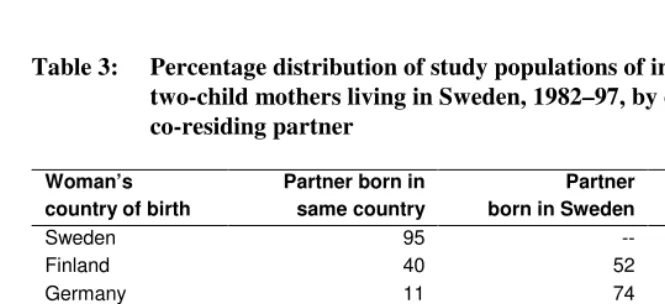
Table 3: Percentage distribution of study populations of immigrant one- and two-child mothers living in Sweden, 1982–97, by country of origin of co-residing partner
Woman’s country of birth
Partner born in same country
Partner born in Sweden
Partner born in third country
Sweden 95 -- 5
Finland 40 52 8
Germany 11 74 15
Poland 36 46 18
Greece 82 13 5
Iran 94 3 3
Turkey 88 3 9
Somalia 82 1 17
Thailand 8 83 10
Vietnam 83 6 11
Chile 73 17 10
Immigrants from Finland comprise by far the largest single foreign-born population in Sweden. The reasons for this are partially historical and partially economic. Due to a shared national history up to the early 19th century, a significant portion, roughly six percent, of the Finnish population is Swedish-speaking and Swedish is an official language in Finland. Finland is also Sweden’s nearest neighbor to the east. It lagged behind Sweden economically before it eventually caught up during the 1980s. These facts, plus the existence of a free Nordic labor market, led to a large flow of labor migrants from Finland to Sweden, which slowed down only during the late 1970s to early 1980s as the living standards between the two countries converged. This migration history is manifested in the fact that 85 percent of the Finnish women in our study arrived in Sweden prior to 1980. Due to the long intertwined migration history, many Finnish-born women have settled down with Swedish-born men, with just over half of co-residing mothers living in union with a native-born.
This study treats immigrants from East and West Germany as members of the
same country, although most immigrants arrived before reunification (and from West Germany). Germany had an early tradition as a labor exporting country immediately following the Second World War, and the country has consistently sent economic migrants to Sweden since then. Very high fractions of German women and men have migrated to Sweden in order to marry or cohabit with a Swede, which in our study can be seen by the fact that German-born women have the second-highest share of unions with a Swedish-born man (74 percent).
Polish immigrants in Sweden arrived for a variety of reasons. Some came as refugees from the communist regime, either for political reasons or as members of the persecuted Jewish minority, while others came as tied movers to join Poles who had previously migrated or, more commonly, to join Swedes: Roughly 50 percent of the Polish mothers in our sample are in union with a Swedish man. As with Finland, geographic proximity to Poland simplified the migration process, while in many ways the communist regime that was installed until the late 1980s worked against it. Migration from Poland was most intense during the 1980s, when successive liberalizations widened opportunities to exit the country.
Immigrants from Greece arrived largely as labor migrants during the late 1960s, and later as joint family members, but there were also a number of refugees who came after the military coup of 1967. These refugees tended to return to Greece, however, leaving the majority of the remaining population as labor immigrants. Migration from Greece has trailed off since the early 1980s, and Greek women show very strong tendencies towards co-residential homogamy, with 82 percent of mothers being in union with a fellow Greek.
The few Iranian immigrants that came to Sweden prior to the 1979 Islamic
waves of refugees arriving during the mid- to late 1980s (with 68 percent of mothers having arrived in this decade). It was during this time that Iranians proceeded to become one of Sweden’s largest immigrant nationalities. In our study, Iran is also the group with the highest homogamy rate, with 94 percent of Iranian mothers being in union with an Iranian-born man.
Turkey has a varied history of migration to Sweden. During the 1960s, Turks arrived as labor migrants. Later, however, there was a shift in character towards refugee immigration – largely dominated by ethnic Kurds. During the entire period, we can identify large-scale tied immigration: Most Turkish-born women arrived in Sweden as wives to previously immigrated Turkish men. In our data, this is reflected in an 88-percent couple-homogamy level of Turkish mothers.
Prior to the civil unrest of Somalia during the 1990s, there was practically no
immigration from Somalia to Sweden. Almost all Somalis living in Sweden arrived
during this very recent period as either refugees or tied movers who had familial relationships with refugees. Of all immigrant nationalities, Somali women have the lowest proportion to have borne children with a Swede; less than one percent of the mothers in our data live with a Swede.
Thailand has not been a major sending country of refugee or labor migrants. However, a large number of Thai women have come to Sweden due to relationships with Swedes, and Thais have the highest level of couple heterogamy of all immigrant groups in our study. Only eight percent of the Thai mothers in our data are in union with a Thai-born man, while 83 percent are in union with a Swedish-born man.
Following the fall of Saigon in 1975, and stretching through the 1980s and 1990s,
Vietnamese immigrants have arrived in Sweden as both refugees and as tied movers related to refugees. The refugees are largely ethnic Chinese who felt persecuted by the Vietnamese government. Vietnamese mothers in Sweden have a very high rate of couple homogamy (83 percent) and a low share of unions with a Swedish-born male (six percent).
Chilean immigration to Sweden started on a fairly large scale following the overthrow of the Allende government in 1973. The mid- to late-1970s saw a large number of Chileans entering Sweden as refugees. These flows soon switched to tied movers during the 1980s, as relatives of the early refugees arrived. There was a renewed increase in the numbers of refugees arriving in the late 1980s, just prior to democratization. Three quarters of Chilean-born mothers in union in Sweden co-reside with a man from their own country.
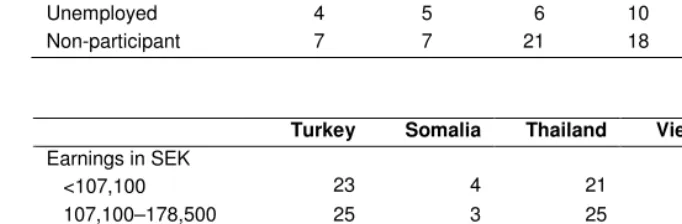
Table 4: Percentage distribution of study populations of one- and two-child mothers living in Sweden, 1982–97, by labor-market status for different countries of birth
Sweden Finland Germany Poland Greece Iran
Earnings in SEK
<107,100 29 23 26 20 22 11
107,100–178,500 46 48 33 33 36 12
178,500–267,750 10 12 10 9 11 2
>267,750 1 1 2 2 1 0
Enrolled student 2 2 3 5 2 16
Welfare recipient 0 1 1 3 1 10
Unemployed 4 5 6 10 6 21
Non-participant 7 7 21 18 21 27
Turkey Somalia Thailand Vietnam Chile
Earnings in SEK
<107,100 23 4 21 12 20
107,100–178,500 25 3 25 27 31
178,500–267,750 2 0 3 5 5
>267,750 0 0 0 0 0
Enrolled student 4 3 6 4 7
Welfare recipient 6 37 2 6 8
Unemployed 13 4 10 15 11
Non-participant 25 48 33 30 19
Source: Calculations based on Swedish population registers.
regards gender differences in labor-market activity, we find that fathers are established in the labor market and have an income of their own somewhat more often than mothers. By the same token, while a large majority of mothers have either low or medium income from earnings, fathers predominantly belong to one of the two higher-earnings categories we have defined. In sum, we demonstrate that there are substantial differences in the way mothers and fathers as well as foreign-born and Swedish-born parents are connected to the labor market. Next, we turn to the study of the fertility dynamics of these parents, and how their actual status on the labor market interacts with their childbearing.
6. Childbearing of Swedish- and foreign-born mothers
As an introduction to our fertility study, we present crude patterns of the progression to a second and third child, by time since previous birth, as they appear in a simplistic ‘survival analysis’ of one- and two-child mothers residing in Sweden. Figures 1a–c display Kaplan-Meier survivor plots for the different country subgroups of one-child mothers, and Figures 2a–c display the corresponding plots for the two-child mothers in our study. These estimates are based on the duration-specific probabilities of mothers to have another child while living in Sweden, calculated from all observations during the period 1982–1997, but without censoring for any union dissolution of the woman and her partner. The curves thus give a lucid overview of the total second- and third-birth fertility of women in Sweden, both as concerns the final level of mothers who have another child and the time interval at which they have such a child. For the corresponding description of first-birth patterns, see our companion article (A&S 1: Figure 1).
Figure 1a: Proportion of one-child mothers not having had a second child by time since first birth; women from Finland, Poland, Germany, and Sweden living in Sweden, 1982–97
0 0.1 0.2 0.3 0.4 0.5 0.6 0.7 0.8 0.9 1
0 2 4 6 8 10
Time since first birth in years
P ro p o rt io n o f o n e -c h ild m o th e rs n o t h a v in g h a d a s e c o n d c h ild
Sweden Finland Poland Germany
Figure 1b: Proportion of one-child mothers not having had a second child by time since first birth; women from Greece, Iran, Turkey, and Sweden living in Sweden, 1982–97
0 0.1 0.2 0.3 0.4 0.5 0.6 0.7 0.8 0.9 1
0 2 4 6 8 10
Time since first birth in years
P ro p o rt io n o f o n e -c h ild m o th e rs n o t h a v in g h a d a s e c o n d c h lid
Sweden Greece Iran Turkey
Figure 1c: Proportion of one-child mothers not having had a second child by time since first birth; women from Chile, Somalia, Thailand, Vietnam, and Sweden living in Sweden, 1982–97
0 0.1 0.2 0.3 0.4 0.5 0.6 0.7 0.8 0.9 1
0 2 4 6 8 10
Time since first birth in years
P ro p o rt io n o f o n e -c h ild m o th e rs n o t h a v in g h a d a s e c o n d c h ild
Sweden Chile Somalia Thailand Vietnam
Figure 2a: Proportion of two-child mothers not having had a third child by time since second birth; women from Finland, Poland, Germany, and Sweden living in Sweden, 1982–97
0 0.1 0.2 0.3 0.4 0.5 0.6 0.7 0.8 0.9 1
0 2 4 6 8 10
Time since second birth in years
P ro p o rt io n o f tw o -c h ild m o th e rs n o t h a v in g h a d a t h ir d c h ild
Sweden Finland Poland Germany
Figure 2b: Proportion of two-child mothers not having had a third child by time since second birth; women from Greece, Iran, Turkey, and Sweden living in Sweden, 1982–97
0 0.1 0.2 0.3 0.4 0.5 0.6 0.7 0.8 0.9 1
0 2 4 6 8 10
Time since second birth in years
P ro p o rt io n o f tw o -c h ild m o th e rs n o t h a v in g h a d a t h ir d c h ild
Sweden Greece Iran Turkey
Figure 2c: Proportion of two-child mothers not having had a third child by time since second birth; women from Chile, Somalia, Thailand, Vietnam, and Sweden living in Sweden, 1982–97
0 0.1 0.2 0.3 0.4 0.5 0.6 0.7 0.8 0.9 1
0 2 4 6 8 10
Time since second birth in years
P ro p o rt io n o f tw o -c h ild m o th e rs n o t h a v in g h a d a t h ir d c h ild
Sweden Chile Somalia Thailand Vietnam
7. Labor-market status, socio-demographic characteristics, and
childbearing
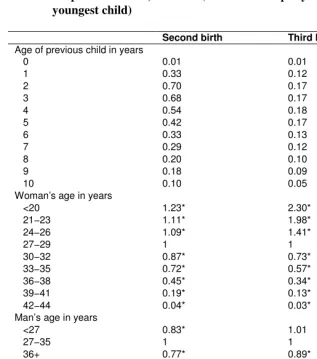
This section presents the results of our multivariate event-history analyses. Table 5 gives the relative risks of our main models on second- and third-birth behavior of all parents in Sweden. These regression results, together with the results of the birth-country specific models of Tables 7 and 8, provide insights into the dynamics producing the type of outcomes we observed in Figures 1 and 2. More specifically, they tell us how different individual and macro-level factors are associated with continued childbearing. The results of Table 5 are based on our pooled data of parents, where observations for Swedish-born mothers have been weighted so that the calculations represent the entire resident population of Sweden. These variable estimates are thus mainly influenced by the behavior of the Swedish-born. A more detailed account of the country-specific models for each foreign-born group is provided in Tables 7 and 8 for second and third births, respectively.
An examination of the associations of parents’ labor-market status with their childbearing behavior reveals that the relation between being well established in the labor market and the propensity to expand one’s family mainly is a positive one. In particular and in line with previous research, there is no indication that a woman’s weak attachment to the labor force is associated with elevated fertility. For second births, we find that couples where the woman has some amount of own earnings, including any income replacement stemming from periods of parental leave, have much higher birth propensities than couples where the mother belongs to any of the four non-employed categories. However, the association of a mother’s annual earnings level with second-birth risks is weak. For fathers, the effect of high annual earnings is more positive, whereas the negative effect of not being employed is weaker than it is for mothers.
Table 5: Relative risk of second and third birth of one- and two-child couples in Sweden, 1982−97 (absolute risks per year by age of youngest child)
Second birth Third birth
Age of previous child in years
0 0.01 0.01
1 0.33 0.12
2 0.70 0.17
3 0.68 0.17
4 0.54 0.18
5 0.42 0.17
6 0.33 0.13
7 0.29 0.12
8 0.20 0.10
9 0.18 0.09
10 0.10 0.05
Woman’s age in years
<20 1.23* 2.30*
21−23 1.11* 1.98*
24−26 1.09* 1.41*
27−29 1 1
30−32 0.87* 0.73*
33−35 0.72* 0.57*
36−38 0.45* 0.34*
39−41 0.19* 0.13*
42−44 0.04* 0.03*
Man’s age in years
<27 0.83* 1.01
27−35 1 1
36+ 0.77* 0.89*
Calendar period
1982−84 0.71* 0.66*
1985−87 0.81* 0.81*
1988−91 1 1
1992−94 1.00 0.89*
1995−97 0.85* 0.63*
Status of local labor market
Good 1 1
Table 5: (Continued)
Second birth Third birth
Woman’s labor-market status
Low earnings 0.98 0.94*
Medium earnings 1 1
High earnings 1.01 1.15*
Top earnings 1.21* 1.50*
Student 0.53* 0.65*
Welfare recipient 0.64* 1.00
Unemployed 0.79* 0.98
Non-participant 0.78* 1.05
Man’s labor-market status
Low earnings 0.95* 1.22*
Medium earnings 1 1
High earnings 1.06* 0.93*
Top earnings 1.21* 1.17*
Student 1.04 1.25*
Welfare recipient 0.76* 1.24*
Unemployed 0.84* 1.06
Non-participant 0.85* 1.27*
Time since migration
Childhood in Sweden 1 1
2nd year in Sweden 1.45* 1.26*
3rd year in Sweden 1.20* 1.24*
4−5th year in Sweden 0.94* 1.27*
6−8th year in Sweden 1.03 1.26*
9th
+ year in Sweden 1.04* 1.17*
Birth country of parents
Man’s birth country Man’s birth country
Woman’s birth country Same Swe Other Same Swe Other
Sweden 1 1 0.87* 1 1 1.07
Finland 0.82* 0.94* 0.87* 0.78* 0.94* 0.89*
Germany 0.98 1.01 0.86 0.71* 1.00 0.81
Poland 0.60* 0.71* 0.65* 0.46* 0.63* 0.48*
Greece 0.88* 1.02 0.83 0.37* 0.62* 0.39*
Iran 0.75* 1.04 0.75* 0.43* 0.99 0.50*
Turkey 1.07* 0.91 1.33* 1.15* 0.53* 1.46*
Somalia 4.57* 1.95 3.83* 5.03* 2.48 4.34*
Thailand 0.84 0.73* 0.76* 1.18 0.86 1.34
Vietnam 1.38* 0.81 1.32* 1.77* 0.98 1.90*
Chile 1.01 0.96 0.78* 0.89* 1.30* 0.90
Source: Calculations based on Swedish population registers.
Note: * Significant at the five-percent level. Observations for the Swedish-born are weighted so that calculations represent the entire resident population of Sweden.
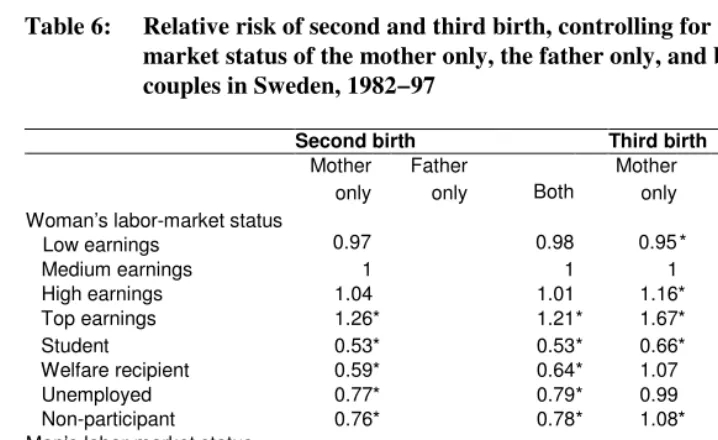
Table 6 provides further evidence of the gendered associations between parents’ labor-market status and their childbearing behavior in that it presents summary output from models that are based on only the mother’s and father’s characteristics, respectively. This serves to demonstrate that the effects of the male and female labor-market status largely work independently of each other. Evidently, in a situation such as in Sweden, a simpler model specification that has information on only one of the two parents produces results that are accurate enough to correctly depict the role of either the mother’s or father’s labor-market attachment in childbearing dynamics. Nevertheless, to gain insights into the gender-specific pathways to family building presented here, we no doubt need data on women as well as men.
Table 6: Relative risk of second and third birth, controlling for the labor- market status of the mother only, the father only, and both parents; couples in Sweden, 1982−97
Second birth Third birth
Mother only
Father
only Both
Mother only
Father
only Both
Woman’s labor-market status
Low earnings 0.97 0.98 0.95 * 0.94 *
Medium earnings 1 1 1 1
High earnings 1.04 1.01 1.16* 1.15*
Top earnings 1.26* 1.21* 1.67* 1.50*
Student 0.53* 0.53* 0.66* 0.65*
Welfare recipient 0.59* 0.64* 1.07 1.00
Unemployed 0.77* 0.79* 0.99 0.98
Non-participant 0.76* 0.78* 1.08* 1.05
Man’s labor-market status
Low earnings 0.92* 0.95* 1.21 * 1.22 *
Medium earnings 1 1 1 1
High earnings 1.06* 1.06* 0.91* 0.93*
Top earnings 1.22* 1.21* 1.20* 1.17*
Student 0.96 1.04 1.20 1.25*
Welfare recipient 0.70* 0.76* 1.23* 1.24*
Unemployed 0.81* 0.84* 1.04 1.06
Non-participant 0.82* 0.85* 1.27* 1.27*
Source: Calculations based on Swedish population registers.
Note: * Significant at the five-percent level. Observations for the Swedish-born are weighted so that calculations represent the entire resident population of Sweden.
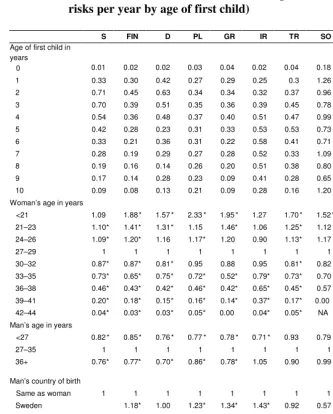
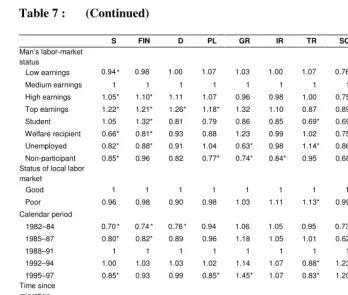
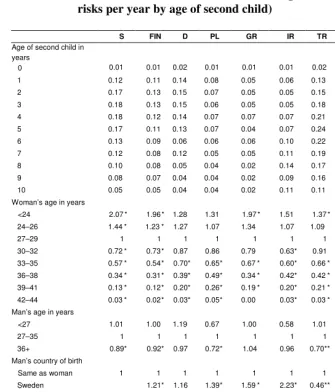
Turning to the issue of whether or not the patterns of associations are similar across the various country groups of foreign-born parents, and whether these patterns deviate from the patterns of the Swedish-born population, we take a closer inspection of the results displayed in the country-specific models of Tables 7 and 8. In the case of associations of the labor-market status with the propensity to become a mother (A&S 1), we found a remarkable similarity across all country groups of women. With second and third births, patterns are sometimes more irregular, and this holds for third-birth patterns in particular. Some categories of the labor-market status of different foreign-born populations of parents contain relatively few individuals, and when exposed to a formal statistical testing at the conventional five-percent level, many relative risks turn out to be non-significant. To overcome some of the problems caused by small exposures, we merge the two highest earnings categories of women.
Nevertheless, our main impression is that the directions of associations are more similar than dissimilar when we focus on the categories to which most parents belong. In particular, the patterns of associations of a mother’s labor-market status with a couple’s second-birth propensity are strikingly similar across the different migrant populations and they are similar to that of the Swedish-born, too. In all cases, one-child mothers who belong to any of the non-employed categories have reduced propensities to have another child, and in almost all cases, there is a moderately positive impact for employed mothers of their level of annual earnings. We find little evidence of extremely gendered patterns of associations of labor-market status with either second- or third-birth risks; there are no examples where a clearly negative effect of a mother’s labor-market attachment co-exists with a strongly positive effect of that of the father.
Table 7: Relative risk of having a second child of one-child couples in Sweden, 1982−1997, for different countries of origin of the mother (absolute risks per year by age of first child)
S FIN D PL GR IR TR SO THA VN CH
Age of first child in years
0 0.01 0.02 0.02 0.03 0.04 0.02 0.04 0.18 0.02 0.04 0.04 1 0.33 0.30 0.42 0.27 0.29 0.25 0.3 1.26 0.34 0.39 0.35 2 0.71 0.45 0.63 0.34 0.34 0.32 0.37 0.96 0.54 0.46 0.43 3 0.70 0.39 0.51 0.35 0.36 0.39 0.45 0.78 0.56 0.46 0.46 4 0.54 0.36 0.48 0.37 0.40 0.51 0.47 0.99 0.59 0.47 0.53 5 0.42 0.28 0.23 0.31 0.33 0.53 0.53 0.73 0.73 0.38 0.50 6 0.33 0.21 0.36 0.31 0.22 0.58 0.41 0.71 0.82 0.38 0.49 7 0.28 0.19 0.29 0.27 0.28 0.52 0.33 1.09 0.72 0.37 0.49 8 0.19 0.16 0.14 0.26 0.20 0.51 0.38 0.80 0.88 0.22 0.45 9 0.17 0.14 0.28 0.23 0.09 0.41 0.28 0.65 0.79 0.13 0.42 10 0.09 0.08 0.13 0.21 0.09 0.28 0.16 1.20 0.98 0.15 0.27 Woman’s age in years
<21 1.09 1.88 * 1.57 * 2.33 * 1.95 * 1.27 1.70 * 1.52 * 1.76 * 1.73 * 1.36 * 21–23 1.10* 1.41* 1.31 * 1.15 1.46* 1.06 1.25* 1.12 0.93 1.23 1.20* 24–26 1.09* 1.20* 1.16 1.17 * 1.20 0.90 1.13* 1.17 1.08 1.24* 1.10
27–29 1 1 1 1 1 1 1 1 1 1 1
30–32 0.87* 0.87* 0.81 * 0.95 0.88 0.95 0.81* 0.82 0.96 0.92 0.99 33–35 0.73* 0.65* 0.75 * 0.72 * 0.52* 0.79* 0.73* 0.70 0.76* 0.85 0.83* 36–38 0.46* 0.43* 0.42 * 0.46 * 0.42* 0.65* 0.45* 0.57 0.51* 0.56* 0.62* 39–41 0.20* 0.18* 0.15 * 0.16 * 0.14* 0.37* 0.17* 0.00 0.29* 0.36* 0.18* 42–44 0.04* 0.03* 0.03 * 0.05 * 0.00 0.04* 0.05* NA 0.07* 0.06* 0.06* Man’s age in years
<27 0.82 * 0.85 * 0.76 * 0.77 * 0.78 * 0.71 * 0.93 0.79 1.16 0.92 0.95
27–35 1 1 1 1 1 1 1 1 1 1 1
36+ 0.76* 0.77* 0.70 * 0.86 * 0.78* 1.05 0.90 0.99 0.69* 1.14 0.88*
Man’s country of birth
Same as woman 1 1 1 1 1 1 1 1 1 1 1
Sweden 1.18* 1.00 1.23 * 1.34* 1.43* 0.92 0.57 0.76* 0.58* 1.08 Other 0.87* 1.06 0.81 1.11 * 1.07 1.09 1.27* 0.84 0.82 1.07 0.85* Woman’s
labor-market status
Low earnings 0.98 0.96 * 1.03 0.82 * 0.66 * 0.78 * 0.83 * 0.64 0.92 0.81 0.85 *
Medium earnings 1 1 1 1 1 1 1 1 1 1 1
High or top
Table 7 : (Continued)
S FIN D PL GR IR TR SO THA VN CH
Man’s labor-market status
Low earnings 0.94 * 0.98 1.00 1.07 1.03 1.00 1.07 0.76 0.81 1.01 0.83 *
Medium earnings 1 1 1 1 1 1 1 1 1 1 1
High earnings 1.05* 1.10* 1.11 1.07 0.96 0.98 1.00 0.75 1.03 1.16 0.9 Top earnings 1.22* 1.21* 1.26* 1.18* 1.32 1.10 0.87 0.89 1.03 0.61 0.88 Student 1.05 1.32* 0.81 0.79 0.86 0.85 0.69* 0.69 1.03 1.09 0.87 Welfare recipient 0.66* 0.81* 0.93 0.88 1.23 0.99 1.02 0.75 0.86 1.28 * 0.86 Unemployed 0.82* 0.88* 0.91 1.04 0.63* 0.98 1.14* 0.86 0.79 0.98 0.85 Non-participant 0.85* 0.96 0.82 0.77* 0.74* 0.84* 0.95 0.68 0.84 0.83 0.83* Status of local labor
market
Good 1 1 1 1 1 1 1 1 1 1 1
Poor 0.96 0.98 0.90 0.98 1.03 1.11 1.13* 0.99 0.98 1.38 * 0.94 Calendar period
1982–84 0.70 * 0.74 * 0.76 * 0.94 1.06 1.05 0.95 0.73 0.92 1.03 0.79 * 1985–87 0.80* 0.82* 0.89 0.96 1.18 1.05 1.01 0.62 0.97 1.15 0.99
1988–91 1 1 1 1 1 1 1 1 1 1 1
1992–94 1.00 1.03 1.03 1.02 1.14 1.07 0.88* 1.23 1.21 0.82 0.98 1995–97 0.85* 0.93 0.99 0.85* 1.45* 1.07 0.83* 1.20 1.03 0.80 0.82 Time since
migration Childhood in
Sweden 1 1 1 1 1 1 1 1 1 1 1
2nd year in Sw NA 1.36* 1.27 1.17 1.04 0.91 1.46* 1.43 1.17 1.38 1.30* 3rd year NA 1.24* 0.78 0.78* 1.25 0.79 1.03 1.56 0.92 1.21 1.08 4th–5th year NA 1.04 0.87 0.64 1.24* 0.78 1.04 1.46 0.70* 1.04 1.12 6th–8th year NA 1.10* 0.93 0.66* 1.07 0.84 1.22* 1.23 0.69* 0.91 1.03 9th+ year NA 1.14* 0.97 0.63* 1.12 0.71 1.19* 1.29 0.42* 0.98 0.96
Source: Calculations based onSwedish population registers.
Note: * Significant at the five-percent level. NA=not applicable.
The parameters are estimated in STATA, using the STPIECE module for piecewise-constant hazard rate estimation written by Jesper Sorensen.
Table 8: Relative risk of having a third child of two-child couples in Sweden, 1982−1997, for different countries of origin of the mother (absolute risks per year by age of second child)
S FIN D PL GR IR TR THA VN CH
Age of second child in years
0 0.01 0.01 0.02 0.01 0.01 0.01 0.02 0.03 0.01 0.01 1 0.12 0.11 0.14 0.08 0.05 0.06 0.13 0.24 0.19 0.09 2 0.17 0.13 0.15 0.07 0.05 0.05 0.15 0.25 0.17 0.09 3 0.18 0.13 0.15 0.06 0.05 0.05 0.18 0.29 0.17 0.09 4 0.18 0.12 0.14 0.07 0.07 0.07 0.21 0.27 0.22 0.13 5 0.17 0.11 0.13 0.07 0.04 0.07 0.24 0.38 0.14 0.13 6 0.13 0.09 0.06 0.06 0.06 0.10 0.22 0.32 0.18 0.13 7 0.12 0.08 0.12 0.05 0.05 0.11 0.19 0.44 0.15 0.13 8 0.10 0.08 0.05 0.04 0.02 0.14 0.17 0.45 0.13 0.10 9 0.08 0.07 0.04 0.04 0.02 0.09 0.16 0.60 0.16 0.09 10 0.05 0.05 0.04 0.04 0.02 0.11 0.11 0.56 0.15 0.11 Woman’s age in years
<24 2.07 * 1.96 * 1.28 1.31 1.97 * 1.51 1.37 * 0.59 0.97 1.70 * 24–26 1.44 * 1.23 * 1.27 1.07 1.34 1.07 1.09 1.02 1.13 1.34*
27–29 1 1 1 1 1 1 1 1 1 1
30–32 0.72 * 0.73 * 0.87 0.86 0.79 0.63* 0.91 0.87 0.83 0.86* 33–35 0.57 * 0.54 * 0.70* 0.65 * 0.67 * 0.60* 0.66 * 0.69 0.73 * 0.73* 36–38 0.34 * 0.31 * 0.39* 0.49 * 0.34 * 0.42* 0.42 * 0.34* 0.49 * 0.47* 39–41 0.13 * 0.12 * 0.20* 0.26 * 0.19 * 0.20* 0.21 * 0.31* 0.16 * 0.19* 42–44 0.03 * 0.02 * 0.03* 0.05 * 0.00 0.03* 0.03 * 0.04* 0.15 * 0.01* Man’s age in years
<27 1.01 1.00 1.19 0.67 1.00 0.58 1.01 0.39 * 1.30 0.71 *
27–35 1 1 1 1 1 1 1 1 1 1
36+ 0.89* 0.92* 0.97 0.72 * 1.04 0.96 0.70** 0.70* 1.03 0.92 Man’s country of birth
Same as woman 1 1 1 1 1 1 1 1 1 1
Sweden 1.21* 1.16 1.39 * 1.59 * 2.23* 0.46** 0.56* 0.64 1.71* Other 1.07 1.15* 1.10 1.13 1.00 1.25 1.33** 0.89 1.17 1.23 Woman’s labor-market
status
Low earnings 0.94 * 0.98 0.89 0.81 * 1.12 0.87 0.95 0.98 1.25 0.86
Medium earnings 1 1 1 1 1 1 1 1 1 1
Table 8: (Continued)
S FIN D PL GR IR TR THA VN CH
Man’s labor-market status
Low earnings 1.23 * 1.19 * 1.21 1.02 0.74 1.08 1.01 0.89 0.97 1.04
Medium earnings 1 1 1 1 1 1 1 1 1 1
High earnings 0.92 * 0.91* 0.95 1.13 0.84 0.84 0.80 * 0.89 0.88 0.91 Top earnings 1.19 * 1.20* 1.00 1.08 0.83 1.62 0.67 0.71 0.51 0.79 Student 1.27 * 1.41* 0.51 0.68 1.85 0.68 0.95 1.24 0.79 0.87 Welfare recipient 1.31 * 1.18 1.20 1.21 0.98 1.06 1.07 0.87 1.18 0.93 Unemployed 1.03 1.12 1.39 0.97 1.05 1.14 1.12 0.60 0.94 0.88 Non-participant 1.31 * 1.11 0.65 1.28 * 0.62 * 0.98 1.00 0.89 1.10 0.88 Status of local labor
market
Good 1 1 1 1 1 1 1 1 1 1
Poor 0.90 * 0.90* 0.98 1.06 1.19 1.06 1.00 1.28 0.93 1.23* Calendar period
1982–84 0.65 * 0.70 * 0.86 0.79 * 0.92 1.38 1.07 1.19 1.36 0.70 * 1985–87 0.81* 0.80 * 0.80 0.81 * 0.85 1.33 1.05 1.04 1.05 0.79*
1988–91 1 1 1 1 1 1 1 1 1 1
1992–94 0.88 * 1.00 0.90 0.99 0.62 * 1.03 0.96 0.93 1.20 0.98 1995–97 0.62 * 0.70* 0.84 0.74 * 0.77 0.80 0.80 * 0.76 0.83 0.63* Time since migration
Childhood in Sweden 1 1 1 1 1 1 1 1 1 1
2nd year in Sw NA 1.70* 1.27 1.55 * 8.85 * 1.25 1.84 * 2.03 2.36* 1.55* 3rd year NA 1.76* 0.75 1.31 1.56 1.21 1.48 * 1.92 1.42 1.45* 4th–5th year NA 1.53* 1.11 1.13 1.67 1.13 1.30 * 1.14 1.31 1.61* 6th–8th year NA 1.25* 1.03 0.93 1.68 * 1.04 1.40 * 0.98 1.17 1.62* 9th+ year NA 1.13* 0.83 0.97 1.12 0.95 1.22 * 0.59 0.97 1.11
Source: Calculations based on Swedish population registers.
Note: * Significant at the five-percent level. NA=not applicable.
The parameters are estimated in STATA, using the STPIECE module for piecewise-constant hazard rate estimation written by Jesper Sorensen.
No model is estimated for mothers from Somalia, due to too few observations.
In addition, our models provide information on the role played by several further covariates of second- and third-birth behavior in Sweden. We do not comment on them here, except on the patterns we find for the variable on different combinations of a mother’s and father’s own birth country. Such information is provided in Table 9, which contains a summary of results from the country-specific regressions of Tables 7 and 8. A rearrangement of the relative risks at the bottom of Table 5 produces more or less the same results. Table 9 demonstrates that the impact of a Swedish-born partner largely serves to modify childbearing propensities towards those of the Swedish-born population. The populations of foreign-born mothers who in Figures 1 and 2 exhibited higher second- and third-birth transitions than Swedish-born women seem to have reduced birth propensities when they live with a Swedish man. Women of populations with lower second- and third-birth rates, by contrast, seem to exhibit elevated birth risks when living with a Swedish-born partner.
Table 9: Second- and third-birth risk of a woman with a Swedish-born partner relative to that of a woman with a partner from her own country of origin; foreign-born one- and two-child mothers in Sweden, 1982−97
Woman’s country of origin Second-birth risk Third-birth risk
Finland 1.18* 1.21*
Germany 1.00 1.16
Poland 1.23* 1.39*
Greece 1.34* 1.59*
Iran 1.43* 2.23*
Turkey 0.92 0.46*
Somalia 0.57 NA
Thailand 0.76* 0.56*
Vietnam 0.58* 0.64
Chile 1.08 1.71*
Source: Calculations based on Swedish population registers.
Note: Standardized for age and the labor-market status of the two parents, the status of the local labor market, the calendar period, and the time since migration and previous birth.
8. Summary and conclusions
This study provides further insight into how the labor-market status of parents in Sweden interacts with their continued childbearing. This is of interest since associations of the kind we studied here can tell us something about the extent to which work and family life are compatible life careers in a country that has made considerable efforts in supporting the role of working mothers and caring fathers. We focused on the role played by gender and the country of origin in associations of the labor-market status with continued childbearing to see whether patterns of behavior are different for mothers and fathers or for parents who stem from different cultural backgrounds. Our study provides suggestive evidence that a welfare state geared towards gender and social equality may counteract the various forces that promote gender and birth-country specific differences in behavior related to family dynamics.
Our previous study on labor-market attachment and first births (A&S 1) revealed a positive effect of being established in the labor market on the propensity to become a mother in Sweden as well as a striking similarity across immigrant groups of women in this positive relation. In the present study, we found much weaker associations of the labor-market status with the continued childbearing of parents. It seems that once childbearing has begun, the role of intervening factors such as the labor-market attachment of parents is not that important in childbearing decisions. At first glance, this may seem to be a disappointing lack of effect in our study, but the patterns nevertheless provide important insights. The absence of any negative association of a mother’s labor-market attachment with her higher-order childbearing and the corresponding lack of a positive effect of her leaving the labor-market on fertility reveal that women in Sweden are by no means forced out of the labor force in connection with motherhood. Evidently, childrearing and employment can readily be reconciled with each other.
In our study, we found no evidence of strongly gendered patterns of fertility-related behavior. In most cases, we found a slightly positive association of labor-market activity and/or the level of annual earnings of the mother as well as the father with family building. Our patterns for fathers and mothers hold irrespective of whether we control for the characteristics of the other partner.
could equally well reflect some more casual approaches to family building in certain marginalized groups of families. The finding calls for more research to be done based on other types of data on fathers and the role played by their labor-market behavior in higher-order fertility.
Our data revealed marked inequalities in Sweden in terms of differences between women and men and between foreign- and Swedish-born as regards their earnings performance. Mothers most often belong to the lower earnings categories we defined while fathers typically belong to the higher ones. Foreign-born parents often have a tenuous link to the labor market. This holds in particular for the groups of immigrants who arrived in Sweden during the late 1980s and early 1990s and who faced difficulties establishing themselves in the labor market, as unemployment peaked in the 1990s. Nevertheless, in terms of observed associations of the actual labor-market status with childbearing behavior, we mainly find a similarity in the directions of associations across the different groups of foreign and native-born parents in Sweden and across gender. We regard the findings of our present and previous study as evidence of at least some equalizing effects on social behavior of the way social rights in Sweden are granted to its residents.
9. Acknowledgements
References
Aguilar, R., and B. Gustavsson. 1994. Immigrants in Sweden’s labour market during
the 1980s, Scandinavian Journal of Social Welfare 3(3): 139−147.
Andersson, G. 1999. Childbearing trends in Sweden 1961−1997, European Journal of
Population 15(1): 1−24.
Andersson, G. 2000. The impact of labour-force participation on childbearing behaviour: pro-cyclical fertility in Sweden during the 1980s and the 1990s,
European Journal of Population 16(4): 293−333.
Andersson, G. 2004a. Demographic trends in Sweden: an update of childbearing and
nuptiality up to 2002, Demographic Research 11(4): 95−110.
www.demographic-research.org/Volumes/Vol11/4/default.htm.
Andersson, G. 2004b. Childbearing after migration: fertility patterns of foreign-born
women in Sweden, International Migration Review 38(2): 747−775.
Andersson, G. 2005. A study on policies and practices in selected countries that encourage childbirth: the case of Sweden. Contribution to the ‘Consultancy Study on Population Related Matters – A Study on Policies and Practices in Selected Countries that Encourage Childbirth’ for the Government of Hong Kong Special Administrative Region. Rostock: Max Planck Institute for
Demographic Research. Working Paper WP–2005–005.
http://www.demogr.mpg.de/papers/working/wp-2005-005.pdf.
Andersson, G., and K. Scott. 2005. Labour-market status and first-time parenthood: the
experience of immigrant women in Sweden, 1981−97, Population Studies 59(1):
21−38.
Andersson, G., A.-Z. Duvander, and K. Hank. 2005. Erwerbsstatus und Familienentwicklung in Schweden aus paarbezogener Perspektive [Employment status and family building in Sweden from a couple perspective], in A. Tölke
and K. Hank (Hgs.), Männer – Das ‚vernachlässigte’ Geschlecht in der
Familienforschung [Men – The Neglected Gender in Family Research]. Sonderheft 4 der Zeitschrift für Familienforschung. Wiesbaden: VS Verlag für Sozialwissenschaften, pp. 220−234.
Andersson, G., J. M. Hoem, and A.-Z. Duvander. 2006. Social differentials in
speed-premium effects in childbearing in Sweden, Demographic Research 14(4):
51−70. www.demographic-research.org/Volumes/Vol14/4/default.htm.
Bergqvist, C., and A. Nyberg. 2002. Welfare state restructuring and child care in
Sweden, in S. Michel and R. Mahon (Eds.), Child Care Policy at the
Crossroads: Gender and Welfare State Restructuring. New York: Routledge, pp. 287−307.
Berinde, D. 1999. Pathways to a third child in Sweden, European Journal of Population
15: 349−378.
Bernhardt, E. 1993. Fertility and employment, European Sociological Review 9: 25−42.
Bevelander, P. 2000. Immigrant Employment Integration and Structural Change in
Sweden, 1970−1995. Lund University: Lund Studies in Economic History 15 (Doctoral Dissertation).
Bevelander, P., and H. Skyt Nielsen. 2001. Declining employment success of
immigrant males in Sweden: observed or unobserved characteristics?, Journal of
Population Economics 14(3): 455−471.
Blossfeld, H.-P., and J. Huinink. 1991. Human capital investments or norms of role transition? How women’s schooling and career affect the process of family
formation, American Journal of Sociology 97: 143−168.
Brewster, K., and R. Rindfuss. 2000. Fertility and women’s employment in
industrialized countries, Annual Review of Sociology 26: 271−296.
Duvander, A.-Z., and G. Andersson. 2003. När har vi råd att skaffa fler barn? En studie om hur inkomst påverkar fortsatt barnafödande [When can we afford more children? A study on how earnings affect continued childbearing]. Riksförsäkringsverket analyserar, 2003: 8. Stockholm: Riksförsäkringsverket.
Duvander, A.-Z., and G. Andersson. 2006. Gender equality and fertility in Sweden: a study on the impact of the father’s uptake of parental leave on continued
childbearing, Marriage and Family Review 39: 121−142.
Forste, R., and M. Tienda. 1996. What’s behind racial and ethnic fertility differentials?,
Population and Development Review, a Supplement to Vol. 22: 109−133.
Friedman, D., M. Hechter, and S. Kanazawa. 1994. A theory of the value of children,
Demography 31: 375−401.
Goldscheider, C., and P. Uhlenberg. 1969. Minority group status and fertility, The American Journal of Sociology 74: 361−372.