DEMOGRAPHIC RESEARCH
VOLUME 32, ARTICLE 15, PAGES 443
−
486
PUBLISHED 17 FEBRUARY 2015
http://www.demographic-research.org/Volumes/Vol32/15/ DOI: 10.4054/DemRes.2015.32.15
Research Article
Labor force projections up to 2053 for 26 EU
countries, by age, sex, and highest level of
educational attainment
Elke Loichinger
©2015 Elke Loichinger.
This open-access work is published under the terms of the Creative Commons Attribution NonCommercial License 2.0 Germany, which permits use, reproduction & distribution in any medium for non-commercial purposes, provided the original author(s) and source are given credit.
1 Introduction 444
2 The relationship between labor force participation and education 446
3 Labor force projections by age, sex, and education 449
3.1 Labor force participation rates 449
3.2 Population projections 453
3.3 Projections of future labor supply 457
3.3.1 Total size of the labor force 457
3.3.2 Aggregate participation rates 460
3.3.3 Educational composition of the labor force 462
3.3.4 Labor force by education and gender 465
3.3.5 Labor force by age and education 466
4 Discussion 468
5 Conclusion 470
6 Acknowledgements 472
References 473
Labor force projections up to 2053 for 26 EU countries, by age, sex,
and highest level of educational attainment
Elke Loichinger1
Abstract
BACKGROUND
One expected consequence of population aging in Europe is the shrinkage of the labor force. Most existing labor force projections allow only inferences about the size and age structure of the future labor force.
OBJECTIVE AND METHODS
In comparison to existing labor force projections, which disaggregate only by age and sex, these projections include information about the highest level of educational attainment (tertiary vs. non-tertiary education), so that an additional level of heterogeneity in labor force participation is considered. This heterogeneity enters the projection methodology through population projection data as well as labor force participation data, since both components are decomposed in the three dimensions of age, sex, and education. Based on data from the European Labor Force Survey (EU LFS), three scenarios were designed to project the economically active population for 26 EU countries up to 2053.
RESULTS
Adding the educational dimension to labor force projections discloses a significant shift towards tertiary education degrees between 2008 and 2053. This educational upgrading of the European labor force is not driven by developments in a few large countries but can be expected to take place in each of the 26 analyzed countries.
CONCLUSION
A better educated but shrinking labor force is likely to be able to alleviate some of the anticipated economic consequences of population aging. The presented projections of education-specific labor supply can serve as inputs into forecasts of economic growth that include educational differentials in labor productivity.
1. Introduction
A significant amount of research has been published on the potential economic consequences of population aging in developed economies (Börsch-Supan 2003; Burniaux, Duval, and Jaumotte 2004; Leibfritz and Roeger 2008; Lee and Mason 2010; Bloom, Canning, and Fink 2011). One topic that has received repeated attention is the expected shrinkage in absolute and relative terms of the working population between the ages 15 and 65. Concurrently, the share of people above the age of 65 is projected to increase significantly in all European countries. If patterns of economic activity stay at current levels, the ratio of the number of people who are not economically active to the number of people that are – i.e., the labor force – is going to increase, which is traditionally seen as a threat to the sustainability of social welfare systems and economic growth.
The majority of existing long-term labor force projections are based on explicit assumptions about the future development of age- and sex-specific participation rates, which are then applied to age- and sex-specific population projections. This allows estimating the absolute future size of the labor force as well as its composition by age and sex. However, the absolute and relative size of the labor force is only one aspect when it comes to estimating the consequences for future total output and economic growth. The fact that a smaller but more productive labor force might be able to alleviate some or all of the expected financial consequences of population aging is another aspect that is increasingly recognized and quantified (Fougere et al. 2009; Lee and Mason 2010; Leibfritz and Roeger 2008; Ludwig, Schelkle, and Vogel 2012; Striessnig and Lutz 2014). The positive relationship between level of educational attainment and productivity, measured mostly by looking at the returns to education, has been shown in many contexts and for countries of various stages of development – see overviews in Psacharopoulos and Patrinos (2004), Gunderson and Oreopoulos (2010), and Patrinos and Psacharopoulos (2010). In their review of the returns to education in developed countries, Gunderson and Oreopoulos (2010) find an increase in returns of around 10% for each additional year of schooling. On the macro level, Razzak and Timmins (2007) estimate that a 10% increase in the share of workers with a university degree entails an increase in GDP between 0.5% and 1% in New Zealand.
increased investments in human capital may substantially mitigate the macroeconomic impact of demographic change, with profound implications for individual welfare” (Ludwig, Schelkle, and Vogel 2012: 106). Recent evidence for the US shows that the interaction between skill levels of workers and technology might be more complex than previously estimated, stressing once again the important role of human capital in the past and for future economic growth (Acemoglu and Autor 2012).
National statistical offices, international organizations, and researchers have been publishing labor force projections for a single country or a whole group of countries for several decades, e.g., Flaim and Fullerton (1978) and Toossi (2009) for the US, Börsch-Supan and Wilke (2009) for Germany, ILO Department of Statistics (1971) for 168 countries in 1971 to 191 countries in 2011 (ILO Department of Statistics 2011), Burniaux, Duval, and Jaumotte (2004) for 30 OECD countries, McDonald and Kippen (2001) for 16 developed countries, Carone (2005) for 25 European countries, updated in 2011 (European Commission 2011), Bijak et al. (2007) for 27 EU countries, and Balleer, Gómez-Salvador, and Turunen (2009) for 12 EU countries.
The great majority of these labor force projections break down the population by age and sex. Lutz, Goujon, and Doblhammer-Reiter (1998) suggest three criteria for considering a potential further dimension in population projection evaluation:
1. The dimension itself is of interest, and information about it by age and sex is desirable.
2. Adding the dimension improves the quality of the projection insofar as it is a relevant source of demographic heterogeneity.
3. Data availability and methodological considerations allow the addition of the dimension.
Although these criteria were originally outlined in reference to population projections, they also apply to the addition of education to labor force projections. Having information about the educational composition of the future labor force is of interest, since this adds information about the quality dimension of labor besides the usual quantity argument. The incorporation of educational differences in economic activity improves the quality of the projection, since another source of heterogeneity besides age and sex is taken into account. Finally, data availability allows the addition of the educational dimension. The fact that educational attainment around age 30 becomes a mostly stable characteristic is an additional argument in favor of this dimension.
27 EU member countries by qualification levels until 2020 using complex supply-and demand-side models. By contrast, this paper employs a shift-share approach and only deals with the supply side of labor, since the goal is to show how the inclusion of education – as a proxy for human capital of the labor force – changes the outcome of long-term labor force projections compared to projections that do not account for educational differences. The present analysis covers 26 EU countries (all EU27 countries except Malta)2, and labor forces are broken down into two education categories, those that hold a tertiary degree and those that do not. The outcome will be 1) a comparison in terms of the total size of the economically active population and participation rates as well as 2) the presentation of the educational composition of the labor force. The projections are meant to add further to the discussion about future paths of labor force participation and labor supply by employing several scenarios of economic activity. Here the goal is to quantify the range of possible outcomes and to demonstrate that Europe‟s future labor force will be different with respect not only to its composition by age and sex but also to its educational structure.3
2. The relationship between labor force participation and education
The positive correlation between education and labor force participation – which can be observed for all age groups and for men as well as women in all developed countries – seems to be general knowledge and is more of a „stylized fact‟ than a thoroughly analyzed phenomenon: “Labor force attachment strongly increases with the level of education […]. This pattern holds across all [European, author‟s note] countries” (Heckman and Jacobs 2010: 13).
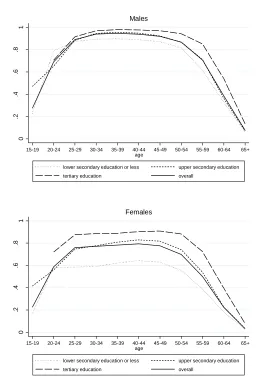
Focusing on the countries in the present analysis, labor force participation by age and highest level of educational attainment follows the same inverted u-shape profile as the profile by age only (see Figure 1): lower participation for younger and older age groups, and an almost flat section for the middle ages. Since the majority of the European labor force currently has a non-tertiary degree, the overall profile is determined by the rates of those without tertiary education. For the middle ages, the difference between educational groups is greater for women than for men. At the same
2 Data for Malta is not available in the EU LFS microdata provided by Eurostat.
time, differences between the rates of men and women are negatively correlated with the highest level of educational attainment. These differences on the aggregate level also hold when looking at each country separately (see Appendix Figure A1 and Appendix Figure A2 for country-specific profiles).
Figure 1: Labor force participation rates for all EU27 countries (except Malta) combined, by highest level of educational attainment, age, and sex; average of years 2004−20084
Source: EU LFS, own calculations.
4 Due to the practical necessity to combine education categories in order to get reliable age-, sex- and education-specific results by country, the two education categories that will be applied in the course of the projections are tertiary and non-tertiary.
0
.2
.4
.6
.8
1
p
a
rti
c
ip
a
ti
o
n
ra
te
15-19 20-24 25-29 30-34 35-39 40-44 45-49 50-54 55-59 60-64 65+ age
lower secondary education or less upper secondary education tertiary education overall
Males
0
.2
.4
.6
.8
1
p
a
rti
c
ip
a
ti
o
n
ra
te
15-19 20-24 25-29 30-34 35-39 40-44 45-49 50-54 55-59 60-64 65+ age
lower secondary education or less upper secondary education tertiary education overall
3. Labor force projections by age, sex, and education
The ILO Department of Statistics (2011) distinguishes between four different macro-level projection approaches to obtain future labor supply: 1) an approach based on certain targets or benchmarks that will be reached in a specified amount of time; 2) one that uses time extrapolation models or growth functions; 3) regression models that explain labor force participation with economic, demographic, and/or cultural factors, and use regression results as inputs in the labor force projection; and 4) an approach based on the analysis of cohort developments of labor force participation, where future participation is based on estimations of the probability to enter or exit the labor force at certain ages. The first two methods are methodologically easier to implement than the latter two as far as data requirements are concerned, which is why they are the most frequently used (ILO Department of Statistics 2011).
For the purpose of the present study the first and the fourth approaches were utilized, i.e., one benchmark scenario and one scenario that explicitly considers cohort developments in participation. In addition, results for a third scenario where participation is kept constant at current levels are also presented.
The labor force projections are carried out in a three-step process:
Labor force participation rates are projected for each country by age, sex, and highest level of educational attainment until 2053 for each scenario.
The population for each country is projected by age, sex, and highest level of educational attainment until 2053.
The results from (1) and (2) are combined, resulting in the projected labor force for each country by age, sex, and educational attainment.
This approach requires data on past, present, and future distributions of labor force participation, and present and future population distributions by age, sex, and educational attainment.
3.1 Labor force participation rates
the time of the analysis the scientific use files covered the years 1983 to 2008 and contained data for all 27 EU member states, except Malta, for varying starting years (unbalanced panel data). The following analyses are done for all 26 EU countries that are contained in the data set and this group of countries will be referred to as “EU 26” whenever results that are aggregated across all countries are presented. The file that is being used for the analysis of past and present labor force participation is the combination of 362 single yearly country files and comprises more than 38.1 million individual and independent observations.
The labor force is equivalent to the economically active population of a country, and is composed of everyone who is either employed or unemployed. Employment (civilian and non-civilian, including conscripts) is defined as any work for pay or profit for at least one hour during the reference week of the labor force survey. In addition, everyone who has a formal job attachment but was temporarily not working (e.g., due to illness, vacation, strike, educational training, or maternity or paternity leave) is counted as being employed. Persons who are not working but available for work and actively looking for a job are considered as being unemployed. These definitions are in accordance with the definitions the ILO uses for their data on economic activity (ILO 1982). The labor force is broken down by age (5-year age groups, from 15 to 65+), sex, and highest level of educational attainment. Educational attainment is divided into two categories: those who have a tertiary degree, equivalent to ISCED 5A/5B/6 (UNESCO 2006), and those who do not hold such a degree. The relevant education variable, HATLEV1D (“education or training successfully completed”), has been included in the datasets since 1992, which defines the starting year of the analysis of the development of education-specific labor force participation over time (European Commission 2009a).
For each country, past and present age-, sex-, and education-specific labor force participation rates are calculated by dividing each sub-group of the labor force by the respective sub-group of the population in the sample:
(1)
where 〖(_i^j)PR〗_(x,x+4)^t is the sex-specific (i) and education-specific (j) participation rate of quinquennial age groups x to x+4 at time t. The youngest age group is 15-19; the last and open age group is 65+. In order to be able to compare the outcome of the labor force projections with and without differentiation by educational attainment, participation rates are also estimated across both education categories.
PR
i j
x,x+4 t = iLF
j x,x+4 t
The three scenarios of labor force participation are:
1. Constant scenario. Labor force participation rates are kept at the level that was observed in 2008.
2. Cohort scenario. In this scenario, cohort participation developments between 2003 and 2008 are analyzed and enter the projection.
3. Benchmark scenario. Participation is modeled towards a given distribution.
The constant scenario is not a likely outcome but serves the purpose of a reference scenario: the resulting labor force size and composition is purely driven by changes in the composition of the population, not by changes in participation.
The cohort scenario takes into account the possible cohort component in labor market attachment. It has been shown that the observed increase in women‟s age-specific labor force participation has been shaped by changes in different birth cohorts‟ participation in the labor force, whereas cohort effects are very small or even slightly negative for men (Balleer, Gómez-Salvador, and Turunen 2009; Burniaux, Duval, and Jaumotte 2004). Using a dynamic cohort approach, differences in participation at two or more points in time are analyzed by birth cohort. The observed cohort component in labor force participation is taken into account by comparing synthetic cohorts over time and allowing cohort behavior to enter the projections. Consequently, past increases in women‟s participation are projected to continue as younger cohorts gradually replace older cohorts.
Cohort developments enter the projections by way of entry and exit rates (Burniaux, Duval, and Jaumotte 2004; Productivity Commission 2005; Carone 2005; Schrier 2010). When cohort participation increases, i.e., when there is an increase in participation between time t-5 and t between age-group (x,x+4) and (x+5,x+9), entry rates are calculated using
where 〖(_i^j)PR〗_(x,x+4) is the education- (j) and sex-specific (i) participation rate of quinquennial age groups x to x+4. The maximum potential participation rate 〖PR〗_max is set at 1.
When cohort participation decreases, i.e., when there is a decrease in participation between time t-5 and t between age-group (x,x+4) and (x+5,x+9), exit rates are calculated using
E
i j
ntryratex,x+4t =
P
i j R
x+5,x+9 t − P
ij Rx,x+4t−5
PRmax − Pij Rx,x+4t−5
E
i
j xitrate x,x+4 t = Pi
j
Rx,x+4t−5 − Pi j
Rx+5,x+9t
P
i j R
x,x+4
Age-, sex-, and education-specific entry and exit rates are calculated for each country, based on the participation rate in the years 2003 and 2008. The design of the calculation of these rates entails that when one of them is positive the other one is negative.
In the next step, future participation rates are calculated based on the last observed participation rates and the calculated entry and exit rates. When the entry rate is positive, education-, sex-, and age-specific labor force participation at time t+5 is calculated using
Analogously, when the exit rate is negative, education-, sex-, and age-specific labor force participation at time t+5 is calculated using
Entry and exit rates were kept constant during the whole projection period. Because all 26 countries have only been in the EU LFS since 2002 and age data is only available in 5-year age groups, it is not possible to calculate any time series of entry and exit rates.
Following the example of Carone (2005), a floor level of labor force participation is applied to the 15 to 19-year-olds: past expansions in educational attainment have entailed decreases in labor force participation that would automatically translate into the lower lifetime participation of these cohorts. This result is not reasonable on theoretical grounds, since the increase in enrollment in tertiary education at young ages does not justify the assumption that their lifetime participation in the labor market will be lowered once they enter the labor force. In order to avoid this unintended mechanism, participation rates of 15 to 24-year-olds that are projected to decrease after 2008 are kept at their 2008 values.
Contrary to the cohort method, where actual age-, sex-, and education-specific developments of labor force participation are the basis for future participation, the benchmark approach is based on the deliberate selection of a future age- and sex- specific target participation distribution. Often, this distribution is one that has been observed in another country that is similar in several respects – culture, history, political system – but considered to be more advanced economically, including greater gender equality or labor market involvement of persons 50+ (Houriet-Segard and Pasteels 2012). The benchmark distribution is seen as a desired outcome that can be achieved in other countries given the right policies. Female labor force participation in Europe has been increasing constantly for several decades, leading to a reduction in gender
PR
i j
x+5,x+9 t+5 = E
i j
ntryratex,x+4t ∗ PRmax − Pi j
Rx,x+4t + Pi j
Rtx,x+4 .
PR
i j
x+5,x+9
t+5 = 1 − E i
j xitrate x,x+4 t ∗ P
i j R
differences in participation (see e.g., Balleer, Gómez-Salvador, and Turunen 2009), and a further reduction does not seem an unreasonable assumption. At the same time, labor force participation among the population aged 55+ has been increasing during recent years (Balleer, Gómez-Salvador, and Turunen 2009; Heckman and Jacobs 2010). This increase has been mainly attributed to changes in retirement regulations and access to different pension schemes (European Commission 2011). Many countries have passed legislation that entails increases in normal retirement ages beyond current ages and further restrictions on the access to invalidity pensions and early retirement schemes. Further increases in the labor force participation of the elderly are likely.
The target distribution in the benchmark scenario in 2053 is the labor force distribution observed in Sweden in 2008. Comparing all countries during this time period, Sweden has the highest values in the majority of all possible education-, sex-, and age-specific combinations of labor force participation. The country-specific developments are interpolated in five-year steps, between the observed values for 2008 and the target distribution in 2053. In the few cases where certain age-, sex-, and education-specific participation rates are already higher in the base year than the ones in the target scenario, participation rates are not modified but kept constant during the whole period. Since the difference in labor force participation between men and women is smaller in Sweden than in any other country, this scenario implicitly models a reduction of the gender disparity.
Differences in labor force participation between the two education categories have not been modified explicitly. However, they do change implicitly in the cohort and benchmark scenarios. In the cohort scenario they decrease if a decrease between consecutive cohorts is picked up. Since educational differences in participation for both men and women are smaller in Sweden than in all other EU countries, the benchmark scenario also implies a reduction.
3.2 Population projections
The population data are the result of population projections from 2008 to 2053 by 5-year age groups, sex, and highest level of educational attainment that have been carried out using the multi-state cohort component method (Rogers 1975). The overall approach as well as the models and specifications used to obtain education-specific input parameters of mortality, fertility, and migration are described in detail in KC et al. (2010)5. The projections described there have been modified in the projections presented here by 1) the use of a different starting population; 2) updating assumptions
5
about age- and sex-specific future developments of mortality and migration using the UN‟s World Population Prospects, 7th revision (United Nations 2011), and 3) combining statistical models with expert judgment (detailed in KC et al. 2013 and Basten, Sobotka, and Zeman 2013) to make assumptions about future levels of fertility. Educational attainment is divided into four categories: less than completed primary education, primary education, secondary education, and tertiary education. The three lowest education categories are combined into one category after the performance of the projections, namely non-tertiary education.
In detail, this means that assumptions about the future development of mortality by age, sex, and highest level of educational attainment are based on the UN‟s age- and sex-specific life tables and life expectancies (medium variant), extended by education differentials: the difference in life-expectancy at age 15 between persons with the lowest and highest education levels is 5 years. With secondary education being the reference category, persons with no education and primary education have 3 years and 2 years lower life expectancy respectively, while those with tertiary education live 2 years longer on average.
Fertility is assumed to reach levels of total fertility (TFR) ranging from 1.5 in Romania to 2.0 in Denmark, Finland, and Sweden in the period 2050-2055 (KC et al. 2013). These target values are those of the medium scenario for low-fertility countries that resulted from combining statistical models with structured expert judgment. Current relative differentials in education-specific fertility are obtained from the literature and from analyses of census and survey data, and are kept constant during the whole projection period – with the exception of Bulgaria and Romania, where they are projected to decline further (Basten, Sobotka, and Zeman 2013).
For each country, migration was incorporated following UN migration assumptions, using the residual method where outcome of population projections without migration (i.e., where only fertility and mortality are applied) is compared with the respective age- and sex-specific population numbers of the UN projections; negative differences mean negative net migration, and migrants are taken proportionally from all education groups and entered into a „global net-migrant pool‟. A positive number of net migrants in a country means that migrants from the „global net-migrant pool‟ are allocated to the respective age, sex, and education group.
The baseline distributions of the country populations that enter the projection by age, sex, and highest level of educational attainment have been calculated using the EU LFS data for 2008. This means that the baseline data for the population projections and the labor force participation rates are coming from the same source, ensuring that future differences between the labor force projected with and without educational attainment are solely attributable to changes in the educational composition of the population, not due to discrepancies originating from sample differences due to non-congruent data sources. Since the EU LFS does not contain the population below age 15, the obtained age-, sex-, and education-specific distributions were applied to the age- and sex-specific populations provided by the UN (United Nations 2011), derived for 2008 by linearly interpolating between data for 2005 and 2010.
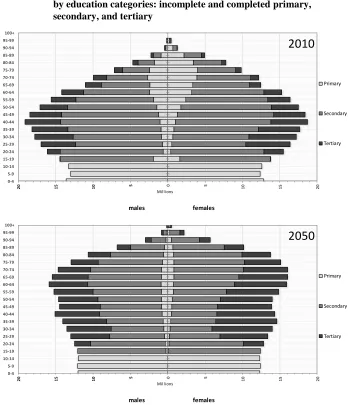
Figure 2: Population pyramids, all EU26 countries combined, 2010 and 2050, by education categories: incomplete and completed primary, secondary, and tertiary
A further expected change in the distribution of higher education is the difference in level of educational attainment for men and women: already in many countries young women are better educated than their male counterparts. This shift means that in each
20 15 10 5 0 5 10 15 20
0-4 5-9 10-14 15-19 20-24 25-29 30-34 35-39 40-44 45-49 50-54 55-59 60-64 65-69 70-74 75-79 80-84 85-89 90-94 95-99 100+
males females Millions
2010
Primary
Secondary
Tertiary
20 15 10 5 0 5 10 15 20
0-4 5-9 10-14 15-19 20-24 25-29 30-34 35-39 40-44 45-49 50-54 55-59 60-64 65-69 70-74 75-79 80-84 85-89 90-94 95-99 100+
males females Millions
2050
Primary
Secondary
country in the period up until 2050 the 15+ female population is projected to be, on average, better educated than the 15+ male population. Under the GET scenario, educational attainment levels of 30 to 34-year-old men and women will converge in the long run, but in the great majority of countries full convergence will not be reached by 2050. In order to not project education attainment levels beyond that currently observed worldwide in countries with the highest levels of tertiary attainment, there is a threshold of 60% tertiary attainment for 30 to 34-year-olds that, once attained anytime between 2008 and 2053, is not increased any further but remains constant (KC et al. 2010).
3.3 Projections of future labor supply
The described population projections are combined with the three scenarios of the future development of labor force participation. This means that for each scenario, age-, sex-, and education-specific sub-groups of the labor force at time t+5 are estimated by
(2)
where t+5 ranges from 2013 to 2053. At any point in time, the total size of the labor force – taking into account the heterogeneity by highest level of educational attainment – is the sum of all sub-groups:
(3)
Additionally, the labor force is estimated using data only by age and sex and the results with and without differentiation by education are compared, as well as the educational composition of certain sub-groups of the population, in particular men and women, and different age groups.
3.3.1 Total size of the labor force
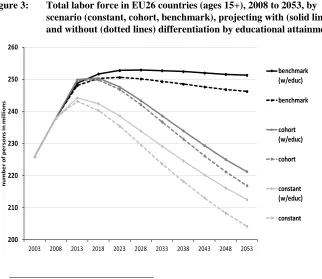
The labor force of the 26 countries considered comprised 237.8 million persons in 2008. Figure 3 illustrates the effect of adding the highest level of educational attainment to the total size of the labor force for the period 2008 to 2053. For each scenario (i.e., irrespective of the method and assumptions used) adding the education dimension leads to a larger projected labor force than without it. By the end of the projection period the
LF
i j
𝑥,𝑥+4t+5 = PRi j
x,x+4 t+5 ∗ POP
i j
x,x+4t+5 ,
LFt+5= LF i j
x,x+4t+5 65
x=15 2
j=1 2
i=1
biggest education effect, 4.1%, occurs in the case of the constant scenario (204.1 versus 212.5 million). The constant scenario leads to the lowest projected size of the labor force: due to population aging there will be an increasing number of people in age groups that are associated with low labor force participation rates, and the constant scenario is the only scenario that, unmodified, captures this demographic effect. The scenario that projects a clear increase in the labor force is the benchmark scenario, resulting in the largest labor force in 2053 (251.3 million with education differentiation). The results on the aggregate level are largely replicated on the country level. The constant and the cohort scenarios lead to a reduction in the size of the labor force in the majority of the 26 countries, whether participation is differentiated by education or not. Only the benchmark scenario with education differentiation anticipates a decrease in just 12 out of the 26 countries.
Figure 3: Total labor force in EU26 countries (ages 15+), 2008 to 2053, by scenario (constant, cohort, benchmark), projecting with (solid lines) and without (dotted lines) differentiation by educational attainment6
6 All results are presented starting at age 15 in order to include the whole labor force. However, it should be kept in mind that this implies some selection, since persons below age 20 have not finished tertiary education yet. However, this effect does not change the results much: for example, the share of the EU26 labor force in 2008 with tertiary education for ages 15+ is 26.0% and for 20+ it is 26.8%.
200 210 220 230 240 250 260
2003 2008 2013 2018 2023 2028 2033 2038 2043 2048 2053
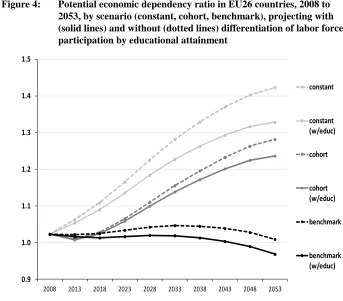
The development of the labor force alone does not say much about the economic consequences of population aging. It is the ratio of the number of persons that are not economically active (i.e., those that are not in the labor force) to those who are (i.e., those that are in the labor force) that is of crucial interest, since this provides an estimate of the economic burden on those that are economically active. This ratio underestimates actual economic dependency, since the economically active comprise those working and those that are looking for work. The measure of choice is what could be called the potential economic dependency ratio. Defining economic dependency in this way leads to a dependency that lies between the even cruder measure based purely on demographic information (total demographic dependency ratio = (pop 65+ and pop. <15)/pop. 15-64) and one based on actual employment (actual economic dependency ratio = everyone employed/everyone who is not employed). The development of the potential economic dependency ratio for all EU26 countries combined is depicted in Figure 47.
Potential economic dependency (PED) on the EU level was 1.02 in 2008, meaning there was already more than one inactive person for every active person. PED increases initially in all scenarios, but starts to level off and even decline halfway through the projection period in the benchmark scenario (cf. Figure 4). The trajectories of economic dependency of the constant and cohort scenarios are driven by a constant decline in the number of active persons (as depicted in Figure 3) and a simultaneous constant increase in the number of inactive persons that only starts to reverse towards the end of the projection period. By contrast, this reversal in the development of the size of the inactive population has already started in the benchmark scenarios halfway through the projection period.
7
Figure 4: Potential economic dependency ratio in EU26 countries, 2008 to 2053, by scenario (constant, cohort, benchmark), projecting with (solid lines) and without (dotted lines) differentiation of labor force participation by educational attainment
3.3.2 Aggregate participation rates
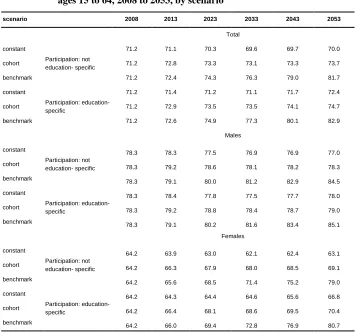
The three participation scenarios lead to adult participation rates at the aggregate level that differ by more than five percentage points in 2033 and more than ten percentage points in 2053 (Table 2). For both sexes combined, participation under the constant scenario – the scenario that accounts only for changes in the composition of the population – declines marginally from 71.2% to 70.0% between 2008 and 2053 when participation is not considered by education. The education-specific projection actually shows a slight increase, to 72.4%. This increase is driven by the change in aggregate participation of women, from 64.2% to 66.8%. Both the cohort and benchmark scenario lead to increases in participation, the main difference being that the increase in the
0.9 1.0 1.1 1.2 1.3 1.4 1.5
2008 2013 2018 2023 2028 2033 2038 2043 2048 2053
constant
constant (w/educ)
cohort
cohort (w/educ)
benchmark
cohort scenario is largely due to the projected increase in participation of women, whereas the benchmark scenario is built on assumed increases for both sexes. The underlying aggregate age-, sex-, and education-specific participation rates are compiled in Appendix Table A2.
Table 2: Labor force participation rates for all EU26 countries combined, ages 15 to 64, 2008 to 2053, by scenario
scenario 2008 2013 2023 2033 2043 2053
Total constant
Participation: not education- specific
71.2 71.1 70.3 69.6 69.7 70.0
cohort 71.2 72.8 73.3 73.1 73.3 73.7
benchmark 71.2 72.4 74.3 76.3 79.0 81.7
constant
Participation: education-specific
71.2 71.4 71.2 71.1 71.7 72.4
cohort 71.2 72.9 73.5 73.5 74.1 74.7
benchmark 71.2 72.6 74.9 77.3 80.1 82.9
Males constant
Participation: not education- specific
78.3 78.3 77.5 76.9 76.9 77.0 cohort
78.3 79.2 78.6 78.1 78.2 78.3
benchmark 78.3 79.1 80.0 81.2 82.9 84.5
constant
Participation: education-specific
78.3 78.4 77.8 77.5 77.7 78.0
cohort 78.3 79.2 78.8 78.4 78.7 79.0
benchmark
78.3 79.1 80.2 81.6 83.4 85.1 Females
constant
Participation: not education- specific
64.2 63.9 63.0 62.1 62.4 63.1 cohort
64.2 66.3 67.9 68.0 68.5 69.1
benchmark 64.2 65.6 68.5 71.4 75.2 79.0
constant
Participation: education-specific
64.2 64.3 64.4 64.6 65.6 66.8 cohort
64.2 66.4 68.1 68.6 69.5 70.4
benchmark 64.2 66.0 69.4 72.8 76.9 80.7
2009b).8 Their assumptions for the future development of labor force participation center around the effect of recent pension reforms in many EU member states, which are projected to entail increases in participation for persons age 45 and older, with older women showing significantly larger increases than older men. The methodology employed is basically the dynamic cohort approach, also implied for the cohort scenario in this paper, extended by changes in the probability of exiting the labor force in order to account for assumed changing retirement behavior (European Commission 2008). The reason why the cohort scenario presented in this paper and the baseline scenario of the European Commission – which does deliberately contain effects of recent pension reforms – lead to such similar results is likely due to the different starting years of the projections. Between 2007 and 2008, participation of older workers continued to increase in the great majority of EU countries, which was picked up by the dynamic cohort model.
The comparison with the results of the baseline scenario of Balleer and colleagues (Balleer, Gómez-Salvador, and Turunen 2009) shows somewhat more discrepancy. Their projected participation for both sexes combined is 72.5% in 2030 for Germany, France, Italy, Spain, and the Netherlands. Their projection results are based on an elaborate econometric model that identifies age and cohort effects separately, as well as the effect of several socio-economic explanatory variables. Calculating aggregate participation for only those 5 countries, the cohort model in this paper leads to a participation level of 73.6 % in both the education-specific and non-education-specific cases in 2033.
3.3.3 Educational composition of the labor force
As far as the educational composition of the labor force is concerned, there is a projected shift towards higher degrees. As shown in Appendix figure A3, the share of the population that holds a tertiary degree will increase in each of the 26 countries during the next decades. This fact, in combination with higher participation rates of the higher educated, leads to an overall better-educated labor force: in all 26 countries combined, the share of workers aged 15 and older that possess a tertiary degree is projected to increase from 26% in 2008 to 45% in 2053 (Figure 5). The medium-term
8 The results are deliberately compared with European Commission (2008) and not European Commission (2011), since the starting year of the labor force projections in the earlier report is closer to the starting year of the projections in this paper. The main differences between the later and the earlier report is the use of EUROPOP2010 instead of EUROPOP2008 as underlying population projection, and the incorporation of the effect of the financial crisis on labor force participation. For all EU27 countries combined, these
projections by CEDEFOP (2010) support these findings. They also foresee an increase in the share of the labor force aged 15+ with tertiary education in the EU 27, to 33.5% in 2020. The comparable figure in 2020 for the cohort scenario is 31.2%.
Figure 5: Share of the labor force with tertiary education, ages 15+, by country, 2008 and 2053 (cohort scenario)
Note: See Appendix Table A1 for a list of country abbreviations and country names.
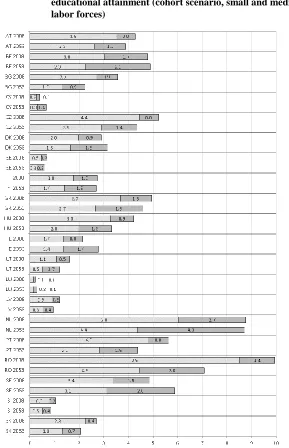
Figure 7: Absolute size of the labor force (ages 15+), by highest level of educational attainment (cohort scenario, six largest labor forces)
3.3.4 Labor force by education and gender
The differences between the three scenarios are not only in the overall size of the labor force: the size of the male and the female labor forces also differs. However, in all scenarios the male labor force is projected to continue to be larger than the female labor force in the great majority of countries.
Already today, the female labor force is equally or better educated than the male labor force (the only exceptions being Austria and Germany). Figure 8 shows the share of the labor force with a tertiary degree by gender in 2008 and 2053 for the cohort scenario. By 2053 a higher share of female than male workers with a tertiary degree is projected in every country. This development is driven by the fact that young women have been catching up with and even surpassing men when it comes to obtaining a tertiary degree, and that female labor force participation shows larger differences between women with tertiary and non-tertiary education than is the case for males. This result, that the female labor force will continue to have higher formal qualification levels than the male labor force, is in line with the medium-term results up to 2020 by CEDEFOP (2010).
Netherlands the male labor force is projected to decrease in size whereas the female one will increase, while both labor forces are projected to increase in Sweden, Ireland, and the UK, for example. A universal decrease is anticipated in e.g., Portugal, Bulgaria, Romania, and Germany.
Figure 8: Share of the labor force with tertiary education, ages 15+, by country and sex, 2008 and 2053 (cohort scenario)
3.3.5 Labor force by age and education
Table 3: Distribution of the labor force (EU26) across age groups (15−29, 30 to 54, 55−64, and 65+), 2008 and 2053, by scenario
2008 constant cohort benchmark
age Absolute size (in millions)
15-29 54.2 45.4 46.9 53.5
30-54 151.5 124.6 126.7 131.2
55-64 28.2 30.5 33.3 44.9
65+ 4.0 12.0 14.3 21.8
total 237.8 212.5 221.2 251.3
Shares in each age-group
15-29 0.23 0.21 0.21 0.21
30-54 0.64 0.59 0.57 0.52
55-64 0.12 0.14 0.15 0.18
65+ 0.02 0.06 0.06 0.09
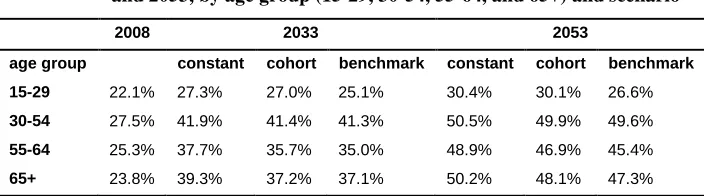
Besides changes in the age distribution in the active population over time, there are expected shifts in the composition by level of educational attainment: the share of the labor force that holds a tertiary degree is estimated to increase in every age group and for every scenario between 2008 and 2053; however, the differences between the individual scenarios are relatively large for every age-group (Table 4). The educational attainment structure of the population aged 50+ in 2033 can be projected with some certainty, since the majority had already finished their education in 2008.
Table 4: Share of the labor force (EU26) with a tertiary degree, 2008, 2033, and 2053, by age group (15-29, 30-54, 55-64, and 65+) and scenario
2008 2033 2053
age group constant cohort benchmark constant cohort benchmark
15-29 22.1% 27.3% 27.0% 25.1% 30.4% 30.1% 26.6%
30-54 27.5% 41.9% 41.4% 41.3% 50.5% 49.9% 49.6%
55-64 25.3% 37.7% 35.7% 35.0% 48.9% 46.9% 45.4%
65+ 23.8% 39.3% 37.2% 37.1% 50.2% 48.1% 47.3%
overall population aged 65+ is lower educated than younger cohorts (compare Figure 2), the greater relative educational differences in labor force participation (compare Figure 1) lead to a higher predicted share of tertiary educated persons in the oldest age group than in the younger ones.
4. Discussion
The size and composition of the labor force during the next four decades depends on two components: the course of population development and the evolution of age-, sex-, and education-specific labor force participation. As far as the reliability of population projections is concerned, most uncertainty comes from migration. Future changes in migration policies can affect the volume and composition of migration flows, but the analysis of the possible impact is beyond the scope of this paper. Bijak et al. (2008) demonstrate the effect of different assumptions of the volume of net migration on the total population and the labor force by comparing various demographic and economic indicators. For their projections of labor force participation, Balleer, Gómez-Salvador,
and Turunen (2009) calculated a scenario with zero future migration. They find an increasing difference in aggregate adult participation, from 0.1 percentage points in 2015 to 0.8 percentage points in 2030, compared to the base scenario that includes migration. This effect is similar in magnitude to the difference found in this paper between performing labor force projections as education-specific or not (cf. Table 2).
Scenarios are one way to address the sensitivity of projection results. Though this approach does not allow for quantitative statements about the likelihood of each scenario describing the future development of labor supply in Europe and in each EU member state, scenarios do permit the provision of a range for reasonable results and address the issue of their robustness (Carone 2005). Based on past development and the experience in countries that are forerunners when it comes to gender equality in the labor market, a further increase in female labor force participation can be reasonably expected. Similarly, it is well justified to anticipate further increases in the labor market attachment of the population aged 55+, due to likely future restrictions on early retirement schemes and increases in statutory retirement ages (European Commission 2011). Hence, it seems justified to assume that the constant scenario represents the lowest level of labor supply in 2053 that can be anticipated. Similarly, achieving participation levels that are currently observed in Sweden would imply a lot of effort in the majority of countries when it comes to the activation of women and older workers, so treating this as an approximate upper bound appears reasonable.
global patterns of education expansion, what will the education composition in each country look like? This of course brings about the question of how accurate such an approach is, and how large the error in estimating future educational attainment might be. A first indication comes from comparing projected attainment levels after the initial projection period with observed levels in 2013 (EUROSTAT 2014). For 19 out of the 26 EU countries, the GET assumptions turn out to underestimate the actual development: i.e., the observed share of 30-34 year-olds with tertiary education in 2013 is higher than projected. Hence, the attainment levels of the presented education projections may be too conservative.
A critical point is the uncertainty about how differentials in labor force participation between those with and without tertiary education will evolve in the future: will the observed differentials persist, become smaller, or even increase? In theory, any of these developments is possible due to the large number of factors responsible for the observed differences, ranging from individual (unobserved) characteristics like ability and motivation to country-specific policies and institutions that might create different incentives and opportunities to be economically active for people with different levels of education. A related crucial question is how far the projected increase in overall educational attainment levels entails a change in the composition of those who obtain a certain level of education due to selection, i.e., the effect of education might get „diluted‟ for those with the highest level of educational attainment, and at the same time those with less than secondary education might find themselves in a pool of negative selection. Both aspects should be kept in mind when looking at the results of the paper. Trying to incorporate this into the present analysis is beyond the purpose of this study.
education has remained high in most OECD countries and has increased in some” (OECD 2011b: 195).
External shocks, for example, the current financial crisis, cannot be anticipated and are therefore not considered in this kind of labor force projection; they can only try to factor in structural changes, not short-term cyclical changes (Houriet-Segard and Pasteels 2012). Cyclical changes like the current crisis have the potential to influence the decision to invest in human capital: rather than facing unemployment, young people in particular may opt to stay in or re-enter the education system. Unforeseeable events and subsequent changes in behavior of educational activity can have an effect on the educational composition of the population and the labor force for several decades.
5. Conclusion
Compared to existing labor force projections, the projections in this paper include information about the highest level of educational attainment, which means another level of heterogeneity in labor force participation besides age and sex is being considered. This heterogeneity is relevant in two ways: 1) it enters the projection methodology, since the fundamental parameters (population and labor force participation) are decomposed into three instead of two dimensions, and 2) it adds a further dimension of information about the future composition of the labor force.
When talking about the effect of adding educational attainment to the dimensions that labor force participation is disaggregated by, one has to distinguish between the effect on aggregate participation rates and the consequences this new dimension has on the composition of the labor force. For each scenario, i.e., irrespective of the assumptions about future development of the labor force and the method used, adding the education dimension leads to a larger projected labor force than when not using it. The effect, however, is moderate. Its magnitude varies across countries and scenarios and increases over time, but in no case in 2053 does it exceed 8%: the average across countries and scenarios in 2053 is 3%. The general development of the size of the labor force is driven by the specification of the scenario, not whether the scenario is estimated with or without education differentiation of participation. Under the constant scenario, aggregate participation of 15 to 64-year-olds would increase slightly between 2008 and 2053, from 71.2% to 72.4% (education-specific calculations). Assuming a development along cohort lines would lead to a slightly larger aggregate rate of 74.7% in 2053, whereas the achievement of „Swedish conditions‟ would imply aggregate participation of 82.9%.
tertiary degree in 2053 is estimated at 45% in the cohort scenario and 47% in the constant scenario. This result holds when additionally breaking down the labor force by sex with small ranges (39% to 40% for males, 52% to 56% for females). The variation increases somewhat when comparing the share of the labor force with a tertiary degree by age-group across scenarios: focusing on older age-groups, the largest share of workers aged 55-64 is projected under the constant scenario (49%) and the lowest under the benchmark scenario (45%), and the respective values for ages 65+ are 50% and 47%. In any case, compared to 2008 this implies a tremendous increase in the share of the active population with a tertiary degree in these age groups. This educational upgrading of the European labor force is not driven by developments in a few large countries but can be expected to take place in each of the 26 analyzed countries.
Summing up, the labor force in Europe is likely to be older, contain a higher share of women, and will overall be composed of people that are on average higher educated than today. This result is robust in the sense that it holds for the overall labor force, irrespective of the scenario, and for the analyzed subgroups (men/women and broad age groups). Whether the labor force will be smaller depends on how participation of women and those aged 55+ years and older evolves.
A better-educated but shrinking labor force is likely to be able to alleviate some of the anticipated economic consequences of population aging, but cannot be the final answer. An increasingly uneven distribution of work would very likely lead to a situation where those in the labor force have to deliver increasing shares of their earnings to support those who are not working (any more). Heckman and Jacobs make a similar point, focusing on changing skill demands: “As relative demand for unskilled labor decreases, low-skill workers become increasingly dependent on welfare state arrangements such as unemployment benefits, public training, and labor market policies. In the end, social cohesion could be undermined with a growing divide on labor markets between the skilled and the unskilled and a larger dependency of low skill workers on welfare state arrangements” (Heckman and Jacobs 2010: 35).
6. Acknowledgements
Funding for this work was made possible by an Advanced Grant of the European Research Council, “Forecasting Societies Adaptive Capacities to Climate Change”, grant agreement ERC-2008-AdG 230195-FutureSoc, and the Austrian Science Fund (FWF) Z171-G11.
References
Acemoglu, D. and Autor, D. (2012). What Does Human Capital Do? A Review of Goldin and Katz‟s The Race between Education and Technology. Cambridge, MA: National Bureau of Economic Research, NBER Working Paper No. 17820.
doi:10.3386/w17820.
Ahlburg, D.A. and Lutz, W. (1998). Introduction: The Need to Rethink Approaches to Population Forecasts. Population and Development Review 24(Special Issue): 1–14. doi:10.2307/2808048.
Balleer, A., Gómez-Salvador, R., and Turunen, J. (2009). Labour Force Participation in the Euro Area. A Cohort Based Analysis. Frankfurt/Main: European Central Bank, ECB Working Paper No. 1049.
Basten, S., Sobotka, T., and Zeman, K. (2013) Future Fertility in Low Fertility Countries. Vienna, Austria: Vienna Institute of Demography, VID Working Paper 05/2013. http://www.oeaw.ac.at/vid/download/WP2013_5.pdf.
Bijak, J., Kupiszewska, D., and Kupiszewski, M. (2008). Replacement Migration Revisited: Simulations of the Effects of Selected Population and Labor Market Strategies for the Aging Europe, 2002–2052. Population Research and Policy
Review 27(3): 321–342. doi:10.1007/s11113-007-9065-2.
Bijak, J., Kupiszewska, D., Kupiszewski, M., Saczuk, K., and Kicinger, A. (2007). Population and Labour Force Projections for 27 European Countries, 2002-2052: Impact of International Migration on Population Ageing. European Journal of
Population/Revue Européenne de Démographie 23(1): 1–31.
Blöndal, S. and Scarpetta, S. (1999). The Retirement Decision in OECD Countries. Paris: OECD Publishing, OECD Economics Department Working Papers, No. 202. doi:10.1787/565174210530.
Bloom, D.E., Canning, D., and Fink, B. (2011). Implications of Population Aging for Economic Growth. Cambridge, MA: Harvard, PGDA Working Paper No. 64.
doi:10.3386/w16705.
Börsch-Supan, A. (2003). Labor Market Effects of Population Aging. Labour
17(Special Issue): 5–44. doi:10.1111/1467-9914.17.specialissue.2.
Bowen, W.B. and Finegan, W.A. (1966). Educational Attainment and Labor Force Participation. The American Economic Review 56(1/2): 567–582.
Burniaux, J.-M., Duval, R., and Jaumotte, F. (2004). Coping with Ageing: A Dynamic Approach to Quantify the Impact of Alternative Policy Options on Future Labour Supply in OECD Countries. Paris: OECD Publishing, OECD Economics Department Working Papers No. 371. doi:10.1787/224538175006.
Carone, G. (2005). Long-Term Labour Force Projections for the 25 EU Member States: A Set of Data for Assessing the Economic Impact of Ageing. Brussels: European Commission, Directorate-General for Economic and Financial Affairs, Economic Papers Nr. 235.
CEDEFOP (2010). Skills Supply and Demand in Europe. Medium-Term Forecast up to 2020. Luxembourg: Publications Office of the European Union.
European, Commission (2008). The 2009 Ageing Report: Underlying Assumptions and Projection Methodologies. Brussels: European Commission, Directorate-General for Economic and Financial Affairs, European Economy 7/2008.
European, Commission (2009a). EU Labour Force Survey Database. User Guide. Luxembourg: Eurostat.
European, Commission (2009b). The 2009 Ageing Report: Economic and Budgetary Projections for the EU-27 Member States (2008-2060). Brussels: European Commission, Directorate-General for Economic and Financial Affairs.
European, Commission (2010). European Union Labour Force Survey (yearly Microdata Files). Luxembourg: Eurostat.
European, Commission (2011). The 2012 Ageing Report: Underlying Assumptions and Projection Methodologies. Brussels: European Commission, Directorate-General for Economic and Financial Affairs, European Economy 4/2011.
EUROSTAT (2014). EUROSTAT Database. LFS Series - Detailed Annual Survey Results (lfsa). http://ec.europa.eu/eurostat/data/database.
Flaim, P.O. and Fullerton, Jr., H.N. (1978). Labor Force Projections to 1990: Three Possible Paths. Monthly Labor Review 101(12): 25–35.
Fougere, M., Harvey, S., Mercenier, J., and Merette, M. (2009). Population Ageing, Time Allocation and Human Capital: A General Equilibrium Analysis for Canada. Economic Modelling 26(1): 30–39.
Gunderson, M. and Oreopoulos, P. (2010). Returns to Education in Developed Countries. In: Peterson, P., Baker, E., and McGaw, B. (eds.) International
Encyclopedia of Education (Third Edition). Oxford: Elsevier: 298–304.
http://www.sciencedirect.com/science/article/pii/B978008044894701215X.
Heckman, J.J. and Jacobs, B. (2010). Policies to Create and Destroy Human Capital in Europe. Cambridge, MA: National Bureau of Economic Research, NBER Working Paper No. 15742. doi:10.3386/w15742.
Houriet-Segard, G. and Pasteels, J.-M. (2012). Projections of Economically Active Population. A Review of National and International Methodologies. Geneva: ILO, ILO Department of Statistics Working Paper Nr. 4.
ILO (1982). Resolution Concerning Statistics of the Economically Active Population, Employment, Unemployment and Underemployment. Adopted by the Thirteenth International Conference of Labour Statisticians (October 1982).
ILO, Department of Statistics (1971). Labour Force Projections, 1965−85. Geneva: ILO.
ILO, Department of Statistics (2011). ILO Estimates and Projections of the
Economically Active Population: 1990-2020. Methodological Description.
Geneva: ILO.
Judy, R. and D‟Amico, C. (1997). Workforce 2020: Work and Workers in the 21st
Century. Indianapolis, IN: Hudson Institute.
KC, S., Barakat, B., Goujon, A., Skirbekk, V., Sanderson, W.C., and Lutz, W. (2010). Projection of Populations by Level of Educational Attainment, Age, and Sex for 120 Countries for 2005−2050. Demographic Research 22(15): 383–472.
doi:10.4054/DemRes.2010.22.15.
KC, S., Potančoková, M., Bauer, R., Goujon, A., and Striessnig, E. (2013). Summary of Data, Assumptions and Methods for New Wittgenstein Centre for Demography and Global Human Capital (WIC) Population Projections by Age, Sex and Level of Education for 195 Countries to 2100. Laxenburg, Austria: International Institute for Applied Systems Analysis, Interim Report IR-13-018. http://webarchive.iiasa.ac.at/Admin/PUB/Documents/IR-13-018.pdf.
Konietzka, D. and Kreyenfeld, M. (2010). The Growing Educational Divide in Mothers‟ Employment: An Investigation Based on the German Micro-Censuses 1976−2004. Work, Employment & Society 24(2): 260–278.
Lee, R. and Mason, A. (2010). Some Macroeconomic Aspects of Global Population Aging. Demography 47(Supplement): 151–172.
Leibfritz, W. and Roeger, W. (2008). The Effects of Aging on Labor Markets and Economic Growth. In: Hamm, I., Seitz, H., and Werding, M. (eds.).
Demographic Change in Germany. The Economic and Fiscal Consequences.
Berlin/Heidelberg: Springer: 35−63.
Ludwig, A., Schelkle, T., and Vogel, E. (2012). Demographic Change, Human Capital and Welfare. Review of Economic Dynamics 15(1): 94–107.
doi:10.1016/j.red.2011.07.001.
Lutz, W., Goujon, A., and Doblhammer-Reiter, G. (1998). Demographic Dimensions in Forecasting: Adding Education to Age and Sex. Population and Development
Review 24(Special Issue): 42–58. doi:10.2307/2808050.
McDonald, P. and Kippen, R. (2001). Labor Supply Prospects in 16 Developed Countries, 2000 to 2050. Population and Development Review 27(1): 1–32.
doi:10.1111/j.1728-4457.2001.00001.x.
Mc Morrow, K. and Roeger, W. (1999). The economic consequences of ageing populations (a comparison of the EU, US and Japan). Brussels: European Commission, Economic and Financial Affairs. European Economy. (Economic Papers Nr. 138).
Neumark, D., Johnson, H., Qian, L., and Schiff, E. (2011). An Assessment of Labor Force Projections Through 2018: Will Workers Have the Education Needed for the Available Jobs? Washington, DC: AARP Foundation, Report Prepared for The AARP Foundation by The Public Policy Institute of California.
OECD (2011a). Education at a Glance 2011: OECD Indicators. Paris: OECD Publishing.
OECD (2011b). OECD Employment Outlook 2011. Paris: OECD Publishing.
Patrinos, H.A. and Psacharopoulos, G. (2010). Returns to Education in Developing Countries. In: Peterson, P., Baker, E., and McGaw, B. (eds.). International
Encyclopedia of Education (third Edition). Oxford: Elsevier: 305-312.
http://www.sciencedirect.com/science/article/pii/B9780080448947012161.
Prskawetz, A., Fent, T., and Guest, R. (2008). Workforce Aging and Labor Productivity: The Role of Supply and Demand for Labor in the G7 Countries.
Population and Development Review 34(Special Issue: Population Aging,
Human Capital Accumulation, and Productivity Growth): 298–323.
Psacharopoulos, G. and Patrinos, H.A. (2004). Returns to Investment in Education: A Further Update. Education Economics 12(2): 111–134.
doi:10.1080/0964529042000239140.
Radl, J. (2007). Individual Determinants of the Age of Retirement an Empirical Analysis of Transitions to Old Age Pensions. Zeitschrift Fur Soziologie 36(1): 43–64.
Razzak, W. and Timmins, J. (2007). Education and Labour Productivity in New Zealand. New Zealand: Department of Labour, MPRA Paper 1882.
Rogers, A. (1975). Introduction to Multiregional Mathematical Demography. New York, NY: John Wiley & Sons. http://www.colorado.edu/ibs/pubs/pop/pop2007-0002.pdf.
Schrier, D. (2010). British Columbia Labour Force Participation Rate Projections. A
Cohort Analysis Model. Victoria, BC: BC Stats.
Striessnig, E. and Lutz, W. (2014). How Does Education Change the Relationship between Fertility and Age-Dependency under Environmental Constraints? A Long-Term Simulation Exercise. Demographic Research 30(16): 465–492.
doi:10.4054/DemRes.2014.30.16.
Toossi, M. (2009). Labor Force Projections to 2018: Older Workers Staying More Active. BLS Monthly Labor Review 132(11): 30–51.
UNESCO (2006). International Standard Classification of Education. ISCED 1997.
United, Nations (2011). World Population Prospects: The 2010 Revision. New York: Department of Economic and Social Affairs, Population Division.
Appendix
Table A1: Country abbreviations and country names
Abbreviation Country name
AT Austria
BE Belgium
BG Bulgaria
CY Cyprus
CZ Czech Republic
DE Germany
DK Denmark
EE Estonia
ES Spain
FI Finland
FR France
GR Greece
HU Hungary
IE Ireland
IT Italy
LT Latvia
LU Luxembourg
LV Lithuania
NL Netherlands
PL Poland
PT Portugal
RO Romania
SE Sweden
SI Slovakia
SK Slovenia
UK United Kingdom
Figure A1: Labor force participation by highest level of educational attainment, males, average of years 2004−2008 (EU LFS, own calculations)
0 .5 1 0 .5 1 0 .5 1 0 .5 1 0 .5 1 15-1 9 20-2 4 25-2 9 30-3 4 35-3 9 40-4 4 45-4 9 50-5 4 55-5 9 60-6 4 65+ 15-1
9 20-2 4 25-2 9 30-3 4 35-3 9 40-4 4 45-4 9 50-5 4 55-5 9 60-6 4 65+ 15-1
9 20-2 4 25-2 9 30-3 4 35-3 9 40-4 4 45-4 9 50-5 4 55-5 9 60-6 4 65+ 15-1
9 20-2 4 25-2 9 30-3 4 35-3 9 40-4 4 45-4 9 50-5 4 55-5 9 60-6 4 65+ 15-1 9 20-2 4 25-2 9 30-3 4 35-3 9 40-4 4 45-4 9 50-5 4 55-5 9 60-6 4 65+ 15-1
9 20-2 4 25-2 9 30-3 4 35-3 9 40-4 4 45-4 9 50-5 4 55-5 9 60-6 4 65+
AT BE BG CY CZ DE
DK EE ES FI FR GR
HU IE IT LT LU LV
NL PL PT RO SE SI
SK UK
non-teriary tertiary total
age
Figure A2: Labor force participation by highest level of educational attainment, females, average of years 2004−2008 (EU LFS, own calculations)
0 .5 1 0 .5 1 0 .5 1 0 .5 1 0 .5 1 15-1 9 20-2 4 25-2 9 30-3 4 35-3 9 40-4 4 45-4 9 50-5 4 55-5 9 60-6 4 65+ 15-1
9 20-2 4 25-2 9 30-3 4 35-3 9 40-4 4 45-4 9 50-5 4 55-5 9 60-6 4 65+ 15-1
9 20-2 4 25-2 9 30-3 4 35-3 9 40-4 4 45-4 9 50-5 4 55-5 9 60-6 4 65+ 15-1
9 20-2 4 25-2 9 30-3 4 35-3 9 40-4 4 45-4 9 50-5 4 55-5 9 60-6 4 65+ 15-1 9 20-2 4 25-2 9 30-3 4 35-3 9 40-4 4 45-4 9 50-5 4 55-5 9 60-6 4 65+ 15-1
9 20-2 4 25-2 9 30-3 4 35-3 9 40-4 4 45-4 9 50-5 4 55-5 9 60-6 4 65+
AT BE BG CY CZ DE
DK EE ES FI FR GR
HU IE IT LT LU LV
NL PL PT RO SE SI
SK UK
non-teriary tertiary total
age