DEMOGRAPHIC RESEARCH
VOLUME 32, ARTICLE 46, PAGES 1267
−
1298
PUBLISHED 3 JUNE 2015
http://www.demographic-research.org/Volumes/Vol32/46/ DOI: 10.4054/DemRes.2015.32.46
Research Article
Living alone in Japan:
Relationships with happiness and health
James M. Raymo
This publication is part of the Special Collection on “Living alone: One-person households in Asia,” organized by Guest Editors Wei-Jun Jean Yeung and Adam Ka-Lok Cheung.
©2015 James M. Raymo.
This open-access work is published under the terms of the Creative Commons Attribution NonCommercial License 2.0 Germany, which permits use, reproduction & distribution in any medium for non-commercial purposes, provided the original author(s) and source are given credit.
1 Introduction 1268
2 Background 1271
2.1 One-person households in Japan 1271
2.2 Living alone and well-being 1275
2.3 Gender differences 1278
2.4 Socioeconomic differences 1279
3 Data and methods 1279
3.1 The rise in one-person households: The role of changes in marriage behavior and changes in living arrangements by marital status 1280 3.2 Living arrangements, happiness, and health 1281
4 Results 1282
4.1 The rise in one-person households – the role of changes in marriage
behavior and living arrangements 1282
4.2 Living arrangements and emotional well-being 1286
5 Discussion 1291
6 Acknowledgements 1293
Living alone in Japan:
Relationships with happiness and health
James M. Raymo1
Abstract
BACKGROUND
One-person households are the most common type of household in Japan, but relatively little is known about the causes and potential consequences of the rise in solo living in young adulthood.
OBJECTIVE
I address two questions: What accounts for the rise in one-person households in young adulthood? How is solo living in young adulthood related to well-being?
METHODS
I use census data to evaluate how much of the growth in one-person households at ages 20−39 between 1985 and 2010 is explained by change in marital behavior and how much is explained by other factors. I then use data from the 2000−2010 rounds of the Japanese General Social Survey to examine whether and why men and women living alone differ from those living with others in terms of happiness and self-rated health.
RESULTS
Results of the first set of analyses indicate that changes in marital behavior explain all of the increase in one-person households for men and three-fourths of the increase for women. Results of the second set of analyses indicate that those living alone are significantly less happy than those living with others, whereas the two groups do not differ with respect to self-rated health. The observed differences in happiness are not explained by differences in subjective economic well-being or social integration.
CONCLUSIONS
The relatively small magnitude of estimated differences in happiness and health provides little evidence to suggest that the projected rise in one-person households is likely to play a significant role in contributing to lower levels of well-being among young adults in Japan.
1. Introduction
The prevalence of one-person households has increased over the past 20−30 years in many wealthy countries (e.g., Hall, Ogden, and Hill 1997; Kaufmann 1994). Viewed as part of the second demographic transition, this trend reflects both changes in marriage behavior and changes in attitudes and preferences (Lesthaeghe and Moors 2000; Ogden and Hall 2004; Surkyn and Lesthaeghe 2004). The former emphasizes the roles of later entry into marriage, increasing proportions of the population who never marry, and high rates of marital dissolution in increasing exposure to the risk of living in a one-person household (e.g., Hall, Ogden, and Hill 1997).2 The latter emphasizes educational
expansion, growing economic independence for women, increasing desire for privacy, independence, and self-actualization, and growth in infrastructure and services that facilitate living alone (Jamieson and Simpson 2013). Popular media accounts have highlighted both the pros and cons of living alone, touting independence and privacy while raising concerns about isolation and loneliness (Klinenberg 2012). However, careful empirical analyses of relationships between living alone and well-being are limited.
The general trend is toward more solo living, but the prevalence of one-person households varies markedly across countries. As shown in Figure 1, in 2010 the prevalence of one-person households (as a proportion of all households) ranged from over one-third in several Northern European countries to about half that level in Southern Europe (OECD 2014). Explanations for this cross-national variation in solo living tend to emphasize differences in both the public safety net (e.g., housing support policies), individuation and “post-materialist” values, and social and cultural norms regarding independence (Lesthaeghe 2010; Lesthaeghe and Moors 2000). For example, the relatively high prevalence of one-person households in Scandinavian countries likely reflects policies supportive of residential independence (both in young adulthood and at older ages) as well as relatively strong preferences for residential independence (Billari, Philipov, and Baizan 2001; Sobotka and Toulemon 2008). Although the role of delayed union formation is recognized (Lesthaeghe and Moors 2000), I am unaware of any efforts to quantify the impact of delayed marriage and union formation on trends in solo living.
2 My use of the term marriage (rather than union) in this paper is motivated both by the relatively low
Figure 1: Prevalence of one-person households in OECD countries, 2010
Source: OECD social indicators data base (http://www.oecd.org/els/soc/database.htm).
In light of this theoretical background, it is surprising that the prevalence of one-person households is also relatively high in Japan, a country characterized not only by limited public housing support, but also by a strong tradition of extended family living and an ethos of independence that is weaker than in the U.S. and other Western countries (Iwakami and Miyamoto 2003; Miyamoto, Iwakami, and Yamada 1997). Figure 1 indicates that 29% of all households in Japan contain only one person, a level that is above the OECD average and higher than in countries like Australia, Canada, and the U.S. where living alone arguably has a longer history as a normative arrangement.Research on the rise in one-person households at older ages is common in Japan, but similar efforts to understand trends, causes, and consequences of living alone at younger ages are scarce. Related research on trends in home leaving has shown that the large majority of those who leave home prior to marriage form one-person households (Fukuda 2009).
My goal is to begin filling this gap in the research literature by focusing on recent trends in the prevalence of one-person households among young adults in Japan and by examining if and how living alone is associated with happiness and health. I begin by using published Census data to examine the extent to which the increase in one-person
0 5 10 15 20 25 30 35 40 M exi co C ypr us Por tugal R om ani a Slov ak R epubl ic G reec e Spai
n Ireland Sloveni
a N ew Z eal and Bul gar ia Pol
and Italy
Lat
via Hungar
y
Aus
tral
ia
C
anada Uni
ted S tat es O EC D av er age Li thuani a Lux em bour g
Japan Uni
2. Background
2.1 One-person households in Japan
Figure 2 describes the trend in the prevalence of one-person households in the Japanese population from 1960, with projections through 2030. The increase over time is clear, with one-person households currently comprising one-third of all households. At the population level (i.e., all ages), one-person households are now the most common of the six major household types in Japan (the other five types are married couple alone, married couple with children, single parent with children, “other” family household −
mostly three-generation households, and non-family households). Figure 3 presents the proportion of men and women living in one-person households in 2010, by five-year age group. Age patterns are very different for men and women, with early-adulthood residence in one-person households more common among men and solo living at older ages more common among women. Census data also show marked regional differences in both the prevalence and age distribution of one-person households (not shown). In Tokyo and other large metropolitan areas, the prevalence is much higher, with one-person households comprising nearly half of all households. One-one-person households are also more heavily concentrated at younger ages in large urban areas.
Figure 2: Trends in the prevalence of one-person households in Japan, 1960−2030
Source: Latest demographic statistics 2014. Tokyo: National Institute of Population and Social Security Research. 0
5 10 15 20 25 30 35 40
1960 1970 1975 1980 1985 1990 1995 2000 2005 2010 2015 2020 2025 2030
Pc
t.
of
one
-pe
rs
on hous
eholds
Figure 3: Percent living in one-person households, by sex and age (2010)
Source: Latest demographic statistics 2014. Tokyo: National Institute of Population and Social Security Research.
Rapid population aging is partially responsible for the patterns observed in Figures 2 and 3, given the relatively high prevalence of one-person households at older ages. I therefore limit the analytical focus of this paper to ages 20−39, at which the impact of trends in marriage timing is more relevant. Figures 4 and 5 present trends in the percentage (and number) of individuals in this age range living in one-person households for men and women, respectively. During the period 1985−2010, change among men was concentrated in the 30s, with one-person households increasing from 13% to 19% among 30- to 34-year-olds and from 9% to 16% among 35- to 39-year-olds. For women, the patterns are even more striking, with 2-3 fold increases in the proportions living alone beyond age 25. The number of 20−39-year-olds living in one-person households (solid black lines) increased by 19% for men and by 89% for women over the twenty-five year period.
0 5 10 15 20 25 30
15-19 20-24 25-29 30-34 35-39 40-44 45-49 50-54 55-59 60-64 65-69 70-74 75-79 80-84 85+
Pc
t.
liv
ing
in
one
-pe
rs
on hous
he
olds
Age
Figure 4: Age-specific prevalence of one-person households for men, 1985−2010
Source: Latest demographic statistics 2014. Tokyo: National Institute of Population and Social Security Research.
The fact that these trends in one-person households correspond closely to trends in age at first marriage (NIPSSR 2014) highlights the potential role of delayed marriage in explaining the increase in living alone. This is particularly important in a country like Japan, where the alternatives to marriage for young men and women are qualitatively different than in most Western societies. Of particular importance are the relatively low prevalence of non-marital cohabitation and the relatively high prevalence of coresidence with parents. Cohabitation experience has increased markedly in recent years (Iwasawa 2005; Tsuya 2006), but the average duration of cohabiting unions in Japan is relatively short (Raymo, Iwasawa, and Bumpass 2009), and the proportion of unmarried men and women in cohabiting unions at any given point in time is relatively low. For example, among unmarried women age 25−29 in the 2010 National Fertility Survey, only 2% were currently in a cohabiting union (NIPSSR 2012). Delayed marriage, in the absence of long-term cohabiting unions, is thus a potentially important reason for the observed increase in the prevalence of one-person households.
0 500 1000 1500 2000 2500 3000 3500 4000 0 5 10 15 20 25 30 35
1985 1990 1995 2000 2005 2010
Num be r liv ing in one -pe rs on hous eholds a ge 20 -39 ( th ou san ds) Pc t. liv ing in one -pe rs on hous eholds Year
Figure 5: Age-specific prevalence of one-person households for women, 1985−2010
Source: Latest demographic statistics 2014. Tokyo: National Institute of Population and Social Security Research.
At the same time, however, the long-standing tendency for unmarried Japanese (especially women) to remain in the parental home until marriage presumably limits the impact of delayed marriage on growth in one-person households. Significant growth in the number of unmarried men and women living with parents has been the subject of much media attention, with critics arguing that this “immature” or “selfish” behavior contributes to lower fertility (via later marriage) and to lower economic growth (by limiting the formation of new households) (Yamada 1999). It is clear, however, that age-specific proportions of unmarried men and women coresiding with parents have actually remained relatively stable over time (Fukuda 2009; Raymo, and Ono 2007) and that the trend toward later marriage is the primary reason for growth in the number of unmarried adults living with parents. Presumably, later and less marriage also contributes to growth in the number of young adults living in one-person households, but this relationship has received far less attention. This is an important omission if we
0 500 1000 1500 2000 2500 0 5 10 15 20 25 30 35
1985 1990 1995 2000 2005 2010
Num be r liv ing in one -pe rs on hous eholds a ge 20 -39 ( th ou san ds) Pc t. liv ing in one -pe rs on hous eholds Year
believe that living arrangements play a key role in shaping experiences, exposures, and well-being during early adulthood.
2.2 Living alone and well-being
What are the implications of the large increase in living alone for the well-being of young Japanese adults in the context of later and less marriage? In contrast to research on the implications of living alone at older ages in Japan (e.g., Brown et al. 2002; Sun et al. 2007), attention to the relative well-being of young adults living alone is scarce. Research on the U.S. and other countries provides only limited guidance. Studies demonstrating that married men and women are happier and less depressed than their unmarried counterparts are plentiful (Waite and Gallagher 2000) and others have compared the emotional well-being of married and cohabiting men and women (Brown 2000), but recent efforts to evaluate relationships between household structure and well-being among the unmarried are less common (see Jamieson and Simpson 2013 and Klinenberg 2012 for exceptions).
To some degree, this presumably reflects the fact that living alone is now a common and normative part of the early life course. In the U.S., one-person households are the fastest growing type of household and are now one of the two most common types of household, along with married parents living with children (Vespa, Lewis, and Kreider 2013). Efforts to understand the implications of living alone for well-being in the U.S. were more common in the past, when marriage was relatively early and cohabitation was less prevalent than it is today (e.g., Anson 1988; Hughes and Gove 1981). The results of previous research are mixed, with some finding that living alone is associated with worse overall health (Anson 1988; Kawachi, Kennedy, and Glass 1999; Macran, Clarke, and Joshi 1996), higher levels of problematic alcohol use (Hughes and Gove 1981; Joutsenniemi et al. 2007), and lower psychological well-being (Harrison, Barrow, Gask, and Creed 1999). Others have found either that differences in well-being between the unmarried who live alone and those who live with others are small (Cramer 1993; Hughes and Gove 1981) or that those living alone actually fare better than those who are married (e.g., Denton and Walters 1999). Klinenberg’s (2012) recent book
Going Solo paints a very positive picture of living alone, but is based on select cases that tend to feature well-educated, highly-connected individuals.
turn, summarizing hypothesized relationships and discussing how these relationships may be shaped by distinctive features of the Japanese context. I also focus attention specifically on the implications for happiness and subjective health − the two dimensions of well-being considered in the analyses presented below.
Economic resources: All else equal, living alone obviously costs more than living with others. Additional income, cost sharing, and economies of scale all contribute to lower costs in shared households. Living alone may thus be associated with relatively lower levels of happiness and health if economic well-being (in both absolute and relative terms) is positively correlated with these outcomes. This may be particularly relevant in the Japanese context where unmarried men and women who do not live on their own typically coreside with parents, an arrangement in which adult children’s economic contributions to the household budget are often quite limited (Raymo and Ono 2007; Yamada 1999). The economic well-being, and by extension the happiness and health, of those living alone may also suffer from the high cost of establishing an independent household in Japan, where rents are high, apartments are unfurnished, and realtors often require large non-refundable deposits. High consumption aspirations (Yamada 1999) may accentuate these relationships to the extent that the ability to achieve aspirations is related to happiness and subjective health. Alternatively, it is possible that those in one-person households have higher incomes or access to parental resources that facilitate living alone in comfort. The potential implications of this kind of selection into one-person households are discussed further below. Evaluating these alternative scenarios requires either objective or subjective measures of individual and household economic well-being.
have little to do with isolation or loneliness. Evaluating this mechanism requires measures of social integration and social support such as network size, perceived access to various types of support, frequency of contact with friends, or involvement in social organizations.
Monitoring: Closely related to the idea of social support is an emphasis on monitoring and shared lifestyle. One explanation for the apparent health benefits of marriage emphasizes the role of spouses in monitoring their partners’ health behaviors (e.g., diet, exercise) and encouraging a healthier lifestyle (e.g., limiting unhealthy activities such as excessive drinking, drug use, and other risky behaviors) (Waite and Gallagher 2000). This kind of support or monitoring appears to be particularly important for understanding the health benefits of marriage for men (Waite and Gallagher 2000). Among the unmarried in Japan, coresidence with parents presumably contributes to better health in similar ways. To the extent that young men and women living alone have more limited access to regular, healthy meals, less monitoring and discouragement of risky behavior, and less encouragement of regular hours, we would expect this group to have lower levels of happiness and health in comparison not only with married men and women, but also with their unmarried counterparts living with parents. Evaluating this mechanism requires information on health behaviors and lifestyle (e.g., drinking, drug use, exercise, sleep) although it may be difficult to distinguish the extent to which these characteristics are due to monitoring rather than differential selection into alternative living arrangements.
Privacy/independence/freedom:Assuming that a primary reason for living alone is a desire for independence and privacy (from parents, siblings, others) and that enjoyment of this autonomy is positively associated with happiness and subjective health, those living alone should fare better than their unmarried counterparts living with parents. Comparisons with the married are less clear, given that concepts such as privacy and freedom mean very different things for those who are married and those who are not. As described below, it is possible that the distinctive patterns of gender relationships in Japanese families may make the benefits of privacy, independence, and freedom particularly salient for women living on their own.
are married. The implications of selection processes for comparisons of the unmarried living alone and living with others are less clear, but may be particularly important in the Japanese context given that extended coresidence with parents remains widespread. On one hand, if those who choose to live alone are either the most eager to embrace an independent lifestyle or those with access to greater economic resources (e.g., parental assistance with rent and other living expenses), levels of happiness and health may be higher for this group relative to their unmarried counterparts coresiding with parents. On the other hand, if young adults without access to family (due to distance or death) or with strained family relationships have a relatively high propensity to live alone, happiness and health may be relatively lower for this group. Both patterns of selection are likely to be operating, perhaps in offsetting ways, making the role of selection very difficult to evaluate. Access to longitudinal data that follow young adults as they move out of the parental home into independent living arrangements or marriage would allow for control of baseline levels of subjective health and other observable characteristics, but the inability to control for potentially important unobservable factors (e.g., quality of relationships with parents) would remain. There is very little that can be done to understand patterns of selection in studies, like this one, that rely on cross-sectional data.
2.3 Gender differences
may not fare as well. Until recently, solo living for unmarried women was socially stigmatized, and normative support of continuous coresidence with parents prior to marriage was strong (Brinton 1993). In combination with limited social alternatives to marriage, this normative environment suggests that solo living is far more of an “incomplete institution” for women than for men in Japan, with potential consequences for gender differences in well-being among those who do live alone.
2.4 Socioeconomic differences
Although much of the popular literature on extended coresidence with parents prior to marriage paints a picture of luxury, with young singles benefitting from free room and board, performing little in the way of domestic work, and spending their earnings on travel, hobbies, and luxury goods (e.g., Yamada 1999), analyses of who actually coresides with parents suggests a rather different story. For example, Raymo and Ono (2007) find that women who delay marriage while living with parents are, on average, less advantaged and live with less-advantaged parents relative to those who marry earlier. I am not aware of any careful studies of the characteristics associated with solo living, but anecdotal evidence highlighting the condominium purchases of highly-educated, well-paid singles (especially women) (Hirayama and Izuhara 2008) suggests a possible interaction between socioeconomic status and living alone, with more advantaged singles benefiting more from this arrangement than their less advantaged counterparts.
3. Data and method
3.1 The rise in one-person households: The role of changes in marriage behavior and changes in living arrangements by marital status
To ascertain the extent to which the growth in one-person households described in Figures 4 and 5 reflects changes in marriage behavior or changes in living arrangements within marital status categories, I first ask what the prevalence of one-person households in 2010 would have been if age-specific marital status distributions had remained at their 1985 values. I then ask what the prevalence of one-person households in 2010 would have been if living arrangements conditional on marital status had remained at their 1985 values. These straightforward standardization exercises facilitate an assessment of the relative importance of each component of change in the prevalence of one-person households. Given large gender differences in both the prevalence of one-person households and marriage timing, I examine data for men and women separately. The logic of these counterfactual analyses is shown in the following equation:
S
P=� �
Sxy Pxy 39
x=20
∗
4
y=1
Pxy P
S = number in one-person households between ages 20-39 P = population age 20-39
x = age (20-39, single years)
y = marital status (never married, married, widowed, divorced).
The proportion of the 20−39 year-old population (by sex) living in a one-person household (S ÷ P) is the weighted sum of age- and marital status-specific proportions living in one-person households (Sxy ÷ Pxy), with the weights being the age-specific
proportions in each of the four marital status categories (Pxy ÷ P). Note that there are
3.2 Living arrangements, happiness, and health
The Japanese General Social Surveys are nationally-representative surveys conducted annually from 2000−2003 and in 2005, 2006, 2008, and 2010. The pooled data file (across all eight survey years) includes 22,796 respondents between the ages of 20−89. As in the counterfactual analyses just described, I limit the analytical sample to men and women age 20−39 (n = 7,218). The key independent variable in this set of analyses is a trichotomous indicator of respondents’ living arrangements and marital status: unmarried and living alone, unmarried and living with others, or married. This more parsimonious classification of marital status and living arrangements (relative to the eight categories considered in the analyses of census data) is motivated by small cell size (e.g., only 3 married respondents in the JGSS data were living alone) and facilitates interpretation of results. I consider two measures of well-being that are consistently available across survey years: happiness and self-rated health. In contrast to happiness, which is a measure of emotional well-being, self-rated health refers to health generally and thus reflects both emotional health and physical health. Both of these indicators are measured on five-point scales, with higher values corresponding to greater well-being. Happiness ranges from unhappy to happy and self-rated health ranges from poor to excellent.
I estimate ordered logistic regression models for happiness and self-rated health as a function of the three-category living arrangements variable. Treating unmarried respondents who are living with others (typically parents) as the omitted category allows for straightforward evaluation of differences in well-being among the unmarried. Comparison of both groups of unmarried respondents with their married counterparts is also straightforward, using post-estimation Wald tests. All models control for age, sex, educational attainment, and survey year. I use a three-category measure of educational attainment: high school or less; vocational school or junior college; four-year university or more. Results of OLS models are substantively identical to the results of the ordered logistic regression models presented below (and are available upon request).
sharing within households. I also include a measure of employment status and type (not employed, regular employment, non-standard employment) as a rough proxy of economic well-being. If limited economic resources contribute to lower levels of emotional well-being among those living alone, as suggested earlier, the negative coefficient for one-person households should be attenuated when these measures of economic well-being are included in the models.
To evaluate the role of social isolation (or integration), I include measures of the frequency with which respondents get together with their friends and their participation in social organizations. Respondents were asked how often they get together with friends, with categorical response options ranging from never to almost every day. Based on the results of preliminary analyses, I collapsed this variable into a dichotomous indicator distinguishing those who reported getting together with friends at least once a month from those who reported less frequent gatherings. This question was only asked of half of the respondents to the 2003 and 2006 surveys, so the size of the analytic sample is reduced accordingly. The measure of participation in social organizations is constructed based on responses to questions about participation in seven different kinds of organizations: political groups, religious groups, sports groups, volunteering groups, citizens’ groups, hobby-related groups, and industry organizations. Based on the results of preliminary analyses, I have dichotomized responses to these questions, distinguishing those involved in at least one type of organization from those not involved in any of the seven types of groups.
Finally, by estimating interactions between the living arrangements variable and both sex and educational attainment, I evaluate the posited differences in the relationship between living alone and both happiness and health. Unfortunately, the Japanese GSS does not contain information that would allow for evaluation of the posited role of spousal monitoring or enjoyment of privacy and independence in shaping relationships between living alone and happiness or health. Results should be evaluated with this caveat in mind.
4. Results
4.1 The rise in one-person households – the role of changes in marriage behavior and living arrangements
distributions and age- and marital status-specific proportions living in one-person households (respectively) constant at their 1985 values. These figures represent the counterfactual prevalence of one-person households that would have been observed in 2010, if marriage behavior had not changed (hatched bars) or if living arrangements (by marital status) had not changed since 1985 (striped bars). For men and women, the hatched bars are both lower than the observed 2010 value, indicating that changes in marital status contributed to the observed rise in one-person households. The fact that the striped bars are taller than the hatched bars indicates that, for both men and women, changes in living arrangements (conditional on marriage) were less important than changes in marriage in contributing to the rise in one-person households. Indeed, changes in living arrangements (by marital status) appear to explain none of the increase in one-person household among men. The proportion of the total observed increase in one-person households for men that is due to changes in marriage behavior
− i.e., (([observed 2010 value = gray bar] - [counterfactual proportion holding marital status constant at 1985 values = hatched bar]) / ([observed 2010 value] – [observed 1985 value = black bar])) is 1.0 and the proportion due to changes in household structure is .05. For women, the corresponding proportions are .78 and .30. The remaining 5−8% of the observed difference not due to changes in marital status or household structure can be attributed to the third, interaction component (negative in sign) of this simple decomposition procedure.
Figure 6: Observed and counterfactual prevalence of one-person households in 1985 and 2010, by sex
Note: MS = Marital status, LA = Living arrangements.
Data sources:
1985 online census data: Table 006 (Total Population/Japanese Population Age 15 and Over in All Areas and Densely Populated Areas, by Sex, Single Year of Age, and Marital Status in the Whole Country, Urban Areas, Rural Areas, and Prefectures) and Table 01301 (Number of Men and Women Living in One-Person Households, by Single Year of Age and Marital Status in the Whole Country, Urban Areas, and Rural Areas).
2010 online census data: Table 8-1 (Number of Men and Women, by Household Type, Household Size, Marital Status, and Single Year of Age in the Whole Country, Urban Areas, and Rural Areas).
http://www.e-stat.go.jp/SG1/toukeidb/GH07010101Forward.do.
For men, the decline in solo living at ages 20−24 is explained primarily by changes
in living arrangements. Beyond age 25, however, the rise in one-person households is due almost entirely to changes in marriage behavior. More specifically, the small decline in the prevalence of one-person households among 20−24 year-old men reflects a decline in the propensity for never married men to live alone that is offset, to some extent, by a small increase in the proportion never married at these ages. Beyond age 25, however, the trend toward later and fewer marriages (and to a lesser extent, the increase in divorce) accounts for nearly all of the growth in one-person households for men.
0.00 0.05 0.10 0.15 0.20 0.25
Men Women
Pr
opor
tion 2
0-39
year
-olds
in one
-pe
rs
on
hous
eholds
Figure 7: Observed and counterfactual prevalence of one-person households for men in 1985 and 2010, by age
Note: MS = Marital status, LA = Living arrangements.
Data sources: See Figure 6.
Figure 8: Observed and counterfactual prevalence of one-person households for women in 1985 and 2010, by age
Note: MS = Marital status, LA = Living arrangements.
Data sources: See Figure 6. 0.00 0.05 0.10 0.15 0.20 0.25 0.30 0.35
20 21 22 23 24 25 26 27 28 29 30 31 32 33 34 35 36 37 38 39
Pr
opor
tion
in one
-pe
rs
on
hous
eholds
Age
1985 2010 Hold MS constant Hold LA constant
0.00 0.05 0.10 0.15 0.20 0.25 0.30 0.35
20 21 22 23 24 25 26 27 28 29 30 31 32 33 34 35 36 37 38 39
Pr
opor
tion
in one
-pe
rs
on
hous
eholds
Age
In contrast to the findings on young men, the propensity for never married 20-24 year-old women to live alone increased over time, accounting for much of the increase in one-person households for this age group. Beyond age 25, however, the relative importance of changes in women’s marriage and changes in their living arrangements conditional on marriage reverses, with the trend toward later and fewer marriages accounting for an increasing proportion of the rise in one-person households. Beyond age 30, the growing prevalence of never married women (and, to a lesser extent, formerly married women) accounts for all of the increase in one-person households.
4.2 Living arrangements and emotional well-being
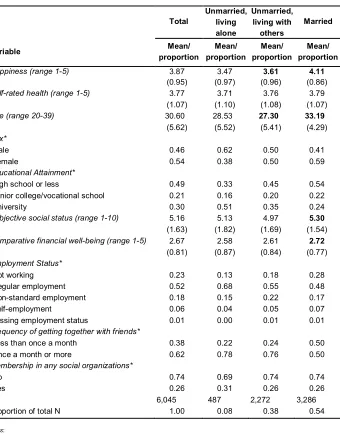
Table 1: Descriptive statistics, by living arrangements and marital status
Total Unmarried, living
alone
Unmarried, living with
others Married
Variable proportion Mean/ proportion Mean/ proportion Mean/ proportion Mean/
Happiness (range 1-5) 3.87 3.47 3.61 4.11 (0.95) (0.97) (0.96) (0.86) Self-rated health (range 1-5) 3.77 3.71 3.76 3.79 (1.07) (1.10) (1.08) (1.07) Age (range 20-39) 30.60 28.53 27.30 33.19 (5.62) (5.52) (5.41) (4.29) Sex*
Male 0.46 0.62 0.50 0.41
Female 0.54 0.38 0.50 0.59
Educational Attainment*
High school or less 0.49 0.33 0.45 0.54 Junior college/vocational school 0.21 0.16 0.20 0.22
University 0.30 0.51 0.35 0.24
Subjective social status (range 1-10) 5.16 5.13 4.97 5.30 (1.63) (1.82) (1.69) (1.54) Comparative financial well-being (range 1-5) 2.67 2.58 2.61 2.72
(0.81) (0.87) (0.84) (0.77) Employment Status*
Not working 0.23 0.13 0.18 0.28
Regular employment 0.52 0.68 0.55 0.48 Non-standard employment 0.18 0.15 0.22 0.17 Self-employment 0.06 0.04 0.05 0.07 Missing employment status 0.01 0.00 0.01 0.01 Frequency of getting together with friends*
Less than once a month 0.38 0.22 0.24 0.50 Once a month or more 0.62 0.78 0.76 0.50 Membership in any social organizations*
No 0.74 0.69 0.74 0.74
Yes 0.26 0.31 0.26 0.26
N 6,045 487 2,272 3,286
Proportion of total N 1.00 0.08 0.38 0.54
Notes:
(a) Standard deviation of continuous variables shown in parentheses
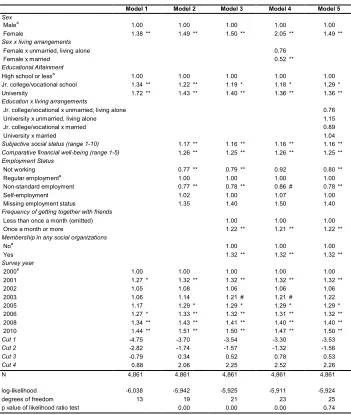
Tables 2 and 3 present results for the models of happiness and self-rated health, respectively. Looking first at Table 2, Model 1 shows that the unmarried living alone are significantly less happy and the married are significantly and substantially more happy than their unmarried counterparts living with others. The odds of being happy vs. somewhat happy (or being at happiness level n vs. happiness level n-1, more generally) are 21% lower for the unmarried living alone relative to the unmarried living with others. Happiness declines with age and is higher among women and among the more highly educated. Model 2 shows that both measures of subjective economic well-being are positively associated with happiness and that those in regular employment are significantly happier than those not employed and those in non-standard employment. However, inclusion of these variables does little to alter the relationships between living arrangements and happiness estimated in Model 1. Similarly, in Model 3 both measures of social integration are positively associated with happiness, but their inclusion does not alter the general conclusion that living alone is associated with lower levels of happiness (compared to both the unmarried living with others and the married respondents). This is not surprising, given the relatively small differences in social integration across living arrangements described in Table 1.
Including interactions between sex and living arrangements in Model 4 shows that living alone is not significantly related to unmarried men’s happiness and that the coefficient for living alone does not significantly differ by sex (i.e., the interaction term is not significantly different from zero). It is important to note, however, that among unmarried women (but not men), those living alone report significantly lower levels of happiness than their unmarried counterparts living with others. Although not directly related to the questions motivating this paper, it is interesting that marriage is associated with significantly lower levels of happiness among women (relative to men). None of the interactions between educational attainment and living arrangements in Model 5 are significantly different from zero. Levels of happiness are significantly lower for those living alone relative to their unmarried counterparts living with others among junior college/vocational school graduates (at p < .10), but not among those with a high school degree or less or among university graduates.
Table 2: Estimated odds ratios from ordered logistic regression models of happiness
Model 1 Model 2 Model 3 Model 4 Model 5
Living arrangements
Unmarried, living with othersa 1.00 1.00 1.00 1.00 1.00 Unmarried, living alone 0.79 * 0.80 * 0.79 * 0.93 0.78 Married 3.82 ** 3.76 ** 3.96 ** 5.51 ** 4.00 **
Table 2: (Continued)
Model 1 Model 2 Model 3 Model 4 Model 5
Sex
Malea 1.00 1.00 1.00 1.00 1.00
Female 1.38 ** 1.49 ** 1.50 ** 2.05 ** 1.49 **
Sex x living arrangements
Female x unmarried, living alone 0.76 Female x married 0.52 **
Educational Attainment
High school or lessa 1.00 1.00 1.00 1.00 1.00 Jr. college/vocational school 1.34 ** 1.22 ** 1.19 * 1.18 * 1.29 * University 1.72 ** 1.43 ** 1.40 ** 1.36 ** 1.36 **
Education x living arrangements
Jr. college/vocational x unmarried, living alone
0.76 University x unmarried, living alone 1.15 Jr. college/vocational x married 0.89 University x married 1.04
Subjective social status (range 1-10) 1.17 ** 1.16 ** 1.16 ** 1.16 **
Comparative financial well-being (range 1-5) 1.26 ** 1.25 ** 1.26 ** 1.25 **
Employment Status
Not working 0.77 ** 0.79 ** 0.92 0.80 ** Regular employmenta
1.00 1.00 1.00 1.00 Non-standard employment 0.77 ** 0.78 ** 0.86 # 0.78 ** Self-employment 1.02 1.00 1.07 1.00 Missing employment status 1.35 1.40 1.50 1.40
Frequency of getting together with friends
Less than once a month (omitted) 1.00 1.00 1.00 Once a month or more 1.22 ** 1.21 ** 1.22 **
Membership in any social organizations
Noa
1.00 1.00 1.00 Yes 1.32 ** 1.32 ** 1.32 **
Survey year
2000a 1.00 1.00 1.00 1.00 1.00
2001 1.27 * 1.32 ** 1.32 ** 1.32 ** 1.32 **
2002 1.05 1.08 1.06 1.06 1.06
2003 1.06 1.14 1.21 # 1.21 # 1.22 2005 1.17 1.29 * 1.29 * 1.29 * 1.29 * 2006 1.27 * 1.33 ** 1.32 ** 1.31 ** 1.32 ** 2008 1.34 ** 1.43 ** 1.41 ** 1.40 ** 1.40 ** 2010 1.44 ** 1.51 ** 1.50 ** 1.47 ** 1.50 **
Cut 1 -4.75 -3.70 -3.54 -3.30 -3.53
Cut 2 -2.82 -1.74 -1.57 -1.32 -1.56
Cut 3 -0.79 0.34 0.52 0.78 0.53
Cut 4 0.88 2.06 2.25 2.52 2.26
N 4,861 4,861 4,861 4,861 4,861
log-likelihood -6,038 -5,942 -5,925 -5,911 -5,924 degrees of freedom 13 19 21 23 25 p value of likelihood ratio test 0.00 0.00 0.00 0.74
Table 3 shows that married respondents report better self-rated health, but living alone is not associated with worse subjective health among the unmarried. The coefficient for living alone is negative (i.e., odds ratio is less than one), but not significantly different from zero. Other coefficients are similar to those in the models for happiness: self-rated health declines with age and is higher among women and university graduates. Subjective economic well-being and social integration are both associated with better self-rated health, but the inclusion of these measures (along with employment status) does not alter the estimated coefficients for living arrangements (and marital status). Models 4 and 5 provide no evidence of gender or educational differences in the relationship between living alone and self-rated health. In no case does the self-rated health of those living alone differ from their unmarried counterparts living with others. Although not directly related to the questions motivating this study, Models 4 and 5 do indicate some significant differences in the relationship between marriage and health. Among the married respondents, women and junior college/vocational school graduates report higher levels of self-rated health than men and those with lower levels of education.
Table 3: Estimated odds ratios from ordered logistic regression models of self-rated health
Model 1 Model 2 Model 3 Model 4 Model 5
Living arrangements
Unmarried, living with othersa 1.00 1.00 1.00 1.00 1.00 Unmarried, living alone 0.94 0.97 0.96 0.98 0.99 Married 1.28 ** 1.21 ** 1.26 ** 1.06 1.19 *
Age 0.97 ** 0.97 ** 0.97 ** 0.97 ** 0.97 **
Sex
Malea 1.00 1.00 1.00 1.00 1.00
Female 1.19 ** 1.13 * 1.12 * 0.97 1.14 *
Sex x living arrangements
Female x unmarried, living alone 0.88 Female x married 1.42 **
Educational Attainment
High school or lessa 1.00 1.00 1.00 1.00 1.00 Jr. college/vocational school 1.09 1.05 1.03 1.04 0.86 University 1.35 ** 1.21 ** 1.19 ** 1.21 ** 1.19 #
Education x living arrangements
Jr. college/vocational x unmarried, living alone 0.91 University x unmarried, living alone
0.95 Jr. college/vocational x married 1.39 * University x married 0.99
Subjective social status (range 1-10) 1.07 ** 1.07 ** 1.07 ** 1.07 **
Table 3: (Continued)
Model 1 Model 2 Model 3 Model 4 Model 5
Employment Status
Not working 1.08 1.10 1.00 1.07
Regular employmenta 1.00 1.00 1.00 1.00 Non-standard employment 1.10 1.10 1.04 1.08 Self-employment 1.42 ** 1.41 ** 1.36 ** 1.40 ** Missing employment status 1.11 1.12 1.09 1.11
Frequency of getting together with friends
Less than once a month (omitted)
1.00 1.00 1.00 Once a month or more 1.18 ** 1.19 ** 1.18 **
Membership in any social organizations
Noa
1.00 1.00 1.00 Yes
1.12 * 1.12 * 1.12 *
Survey year
2000a 1.00 1.00 1.00 1.00 1.00
2001 1.10 1.10 1.10 1.10 1.10
2002 1.00 1.01 1.00 1.00 1.00
2003 1.05 1.07 1.09 1.09 1.09
2005 1.42 ** 1.49 ** 1.48 ** 1.48 ** 1.48 ** 2006 1.19 # 1.18 # 1.17 1.17 1.17 2008 1.46 ** 1.51 ** 1.50 ** 1.49 ** 1.49 ** 2010 1.52 ** 1.55 ** 1.54 ** 1.56 ** 1.54 **
Cut 1 -4.39 -3.62 -3.50 -3.63 -3.54
Cut 2 -2.42 -1.65 -1.52 -1.66 -1.57
Cut 3 -0.88 -0.10 0.04 -0.10 -0.01
Cut 4 0.29 1.09 1.23 1.09 1.18
N 5,435 5,435 5,435 5,435 5,435
log-likelihood -7,513 -7,474 -7,466 -7,460 -7,462 degrees of freedom 13 19 21 23 25 p value of likelihood ratio test 0.00 0.00 0.00 0.09
Note: **p < .01, * p<.05, # p<.10 a:omitted category
5. Discussion
The increasing prevalence of young adult one-person households in Japan is a major focus of the real estate and service industries, but has received relatively little scholarly attention. Despite the proliferation of one-person housing, omnipresent convenience stores filled with individually-packaged items, and numerous web sites providing tips on “hitori-gurashi” (single living), we know very little about the mechanisms underlying this trend, the characteristics associated with living alone, or the potential implications of solo living for well-being. My primary goal in this paper was to provide an empirical foundation from which to begin answering these questions.
Importantly, these relationships differ by both age and sex. The trend toward later marriage explains all of the increase in one-person households for men and about three-fourths of the increase for women. For women, the remainder is explained by changes in living arrangements (conditional on marital status) and these changes in living arrangements are more important for explaining the rise in one-person households at younger ages, whereas changes in marriage behavior are more important at older ages. Subsequent research should examine factors underlying the observed changes in living arrangements conditional on marital status for young women. These might include changing parent-child relationships, increasing desire for independence, a growing social acceptance of living alone, increased access to attractive housing options, and growing financial independence. It is important to note, however, that despite the increase in living alone, young unmarried Japanese remain far more likely than their counterparts in many other wealthy countries to coreside with their parents.
In the U.S. and other countries where extended coresidence with parents is uncommon, scholarly interest in the relative well-being of young adults living on their own is limited. Despite substantial media attention to Klinenberg’s recent book Going Solo, most research on the relative well-being of those living in one-person households was conducted years ago when this was a less common arrangement. Prominent theories suggested that the higher costs of living alone and the social isolation it entails should contribute to lower levels of emotional well-being. Extending these ideas to the Japanese context, I examined General Social Survey data from the period 2000−2010 to produce three main findings. First, living alone is associated with significantly lower levels of happiness, but differences between those living alone and those coresiding with parents are not substantively large. For example, in Model 1, the difference between the unmarried living alone and those living with others (1.00 - 0.79 = 0.21) is half the difference between those with a high school degree or less and those with university education (1.00 – [1.00 ÷ 1.72] = 0.42). This general pattern of results is similar to a number of earlier studies that found lower levels of well-being among young men and women living alone in the U.S.
correlates of self-selection into different living arrangements could not be considered due to data limitations. Attention to alternative mechanisms such as these is an important task for subsequent research on the link between solo living and well-being.
Third, there is little to suggest that relationships between living alone and happiness or health differ by sex or socioeconomic status. The only significant differences from Models 4 and 5 indicated that living alone is associated with relatively lower happiness among women (but not men) and among junior college/vocational school graduates (but not those in the lowest and highest educational categories).
Projected trends in marriage suggest that the prevalence of one-person households is likely to continue to increase among young adults in Japan. According to recent projections, nearly one-fourth of those born after 1985 will never marry (NIPSSR 2013), a trend that should result in further growth in living alone not only among those in young adulthood, but also in middle and later life. Additional efforts to understand who lives alone, why, under what circumstances, and for how long are thus of critical importance for understanding how demographic and social changes are reshaping lives in one society that has, until recently, been characterized by a highly-structured, homogeneous work and family life course (Brinton 1992). Comparison of the Japanese experience with that in other “familistic” countries where marriage behavior and attitudes have changed rapidly (e.g., Southern Europe, East Asia) may provide important insights into the ways in which the causes and consequences of increases in one-person households are shaped by social, political, and economic context.
6. Acknowledgements
References
Anson, O. (1988). Living arrangements and women’s health. Social Science & Medicine 26: 201−208. doi:10.1016/0277-9536(88)90240-7.
Billari, F.C., Philipov, D., and Baizán, P. (2001). Leaving home in Europe: The experience of cohorts born around 1960. International Journal of Population Geography 7: 339−356. doi:10.1002/ijpg.231.
Brinton, M.C. (1992). Christmas cakes and wedding cakes: The social organization of Japanese women's life course. In: Lebra, T.S. (ed.). Japanese social organization. Honolulu, HI: University of Hawaii Press: 79−107.
Brinton, M.C. (1993). Women and the economic miracle: gender and work in postwar Japan. Berkeley, CA: University of California Press.
Brown, J.W., Liang, J., Krause, N., Akiyama, H., Sugisawa, H., and Fukaya, T. (2002). Transitions in living arrangements among elders in Japan: Does health make a difference? Journal of Gerontology: Social Sciences 57: S209−S220.
doi:10.1093/geronb/57.4.S209.
Brown, S.L. (2000). The effect of union type on psychological well-being: Depression among cohabitors versus marrieds. Journal of Health and Social Behavior 41: 241−255. doi:10.2307/2676319.
Cramer, D. (1993). Living alone, marital status, gender and health. Journal of Community & Applied Social Psychology 3: 1−15. doi:10.1002/casp.245 0030102.
Denton, M. and Walters, V. (1999). Gender differences in structural and behavioral determinants of health: An analysis of the social production of health. Social Science & Medicine 48: 1221−1235. doi:10.1016/S0277-9536(98)00421-3. Fukuda, S. (2009). Leaving the parental home in post-war Japan. Demographic
Research 20(30): 731−816. doi:10.4054/DemRes.2009.20.30.
Hall, R., Ogden, P.E., and Hill, C. (1997). The pattern and structure of one-person households in England and Wales and France. International Journal of Population Geography 3: 161−181. doi:10.1002/(SICI)1099-1220(199706) 3:2<161::AID-IJPG64>3.3.CO;2-U.
Hirayama, Y. and Izuhara, M. (2008). Women and housing assets in the context of Japan’s home-owning democracy. Journal of Social Policy 37: 641−660.
doi:10.1017/S0047279408002250.
Helliwell, J.F., Layard, R., and Sachs, J.D. (eds.) 2013. World Happiness Report 2013. New York: UN Sustainable Development Solutions Network. http://unsdsn.org/files/2013/09/WorldHappinessReport2013_online.pdf.
House, J.S., Landis, K.R., and Umberson, D. (1988). Social relationships and health.
Science 241: 540−545. doi:10.1126/science.3399889.
Hughes, M. and Gove, W.R. (1981). Living alone, social integration, and mental health.
American Journal of Sociology 87: 48−74. doi:10.1086/227419.
Hughes, M.E. and Waite, L.J. (2002). Health in household context: Living arrangements and health in late middle age. Journal of Health and Social Behavior 43: 1−21. doi:10.2307/3090242.
Iwakami, M. and Miyamoto, M. (2003). Work, marriage, and parent-child relations among singles in their twenties: Research on the transition to adulthood. Tokyo: Post-Seinenki Kenkyūkai.
Iwasawa, M. (2005). Cohabitation in Japan. In: Mainichi Shinbun Population Problems Research, Council (ed.). Family attitudes in an era of very low fertility: Report on the 1st Survey of Population, Family, and Generations. Tokyo: Mainichi Shinbunsha: 69−104.
Jamieson, L. and Simpson, R. (2013). Living alone: Globalization, identity and belonging. New York: Palgrave Macmillan. doi:10.1057/9781137318527. Jamieson, L., Wasoff, F., and Simpson, R. (2009). Solo-living, demographic and family
change: The need to know more about men. Sociological Research Online 14.
doi:10.5153/sro.1888.
Joutsenniemi, K., Martelin, T., Kestilä, L., Martikainen, P., Pirkola, S., and Koskinen, S. (2007). Living arrangements, heavy drinking and alcohol dependence. Alcohol and Alcoholism 42: 480−491. doi:10.1093/alcalc/agm011. Kaufmann, J. (1994). One-person households in Europe. Population 49: 935−958.
doi:10.2307/1533664.
Kawachi, I., Kennedy, B.P., and Glass, R. (1999). Social capital and self-rated health: A contextual analysis. American Journal of Public Health 89: 1187−1193.
Klinenberg. E. (2012). Going solo: The extraordinary rise and surprising appeal of living alone. New York: Penguin Books.
Lesthaeghe, R. (2010). The unfolding story of the second demographic transition.
Population and Development Review 36: 211−251. doi:10.1111/j.1728-4457. 2010.00328.x.
Lesthaeghe, R. and Moors, G. (2000). Recent trends in fertility and household formation in the industrialized world. Review of Population and Social Policy 9: 121−170.
Macran S., Clarke, L., and Joshi, H. (1996). Women's health: Dimensions and differentials. Social Science & Medicine 42: 1203−1216. doi:10.1016/0277-9536(95)00432-7.
Miyamoto, M., Iwakami, M., and Yamada, M. (1997). Parent-child relations in a late-marriage society. Tokyo: Yuhikaku.
Nakano, L. and Wagatsuma, M. (2004). An intimate look at generational change. In: Mathews, G. and White, B. (eds.). Japan's changing generations: Are young people creating a new society. London: Routledge: 137−154. doi:10.4324/ 9780203316627_chapter_8.
National Institute, of Population and Social Security Research (2012). Report on the fourteenth Japanese National Fertility Survey in 2010. Tokyo: National Institute of Population and Social Security Research.
National Institute, of Population and Social Security Research (2013). Household projections for Japan: 2010-2035. Population Research Series no. 329. Tokyo: National Institute of Population and Social Security Research.
National Institute, of Population and Social Security Research (2014). Latest Demographic Statistics. Tokyo: National Institute of Population and Social Security Research.
Ogden, P.E. and Hall, R. (2004). The second demographic transition, new household forms and the urban population of France during the 1990s. Transactions of the Institute of British Geographers 29: 88−105. doi:10.1111/j.0020-2754.2004. 00116.x.
OECD (2005). Society at Glance: 2005 Edition. Paris: OECD Publishing.
doi:10.1787/eag-2005-en.
Raymo, J.M., Iwasawa, M., and Bumpass, L. (2009). Cohabitation and first marriage in Japan. Demography 46: 785−803.
Raymo, J.M. and Ono, H. (2007). Coresidence with parents, women's economic resources, and the transition to marriage in Japan. Journal of Family Issues 28: 653−681. doi:10.1177/0192513X06298236.
Retherford, R.D., Ogawa, N., and Matsukura, R. (2001). Late marriage and less marriage in Japan. Population and Development Review 27: 65−102. doi:10.111 1/j.1728-4457.2001.00065.x.
Sasagawa, A. (2006). Mother rearing: The social world of mothers in a Japanese suburb. In: Rebick, M. and Takenaka A. (eds.). The changing Japanese family. New York: Routledge: 129−146.
Sobotka, T. and Toulemon. L. (2008). Changing family and partnership behaviour.
Demographic Research 19(6): 85−138. doi:10.4054/DemRes.2008.19.6.
Stone, J., Berrington, A., and Falkingham, J. (2011). The changing determinants of UK young adults' living arrangements. Demographic Research 25(20): 629−666.
doi:10.4054/DemRes.2011.25.20.
Sun, W., Watanabe, M., Tanimoto, Y., Shibutani, T., Kono, R., Saito, M., Usuda, K., and Kono, K. (2007). Factors associated with good self-rated health of non-disabled elderly living alone in Japan: A cross-sectional study. BMC Public Health 7: 297−305. doi:10.1186/1471-2458-7-297.
Surkyn, J. and Lesthaeghe, R. (2004). Value orientations and the second demographic transition in northern, western and southern Europe: An update. Demographic Research Special Collection 3(3): 45−86. doi:10.4054/DemRes.2004.S3.3. Tsuya, N.O. (2006). Patterns and correlates of partnership formation in Japan. Journal
of Population Problems 62: 1−19.
Tsuya, N.O., Bumpass, L.L., Choe, M.K., and Rindfuss, R.R. (2005). Is the gender division of labour changing in Japan? Asian Population Studies 1: 47−67.
doi:10.1080/17441730500125805.
Tsuya, N.O. and Mason, K.O. (1995). Changing gender roles and below replacement fertility in Japan. In: Mason, K.O. and Jensen, A.-M. (eds.). Gender and family change in industrialized societies. Oxford, U.K.: Clarendon Press: 139−167. Vespa, J., Lewis, J.M., and Kreider, R.M. (2013). America’s families and living
Waite, L.J. and Gallagher, M. (2000). The case for marriage: Why married people are happier, healthier, and better off financially. New York: Broadway Books. Wood, R.G., Goesling, B., and Avellar, S. (2007). The effects of marriage on health: A
synthesis of recent research evidence. Princeton, NJ: Mathematica Policy Research, Inc.