Summary
The Abnormal Bodily Phenomena questionnaire (ABPq) is a semi-structured interview that originates from analyses of the clinical files of over 350 patients with schizophrenia. The result provide a rich and detailed collection of patients’ self-descrip-tions related to subjective, experiential anomalies about feelings, sensations, perceptions and cognitions arising in the domain of the lived body. ABPq comprises nine distinctive items, grouped in five categories: demarcation, vitality, coherence, identity and activity. For each item and category, an accurate description and a list of examples are provided. Different intensities of
phenom-ena are assessed through a Likert Scale by rating each item ac-cording to its quantitative features (frequency, intensity, impair-ment and coping). ABPq may help to discriminate schizophrenia from other psychoses and cluster A personality disorders from other personality disorders. This scale may also contribute in as-sessing features of clinical high risk or ultra high risk syndromes.
Key words
Coenaesthesia • Embodiment • Phenomenology • Psychopathology • Schizophrenia • Subjective experience
Abnormal Bodily Phenomena questionnaire
Questionario dei Fenomeni Corporei Abnormi
G. Stanghellini1,2, M. Ballerini3, J. Cutting4
1 “G. d’Annunzio” University, Chieti (Italy); 2 “D. Portales” University”, Santiago (Chile); 3 Department of Mental Health, Florence (Italy); 4 Institute
of Psychiatry, London (UK)
Correspondence
Giovanni Stanghellini, DiSPUTer, “G. d’Annunzio” University, via dei Vestini 31, 66110 Chieti Scalo, Italy • E-mail: [email protected]
Introduction
Persons with schizophrenia display a morbidly expe-rienced body. Abnormal bodily phenomena (ABP) are subjective, experiential anomalies in feelings, sensations, perceptions and cognitions arising in the domain of the lived body. ABP are a set of somatic complaints, acces-sible to the patient’s introspection, which entail mild to severe subjective distress or interference with daily activi-ties. The most represented phenomena include violability, altered shape or structure, false composition and altered regional sensitivity 1-4. These abnormal phenomena may
lead to psychotic symptoms, such as hypochondriac sions, and typical schizophrenic symptoms, such as delu-sions of being controlled.
Phenomenology conceives the lived body (i.e. the often implicit experience one has of ones own body), as the centre of the most primitive form of self-awareness. This basic form of self-experience – that is, the implicit, pre-reflexive, immediate, non-conceptual, non-objectifying and non-observational sense of existing as a subject of awareness – is rooted in ones bodily experience. This basic, embodied form of self-awareness is assumed to be the background of the experienced differentiation between self and non-self, my self and the object I per-ceive, and my representation of that object and the ob-ject itself.
Contemporary phenomenological research assumes that the disruption in the basic sense of being a ‘self’ is a fun-damental feature in schizophrenia 5-10. Somato-psychic
depersonalisation, loss of ego boundaries and disorders of sense of agency and my-ness are well known clinical features of schizophrenia. It can be assumed that ABP may play a key role in the constitution of an abnormal sense of selfhood in persons with schizophrenia. In schizophre-nia, the weakening of the basic sense of self, disturbance of implicit bodily functioning and disruption of body-to-body attunement with others are taken to be manifesta-tions of a fundamental disturbance of the bodily self. These phenomena are not part of the mainstream diagnos-tic criteria for schizophrenia. One of the reasons is their quasi-ineffable nature and the lack of sensitive, specific and reliable methods to assess them. Since disorders of the embodied self may be a conceptual framework to un-derstand the psychopathology of schizophrenia, achieve-ment of detailed characterisation and operationalized definition of ABP is becoming a priority.
Construction of the questionnaire
ternal world, or merging with it, or invaded by it? • Did you ever happen to feel like a robot, or a thing,
rather than as a human person?
• Do you feel effective as an agent in the world, or rath-er as being exposed to or subjugated by the world? • Have you ever felt like parts of your body were
mov-ing away from their usual position?
• Do you sometimes experience a tendency to take an external perspective to your body?
• Do you sometimes feel your body changing, for exam-ple, in appearance?
• Do you have strange feelings of pain that you cannot explain?
The result has been a rich and detailed collection of pa-tients’ self-descriptions related to e.g. bodily coherence/ fragmentation, body vitality/devitalisation, body-world demarcation/permeability, etc. We created a database us-ing patients’ self-reports from which we later developed categories based on structural similarities among bodily abnormal phenomena. These categories fulfil three for-mal criteria: reliability (they must comprise consistent findings), discriminant validity (for patients with differ-ent psychopathological features) and sensibility (ability to depict different intensities of a phenomenon) 18. This
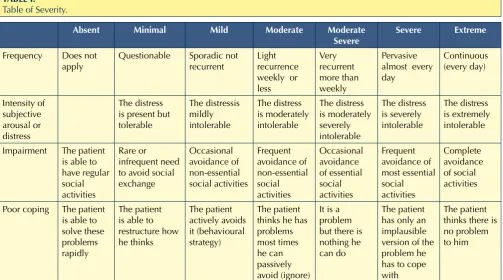
last criterion is achieved by rating each item according to its quantitative features (frequency, intensity, impairment and coping) (Table I) using a Likert Scale.
ABPq comprises nine distinctive items, grouped in five categories: demarcation, vitality, coherence, identity and activity. For each item and category, an accurate descrip-tion and a list of examples are provided (Appendix 1). Each item should be queried as to their phenomenal quality, that is, whether it is expressed as an abnormal physical sensation (‘A gas is filling my head’), or in terms of its causes (‘They are blowing my head’), or using a neologism (‘A twutta insided my head’).
The interview may take about 30-60 minutes.
The Abnormal Bodily Phenomena
questionnaire (ABPq)
Who: patients with schizophrenia, or suspected to have
schizophrenia or schizophrenia spectrum disorders. This scale may help to discriminate schizophrenia from other psychoses and cluster A personality disorders from other personality disorders. This scale may contribute to assessment of features of clinical high risk or ultra high risk syndromes.
What: subjective bodily phenomena. We focus on bodily
experiences, rather than on bodily image or schema, or on beliefs about ones body.
When: last three months.
How: assessing quality of phenomena by addressing
questions about sensations coming from the body. (e.g. delusions and hallucinations) as well as “softer”
phenomena that are traditionally not included in symp-tom checklists. These subtle, abnormal phenomena are reported by patients when asked about the way they ex-perience and act in the world they actually live in. Since the patients’ phenomenal universe is not confined to their symptoms, systematic exploration of anomalies in the patients’ experience, e.g. of body, time, space, self, and otherness, may provide a useful integration to a tra-ditional symptom-oriented approach 11. These abnormal
phenomena can be used as pointers to the fundamental alterations of the structure of subjectivity characterising schizophrenia.
Psychopathological assessment should neither be con-fined to determining the presence or absence of a given symptom, nor should it simply focus on surface symp-toms chosen for their reliability. Rather, it should look for deeper phenomena which may emerge only from careful phenomenological analysis. Especially in per-sons with a severe mental disorder that may affect their insight and/or their capacity to understand correctly a given item of a rating scale, it is not advisable to assess abnormal phenomena using research tools based solely on yes-or-no answers 12.
There are several reasons to prefer semi-structured inter-views such as the ABPq rather than standard rating scale procedures. While using standard yes-or-no rating scales: 1) the stimulus-response process disrupts the specific rhythm of natural conversation, and fragmentation of per-sonal experience occurs. The intimacy of the relationship is affected, and hence the reliability and validity of the in-terviewee’s responses; 2) shared meanings between inter-viewer and interviewees are assumed, and not investigat-ed, in the process of the interview itself. Serious questions should be raised about the validity of the assumption of real mutual understanding. The coding of each item of an interview may require interpretation; 3) the pattern of interviewer dominance and respondent acquiescence is emphasised and enhanced. This entails a shift from initial extended self-reports to simple a priori “relevant” yes-or-no answers 13-17.
Abnormal experiences in persons affected by schizophre-nia cannot be reliably and validly assessed in the sole form of frequency or intensity. Their assessment requires a pre-cise characterisation of the phenomenal quality of the ex-perience. In-depth, fine-tuned characterisation of the phe-nomenal quality of abnormal experiences is needed that can only be provided by using more flexible instruments. This characterisation can avoid diagnostic mistakes, e.g. overdiagnosis or underdiagnosis of schizophrenia. In order to investigate the ABP, during clinical interviews patients were asked questions such as:
ex-ence of splitting of ones body outside its boundaries, or, vice versa, parts of the external world inside ones body. Rather, movement is implied.
A1.1 Violation
Immediate experience of strange, unusual, abnormal, uncommon forces, energies or movements violating from without the surface and the boundaries of the body; in other cases, the patient may refer to a perplex-ing experience of intrusion or incorporatperplex-ing extra-per-sonal entities, things or objects in their own body. Examples:
• areas of body where forces enter; • horse’s hair went into body; • gas filled body completely; • skin scarred with acid; • pains in body inflicted;
• ghost entering body at bottom of spine.
A1.2 Externalisation
Body components or sub-components, corporeal move-ments, vital energies or biological activities are experi-enced as projected beyond ones ego boundaries into the outer space.
Examples:
• face intermingled with examiner’s;
Subtyping the quality of phenomena
Subtype 1: includes experiences described in terms of their
physical properties or features; patients often use
meta-phors to illustrate subjective experience (e.g. “The left part of my brain has been displaced in the back of my head”). Subtype 2: includes experiences described in terms of their
causes, i.e. specific forces or energies are violating the body
boundaries, or specific objects or entities are intruding into the body (e.g. “Laser beam entering into my skull”).
Subtype 3: includes experiences described in terms of
ne-ologisms (e.g.”I have the twutta inside-out”).
Assessing quantity (severity) of phenomena
Rate severity, addressing questions about: a) frequency; b) subjective change; c) impairment in daily interpersonal relationships, activities, transactions, situations; d) possi-bility to cope; rate the highest level reached (Table I).
Items and Categories of ABPq
A1. DEMARCATIONDynamisation of bodily boundaries
It includes experiences of violation and externalisation concerning ones body (or part of it). Dynamisation means that they are not a static experience, e.g. a static
pres-TABLE I. Table of Severity.
Absent Minimal Mild Moderate Moderate
Severe Severe Extreme
Frequency Does not apply
Questionable Sporadic not recurrent
Light recurrence weekly or less Very recurrent more than weekly Pervasive almost every day Continuous (every day) Intensity of subjective arousal or distress The distress is present but tolerable The distressis mildly intolerable The distress is moderately intolerable The distress is moderately severely intolerable The distress is severely intolerable The distress is extremely intolerable
Impairment The patient is able to have regular social activities
Rare or infrequent need to avoid social exchange Occasional avoidance of non-essential social activities Frequent avoidance of non-essential social activities Occasional avoidance of essential social activities Frequent avoidance of most essential social activities Complete avoidance of social activities
Poor coping The patient is able to solve these problems rapidly
The patient is able to restructure how he thinks The patient actively avoids it (behavioural strategy) The patient thinks he has problems most times he can passively avoid (ignore)
It is a problem but there is nothing he can do
The patient has only an implausible version of the problem he has to cope with
Examples:
• arms sticking out of chest; • mouth was where hair should be;
• two lobes of brain revolving round and round; • brain rotating and not working as it should; • eyes on back of head;
• body collapsing.
A4. IDENTITY
Dysmorphic experiences
Single parts of the body or its appearances are changing through time.
A4.1 Transformation
Experiences of a change in ones body or parts of it; the experience involves components or sub-components of the body, including the surface or the inner parts or or-gans. In these experiences, there is an on-going experi-ence of movement and change, not just a change in bod-ily scheme of which one can only see the final result. Examples:
• hair getting dry;
• nose changing in mirror; • face strange when I look at it;
• in the mirror, I sometimes look older and sometimes younger;
• hands getting bigger.
A4.2 Dysmorphophobia
A subjective feeling of something going wrong with the body, ugliness, physical defect or disproportion in body parts which the patient feels is noticeable to others (al-though his appearance is within normal limits).
Examples:
• bust bigger and bones smaller; • sometimes is physically wrong in me; • something wrong with throat;
• wisdom teeth make my face uncomfortable; • skin yellow.
A5. ACTIVITY
Cenesthopathic Flooding
Control over ones body is lost. Strange or painful feelings or sensations emerge. These abnormal phenomena are neither fully developed experiences of passivity or exter-nal control nor delusions of exterexter-nal influence.
A5.1 Dysaesthesic paroxysm
Feeling oppressed from within by distressing paroxysms of strange, uncanny and incomprehensible bodily sensa-tions when in front of others. Patients usually do not
ac-knowledge that these feelings are emotions.
• feeling of sitting on interviewer’s knee; • arms disjointed from body and reaching out; • vagina half outside;
• legs and arms dropped off.
A2. VITALITY
Morbid objectivisation and devitalisation
The body or its parts are experienced as mere things, thing-like entities, rather than as living flesh. Parts of one-self are spatialised, that is experienced as if they were disintegrated from and external to one’s bodily self.
A2.1 Morbid objectivisation
An increased degree of ‘thingness’ in the body; parts of ones body that are usually silently and implicitly present and at work become explicitly experienced; in other cas-es, parts of oneself are spatialised, or experienced as if they were disintegrated from the living totality of ones bodily self.
Examples:
• thoughts arising in the back side of the head; • parts missing in my heart or soul;
• I feel my sperm;
• I feel the blind part of my brain part of brain;
• head fogged up on left as if it’s not working, as if I’m only thinking on one side.
A2.2 Devitalisation
The body or its parts are experienced as mere things, thing-like entities, rather than as living silent working flesh; parts of ones body are felt as substituted by some kind of mechanism.
Examples: • I am a robot;
• she felt programmed like a robot;
• device implanted into back of head to control him; • bionic arms;
• hands are under somebody’s control;
• believes a jinx is on her, makes her do actions; • pieces of metal in leg.
A3. COHERENCE
Disintegration of bodily construct
Part(s) of the body is moving away from usual position. Their body structure is being disintegrated.
A3.1 Internal dyamisation
4 Cutting J. Principles of psychopathology. Two minds, two worlds, two hemispheres. Oxford/New York/Tokyo: Oxford University Press 1997.
5 Zahavi D. Self-awareness and alterity: a phenomenologi-cal investigation. Evanston: Northwestern University Press 1999.
6 Parnas J. A disappearing heritage: the clinical core of schizo-phrenia. Schizophr Bull 2011;7:1121-30.
7 Parnas J. The Core Gestalt of Schizophrenia. World Psychia-try 2012;11:67-9.
8 Stanghellini G, Ballerini M. Autism – disembodied existence. Philosophy Psychiatry, & Psychology 2004;11:259-68. 9 Stanghellini G. Embodiment and schizophrenia. World
Psy-chiatry 2009;8:56-9.
10 Fuchs T, Schlimme JE. Embodiment and psychopathology: a phenomenological perspective. Curr Opin Psychiatry 2009;22:570-5.
11 Stanghellini G, Rossi R. Pheno-phenotypes: a holistic ap-proach to the psychopathology of schizophrenia. Curr Opin Psychiatry 2014;27:236-41.
12 Stanghellini G, Langer AI, Ambrosini A, et al. Quality of hal-lucinatory experiences: differences between a clinical and a non-clinical sample. World Psychiatry 2012;11:110-13. 13 Stanghellini G. The puzzle of the psychiatric interview. J
Phenomenological Psychol 2004;35:173-95.
14 Stanghellini G. The grammar of psychiatric interview: a plea for the second person Mode of Understanding. Psychopa-thology 2007;40:69-74.
15 Stanghellini G. The meanings of psychopathology. Curr Opin Psychiatry 2009;22:559-64.
16 Stanghellini G. A hermeneutic framework for psychopathol-ogy. Psychopathology 2010;43:319-26.
17 Stanghellini G. Philosophical resources for the psychiatric interview. In: Fulford KWM, Davies M, Gipps R et al. eds. Oxford Handbook of Philosophy and Psychiatry. Oxford/ New York: Oxford University Press 2013, pp. 320-55. 18 Stanghellini G, Ballerini M. Qualitative analysis. Its use
in psychopathological research. Acta Psychiatr Scand 2008;117:161-3.
Examples:
• when I am at work and a client approaches me, I start trembling, a pain in the stomach mounts up to my head;
• being with people provokes an internal block, a block of feelings;
• when I look someone straight in the eyes I feel strange vibrations inside… either they like me or they don’t want me;
• when I meet with persons, I am overtaken by obscu-rity;
• it is something in my head, not a pain, I feel suffo-cated, my mind repressed, like a psychic pain; • when I look people in the eyes I feel a kind of heat in
my head, in my back.
A5.2 Recurrent pain-like experiences
Recurrent painful experiences not substantiated by any medical cause; here there is no ascertainable cause using standard diagnostic procedures; experience may present itself in form of paroxysms or persistent sensations; they are usually characterised by feelings of strangeness and uncanniness.
Examples:
• head red hot all over;
• pains and feeling of being cut up in various parts of body;
• saint’s stigmata;
• stinging feelings all over; • felt gushing torment in body; • pains in body inflicted.
References
1 Jaspers K. General psychopathology. Baltimore/London: Johns Hopkins University Press 1997.
2 Huber G. Die coenesthetische schizophrenie. Fortschr Neu-rol Psychiatr 1957;25:491-520.
APPENDIX 1.
The Abnormal Bodily Phenomena questionnaire (ABPq).
ABNORMAL BODILY PHENOMENA
Frequency Intensity
of Arousal or Distress
Impairment Poor
Coping NAME: ______________________
CODE: ______________________
Classify in:
(1) Absent; (2) Minimal; (3) Mild; (4) Moderate’
(5) Moderate Severe; (6) Severe; (7) Extreme DD/MM/YYYY: ___/____/______ 1,1 Experience
of violation
Immediate experience of strange, unusual, abnor-mal, uncommon forces, energies or movements vio-lating from without the surface and the boundaries of the body; in other cases, the patient may refer a perplexing experience of intrusion or incorpora-tion in own body of extra-personal entities, things or objects.
1,2 Experience of
externalisation Body components or sub-components, corporeal movements, vital energies or biological activities are experienced as projected beyond ones ego boundaries into the outer space.
2,1 Morbid Objectivisa-tion
An increased degree of ‘thingness’ in the body; parts of ones body that are usually silently and implicitly present and at work become explicitly experienced; in other cases parts of oneself are spatialised, that is experienced as if they were disintegrated from the living totality of ones body.
2,2 Devitalisation The body or its parts are experienced as mere things, thing-like entities, rather than as living silent work-ing flesh, parts of ones body are felt as substituted by some kind of mechanism.
3,1 Experience of internal dynamisation
Experience of unusual, strange, abnormal move-ments or forces acting inside ones body; in other cases, body components or sub-components are felt as moving away from their usual position, shifting around the usual spatial relationships.
4,1 Experience of transforma-tion
Experiences of an on-going change in ones body or parts of it; the experience may involve the entire or-ganism, components or sub-components, including the surface or the inner parts or organs.
4,2 Dysmorpho-phobia
A subjective feeling of something going wrong with his body, ugliness, physical defect or disproportion in body parts which the patient feels is noticeable to others (although appearance is within normal limits).
5,1 Dysaesthesic paroxysm
Feeling oppressed from within by distressing par-oxysms of strange, uncanny and incomprehensible bodily sensations when in front of others.
5,2 Recurrent pain-like experience