Original Research Article
Preoperative Grading System versus Intraoperative Grading System as
Predictors for Difficult Laparoscopic Cholecystectomy: A Comparative
Validation Study
Sudhir M1, Pruthvi Raj1*
1
Department of General Surgery, Kempegowda Institute of Medical Sciences, Rajiv Gandhi University of Health Sciences, Karnataka, India
ABSTRACT
Introduction: Gallbladder-related disease is currently one of the most common indications for elective and emergency surgical management of cholecystitis. Considering the increasing rate of complications, there has been a notable paradigm shift in the management of patients since the introduction of laparoscopic cholecystectomy. We aimed to develop a new preoperative scoring model for evaluation of the laparoscopic cholecystectomy outcome.
Materials and methods: All patients admitted to the Kempegowda Institute of Medical Sciences from January 2016 to August 2017 with symptoms of gallstone disease were screened for cholelithiasis. Hundred patients undergoing laparoscopic cholecystectomy were randomly selected. Before the surgery patients were scored according the preoperative model, and the intraoperative scoring was recorded during the surgery. Finally, the two scoring systems were compared. Results: Preoperative scoring had a sensitivity of 95.71%, specificity of 50%, positive predictive value of 81.71%, negative predictive value of 83.3%, diagnostic accuracy of 82%, and Kappa agreement of 0.5161 compared to the intraoperative scoring system. Conclusions: We strongly recommend using the preoperative scoring system for predicting the degree of difficulty for laparoscopic cholecystectomy. In addition, it is also recommended to conduct more studies on the application of the intraoperative scoring system.
KEYWORDS: Gallbladder disease, Laparoscopic cholecystectomy, Grading system, Preoperative, Intraoperative
*Correspondence: Pruthvi Raj, Address: Department of General Surgery, Kempegowda Institute of Medical Sciences, Rajiv Gandhi University of Health Sciences, Karnataka, India, Telephone: +919945866007, Email: [email protected]
INTRODUCTION
Gallstones are among the most common gastrointestinal disorders that require hospitalization with a prevalence of 11-36% based on autopsy reports. Cholecystectomy is the optimal treatment for patients with symptomatic cholelithiasis [1,2]. Laparoscopic cholecystectomy is the procedure of choice for majority of patients with gallbladder disease. The postulated
advantages of laparoscopic
cholecystectomy include avoidance of large incision, shortened hospital stay and early recovery. The condition of the patient, surgeon’s expertise, and technical factors can influence the decision for conversion. Inability to define the anatomy and difficult dissection are the main reasons for conversion followed by other complications
such as bleeding. The conversion rate for elective laparoscopic cholecystectomy is around 5%, whereas the conversion rate in the setting of acute cholecystitis may be as high as 30%. While conversion to open cholecystectomy will always be an essential part of safe surgical practice, a greater understanding of the factors leading to conversion and potential postoperative complications seems essential. Therefore, we aimed to determine the predictive factors for a difficult laparoscopic cholecystectomy and to validate and compare the two scoring systems: the preoperative scoring (Command hospital Bangalore 2013, Table 1) and the intraoperative scoring system (Table 2).
Table 1. The preoperative scoring system [1] Score: <5: easy, 6–10: difficult and 11–15: very difficult
Age <50 years (0) >50 years (1) 1
Sex Female (0) Male (1) 1
History of previous
hospitalization
N (0) Y(4) 4
Clinical findings
Body mass index (BMI) <25(0) 25-27.5(1) 2
>27.5 (2)
Abdominal scar N(0) Y(1) 2
Palpable gallbladder N(0) Y(1) 1
Abdominal ultrasound
Wall thickness Thin(0) Thick>4mm(2) 2
Pericholecystic edema N(0) Y(1) 1
Impacted stone N(0) Y(1) 1
Table 2. Intraoperative scoring system [3]
Scores: <2: Easy, 3-4: Moderate, 5-7: Difficult, 8-10: Extremely difficult Gall bladder appearance
Gallbladder appearance Adhesions<50% (1) Adhesions>50%(3) 3
Distention/contraction
Distended /contracted/shriveled gallbladder N(0) Y(1) 1
Unable to grasp gallbladder with atraumatic lap forceps N(0) Y(1) 1
Stone size > 1cm impacted in the Hartmann pouch N(0) y(1) 1
BMI>27.5 N(0) Y(1) 1
Adhesions from previous surgery N(0) Y(1) 1
Severe sepsis/complications
Bile /pus outside gallbladder N(0) Y(1) 1
Time to identify cystic duct and artery >90mins N(0) Y(1) 1
MATERIALS AND METHODS
The study was conducted between January 2016 and July 2017 at Kempegowda Institute of Medical Sciences Hospital (Bangalore, India) after obtaining approval
from the Hospital’s Ethical Committee (KIMS IEC/D-45/2015). This prospective randomized study included 100 patients (42% male, 58% female) undergoing
laparoscopic cholecystectomy. The standard laparoscopy procedure was followed. The surgery and port placement were done according to the American guidelines using two 5-mm and two 10-mm standard ports. The time was recorded from the first port incision until the last port’s closure. All intraoperative events were recorded. All cases received standard postoperative care and follow up. All patients were given a score according to their preoperative symptoms and sonography and intraoperative findings. The details were entered in proforma and
scores were given according to the preoperative and intraoperative scoring systems. On postoperative day 1, preoperative score and intraoperative events were compared and conclusions were noted in the proforma.
RESULTS
Comparison between the intraoperative scoring and preoperative risk score
The mean age of patients was 46.92.3 years (age range: 18 to 76 years) (Figure 1). In our study, age had no significant impact on prediction of difficulty.
Figure 1. Age distribution of the patients
The preoperative parameters and variables are shown in table 3. Based on the preoperative scoring, 82 cases were in the easy category (score<5), 17 cases in the
difficult category (score: 6-10) and one case in the very difficult category (score: 11-15).
Table 3. The preoperative scoring of patients
Preoperative Score P-value Easy Difficult Very diff
Count (N=82)
% Count (N=17)
% Count (N=1)
%
Age <50
years
50 61.00% 7 41.20% 1 100.00% 0.223
>50 years
32 39.00% 10 58.80% 0 0.00%
Gender Female 50 61.00% 7 41.20% 1 100.00% 0.223 Male 32 39.00% 10 58.80% 0 0.00%
History of previous hospitalization
No 76 92.70% 12 70.60% 0 0.00% 0.001*
Yes 6 7.30% 5 29.40% 1 100.00%
BMI <25 59 72.00% 7 41.20% 0 0.00% 0.023* 16.00% 18.00%
24.00%
18.00% 20.00%
4.00%
0% 5% 10% 15% 20% 25% 30%
21 to 30 years
31 to 40 years
41 to 50 years
51 to 60 years
61 to 70 years
71 to 80 years
Age
25 to 27.5
13 15.90% 5 29.40% 0 0.00%
>27.5 10 12.20% 5 29.40% 1 100.00%
Abdominal scar No 69 84.10% 14 82.40% 1 100.00% 0.893
Yes 13 15.90% 3 17.60% 0 0.00%
Palpable gallbladder No 82 100.00% 11 64.70% 0 0.00% <0.001*
Yes 0 0.00% 6 35.30% 1 100.00%
Gallbladder wall thickness
No 70 85.40% 9 52.90% 1 100.00% 0.009*
Yes 12 14.60% 8 47.10% 0 0.00%
Pericholecystic edema No 76 92.70% 6 35.30% 0 0.00% <0.001* Yes 6 7.30% 11 64.70% 1 100.00%
Impacted stone No 78 95.10% 6 35.30% 0 0.00% <0.001* Yes 4 4.90% 11 64.70% 1 100.00%
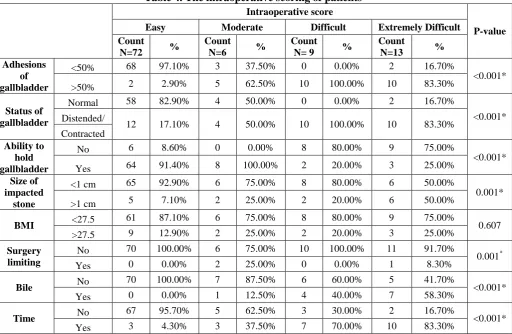
The parameters of intraoperative scoring system are shown in table 4. Based on the intraoperative scoring, 72, 6, 9 and 13 cases
were in the easy, moderate, difficult and very difficult category, respectively.
Table 4. The intraoperative scoring of patients
Intraoperative score
P-value Easy Moderate Difficult Extremely Difficult
Count
N=72 %
Count
N=6 %
Count
N= 9 %
Count
N=13 % Adhesions
of gallbladder
<50% 68 97.10% 3 37.50% 0 0.00% 2 16.70%
<0.001* >50% 2 2.90% 5 62.50% 10 100.00% 10 83.30%
Status of gallbladder
Normal 58 82.90% 4 50.00% 0 0.00% 2 16.70%
<0.001* Distended/
12 17.10% 4 50.00% 10 100.00% 10 83.30% Contracted
Ability to hold gallbladder
No 6 8.60% 0 0.00% 8 80.00% 9 75.00%
<0.001* Yes 64 91.40% 8 100.00% 2 20.00% 3 25.00%
Size of impacted
stone
<1 cm 65 92.90% 6 75.00% 8 80.00% 6 50.00%
0.001* >1 cm 5 7.10% 2 25.00% 2 20.00% 6 50.00%
BMI <27.5 61 87.10% 6 75.00% 8 80.00% 9 75.00% 0.607 >27.5 9 12.90% 2 25.00% 2 20.00% 3 25.00%
Surgery limiting
No 70 100.00% 6 75.00% 10 100.00% 11 91.70%
0.001*
Yes 0 0.00% 2 25.00% 0 0.00% 1 8.30%
Bile No 70 100.00% 7 87.50% 6 60.00% 5 41.70% <0.001*
Yes 0 0.00% 1 12.50% 4 40.00% 7 58.30%
Time No 67 95.70% 5 62.50% 3 30.00% 2 16.70% <0.001*
Yes 3 4.30% 3 37.50% 7 70.00% 10 83.30%
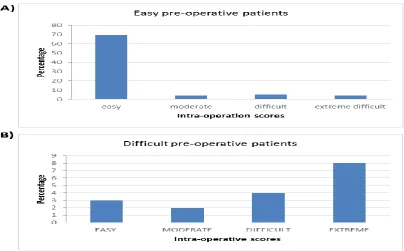
The operation outcome for subjects in each category of preoperative scoring was assessed. Of 82 cases in the easy preoperative category, 69 cases turned to be easy, 4 cases were moderate, 5 were
difficult and 4 cases were extremely difficult intraoperatively (Figure 2A). The intraoperative scores of patients in the difficult preoperative category are shown in figure 2B.
Figure 2. The intraoperative outcome of patients in the difficult preoperative scoring.
Comparison between intraoperative scoring and preoperative risk score
Intraoperative moderate, difficult and extreme scores were considered as difficult, and then were compared with preoperative risk scores. Of 70 patients with easy intraoperative score, 95.7% had easy and 4.3% had difficult preoperative risk score. Of 30 subjects with difficult intraoperative score, 30% were scored as easy, and 70% were scored as difficult. There was a significant association between the intraoperative score and the preoperative risk score (P=0.000). The preoperative risk score had 82% diagnostic accuracy in predicting difficult laparoscopic cholecystectomy compared with the
intraoperative (>90%) score. The preoperative scoring had sensitivity of 95.71%, specificity of 70.1%, positive predictive value of 81.71%, negative predictive value of 83.3%, and Kappa agreement of 0.5161.
Area under the curve (AUC) of preoperative score was 0.729 in predicting difficult laparoscopic cholecystectomy, which was significantly more than that of the intraoperative scoring (AUC=0.85) (Figure 3).
Figure 3. AUC for preoperative score in predicting difficult laparoscopic cholecystectomy
DISCUSSION
Cholecystectomy is currently one of the most common reasons for emergency admission with an associated mortality rate of 0.45 to 6%, depending on the severity of gallbladder disease. This study was conducted to determine predictive factors of a difficult cholecystectomy and validate the new scoring system developed by Randhava et al. [1] and intraoperative grading system developed by Sugrue et al. [3]. Randava et al. [1] proposed a preoperative grading system with sensitivity of 75% and specificity of 90% in 2005. In our previous experience, we used the Randhava scoring model and found it to have sensitivity of 69% and specificity of 100% in our target population. Hence, we chose Randhava et al. method of preoperative scoring system for validation. Variation in surgery outcomes is a major challenge, and defining surgical findings may help set the benchmark. In Ireland, Surgue et al. developed an intraoperative grading system which was the only available method at the time of study. This is one such effort indicating the necessity of more studies to develop intraoperative grading systems as benchmark for future research.
Many factors were found to be predictors of a difficult surgery.Generally, the surgery
process becomes difficult in subjects older than 50 years and conversion is higher with increasing age due to recurrent attacks [4,5]. In our study, 8 of 10 converted cases were male, indicating the higher rate of difficult dissection in males. A study with a larger study population could help clarify the results.
The other factor that significantly predicted the risk of conversion was BMI>30 Kg/m2. Obesity is known to harden the access to the peritoneal cavity, thus increasing the need for conversion to open laparotomy [4]. In our study, BMI of >27.5 Kg/m2 was found to be a significant predictor of difficult cholecystectomy preoperatively. Even history of an acute attack requiring hospitalization made the surgery difficult in our study (P<0.001it was also found to be a significant predicting factor of difficult laparoscopic cholecystectomy. Such cases required more time for dissection of Calot's triangle and dissection of gallbladder from the liver bed (>90 min).
Clinically palpable gallbladderhas not been reported to be a predictor of difficult cholecystectomy [5]. In distended gallbladder, it is difficult to grab the fundus of gallbladder, often requiring aspiration of the contents of the gallbladder. This process is complicated and time consuming, and
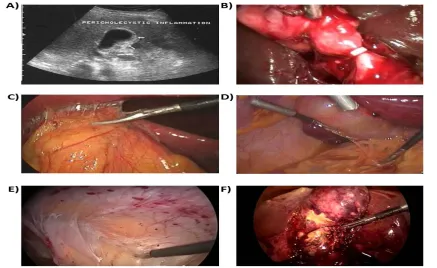
increases the possibility of spillage of contents into the peritoneal cavity. Clinically palpable gallbladder is a significant predictor of difficult cholecystectomy. Upper abdominal surgery is reported to have a high rate of conversion (37.5%) due to dense adhesion. Increasing experience on adhesiolysis and advanced laparoscopic surgery (using high definition cameras and newer energy sources) have led to reduced need for conversion [4,5]. Sonography is the method of choice for detection of gallbladder wall thickening and gallstones (Figure 4A). Thickening of the gallbladder wall is an important predictor for conversion. It is mainly related to inflammation or fibrosis following previous attacks of cholecystitis, and thus may reflect difficulty in delineation of the anatomy during surgery [4, 6]. Our study shows that stone impaction in the gallbladder neck is a good predictor of difficulty in laparoscopic cholecystectomy (Figure 4B). This is contrary to the findings of previous studies indicating that stone impaction has a moderate correlation with difficulty in laparoscopic cholecystectomy [2,6]. In our study, sonologically impacted stone was found as a significant predictor of difficult cholecystectomy.
The presence of pericholecystic fluid significantly increases difficulty of visualization and risk of local sepsis. Pericholecystic fluid collections and edema have been reported to be significant predictor of difficulty [4]. In our institution, we consider sub-total cholecystectomy for stones in the gallbladder neck with frozen Calot's triangle. Some risk factors must be considered when using the intraoperative scoring system (figure 4 A-F).
In our study, inability to visualize gallbladder on initial introduction of scope was mostly due to dense adhesions around the gallbladder (Figure 4C). These adhesions cause distortion of anatomy due to severe inflammation, which considerably complicates clipping of artery and duct. Other risk factors including the intraoperative status of distended, contracted or shriveled gallbladder corollary to the thickened gallbladder wall may be considered important poor prognostic criteria for laparosciopic cholecystectomy. The size of the impacted stone (especially > 1 cm) at the neck of the gallbladder was also found as a determinant of the surgery outcome (Figure 4B). According to Rosen et al., obesity is another risk factor for a difficult laparoscopic cholecystectomy [7]. All upper abdominal surgeries cause adhesions between bowel and anterior abdominal wall or gallbladder. After previous upper or lower abdominal surgery, there may be adhesions present between abdominal viscera or omentum and abdominal wall (Figure 4E). Presence of pus/bile outside the gallbladder is significantly associated with adhesions to lateral wall and surrounding structures with higher risk of injury and bleeding. This significantly affects the course of surgery and increases the risk of conversion (Figure 4F). Lal et al.
stated that any laparoscopic
cholecystectomy requiring more than 90 minutes for detection of cystic duct and artery and more 20 minutes for extraction of gallbladder should be regarded as difficult [8], which is in line with our results.
Figure 4. Clinical manifestations of some predictors of a difficult laparoscopic cholecystectomy.
A) Sonography of the gallbladder wall thickness and gallstones. B) Intraoperative image of a large impacted stone. C) Intraoperative image of gallbladder adhesions. D) Distended gall bladder. E)
Intra-abdominal adhesions obscuring the access. F) Intra-operative image of cholecystitis with impending rupture with pus.
CONCLUSION
Our findings indicate that the preoperative scoring system is more useful for predicting
the outcome of laparoscopic
cholecystectomy. With the help of an accurate prediction method, high-risk patients may be informed beforehand regarding the possibility of conversion, enabling the patients to make arrangements accordingly. This also increases awareness of surgeons regarding the spectrum of potential complications in high-risk patients. Therefore, the preoperative scoring system can be used as a simple method of predicting difficult laparoscopic cholecystectomy. A new scoring system based on both the preoperative and intraoperative variables could be more effective. Finally, the need for conversion to laparotomy is neither a failure nor a complication, but merely an attempt to avoid complications.
CONFLICT OF INTEREST
There is no conflict of interest to declare.
REFERENCES
1. Randhawa JS, Pujahari AK. Preoperative prediction of difficult lap chole: A scoring method. Indian Journal of Surgery. 2009; 71:198–201.
2. Dhanke PS, Ugane SP. Factors predicting difficult laparoscopic cholecystectomy: A single-institution experience. International Journal of Students’ Research. 2014; 4(1):3-7.
3. Sugrue M, Sahebally SM, Ansaloni L, Zielinski MD. Grading operative findings at laparoscopic cholecystectomy-a new scoring system. World Journal of Emergency Surgery. 2015 Dec;10(1):14.
4. Nachnani J, Supe A. Pre-operative prediction of difficult laparoscopic cholecystectomy using clinical and ultrasonographic parameters. Indian journal of gastroenterology. 2005; 24:16–8.
5. Singh K, Ohri A. Difficult laparoscopic cholecystectomy: A large series from north India. Indian Journal of Surgery. 2006; 68(4):205–8.
6. Daradkeh SS, Suwan Z, Abu-Khalaf M. Preoperative ultrasonography and prediction of difficulties in laparoscopic cholecystectomy. World Journal of Surgery. 1998; 22(1):75-7.
7. Rosen M, Brody F, Ponsky J. Predictive factors for conversion of laparoscopic cholecystectomy. The American journal of surgery. 2002; 184(3):254-8.
8. Lal P, Agarwal PN, Malik VK, Chakravarti AL. A difficult laparoscopic cholecystectomy that requires conversion to open procedure can be predicted by preoperative ultrasonography. Journal of the Society of Laparoendoscopic Surgeons. 2002; 6(1):59–63.
![Table 1. The preoperative scoring system [1] Score: <5: easy, 6–10: difficult and 11–15: very difficult](https://thumb-us.123doks.com/thumbv2/123dok_us/8954078.1863446/2.595.69.515.75.319/table-preoperative-scoring-score-easy-difficult-difficult.webp)