in the population sciences published by the Max Planck Institute for Demographic Research Konrad-Zuse Str. 1, D-18057 Rostock · GERMANY www.demographic-research.org
DEMOGRAPHIC RESEARCH
VOLUME 21, ARTICLE 23, PAGES 681-718
PUBLISHED 06 NOVEMBER 2009
http://www.demographic-research.org/Volumes/Vol21/23/ DOI: 10.4054/DemRes.2009.21.23
Research Article
Lowest-low fertility:
Signs of a recovery in Italy?
Marcantonio Caltabiano
Maria Castiglioni
Alessandro Rosina
© 2009 Marcantonio Caltabiano et al.
This open-access work is published under the terms of the Creative Commons Attribution NonCommercial License 2.0 Germany, which permits use, reproduction & distribution in any medium for non-commercial purposes, provided the original author(s) and source are given credit.
1 Introduction 682
2 Background 684
3 A descriptive picture of regional Italian fertility 688
3.1 Sources and methods 688
3.2 A brief summary of the different patterns of fertility in northern and southern Italy
689
4 An analysis of fertility postponement and recovery 694 4.1 The experience of cohorts born after 1940 694 4.2 A comparison of older cohorts 702
5 The role of female education 704
6 Discussion 708
7 Acknowledgements 710
References 711
Lowest-low fertility:
Signs of a recovery in Italy?
Marcantonio Caltabiano1
Maria Castiglioni2
Alessandro Rosina3
Abstract
The goal of this study is to describe the process of birth postponement and recovery in Italy, a country with persistent very low fertility levels.
The case of Italy is particularly noteworthy given that this country carries great demographic weight in Southern Europe, an area characterized by cultural and institutional specificities which have important implications for the timing of family formation and the final number of children.
We use data recently published by the Italian National Institute of Statistics (Istat), applying a cohort approach to show changes in CTFRs and the timing of births for the 1950-1980 cohorts. In order to further evaluate the evolution of Italian “fertility ageing” across social groups (with a focus on female education), we also use individual-level data from the 2003 Istat multipurpose survey, Famiglia e soggetti sociali (Family and Social Subjects).
We find that a recovery is presently underway in the northern regions of Italy, even if not all postponed births are recovered. As expected, signs of recovery are above all evident among the youngest generations and more educated women.
1 Università di Messina, Dipartimento di Economia, Statistica, Matematica e Sociologia V. Pareto,
Via T. Cannizzaro 278, 98122 Messina, Italy. Tel. +39.0906411070, Fax +39.0906416275 E-mail: [email protected].
2 Dipartimento di Scienze Statistiche, Università di Padova, Via C. Battisti 241, 35121 Padova, Italy. 3 Dipartimento di Scienze Statistiche, Università Cattolica del Sacro Cuore, Largo A. Gemelli 1, 20123 Milan,
1. Introduction
Italy is a country characterized by persistent very low fertility levels. A country’s fertility level is considered to be “very low” if it falls below 1.5 children per woman (Lesthaeghe and Willems 1999). The term “lowest low fertility” was introduced by Kohler, Billari, and Ortega (2002) to describe those cases in which the total period fertility rate (TFR) drops below 1.3. Lowest low fertility levels were recorded at a national level for the first time in Italy (and Spain) in 1992. Italy has had a fertility level below 1.5 for over 25 years, and the decade of 1993-2003 saw levels consistently below 1.3. The nation reached a record low fertility rate in the mid-1990s, recording a TFR of less than 1.2. Fertility rates since then have gradually increased (for the first time since the baby boom), up to today’s current fertility level of 1.4 children per woman (Istat 2009a).
The moderate yet significant increase in Italian fertility over the last 15 years has been characterized by distinct regional patterns. In the northern regions of Italy, period fertility has returned to the levels observed in the early 1980s, in part due to an increasing number of babies born to immigrants, whose fertility tends to be higher than that of native Italians. Overall, however, there has also been a slight increase in native fertility, coupled with the diffusion of new forms of family arrangements among the younger cohorts. Today in the northern regions, about 30% of births occur outside of wedlock, while about 20% of births have at least one immigrant parent (Istat 2009b).
In a number of southern regions, on the other hand, period fertility has continued to decline to very low levels (e.g., in 2005, the TFR in Sardinia was around 1.0). In other southern regions, period fertility levels have recently stabilized, although at levels much lower than those observed in early 1980s.
When cohort fertility, rather than period measures, is considered, Italian fertility levels are still found to be exceptionally low. Although the decline in fertility concerns all generations of women (at least beginning with those born in the 1920s), the proportion of women without any children in Italy has long remained relatively stable at less than 15%. Childlessness first began to increase noticeably among the cohorts of women born in the 1960s (De Rose, Racioppi, and Zanatta 2008). Beginning with the generations born at the end of the 1950s, ever more women in the central and northern regions started to forego early maternity, and the process of postponing first births began. With the birth cohorts of the 1960s, this behaviour became increasingly common, and spread throughout the country. The recent increase in fertility among older age groups could help to explain the halt in the decline of period fertility.
cohort of 19654). It is worth noting, however, that even after many years of very low and lowest low period fertility, cohort fertility has only recently reached the threshold of 1.5 children per woman. In fact, only those cohorts born in the 1960s find themselves on the doorstep of very low cohort fertility, and are still quite far from having lowest low fertility.
But what can be said about the future of Italian fertility? Frejka and Sardon (2006, 2007) show a permanent deficit in total cohort fertility among younger cohorts, who seem unable to recover the declines seen at earlier ages. Moreover, Frejka (2008) points out that the Italian cohort born in 1965 will have the highest proportion of childless women (about 24%), the lowest proportion of women with two children (37%), and one of the lowest percentages of women with three or more children (16%) in Europe. Finally, the Council of Europe’s 2005data confirm that there is currently no indication that the decline in total cohort fertility has come to a halt.
On the other hand, Golini (1998) and Sobotka (2004b) suggest that lowest low fertility is a temporary phenomenon linked to the postponement of childbearing, and that it may be overcome in a relatively short time if cohort fertility is constant. In this view, an increase in fertility rates among the older age groups of Italian cohorts should be expected. Supporting this proposition is the finding that the discrepancy in Italy between desired and actual fertility is among the highest in Europe (Testa 2006).
This study aims to describe the process of birth postponement south of the Alps, and more specifically, the dynamics behind fertility decline among women under the age of 30, and the recovery of fertility later in their reproductive lives. A recent study has pointed out that “while in Western European countries, the fertility ‘lost’ before the age of 30 is recovered afterwards, in the other areas this is not the case” (Sànchez-Barricarte and Fernàndez-Carro 2007:145). In this paper, we endeavour to explore whether it is possible to discern signs of recovery in Italy. We take our analysis to the national level, distinguishing between northern and southern Italy, as these areas have quite different demographic and socioeconomic histories (Livi Bacci 1977; Rallu 1983; Santini 1995; De Sandre 2000; Rosina 2004).
Our analysis is based on data published by the Italian National Institute of Statistics (Istat 2009b). We apply a cohort approach to show changes in CTFRs and the timing of births for the 1950-1980 cohorts. We could not, however, study changes in cohort fertility by parity, as these data are not currently provided by the Italian civil registry system. This limitation allows us to provide only a general picture of Italian reproductive behaviour and dynamics. In order to further evaluate the evolution of Italian fertility ageing across social groups (with a focus on female education), we also
4 In calculating CTFR for censored cohorts, each missing age-specific rate is replaced by the rate observed at
use individual level data from the 2003 Istat multipurpose survey, Famiglia e soggetti sociali (Family and Social Subjects).
We expect to find that, if signs of recovery exist, they will be more evident among younger generations of women with higher levels of education living in northern Italy. In other words, we assume that signals will emerge in contexts and social categories in which childcare services are more readily available, gender asymmetries are less evident, economic conditions are better, and modern and post-modern values are more diffused (Saraceno 1994; Pinnelli 1995; Del Boca, Pasqua, and Pronzato 2004; Van de Kaa 2004; Rosina and Sabbadini 2006; Sànchez-Barricarte and Fernàndez-Carro 2007). In an effort to describe the mechanisms behind the widespread postponement of births, in the section which follows we contextualize Italian fertility dynamics within the larger framework of European fertility at the beginning of the 21st century. We focus specifically on the role of female education levels. In Sections 3 and 4, we describe cohort fertility behaviour in Italy, showing evidence for fertility recovery in the northern regions (although not all postponed births are recovered). In Section 5, we use micro-level data to demonstrate the possible early stages of a slowing, if not a reversal, in fertility decline. This phenomenon seems due in large part to fertility recovery by women over the age of 30, especially among the youngest generations who hold a university degree.
2. Background
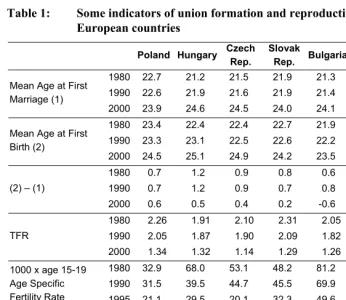
At the turn of the century, low levels of fertility were observable across all Western countries. In fact, while many nations had a TFR above two children per woman in 1980, over the last 25 years lowest low fertility has become increasingly widespread, especially in Southern and Eastern Europe (Table 1). The most important change in the last few decades, however, concerns the general postponement of fertility within the larger processes of delayed family formation, a trait shared by almost all European countries (Billari, Liefbroer, and Philipov 2006).
Although there has been some variation across countries, the postponement of the transition to motherhood is generally characterized by both an increase in average age at first birth, and a decrease in adolescent (ages 15-19) and juvenile (ages 20-26) fertility. In fact, in many European countries (with the exception of Eastern Europe) more than 50% of births are from mothers over the age of 26 (Table 1).
these countries have higher fertility levels (see Table 1 and Figure 1 for a comparison of Italy and France).
Table 1: Some indicators of union formation and reproductive behaviour in
European countries
Poland Hungary Czech Rep.
Slovak
Rep. Bulgaria Romania Sweden 1980 22.7 21.2 21.5 21.9 21.3 21.5 26.0 1990 22.6 21.9 21.6 21.9 21.4 22.0 27.5 Mean Age at First
Marriage (1)
2000 23.9 24.6 24.5 24.0 24.1 23.4 30.2 1980 23.4 22.4 22.4 22.7 21.9 22.4 25.3 1990 23.3 23.1 22.5 22.6 22.2 22.7 26.3 Mean Age at First
Birth (2)
2000 24.5 25.1 24.9 24.2 23.5 23.6 27.9 1980 0.7 1.2 0.9 0.8 0.6 0.9 -0.7 1990 0.7 1.2 0.9 0.7 0.8 0.7 -1.2 (2) – (1)
2000 0.6 0.5 0.4 0.2 -0.6 0.2 -2.3 1980 2.26 1.91 2.10 2.31 2.05 2.43 1.68 1990 2.05 1.87 1.90 2.09 1.82 1.84 2.13 TFR
2000 1.34 1.32 1.14 1.29 1.26 1.31 1.54 1980 32.9 68.0 53.1 48.2 81.2 72.3 15.8 1990 31.5 39.5 44.7 45.5 69.9 51.5 14.1 1000 x age 15-19
Age Specific
Fertility Rate 1995 21.1 29.5 20.1 32.3 49.6 42.0 7.7
c.1950 … 28.3 26.7 31.0 22.5 30.7 46.7 c.1960 … 31.8 25.4 28.1 20.2 26.0 60.9 % CTFR
after age 27
c.1965 … 33.3 25.9 21.1 18.5 22.3 58.8 1980 4.8 7.1 5.6 5.7 10.9 2.8 39.7 1990 6.2 13.1 8.6 7.6 12.4 4.0 47.0 Nonmarital Birth %
Table 1: (Continued)
UK Nether-lands
former
FDR France Spain Italy Greece Portugal 1980 23.0 23.2 23.3 23.0 23.4 23.8 23.3 23.2 1990 25.0 25.9 25.7 25.6 25.3 25.5 24.6 23.9 Mean Age at
First Marriage (1)
2000 27.2 27.8 … 27.8 27.8 27.0 26.6 25.3 1980 … 25.7 25.5 25 25.0 25.0 24.1 24.0 1990 27.3 27.6 27.0 27 26.8 26.9 25.5 24.9 Mean Age at
First Birth (2)
2000 29.1 28.6 28.0 28.7 29.1 28.7 b 27.3 26.5 1980 … 2.5 2.2 2.0 1.6 1.2 0.8 0.8 1990 2.3 1.7 1.3 1.4 1.5 1.4 0.9 1.0 (2) – (1)
2000 1.9 0.8 … 0.9 1.3 1.7 0.7 1.2 1980 1.89 1.60 1.45 1.95 2.20 1.64 2.23 2.25 1990 1.83 1.62 1.45 1.78 1.36 1.33 1.39 1.57 TFR
2000 1.65 1.72 1.38 1.89 1.24 1.24 1.29 1.55 1980 29.6 a 9.2 19.5 25.4 25.8 20.9 53.1 41.0 1990 33.2 a 8.3 16.8 13.3 11.9 9.0 21.6 24.1 1000 x age
15-19 Age Specific
Fertility Rate 1995 28.4 a 5.8 13.2 10.0 7.8 6.9 13.0 20.9
c.1950 43.1 a 47.5 41.3 41.1 47.4 37.2 39.7 43.1 c.1960 53.0 a 66.0 55.0 50.7 53.6 46.5 37.7 42.8 % CTFR
after age 27
c.1965 55.7 a 71.7 61.5 57.9 62.9 56.0 46.0 50.2 1980 11.5 4.1 7.6 11.4 3.9 4.3 1.5 9.2 1990 27.9 11.4 10.5 30.1 9.6 6.5 2.2 14.7 Nonmarital Birth
%
2000 39.5 24.9 18.6 42.6 17.7 9.7 … 22.2
a England and Wales b 29.4 in the Centre-North and 27.5 in the South-Islands
Sources: Billari (2005) and our elaboration of Italian data from http://demo.istat.it
Figure 1: Age-specific fertility rates in Italy and France, 1995 and 2005
Italy France
0 20 40 60 80 100 120 140 160 180 200
15 20 25 30 35 40 45 50
age
age
specif
ic fer
tility
rates
per t
housand
Italy 1995 Italy 2005 France 1995 France 2005
Sources: http://demo.istat.it and http://www.ined.fr.
In fact, scholars have suggested that increased female education and economic autonomy are among the principal factors shaping new patterns of family formation and postponed parenthood (Lesthaeghe 2001; Sobotka 2004a). When women delay first births, they increase their chances of securing well-paid employment as a result of their education, their accumulated on-the-job skills, and their experience (McDonald 2000). “Given the consistency of the various findings in the literature, trends in female education can be seen as a major force shaping the postponement of childbearing in Europe” (Billari, Liefbroer, and Philipov 2006:5).
In Italy, the postponement of childbearing until older ages and the marked decline in marriage and children in the central and northern regions are trends that are particularly widespread among more educated women. This is especially true among women from parental families with poor financial and cultural resources (Rosina, Fraboni, and Sabbadini 2003).
higher levels of education, were in opposition to a more traditional context (i.e., with regard to family patterns, gender roles, and work time management), and may ultimately have polarized work and family for these women. According to Piazza (1994), this generation was typified by a “daily synchronicity,” or by the quotidian challenge of equally managing and maintaining the two poles of family and work. Indeed, many women from these cohorts faced a reality characterized by hard work, lack of social resources, and hostility from the cultural environment. One obvious way out of this situation was to sacrifice one of the two poles. It was not until the birth cohorts of the 1960s that a “diachronic strategy” seems to have emerged, characterized by a postponement, and then a recovery of childbearing, and by greater flexibility in the management of time spent working (Rosina 2004).
The opportunity for a more flexible life course, in which having children becomes one of many possible choices, has been discussed by proponents of the second demographic transition (Van de Kaa 2004). They argue that a modern society that is open to social and cultural changes allows couples and individuals to develop a more individualized lifestyle in which options and choices are multiplied. The decision to have an (additional) child – including at older ages – may be considered to be an enrichment of one’s personal life and that of the couple; i.e., as a means of attaining self-fulfilment and parental satisfaction. Couples with higher levels of education may be more likely to seek such self-realization through individualized choices.
Recent empirical data demonstrate, however, that the negative impact of higher educational levels on fertility has progressively lessened over time, to the point that it disappears, or even reverses direction (Kravdal 2001; Dalla Zuanna and Impicciatore 2007). The absence of a clear relationship (at least in Western countries) between the distribution of women by parity and their level of education also tends to confirm the finding that, given equal levels of education, reproductive decisions can be very different (Shkolnikov et al. 2007). In Italy, a recent trend has been observed in which couples with greater cultural and economic resources do not have a lower propensity to have children (Dalla Zuanna and Tanturri 2007; Rosina and Testa 2007).
3. A descriptive picture of regional Italian fertility
3.1 Sources and methods
available only online at http://demo.istat.it/altridati/IscrittiNascita/index.html). Birth data by parity and mother’s age are not available after 1996 (Bonarini 2006).
By aggregating cross-sectional data at a cohort level, the complete age schedule of fertility is available for the 1935-1958 cohorts. For the 1959-1970 cohorts, some of the CTFRs were estimated (ages 49-38) with the assumption that age-specific fertility rates will not change between younger and older cohorts. This procedure may overestimate fertility if the delay in births continues over the following years, or it may underestimate fertility if the recovery is faster than that of the recent past. However, any distortion for the cohorts examined here should be negligible (Caltabiano 2008). Finally, this seemed to be the most “neutral” choice, as it would not overly influence the analysis of a delay or a recovery.
3.2 A brief summary of the different patterns of fertility in northern and southern Italy
Over the last 50 years, fertility in northern and southern Italy has followed two distinct patterns (Livi Bacci 1977; De Sandre 2000).
In the northern and central regions, the TFR increased considerably in the early 1960s, during the years of the Italian baby boom (Terra Abrami and Sorvillo 1993). This increase was, however, followed by a decline, which accelerated in the late 1970s. The TFR reached its lowest point in 1995, and then gradually began to rise. In the regions of southern Italy, the end of fertility transition masked the baby boom (Rallu 1983), and the TFR slowly declined in the 1960s, accelerating in 1970s. At present, the decline in southern Italy’s TFR has not yet reached a minimum level, but has rather only slowed, or stabilized at low levels in a few regions (Caltabiano 2006). Notably, recent data (Istat 2009a) show that, for the first time in Italian history, the TFR in the North (1.45) is higher than that in the South (1.35). This switch may be due in part to a comparatively larger relevant share of young immigrant births in the North, and to a slower pace of postponement and recuperation in the South (see Section 4).
Changes in CTFRs are less irregular than those seen in the period TFRs: there is no baby boom, and the decrease in cohort fertility is slow but continuous, at least since those cohorts born in late 1930s (Table 2, Figure 2).
A comparison of the fertility schedules of women living in northern and southern Italy again reveals two distinct patterns. Women born in 1970, 1975, and 1980 in the northern regions of Italy are similar with regard to the first part of their reproductive lives (Figure 3). Women born in 1960, on the other hand, began having children at an earlier age. Overall CTFRs for the different cohorts may not, however, be all that dissimilar, given that the younger cohorts seem to recover fertility levels after age 30 (thereby beginning childbearing later).
Table 2: Levels of CTFRs and mean age at childbirth in Italy,
1935-1970 cohorts
CTFR
1935 1945 1950 1955 1960 1965 1970
Northern Italy 1.94 1.83 1.68 1.58 1.47 1.37 1.32 Central Italy 2.04 1.94 1.79 1.69 1.59 1.45 1.36 Southern Italy 2.89 2.49 2.27 2.17 2.03 1.84 1.65
Italy 2.30 2.08 1.91 1.83 1.71 1.56 1.45
Mean age at childbirth
1935 1945 1950 1955 1960 1965 1970
Northern Italy 28.6 26.9 26.8 27.2 28.4 30.2 31.4 Central Italy 28.2 26.9 26.9 27.2 28.3 30.0 31.3 Southern Italy 29.0 27.4 27.1 26.9 27.2 28.2 29.2
Italy 28.6 27.1 26.9 27.0 27.8 29.2 30.4
Source: Our elaboration of Italian data from http://demo.istat.it
In the southern regions, the fertility of the 1970 cohort is much lower than that of the 1960 cohort. For the 1975 and the 1980 cohorts, this decline continues – even if less dramatically – and the timing of fertility begins only slightly later (Figure 4).
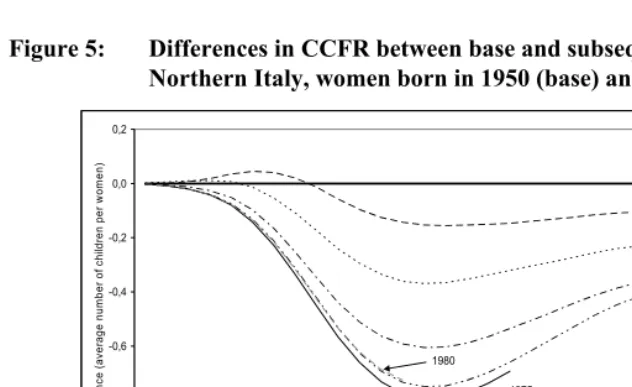
The process of fertility recovery in northern Italy becomes more visible when we compare cumulated cohort fertility rates (CCFR) up to age x for the 1950-1980 cohorts (Figure 5).We take the cohort born in 1950 as our base, and then compare its cumulated fertility to that of the younger cohorts5 (Frejka and Calot 2001).
5 That is 1950CTFR
Figure 2: TFR and CTFR (lagged by mean age at childbearing), Northern and Southern Italy
northern Italy N
1965 cohort 1935 cohort 1945 cohort 1955 cohort 1970 cohort southern Italy S 1935 cohort
1945 cohort 1955 cohort
1970 cohort 1965 cohort 0,50 1,00 1,50 2,00 2,50 3,00 3,50 4,00
1950 1960 1970 1980 1990 2000 2010
TFR /
CT
FR
TFR northern Italy CTFR northern Italy TFR southern Italy CTFR southern Italy
Source: Our elaboration of Italian data from http://demo.istat.it
Figure 3: Cohort age specific fertility rates per thousand, Northern Italy,
1950-1980 cohorts 1950 1960 1970 1980 1975 0 20 40 60 80 100 120 140 160 180 200
15 20 25 30 age 35 40 45 50
ag e s p ec ific fe rt ility r a te s pe r th ou sa n d
Figure 4: Cohort age specific fertility rates per thousand, Southern Italy, 1950-1980 cohorts
1950
1960
1970
1980
1975
0 20 40 60 80 100 120 140 160 180 200
15 20 25 30 35 40 45 50
age
ag
e
sp
ec
ific
f
er
til
ity
r
at
es
p
er
t
ho
us
an
d
Source: Our elaboration of Italian data from http://demo.istat.it
The analysis of CCFRs shows a recovery of fertility in northern Italy among the 1960, 1965, and 1970 cohorts, compared to the 1950 cohort. In northern Italy, the difference in CCFRs decreases from a maximum of -0.35 child per women at age 29 to -0.20 at age 49 between the 1950 and the 1960 cohorts, from -0.59 child per women at age 29 to -0.31 at age 49 between the 1950 and 1965 cohorts, and from -0.73 child per women at age 29 to -0.36 at age 49 between the 1950 and 1970 cohorts.
Furthermore, a comparison within the same northern regions of the 1975 and 1980 cohorts with the 1970 cohort shows negligible differences.
Figure 5: Differences in CCFR between base and subsequent cohorts: Northern Italy, women born in 1950 (base) and 1955-1980
1950 1955 1960 1965 1970 1975 1980 -1,0 -0,8 -0,6 -0,4 -0,2 0,0 0,2
15 20 25 30 35 40 45
age di ff er ence ( aver age nu m ber of chi ldr en p e r w om en)
Source: Our elaboration of Italian data from http://demo.istat.it
Figure 6: Differences in CCFR between base and subsequent cohorts:
Southern Italy, women born in 1950 (base) and 1955-1980
1950 1955 1960 1965 1970 1975 1980 -1,0 -0,8 -0,6 -0,4 -0,2 0,0 0,2
15 20 25 30 35 40 45
age di ffer enc e ( av er a ge num be r of ch ildr en per w om en)
4. An analysis of fertility postponement and recovery
4.1 The experience of cohorts born after 1940
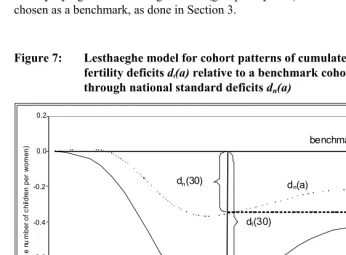
In this section, we more formally analyze fertility postponement and recuperation among Italian cohorts by applying a model proposed by Ron Lesthaeghe (2001; see his article for further methodological details).
This model provides a means of studying the deficits and surpluses in cumulative fertility by age in succeeding cohorts (grouped by five) in relation to an older cohort chosen as a benchmark, as done in Section 3.
Figure 7: Lesthaeghe model for cohort patterns of cumulated age-specific
fertility deficits dt(a) relative to a benchmark cohort, standardized
through national standard deficits dn(a)
-1.0 -0.8 -0.6 -0.4 -0.2 0.0 0.2
15 20 2 5 30 35 40 45
age
di
ff
er
enc
e
(a
v
e
ra
g
e
n
u
m
b
er
of c
h
ildr
en per
w
o
m
e
n
) benchmark
dn(30)
dt(30)
dt(a)
dn(a)
dn(30)-dn(50)
Postponement and recuperation on the part of each cohort, with respect to the benchmark, are measured by means of two series of scalars: the through scalars ktand
the relative recuperation scalars Rt (Lesthaeghe 2001:15-17). The through scalar,
intended to assess postponement, is measured at age 30 as:
(30) (30) (30)
(30) (30) (30)
t b t
t
n b n
cumfert cumfert d
k
cumfert cumfert d
− =
− = (1)
where cumfert is cumulated fertility up to age 30 respectively for each cohort (subscript t), in the national standard schedule of deviations (subscript n)6, and in the benchmark schedule (subscript b). In such a model, the national standard synthesizes the country’s specific age shape of fertility, and the deviations of each cohort are scaled up or down with the throughscalarktat all ages (Lesthaeghe 2001).
The second scalar, Rt , intended to assess recuperation, is measured as:
(30) (50)
(30) (50)
t t
t
n n
d d
R
d d
− =
− (2)
In other words, it is the ratio of the amount of fertility recuperated at age 50 with respect to age 30 in any cohort7, over the amount recuperated in the standard national schedule.
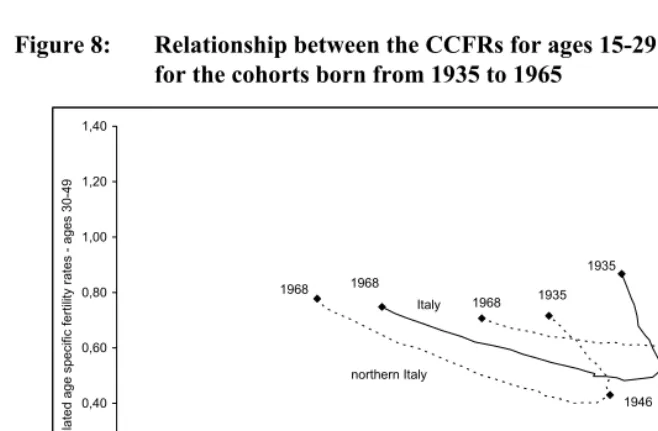
Lesthaeghe himself suggests a criterion for choosing the best benchmark cohort: “A good benchmark cohort would be one that has not yet experienced much postponement nor catching up.” For this reason, we chose the Italian cohort of 1948-52 as our benchmark. The model is thus “centred” on the 1950 cohort, the last before a significant postponement in fertility schedule (Figure 8). We used this same group in Section 3 as our base cohort. In addition, women in Italy (as in other Southern European countries) began to postpone fertility later than women in Northern and Western European countries (Frejka and Sardon 2007).
In order to best examine postponement and recuperation in Italy, we thus chose a benchmark cohort born about five years after the cohorts chosen by Lesthaeghe in his paper, in which he compares Austria, Belgium, France, Germany, Netherlands, and Switzerland.
6 Computed as the average deviation from the benchmark cohort for the first three cohorts after the
benchmark.
7 Each d
tvalue is the deviation in cumulated fertility compared to that of the benchmark cohort, e.g.,
Figure 8: Relationship between the CCFRs for ages 15-29 and 30-49, for the cohorts born from 1935 to 1965
northern Italy
1968 1935
1946
1946 southern Italy
1968
1935
1946 1968
Italy
1935
0,00 0,20 0,40 0,60 0,80 1,00 1,20 1,40
0,00 0,20 0,40 0,60 0,80 1,00 1,20 1,40 1,60 1,80 2,00
cumulated age specific fertility rates - ages 15-29
cu
mulated age
specif
ic
fert
ility
r
at
es
ages
30-49
Source: Our elaboration of Italian data from http://demo.istat.it
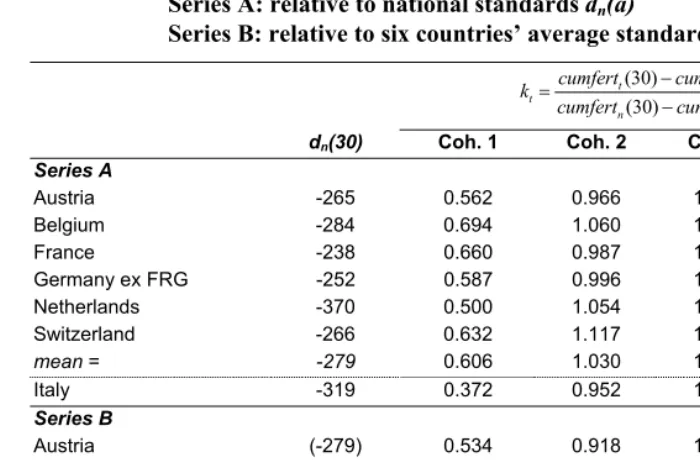
Tables 4 and 5 compare the speed of postponement and recuperation in the six countries analyzed by Lesthaeghe, plus Italy. The levels of CTFR for each cohort and country are in Table 3.
The series dn(30) and dn(30) – dn(50) synthesize the specificities of fertility in each
country. The Netherlands, for example, shows the highest levels of both postponement and recuperation. In Italy, postponement is also high, but recuperation is similar to that of other countries, and does not compensate for the missing births before age 30. Austria and Belgium, on the other hand, show very low levels of recuperation.
The series of kt and Rt scalars provide the time schedule for postponement and
recovery. We present two different series of data. (1) Series A gives the values of kt and
Rt based on each national standard; these cannot be used for international comparisons,
but are useful for observing national time paths. (2) Series B gives the values of kt and
Rt based on the average postponement/recuperation in the six countries of Western
Table 3: Levels of CTFR in the seven European countries examined in Tables 4 and 5 and in the Italian macro-regions examined in Tables 6 and 7
Bench. Coh. 1 Coh. 2 Coh. 3 Coh. 4
1940-44 1945-49 1950-54 1955-59 1960-64 Belgium 2.07 1.87 1.82 1.84 1.82
1942-46 1947-51 1952-56 1957-61 1962-66 France 2.25 2.12 2.13 2.12 2.04 Germany ex FRG 1.82 1.73 1.67 1.65 1.55 1943-47 1948-52 1953-57 1958-62 1963-67 Austria 1.96 1.87 1.77 1.69 1.63 Netherlands 2.00 1.89 1.87 1.85 1.78 Switzerland 1.87 1.79 1.75 1.76 1.66
Average 1.99 1.88 1.84 1.82 1.75
1948-52 1953-57 1958-62 1963-67 -
Italy 1.91 1.83 1.70 1.56 -
Northern Italy 1.68 1.58 1.47 1.37 - Central Italy 1.77 1.69 1.57 1.45 - Southern Italy 2.25 2.17 2.02 1.84 -
Sources: Italy: our elaboration of Italian data from http://demo.istat.it
All other European countries: our elaboration of Council of Europe data from: http://www.coe.int/t/e/social_cohesion/population/ demographic_year_book/2003_edition/04%20Country%20Data/Default.asp#TopOfPage (last retrieved 30/06/2009)
Series A in Table 4 shows that postponement accelerated among the younger cohorts in all of the countries examined. In the beginning, postponement in Italy is slower than the average, but then quickly accelerates, surpassing the levels reached in all of the other countries.
Series B allows for a comparison of the patterns among countries: in Italy postponement started more slowly than in other countries, but soon accelerated and reached the levels found in the Netherlands, the country with the greatest postponement among those analyzed.
In Table 5 we present the recuperation scalars Rt. The time path of deficit
reduction among Italian cohorts is similar to that of other countries, with a sharp acceleration among the younger cohorts (Series A). The intensity of recuperation is also similar for each group of cohorts relative to the average for the other countries.
Table 4: Evolution of the speed of postponement kt in the cumulated fertility
deficits of cohorts in seven European countries (see Lesthaeghe 2001)
Series A: relative to national standards dn(a)
Series B: relative to six countries’ average standard
(30) (30) (30) (30)
t b
t
n b
cumfert cumfert cumfert cumfert
− =
− k
dn(30) Coh. 1 Coh. 2 Coh. 3 Coh. 4
Series A
Austria -265 0.562 0.966 1.468 1.823 Belgium -284 0.694 1.060 1.250 1.588 France -238 0.660 0.987 1.357 2.235 Germany ex FRG -252 0.587 0.996 1.413 2.032
Netherlands -370 0.500 1.054 1.449 1.876 Switzerland -266 0.632 1.117 1.252 1.883
mean = -279 0.606 1.030 1.365 1.906
Italy -319 0.372 0.952 1.676 2.272
Series B
Austria (-279) 0.534 0.918 1.394 1.731 Belgium (-279) 0.706 1.079 1.272 1.616 France (-279) 0.563 0.842 1.158 1.906 Germany ex FRG (-279) 0.530 0.900 1.276 1.835
Netherlands (-279) 0.663 1.398 1.921 2.487 Switzerland (-279) 0.602 1.065 1.194 1.796 Italy (-279) 0.425 1.087 1.913 2.593
Note: Benchmark cohort born in 1940-44 (Belgium), 1942-46 (France, Germany ex FRG), 1943-47 (Netherlands, Switzerland, Austria), 1948-52 (Italy). CTFRs for all cohorts are in Table 3.
Table 5: Evolution of the relative recuperation scalar Rt in the cumulated
fertility deficits of cohorts in seven Western European countries (see Lesthaeghe 2001)
Series A: relative to national standard dn(30)-dn(50)
Series B: relative to six countries’ average standard
(30) (50) (30) (50)
t t
t
n n
d d
d d
− =
− R
dn(30)–dn(50) Coh. 1 Coh. 2 Coh. 3
Series A
Austria +60 0.417 0.917 1.633
Belgium +51 -0.118 0.647 2.510
France +151 0.556 1.026 1.430
Germany ex FRG +103 0.340 1.000 1.641
Netherlands +277 0.339 1.040 1.632 Switzerland +111 0.432 1.097 1.471
mean = +126 0.328 0.955 1.720
Italy +109 0.351 0.903 1.746
Series B
Austria (+126) 0.198 0.437 0.778
Belgium (+126) -0.047 0.262 1.016
France (+126) 0.667 1.230 1.714
Germany ex FRG (+126) 0.278 0.817 1.341
Netherlands (+126) 0.746 2.286 3.587 Switzerland (+126) 0.381 0.966 1.296
Italy (+126) 0.304 0.783 1.514
Note: Benchmark cohort born in 1940-44 (Belgium), 1942-46 (France, Germany ex FRG), 1943-47 (Netherlands, Switzerland, Austria), 1948-52 (Italy). CTFRs for all cohorts are in Table 3.
Source: Lesthaeghe (2001) and our elaboration of Italian data from http://demo.istat.it
To conclude, national trends in recuperation are quite similar among the selected countries, while differences appear in postponement patterns. The slow beginnings of postponement explain the initial stability of the CTFR in Italy, and the acceleration which follows explains its steep decline (Table 3). In the other countries, the slow decline in CTFR (and also sometimes the increase) is due to a weaker postponement, balanced by enough recovery.
higher in the northern and central regions of Italy than in the south, where recovery is very slow (see the series of dn(30) and dn(30) – dn(50)).
Data in Table 6 show that fertility postponement in northern and central Italy has followed a pattern similar to that of the Netherlands; the 1963-67 cohorts already surpass the levels of postponement reached in the countries examined by Lesthaeghe (series B). The southern regions, on the other hand, initially experienced weak postponement among the older cohorts, but then soon caught up, such that postponement on the part of the 1968-72 cohorts reaches almost the same levels as the rest of the country8.
Table 6: Evolution of the speed of postponement ktin the cumulated fertility
deficits of cohorts in Italian macro-regions
Series A: relative to local standards dn(a)
Series B: relative to the common average standard for the six Western European countries in Table 4
(30) (30) (30) (30)
t b
t
n b
cumfert cumfert k
cumfert cumfert − =
−
dn(30) 1953-57 1958-62 1963-67 1968-72 1973-77
Series A
Northern Italy -369 0.428 0.982 1.590 1.967 2.086 Central Italy -355 0.399 0.967 1.634 2.168 2.423 Southern Italy -256 0.291 0.907 1.802 2.771 3.551 Italy -319 0.372 0.952 1.676 2.272 2.596
Series B
Northern Italy (-279) 0.565 1.298 2.102 2.600 2.757 Central Italy (-279) 0.507 1.229 2.075 2.754 3.077 Southern Italy (-279) 0.267 0.832 1.655 2.544 3.261 Italy (-279) 0.425 1.087 1.915 2.595 2.965
Note: Benchmark cohort born in 1948-52. CTFRs for all cohorts are in Table 3.
Source: Our elaboration of Italian data from http://demo.istat.it
8 Measures of postponement and recuperation for southern Italy may be partly biased due to our decision to
use as a benchmark a cohort in which fertility of parity 3+ is not yet negligible. On the other hand, it is not possible to use as a benchmark a cohort younger than 1948-52 given that we need the complete time schedule of fertility (observed or estimated) for three cohorts younger than the benchmark in order to compute the rt
Table 7: Evolution of the relative recuperation scalar Rt in the cumulated
fertility deficits of cohorts in Italian macro-regions Series A: relative to local standard dn(30)–dn(50)
Series B: relative to the common average standard for the six Western European countries in Table 5
(30) (50) (30) (50)
t t
t
n n
d d
d d
− =
− R
dn(30)–dn(50) 1953-57 1958-62 1963-67
Series A
Northern Italy +161 0.375 0.938 1.686 Central Italy +156 0.410 0.929 1.661 Southern Italy +13 -0.650 0.088 3.562
Italy +109 0.351 0.903 1.746
Series B
Northern Italy (+126) 0.481 1.203 2.163 Central Italy (+126) 0.508 1.152 2.059 Southern Italy (+126) -0.068 0.009 0.372
Italy (+126) 0.304 0.783 1.514
Note: Benchmark cohort born in 1948-52. CTFRs for all cohorts are in table 3.
Source: Our elaboration of Italian data from http://demo.istat.it
We see differentiated fertility recuperation between macro-regions as well (Table 7). Recovery is almost absent in southern Italy, weakly beginning only with the cohorts born in 1963-679.
On the other hand, recovery is quite strong in the other two macro-regions, reaching levels higher than in France. Only the Netherlands, the “record” performer (Lesthaeghe 2001), presents a greater level of recuperation. However, given that the highest absolute level of CCFRs at age 29 among the Italian cohorts examined here is much lower than in France, the Italian CTFR, even with such a significant level of recovery, will ultimately be lower compared to the corresponding French cohorts.
It would be interesting to analyze cohort recuperation for different parities separately, in order to gain a better understanding of the compositional patterns of Italian low fertility and geographical specificities. Unfortunately, however, fertility rates by birth order are not currently available for Italy.
9 Of course, in southern Italy a return to the fertility levels reached by the 1950s cohorts, characterized by a
Finally, in Table 8 we estimate the quota of fertility after age 30 on overall fertility. This quota increases significantly in succeeding cohorts, demonstrating that fertility after age 30 is a relevant component of fertility in contemporary Italy. This trend will be the subject of Section 5.
Table 8: (Fertility after age 30) / (CTFR)
1953-57 1958-62 1963-67 Northern Italy 29.9% 39.2% 51.2% Central Italy 29.5% 37.4% 48.4% Southern Italy 28.0% 30.6% 35.9%
Italy 28.9% 34.9% 43.9%
Source: Our elaboration of Italian data from http://demo.istat.it
Thus, changes in fertility in Italy are characterized by different regional trends, which distinguish the North from the South. A similar pattern occurred with the fertility transition, which did not start in southern Italy until about 30 years after it began in the northern regions (Livi Bacci 1977). The determinants of these differences, whether economic, social, or cultural, are today still greatly debated (for an extensive analysis of this issue, see Kertzer et al. 2006; White et al. 2007). In Section 5, we focus our attention on the northern and central regions of Italy, in order to examine fertility recovery in a more homogeneous area of the country.
4.2 A comparison of older cohorts
In order to compare recent fertility behaviour with the behaviour of older cohorts who experienced a decline and recovery in fertility, we have analyzed changes in the fertility schedules of Italian cohorts born in the 1920s, 1930s, and 1940s using Lesthaeghe’s model. As birth data by region and birth order were first collected in 1952 (Istat 1997), it is possible to conduct an in-depth study only of those cohorts born in the 1930s and 1940s.
For women born in 1918-29, we use Santini’s (1974) estimations of cohort fertility schedule. For women born in 1930-48, we elaborate official Istat data (see § 3). The benchmark cohort here is the 1918-22 cohort10. The benchmark cohort § 4 (1948-52) is now the youngest cohort.
The negative values of the kt scalars show that these cohorts were characterized by
a remarkable anticipation of the fertility schedule (Table 9), beginning with women born in the late 1920s, in part due to a younger age at marriage. This anticipation intensifies among the cohorts more influenced by the Italian baby boom, and then begins to diminish and fade away.
The negative values of the Rt scalars (Table 9) indicate that anticipation of the
fertility schedule for these cohorts did not result in a higher CTFR: fertility was lost after age 30 as birth rates of order 3+ continued their uninterrupted decline.
Table 9: Evolution of the speed of postponement kt and recuperation Rt in
Italian cohorts born in 1923-52, relative to the common average standard for the six Western European countries in Table 4
Italy - Series B
Cohort 1923-27 1928-32 1933-37 1938-42 1943-47 1948-52 CTFR 2.35 2.33 2.29 2.17 2.08 1.91
kt 0.265 -0.021 -0.451 -0.614 -0.725 -0.230
Rt -0.400 -1.164 -2.452 -3.760 -4.738 -5.008
Note: Benchmark cohort born in 1918-22 with a CTFR of 2.47. dn(30) is -279, dn(30) – dn(50) is +126.
Source: Our elaboration of Italian data from Santini (1974) and http://demo.istat.it
Thus, the experiences of cohorts born in the 1920s and 1930s were the opposite of the experiences of the cohorts born 40 years later. The former are characterized by an anticipation of fertility followed by a decrease at older ages, while among the latter, we see a postponement followed by a recovery.
A more in-depth analysis of the cohorts born in the 1930s and 1940s confirms these general trends.
Anticipation of the fertility schedule was more significant in northern and central Italy, and less apparent in the southern regions. The decline in fertility after age 30 was seen in all areas, but was stronger in southern Italy (Tables A1-A2 in appendix).
Anticipation of the first and second order fertility schedule mainly concerned the northern regions, whereas its decrease at later ages affected all regions. However, the
10 Note that the results that follow do not change even if we choose a younger cohort as a benchmark, such as
decrease after age 30 was more intense in the northern regions, especially for second order births (Tables A3-A4 in appendix).
Trends in births of third and higher orders varied significantly. Anticipation of the fertility schedule concerned only northern and central regions, ceasing among the 1945-49 cohort. In southern Italy, higher order fertility decreased at all ages (Table A5 in appendix).
5. The role of female education
In order to further explore our hypothesis, we provide in this section a descriptive analysis of the microdata. Our goal is to evaluate whether signs of recovery are confirmed by the data, and if so, whether they emerge more clearly if the level of education, in addition to the territorial dimension, is taken into account.
As we described in the background section above, a number of scholars have suggested that increases in female education and economic autonomy are among the most important factors influencing the new patterns of family formation and the postponement of parenthood. High levels of education seem to have a particularly positive effect on fertility at later ages. Growing numbers of women hold university degrees, and, after having postponed forming a family in order to invest in their personal development and professional careers, they may then decide to “make up for lost time” (i.e., recover their fertility). We therefore expect to see a growing association between the propensity of women to have children in their thirties, and having a university-level education among the youngest generations of females.
We conducted this descriptive analysis using data from the most recent Istat survey on reproductive behaviour, Famiglia e soggetti sociali (Family and Social Subjects). A representative sample of 49,541 individuals belonging to 19,227 families were interviewed. Because the survey was conducted in 2003, the most recent cohort for which it is possible to reconstruct fertility completed at age 40 corresponds to those women born in 1957-62.
demonstrated that signs of recovery seem to have emerged predominantly in the northern part of the country. We therefore focus our analysis on the centre-north of Italy.
Table 10: Percentage of women by age at first and second child. Centre-North.
Cohorts 1943-47, 1948-52, 1953-57, 1958-62
First child Second child
No 2nd child by 40
Before
30 30-40 Childless
by 40 Total
Before
30 30-40 Only one None Total N 1943-47 78.3 11.7 10.0 100.0 43.9 21.3 24.8 10.0 100.0 1,149 1948-52 76.0 13.4 10.6 100.0 37.9 23.5 28.0 10.6 100.0 1,289 1953-57 70.1 13.6 16.3 100.0 33.7 20.7 29.2 16.3 100.0 1,275 1958-62 58.4 22.8 18.8 100.0 24.2 27.3 29.6 18.8 100.0 1,453
Source: Our elaboration of Istat Multipurpose Survey, 2003.
The data in Table 10 confirm a continual decrease in the arrival of both the first and the second child before the age of 30. On the other hand, an increase in first and second order fertility during a woman’s thirties becomes relevant for the most recent generation considered (1958-62). This increase (at least up until the age of 40), is not, however, great enough to compensate for the decrease in fertility before the age of 30. The decrease in second order births is due more to the diffusion of childlessness than to an increase in only children.
An examination of the behaviour of individuals by level of education reveals that the quota of fertility achieved between ages 30 and 40 is, as expected, much higher for more educated women. Indeed, there is a trend towards substantial and continual growth in fertility among women who hold a degree. For women with medium levels of education (and, to a lesser extent, those with low levels), the proportion of fertility (of the first and second orders) achieved between ages 30 and 40 remains roughly stable up until the 1953-57 generation (Figures 9 and 10).
Figure 9: Percentage of women who had their first child between the ages of 30-40 (on women who had their first child by 40), by cohort and education. Centre-North
0 10 20 30 40 50 60 70 80 90 100
1943-47 1948-52 1953-57 1958-62
University High school Lower
Source: Our elaboration of Istat Multipurpose Survey, 2003
Figure 10: Percentage of women who had their second child between the ages of 30-40 (among women who had their second child by 40), by cohort and education. Centre-North
0 10 20 30 40 50 60 70 80 90 100
1943-47 1948-52 1953-57 1958-62
University High school Lower
Figure 11: Percentage of women who had their first child by 40 (among all women), by cohort and education. Centre-North
0 10 20 30 40 50 60 70 80 90 100
1943-47 1948-52 1953-57 1958-62
University High school Lower
Source: Our elaboration of Istat Multipurpose Survey, 2003
Figure 12: Percentage of women who had their second child by 40 (among all women), by cohort and education. Centre-North
0 10 20 30 40 50 60 70 80 90 100
1943-47 1948-52 1953-57 1958-62
University High school Lower
6. Discussion
Italy is a country characterized by persistent very low fertility levels. Indeed, despite having recently reached a TFR of about 1.41 (Istat 2009a), the nation experienced a TFR of less than 1.35 for over 15 years. A historic low TFR of less than 1.2 children per woman was reached in the mid 1990s. The moderate, yet notable, increase in fertility observed since then is the result of complex regional patterns.
In this paper, we presented and discussed current developments concerning this trend, using recently published regional data from the Italian National Institute of Statistics.
We found that a recovery in cohort fertility seems to be presently in progress in the northern regions of Italy, even if not all postponed births are recovered. Cohort fertility in the southern regions, on the other hand, continues to decline rather significantly.
We also measured fertility postponement and recuperation among Italian cohorts born between 1948 and 1972 in a more formal manner, applying a model proposed by R. Lesthaeghe (2001). The results confirm that fertility recuperation after age 29 is almost absent in southern Italy, weakly beginning only with the 1963-67 cohort. Recovery is quite strong, on the other hand, in northern Italy, reaching levels higher than those seen in France (only the Netherlands, the “record” performer, presents a higher level of recuperation). However, because the level of CCFRs reached at age 29 in Italy is quite low, the Italian CTFR will ultimately be lower than in France.
Our analysis is, however, limited due to a lack of information available concerning birth parity in the Italian civil registry (not available since 1997).
In order to describe the evolution of fertility ageing across social groups (focusing on female education), we used individual level data from the 2003 Istat multipurpose survey on the family, Famiglia e soggetti sociali (Family and Social Subjects).
Differentiation by level of female education draws particular attention to those women who hold university degrees, and who increasingly recover fertility after the age of 30. In fact, women born around the year 1960 who have achieved a high level of education recover fertility to such a degree that, by the age of 40, they surpass the total quota of women who have had children among women born in the mid-1950s.
Our hypothesis that signs of recovery exist, and that these signs are above all evident among the youngest generations of women in northern Italy who have the highest levels of education, is consistent with our results.
These results are consistent with the growing amount of attention that has been dedicated to improving institutions and policies which promote the balance between work and family. More specifically, the last 10 years have seen an emphasis on issues such as parental leave, childcare provision, and access to part-time employment. Interest has also been expressed in understanding the dynamics which contribute to a gender-symmetric division of domestic labour (an increasingly common characteristic among the more educated couples from the youngest generations11; see Mencarini and Tanturri 2004; Rosina and Sabbadini 2006). Furthermore, women with higher levels of education also tend to have greater resources, which are needed to pay for services in the private sector, such as childcare and assistance for their elderly parents. In light of this last consideration we wonder about the future fertility of less educated women. They still show higher fertility levels, but with a continuous declining trend. Increased efforts on the part of institutions and policies to reduce the direct and indirect costs of childrearing might lessen the constraints that reduce fertility choices among less educated women (Boccuzzo et al. 2008).
Birth data by parity have not been available in Italy since 1997 (Bonarini 2006). However, Istat has recently implemented new surveys and methodologies in order to estimate fertility rates by birth order after 199812. When the results of these estimations are disclosed to the general public of population researchers, efforts to construct a general picture of Italian fertility will be more effective.
In this paper we used a descriptive approach. We believe that our findings are particularly useful for understanding the evolution of Italian fertility, but that they also highlight the need for further research which uses explanatory models for micro-level data. Future work of this nature should aim, above all, to identify the parity-specific impact of explanatory factors behind the postponement and recovery of fertility.
11 “Our results show that in Italy, even in urban contexts, not much change has taken place in the family
role-set (…). However, a progressive adaptation towards gender equity of family organization during the life course, including childbearing, is evident among a small proportion of dual-earning couples. Among these couples, belonging to the higher socio-economic level, women have a relatively high education level (…) Moreover, the gender-symmetric role-set of parents increases their likelihood to have one more child” (Mencarini and Tanturri 2004:134).
12 Since 2004, the statistical form local authorities send to the Istat concerning each birth recorded in their
7. Acknowledgements
This research was supported by the Italian MiUR PRIN grants “Il costo dei figli. Stima, collegamenti con la bassa fecondità italiana, e indicazioni per la politica sociale, e per il calcolo dell’assegno di mantenimento dei figli nei casi di separazione tra coniugi,” coordinated by Gustavo De Santis and “Dinamiche dei corsi di vita tra contesto e legami forti,” coordinated by Francesco C. Billari.
References
Andersson, G., Rønsen M., Knudsen, L.B., Lappegård, T., Neyer, G., Skrede, K., Teschner, K., and Vikat, A. (2009). Cohort fertility patterns in the nordic countries. Demographic Research 20(14): 313-352.
doi:10.4054/DemRes.2009.20.14.
Billari, F. C. (2005). Partnership, childbearing and parenting: Trends of the 1990s. In: Macura, M., MacDonald, A.L., and Haug, W. (eds.). The New Demographic Regime Population Challenges and Policy Responses. Geneva: United Nations: 63-94. http://www.unece.org/pau/_docs/pau/PAU_2005_Publ_NDRCh05.pdf. Billari, F.C., Liefbroer, A. C., and Philipov, D. (2006). The postponement of
childbearing in Europe: Driving forces and implications. Vienna Yearbook of Population Research 2006: 1-17. doi:10.1553/populationyearbook2006s1. Boccuzzo, G., Caltabiano, M., Dalla Zuanna, G., and Loghi, M. (2008). The impact of
the bonus at birth on reproductive behaviour in a lowest-low fertility context: Friuli-Venezia Giulia (Italy), 1989-2005. Vienna Yearbook of Population Research 2008: 125-147. doi:10.1553/populationyearbook2008s125.
Bonarini, F. (2006). Guida alle fonti statistiche socio-demografiche. Padova: Cleup. Caltabiano, M. (2006). Recent developments in cohort fertility in Italian regions.
Padova: Dipartimento di Scienze Statistiche dell’Università di Padova (WP-2006-02).
Caltabiano, M. (2008). Has the decline of fertility come to an end in the different regions of Italy? New insights from a cohort approach. Population-E 63(1): 157-170. doi:10.1353/pop.0.0002.
Council of Europe (2006). Recent demographic developments in Europe, 2005 edition. Strasbourg: Council of Europe Publishing.
Dalla Zuanna, G. and Impicciatore, R. (2007). Bassa fecondità e istruzione nell’Italia di fine Novecento. In: Gruppo di coordinamento per la demografia (eds.). Rapporto sulla popolazione. Bologna: Il Mulino: 75-83.
Dalla Zuanna, G. and Tanturri, M.L. (2007). Veneti che cambiano 1971-2021. La popolazione sotto la lente di quattro censimenti. Verona: Edizioni CIERRE. Del Boca, D., Pasqua, S., and Pronzato, C. (2004). Why are fertility and women’s
De Rose, A., Racioppi, F., and Zanatta, A.L. (2008). Italy: Delayed adaptation of social institutions to changes in family behaviour. Demographic Research 19(19): 665-704. doi:10.4054/DemRes.2008.19.19.
De Sandre, P. (2000). Patterns of fertility in Italy and factors of its decline. Genus 56(1-2): 19-54.
Frejka, T. and Calot, G. (2001). Cohort reproductive patterns in low-fertility countries. Population and Development Review 27(1): 103-132.
doi:10.1111/j.1728-4457.2001.00103.x.
Frejka, T. and Sardon, J.-P. (2006). First birth trends in developed countries: Persisting parenthood postponement. Demographic Research 15(6): 147-180.
doi:10.4054/DemRes.2006.15.6.
Frejka, T. and Sardon, J.-P. (2007). Cohort birth order, parity progression ratio and parity distribution trends in developed countries. Demographic Research 16(11): 315-374. doi:10.4054/DemRes.2007.16.11.
Frejka, T. (2008). Overview Chapter 2: Parity distribution and completed family size in Europe: Incipient decline of the two-child family model? Demographic Research 19(4): 47-72. doi:10.4054/DemRes.2008.19.4.
Golini, A. (1998). How low can fertility be? An empirical exploration. Population and Development Review 24(1): 59-73. doi:10.2307/2808122.
Gustafsson, S. (2001). Optimal age at motherhood. Theoretical and empirical considerations on postponement of maternity in Europe. Journal of Population Economics 14(2): 225-247. doi:10.1007/s001480000051.
Istat (1997). La fecondità nelle regioni italiane, analisi per coorti: anni 1952-1993. Roma: Istat. (Collana Informazioni; 35).
Istat (1998a). La fecondità regionale nel 1994. Roma: Istat. (Collana Informazioni; 66). Istat (1998b). La fecondità regionale nel 1995. Roma: Istat. (Collana informazioni; 97). Istat (2000). La fecondità regionale nel 1996. Roma: Istat. (Collana Informazioni; 11). Istat (2009a). Sistema indicatori nowcast [electronic resource] Roma: Istat.
http://demo.istat.it/altridati/indicatori/index.html.
Kertzer, D.I., White, M.J., Bernardi, L., and Gabrielli, G. (2006). Toward a better theory of very low fertility: Lessons from Italy. Paper presented at the Population Association of America 2006 Annual Meeting, Los Angeles, USA, March 30 - April 1 2006.
Kneale, D. and Joshi, H. (2008). Postponement and childlessness: Evidence from two British cohorts. Demographic Research 19(58): 1935-1968.
doi:10.4054/DemRes.2008.19.58.
Kohler, H.-P., Billari, F.C., and Ortega, J.A. (2002). The emergence of lowest-low fertility in Europe during the 1990s. Population and Development Review 28(4): 641-680. doi:10.1111/j.1728-4457.2002.00641.x.
Kravdal, Ø. (2001). The high fertility of college educated women in Norway: an artefact of the separate modelling of each parity transition. Demographic Research 5(6): 188-216. doi:10.4054/DemRes.2001.5.6
Lesthaeghe, R. (2001). Postponement and recuperation: Recent fertility trends and forecasts in six Western European countries. Brussels: Vrije Universiteit Brussels (Interuniversity papers in demography; WP- 2001-01).
Lesthaeghe, R. and Neels, K. (2002). From the first to the second demographic transition: An interpretation of the spatial continuity of demographic innovation in France, Belgium and Switzerland. European Journal of Population 18(4): 325-260. doi:10.1023/A:1021125800070.
Lesthaeghe, R. and Willems, P. (1999). Is low fertility a temporary phenomenon in European Union? Population and Development Review 25(2): 211-228.
doi:10.1111/j.1728-4457.1999.00211.x.
Livi Bacci, M. (1977). A history of Italian fertility during the last two centuries. Princeton: Princeton University Press.
McDonald, P. (2000). Gender equity in theories of fertility transition. Population and Development Review 26(3): 427-439. doi:10.1111/j.1728-4457.2000.00427.x. Mencarini, L. and Tanturri, M.L. (2004). Time use, family role-set and childbearing
among Italian working women. Genus 60(1): 111-137.
Mencarini, L. and Tanturri, M.L. (2006).High Fertility or Childlessness: Micro-Level Determinants of Reproductive Behaviour. Population-E 61(4): 389-415.
Pinnelli, A. (1995). Women’s condition, low fertility, and emerging union patterns in Europe. In: Mason, K.O. and Jensen, A.-M. (eds.). Gender and Family Change in Industrialized Societies. Oxford: Oxford University Press: 82-101.
Rallu, J.-L. (1983). Permanence des disparités régionales de la fécondité en Italie? Population(French Edition) 38(1): 29-59. doi:10.2307/1532650.
Rosina A., Fraboni, R., and Sabbadini, L.L (2003). Diventare uomini e donne in Italia. In: Pinnelli, A., Racioppi, F., and Rettaroli, R. (eds). Genere e demografia. Bologna: Il Mulino.
Rosina, A. (2004). Family formation in Italy: A cohort approach. In: Dalla Zuanna, G. and Micheli, G.A. (eds.). Strong family and low fertility: a paradox? Dordrecht: Kluwer Academic Publishers: 23-43.
Rosina, A. and Sabbadini, L.L. (2006). Diventare padri in Italia. Fecondità e figli secondo un approccio di genere. Roma: Istat.
Rosina, A. and Testa, M.R. (2007). Fertility Intentions of the Italian Couples: Which kind of Agreement? Paper presented at the 2007 Annual Meeting of the Population Association of America, New York, USA, March 29-31 2007.
Sánchez-Barricarte, J.J. and Fernández-Carro, R. (2007). Patterns in the delay and recovery of fertility in Europe. European Journal of Population 23(2):145-170.
doi:10.1007/s10680-006-9114-2.
Santini, A. (1974). La fecondità delle coorti: studio longitudinale della fecondità italiana dall’inizio del secolo 20. Firenze: Dipartimento Statistico Matematico dell’Università degli Studi di Firenze (Serie Ricerche Empiriche; 9)
Santini, A. (1995). Continuità e discontinuità nel comportamento riproduttivo delle donne italiane nel dopoguerra: tendenze generali della fecondità delle coorti nelle ripartizioni tra il 1952 e il 1991. Firenze: Dipartimento Statistico dell’Università degli Studi di Firenze (WP-1995-53)
Santini, A. (2006). Nuzialità e fecondità in Italia e nelle sue regioni dalla fine dell’800 agli ultimi anni del ’900. Paper presented at the Italian Society of Historical Demography Triennial Meeting, Pavia, Italy, September 28-30 2006.
Saraceno, C. (1994). The ambivalent familism of the Italian welfare state. Social Politics 1(1): 60-82. doi:10.1093/sp/1.1.60.
States. Population and Development Review 33(1): 67-100.
doi:10.1111/j.1728-4457.2007.00159.x.
Sobotka, T. (2004a). Postponement of Childbearing and Low Fertility in Europe. Amsterdam: Dutch University Press.
Sobotka, T. (2004b). Is the lowest-low fertility explained by the postponement of Childbearing? Population and Development Review 30(2): 195-220.
doi:10.1111/j.1728-4457.2004.010_1.x.
Tanturri, M.L. and Mencarini, L. (2008). Childless or Childfree? Paths to Voluntary Childlessness in Italy. Population and Development Review 34(1): 51–77.
doi:10.1111/j.1728-4457.2008.00205.x.
Terra Abrami, V. and Sorvillo, M.P. (1993). La fécondité en Italie et dans ses régions: analyse par période et par génération. Population 48(3): 735-751.
doi:10.2307/1534103.
Testa, M.R. (2006). Childbearing preferences and family issues in Europe. Brussels: European Commission (Special Eurobarometer 253 / Wave 65.1 – TNS Opinion & Social).
Toulemon, L. (2005). Who are the late mothers? Revue d'épidémiologie et de santé publique 53(Supplement 2): 13-24. doi:10.1016/S0398-7620(05)84764-9. Van de Kaa, D. (2004). The true communality: In reflexive modern societies fertility is
a derivative. Population Studies 58(1): 77-81.
Appendix
Table A1: Levels of CTFR in Italian macro-regions by birth order,
cohorts 1930-1949
Bench. Coh. 1 Coh. 2 Coh. 3
1930-34 1935-39 1940-44 1945-49
First order
Italy 0.87 0.87 0.89 0.90 Northern Italy 0.87 0.88 0.90 0.91 Central Italy 0.89 0.91 0.92 0.93 Southern Italy 0.85 0.83 0.83 0.85
Second order
Italy 0.68 0.70 0.71 0.69 Northern Italy 0.60 0.64 0.65 0.61 Central Italy 0.68 0.70 0.70 0.68 Southern Italy 0.77 0.78 0.78 0.79
Third order or more
Italy 0.77 0.67 0.54 0.42 Northern Italy 0.45 0.41 0.33 0.24 Central Italy 0.46 0.41 0.33 0.25 Southern Italy 1.35 1.18 0.97 0.77
All orders
Italy 2.32 2.24 2.13 2.01 Northern Italy 1.92 1.93 1.89 1.77 Central Italy 2.01 2.01 1.95 1.86 Southern Italy 2.97 2.78 2.58 2.41
Source: our elaboration of Italian data from http://demo.istat.it and Istat (2000).
Tables A2-A5:
Evolution of the speed of postponement kt and recuperation Rt in the cumulated
fertility deficits of cohorts in Italian macro-regions. Different orders
Series A: relative to local standards dn(a)
Table A2: All orders
dn(30)
(30) (30) (30) (30) t b t n b cumfert cumfert k cumfert cumfert − = −
dn(30)–
dn(50)
(30) (50) (30) (50) t t n n d d d d − − t R = All orders
1935-39 1940-44 1945-49 1935-39 1940-44 1945-49
Series A
Northern Italy 161 0.754 1.245 1.001 -218 0.504 1.072 1.424 Central Italy 125 0.815 1.156 1.029 -199 0.515 1.053 1.432 Southern Italy 28 1.316 1.224 0.460 -409 0.545 1.043 1.412 Italy 95 0.829 1.207 0.964 -285 0.543 1.062 1.394
Series B
Northern Italy (-279) -0.436 -0.719 -0.578 (+126) -0.875 -1.861 -2.473 Central Italy (-279) -0.364 -0.517 -0.460 (+126) -0.816 -1.669 -2.270 Southern Italy (-279) -0.133 -0.124 -0.047 (+126) -1.775 -3.401 -4.604 Italy (-279) -0.282 -0.410 -0.327 (+126) -1.233 -2.413 -3.167
Note: Benchmark cohort born in 1930-34. CTFRs for all cohorts are in Table A1.
Source: Our elaboration of Italian data from http://demo.istat.it and Istat (2000).
Table A3: First order
dn(30)
(30) (30) (30) (30) t b t n b cumfert cumfert k cumfert cumfert − = −
dn(30)–
dn(50)
(30) (50) (30) (50) t t n n d d d d − − t R = First order
1935-39 1940-44 1945-49 1935-39 1940-44 1945-49
Series A
Northern Italy 61 0.482 1.124 1.394 -34 0.650 1.056 1.294 Central Italy 55 0.632 0.968 1.400 -25 0.595 0.946 1.459 Southern Italy 18 0.228 0.468 2.304 -27 0.701 0.948 1.351 Italy 47 0.487 1.030 1.483 -31 0.683 0.996 1.321
Series B
Northern Italy (-279) -0.106 -0.247 -0.307 (+126) -0.178 -0.290 -0.355 Central Italy (-279) -0.124 -0.190 -0.274 (+126) -0.116 -0.185 -0.285 Southern Italy (-279) -0.014 -0.029 -0.145 (+126) -0.150 -0.202 -0.288 Italy (-279) -0.082 -0.174 -0.251 (+126) -0.167 -0.244 -0.324
Note: Benchmark cohort born in 1930-34. CTFRs for all cohorts are in Table A1.