Demographic Research a free, expedited, online journal of peer-reviewed research and commentary
in the population sciences published by the Max Planck Institute for Demographic Research
Doberaner Strasse 114 · D-18057 Rostock · GERMANY www.demographic-research.org
DEMOGRAPHIC RESEARCH
VOLUME 3, ARTICLE 7
PUBLISHED 20 SEPTEMBER 2000
www.demographic-research.org/Volumes/Vol3/7/
DOI: 10.4054/DemRes.2000.3.7
Empirical Assessments of Social Networks,
Fertility and Family Planning Programs:
Nonlinearities and their Implications
Hans-Peter Kohler
Jere R. Behrman
Susan Cotts Watkins
Empirical Assessments of Social Networks, Fertility
and Family Planning Programs:
Nonlinearities and their Implications
Hans-Peter Kohler1
Jere R. Behrman2
Susan Cotts Watkins3
Abstract
Empirical studies of the diffusion of modern methods of family planning have increasing incorporated social interaction within nonlinear models such as logits. But they have not considered the full implications of these nonlinear specifications. This paper considers the implications of using nonlinear models in empirical analyses of the impact of family programs, modulated by social interaction, on reproductive behavior. Three implications of nonlinear models, in comparison with linear models, are developed. (1) With nonlinear models, there may be both low and high contraceptive-use equilibria (i.e., the ultimate level of use of modern family planning that a population can be expected to reach after the effects of a sustained change in a family planning program have worked through the population) rather than just one equilibrium as in linear models. If there are multiple equilibria, then one striking and important result is that a transitory large program effort may move a community from sustained low- to high-level contraceptive use. (2) With nonlinear models the extent to which a social interaction multiplies program efforts depends on whether the community is at a low or high level of contraceptive use rather than being independent of the level of contraceptive use as in linear models. (3) With nonlinear models, intensified social interaction can retard or enhance the diffusion of family planning, in contrast to only enhancing diffusion as within linear models. To clarify these implications, for comparison a simple and more transparent linear model is also discussed. Illustrative estimates are presented of simple linear and nonlinear models for rural Kenya that demonstrate that some of these effects may be considerable.
1 Head of the Research Group on Social Dynamics and Fertility, Max-Planck Institute for Demographic Research,
Doberaner Str. 114, 18057 Rostock, Germany, e-mail: [email protected].
2 Director of the Population Studies Center and the W.R. Kenan, Jr. Professor of Economics, McNeil 160, 3718
Locust Walk, University of Pennsylvania, Philadelphia, PA 19104-6297, USA; telephone 215 898 7704, fax 215 898 2124, e-mail: [email protected]
19104-1. Introduction
Most empirical studies of the diffusion of modern methods of family planning have treated family planning programs as if they only affect individuals directly [Note 1]. It is unlikely, however, that all of those who hear family planning messages on the radio or from the clinic keep quiet about what they have heard [Katz and Lazarsfeld 1955]. Indeed, exposure to messages from formal sources may stimulate conversation, perhaps especially when there is widespread uncertainty–for example, about the desirability of fewer children, the legitimacy of deliberate control of fertility in marriage, or the safety of modern methods of family planning.
If social interaction is relevant for attitudes and behavior, then family planning programs have both a direct effect on those who are in contact with the program and an indirect effect produced by social interaction [Bongaarts and Watkins 1996, Montgomery and Casterline 1993, Montgomery and Casterline 1996]. This latter, indirect effect of family planning programs leads to a social multiplier
effect that implies that the total–or long term–change in family planning use exceeds the change in
contraceptive prevalence that is directly attributable to program interventions. For example, in a recent household survey conducted in Nyanza Province, Kenya and described in more detail below, the majority of women who reported hearing a family planning talk in a clinic or receiving a family planning message from the radio, movies or newspapers or who were visited by a Community Based Distribution agent, said they then talked about it with others. Moreover, substantial proportions of those who had not directly been exposed to a program message nonetheless had chatted about family planning with others. Indeed, it may be that messages heard second-hand may be particularly influential and thus lead to additional increases in contraceptive use among women who were not reached or not convinced by the initial program effort. For instance, in the qualitative component of the Nyanza study, the process of transmission of information from person to person was often accompanied by an evaluation of the generic program information to suit the particular local context, and social interaction therefore augmented and modulated the information provided by the program [Watkins 1998, Watkins, Rutenberg, and Green 1995].
Because social interactions might be important in helping us to understand fertility change in developing countries, there has been a small, though rapidly growing, empirical literature that examines their possible impact [e.g., Arends-Kuenning 1997, Entwisle and Godley 1998, Kohler, Behrmann, and Watkins 2001, Montgomery and Casterline 1993, Montgomery and Casterline 1996, Montgomery and Chung 1994, Munshi and Myaux 1997]. But despite the increasing attention given by demographers to issues of social interaction, there remain fundamental problems of analysis and inference.
transparent linear model that we perceive is the basis of the intuitions of many analysts regarding the impact of social interactions on family planning adoption. Although this linear model is used in some studies [e.g., Montgomery and Casterline 1993], most studies of social interactions in the context about the adoption of contraception use nonlinear models, frequently logistic models, without extensive discussion of the implications of this choice [Arends-Kuenning 1997, Entwisle and Godley 1998, Kohler, Behrman, and Watkins 2001, Montgomery and Chung 1994, Munshi and Myaux 1997]. Although the implications of using nonlinear models might appear to be a technical issue with little consequence for the results of empirical analyses, the implications of this choice for understanding behavior and for policy may be substantial. We are unaware of any prior consideration of the implications of using nonlinear models, nor of the consequences of using linear versus a nonlinear model, in the literature on the diffusion of contraception with social interactions.
If the relation between program effort and the use of family planning is linear, there is only one stable equilibrium, i.e., the ultimate level of use of modern family planning that a population can be expected to reach after the effects of a sustained change in a family planning program have worked through the population. The extent to which social interaction multiplies program efforts is unaffected by whether the equilibrium is at a low or high level of contraceptive use. With a nonlinear model, however, there may be both low and high equilibria; in the former family planning use is low despite program effort, and in the latter it is high. In this nonlinear world, the effects of program efforts depend on whether the community targeted by the program has a low or a high level of contraceptive use. A striking implication of a nonlinear model, moreover, is that a sufficiently large change in program intensity may cause a large shift from a old, low-family-planning-use equilibrium to a new, high-level equilibrium even if the program change is transitory rather than sustained. This means that even were program efforts to subsequently diminish – due, for example, to donor fatigue or strained governmental budgets– fertility would continue to be controlled [Note 2].
ties [e.g., for relevant demographic discussions see Crook 1978, Bongaarts and Watkins 1996, Montgomery and Casterline 1993, Montgomery and Casterline 1996], it has not been addressed within formal analyses on the adoption of contraception. Our analyses in this paper show that if the model is nonlinear, the ambiguous effect of intensifying social interaction is represented in the theoretical framework. In a nonlinear model, intensified social interaction can increase or decrease the social multiplier effect and intensified social interaction can thus retard or enhance the diffusion of family planning after program interventions. The direction of this effect is then an empirical question, and it is no longer imposed by the formal theoretical framework as is the case with a linear model.
2. Implications of Linear and Nonlinear Models of Family Planning Diffusion
with Social Interactions
In this section we formally identify the direct program impact versus total effect (i.e., the direct effect modulated by social interactions, see below) of increases in family planning program efforts in both linear and nonlinear models. We then compare the implications of linear and nonlinear models in situations in which program efforts are increased and in situations in which social interactions are intensified.
Linear probability model: We begin with the linear model because it is simpler and more transparent despite its well-known limitations. Let the probability that a woman adopts modern family planning (y = 1) be:
P(y=1 | x, yc) =α*(-.5 + yc) + β*x + δ {1}
The term α*(-.5 + yc) represents the influence of social interaction on a woman’s probability to use family planning and is chosen to match our subsequent specification of the nonlinear model. The parameter α reflects the ‘strength’ or relevance of social interaction and determines the extent to which the adoption probability is affected by the contraceptive behavior in the village or reference
group (yc). For α = 0 there is no effect of social interaction, and increasing levels of α tend to increase the relevance of social interaction for a woman’s family planning decision. As shown
below, 0 < α < 1 is necessary for there to be an interior equilibrium in which some women in a community, but not every woman in the community, uses contraceptives. The term 0.5 represents a critical level that determines the direction of the social influence on a woman’s contraceptive decision. If the contraceptive prevalence in the reference group (yc) is above 0.5, then social interaction increases the probability of using family planning as compared to the situation when no social interaction is present, and otherwise it decreases the probability. In a situation with yc = .5, i.e., a situation where half of the population uses and half does not use family planning, social
interactions has no effect on a woman’s decision to adopt contraception. The coefficient β is the direct effect of program efforts (x), and larger program efforts increase the probability of using
contraception when β > 0. The final term δ is the constant. For simplicity, in our discussion of this theoretical model in this section (but not in our estimates in Section 4) we consider only women who are identical with respect to individual characteristics, which permits us to combine the effect of these characteristics into the constant term. As in the nonlinear model below, the constant term is assumed only to represent these individual characteristics and is assumed not to adjust to offset changes in the first term that determines the relevance of social influences on women’s fertility decisions.
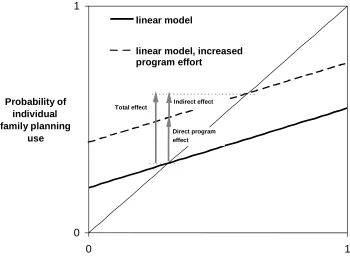
of other villagers who “heard a family planning message on the radio”). The slope of the solid line indicates how the probability of individual use changes when there is a discrepancy between the probability of an individual’s use and the average contraceptive use of other women in her village. It is important to note that the lines in Figure 1 specify the dependence of individual behavior on the family planning prevalence in the social environment of that individual. The figure therefore represents a micro-macro relation between individual and population behavior, and not an intertemporal relation. In particular, the linear model in Figure 1 is consistent with the typical S-shaped diffusion curve reflecting the increased adoption of an innovation over time in aggregate data [e.g., see Rogers 1995].
The linear model in Figure 1 exhibits only one equilibrium, the point at which each individual’s behavior mirrors the village average -- where the solid line intersects the 45o ray from the origin in Figure 1 [Note 3]. This equilibrium therefore satisfies P(y=1 | x, ye) = ye, where ye is the equilibrium level of contraceptive use. In linear models, this equilibrium level can be calculated
directly from the model parameters as ye=βx/(1-α) + (δ - .5α)/(1-α). If individuals prefer to behave
somewhat like others in their reference group (so that α is positive but less than one), this equilibrium is stable. To the left of it the individual probability of use is above the village average use; therefore the average village use increases because the individual is in the reference group for others in the village, which causes movement to the right towards the equilibrium (and vice versa to the right of the equilibrium).
What happens when there is an increase in program effort, for example a new media campaign? We depict this changed relation between the program and social interaction as a shift from the solid to the dashed line in Figure 1. The direct effect on the probability of the individual’s use of changing program efforts is the vertical distance indicated as the “direct program effect” in Figure 1 (the result of changing program effort by one unit while holding constant village average use). This direct program effect is not modulated by social interactions. If, however, the individual adjusts to her reference group, we get a social multiplier [Montgomery and Casterline 1993]. The social multiplier leads to a new and higher equilibrium level of contraceptive use, i.e., where the dashed line intersects the 45o ray. The total increase in the probability of contraceptive use is thus the total program effect, consisting of a direct program effect plus its multiplication by social interaction.
It is obvious that if one evaluates changes in family planning programs without taking the indirect effects of social interaction into account, the total effect provides an overestimate of the direct influence of program interventions. Whereas the direct effect is immediately linked to the intervention, the total effect results in addition from feedbacks in which initial program interventions are augmented through interaction. Formally, the total change in contraceptive use due to a unit
ML in the linear model, and this multiplier effect equals the ratio of the total program effect to the direct impact of the program. Since ML in the linear model exceeds one for 0 < α < 1, the total program effect is always larger than the direct effect of the program. Moreover, the social multiplier
has the same value for all levels of contraceptive use, and its value is greater the greater is α. That is, intensifying social interaction - in the sense of making the reference-group behavior more relevant
for a woman’s contraceptive decision by increasing the parameter α - increases the social multiplier effect. Formally, this positive effect of strengthening social interaction on the multiplier effect is seen
in the derivative ∂ML/∂α = 1/(1 - α)2 > 0. It is important to note that this increase of the social
multiplier due to more intensive interaction is independent of the sign of ∂P(y=1 | x, yc)/ ∂α, i.e.,
the effect of the change in α on the individual probability to use modern contraception.
While a fully dynamic model of social interaction is desirable [e.g., see Montgomery and Casterline 1998 or Montgomery and Zhao 1998 for simulation-based dynamic models of social interactions and fertility decisions], the distinction between direct and total effects provides a first approximation for interpretation of estimates within a dynamic framework. The direct effects of program changes can be interpreted to be short-term effects of program intervention, while the total effects incorporate the long-term implications that also include the eventual indirect consequences of family planning programs on knowledge about contraception and on norms of reproductive behavior.
A nonlinear model: We use the logistic form of a nonlinear model, a specification that is frequently used in theoretical models of social interactions [Brock and Durlauf 1995, Kohler 2000a,b, Manski 1993] and for empirical estimates [Arends-Kuenning 1997, Entwisle and Godley 1998, Kohler, Behrman, and Watkins 2001, Montgomery and Chung 1994, Munshi and Myaux 1997]. In addition, and importantly for our discussion below, this logistic model can be motivated from individual utility maximization [McFadden 1981]. While the standard motivation is individualistic--behavior depends only on individual characteristics (and prices)--we also include dependence of behavior on the social environment. In particular, we represent social interactions via a social utility term in which women experience disutility if their behavior deviates from the average level of contraceptive use in their reference group. This assumption captures our findings in the ethnographic interviews in the Kenya Diffusion and Ideational Change Project (KDICP) that in Nyanza, where family planning use was still quite low, there was substantial uncertainty about the appropriateness and the safety of modern methods [Rutenberg and Watkins 1997]. Alternatively, small families may be socially stigmatized if a large family norm is prevalent. Thus, we expect that increases in the prevalence of family planning in a village lead to a reduction in uncertainty about the consequences of small families and that these increases also make the use of family planning methods socially more acceptable.
the average reference group behavior yc. More specifically, we assume that the social utility term takes the form of a*(-.5 + yc), where .5 is the critical level above which the prevalence of contraceptive use in a woman’s village or reference group has a positive influence on the adoption of family planning, and a is the ‘strength’ or relevance of this social interaction effect. The standard derivation leads to the probability that a woman uses a modern method of family planning given by
P(y=1|x, yc) = F(a*(-.5 + yc) + b*x + d), {2}
where d is a constant including the effect of the individual characteristics and F is the cumulative logistic distribution.
The above model is interesting because with slight modifications it can capture two important processes that are frequently used to motivate the relevance of social interactions: social learning and social influence [Montgomery and Casterline 1993]. The former stresses that contraceptive adoption decisions are subject to substantial uncertainty, for example about the medical side effects of modern contraception and/or the benefits of choosing a smaller number of children. Learning about the experiences of other women through social interactions may reduce this uncertainty and thus change the probability that a woman adopts contraception or reduced fertility herself. The second aspect, social influence, emphasizes normative influences on behavior. Social influence captures the fact that preferences regarding modern contraception and/or the number of children are affected by the fertility-related opinions and behaviors that prevail in an individual's social environment. These two aspects can be incorporated in {2} by replacing the term .5 in the social
utility term with a more general critical level φ. Kohler et al. [2001] have shown that the above framework can then be used to empirically and theoretically distinguish between social learning and social influence based on data that include information about the structure of women’s social networks. If social influence is most relevant, then we expect φ to be relatively large since φ represents a critical level of contraceptive use among her network partners that needs to be exceeded before networks have a positive effect on the adoption of modern contraception. If social learning dominates, then φ is small because even a small proportion of users in a network can provide useful information about modern contraception that reduces the respondent's uncertainty about this innovation.
In the context of this paper, however, the critical level φ is only of secondary importance. In particular, we focus here on the strength of social interaction – as reflected in the parameter a – since this aspect is most relevant for the comparison between linear and nonlinear models and for the existence of multiple equilibria. In our analyses of model {2} we therefore assume that the critical level φ equals 0.5 because this level constitutes in our opinion a plausible specification and most data-sources will not allow the estimation of an alternative value.
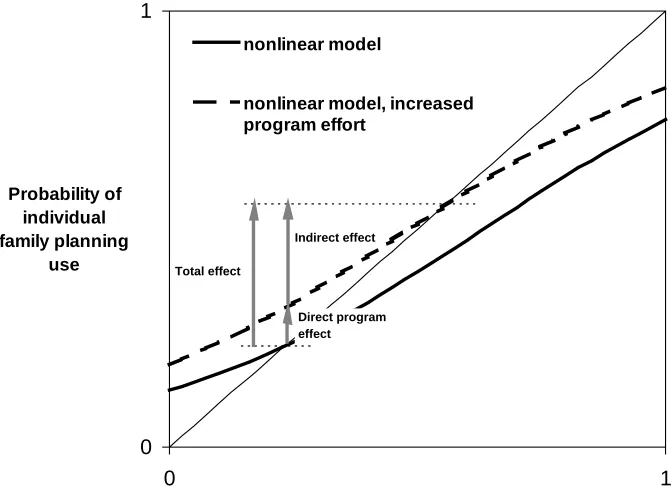
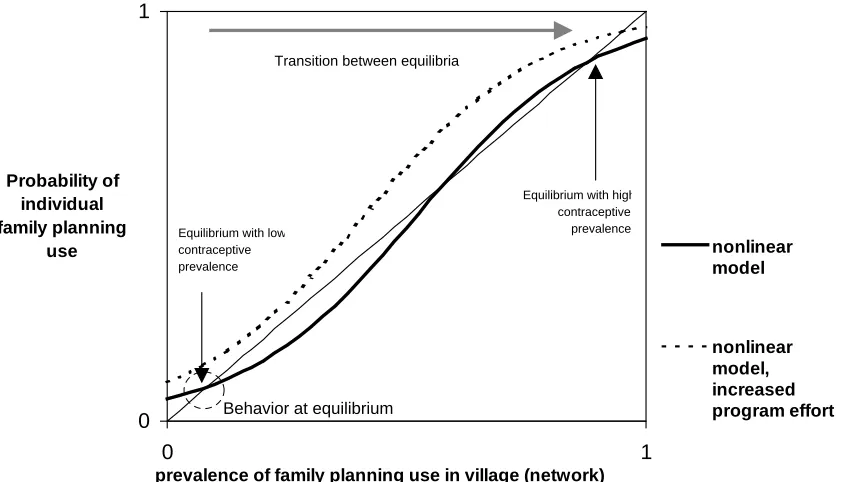
level of contraceptive use that satisfies P(y=1|x,ye ) = ye, or equivalently, an equilibrium is a fixed point at which ye = F(a*(-.5 + ye) + b*x + d). These equilibria are thus at intersections of the "s-shaped" curve F(.) with the diagonal.
The solid line in Figure 2 displays a case in which only one such equilibrium exists. The solid line in Figure 3, on the contrary, shows a case with three intersections. Multiple equilibria are a possibility, though not a necessity, with nonlinear models; they arise when the effect of social interaction (the social utility term in {2}) is sufficiently strong, or alternatively, if the coefficient a is sufficiently large (A necessary but not sufficient condition for the existence of multiple equilibria is that the largest derivative {2} with respect to yc exceeds one, which implies that a needs to be larger than four). The equilibria at low and high levels of contraceptive use are stable for reasons parallel to those discussed with regard to Figure 1. The same reasoning, however, indicates that the center equilibrium always is unstable. A population converges to one of the two stable equilibria depending on whether it is to the left or right of the unstable equilibrium.
The use of the logistic distribution F(.) in the nonlinear model {2} is convenient choice, but it is not essential for the implications of our model. The most important aspect of ‘nonlinearity,’ which is implied by the logistic function F(.) but also many other functional forms, is the convex-concave property, or the s-shape, of the curve in Figure 3. Multiple equilibria can arise if the functional form in model {2} exhibits a s-shape for sufficiently strong social interaction effects, i.e., for a sufficiently large value of a. Analytically less convenient, but otherwise very similar functional forms that can be used instead of the logistic function F(.) are the cumulative normal distribution or the arctan function (i.e., the inverse of the tangent function).
The above nonlinear model points to three relevant aspects of social interactions for program effects.
This effect of small changes in program efforts on the location of equilibria can be evaluated analytically. Assume that a population is currently at an equilibrium ye = ye(x,a,b,d) which satisfies
ye = F(a*(-.5+ ye) + b*x + d). The direct effect of changing the program effort x then equals ∂P(y=1|x,ye)/∂x = ∂F(.)/∂x = b*ye*(1-ye), where the equilibrium value ye is held constant when taking the derivative with respect to x. The total—or long term—program effect is measured by the shift in the equilibrium level caused by program efforts and thus equals ∂ye/∂x. Using the implicit function theorem we obtain ∂ye/∂x = b (ye*(1-ye))/ [1- a (ye*(1-ye))] = (1-a*ye*(1-ye))-1 *∂P(y=1|x,ye)/∂x, where ∂P(y=1|x,ye)/∂x is the direct program effect. Because at a stable equilibrium ∂F(.)/∂y y=ye =a*ye*(1-ye) < 1, the total program effect exceeds the direct effect at a
stable equilibrium. In particular, the ratio of the total to direct effect, or the social multiplier, equals 1/(1-a*ye*(1-ye)) and is larger than one.
Therefore, in the nonlinear case as well as in the linear case, the social multiplier effect implies that the total change in contraceptive use exceeds the direct program effect. Ignoring social interaction is therefore likely to lead to overestimates of direct program effects. Similarly, in the linear case the change in the equilibrium level of contraceptive use is maintained only if the change in program effort is permanent. But, in contrast to the linear model, in the nonlinear model the size of the social multiplier depends on the extent of average use in the reference group and the shape of the curves in Figures 2 and 3. If the curve is more sharply upwardly sloped around the initial equilibrium, for example, the social multiplier for a given increase in program effort is greater.
In the presence of these multiple equilibria, the onset of a fertility decline can constitute a coordination problem where a critical mass of fertility change can initiate a sustainable transition towards low fertility, and where expectations about future fertility levels are an important element in contemporary fertility decisions. Kohler [2000b] shows that in the context of such a coordination problem, social networks can be an important determinant of the onset and pace of fertility change in addition to program efforts and socioeconomic change. The specific effect depends on the structure and content of the interaction in social networks. In particular, ‘information networks’ that provide information about the fertility intentions of other members of the village or reference groups have little effect on a population’s ability to achieve a fertility decline as long as there is a stable high fertility equilibrium that inhibits the adoption of low fertility. However, if the population is out of equilibrium, for example, due to recent program efforts or socioeconomic changes, then information networks increase the speed of a change in fertility behavior that is already taking place. If social interaction is in the form of ‘coordination networks,’ i.e., if the ties among individuals in a group are sufficiently strong to allow collective action among individuals, then social interactions can lead to an earlier onset and a faster pace of a fertility transition.
Social interactions therefore have a twofold implications for the dynamics of fertility change. First, if social effects are sufficiently strong and if the nonlinear model {2} describes a woman’s decision to adopt family planning or low fertility, then the presence of social interaction can lead to multiple equilibria with a Malthusian ‘high fertility trap’ and sustainable fertility decline that results from temporary interventions by family planning. Second, social interactions not can not only lead to these multiple equilibria, but also be an important determinant – in addition to program efforts and socioeconomic change – of whether a population can ‘escape’ the high fertility equilibrium and initiate a sustainable transition to the low fertility equilibrium.
Third, the intensification of social interaction may have a negative effect on the size of the social multiplier; thus, intensified social interaction can lead to a reduction in the total change in contraceptive use that results from family planning programs. We define the intensification of social
LQWHUDFWLRQDVDQLQFUHDVHRIWKHSDUDPHWHU RUa in relations {1} or {2}, which implies a greater
can make it more difficult for program interventions to achieve a given amount of total—or long term—change in contraceptive use. We denote the fact that more intensive social interaction, i.e.,
DKLJKHUYDOXHRI RUa in relations {1} or {2}, decreases the social multiplier effects as status-quo enforcement.
This result points to an important and intuitive, but in the literature on modeling social interactions and fertility not sufficiently emphasized and elaborated point [e.g., Bongaarts and Watkins 1996, Montgomery and Casterline 1993, Montgomery and Casterline 1996]. There are situations in which there are stable equilibria with positive but not universal contraceptive use in which social interactions are status-quo enforcing. For instance, the discomfort of deviating from a high-fertility social norm may increase the more a woman interacts with others in her village who behave according to the high-fertility norm. Increasing the strength of social interactions then tends to increase the disutility of a small family, and it can reduce the total behavioral change that results from program efforts. In such cases, social interactions are status-quo enforcing: the more intensive is social interaction, the more the multiplier effect of family planning programs decreases.
If there is only one equilibrium, then social interaction can be-- but need not be-- status-quo enforcing. On the other hand, if there are multiple equilibria then social interaction is always status-quo enforcing (see note 5 for the formal derivation of this property). Most importantly, therefore, an intensified social interaction at a Malthusian high fertility equilibrium reduces the multiplier effect of increased family planning efforts at this equilibrium and therefore makes it more difficult for program efforts and other socioeconomic changes to increase the level of contraceptive use in a population that is at such a high fertility equilibrium.
It is important to keep in mind that this status-quo enforcement of social interaction is a "local" property that reflects changes in the social multiplier due to small changes in program effort x in the neighborhood of a stable equilibrium ye. It does not affect the implication discussed above that transitory large changes in x can induce a transition from a high-fertility to a low-fertility equilibrium in cases with multiple equilibria. Moreover, status-quo enforcement in our definition depends only on the social multiplier effect, i.e., the ratio of total to direct changes in family planning use caused by program efforts. It is not necessarily associated with a specific level of contraceptive use. Status-quo enforcement thus characterizes situations where more intensive social interaction makes it more difficult for program efforts to change the level of contraceptive use in a population.
3. Data and Context of Empirical Estimation
Program efforts began in Kenya in the late 1950s in urban areas, and were expanded after President Kenyatta’s government adopted a family planning policy in 1967. Support for the program was quite modest, however, until Moi became president in 1978. Moi’s public support of efforts to reduce population growth rates may have acted as a “shock” to the system, legitimizing family planning and permitting much greater donor activity [Robinson 1992]. Family planning messages were regularly distributed over the radio and through posters and routine family planning talks in the clinics, and by the early 1990s family planning was widely accessible in local clinics in rural areas. The methods and messages are widely and frequently discussed in informal conversations, which thus may multiply program efforts. The overall picture from our household surveys as well as from qualitative data is of conversations about family planning that occur frequently and casually [Rutenberg and Watkins 1997, Watkins and Warriner 1999]. Because transportation is limited and expensive and telephones very few, frequent interaction is largely restricted to members of the local community. For our empirical illustrations of how the estimation of program effects is affected by incorporating the social interaction, we use the Kenya Diffusion and Ideational Change Project (KDICP) of Watkins and colleagues and the Kenya Demographic and Health Survey (KDHS 1989 and 1993). Using two data sets permits us to evaluate whether our results hold across time and across data sets, and across different measures of social interaction based on cluster (village) aggregates and reported social networks. In addition, the KDHS data have the advantage of being similar to data that are widely available, so others can replicate our analysis in other settings. The KDICP data were collected in South Nyanza District (subsequently subdivided and renamed) in Nyanza Province, a predominantly rural area. To maximize comparability with the KDICP data, we restrict the KDHS to Nyanza Province. The characteristics of rural Nyanza Province are quite similar to those of South Nyanza District [Ayiemba 1986, Blount 1972, Ndisi 1974, Ocholla Ayayo 1976, Olenja 1991, Reynar 2000] and the KDICP and the KDHS for Nyanza give similar results for a variety of measures. (In preliminary analysis we further restricted the KDHS to rural South Nyanza, but this reduced the sample size substantially)
program and a limited range of basic demographic information. Even though the overlap of comparable variables between these data sets is limited, it includes enough of the standard variables for analysis of contraceptive use to make the comparisons that we present in Section 4 of interest. Because the KDICP 1994 data were gathered only one year after the KDHS 1993 data, there are not likely to be large differences between these two data sets due to events associated with the passage of time.
In the analyses in this paper, the unit in which social interaction is assumed primarily to take place is the sample cluster in the KDHS and the village in the KDICP. The KDHS clusters correspond to larger geographical units than the KDICP villages, and thus are likely to approximate less well than villages the area of local social interactions. Thus, from the point of view of each respondent’s local social interactions, a cluster average is likely to be a noisy indicator of the average for the respondent’s (smaller) village. This means that the coefficient estimates of the cluster averages are likely to be biased towards zero in comparison with the coefficient estimates that would have been obtained were village averages available from the DHS; the bias is smaller in clusters that have villages with similar family planning use rates than clusters in which villages have different family planning use rates. In the absence of data on both, however, it is not possible to know how large these biases are.
By comparing the estimates based on village aggregates with those that use individual-level social network data in the KDICP, we are able to assess the extent to which these aggregate measures of social interaction lead to different results than the individual-level information on the interaction about family planning with members of the respondent’s social network.
We restrict the analyses in this paper to currently married women respondents, whether or not their husband was present, to avoid complications related to absent husbands (27.4% of the husbands were not present at the time of the first wave of the KDICP, most of them because they were working elsewhere), which are unimportant for the purposes of this paper. Moreover, there is evidence from the KDICP data and elsewhere that in fact women may be the final arbiters of contraceptive use, at least in part because the availability of modern methods permits them to use family planning without their husband’s agreement [Bawah et al. 1999, Biddlecom and Fapohunda 1998, Pictet and Ouedraogo 1999, Reynar 1998, Reynar 2000, Watkins, Rutenberg and Wilkinson 1997].
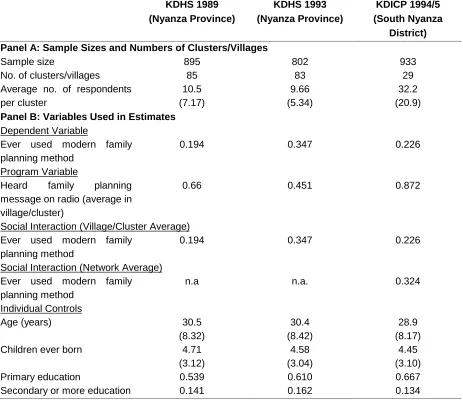
Table 1 gives basic sample characteristics and variable means for the variables used in this paper. Panel A gives the total number of respondents, the number of clusters/villages, and the average number of respondents in each cluster/village. Panel B summarizes the distributions of the main variables in the samples used for our estimates.
1993 KDHS than for the KDICP, which may be due to the fact that the former is based on a larger geographic area (Nyanza Province instead of South Nyanza District) [Note 6].
4. Estimates and Interpretation
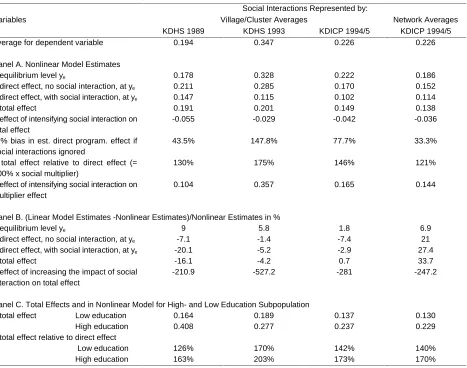
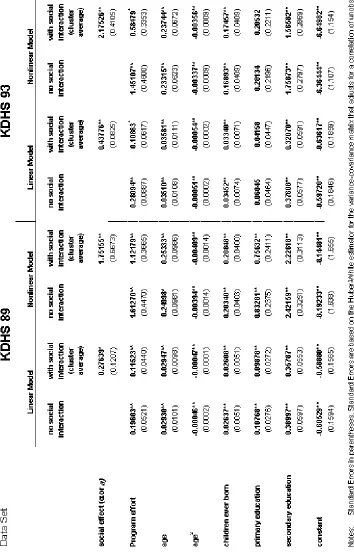
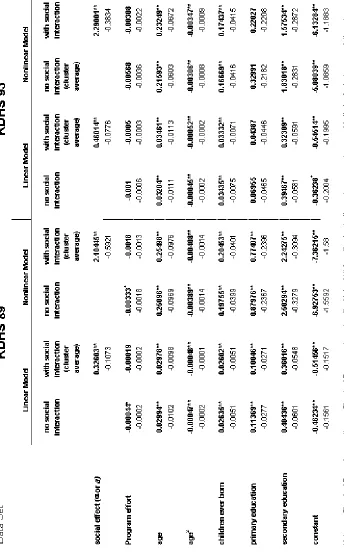
Table 2 summarizes the pertinent implications of the estimates (fully presented in the appendix) for the basic nonlinear estimates in Panel A and for the comparison between the nonlinear and the linear estimates in Panel B. The theoretical derivation in Section 2 assumes that the population is homogeneous. This assumption is relaxed for the empirical implementation. Initially we therefore calculate individual-level direct and total effects for each woman in the sample, assuming she interacts with a population having a distribution of characteristics as do the remaining women in the sample. We then average over these individual-level effects and obtain the (overall) direct and total effects. These (overall) direct and total effects are reported in Tables 2. They measure the average direct and total increases in the probability of ever using family planning for all women in the sample resulting from a small increase in program effort x. The specific equations to calculate these effects are extensions of the respective equations in Section 2 and are reported in the Appendix.
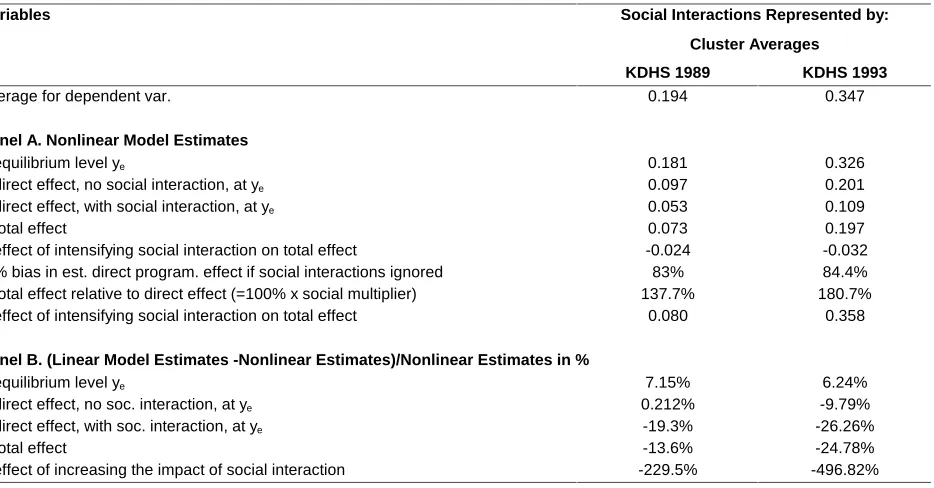
The first three columns in Table 2 gives the results for the KDHS 1989, KDHS 1993, and KDICP 1994/5 data sets on the basis of cluster (village) based measures of interaction. The last column reports the results for the KDICP 1994/5 data using reported networks. For each of the two dependent variables there are eight sets of estimates – one for the nonlinear logistic model and one for the linear probability model for each of the four columns. In tables A2 and A3 in the appendix we additionally provide the corresponding results that are obtained from an alternative measure of family planning effort based on the distance to the nearest family planning clinic (KDHS 1989 and 1993 only).
Multiple equilibria: We first consider whether the estimates for the logistic model imply that there is more than one stable equilibrium after the effects of a family planning innovation have worked their way through the population, an interesting possibility with policy implications that we discussed above. We find that in these data there is only one equilibrium level of ever used family planning [Note 8]. Our estimates thus imply that Nyanza is not stuck in a low-level Malthusian equilibrium with another high contraceptive use stable equilibrium that is attainable if there were a large enough program effort. This, then, suggests that a large but transitory program effort would not have the effect of shifting women in this province rapidly to a sustainable high-contraceptive-use and low-fertility equilibrium. Persistent changes in program effort are necessary to affect the equilibrium and therefore long-term levels of contraceptive use and desires to stop childbearing.
estimated equilibrium levels for the linear model are slightly higher (row B1) and are basically at the sample means.
Direct program effects, without and with social interactions: The estimated direct effects from a marginal increase in program effort are given both for a specification with no social interactions and a specification with social interactions (rows A2 and A3). All the estimates indicate that the failure to include social interactions would result in substantial upward biases in the estimated direct program effects. These overestimates are considerable – in the nonlinear models by from 33 to 148% for the effect of how program efforts change the level of ever used family planning (row A6). The linear model produces estimates of direct program effects that are higher than the nonlinear model in the KDICP data, but lower than the nonlinear model in the KDHS data (rows B2 and B3). Moreover, the direct effect with and without social interaction for the KDICP data differ relatively little depending on whether village averages or network averages are used to measure social interaction, although the bias caused by ignoring social interactions in the direct program effect is lower when individual-level measures of social interaction are used.
Total program effects with social interactions: The total program effects with social interactions in the nonlinear model have a marginal effect on the probability of having ever used family planning in the range of 0.14 to 0.20 (row A4). These estimates imply that social interactions amplify the direct program effects on the propensity to ever use family planning considerably, ranging from 21 to 75% (row A7). The estimates for the total program effort in the KDICP data differ relatively little between the two measures of social interaction, while the social network-based estimates yield the lower social multiplier. Similar to our estimates of direct program effects, the linear model estimates of the total program effect are less than the nonlinear model estimates for the KDHS data (by -4.2 to -16.1%), but tend to be greater for the KDICP (with a range from 0.7 to 33.7%, row B4).
In the linear model, the total program effect does not depend on individual characteristics. In the nonlinear model, however, subpopulations with different levels of contraceptive use can be subject to different multiplier effects and also total effects. Since the education level is a significant determinant of having used family planning, we provide in Panel C of Table 2 the total effect separately for women with low and high education. The results clearly demonstrate that both the total effect and the social multiplier are higher–sometimes substantially so-- for the high education subpopulation with a higher overall propensity of ever using family planning.
5. Conclusions
This paper is motivated by the increasing attention that has been given by demographic analysts and family planning program supporters to the possible roles of social interactions in the diffusion of knowledge, attitudes and behaviors related to family planning. The few previous empirical studies of this topic suggest that if social interactions are important, their omission from empirical models is likely to result in distorted estimates of the direct effects of family planning programs. Our analysis adds to this literature by showing that there are some important implications of using nonlinear models for measuring program effects and for evaluating the roles of social interaction that have not been explicitly considered in the previous empirical literature. We demonstrate some of these properties formally, and investigate them empirically using data that includes measures of social interactions. We find that for Nyanza, Kenya, the nonlinear versus the linear specifications indeed lead to different substantive results with different implications for demographic analysts and program supporters.
First, we distinguish between the direct effects of a family planning program on an
individual’s probability of using family planning and the indirect effects due to social interaction. Our empirical estimates show that the nonlinear model of the relations among program effects, social interaction and of modern family planning leads to some fairly large differences in the estimates of program effects from those obtained with the linear model – e.g., with estimated direct program effects on the ever use of family planning from 20% lower to 27% higher for the linear than the nonlinear model. We then show empirically that in our data as much as 43% of total program effects are due to social interaction [Note 9]. This social multiplier effect, as it has been named by Montgomery and Casterline [1993], is due to a feedback loop that occurs because social interaction renders the family decisions of community members interdependent. Because of this social multiplier effect, attributing all of the total change in contraceptive behavior to a direct impact of changes in program effort is a substantial overestimate of the direct program effect.
In addition, the linear specification assumes that the total program effect and the social multiplier are identical across subpopulations with different levels of contraceptive use. This need not be the case in the nonlinear model, and our results show important differences in these effects between the women with low and high education: social interaction leads to substantially larger multiplier effects in the high education subpopulation with a higher overall propensity of using family planning.
Second, we show formally that if the model is nonlinear, there may be both a low-level
relatively small effects. However, large increases in program efforts – even if transitory – may cause a shift to a high-contraceptive-use and low-fertility equilibrium. In a linear model, in contrast, large program efforts can lead to high contraceptive use, but the program efforts must be maintained at high levels to sustain high contraceptive use. Our empirical analysis does not indicate the presence of multiple equilibria in our data. Thus, these estimates suggest that there is little likelihood that a sharp transitory increase in program activities in Nyanza would lead to a rapid shift to much higher sustained levels of contraceptive use. But such possibilities may exist in other contexts.
Third, we show formally that intensified social interactions may either increase or decrease the
total effect and social multiplier effect resulting from family planning program efforts, and ‘more’ social interaction can thus reinforce or retard the diffusion of an innovation. When a nonlinear (logistic) model is used, increasing the impact of social interactions is status quo reinforcing close to a stable equilibria (whether at low or high contraceptive use) in a multiple-equilibria situation. Therefore, if a new program effort were to intensify social interactions near the stable equilibria, the total—or long-term—change in contraceptive use resulting from the program effort is reduced and these more intensive social interactions would retard the diffusion of family planning after the program interventions. Our nonlinear empirical estimates for S. Nyanza District imply that when social interactions are intensified, they reduce the total effect associated with program interventions, but slightly increase the social multiplier effect. These findings are in contrast to the linear estimates that imply that more intense social interaction leads to a larger social multiplier effect and an increased total effect after the program interventions.
Acknowledgment
Appendix: Calculation of direct and total effect in heterogeneous populations
The calculations of the direct and total effect reported in Table 2 assume that a woman interacts with a population having a distribution of characteristics as do the remaining women in the sample and that the program effort in the population equals the average program effort in the sample. Based on this assumption we first calculate the equilibrium level, and the individual-level direct and total effects for each woman in the sample. We then average over these individual-level effects and obtain the (overall) direct and total effects that are reported in Table 2. In this appendix we provide the specific equations that are used for these calculations.
Denote as zi the individual characteristic of women i = 1, ..., N in the sample, where N is the sample size. Moreover, denote x as the average program effort in the sample, i.e., the proportion of women in the sample who have heard a family planning message on the radio. Denote as xi the specific program effect for women i, which in our estimations equals the proportion of family planning user’s in woman i’s village of residence.
Linear model: The parameters αˆ, βˆ and ˆδ re the coefficients from estimating relation {1}
via a linear regression of woman i’s contraceptive use on the proportion of contraceptive users in woman i’s village/reference group, the program effort xi in the woman’s village of residence, and
the individual characteristics zi (i.e., the regression subsumes term -.5α in {1} into the constant
term). The equilibrium level ye is then calculated as ye =βˆ/(1− ⋅ +αˆ) x δˆzi/(1−αˆ). The direct and
total effect of changes in program effort is given respectively by βˆ and βˆ/(1−αˆ) and in the linear
model neither effect depends on the level or distribution of the individual characteristics zi in the data.
Nonlinear model: The parameter aˆ, ˆb and ˆd are the coefficients from the estimation of
relation {2} via a logistic regression of woman i’s contraceptive use on the proportion of contraceptive users in woman i’s village/reference group, the program effort xi in the woman’s village of residence, and the individual characteristics zi (i.e., the logistic regression again subsumes the term -.5α in {2} into the constant term). The equilibrium level is then calculated iteratively and
solves 1
1
ˆ ˆ
ˆ
( )
N
e i e i
y N− F ay bx dz
=
=
∑
+ + , that is, the equilibrium level equals the average probabilitythat women in the sample use family planning, given that they interact with a reference group with a prevalence of ye. This definition of the equilibrium level is analogous to the definition of the equilibrium level in homogeneous populations after equation {2} above. The direct effect in Table 2 is then obtained as the average of the individual direct effects
ˆ (ˆ ˆ ˆ )(1 (ˆ ˆ ˆ ))
e i e i
bF ay +bx+dz −F ay +bx+dz , and the total effect is calculated as the average of the
individual-level total effects
(
)
1 1
ˆ [ (ˆ ˆ ˆ )(1 (ˆ ˆ ˆ ))] ˆ
e i e i
Notes
1. In this paper we use the terms family planning, modern methods and contraception interchangeably to mean the methods promoted by family planning programs. These methods are distributed primarily through health services (clinics, hospitals) such as the pill, the injection and tubal ligation, as well as condoms.
2. If part of the previous program effort involved public subsidization of contraceptives, the elimination of these subsidies might increase the price of contraceptives, which in turn could induce some reduction in use from what use would have been in the absence of this increase. If this increase were small enough, it would cause a small downward movement in the same equilibrium. If it were large enough, it could cause a nonlocal movement to a lower equilibrium.
3. For this equilibrium to be in the [0,1] interval places constraints on the parameters in relation {1}, though if it were not the corner solution of 0 or 1 would prevail. We also note that an interior equilibrium value may seem peculiar in the sense that we have assumed identical individuals for this discussion, so in equilibrium all would seem to be either nonusers or users, not some mixture. Empirical estimates, from this perspective, combine different groups of individuals so that on the average the probability of use may be between 0 and 1. Alternatively, the equilibrium can be defined to be the point at which the probability of adoption of each individual (not whether they actually adopt or not) is identical (though this probability may be between 0 and 1 so that some but not everyone adopts at a point of time with stochastic differences determining who actually does and does not adopt).
4. :LWKLQWKHOLQHDUPRGHODERYHWKHUHPD\EHVWDWXVTXRUHLQIRUFHPHQWLI EXWRQO\IRUFRUQHU solutions, not stable interior solutions. For interior solutions, increasing the impact of social
LQWHUDFWLRQVLQWKHVHQVHRILQFUHDVLQJ³ ´LQUHODWLRQXQDPELJXRXVO\LQFUHDVHVWKHVRFLDO
multiplier.
0. In all situations with multiple equilibria, therefore, intensifying social interaction reduces the social multiplier effect and ‘more’ social interaction is therefore not desirable from the standpoint of program effectiveness because they retard rather then reinforce the changes introduced by programs. The effect of intensifying social interaction on the total program effect can be analyzed similarly by taking the derivative ∂2(ye)/∂x∂a, and the sign of this derivative is also ambiguous. Similar to the effect of intensified social interaction on the multiplier effect, the total effect also decreases with ‘more’ social interaction at each stable equilibrium in a multiple-equilibria situation.
6. The transitions between the equilibria in our theoretical model are reversible, i.e., there can be a transition from the low to high contraceptive use equilibrium and also vice versa. The proportion of women who have ever used contraception in a population, however, cannot decline. Since S. Nyanza District is still at early stages in the fertility decline and has never experienced a high level of contraceptive use, only the former transition is empirically relevant. This transition from low to high contraceptive use can be measured with both dependent variables "ever used contraception" and "currently using contraception". We believe that the former provides a better measure for the adoption of modern family planning and we subsequently use it in our empirical analyses. The reverse transition from high to low levels of contraceptive use, which cannot be measured with a dependent variable like "ever use", is not empirically relevant in the present context.
7. Note that this variable is not confounded by the well-known problem of selective recall (i.e. that the respondent who is more disposed to using contraception is more likely than average in her community to recall hearing a family planning message on the radio) because the variable is constructed so that the respondent’s response is not included in the measure used for that respondent.
8. That is, in none of the estimated models that underlie Table 2 do the estimates for the parameter a exceeded the critical level a > 4 which is necessary in order to have multiple equilibria [Table A1].
9. That is, if the social multiplier is 175%, the proportion of the total effect due to social interaction is 75/175.
References
Arends-Kuenning, M. “How Do Family Planning Worker Visits Affect Women’s Behavior in Bangladesh?” 1997, New York: Population Council, mimeo.
Ayiemba, E. H. O. “Demographic Patterns”. In: Gideon S. Were, Ben E.. Kipkorir, Elias O. editors.
South Nyanza District Socio-Cultural Profile. 1986, Nairobi. The Ministry of Planning and
National Development and The Institute of African Studies, University of Nairobi, pp.112-30 Bawah, Ayaga Agula, Patricia A., Ruth S., Phillips, J. F. “Women’s Fears and Men’s Anxieties: The Impact of Family Planning on Gender Relations in Northern Ghana.”. Studies in Family
Planning , 1999, 30(1):54-66.
Becker, Gary S., Murphy Kevin M., Tamura, R. “Human Capital, Fertility, and Economic Growth”.
Journal of Political Economy, 1990, 98(5) (part 2): 12-37.
Biddlecom, Ann E., Fapohunda, B. M. “Covert Contraceptive Use: Prevalence, Motivations, and Consequences.” Paper presented at the annual meeting of the Population Association of America,1998, April 2-4, Chicago, IL.
Bongaarts, John and Watkins, Susan C. “Social Interactions and Contemporary Fertility Transitions.” Population and Development Review, 1996, 22(4):639-682.
Blount, Ben G. “The Luo of South Nyanza, Western Kenya.” In: Molnos Angela Ed. Cultural Source
Materials for Population Planning in East Africa. Vol 2,"Innovations and Communication".
1972. Nairobi: East Africa Publishing House : 275-80
Brock, William A., Durlauf, S. N. Discrete Choice with Social Interactions, Part I: Theory. National Bureau of Economic Research Working Paper #5291, 1995.
Crook, Nigel R. “On Social Norms and Fertility Decline.” Journal of Development Studies, 1978, 14(4):198-210.
DeClerque, J., Tsui, Amy Ong, Abul-Ata, M. F., Barcelona, D. “Rumor, Misinformation and Oral Contraceptive Use in Egypt.” Social Science Medicine, 1986, 23(1):83-92
Entwisle, B., Godley, J. “Village Networks and Patterns of Contraceptive Choice,” Paper presented at a meeting of the Population Committee of the National Academy of Sciences, 1998, January 29-30,. Washington, D.C. Forthcoming in the conference volume.
Forthingham, Nathaniel. Report to the Pathfinder Fund on Population Concerns and Family Planning in Africa South of the Sahara. 1968 January.
Galor, O., Weil, D. N. “The Gender Gap, Fertility and Growth”. American Economic Review, 1996, 86(3) : 374-387.
Granovetter, Mark S. “The Strength of Weak Ties.” American Journal of Sociology, 1973, 73(6):1361-1380.
Katz, E., Lazarsfeld, P. F. Personal Influence: The Part Played by People in the Flow of Mass
KDHS: Kenya National Council for Population and Development, Kenya Central Bureau of Statistics, and Macro International Inc., 1994, Kenya Demographic and Health Survey 1993. Nairobi, Kenya and Calverton, Maryland
Kenya: Central Bureau of Statistics, Ministry of Economic Planning and Development.. Kenya
Fertility Survey 1977-78, First Report, Vol. 2. 1980. Nairobi, Kenya: World Fertility Survey
Programme
Kohler, Hans-Peter. “Learning in Social Networks and Contraceptive Choice”. Demography, 1997 34(3): 369-383.
Kohler, Hans-Peter. “Social Interaction and Fluctuations in Birth Rates”. Population Studies, 2000a, forthcoming
Kohler, Hans-Peter. “Fertility Decline as a Coordination Problem”. Journal of Development
Economics, 2000b, forthcoming.
Kohler, H.-P., Behrman, Jere R., Watkins, Susan C. “The Density of Social Networks and Fertility Decisions: Evidence from S. Nyanza District, Kenya.” Demography ,2001,forthcoming. Manski, Charles F. “Identification of Endogenous Effects: The Reflection Problem.”. Review of
Economic Studies, 1993, 60: 531-542.
Marsden, P., Friedkin, N. “Network Studies of Social Influence”. Sociological Methods and
Research, 1993, 22.
McFadden, Daniel L. “Econometric Models of Probabilistic Choice.” In: Manski, Charles F., McFadden, Daniel L. Structural Analysis of Discrete Data with Econometric Application. 1981. Cambridge: MIT Press.
Montgomery, Mark R., Casterline, John B. “Social Influence, Social Learning and New Models of Fertility.” Population and Development Review, 1996, 22:151
Montgomery, Mark R., Casterline, John B.. “The Diffusion of Fertility Control in Taiwan: Evidence from Pooled Cross-Section, Time-Series Models.” Population Studies, 1993, 47(3): 457-479. Montgomery, Mark R. and Casterline, John B.. Social networks and the diffusion of fertility control.
Population Council, Policy Research Division, Working Papers, 1998 No.119 .
Montgomery, Mark R., Chung, Woojin. “Social Networks and the Diffusion of Fertility Control: The Korean Case ”. In: Leete, R. ed., Values and Fertility Change. 1994, Oxford: Oxford University Press.
Montgomery, Mark R., Zhao, J. Social Learning and Networks in the Diffusion of Fertility Control. Paper presented at the Annual Meeting of the Population Association of America, 1998. April 2-4, Chicago, Il.
Munshi, K., Myaux, J. “Social Effects in the Demographic Transition: Evidence from Matlab, Bangladesh”. 1997, Boston: Boston University, mimeo.
Ocholla Ayayo, A. B. C. Traditional Ideology and Ethics Among the Southern Luo. 1976, Uppsala: Scandinavian Institute of African Studies.
Olenja, Joyce M. “Women and Health Care in Siaya District”. In: Collette A. S. a. J. M. O. Gideon S. Were, editors. Women and Development in Kenya: Siaya District. 1991, Nairobi: Institute of African Studies: 44-69.
Pictet, G., Ouedraogo, C. “Let’s Talk About It: Married Couples and Fertility Decisions in Rural Burkina Faso”. Paper presented at the annual meeting of the Population Association of America, New York, 1999, March 25-27.
Reynar, A. “He Says, She Says, Who Gets Their Way? Marital Dynamics and Fertility in Kenya.” Paper presented at the annual meeting of the Population Association of America, 1998, April 1-3, Chicago, IL.
Reynar, A. G. Fertility Decision Making by Couples Amongst the Luo of Kenya. PhD Dissertation, Graduate Group in Demogaphy, University of Pennsylvania.2000
Robinson, Warren C. “Kenya Enters the Fertility Transition.” Population Studies, 1992, 46: 445-457 Rutenberg, N., Watkins, S.C. “The Buzz Outside the Clinics: Conversations and Contraception in
Nyanza Province, Kenya.” Studies in Family Planning, 1997, 28(4): 290-307. Rogers, Everett M. Diffusion of Innovations. 1995, New York: Free Press.
Watkins, S. C. “Local and Foreign Models of Reproduction in Nyanza Province, Kenya.” Population
and Development Review, 26(4), forthcoming.
Watkins, Susan C., Rutenberg, N., Green, S. “Diffusion and Debate: Reproductive Change in Nyanza Province, Kenya”. 1995, Philadelphia, PA: University of Pennsylvania, mimeo. Watkins, Susan C., Rutenberg, N., Wilkinson, D. “Orderly Theories, Disorderly Women”. In:. Jones,
G. W., Douglas, R. M., Caldwell, J.C., D’Souza, R. M. The Continuing Demographic
Transition. 1997, Oxford, Clarendon Press, pp. 213-245.
Table 1:
Basic Sample Characteristics and Variable Meansa
KDHS 1989 (Nyanza Province) KDHS 1993 (Nyanza Province) KDICP 1994/5 (South Nyanza District) Panel A: Sample Sizes and Numbers of Clusters/Villages
Sample size 895 802 933
No. of clusters/villages 85 83 29
Average no. of respondents per cluster 10.5 (7.17) 9.66 (5.34) 32.2 (20.9)
Panel B: Variables Used in Estimates
Dependent Variable
Ever used modern family planning method
0.194 0.347 0.226
Program Variable
Heard family planning message on radio (average in village/cluster)
0.66 0.451 0.872
Social Interaction (Village/Cluster Average) Ever used modern family
planning method
0.194 0.347 0.226
Social Interaction (Network Average) Ever used modern family planning method
n.a n.a. 0.324
Individual Controls
Age (years) 30.5
(8.32)
30.4 (8.42)
28.9 (8.17)
Children ever born 4.71
(3.12)
4.58 (3.04)
4.45 (3.10)
Primary education 0.539 0.610 0.667
Secondary or more education 0.141 0.162 0.134
Table 2:
Summary of Nonlinear Estimates and Comparisons Between Linear and Nonlinear Models for Ever Used Family Planning
Social Interactions Represented by:
Village/Cluster Averages Network Averages
Variables
KDHS 1989 KDHS 1993 KDICP 1994/5 KDICP 1994/5
average for dependent variable 0.194 0.347 0.226 0.226
Panel A. Nonlinear Model Estimates
1 equilibrium level ye 0.178 0.328 0.222 0.186
2 direct effect, no social interaction, at ye 0.211 0.285 0.170 0.152
3 direct effect, with social interaction, at ye 0.147 0.115 0.102 0.114
4 total effect 0.191 0.201 0.149 0.138
5 effect of intensifying social interaction on total effect
-0.055 -0.029 -0.042 -0.036
6 % bias in est. direct program. effect if social interactions ignored
43.5% 147.8% 77.7% 33.3%
7 total effect relative to direct effect (= 100% x social multiplier)
130% 175% 146% 121%
8 effect of intensifying social interaction on multiplier effect
0.104 0.357 0.165 0.144
Panel B. (Linear Model Estimates -Nonlinear Estimates)/Nonlinear Estimates in %
1 equilibrium level ye 9 5.8 1.8 6.9
2 direct effect, no social interaction, at ye -7.1 -1.4 -7.4 21
3 direct effect, with social interaction, at ye -20.1 -5.2 -2.9 27.4
4 total effect -16.1 -4.2 0.7 33.7
5 effect of increasing the impact of social interaction on total effect
-210.9 -527.2 -281 -247.2
Panel C. Total Effects and in Nonlinear Model for High- and Low Education Subpopulation 1 total effect Low education
High education 0.164 0.408 0.189 0.277 0.137 0.237 0.130 0.229 2 total effect relative to direct effect
Table A2 - Panel 1:
Table A3 - Panel 1:
Summary of Nonlinear Estimates and Comparisons Between Linear and Nonlinear Models for Ever Used Family Planning — Program effort is “distance to family planning clinic”
Social Interactions Represented by:
Cluster Averages Variables
KDHS 1989 KDHS 1993
average for dependent var. 0.194 0.347
Panel A. Nonlinear Model Estimates
1 equilibrium level ye 0.181 0.326
2 direct effect, no social interaction, at ye 0.097 0.201
3 direct effect, with social interaction, at ye 0.053 0.109
4 total effect 0.073 0.197
5 effect of intensifying social interaction on total effect -0.024 -0.032
6 % bias in est. direct program. effect if social interactions ignored 83% 84.4%
7 total effect relative to direct effect (=100% x social multiplier) 137.7% 180.7%
8 effect of intensifying social interaction on total effect 0.080 0.358
Panel B. (Linear Model Estimates -Nonlinear Estimates)/Nonlinear Estimates in %
1 equilibrium level ye 7.15% 6.24%
2 direct effect, no soc. interaction, at ye 0.212% -9.79%
3 direct effect, with soc. interaction, at ye -19.3% -26.26%
4 total effect -13.6% -24.78%
Figure 1:
Linear Model with Social Interaction.
0 1
0 1
prevalence of family planning use in village (network) Probability of
individual family planning
use
linear model
linear model, increased program effort
Indirect effect
Figure 2:
Nonlinear Model with Social Interaction, Single Equilibrium.
0 1
0 1
prevalence of family planning use in village (network) Probability of
individual family planning
use
nonlinear model
nonlinear model, increased program effort
Indirect effect
Figure 3:
Nonlinear Model with Social Interaction, Multiple Equilibria.
0 1
0 1
prevalence of family planning use in village (network) Probability of
individual family planning
use nonlinear
model
nonlinear model, increased program effort
Behavior at equilibrium
Transition between equilibria
Equilibrium with low contraceptive prevalence