1
Experimental analysis on bituminous concrete
mix roads under the uses of dissipation poly
(Methylene)
Naveen
1, Pardeep
2 1M. Tech. Student, Department of Civil Engineering, Sat Priya Group of Institutions, Rohtak, Haryana 2
Asst. Professor, Department of Civil Engineering, Sat Priya Group of Institutions, Rohtak, Haryana
ABSTRACT
Bituminous Concrete (BC) is a composite material mostly used in construction projects like road surfacing, airports, parking lots etc. It consists of bitumen (used as a binder) or asphalt and mineral aggregate which are mixed together & laid down in layers then compacted. Over the last few decades increasing awareness of human being about environment protection and preservation guides some new techniques. Now a days, the steady increment in high traffic intensity in terms of commercial vehicles, and the significant variation in daily and seasonal temperature put us in a demanding situation to think of some alternatives for the improvisation of the pavement characteristics and quality by applying some necessary modifications which shall satisfy both the strength as well as economical aspects.
Key words: Bituminous Concrete (BC), Marshall Stability, Flow value, Optimum Polythene Content
INTRODUCTION
Bituminous binders are widely used by paving industry. A pavement has different layers. The main constituents of bituminous concrete (BC) are aggregate and bitumen. Generally, all the hard surfaced pavement types are categorized into 2 groups, i.e. flexible and rigid.
i.Flexible Pavement:
It can be defined as the one consisting of a mixture of bituminous material and aggregates placed on a bed of compacted granular material then it is called "flexible" since the total pavement structure can bend or deflect due to traffic loads.
ii.Rigid Pavement:
If the surface course of a pavement is PCC then it is called "rigid" since the total pavement structure can’t bend or deflect due to traffic loads. Such pavements are much stiffer than the flexible pavements due to the high modulus of elasticity of the Plain Cement Concrete material. Importantly, we can use reinforcing steel in the rigid pavements, to decrease or eliminate the joints.
Need of the hour
The steady increase of wheel loads, tyre pressure, change in climatic conditions & daily wear and tear severely affect the performance of bituminous mix pavements. Hence any improvement in the property of the pavement is highly essential considering the present scenario.
Waste plastic is a concern
2 persist for hundreds or even, thousands of years. The plastic gets mixed with water, doesn’t disintegrate, and takes the form of small pallets which causes the death of fishes and many other aquatic animals who mistake them as food materials.
Today the availability of the plastic wastes is enormous, as the plastic materials have become the part and parcel, of our daily life. Either they get mixed with the Municipal Solid Waste or thrown over a land area. If they are not recycled, their present disposal may be by land filling or it may be by incineration. Both the processes have significant impacts on the environment. If they are incinerated, they pollute the air and if they are dumped into some place, they cause soil & water pollution. Under these circumstances, an alternate use for these plastic wastes is required.
Role of plastic or polymer in pavement
Modification of BC, with the synthetic polymer binder can be considered as a solution to overcome the problems, arising because of the rapid increase in wheel loads and change in climatic conditions. Polymer modification can be considered as one of the solution to improvise the fatigue life, reduce the rutting & thermal cracking in the pavement. Asphalt, when blended or mixed with the polymer, forms a multiphase system, containing abundant asphaltenes which are not absorbed by the polymer. This increases the viscosity of the mix by the formation of a more internal complex structure.
RELATED WORK
Evolution of mix design concepts
During 1900’s, the technique, of using bitumen in pavements, was first used on rural roads in order to prevent rapid removal of the fine particles such as dust, from Water Bound Macadam, which was caused due to fast growth of automobiles [Roberts et al. 2002]. At initial stages, heavy oils were used as dust palliative. An eye estimation process which is called pat test, was used to estimate the required quantities of the heavy oil, in the mix.
The 1st formal method of mix design was Habbard field method, which was actually developed on sand-bitumen mixture. Mixtures with larger sized aggregate particles could not be handled in this method. This was one limitation of this procedure.
Fransis Hveem, 1942; who was a project engineer of California Department of Highways, has developed the Hveem stabile meter in 1927. He did not have any previous experience on judging, the required mix from its colour, hence he decided to measure various mixture parameters to find the optimum quantity of bitumen [Vallerga and Lovering 1985]. He had used the surface area calculation concept, (which was already in use, at that time for the cement concrete mix design), to estimate the quantity of bitumen actually required.
Bruce Marshall developed the Marshall testing machine just before the World War-II. It was adopted in the US Army Corpes of Engineers in 1930’s and subsequently modified in 1940’s and 50’s.
Polymer modification
The Indian Roads Congress Specifications Special Publication: 53 (2002) indicate that the time period of next renewal may be extended by 50% in case of surfacing with modified bitumen as compared to unmodified bitumen. .
Shukla and Jain (1984) described that the effect of wax in bitumen can be reduced by adding EVA (Ethyl Vinyl Acetate), aromatic resin and SBS in the waxy bitumen. The addition of 4% EVA or 6% SBS or 8% resin in waxy bitumen effectively reduces the Susceptibility to high temperatures, bleeding at high temperature and brittleness at low temperature of the mixes.
3 increased significantly as compared to unmodified asphalt mix at mi nus 21, 25and 410C.
Collins et al. (1991) and Baker (1998) observed that SBS modified asphalt mixes have longer lives than unmodified asphalt mixes. The addition of SBS polymer to unmodified bitumen also increases its resistance to low temperature cracking.
Recent applications
A 25 km plastic modified bituminous concrete road was laid in Bangalore. This plastic road showed superior smoothness, uniform behaviour and less rutting as compared to a plastics-free road which was laid at same time, which began developing “crocodile cracks” very soon after. The process has also been approved, in 2003 by the CRRI (Central Road Research Institute Delhi).
Justo et al (2002), at the Centre for Transportation Engineering, of Bangalore University used processed plastic bags as an additive in asphalt concrete mixes. The properties of this modified bitumen were compared to that of ordinary bitumen. It was noted that penetration and ductility values, of modified bitumen was decreasing with the increase in proportion of the plastic additive, up to 12 % by weight.
Mohammad T. Awwad et al (2007), polyethylene as one sort of polymers is used to investigate the potential prospects to enhance asphalt mixture properties. The objectives also include determining the best type of polyethylene to be used and its proportion. Two types of polyethylene were added to coat the aggregate High Density Polyethylene (HDPE) and Low Density Polyethylene (LDPE). The results indicated that grinded HDPE polyethylene modifier provides better engineering properties. The recommended proportion of the modifier is 12% by the weight of bitumen content. It is found to increase the stability, reduce the density and slightly increase the air voids and the voids of mineral aggregate.
Shankar et al (2009), crumb rubber modified bitumen (CRMB 55) was blended at specified temperatures. Marshall’s mix design was carried out by changing the modified bitumen content at constant optimum rubber content and subsequent tests have been performed to determine the different mix design characteristics and for conventional bitumen (60/70) also. This has resulted in much improved characteristics when compared with straight run bitumen and that too at reduced optimum modified binder content (5.67%).
RAW MATERIALS
Basic materials
The materials used are as follows. i. Aggregates
ii. Bituminous Binder iii. Mineral Filler iv. Polythene Aggregate
Aggregate constitutes the granular part in bituminous concrete mixtures which contributes up to 90-95 % of the mixture weight and contributes to most of the load bearing & strength characteristics of the mixture. Hence, the quality and physical properties of the aggregates should be controlled to ensure a good pavement. The properties that aggregates should have to be used in pavement are shown below.
1) Aggregates should have minimal plasticity. The presence of clay fines in bituminous mix can result in problems like swelling and adhesion of bitumen to the rock which may cause stripping problems. Clay lumps and friable particles should be limited to utmost 1%.
4 4) It is recommended AASHTO T-209 to be used for determining the maximum specific gravity of bituminous concrete mixes.
Bitumen
Asphalt binder 60/70 and 80/100 are used in this research. The bitumen used should have the following properties. Grade of bitumen used in the pavements should be selected on the basis of climatic conditions and their performance in past.
It is recommended that the bitumen should be accepted on certification by the supplier (along with the testing results) and the State project, verification samples. The procedures for acceptance should provide information, on the physical properties of the bitumen in timely manner.
The physical properties of bitumen used which are very important for pavements are shown below. Each State should obtain this information (by central laboratory or supplier tests) and should have specification requirements for each property except specific gravity.
Mineral Filler
Mineral filler consists of, very fine, inert mineral matter that is added to the hot mix asphalt, to increase the density and enhance strength of the mixture. These fillers should pass through 75µm IS Sieve. The fillers may be cement or fly ash.
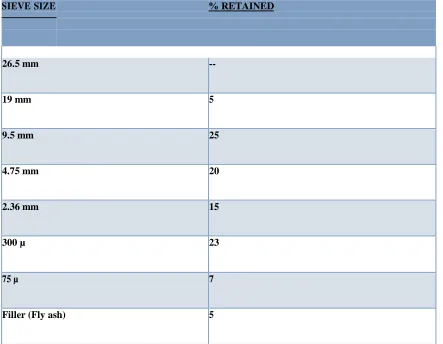
Table 1: Gradation of Aggregates
SIEVE SIZE % RETAINED
26.5 mm --
19 mm 5
9.5 mm 25
4.75 mm 20
2.36 mm 15
300 µ 23
75 µ 7
5 So the aggregates of different grades were sieved through different IS Sieves and they were kept in different containers with proper marking.
Specific Gravity of Coarse aggregate = 2.7 Specific Gravity of Fine aggregate = 2.6 Polythene
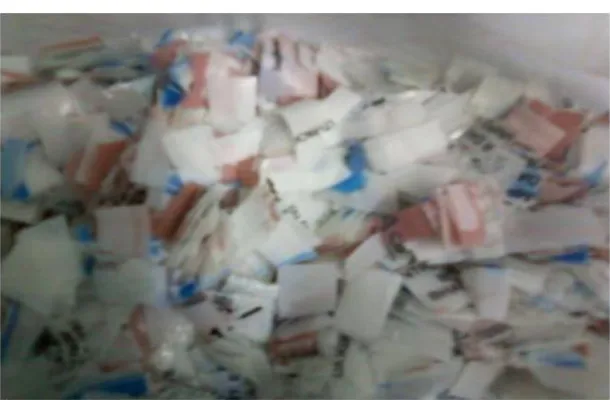
The polythene used in OMFED milk packets was used as raw material for preparation of the samples. These polythene packets were collected; they were washed and cleaned by putting them in hot water for 3-4 hours. They were then dried.
Specific Gravity of polythene = 0.905 Shredding
The dried polythene packets were cut into tiny pieces of size 2 mm maximum. This is because when the polythene is to be added with bitumen and aggregate it is to be ensured that the mixing will be proper. The smaller the size of the polythene, the more is the chance of good mixing.
Figure 1: OMFED Polythene used
6 RESULTS
Plotting Curves
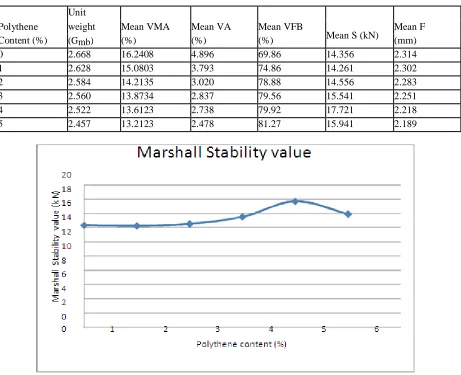
5 curves were plotted. i.e.
i. Marshall Stability Value vs. Polythene Content ii. Marshall Flow Value vs. Polythene Content iii. VMA vs. Polythene Content
iv. VA vs. Polythene Content v. VFB vs. Polythene Content
vi. Bulk unit weight vs. Polythene Content
For each % of polythene, 3 samples have been tested. So the average value of the 3 were taken. The mean values are shown in Table – 2
Table 2: Data for plotting curves
Unit
Mean S (kN)
Polythene weight Mean VMA Mean VA Mean VFB Mean F
Content (%) (Gmb) (%) (%) (%) (mm)
0 2.668 16.2408 4.896 69.86 14.356 2.314
1 2.628 15.0803 3.793 74.86 14.261 2.302
2 2.584 14.2135 3.020 78.88 14.556 2.283
3 2.560 13.8734 2.837 79.56 15.541 2.251
4 2.522 13.6123 2.738 79.92 17.721 2.218
5 2.457 13.2123 2.478 81.27 15.941 2.189
7 CONCLUSIONS
It was found from the study of behavior of polythene modified BC improvement of modified mix possesses Marshall Characteristics as mentioned It is found from the study that increase of Marshall stability value with polyethylene content upto 4% and after that it decreases. It was found that the marshall flow value decreases upon addition of polythene i.e the resistance to deformations under heavy wheel loads increases and Also the values of the parameters like VMA, VA, VFB are within the required specifications. Also analyzing and Considering of these factors we can assure that we can took a more durable and stable mix for the pavements by polymer modifications. This small investigation shows not only utilizes beneficially, the waste non-degradable plastics but also provides us an improved pavement with better strength and longer life period. Pavements of modified Polymer would be a boon for India’s hot and extremely humid climate, where temperatures frequently rises past 50°C and torrential rains create havoc, leaving most of the roads with heavy distresses. Life of the pavements is also affects adversely. The improved properties for pavement constructions is also showed by polymer modified bitumen . This also can reduce the amount of plastics waste which otherwise are considered to be a threat to the hygiene of the environment. plastics-waste is coated over aggregate in this modification process. This ensures better bonding between aggregate and bitumen and increases the surface area of contact at the interface. The polymer coating also reduces the void spaces present in the mix. This prevents the moisture absorption and oxidation of bitumen by entrapped air. The road can withstand heavy traffic and show better service life. as It will reduce the volume of plastic waste to be disposed off by incineration and this study will have a positive impact on the environment and land filling. It will not only develop a technology, which is eco-friendly but aslso add value to plastic waste. However, it is recommended that more research regarding the topic should be done and more trial sections should be laid and their performance should be studied.
REFERENCES
[1] Vasudevan, R., Utilization of waste plastics for flexible pavement, Indian Highways Indian Road Congress, Vol. 34, No.7, 2006.
[2] T. Awwad Mohammad and Sheeb Lina, the Use of Polyethylene in Hot Asphalt Mixtures, American Journal of Applied Sciences 4 (6) pp-390-396, 2007.
[3] Shuler, T.S., Collins, J.H. and Kirkpatrick, J.P., Polymer modified asphalt properties related to asphalt concrete performance. In Asphalt Rheology Relationship to Mixture, ASTM, STP 941, edited by O.E. Briscoe, 1987 (ASTM: Philadelphia).
[4] Shukla, R.S. and Jain, P.K., Improvement of waxy bitumen by the addition of synthetic rubbers, polymers and resins. Highway Res.Bull., 1984, 38, 17–28 (Indian Roads Congress, Delhi).
[5] Sabina, Khan Tabrez A, Sangita, Sharma D.K., Sharma B.M, Performance Evaluation. of Waste Plastic/ Polymers Modified Bituminous Concrete Mixes, Journal of Scientific and Industrial Research Vol.68,2009.
[6] Partha Chakroborty & Animesh Das, Principles Of Transportation Engineering, Published by Asoke K. Ghosh, Prentice-Hall of India Private Limited, 2005.
[7] Pandey, B. B., “Bituminous Mix Design”, A Two Day Workshop on Desi gn of Flexible Pavement with Emphasis on the New IRC:37-2001 Guidelines, 9-10 February, IIT Kanpur, 2002.
[8] Mahrez, A., Karim. M. and Katman, H. (2005), “Fatigue and deformation properties of glass fiber reinforced bituminous mixes”, JEastAsiaSocTransStudies.6.997–100
[9] Mahrez, A., Karim, M. and Katman, H. (2003), “Prospect of using glass fiber reinforced bituminous mixes”, J East Asia Soc TransStudies; 5:794– 807.