_____________________________________________________________________________________________________
*Corresponding author: E-mail: [email protected];
(Past name: American Chemical Science Journal, Past ISSN: 2249-0205)
Spatial and Temporal Variations in Physicochemical
Properties of an Aquatic Environment
O. C. Eze
1, B. W. Tukura
1*, B. O. Atolaiye
1and O. D. Opaluwa
11
Department of Chemistry, Faculty of Natural and Applied Sciences, Nasarawa State University, Keffi, Nigeria.
Authors’ contributions
This work was carried out in collaboration between all authors. Author OCE designed the study, performed the statistical analysis, wrote the protocol and wrote the first draft of the manuscript. Authors BWT and BOA managed the analyses of the study. Author ODO managed the literature searches. All authors read and approved the final manuscript.
Article Information
DOI: 10.9734/CSJI/2018/40942
Editor(s):
(1)Say Leong Ong, Department of Civil and Environmental Engineering, NUS Environmental Research Institute, National University of Singapore (NUS), Singapore. (2)A. V. Raghu, Department of Food Technology, Centre for Emerging Technologies-Coordinator, School of Engineering
Technology, Jain Global Campus, Jain University, India. (3)Nagatoshi Nishiwaki, Professor, Kochi University of Technology, Japan.
Reviewers:
(1)Caroline Lomalungelo Dlamini, University of South Africa, South Africa. (2)Hermine Ramzy Zaki Tadros, National Institute of Oceanography and Fisheries, Egypt. (3)Miraji Hossein, University of Dodoma, Tanzania. (4)Obiekea Kenneth Nnamdi, Ahmadu Bello University Zaria, Nigeria. (5)Fábio Henrique Portella Corrêa de Oliveira, Universidade Federal Rural de Pernambuco, Brazil. (6)O. Onigbinde, Moses, Samuel Adegboyega University, Nigeria. Complete Peer review History:http://www.sciencedomain.org/review-history/24914
Received 10th March 2018 Accepted 25th May 2018 Published 1st June 2018
ABSTRACT
The study was carried out to evaluate spatial and temporal variations in the levels of some physicochemical parameters in water and sediments from Mpape River, Abuja, Nigeria. The samples were collected along the river bank in dry and rainy seasons from five (5) locations and were analysed using standard methods. Levels of pH, nitrate, phosphate, and biochemical oxygen demand (BOD) in water did not vary according to sites. However, the highest levels of electrical conductivity (EC) and total dissolved solids (TDS) were recorded at site 4 for both seasons. During the dry season, levels of pH (7.36±0.16), EC (300.73±0.05 µs/cm), TDS (185.11±0.10 mg/L), BOD (0.98±0.30 mg/L), SO42- (9.8±0.14 mg/L) and Cl- (38.00±0.15 mg/L) in water were higher.
Concentrations (3.42±0.10 mg/L) of dissolved oxygen (DO), PO4
(0.21±0.06 mg/L) increased in rainy season. In sediments, levels of physicochemical parameters did not vary according to sites, except for PO43- and organic matter (OM). pH of sediments was more
acidic (6.23±0.05) and higher in the dry season. Levels of OM (2.66±0.11 %), PO43- (5.06 mg/Kg),
NO3 -
(0.21±0.09 mg/Kg), CEC (0.29±0.05 Cmol/Kg) and Cl- (0.17±0.02 mg/Kg) in sediments were higher in rainy season. Levels of physicochemical parameters in water and sediments for the two seasons were not significantly different (P ≤ .05), except for BOD, SO42- and Cl- in water. Levels of
physicochemical parameters of water were within the WHO/FAO permissible limits for irrigation. The acidic nature of sediments may lead to remobilization of heavy metals adsorbed onto the sediment surfaces into the water column, which may result to pollution.
Keywords: Physicochemical; properties; spatial; temporal; water; sediment; river.
1. INTRODUCTION
Water is an essential natural resource for sustainability of life and is used for domestic, industrial and agricultural purposes [1,2]. Rivers serve as sinks for wastes from the point and non-point sources, mainly from anthropogenic activities [3,4]. These wastes include toxic chemicals, acids, alkalis, dyes, detergents, pesticides and agrochemicals which significantly affect the physicochemical properties of water and sediments [5].
Some of the physicochemical parameters that affect the quality of water and sediment include pH, temperature, EC, solids, nitrate, DO, BOD, chloride, sulphate, and phosphate [6]. The physicochemical parameters may be affected by seasonal variations. Changes in pH affect chemical and biological processes which are essential to the survival and reproduction of marine life in an aquatic environment. Low pH can affect the toxicity of oceanic compounds such as ammonia and certain metals, by making them more bio-available [7]. Water temperature is a critical parameter for marine life and has an impact on other quality parameters such as DO concentration and bacterial activity in water. Rates of photosynthesis and metabolism by algae can also be affected by temperature. Phosphorus is an essential nutrient for plants and animals, however, can cause an increase in biological activity of water if in excess concentration. Excess levels of phosphorus and nitrate in water can lead to a process known as eutrophication, with a subsequent decrease in DO [8].
Water quality monitoring is an integrated activity for assessing the physical, chemical and biological features of water, with emphasis on human health, ecological conditions and designated pool use [9]. Evaluating the quality of water and sediment of an aquatic environment
helps in the sustainability of the resources [2,10].
Study on physicochemical properties of water and sediment for some rivers has been reported [11,12], however, there is scanty information on the physical and chemical properties of water and sediments from Mpape River. The aim this study, therefore, is to evaluate spatial and seasonal variations in the levels of physicochemical parameters of water and sediment from the Mpape River, Nigeria. Information from the present study would be a useful tool for further assessment and monitoring of the river quality.
2. MATERIALS AND METHODS
2.1 Study Area
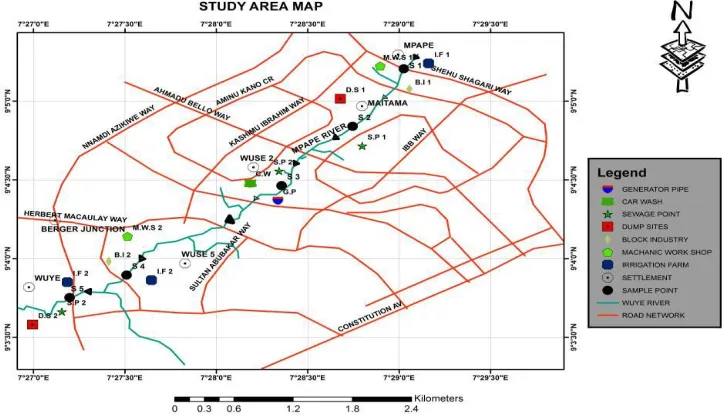
Mpape River is located at latitude 9° 5’ N and longitude 7° 29‘E and originates from Mpape Rock in Federal Capital Territory, Abuja, Nigeria (Fig. 1).
The River experiences a massive influx of wastes from both points and non-point sources, especially during the rainy season. In the dry season, water from the river is used for irrigation. Fishing is also carried out in the river, especially during dry season. Some anthropogenic activities such as block moulding, mechanic workshops, and washing of cars take place along the bank of the river throughout the year. Domestic sewage, agricultural runoffs and domestic wastes are sometimes discharged into the river at specific points.
2.2 Sample Collections and Preparations
Water (100 cm3) and sediment samples (5 kg)
were collected simultaneously at a distance of about 6 Km apart from Mpape (S1),
Fig. 1. Abuja map showing River Mpape and sampling locations
Wuse Zone (S4) and Wuye (S5). The samples were collected in the dry season (January, March and May) and in the rainy season (June, August and October). Surface sediment samples were collected into decontaminated polyethene bags using hand auger, while water samples were collected into 1 L pre-washed plastic bottles. The water samples were filtered through a 0.4 µm Whatman filter paper using a vacuum pump to remove particulate matters, and then preserved in an ice-bath cooler.
2.3 Determination of Physicochemical Properties of Water and Sediment
Electrical conductivity (EC), total dissolved solids (TDS), dissolved oxygen (DO), pH and temperature were determined using a portable automated probe - Jenway hand-held instrument (Model- 430) by dipping it into the water sample at the point of collection. DO was determined using a portable DO Analyser (Model JPB- 607A by dipping the DO meter into water sample and the reading was recorded from the instrument. A 5 - day BOD test method 521.0 was used to determine BOD [9], Organic matter (OM) contents of sediment was determined using acid extraction method [10], while cation exchange capacity (CEC) was determined using WHO method [11]. Chloride ion (Cl-) was determined titrimetrically, while phosphate (PO43-), nitrate
(NO3-), sulphate (SO42-) were determined using
the method by Association of Analytical Chemists [12]. Statistical techniques such as mean,
standard deviation and t-test were used for seasonal and spatial comparisons in the mean levels of physicochemical parameters.
3. RESULTS AND DISCUSSION
3.1 Physicochemical Properties of Water
Levels of physicochemical parameters in water during the dry season are shown in Figs. 2 and 3, while variations in the rainy season are shown in Figs. 4 and 5. Seasonal comparisons for levels of the physicochemical parameters are presented in Table 1.
Levels of pH, PO43- and N03- in the dry season
(Fig. 2) were similar across the sites. pH of an aquatic system is an essential indicator of water quality and the extent of pollution. Unpolluted rivers usually show neutral to slightly alkaline pH (7.0 - 7.5). Removal of CO2 during
photosynthesis, seawater dilution by the influx of freshwater, reduction of salinity, temperature and organic matter content affect pH of an aquatic system [13]. The availability of nutrients in an aquatic environment may be attributed to organic mineralization of nitrates and phosphates derived mainly surface runoff from the immediate environment and perhaps by in-situ
mineralization.
Site 4 recorded the highest and lowest concentrations for DO and SO42- respectively.
leaching from gypsum and other common minerals, industrial wastes and domestic sewage [14-16]. There was a decrease in the level of DO downstream, except at S5. Depletion in DO may be attributed to increasing in aerobic activities in the aquatic ecosystem. Similar trends were also observed for EC, TDS, and Cl- in the rainy season (Fig. 3); however, with the highest and lowest concentrations being recorded at S1 and S4 respectively. The observed trend could be as a result of an increase in pollution load downstream. EC is a measure of total dissolved solids and ionised species, which reflects the status of chemical pollution in water. Levels of temperature in water were similar across the sites. Cl- is present in natural waters in varying concentrations, depending on the geochemical condition of the area [16]. Although Cl- is essential to plants at shallow density, it can become toxic at high concentrations. Chloride may be considered as one of the indices of water pollutions from sewage [2].
Spatial variation during the rainy season (Fig. 4) indicated that the levels of PO43- and DO vary
across the sites, attaining the highest and lowest concentrations at S2 and S1 respectively. Dissolved oxygen is one of the essential parameters of water that directly affects the survival and distribution of flora and fauna, and in assessing the trophic status and magnitude of eutrophication in an aquatic ecosystem [2]. EC and TDS exhibited a similar trend across the sites (Fig. 5), with both having the highest levels at S4. High concentrations of free ions in water might be responsible for the increase in EC [17]. Levels of water temperature were similar across the sites, except for S2 and S4 that recorded relatively higher levels. The variation according to sites could be due to differences in physicochemical changes as a result of levels
and nature of pollutants discharged into the river at the different locations.
Seasonal mean levels of physicochemical
parameters of water (Table 1) were higher in the dry season, except for temperature
(29.35±0.96°C), DO (3.42±1.96 mg/L) and NO3
-(0.21±0.08 mg/L) that were higher in the rainy season. Fluctuations in the intensity of solar radiation could be responsible for the
seasonal variations in the levels of the parameters [16]. The temperature values recorded in this study were higher than values (25.80±0.5°Ϲ to 26.50±1.0°Ϲ) reported for water samples from River Msimbazi [18] and the 20.30±2.3°Ϲ to 23.24±2.0°Ϲ recorded for water samples from Lake Nairasha [19]. pH and SO4
2-levels were lower compared to the 2-levels reported for water from Mada River, Nasarawa state, Nigeria [20], while TDS and phosphate levels were similar to the results published for River Kaduna [21]. ANOVA shows that BOD, SO42- and Cl- contents were significantly (P ≤ .05)
higher in the dry season. Levels of physicochemical parameters were within the permissible limits for irrigation water [22], except for phosphate.
3.2 Physicochemical Properties of Sediments
Spatial variations in the levels of physicochemical parameters in sediment are shown in Figs. 6 and 7. Temperature, pH, NO3-,
CEC and Cl- did not show much variation according to sites in both seasons. The pH was acidic (6.23±0.15 - 6.40±0.15) for both seasons. This may be attributed to biodegradation of OM with the release of carbon dioxide which
combines with water to produce carbonic acid, thereby, lowering the pH [22,23].
Table 1. Seasonal-mean levels of physicochemical properties of water
Parameter Dry season Rainy season
Temp (°C) 29.18±4.49b 29.35±0.96b
pH 7.36±0.20b 7.24±0.19b
EC (µS/cm) 300.73±68.75b 243.79±60.47b
TDS (mg/L) 185.11±43.69b 149.44±57.14b
DO (mg/L) 2.95±1.64b 3.42±1..96b
BOD (mg/L) 0.98±0.79b 0.49±0.37a
SO42- (mg/L) 9.80±6.77b 0.40±0.05a
Cl- (mg/L) 38.00±10.09b 0.17±0.02a
NO3
(mg/L) 0.01±0.01a 0.21±0.08a
PO4
(mg/L) 3.69±0.03b 5.66±3.22b
Fig. 2. Levels of physicochemical properties of water in the dry season
Fig. 3. Levels of physicochemical properties of water in the dry season
Fig. 4. Levels of physicochemical properties of water in the rainy season
0 5 10 15 20 25
S1 S2 S3 S4 S5
Le
ve
ls
Sites
DO (mg/L)
BOD (mg/L)
SO₄²¯(mg/L)
pH
NOɜ¯(mg/L)
PO₄³¯(mg/L)
0 100 200 300 400 500 600
S1 S2 S3 S4 S5
L
ev
el
s
Sites
Temp (⁰C)
EC (μS/cm)
TDS (mg/L)
Cl⁻(mg/L)
0 1 2 3 4 5 6 7 8 9 10
S1 S2 S3 S4 S5
Le
ve
ls
Sites
pH
DO (mg/L)
BOD(mg/L)
Cl¯ (mg/L)
SO4²¯(mg/L)
NOɜ¯(mg/L)
Fig. 5. Levels of physicochemical properties of water in the rainy season
At low pH, hydrogen ions compete with metal cations that are adsorbed onto sediment surface. This may lead to remobilisation of the ions into the water column [23], which increases availability to organisms and irrigated crops [24]. The lower pH (6.23 ± 0.05) recorded in dry season could be due to oxidation of Fe to H2SO4
[25], and other redox reactions within the water column [26]. The pH values recorded in this study were similar to the pH (6.19± 0.18 to 6.78±0.08) for sediment in Mada River, Nasarawa State, Nigeria [20], and also with the pH of 6.10 to 6.45 and 6.10 to 6.3 recorded for sediment samples from different stations in Niger Delta [27] and Mumbai India River [28] respectively.
Organic matter (OM) and PO43- exhibited an
opposite trend across the sites, except at S5 in the dry season (Fig. 6). A similar pattern was observed in the rainy season (Fig. 7). In the dry and rainy seasons, the highest levels of OM and phosphate were recorded at sites S4 and S5, and at S2 and S3 respectively. Organic matter contents in sediment play an essential role in the adsorption and retention of heavy metals,
thereby decreasing mobility and bioavailability. At high pH, most dissolved minerals form complexes with OM, while at low pH, the formation of ligand complexes reduces [29]. Seasonal comparison (Table 2) indicated that except for SO4
2-(0.40±0.05 mg/L] and temperature (27.27±0.22°C), levels of other physicochemical parameters were higher in the rainy season, but were not significantly different (P ≤.05).
Table 2. Seasonal-mean levels of physicochemical properties of sediment
Parameter Dry season Rainy season
Temp (°C) 27.27±0.22b 27.11±0.12b
pH 6.23±0.15b 6.40±0.15b
CEC (mol/dm3) 0.28±0.06a 0.29±0.05a O.M (%) 2.11±1.11b 2.66±1.69b PO4
3-
(mg/L) 2.11±0.14b 5.06±3.22b NO3- (mg/L) 0.18±0.07a 0.21±0.08a
Cl- (mg/L) 0.10±0.07a 0.17±0.02a SO4
2-
(mg/L) 0.45±0.06a 0.40±0.05a Levels with the same alphabets within the same row
are not statistically different at (P ≤ .05)
Fig. 6. Variations in the levels of physicochemical properties of sediment in the dry season
0 100 200 300 400 500
S1 S2 S3 S4 S5
L
ev
el
s
Sites
Temp(⁰C)
EC (μS/cm)
TDS (mg/L)
0 5 10 15 20 25 30
S1 S2 S3 S4 S5
Le
ve
ls
Sites
Temp (ºC)
pH
CEC(mol/dm3)
O.M (%)
PO₄³¯(mg/kg)
NOз¯ (mg/kg)
Fig. 7. Variations in levels of physicochemical properties of sediment in the rainy season
4. CONCLUSION
Physicochemical parameters in water and sediment showed both seasonal and spatial variations-. Levels of BOD, SO42- and Cl- in water
were significantly (P ≤ .05) higher in the dry season. However, for sediments, seasonal levels of the physicochemical parameters were not significantly (P ≤ .05) different. The levels of the physiochemical parameters in water were within the WHO/FAO and FAO permissible limits for irrigation water. The quality of the aquatic environment requires regular monitoring, especially during rainy season, because of the frequent discharge of pollutants from point and non-point sources into the river; which may lead to an unprecedented outbreak of diseases from consumption of fish and irrigated crops grown along the river bank.
COMPETING INTERESTS
Authors have declared that no competing interests exist.
REFERENCES
1. Chinedu SN, Nwinyi OC, Oluwadamisi AY, Eze VN. Assessment of water quality in Canaanland, Ota, Southwest, Nigeria. Agriculture and Biological Journal of North America. 2011;2(4):577-583.
2. Nabakishor N, Basudha H. Physico-chemical properties of different water bodies of Manipur. Journal of Scientific Research and Reports. 2017;16(1):1-6. 3. Jonnalagada SB, Mhere G. Water quality
of the river in the eastern highlands of Zimbabwe. Water Research. 2001;35: 2371-2376.
4. Das J, Achary BC. Hydrology and assessment of lotic water quality in Cuttack
city, India. Water, Air and Soil Pollution. 2003;150:163–175.
5. Pravin US, Ansari MVA, Dixit NN. Assessment of physicochemical properties of sediments collected along the Mahul Creek near Mumbai, India. International Letters of Natural Sciences. 2014;16:54-61.
6. Seiyaboh EI, Izah SC, Oweibi S. Physico-chemical characteristics of sediment from Sagbama Creek, Nigeria. Biotechnology Research. 2017;3(1):25-28.
7. Saravanakumar A, Rajkumar M, Sesh J, Thivakaran GA. Seasonal variations in physicochemical characteristics of water, sediment and soil texture in arid zone mangrove of Kachchh – Gujarat. Journal of Environmental Biology. 2008;29:725-732. 8. Adeola AA, Moses ON, Modupe OA,
Kelechi LN, Anuoluwapo OJ. Assessment of physicochemical characteristics of sediment from Nwaja Creek, Niger Delta, Nigeria. Journal of Geoscience and Environment Protection. 2016;4:16-27. 9. Randa RE, Mohamed AH, Khaled SA.
Physicochemical properties of Manzala Lake, Egypt. Egypt Journal of Chemistry. 2017;60(4):519-535.
10. Abdelhamid AE, Muhammad AE. Physiochemical properties of water and sediments in Manzala Lake, Egypt. Journal of Environmental Sciences. 2016;45(2): 157-174.
11. Umar MA, Ebong MC. Determination of heavy metals in soil, water, sediment, fish and crawfish of Jabi Lake in the federal capital territory, FCT, Abuja – Nigeria. International Journal of Research in Pure and Applied Chemistry. 2013;2(1):5-9. 12. Isaac AO, Bello OM, Patricia EO. Heavy
metals evaluation of Madna stream sediment in Kubokun village of Abuja
0 5 10 15 20 25 30
S1 S2 S3 S4 S5
Le
ve
ls
Sites
Temp (0C)
pH
CEC(mol/dm3)
O.M (%)
PO₄³¯(mg/kg)
NOɜ¯(mg/kg)
metropolis. Advance in Applied Science Research. 2013;4(6):237-241.
13. Kurma R, Ramesh BK. Seasonal variations in physicochemical characteristics of Champavathi Estuary, East Coast of India. International Journal of Current Microbiology and Applied Sciences. 2017;6(6):443-447.
14. Kaizer AN, Osakwe SA. Physicochemical characteristics and heavy metal levels in water and sediment sample from five river systems in Delta State, Nigeria. Journal of Applied Science and Environmental Management. 2010;14(1):83-87.
15. Annalakshmi G, Amsath A. An assessment of water quality of river Cauvery and its tributaries arasalar with reference to physicochemical parameters at Tanjore DT, Tamilnanadu, India. International Journal of Applied Biology and Pharmaceutical Technology. 2012;3(1): 269-279.
16. World Health Organization (WHO). Guidelines for drinking water, Geneva; 2008.
17. Ali M, Salam A, Ahmed N, Khan B, Khokhar MY. Monthly variation in the physicochemical characteristics and metal contents of Indius River at Ghazi Hgat, Muzaffargarh, Pakistan. Pakistan Journal of Zoology. 2004;36(4):295-300.
18. Mwegoha WJ, Kihampa S. Heavy metal contamination in agricultural soils and water in Dares Salaam city, Tanzania. African Journal of Environmental Science and Technology. 2010;4(11):763-769. 19. Ogendi GM, Maina GM, Mbuthia JW,
Koechi HK, Ratemo CM, Koskey JC. Heavy metal concentrations in water, sediments and common carp (Cyprinus carpio) fishes species from Lake Naivasha, Kenya. Research Journal of Environmental and Earth Science. 2014;6(8):416- 423.
20. Tukura BW, Gimba CE, Ndukwe IG, Kim BC. Physicochemical characteristics of water and sediment in Madariver,
Nasarawa State, Nigeria. Journal of Environmental and Bioenergy. 2012;1(3): 170-178.
21. Marhre MY, Akan JC, Moses EA. Pollution indicators in River Kaduna, Nigeria. Trend in Applied Science Research. 2007;2:304-311.
22. Tukura BW, Kagbu JA, Gimba CE. Effects of pH and seasonal variations on dissolved and suspended heavy metals in dam surface water. Chem Class Journal. 2009;6:27-30.
23. USEPA. Recent developments for in-situ
treatment of metals contaminated soils, US environmental protection agency. Office of Solid Waste and Emergency Response; 1999.
24. Sabo A, Gani AM, Ibrahim AO. Pollution status of heavy metals in water and bottom sediment of river Delmi in Jos, Nigeria. American Journal of Environmental Protection. 2013;1(3):47-53.
25. Ramanathan AL. Sediment characteristics of the Pichararam mangrove, Southeast coast of India. Indian Journal of Marine Science. 1997;26:319-322.
26. Holmer M, Kristensen E, Banta G, Hansen K, Jensen MH, Bussanwarit N. Biogeochemical cycling of sulphur and iron in sediments of a south-east Asian mangrove, Phuket Island, Thailand.
Biogeochemistry. 1994;26:145-161.
27. Food and Agricultural Organization (FAO). Environmental impact assessment of irrigation and drainage projects, FAO. Rome; 1999.
28. Adeola AA, Moses ON, Modupe OA, Kelechi LN, Anuoluwapo OJ. Assessment of physicochemical characteristics of sediment from Nwaja Creek, Niger Delta, Nigeria. Journal of Geoscience and Environment Protection. 2016;4:16-27. 29. Pravin US, Manisha PT, Ravindra MM.
Assessing the physic-chemical parameters of sediment ecosystem of Vasai creek at Mumbai, India. Journal of Marine Science. 2011;1(1):22-29.
_________________________________________________________________________________ © 2018 Eze et al.; This is an Open Access article distributed under the terms of the Creative Commons Attribution License
(http://creativecommons.org/licenses/by/4.0), which permits unrestricted use, distribution, and reproduction in any medium,
provided the original work is properly cited.
Peer-review history: