Architectural Framework for eLearning
Platform in a College of Education
Olusola Theophilus, Faboya
#1, Emmanuel Ifedayo, Adu
*2, Oludare Jethro, Olojo
#3#1&3Computer Science Department, College of Education Ikere-Ekiti,
Ekiti State, Nigeria
#2School of Education, College of Education Ikere-Ekiti,
Ekiti State, Nigeria
Abstract— This paper provides a proposal for e-learning system for a college of education with sandwich and satellite campuses. The main objective of the project is to make available to the target audience flexible, collaborative, and personalized learning. The architecture expresses new and important demands on learning process, both with regards to pedagogy, organization and technology. The paper presents an infrastructure, architecture and a framework that support learner-centric. It is concluded that the study contributes to a public e-learning platform which can achieve true interoperability based on open source.
Keywords- e-learning, collaborative, framework, interoperability.
I. INTRODUCTION
Millions of people lack the opportunity for higher education in countries around the world. Tuition costs, competition, and the opportunity costs of leaving employment to full-time study prevent many from learning the skills necessary to increase their standard of living. The advent of modern ways of learning as a result of technologies has alleviated this plight. Over the last few years, e-learning method of education has come into its own as the mainstay in the field of education especially in the developed countries [11]. It has emerged to be the most efficient and time-saving technique of learning for distance and flexible learning. However, there are many opportunities and challenges associated with the use of innovations in technology for extending educational opportunities in developing countrie; one of these opportunities is e-learning.
E-learning provides information through the use of electronic media with the help of information and communication technologies [4]. This is one of the most emerging concepts in the field of technology. This method of learning includes numerous types of media support that delivers text, audio, images, animation, and streaming videos for teaching and learning purposes. It can be either synchronous or asynchronous [7]. Synchronous learning occurs in real time by allowing interaction at the same time, while asynchronous learning allows interaction without the involvement of other individuals at the same time [3]. This method of learning supports cost effectiveness,
reusability, storage capacity, powerful computing and virtualization which can be provided by cloud computing [2].
This online educational system has transformed knowledge delivery processes and 'Virtual Education' world over by changing the way people learn and train, allowing them to do it anywhere, any time and allow extremely useful contact across national and international borders [11]. However, in developing countries, actors in educational sectors are still struggling to fill the digital divide created by this powerful web tool. However, the reason is not farfetched from the inadequate Information Technologies (ITs) infrastructures; despite the availability of vast teaching and learning contents.
This study is motivated by the recent efforts of the management of the College of Education, Ikere –Ekiti to reposition the Information and Communication Technologies (ICTs) usage to enhance teaching and learning process in the institution. In recent time, the management employed the service of major uplink providers in Nigeria to provide formidable 24/7 wired and wireless internet service in the main campus and the satellite campuses. To key into this vision, and to make maximum use of the facilities provided, this framework has become necessary. This paper focuses on the technological architecture and contents requirements to set up a robust e-learning environment in a College of Education. The architectural framework aims to provide a distance e-learning and e-teaching facility available at any place and at any time to individuals and groups of students/lecturers both in synchronous and asynchronous modes.
This paper is structured as follows: section 2 provides the background to the study through a literature survey on the existing e-learning frameworks. Section 3 gives details of the architecture of the proposed framework. Section 4 describes the implementation procedure for the framework. Section 5 presents conclusion and recommendations.
II. LITERATURE REVIEW
content to be delivered and the technology that support the delivery. Traditionally, education has been very linear, such that teachers teach from point A to point B and formal education is hierarchical, as teachers teach from top and students learn from the bottom. Informal education moves away from traditional teacher/student roles and allows a more collaborative learning environment [7].
E-learning, a web based technology presents an alternative pedagogy that strike a balance between the formal and informal education methods. Students tailor the learning process to fit their individual needs and have complete control of the speed and direction of their learning. It can cover a range of activities from supporting learning, combination of e-learning and traditional learning through to learning that is delivered entirely online [5]. However, there is no definitive agreement on what e-learning is and on terminology utilised to describe the use of technology in learning [6]. E-learning is a wide set of applications and processes, which uses available electronic media (and tools) to deliver vocational education and training. It has progressed a long way from web-based learning to innovations such as online conferences.
Reference [7] gave an all-encompassing definition of e-learning as a solitary individual activity, or a collaborative group activity where both synchronous (real time) and asynchronous (flexi-time) communication modes may be employed. The position of this definition is clear as it adequately takes care of collaborative group learning and individual study both in real time and off line.
E-learning has benefited immensely from the developments that emerge from the convergence of technologies. The World Wide Web (www) gave birth to the concept of e-Learning and collaborative knowledge sharing across the globe. But due to largely unplanned and uncoordinated growth, these fall short of earlier promises and lack of machine readable content coupled with information overload has put strains into the traditional knowledge delivery model of www. However, the situation is especially serious in the e-Learning domain where the success and usefulness directly correlates with the effectiveness of the knowledge delivery in a dynamic setting [8], The fusion of telecommunication technologies and computing technologies has accelerated the rate of change of many of these services and also functions of modern society. With the advent of wireless internet, more educational opportunities are becoming available not only in the form of scanned digital textbooks and creating Java scripted multiple choice tests, but informal educational methods is also inclusive.
The choice of distributing education via networks is becoming economically more attractive.
hypermedia has helped users to browse through all forms of information whether visual, graphic, moving, or auditory, and these can be stored digitally and can therefore be conveniently accessed and mixed for alternative presentations under computer control [11]. Telecommunication technologies makes dissemination of information to the target audience a reality, therefore the knowledge base available to an individual is no longer restricted to what can be stored in one computer. This is achieved by the integration of new electronic technologies with practical realities of human communication and instruction.
However, the above concept is achievable with systematic application of the disciplines of instructional design and development through the use of some industrial standard platforms such as Sharable Content Object Reference Model (SCORM) and Learning Management System (LMS). SCORM is a set of technical standards for e-learning software products. It is the de facto industry standard that allows interoperability between e-learning software products. Specifically, SCORM governs how online learning content and Learning Management Systems (LMSs) communicate with each other. It does not speak to instructional design or any other pedagogical concern; and it is purely a technical standard, [9]. LMSs are web-based software application platforms utilised to plan, implement, and assess learning processes related to online and offline training administration and performance management [10].
They allow an instructor to create and deliver content, monitor learners' participation, and assess student performance. LMSs also allow learners to use interactive features such as blogs, chats, web conferencing, discussion forums, and other methods of communication [10]. Furthermore, the basic entity that SCORM and LMS operates on is the Learning Object. This is an individual element of learning which can easily be recognized as an activity or a lesson, each learning object is designed to teach or test a series of specific objective, and it is re-usable and transportable standalone entity. It does not rely on other learning objects to function and does not specifically refer to other learning object.
III.THE COMPONENTS OF THE E-LEARNING
FRAMEWORK
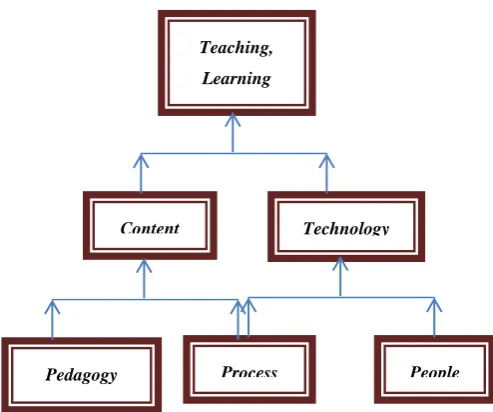
Fig. 1. The components of the e-learning Framework. Adapted from VTU
(http:/elearning.vtu.ac.in/edusat.html
1. The Teaching and Learning: The ultimate aim of any educational institution is to deliver effective training to students and embark on research works. This can be achieved by having easy access to resources and effective collaborative work. However, without reasonable and quality contents, coupled with tools, process and people, this aim would be difficult to achieve. Therefore, contents form a major component of any institution and the delivery of these contents to target audience becomes an issue
2. Technology :The technology includes the database that contains the content to be delivered, software, machines for information gathering and processing, networking and telecommunication facilities for dissemination of contents to target audience in different geographical location and this become an important part of this framework.
3. Pedagogy: Current classroom practice is largely derived from the belief that teacher's basic task is the 'transmission of knowledge' [3]. That is passing on knowledge from the teacher to the pupil. This is a set of knowledge previously planned or defined by the teacher as the basic objective. This framework will present alternative pedagogy where learners are at liberty to learn at their own pace and training occur in small parcel. Some informal aspect will include collaborative tools such as scheduled mentoring sessions, group chats, message board discussion, blogs, skype and other technological driven learning such as podcast, pencast, slideshare, and so on.
4. Process: Process contributes immensely to the overall objective of any institution. It involves processes that lead to assurance of the quality of study materials, adequacy of covering the curriculum and other procedures to follow in disseminating and examining the learners. It also includes the policy of the institution, and that of the method employed to achieve the training system of this magnitude.
5. People: The people include the lecturers who teach students, administrators, students and technical officers who assign hardware, software or attributes to users or group of users.
The Architecture of the College of Education E-Learning Framework
The development of e-learning platform is usually connected with the use of determinant standards, which allows exchange of e-learning resources between nodes of the system. This work is not an exception because it provides effective distribution of resources (contents). This architectural framework provides the needed interoperability of the portal by using SCORM standard. This will ensure successful creation and proper exchange of training resources among the users of the facility.
The institution (College of Education, Ikere-Ekiti, Nigeria.) runs a lot of programmes such as Sandwich, National Certificate in Education (NCE) regular and sandwich, Postgraduate Diploma in Education (PDE), and Degree programme in affiliation with Universities, all of which are distributed across large geographical areas. The equipment in the form of servers and administration of learning objects (contents) are located in the main campus of the institution while users are scattered all over the campuses and beyond.
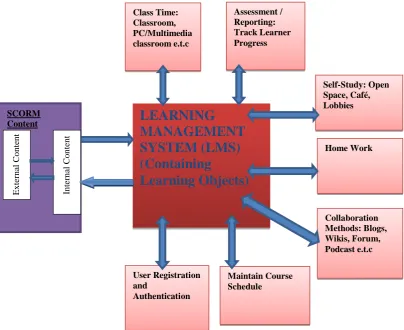
There is actually a fairly straightforward relationship between the SCORM content (Internal and the External Contents) and the Learning Management System that manages the whole e-learning experience, the e-learning object that constitute the training and various activities that a user can perform on the e-learning platform. There are quite a number of facilities on the web-based e-learning platform which include self-study opportunity for the users which can take place at anytime and anywhere, collaborative works with colleagues through the use of blogs, chats, forum, Wikis, authentication which give assess in the form of identification, maintaining course schedule, monitoring users’ progresses, and so on. These are made available to users through the LMS over the SCORM protocol.
The LMS communicates with the SCORM contents (database) to store and retrieve contents. The individual learning objects do not connect to the database at all. When the learning objects require information that may be stored in the database, they ask the LMS for this information using the protocol SCORM. When the Learning Object is ready, it sends information to the LMS using the SCORM protocol again. SCORM is the language that both LMS and Learning Objects understand [9]. The users make use of the e-learning facilities by connecting their computer through the wired or wireless connection to the internet to assess the web-based e-learning facilities.
Teaching,
Learning
and
Research
Technology Content
Fig. 2. The Architecture for the College of Education E-Learning Framework
How it Works: Implementation Procedures
In the proposed College e-learning project, various campuses of the College are already connected with the robust internet services provided by the College management. While students or users are off campus, they need to be connected with the Internet before College e-learning web can be accessible. The subject experts would have used presentation content, which is derived from the deployed e-Learning content to prepare their SCORM complaint learning object before deployment. If the learning object is in form of video session, such sessions would be captured, digitized and linked to become part of the overall e-learning content.
All course materials must be developed in standard SCORM format. The SCORM contents will be deployed in MOODLE’s LMS where the course materials can be accessed. SCORM is a set of specifications that, when applied to course content, produces small, reusable e-learning objects. SCORM-complaint courseware elements are easily merged with other compliant elements to produce a highly modular repository of training materials [9].
This student-centric proposed system will enable students to access materials such as lectures notes, courses outlines, reading lists and assignments
collaborate with colleagues using forum, blogs and so on.
IV.CONCLUSIONS
It is understood that many people come to e-learning with a single goal of cost saving in mind. There is no doubt that e-learning can help in achieving this, but there are other distinct advantages that can be derived from this method of learning such as opportunity for users to learn at their own pace and training which the method usually present in small parcel. Apart from these, e-learning distinguishes itself from other distance learning programs with advantage of alternative pedagogy it presents.
This paper has been able to present an architectural framework for e-learning environment in a College of Education. However, to achieve desired goal of effective teaching and learning activities, balancing formal and informal education, an e-learning development process must take into account the items mentioned under the components of the framework presented in this paper in the right order, and also put in place necessary and adequate infrastructure in terms of hardware and application software so that the users can enjoy the benefits therein and maximise the potential it presents.
Finally, this architectural framework can be adopted by any institution planning to put up e-learning system.
LEARNING
MANAGEMENT
SYSTEM (LMS)
(Containing
Learning Objects)
SCORMContent
C
oUser Registration and
Authentication Class Time: Classroom, PC/Multimedia classroom e.t.c
Self-Study: Open Space, Café, Lobbies
Home Work
Collaboration Methods: Blogs, Wikis, Forum, Podcast e.t.c Assessment /
Reporting: Track Learner Progress
Maintain Course Schedule
Ex
tern
al
C
o
n
te
n
t
In
ter
n
al
Co
n
ten
REFERENCES
[1] Dabbagh, N. “Pedagogical models for E-Learning: A
theory-based design framework.” International Journal of
Technology in Teaching and Learning, vol 1(1), pp. 25-44. 2005.
[2] Geetha. M., Suresh. J., & Srinivasan A.. “gBeL:An Efficient Framework for e-Learning Using Grid Technology”.
Computer Networks and Information Technologies:
Communications in Computer and Information Science. Vol 142. pp. 63-68. 2011.
[3] Goodson, I.F (2005). “Learning, Curriculum and Life Politics: the selected works of Ivor F Goodson- towards an alternative
pedagogy”. Routledge. [Online]. Available:
http://www.ivorgoodson.com.
[4] Hua, Y., & Jianbo, F. (2009). Design and Implementation of
the Framework for Adaptive e-Learning System: Hybrid Learning and Education. Lecture Notes in Computer Science.Ningbo, China: Springer, 2009, vol 5685. pp. 140-149.
[5] Mayes, T. and de Freitas, S. “Review of e-learning theories, frameworks and models” London: Joint Information Systems Committee. 2004
[6] Pailing, M. “E‐learning: is it really the best thing since sliced
bread?", Industrial and Commercial Training, Vol. 34 (4),
pp.151 – 155. 2002
[7] Romiszowski, A., J.“Online Learning: Are We On The Right Track(s)”: In Dills C.R, & Romiszowski (Eds). Instructional Development Paradigms. NJ. Englewood Cliffs.2005. [8] Stoyannov, S., Ganchev, I., Popchev, I & O’Droma, M. An
Approach to the Development of Infostation-Based eLEarning
Architectures. Dokladi na B”lgarskata academia na naukite.
Vol 61. Pp 1189-1198. 2008
[9] (2014) The Scorm website. [Online]. Available:
http://www.scorm.com/
[10] (2014) The Syberworks website. [Online]. Available: http://www.syberworks.com
[11] VTU(2014) VTU homepage on EDUSAT-based Distance
Education. [Online]. Available: