Biolinguistics 12: 001–013, 2018 ISSN 1450–3417 http://www.biolinguistics.eu
Complex Ideas: Fodor’s Hume Revisited
Sergio Balari & Guillermo Lorenzo
To Jerry Fodor (1935–2017), in memoriam
1. Introduction
In 2003, Jerry Fodor published Hume Variations (HV), a book sitting astride The Mind Doesn’t Work That Way (Fodor 2000) and LOT 2 (Fodor 2008). Sadly, we now know that the latter would end up being Fodor’s last solo effort to defend the Representational/Computational Theory of Mind (RCTM) in book format. There-after two collaborative endeavors ensued, the widely vituperated What Darwin Got Wrong (Fodor & Piattelli-Palmarini 2010) and the sketchy Minds Without Meanings (Fodor & Pylyshyn 2015). The former could easily be connected with Fodor (2000) as striking the, in our opinion, definitive blow on evolutionary psychology, while the latter elaborated on Fodor’s (2008) referentialist account of the content of intentional states, hinting, also in our opinion, at the basis of what might eventually constitute a solution for this hard problem—we held our breaths awaiting the next season, only to recently know that it would not be shot. This apparently leaves HV in a kind of no man’s land and seemingly makes of it a relatively minor work not worth the attention of the casual follower of the happenings in the philosophy of mind—a text for wholehearted fans only.1 However, when read as part of a trilogy that opens with Fodor (2000) and culminates with LOT 2, HV acquires a full sense of its own as the necessary link between the computational model of the former and the theory of ideas developed in the latter. Especially, we believe, when Fodor’s Hume is reassessed under the reading we propose here.
In HV, Fodor got it right when he asserted that the etiology of complex ideas is the crux of Hume’s psychology; but he didn’t get it completely right, for Hume’s etiological suggestions are more complex and nuanced than they surface in Fodor’s portrait. The first section of this note is aimed at explaining why we believe so. Thereafter, we move to the question of what, according to Fodor, Hume got inexcusably wrong. Again, while we would like to suggest that Fodor got this partially right, we nonetheless believe that Hume’s contentions are not as inexcusably wrong as Fodor argued them to be, even from the point of view of a
This paper has benefited from a grant of the Generalitat de Catalunya (2014-SGR-1013) to the Centre de Lingüística Teòrica at the Universitat Autònoma de Barcelona (SB), and a grant of the Spanish Government (FFI2017-87699-P) (SB & GL). We are grateful for the very insightful comments of two anonymous reviewers.
Cartesian-biased RTCM. Notwithstanding, the conclusion of this contribution is to a great extent in agreement with Fodor’s vindication of Hume: Much against conventional wisdom, Hume attained a rather balanced compromise between the constraints imposed by the Cartesian theory of ideas and the rigors of empi-ricism, which he felt compelled to embrace in order to attain a bona fide scientific view on human nature.
2. Hume on the Etiology of Complex Ideas: What Fodor Got Wrong (or Did He?)
How Hume taxonomized ‘perception’ into ‘impressions’ and ‘ideas’ is a story that has been told many times, obviously enough starting with Hume himself (Treatise, § 1.1;2 see, among others, Stroud 1977: Ch. 2, Pears 1990: Part I, and Garrett 2011). This section is specifically devoted to introducing Fodor’s HV
version of that story and confronting it with our own construal of Hume’s relevant passages of the Treatise—for those readers wishing to refer to different reviews of Fodor’s book for a more all-encompassing set of commentaries, we recommend those of Crane (2004), Garvey (2004), Biro (2005), and Carruthers (2005). Turning then to the case that concerns us here, Hume famously set apart, on the one hand, ‘impressions’ from ‘ideas’ as the two main denizens of our perceptual life—which measured against each other by their relative ‘force’ and ‘violence’ (Govier 1972, Everson 1988, Dauer 1999, Bennet 2001: 204–206)—and, cutting across both categories, ‘simple’ from ‘complex’ impressions/ideas—a matter in this case of internal ‘distinctiveness’ and ‘separability’ (Stroud 1977: Ch. 2, Bennet 2001: 209–211, Owen 2009).
As for the former distinction, Hume observed that mental moods exist in which it becomes blurred—like fever, sleep, and so on, but that it is unproblematic in most common situations. He also famously introduced at the beginning of the Treatise that there exists a causal arrow pointing from ‘impressions’ to ‘ideas’ (Treatise, p. 9), so for him it generally rules that:3
all ideas are deriv’d from impressions, and are nothing but copies or repre-sentations of them […] Impressions and ideas differ only in their strength
and vivacity. (Treatise, p. 18)
To this he added that, as a consequence, the distinction is not subservient to “any particular degree of vivacity”, as well as the corollary (to be discussed below) that “whatever is true of the one must be acknowledg’d concerning the other” (Treatise, p. 18).
As for the latter distinction, Hume introduced it as a clear-cut, uncompli-cated one, which has to do with the internal decomposability (or lack thereof) of
2 We will quote from the following edition: A Treatise of Human Nature, vol. 1, ed. David Fate Norton & Mary J. Norton. Oxford: Clarendon Press, 2007. As for references to Fodor, unless otherwise stated, all are to HV with page numbers appearing within parentheses.
impressions/ideas. The distinction holds the same in the case of both kinds of percepts, which actually follows from the corollary above: Namely, if an impression decomposes into minor impressions, the same property must apply to the corresponding idea—i.e. it must decompose into minor ideas; and obviously enough, simple corresponding impressions and ideas must be equally isomorphous in not being internally decomposable.
But Hume also acknowledged that ‘complex ideas’ raise a non-trivial challenge to this whole edifice, for
tho’ there is in general a great resemblance betwixt our complex impressions and ideas, yet the rule is not universally true, that they are exact copies of each other. (Treatise, p. 8; emphasis in original)
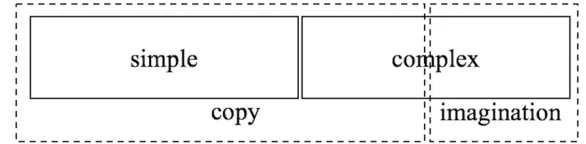
Clearly enough, winged horses, fiery dragons, and monstrous giants, are not copies of anything that directly impresses us, in the way ordinary horses, common alligators or basketball players do. Therefore, two different mental mechanisms appear to be at work in the completion of complex ideas, even if both ultimately anchored in the solid ground of impressions. Fodor referred to the corresponding mechanisms as ‘copy’ (also Bennet 2011: 209ff.) and ‘imagi-nation’,4 which superimpose to the ‘simple/complex’ distinction as depicted in Figure 1:
Figure 1: Hume’s fabric of ideas (Fodor’s version).
According to this reading, ‘copy’ may apply to create both simple and complex ideas—or ‘copies’, the difference being that in the former case the mechanism just coins the corresponding idea from a single, non-decomposable impression, while in the latter case it copies a certain number of minor, non-decomposable impressions, plus the ‘joints’ that keep them apart and, at the
same time, makes a coherent whole of them. Besides, simple ideas, according to Hume’s strong empiricist commitment, are exhaustively copies of impressions (Treatise, p. 8); but the same needs not be the case of complex ideas, for many of them are the product of ‘imagination’—see fn.3, a faculty capable of joining ideas—themselves copies, without however copying their joints from impres-sions. Thus, from the projection of the dual (copy/imagination) mechanism onto the originally dual (simple/complex) taxonomy, it results a triple taxonomy of ideas: namely, (1) ‘simple copies’, (2) ‘complex copies’, and (3) ‘complex images’ —a set of labels for which only us must be blamed.5
One of the main points of Fodor’s critique—and the one to be discussed here, is that Hume was wrong in believing that complex impressions contain joints directly reflecting sensed experiences—for experiences lack them to start with, which could be directly copied and translated into ideas. This was one of Hume’s main empiricist sins, according to Fodor’s reading. But also according to him, Hume’s was nevertheless a rightly focused mentalist project that embraced two fundamental Cartesian stances, upon which successful modern RCTMs build: namely, (i) the concept of the mental as the site of a multilevel architecture of self-contained ideational systems (representationalism) and (ii) the idea of representations as the outset and outcome of mind-internal symbol manipulation processes (computationalism)—see Biro (2004). Hume’s implementation of these theses—according to Fodor’s exegesis—is captured in Figure 2.
Figure 2: Hume’s representational/computational theory of mind (Fodor’s version).
Let us concentrate on the particular case of complex ideas/concepts— copies and images; (2) and (3) in the figure, which for obvious reasons are crucial for evaluating Hume’s commitment with (a version of) the RCTM and, comple-mentarily, the extent to which his empiricism was as radical as customarily assumed. In brief, our conclusion is that Fodor’s image of Hume’s RCTM is not completely accurate, but in a somehow unexpected direction: Despite the fact that there clearly exists an obvious lack of balance between the Baconian and Cartesian components of Hume’s recipe for a future science of human nature, there are reasons to conclude that the weight of the latter relatively to the former was even heavier than Fodor believed it to be. Here follows our reasoning.
As already observed, Hume singled out two separate mechanisms in charge of bringing about the generation of complex copies (2) and images (3). In the case of images, as Fodor correctly observed, he appealed to the generative resources of ‘imagination’, a faculty capable of putting together independently remembered simple and complex copies, and adding new kinds of joints uniting them. Fodor’s preferred example is UNICORN, but Hume’s main illustration is much more complex than that: the idea corresponding to the city of New Jerusalem—NEW JERUSALEM, a biblical image for the reconstruction of the soul, in the (imagined) physical instantiation of which “pavement is gold” and “walls are rubies” (Treatise, p. 8). That Hume’s complex examples are as a matter of fact more complex than Fodor’s is not a negligible detail, as we shall presently show. So let’s keep this in mind. As for copies, according to Fodor’s construal complex ideas spring in its turn from the non-generative mechanism of ‘copy’, which just replicates the corresponding impressions, creating relatively less forceful and less violent reflexes therefrom. We think that here Fodor erred in his exegesis, though, as an examination of Hume’s main example clearly demonstrates.
Hume specifically concentrates on the idea corresponding to the city of Paris—PARIS; or more accurately, the idea that Hume himself constructed after visiting Paris during his pre-Treatise stay in France. The importance of the fragment has been previously emphasized—for example, by Stroud (1977: 20) and Traiger (2011: 59), but without deriving all the far-reaching consequences that in our opinion it might inspire. PARIS, according to Hume, is not simply a faint version of the impressions left by the Paris he visited: It is, granted, a faint version of many such impressions… less many other such impressions that he also received from 1734 to 1737. In Hume’s own account:
I have seen Paris, but shall I affirm I can form such an idea of the city, as will perfectly represent all its streets and houses in her real and just
pro-portions? (Treatise, p. 8)6
So, complex copies derive from processes that involve, surely among others, such operations as ‘subtracting’ and ‘resizing’ impressions, a much more creative (generative) computational procedure than merely a ‘copy’ mechanism. It is worth remembering that in the Enquiry, Hume enumerated a series of facult-ies that underlie the seemingly unbounded liberty of thought, which include ‘compounding, transposing, augmenting, or diminishing the materials afforded us by the senses and experience’ (Enquiry: p. 14).7While the immediate context of the quote suggests that Hume is narrowly referring to the labors of our capacity
6 It seems clear that Pears misreads this passage when he writes the following: You look down on Paris from a plane and get a complex impression of it: according to Hume, your singular idea of Paris is just a mechanical copy of this impression, and no selection or abstraction is needed before you can acquire it. (Pears 1990: 27)
Hume’s intended sense is nicely captured in the following passage from Stroud:
I have had a breathtaking impression of Paris from the steps of Sacré Coeur, but I cannot now form an idea which exactly resembles that impression. So there are […] impressions without exactly resembling ideas. (Stroud 1977: 20)
for fiction, a broader interpretation strikes us as legitimate when turning to his reflection in the Treatise, according to which such faculties are also recruited in the editing of complex realistic ideas with the distinctive seal of beliefs. Surely enough, the less complex an idea, the less operative the whole complex proced-ure; but by concentrating on these less complex, yet still intricate kinds of copies —like say, HORSE, COW, and so on, one misses the opportunity of capturing it in its full-fledged generative grandeur. Which certainly was Fodor’s mistake, whose attention seems to be too much focused on such ‘less complex’ complex copies, corresponding to cows, unicorns, and similarly middle-sized, well-delimited entities. We thus disagree with Fodor’s persuasion that Hume is fettered to the thesis that “the mind doesn’t add anything to impressions in the course of getting from sensation to perception” (41, emphasis in the original); it actually, it adds a lot in the way to complex percepts.8
The moral is clear: Simple ideas are, within Hume’s framework, systematic-cally the result of a non-generative ‘copy’ procedure—which generates less forceful and violent versions of impressions—(1) in Figure 2; complex images are in turn the result of the generative powers of ‘imagination’—which generates ideas with no external correlates via separate impressions—(3) in Figure 2; but an intermediate different category appears also to deserve recognition, corres-ponding to what according to Fodor are just complex copies—(2) in Figure 2, for complex ideas with external correlates via impressions are not just the product of ‘copy’. Certain kinds of editing work, like ‘subtraction’ or ‘resizing’, are required by this class of ideas, a reason for which we suggest to name the procedure ‘edit’—somehow reminiscent of Dennett’s (1991) ‘multiple drafts’ model of consciousness—and which claim to be qualitatively different from just copying or imagining. If our conclusion is on the right track, Figure 2 above thus deserves to be amended along the following lines:
Figure 3: Hume’s representational/computational theory of mind (revised version).
According to this interpretation, Hume’s assertion above that “the rule is not universally true, that they [complex impressions/ideas] are exact copies of each other” (Treatise, p. 8) does not specifically apply to ideas/concepts resulting from the labors of imagination—that is, complex images, contrarily to what Fodor’s interpretation entails. It also applies, and critically enough, to ideas/concepts resulting from the kinds of distortions representative of editing,
not just to the kinds of recombination appropriate to imagination.9
Against this interpretation, the objection may be raised that it does not seem to be compatible with Hume’s basic principle, according to which the relation between impressions and ideas is ‘character preserving’—our own desig-nation: That is, “whatever is true of the one [an impression] must be acknowl-edg’d concerning the other [the corresponding idea]” (Treatise, p. 18). At first glance, editing certainly appears to be so strong an operation as to be incompat-ible with such character preserving principle. But maybe not at a second glance. Note that character preservation is saved across a wide range of “strength and vivacity”, for the impression/idea relation is not subservient to “any particular degree” thereof (Treatise, p. 18). The claim naturally applies to the fading out of simple impressions into simple ideas. But it seems clear that something needs to be added when one tries to extend it to complex impressions/ideas, for in that case attention must also be paid to the different kinds of relations that may bring together different perceptions to compound more complex ones.
Let’s turn to PARIS and, for the sake of the argument, let’s also simplify the case by supposing that such a complex idea comprises an increasing number of simple ideas united by the relation of ‘contiguity’. As shown, it is Hume’s conten-tion that in the transiconten-tion from the corresponding impressions, many percepconten-tions are lost, and the ones that remain become differently ranked relatively to each other in terms of strength, vivacity, and maybe other qualities like size, contour, and so on. It sounds reasonable to conclude that in as much as it does not destroy the underlying principle (contiguity, in this case), the resulting ideas/concepts— in the same individual at different times, or in different individuals at the same or different times—still count as instantiations of the same idea, despite losses and reconfigurations; so ‘character preserving’ is preserved. A nice way of con-ceptualizing these kinds of ‘resizing’ operations has been suggested to us by an anonymous reviewer, based on Gallistel’s (1989, 1990) theory of representation for non-human cognition, inspired on the measurement theory of Stevens (1946) and later work; see Gallistel (1989, 1990) for references. According to this theory, mental representations and external contingencies stand on an isomorphic relation, but one based on specific still to-be-measured psychological variables. Thus, representations may exhibit variable-constrainedly re-dimensioned out-puts (’resizing’), yet respectful of a fully isomorphic (‘character preserving’) underlying grid.10 What seems to be clear is that complex operations leading
9 We are respecting Fodor’s use of ‘concept’ as freely interchangeable with ‘idea’, for it is harmless regarding the subject matter of his and our enterprises. See, however, Pears (1990: 16–17), where the clarification is made that the latter must refer to bare mental ‘data’, while the former must do to the same data, but qua bearers of meaning.
from environmental impressions to ideas operate differently, i.e. not by just copying—subject only to the loss of ‘strength and vivacity’, or imagining—the distinctive character of which is its indirect relation with environmental impressions and its intensive use of recombination.11
The conclusion that one can reach from the observations above regarding Fodor’s interpretation of Hume is twofold. Firstly, Fodor failed to appreciate the computational richness of ideas/concepts directly derived from complex impres-sions: Granted, they carry the seal of environmentally induced impressions; yet they also purport the application of rich generative—as opposed to just imitative—procedures. But secondly, Fodor’s error serves to stress that his main tenet is nevertheless on the right track: Hume’s computationalism is a sophisti-cated stance, an attentive reading of which reveals that it sometimes even defeats his empiricist commitments, as it is clearly the case in the realm of complex ‘realistic’ ideas—that is, complex copies or, better, edits. The next section is devoted to explore the consequences of this unexpected conclusion.
3. From Simple Impressions to Complex Concepts: What Hume Got Wrong (or Did He?)
Fodor put too much emphasis on how Hume dealt with representations not directly derived from experience (UNICORN, NEW JERUSALEM, and so on). He had good reasons for doing so, since according to his reading non-experienced representations must somehow be ‘experienceable’ in order not to destroy Hume’s whole empiricist edifice. Hume guarantees this requirement, so Fodor’s story goes, by granting that the ultimate constituents of complex representations fulfill the condition of being rooted in experience, plus positing what, from our contemporary perspective, might be characterized as a ‘weak’ compositional procedure—our own characterization, incapable of distorting such constituents in any relevant sense. Fodor is very clear in this respect, as witnessed by the following passage:
Hume’s psychological defense of empiricist epistemology consists of the claim that the content of simple concepts is empiricist (they just copy experiences), together with the assumption that compositional processes are semantically transparent (they add nothing to the content of simple concepts when they join them together into complex ones).
(95; emphasis in the original)
But according to Fodor, the second assumption is right away wrong, for when joined together, two simple concepts remain intact only in as much as they do not compose; if they compose, then new conceptual material inescapably arises. Thus the idea of LOVER, to offer an illustration of a reliably complex concept, when applied to the idea of an individual—say, JOHN, automatically
externalist about content, wouldn’t. The issue is quite relevant, but getting in full into it would take us too far afield.
implies the idea of another individual—say, MARY—as BEING LOVED, which is obviously not an experience-based idea itself. On this account, Fodor concludes that Hume, in order not to betray his empiricist commitment, appoints the task of composing complex representations to a computational apparatus that betrays the manner how a human mind actually composes them. In other words, Hume’s greatest weakness was to put too much confidence on the powers of a weak compositional procedure.
As we have been suggesting in the previous section, things turn out not to be for Hume as neatly delineated as Fodor contended. Important consequences follow. The heart of the matter has to do with how Fodor, consistently through his monograph, emphasized as essential the link between the mind’s higher representational powers and ‘pure imaginative efforts’ (see fn. 3), of the kind required to compose ideas like NEW JERUSALEM. Wrongly, we claim, for it seems clear from Hume’s own statements that equally powerful procedures are also entailed by complex representations more directly anchored on experience—for example, PARIS—that, as argued above, happen not to be just copies. Therefore, at odds with Fodor’s reading, ‘imagination’ is not the faculty of composing unrealistic ideas, but the faculty of composing tout court.12
Fodor writes, as capturing the gist of Hume’s ‘faculty of imagination’, that it is the mental quality that grants that “there’s no end to the things one can think of”, despite “the population of simple concepts is fixed” by experience. So there exists a division of labor of sorts between imagination and experience, in that the former endlessly opens the realm of the thinkable, while the latter puts “an end to the things one can think of” (85) within that realm. We agree that all this captures Hume’s idea of the imagination; but only partially so and, in our opinion, not in its core, more essential aspect. According to our own view, Fodor’s statement above (“there’s no end to the things one can think of”) needs to be supplemented with the following crucial one: There is no end in the way one can think of a particular ‘real’ something. According to our own interpretation, it is this statement that more directly captures what Hume’s ‘imagination’ does, while Fodor’s counterpart surely captures a sort of side-effect of its natural powers. This is, assumedly, a contentious claim, and one that deserves to be neatly justi-fied. The key of our argument is again PARIS, so let’s visit one more the City of Light.
Remember that it is Hume’s contention that one cannot construct an idea of Paris roughly based on the impressions received after visiting the city. No
mind—not even an extremely hypermnesic one—could do that. Minds are doomed to be manipulative in order to be viable at all as the fabric of ideas. This is how the faculty of imagination actually enters into the economy of mind according to Hume’s narrative: Impressions that massively impact the represen-tational mind need to pale into shadowy ideas in order to serve as the bricks for representing complex experiences—that is, ‘memory’ must give way to ‘imagi-nation’ (Treatise, § 1.1.3; see fn. 4). In the way, impressions are lost, resized, trans-posed, and recomposed (Treatise, p. 8; Enquiry, p. 14)—or, as summarized in the previous section, ‘edited’ for representation. As nicely captured by Wilbanks (1968: 72ff.), forming ideas, and not just uniting and separating them, is one of the powers of imagination, which is assisted by a principle of liberty. Conse-quently, a particular ‘real’ something—Paris—may be variously (as a matter of fact, endlessly) represented at different times within the same mind, not to speak of different minds at the same or different times. What Fodor missed about Hume’s ‘imagination’ is its complementary role to the one of ‘memory’ in the economy of mind, as well as the richness of its effects on representations, for con-trarily to Fodor’s partial reading, they amount to much more than simply ‘glu-ing’ ideas. Such effects, while primarily apt to countervailing the inconveniences of rough memory, also pave the way to the boundless scope of things one can think of.
What we conclude is that Hume’s computational apparatus is not as ‘weak’ as Fodor believed it to be. On the contrary, it is rather ‘strong’: It deletes, aug-ments, diminishes, transposes, and composes, at a minimum. If something is clear, it is that much against Fodor’s construal, it ‘adds’ a lot—or potentially so— to the content of previously processed representations, either by memory or by prior imaginative efforts applied to impressions directly rooted in experience. Fodor failed to appreciate all this, which defies the crucial point of his whole argument: Hume doesn’t appear to be as strongly committed to the empiricist stance as to believe that computations cannot cause representations to depart in essential respects from the experiential patterns that impress the mind. Fodor contends that Hume had a problem with this, but we think that he hasn’t.
empiricism” (Fodor 2003: 119). As a matter of fact, Hume’s associations are rich from the start, clearly much more than what Fodor referred to as the “bare bones Law of Association”, which he (Fodor) felt so reasonably committed to fight against. But it was probably not so needed, we believe, to get Hume off this hook. According to our interpretation, Hume’s science of human nature was even closer to contemporary RCTM than Fodor explicitly guessed; and Fodor’s own version of RCTM was closer to Hume’s science of human nature than the latter could have been possibly prompt to admit. Obviously enough, this must not be read as positing that no serious gaps exist between them, since, as commented by an anonymous reviewer, key contributions of mind to meaningful represen-tations were certainly far away from Hume’s Cartesian horizon—e.g. logical form composition on a Turing-style basis, or the kinds of additive meanings that obtain ‘beyond’ strict composition.
4. Conclusion
Hume was, according to Fodor’s apt description, a ‘Cartesian naturalist’ (Ch. 1): As a Cartesian, he treated ‘ideas’ as what make things they are about ‘thinkable’; as a naturalist, he tried to avoid any metaphysic apriorism about what ideas are, by rigidly anchoring them in experience. This was not an easy tension, as anyone can appreciate considering how the former stance approximated him to contem-porary RCTM, while the latter inclined him toward present-day Pragmatism. According to Fodor’s diagnosis, Hume succeeded in avoiding the pragmatists’ original sin of plainly ignoring the structure of mind, yet he had to pay the price of exacerbating his empiricism, at the cost of sacrificing the whole success of his computational project. In this note we have partially disagreed with this diag-nosis. Sure enough, Hume’s RCTM was not a fully successful one, but as Fodor himself implicitly acknowledged (115), such was an aspiration completely out of place before the advent of Turing’s contributions.
In this note we have claimed that Hume’s purported failure was of a different, more justifiable kind: He just didn’t manage to carry to completion the project of identifying the powers by which a humanly structured mind trans-forms simple experienced impressions into complex representations. But in all likelihood, he didn’t manage for he didn’t even intend to fulfill it. It was not among his main preoccupations, which justifies his loose way of referring to specific computational operations, both in the Treatise and in the Enquiry. Hume’s main preoccupation seems to have been one that was already in his mind well before he actually started building his science of human nature: namely, correct-ing the ‘natural philosophy’ of the forerunners of such a project “of becorrect-ing entirely hypothetical, & depending more upon invention than experience”.13 We have argued that in doing so, Hume left enough elbow room to a more sophisticated cognitive architecture than commonly thought, which, in the end, makes Fodor’s claim that the “Treatise is the foundational document of cognitive science” (134) even truer.
References
Bennet, Jonathan. 2001. Learning from Six Philosophers, vol. 2. Oxford: Oxford University Press.
Biro, John. 2004. Cognitive science and David Hume’s science of the mind. In Kepa Korta & Jesús M. Larrazabal (eds.), Truth, Rationality, Cognition, and Music, 1–20, Dordrecht: Kluwer.
Biro, John. 2005. Jerry A. Fodor: Hume Variations. Hume Studies 31, 173–176. Carruthers, Peter. 2005. Review: Hume Variations. Mind 114, 141–145.
Churchland, Paul M. 1989. Some reductive strategies in cognitive neurobiology. In A Neurocomputational Perspective: The Nature of Mind and the Structure of Science, 77–110. Cambridge, MA: The MIT Press.
Crane, Tim. 2004. Something else, surely. The Times Literary Supplement May 7. Cummins, Robert. 1996. Representations, Targets, and Attitudes. Cambridge, MA:
The MIT Press.
Dauer, Francis W. 1999. Force and vivacity in the Treatise and the Enquiry. Hume Studies 25, 83–100.
Dennett, Daniel C. 1991. Consciousness Explained. Boston, MA: Little, Brown and Co.
Everson, Stephen. 1988. The difference between feeling and thinking. Mind 97, 401–413.
Fodor, Jerry A. 2000. The Mind Doesn’t Work That Way. Cambridge, MA: The MIT Press.
Fodor, Jerry A. 2003. Hume Variations. Oxford: Oxford University Press.
Fodor, Jerry A. 2008. LOT 2: The Language of Thought Revisited. Oxford: Oxford University Press.
Fodor, Jerry A. & Massimo Piattelli-Palmarini. 2010. What Darwin Got Wrong. New York: Farrar, Straus and Giroux.
Fodor, Jerry A. & Zenon Pylyshyn. 2015. Minds Without Meanings. Cambridge, MA: The MIT Press.
Gallistel, Charles R. 1989. Animal cognition: The representation of space, time and number. Annual Review of Psychology 40, 155–189.
Gallistel, Charles R. 1990. Representations in animal cognition: An introduction.
Cognition 37, 1–22.
Garrett, Don. 2011. Hume’s theory of ideas. In Elizabeth S. Radcliffe (ed.), A Companion to Hume, 41–57. Chichester: John Wiley & Sons.
Garvey, Brian. 2004. Book Review: Hume Variations, by Jerry Fodor. International Journal of Philosophical Studies 12, 511–513.
Govier, Trudy. 1972. Variations of force and vivacity in Hume. Philosophical Quaterly 86, 44–52.
Morris, William Edward & Charlotte R. Brown. 2016. David Hume. In Edward N. Zalta (ed.), The Stanford Encyclopedia of Philosophy (Spring 2017 Edition),
http://plato.stanford.edu/archives/spr2016/entries/hume
.Owen, David. 2009. Hume and the mechanics of mind: Impressions, ideas, and association. In David Fate Norton (ed.), The Cambridge Companion to Hume, 70–104. Cambridge: Cambridge University Press.
Oxford: Oxford University Press.
Sarnecki, John. 2005. Book Review/Compte rendu: Hume Variations. Jerry Fodor.
Dialogue: Canadian Philosophical Review/Revue Canadienne de Philosophie 44, 809–811.
Schmidt, Claudia M. 2007. Jerry A. Fodor. Hume Variations. Philosophy in Review
27, 25–27.
Stevens, Stanley Smith 1946. On the theory of scales of measurement. Science 103, 677–680.
Stroud, Barry. 1977. Hume. London: Routledge.
Traiger, Saul. 2011. Hume on memory and imagination. In Elizabeth S. Radcliffe (ed.), A Companion to Hume, 58-71. Chichester: John Wiley & Sons.
Wilbanks, Jan. 1968. Hume’s Theory of Imagination. The Hague: Martinus Nijhoff.
Sergio Balari Guillermo Lorenzo
Universitat Autònoma de Barcelona Universidad de Oviedo
Department de Filologia Catalana Departamento de Filología Española Facultad de Lletres, Edifici B Facultad de Filosofía y Letras
Bellaterra, Barcelona 08193 Oviedo 33011
Spain Spain
Biolinguistics 12: 014–038, 2018 ISSN 1450–3417 http://www.biolinguistics.eu
Building upon the Second Picture Theory
John Bolender
Circa 1930, Wittgenstein began to develop a theory of semantics in terms of distinct representational systems (calculi) each constructed from measure-ment scales. Impressed by the heterogeneity of measuremeasure-ment scaling, he eventually abandoned the effort. However, such a project can be continued in the light of later developments in measurement theory. Any remaining heterogeneity can be accounted for, plausibly enough, in terms of the facul-tative nature of the mind/brain. Developing such a theory is potentially a contribution to biolinguistics. The symmetries and asymmetries of the measurement scales suggest self-organization in brain activity, further sug-gesting a connection between such a neo-Wittgensteinian approach to the thought systems and minimalist approaches to syntax.
Keywords: calculus model; conceptual-intentional systems; measurement theory; Satzsysteme; picture theory; self-organization
1. Introduction
Practitioners of biolinguistics, the attempt to understand language by situating it within a biological framework, are often drawn to appeals to symmetry and beauty (Chomsky 2005). Lyle Jenkins (2000: 147) suggests that an important strategy in biolinguistics should be to seek confirmation of Einstein’s observation that “symmetry dictates design”. Juan Uriagereka (1998) notes that the branching form of a structural description exhibits dilation symmetry, by virtue of being fractal. The point is to discover how much of syntax ‘comes for free’, in the sense of being directly the result of physics, as opposed to the molding and shaping of differential reproduction as genetically encoded.
In the study of the inorganic world, for mysterious reasons, it has been a valuable heuristic to assume that things are very elegant and beautiful. If physicists run across a number like 7, they may assume that they have missed something, because 7 is too ridiculous a number: it must really be 23,
or something like that. […] Similar intuitions have been reasonably success-ful in the study of language. If they are on target, it may mean that language is rather special and unique, or that we do not understand enough about other organic systems to see that they are much the same, in their basic
Despite occasional inclusive remarks, such as the above reference to “other organic systems”, this approach has usually focused on the computational core of the language faculty and its interfaces. In the biolinguistics literature, it is more common to find observations regarding beauty limited to syntax, such as the following: “[T]he principles of language are determined by efficient computation and language keeps to the simplest recursive operation designed to satisfy interface conditions in accord with independent principles of efficient computation. In this sense, language is something like a snowflake, assuming its particular form by virtue of laws of nature” (Berwick & Chomsky 2016: 71). Less attention has been paid to the conceptual-intentional systems, the systems of thought.
One aim of this article is to show that the picture theory of Ludwig Wittgenstein (ca. 1930) holds promise as a potentially biolinguistic approach to the thought systems, by reason of revealing symmetry and beauty in those systems. When the picture theory of 1930 is developed as a generative system— contrary to Wittgenstein’s own wishes, it must be said—then the relevance of third-factor considerations (Chomsky 2005) to the thought systems becomes apparent. The systems of thought also turn out to be like a snowflake, in other words.
2. The Second (Version of the) Picture Theory
Wittgenstein’s picture theory of meaning has a long and interesting history, even if not an entirely happy one. An atomistic version of the theory forms the center-piece of his first book, Tractatus Logico-Philosophicus (Wittgenstein 1922), later replaced by a holistic version in his second book Philosophical Remarks, completed in 1930 (Wittgenstein 1975a). While the notion of a measurement scale was important for the theory from the very beginning,1 the concept of measurement scaling assumes a much greater and more explicit role in the later holistic version. It is the role of scaling which, as I shall argue, reveals how beauty and symmetry enter into processes in the thought systems.
Unfortunately, Wittgenstein was developing this approach to semantics primarily in the years 1929 and 1930, prior to important developments in measurement theory. As a result, the theory was never fully developed. In fact, his frustration in regard to the hope of fully developing the theory eventually led to his adopting an anti-theoretical stance, most famously elaborated upon in
Philosophical Investigations (Wittgenstein 2001). However, when one considers advances in measurement theory, one becomes optimistic of further developing the holistic version of the picture theory. In fact, it is reasonable to expect the
1 In his earliest reference to the picture theory, Wittgenstein mentions measurement and
development of a kind of generative grammar for the representational systems which Wittgenstein posited in his second book, i.e. a grammar for specifying calculi, just as the particular grammar of a natural language specifies structural descriptions. This would not, however, be a replacement for the Merge-based generative grammar familiar in minimalist linguistics, since it would pertain to systems outside the narrow language faculty. It would be complementary.
The version of the picture theory at issue here is the holistic version circa 1930, formulated nearly a decade after Tractatus. One could even, properly enough, speak of the holistic version as a second picture theory. The term ‘picture theory’, in fact, is so closely associated with Tractatus, it may be wise to avoid the phrase ‘picture theory’ in reference to the later holistic view. From now on, I will speak of ‘Wittgenstein’s Second Theory’ or, simply, ‘The Second Theory’, thus minimizing use of the word ‘picture’. The Second Theory is a partially developed viewpoint, found primarily in Wittgenstein’s “Some Remarks on Logical Form” (Wittgenstein 1929), Philosophical Remarks (Wittgenstein 1975a), and conversations recorded by Friedrich Waismann (McGuinness 1979). (I will, even so, sometimes cite pre-1929 work as belonging to The Second Theory when it seems appropriate to do so, on the plausible assumption that many ideas from the first picture theory were meant to carry over into The Second Theory.)
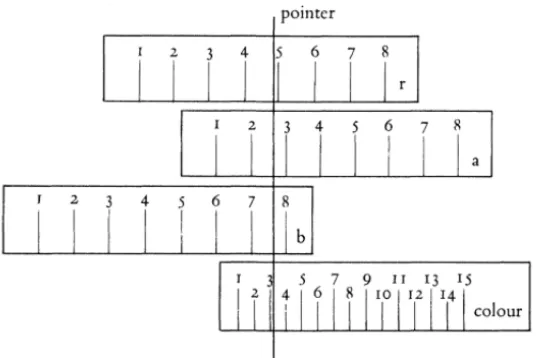
The core idea in The Second Theory is that semantics is measurement: The mind/brain uses measurement scales to make pictures of ‘spaces’, where a space is a range of logical possibilities for some domain of phenomena (Wittgenstein 1975a: Ch. IV & p. 317). The semantic properties of a scale are partially a matter of the internal structure of the scale, its ‘multiplicity’, and also partly a matter of how the scale is used (Wittgenstein 1922: §3.326). The use crucially depends upon the multiplicity; without the right multiplicity, there could be no relevant use. Scales are sometimes combined into complex structures, ‘calculi’ (Wittgenstein 1975a, McGuiness 1979), each scale of a given calculus being a picture of a dimension of the corresponding space. A given calculus is thus a picture of the pertinent space. (It is the construction of these calculi which raises the possibility of a generative grammar of sorts, a point to be expanded upon later.)
Figure 1: Representation of a calculus, or Satzsystem (propositional system). This calculus pictures the ranges of possible positions, colors, and radii of a circle in a two-dimensional space. The example is from Wittgenstein (1975a: §84).
Writing to G. E. Moore in 1930, Russell noted, in reflecting on recent conversations with Wittgenstein regarding his manuscript Philosophical Remarks, that Wittgenstein “uses the words ‘space’ and ‘grammar’ in peculiar senses, which are more or less connected to each other. He holds that if it is significant to say ‘This is red,’ it cannot be significant to say ‘This is loud.’ There is one ‘space’ of colours and another ‘space’ of sounds. […] Mistakes of grammar result from confusing ‘spaces’” (Russell 1951: 297). The grammar of a given calculus consists of the measurement scales making up its dimensions. “The syntax of ordinary language […] does not in all cases prevent the construction of nonsensical pseudo-propositions (constructions such as ‘red is higher than green’ […])” (Wittgenstein 1929: 162). “Red is higher than green” violates grammar because the scales which constitute the color calculus are distinct from the scales constituting the pitch calculus. The sentence “This is red and loud”, when it expresses a proposition, must thus be analyzable, on the level of the thought systems, into something along the lines of “A is red, and B is loud”. Each calculus, loosely speaking, represents its own world; the logical connectives (such as ‘and’, ‘or’, etc.) link these worlds.
Note, however, that this is only a theory of mental representation if measure-ment scaling is a specific type of thing. Wittgenstein was sensitive to the various sorts of measurement scaling, a point to be expanded upon later. Struck by this variety, he eventually came around to the view that logic and language have no essence. There is too much variety for theory to be possible, or so he came to be-lieve. Note Wittgenstein’s eventual anti-essentialism with regard to both number and language in Philosophical Investigations (Wittgenstein 2001: §§65–71). Given his earlier meditations on the varieties of scaling (Wittgenstein 1975a, McGuin-ness 1979) and the fact that the various scales can be used to define different types of number (Ellis 1966: Ch. IV, Wiese 2003: Ch. 1), an anti-essentialism with regard to scaling was almost certainly on his mind in writing about number in
However, as would be revealed by advances in measurement theory begin-ning in the late 1940s, there is some degree of beauty and formal simplicity underlying the types of measurement scales. It is at this point that the prospect of self-organization in neural activity arises with regard to the Second Theory. I suggest that, encouraged by these developments, one should pick up the thread and continue theorizing precisely where Wittgenstein left off. If the Wittgenstein-ian calculi provide insight into the representational powers of non-linguistic faculties, then the beauties of measurement theory could reveal that language is not so unique in this regard, since other systems also exhibit beauty.
There is another source of heterogeneity among logical forms, namely the contrast between forms arising within a calculus versus the recursive/combina-torial operation linking representations to yield molecular forms. In other words, there is the distinction between the language faculty and the thought systems, especially in terms of how the latter function apart from the influence of language. Advances in measurement theory will not make this kind of hetero-geneity go away. However, biolinguists should be comfortable with it, as it merely reflects the facultative nature of mind (Hauser et al. 2002).
3. The Atomic and the Molecular
The Second Theory, like the earlier version of the picture theory in Tractatus, assumes a potential analysis of representations into atomic representations. Each calculus determines logical relations among the atomic representations belonging to it.
If we try to analyze any given propositions we shall find in general that they are logical sums, products or other truthfunctions of simpler propositions. But our analysis, if carried far enough, must come to the point where it reaches propositional forms which are not themselves composed of simpler propositional forms. We must eventually reach the ultimate connection of the terms, the immediate connection which cannot be broken without destroying the propositional form as such. The propositions which represent this ultimate connexion of terms I call, after B. Russell, atomic propositions. They, then, are the kernels of every proposition, they contain the material, and all the rest is only a development of this material.
(Wittgenstein 1929: 162–163)
com-bined, according to a recursive operation, to form molecular propositions (Witt-genstein 1922: §§6–6.01). For example, if P, Q, and R are elementary propositions, then P & (Q & R) is a molecular proposition. Connectives introduce new logical relations, including those between calculi.
In Tractatus, Wittgenstein affirmed that there are no logical relations between elementary propositions other than consistency and self-implication, which are merely degenerate or limiting cases. True logical relations arise at the molecular level, and are captured in truth tables, according to this early view. However, by 1929, Wittgenstein came to realize that there are logical relations of exclusion among the readings of a single measurement scale even without molecular structure. In any specific case of measurement, a given reading logically excludes every other reading for that scale: “But from ‘a is now red’, ‘a is now not green’ follows, and so elementary propositions in this sense aren’t independent of each other like the elementary propositions in the calculus I described earlier—a calculus to which I assumed the entire use of propositions must be reducible—seduced by a false concept of such a reduction” (Wittgenstein 2013: 82). This is a general property of measurement: “[A] point mass can only have one velocity at a time, there can only be one charge at a point of an electrical field, at one point of a warm surface only one temperature at one time, at one point in the boiler only one pressure etc.” (Wittgenstein 1975a: §81).
Furthermore, there are arithmetical relations among the readings of a scale, e.g. the transitivity of an ordinal scale, which cannot be captured by truth tables. In fact, it is by reason of these arithmetical relations that the word ‘calculus’ is appropriate. Wittgenstein thus concluded that “[o]ne could surely replace the logic of tautologies by a logic of equations” (quoted in Hintikka 1996: 85). This is an overstatement, since one would also have to include relations of greater-than and less-than, e.g. in ordinal scaling. It is also an overstatement by reason of the fact that one would still need a logic of tautologies at the molecular level. Even so, the quote is useful in illustrating Wittgenstein’s perception that arithmetical relations are even more basic than truth-functional relations. Truth-functional relations presuppose these calculi, thus turning on its head the older view (Russell 1919) that arithmetic was reducible to logic, or some combination of logic and set theory.
4. Prelinguistic Systems
The picture theory of Wittgenstein, both in Tractatus and circa 1930, was intended as an account of mental representation. This is explicit in Tractatus: “The logical picture of the facts is the thought” (Wittgenstein 1922: §3), and “[t]he thought is the significant proposition” (Wittgenstein 1922: §4).2 Note also the remark
2 This is why Steven Pinker was unfair to Wittgenstein in speaking scornfully of his remark
genstein made in a lecture of 1930, as recorded in G. E. Moore’s notes: “What sort of harmony must there be between thoughts & the world? Only that the thought must have logical form; & without this it wouldn’t be a thought” (quoted in Stern et al. 2016: 2520). The point is that the calculus must have the same multiplicity as the relevant space of facts, the calculus here being something mental.
Given that the picture theory, including Wittgenstein’s Second Theory, is a theory of mental representation, it is in no way alarming to realize that some of Wittgenstein’s calculi are not language-like. This simply reflects the fact that not all thought is language-like. Some Wittgensteinian calculi are not language-like by virtue of not exhibiting discrete infinity (Bolender 2017). Within the biolinguistic paradigm, discrete infinity is understood to be biologically rare and, within the domain of cognition, uniquely human and wholly due to language (Hauser et al. 2002, Berwick & Chomsky 2016). Specifically, it is taken to be the result of recursion, usually understood as Merge (Chomsky 1995). Hence, bio-linguists seldom recognize any reason to posit a Merge operation in the systems of thought.3,4
Consider the calculus illustrated in Figure 1 above. It exhibits a kind of infinity but not the infinity resulting from the recursive combination of discrete constituents. It exhibits infinity of the same sort as the waggle dance of the honeybee: “Between any two signals there is in principle another, signaling a distance in between the first two, and this continues down to the ability to discriminate” (Chomsky 1988: 169). One finds here, in other words, either discrete finitude (finite due to performance limitations) or continuum infinity.
exactly it was supposed to mean, but it is not as patently absurd as saying that the limits of German were the limits of Wittgenstein’s world.
3 A reviewer for this journal suggests that the claim made here conflicts with the following
passage from Chomsky: “[T]he Basic Property is generation of an unbounded array of hier-archically structured expressions mapping to the conceptual-intentional interface, providing a kind of ‘language of thought’—and quite possibly the only such LOT, though interesting questions arise here” (Chomsky 2016: 13). The referee suggests that this passage indicates that Chomsky believes that the thought systems also utilize Merge.
My interpretation of the passage differs, however. In fact, the whole point in Chomsky’s speaking of interfaces is to imply that the systems of thought do not produce indefinitely many hierarchically structured expressions independently of language. Chomsky speaks of the language faculty as LOT, because he recognizes it as playing a role in cognition by means of the CI interface. (For a brief discussion of one of the “interesting questions” which Chomsky alludes to, see fn. 4 right below.) That Chomsky does not equate language with thought itself should also be clear from the following quote from the same book: “[F]unda-mental properties of language design indicate that a rich tradition is correct in regarding language as essentially an instrument of thought, even if we do not go as far as Humboldt in identifying the two” (Chomsky 2016: 16, emphasis added).
4 One apparent anomaly for this approach is the fact that people who lose syntactic ability in
That at least some calculi exhibit continuum infinity is clear from Wittgenstein’s first published attempt to articulate The Second Theory, or a fragment thereof.
If, now, we try to get at an actual analysis, we find logical forms which have very little similarity with the norms of ordinary language. We meet with the forms of space and time with the whole manifold of spacial and temporal objects, as colours, sounds, etc., etc., with their gradations, continuous transitions, and combinations in various proportions, all of which we cannot seize by our ordinary means of expression. And here I wish to make my first definite remark on the logical analysis of actual phenomena: it is this, that for their representation numbers (rational and irrational) must enter into the structure of the atomic propositions themselves. I will illustrate this by an example. Imagine a system of rectangular axes, as it were, cross wires, drawn in our field of vision and an arbitrary scale fixed. It is clear that we then can describe the shape and position of every patch of color in our visual field by means of statements of numbers which have their significance relative to the system of co-ordinates and the unit chosen. Again, it is clear that this description will have the right logical multiplicity, and that the description which has a smaller multiplicity will not do.
(Wittgenstein 1929: 165)
The calculus, in this case, must have representational powers corresponding to the real numbers in order to be homomorphic with the space of possible visual sensations. It is in this sense that the atomic propositions have real numbers coded into their structure. Relations of logical implication among numbers turn out to be primary, since they can be found at the level of the atomic proposition.
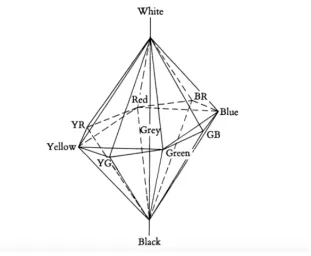
The reference to numbers here does not mean that the calculus in question is a system of discrete infinity. For a Wittgensteinian calculus is not, in every case, a system for combining discrete objects. The notion of calculation or equation, at least as it appears in early intermediate Wittgenstein, should not be taken to involve discrete objects or, at least, not in every case. In some cases, a number is not a digit but a point in a continuous space. Consider Wittgenstein’s attempt to illustrate a calculus for representing the space of possible colors (Figure 2); the system represented is not a particulate system but a blending system.5 The calculus in Figure 2 only contains numbers insofar as each point in the continuous structure represents a number.6
5 Abler (2005) observes that complex systems divide into two types: particulate and blending.
A particulate system consists of building blocks in hierarchical arrangement. Such a system is combinatorial and open-ended, language being a classic illustration. A particulate system stands in contrast to a blending system.
Continuous variation along one or a few dimensions is the very definition of a blending system. In spite of the panoramic grandeur and local fascination, geology is a blending system. Hills, plains and valleys don’t form combi-nations with one another to create something with properties beyond those of hills, plains, and valleys. Not the way atoms do.” (Abler 2005: 70–71) Wittgenstein’s calculus for representing possible colors is a blending system, as it exemplifies continuous variation along dimensions.
6 Wittgenstein would later reject the double-cone representation appearing in Figure 2
Figure 2: Wittgenstein’s double-cone representation of color space. “If we represent the colours by means of a double-cone, instead of an octahedron, there is only one between on the colour circle, and red appears on it between blue-red and orange in the same sense as that in which blue-red lies between blue and red. And if in fact that is all there is to be said, then a representation by means of a double-cone is adequate, or at least one using a double eight-sided pyramid is” (Wittgenstein 1975a: §221).
Figure 2 illustrates a continuous calculus, not Merge-like in any way. It is true that the real numbers are definable in terms of operations on the naturals, and the naturals exhibit discrete infinity. However, in Figure 2, one finds a system of infinite multiplicity not presupposing discrete infinity. One has here the reals without the naturals.
I earlier noted that some Wittgensteinian calculi are not language-like by reason of exhibiting continuum infinity; note that there are others which are not language-like by reason of exhibiting discrete finitude. Once again, this is an encouraging feature of Wittgenstein’s Second Theory since it underscores the potential here for understanding the form of representations outside the lang-uage faculty. Before considering examples from Wittgenstein, let’s review the distinctions in question:
To put it simply, each sentence has a fixed number of words: one, two, three, forty-seven, ninety-three, etc. And there is no limit in principle to how many words the sentence may contain. Other systems known in the animal world are quite different. Thus the system of ape calls is finite; there are a fixed number, say, forty. The so-called bee language, on the other hand, is infinite, but it is not discrete. A bee signals the distance of a flower from the hive by some sort of motion; the greater the distance, the more the motion. Between any two signals there is in principle another, signaling a distance in between the first two, and this continues down to the ability to discriminate.
In addition to those Wittgensteinian calculi which are formally analogous to bee signals, there are also such systems which are formally analogous to ape calls. In a conversation with Friedrich Waismann early in 1930, Wittgenstein observed that “[w]hat I admittedly do not know is how large the domain of arguments is. And there might, for example, be only two. (Telephone dialling: free, in use— here we know that only these two values exist and they depict reality. An inter-mediate position does not signify anything. No transition.)” (quoted in McGuin-ness 1979: 90). In other words, a given dimension of such a system need not be continuous, but may consist of a finite set of logical possibilities. Wittgenstein also made the point in writing.
What we have recognized is simply that we are dealing with yardsticks, and not in some fashion with isolated graduation marks. […] We might think of the signals on a ship: ‘Stop’, ‘Full Speed Ahead’, etc. Incidentally, they don’t have to be yardsticks. For you can’t call a dial with two signals a yardstick. […] If I say I did not dream last night, I must still know where I would have to look for a dream (i.e. the proposition ‘I dream’, applied to this situation can at most be false, it cannot be a nonsense). I express the present situation by a setting—the negative one—of the signal dial ‘dreams—no dreams’.
(Wittgenstein 1975a: §§84 & 86)
The examples which Wittgenstein gives here are recognizable as instances of what would later be called ‘nominal scaling’ (Stevens 1946). A nominal scale consists of labels, each label corresponding to a property. On a questionnaire, for example, one might encounter the question “Are you a smoker? Yes or no”. Or one might encounter “State your political party”. Each of these questions measures the thing, such as a person, simply by putting it into the proper slot in a list of categories. Hence, among the Wittgensteinian calculi, one finds both alter-natives to discrete infinity, namely continuum infinity and discrete finitude.
In his Tractatus, Wittgenstein may have succeeded in avoiding the appear-ance of heterogeneity by naively assuming that all measurement is reducible to nominal scaling. Consider the following illustration of representation in
Tractatus:
An illustration to explain the concept of truth. A black spot on white paper; the form of the spot can be described by saying of each point of the plane whether it is white or black. To the fact that a point is black corresponds a positive fact; to the fact that a point is white (not black), a negative fact. If I indicate a point of the plane […], this corresponds to the assumption pro-posed for judgment, etc. etc. (Wittgenstein 1922: §4.063)
The notion of information is thus clear enough nowadays when properly relativized. It is central to the theory of communication. It makes sense relative to one or another preassigned matrix of alternatives—one or another checklist. You have to say in advance what features are going to count. Thus consider the familiar halftone method of photographic illustration. There is a screen, say six by six inches, containing a square array of regularly spaced positions, say a hundred to the inch in rows and columns. A halftone picture is completely determined by settling which of these 360,000 points are black. Relative to this screen as the matrix of alternatives, information consists in saying which places are black. Two paintings give the same information, relative to this matrix, when they determine the same points as black.
(Quine 1986: 4)
This example illustrates how a calculus exhibiting discrete finitude, even when based upon the simplest kind of nominal scaling, can be informationally rich.
5. Scales as Constituting Essence
Wittgenstein’s abandoned second philosophy of logic is a torso in the same sense that one speaks of an unfinished work of art as a torso. One can make progress in developing the torso by considering developments in measurement theory. The aim here is to arrive at a conception of logical form for natural logic, by which I mean the theory of how logical relations are represented in the mind/brain. Given that the logic in question is natural logic, a more developed form of Witt-genstein’s second philosophy of logic has the potential to connect with work in cognitive science.
Measurement scales also play a fundamental role in Relational Models Theory (RMT) in cognitive anthropology (Fiske 1990, 1991, 1992, 2004a). In contrast to Wittgenstein’s eventual theoretical nihilism, however, RMT is usually understood to be an attempt at formulating a generative grammar for social relations. Reflecting on why RMT is interpreted so differently from Wittgen-stein’s philosophy of logic, despite both being similar, even in very fundamental ways, will throw light on how the Second Theory can be understood in gener-ative terms. RMT not only provides a model for theoretical development, it is an actual example of the application of calculi to spaces of social relations.
RMT assumes that the four scale types of Stevens (1946) are basic to social cognition. These four types are familiar from everyday life, illustrated in Table 1.
Scale types Examples Examples
Nominal Pass versus fail Hot versus cold Ordinal Student ranking This is hotter than that
Interval Letter grading Centigrade
Ratio Percentage grading Kelvin
According to RMT, each basic mental model used in structuring social cognition strongly resembles one of the scale types. There are, thus, four basic forms of so-cial interaction, one for each type of measurement scale.7 Quoting the originator of RMT:
Relational models theory is simple: People relate to each other in just four ways. Interaction can be structured with respect to (1) what people have in common, (2) ordered differences, (3) additive imbalances, or (4) ratios. When people focus on what they have in common, they are using a model we call Communal Sharing. When people construct some aspect of an interaction in terms of ordered differences, the model is Authority Ranking. When people attend to additive imbalances, they are framing the interaction in terms of the Equality Matching model. When they coordinate their actions according to proportions or rates, the model is Market Pricing. (Fiske 2004a: 3)
In Communal Sharing, people focus on what they have in common. This could be friendship, ethnicity, a history of suffering, romantic love, sharing food at the dinner table, etc. Fiske not only notes that nominal number assignments resemble Communal Sharing, he identifies Communal Sharing (CS) as a nominal scale:
Roughly speaking, Communal Sharing is a kind of categorical (nominal) scaling, in that the only distinction that people make is of type or class: are two people of the same kind or different? Within the framework of the CS relationship, if two people belong to the same category (say, a family or ethnic group) then, with regard to the dimension that is communally organ-ized, the people in that relationship are equivalent and undifferentiated.
(Fiske 1991: 209)
An example of nominal scaling in measurement would be a questionnaire asking whether people smoke. Even though smoking is a matter of degree, this is ignored in nominal scaling. Either one belongs in the category of smoker or one does not. In Communal Sharing, likewise, one is either in the group or one is not. Shades of gray are not recognized.
Authority Ranking (AR) concerns ordered differences. Social units consti-tute a hierarchy. It resembles an ordinal scale, namely “a scale on which data are shown simply in accordance with some order, in the absence of appropriate units of measurement. For example, a squash ladder is an ordinal scale since one can say only that one competitor is better than another, but not by how much” (Borowski & Borwein 1991: 423). “Authority ranking is a linear ordering in which everyone’s rank can be compared with everyone else’s […]. Thus, the relations that are socially significant in an authority ranking relationship are similar to those that are specified by an ordinal scale” (Fiske 1992: 690).
In Equality Matching (EM), one maintains balance and corrects imbalances. Examples include the democratic principle of one vote per person, equal distri-bution of food in a school cafeteria, people taking turns, etc.
7 There is much controlled evidence supporting the claim that the scale types play a