MAXIMUM LOAD AND MINIMUM VOLUME
STRUCTURAL OPTIMIZATION
J. Pietrzak
Department of Civil Engineering, University of Beira Interior 6200 Covilhâ, Portugal
(Received: June. 4, 1997 Accepted in Final Form : May 22, 2000)
A bi-criteria optimization is considered whose objectives are the maximization of the Abstract
load sustained by a structure and the minimization of the structure's volume. As the objectives are conflicting, the solution to the problem is of the Pareto type. The problem is elaborated for a thin-walled column of cruciform cross-section, prone to flexural and torsional buckling. A numerical example is also presented.
Bi-cr ite ria , O p tim iza tio n, Bu ckling, Co lu m n, Pa ret o Solu tion , Str u ct u ra l, Key Words
Optimization
©\e ¬jo ¥ Ake ° ²pBw w±U ²k{ ¥ªdU nBM ¬jo oX @Ake kµ BM ºA³¯B£°j ºpBw ³®¼´M x°n
²k¼ña
y¯Bª ºAoM ³§Fv« /SwA "±UnBQ" ±¯ pA ³§Fv« ¥e Am§ ,k® B®T« B´ kµ ½A ³ B\¯C pA /SwA ²k{ ³T o£ o ¯ nj ²pBw ºjkî »§BX« /SwA ²k{ ³T o£ o ¯ nj »z`¼Q y¯Bª ±¯ ° ²k{ ²joM nBñM ¥ñ{ »L¼¦æ é « BM pB¯ nA±½j ¬±Tw /SwA ²k{ ³ÄAnA q¼¯
INTRODUCTION
The majorit y of t he st ruct ural optimization problems presented in the literature [2,5,12] are single -crite rion ones wit h the obje ct ives of e it he r t h e ma ximiza t io n of t he st ru ct ure ' s carrying capacity or the minimization of its cost or volume. When se arching for the stronge st st ruct ure ( P ro ble m 1), it s co st o r ma t e rial volume is pre det ermine d and kept constant . When, on the other hand, the minimization of the structure ' s cost or volume is carrie d out (Problem 2), t hen the bearing capacit y of the structure or its external load is predetermined and kept constant.
T h e a im o f t h is p a pe r is t o co n side r a bi-criteria optimization problem that combines t h e t wo a bove me n t io ne d p roble ms. M o re specifically the combined problem is to find the structure that, within the frames of various side
a n d be h avio ra l con st r ain t s, wo u ld be t h e st rongest and would have the least possible volume.
C le a r ly, t h e de ma n ds o f t h e ma ximu m strength and the minimum material volume are conflicting and, therefore, the optimum solution t o the proble m, in t he ordinary se nse of the word, does not exist. Instead, the problem can b e a p p r o a ch e d b y a p p lyin g t h e P a r e t o optimality [4,13].
mu lt iple -cr it e ria pr oble ms h ave also be e n stated, solved and published in the literature [1, 3,4,6,7,13]. I n mo st o f t h e se p a p e r s, t h e objective functions adopted by the authors were the structure's volume and displacements of the se le ct e d p oint s, or t he allowable load a nd displacements.
L it t l e wo r k i s r e p o r t e d c o n ce r n in g multi-criterion optimization with the objective functions reoriented towards the maximization of the allowable load applied to the structure and the minimization of its volume [10,11]. Such a type of the reoriented bi-criterion problem is presented in this paper.
The procedure followed is as follows. First the bi-criterion problem is stated more formally and t he adopted criterion for ranking Pare to solution is described. Then, the same problem is specified for a thin-walled column of cruciform cross-section. And finally, a numerical example is solved.
GENERAL FORMULATION OF THE PROBLEM
Consider a structure whose material, topology and loading pat tern ( but not the value of t he lo ad fa ct o r) are kn own a nd who se ove ra ll ge o me t r y, a s we ll a s t h e cr o ss-se ct io n a l dimensions are specified by a set of preassigned parameters and by a set x of design variables x1, x2, ..., xn. Le t t he fe asible domain D of t he de sign variable s be de line at ed by m side and behavioral inequality constraints gi(x) À 0. The problem is to find such feasible design variables that describe the structure capable of sustaining possible the largest load, using possibly the least amount o f mat erial. Since t he object ives are conflict ing, there e xist only P areto opt imum solutions x* to the problem.
The solution x*ûD is a Pareto solution to
the problem considered if and only if there is no such xûD which gives simultaneously greater or equal (Â) allowable external load and less or equal (À) volume than x*does, and additionally makes at least one of the two relations: Âand
À, a sharp inequality.
M o st commo n is t he e xist e n ce o f ma ny Pareto solutions for any bi-criterion problem, from which, usually, one or more so calle d preferred solutions`x*could be selected. The preferred solution is the one which satisfies an adopted additional criterion.
O ur aim is just t o de termine t he preferred Paret o opt imum solution(s)`x*, which can be stated more formally as follows: find`x*ûD that ma ximize s loa d fa ct or f1( x), min imize s t he st r uct ur e ' s vo lu me f2( x), an d sa t isfie s t h e adopte d crit e rion for being classifie d as the preferred solution.
Be fore st ating t he crit erion of pre fe rence that will be used in this paper, let us introduce two pe rformance functions f'
1( x) and f'2( x), defined as follows:
f'1(x)=100[f1(x)-f1max]/(f1min-f1max) f'2(x)=100[f2(x)-f2min]/(f2max-f2min)
where f1max and f1min are the maximum and minimum values, respectively, of the load factor function f1( x) for xûD , f2maxand f2minare t he maximum and minimum values, respectively, of the structure's volume function f2(x) for xûD.
E ach of the performance functions map the design variables space (D VS) 0, x1, ... , xninto the pe rformance function space (PFS) 0'f'1f'2. Thus, each point xûDVS has its image x'ûPFS, each Pareto solution x*ûDVS is mapped into its image x*' in PFS, and the whole feasible domain D is mapped into its image set D'.
equal to zero. Z ero coordinates indicate t hat t h e o b je ct ive fu n ct io n s f1( x) a nd f2( x) a re simu lt an e o usly be st fu lfille d by a ce r t a in hypothetical point x1ûDVS.
H owe ve r, such a point xI, representing an ide a l so lu t ion , do e s n ot e xist be cau se t he o bje ct ive s f1( x) a n d f2( x) ar e co n flict in g. Nevertheless, despite non-existence of the point xI, it is convenient to consider its counte rpart x'
IûP F S and t re at it as a re fere nce point in ranking the Pareto solutions. The ranking can be performed in accordance with the following criterion.
The Pareto solution x*IûD VS is deemed to be be t t e r t h a n P a r e t o so lu t io n x*
2 if t h e distance, measured in PFS, between the images x*
1', and x'I is smaller than the distance between x*
2'and x'I.
I n t h e ca se o f t h e bi-cr it e r ia p r o ble m considered in the paper, the distance between x*' and x'I is given by
r =
¡
f'1(x*)2 + f'2(x*)2
Pareto solution x* is treated as the preferred one ( denote d furt he r by`x*) if t he dist ance between it image `x*' and x'
I is the least of the distances between the images x*'of other Pareto solutions and point x'
I.
The proble m outlined above will now be specified for the optimization of a thin-walled column of cruciform cross-section.
COLUMN OPTIMIZATION
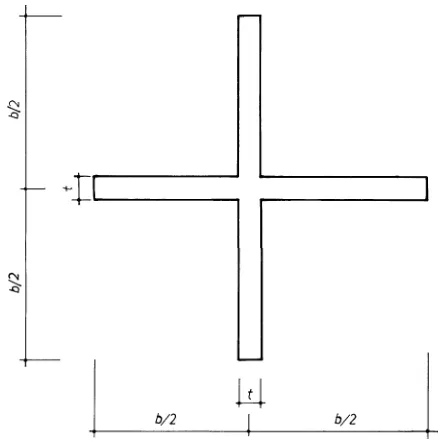
Consider a pinned-pinned column of length L, of the thin-walled cruciform cross-section shown in
F igure 1, subje cte d t o a cent ral load P . The column, due to it s cross-sectional shape and dime n sions ( tÀL), is prone to fle xural and torsional buckling [14].
The flexural buckling load, PFB, expressed in
Figure 1. The cross-section of a column.
t erms of dime nsionle ss quant itiesx= t /b and
h= b/L is e qual t o PFB=p2EL2h4x(1+ x2-x3)/12 while the torsional buckling load, PTB, is given byPTB= 2EL2h2x3(2-x)/[(1+n)(1+x2-x3)], where E andnde note the modules of e lasticity and Poisson's ratio, respectively.
In some circumstances, yield of the column's material may occur be fore or simult ane ously wit h buckling. The yield force, PY, is given by PY = sYA = sYL2h2x ( 2-x) , wh e re sY is t he yield stress and A is the cross-sectional area of the column.
The t ypical single -crit e rion opt imization problems that can be formulated with reference to the above column are as follows.
For a given material volume V1
Problem 1.
and prescribed column's length L, findxandh
that in the feasible domain D maximize the load P applied to the column.
Problem 2.
For a given load P and column's le n gt h L , fin d x a n d h t h a t min imize t h e column's volume V in the feasible domain D.the following manner:
Problem 1.
F in d x = {x1 x2}= {x h} t h a t maximizes f1(x)=P=min(P FB,PTB,PY) subject to g1(x) = V1-L3h2x( 2 -x) = 0 ( vo lu m e is k e p t constant)í
g2(x) = xmin-x À 0
à à
g3(x) = x-xmaxÀ0
¯ (side constraints)
®
g4(x) = hmin-h À 0
à î
g5(x) = h-hmaxÀ0
Problem 2.
Find x = {x1 x2}={x h}that minimizes f2(x)= V = L3xh2(2-x) subject to g'1(x)= P -min( PFB, PTB, PY)= 0 ( t he a pplie d load is kept constant)
g'
2(x) = xmin-xÀ0
g'3(x)= =x-xmaxÀ0 (side constraints) g'
5(x) = h-hmaxÀ0 g'
4(x) = hmin-hÀ0
The bi-criterion problem, suggested in this paper, specified for the column considered, is to find x and hthat make the column possibly the st rongest , using possibly t he least amount of material.
St a t in g it fo r m a lly, t h e p r o ble m is t o determine
`
x*= {`
x*`h*} that constitutes the preferred solution within the Pareto solutions to the bi-criterion problem:find x = {x1 x2} = {x h} that maximizes f1(x)=min(P FB, PTB, PY),
minimize s f2(x)= L3 h2x( 2-x) , sa t isfyin g t he constraints g2(x), g3(x), g4(x) and g5(x).
The problem can be solve d in a varie ty of wa ys. O ne op tio n wou ld be t he u se of t he weighting method [4].
The weighting method transforms the vector optimization problem int o the scalar problem who se so lu t io n co in cide s wit h t h e P a r e t o solution to t he original proble m. The scalar problem consists in finding the minimum point
x*of a single-valued obje ct ive funct ion z(x), fo r m e d a s t h e su m o f p r o d u ct s wifi(x) , i= 1, 2, .. .,n , o f n o n - n e ga t ive we i gh t i n g
coe fficie nts wi's and t h e object ive fu n ct ions fi(x)'s. The weighting coefficients are, usually, normalized so that õwi=1. Consequently, in our bi-crit e r ion case , z( x) wou ld be w1f1( x) + w2f2(x) = w1f1(x) + (1-w1)f2(x).
The scalar minimization of z(x), carried out for various values of weighting coefficients wi, le ads to creating a set of Paret o solutionsx*. Th e solu t ions obt aine d ar e , subse que n t ly, subject ed to a ranking procedure, pe rformed according to an adopted preference criterion. The crit erion may be, for e xample, t he above mentioned criterion of the minimum distance r of the imagex*,of the Pareto solutionx*from the ideal solution's image xI', me asured in the objective functions space Of1f2.
Another option, well suited for solving the proble m posed in this paper, is t o det ermine and plot the contour lines of functions f1(x) and f2(x). Their inspe ction, accompanie d by t he inspection of the directions of gradient vectors
Ø Ø
êf1and êf2pe rmit s, as will be shown in t he numerical example, to recognize easily the set o f P a r e t o so lu t io n s x* in D . N e xt , t h e recognized Pareto solutionsx*are subjected to ranking, carrie d out in accordance with t he crit e rion of t he minimu m distance r of the image x*' from xI'in the objective function space Of1 ' f2 ' or performance function space O ' f1 ' f2 ' .
T h e p r o b le m ca n a ls o b e so lve d b y minimization, in the design variable space, of a scalar fu nctio n r(x)=¡f 1'(x)2+ f2'(x)2,xûD , that describes the distance of any feasible design's image (Pareto solutions'x*,included) fromxI'. The numerical problem that follows is solved by using the last two methods.
Numerical example.
The problem is solved for t he following dat a: E = 205 G P a, n= 0.3, L = 3 . 0 m , sY= 3 5 0 M P a , xmin= 0 . 0 1 5 ,The obje ctive functions f1(x) and f2(x) for the above data are of the form
f1(x) = min{1.5174*106h4x(1+x2-x3), 2.8385*106
h2x3(2-x)/(1+ x2-x3); 3150h2x(2-x)} f2(x) = 27.0h2x(2-x).
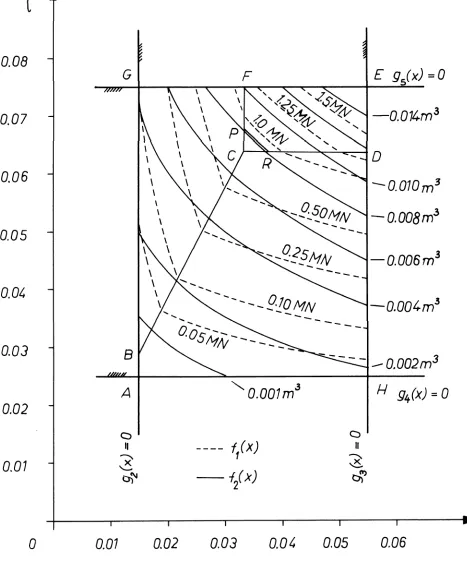
The feasible domain and contour lines of the functions f1(x) and f2(x) are shown in Figure 2. Examination of Figure 2 indicates that within rectangle CDEF the contour lines of f1(x) and f2(x) are parallel which means that the gradient
Ø Ø
vectors êf1 and ê f2 have the same directions. F or any point xûCD E F the incre ase of t he value of f1(x) is possible in any direction which
Ø
makes an angle aû(-p/2, p/2) with vector êf1, while the decrease of f1(x) is possible only in
Ø
the direction forming with vector -êf2 an angle
bû(-p/2,p/2). Since aúbis an empty set, there exists no such a direction from any p o in t xû
CD E F which would allow for simult ane ous i n c r e a s e o f f1(x) and decrease of f2(x). Consequently, any point xû CDEF is the Pareto solution.
Let us now examine ridge BC of function f1(x) . F r o m a n y p o in t x o f t h e r idge , t h e in cre a se o f f1(x) can be obtained if a step is made in the direction contained in the cone of angle g, (g<p), formed by the tangents to the contour lines of f1(x) at x belonging to the ridge. At the same time, the decrease of f2(x) can be obtained if a step is made from x in the direction that forms an angle bû(-p/2,p/2) with the negative gradient of f2(x). Since gúb=f, there is no such a direction along which a step made would simultaneously increase f1(x) and decrease f2(x). Thus, any xû BC is the Pareto solution.
By similar reasoning, suppleme nted by the e ffe ct of the const raint g2(x)=0, one can also find t h at a ll o f t h e p oin t s x be lon gin g t o segme nt AB are t he P are to solutions to the
problem.
Among the det e rmined Pare to solut ions, t h e r e a r e t wo wh ich , a t t h e sa me t im e , co n st it u t e solu t io n s t o t h e single -crit e rion optimizat ion proble ms. The se solutions are represented in F igure.2 by points E (x= 0.055,
h= 0 . 0 7 5 ) a n d A (x= 0 . 0 1 5 , h= 0 . 0 2 5 ) , respectively.
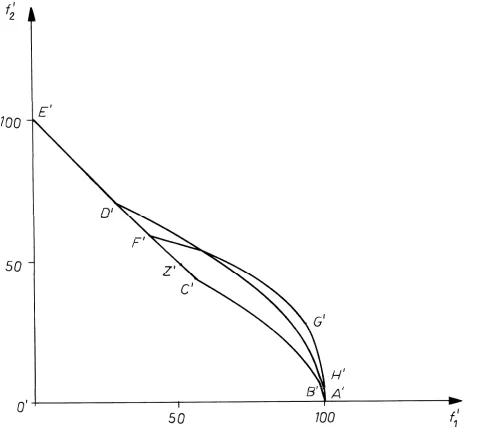
From the design variable space, let us now move to the performance function space Of1'f2'. The image of t he feasible domain D (area AH E G ) in t he pe rformance function space O'f1'f1'is presented in Figure. 3. The collection o f p o i n t s a l o n g t h e c u r ve A'B'C'F'D'E' represents the image of the Pareto solution set. T h e p oin t clo se st t o t h e o r igin O' o f t h e reference frame, denoted in Figure 3 by letter Z', is an image of the preferred solutions. In the DVS, the preferred solutions are represented by t h e p o in t s be lo n gin g t o lin e P R , wh o se e xt r e mit ie s P a n d R h a ve t h e fo llo win g coordinate s ( 0.03333, 0.06792) and (0.03780, 0.06386), respectively.
For all the preferred solutions `x*, the values o f t h e o bje ct ive fu n ct io n s a r e t h e sa me : f1(`x*)=0.953 MN and f2(`x*)=0.00816m3.
Comparing the maximum load sustained by the preferred design `x* and its volume with the P and V pertaining to other characteristics of the feasible designs, it can be found that P(`x*) = 0.953 MN= 0.503 f1max= 0.503(xE)= 107.207*f1min = 107.207P(xA), V(`x*) = 0.00816m3 = 1.991 f
2min = 1.991V(xA) = 0.502 f2max= V(xE).
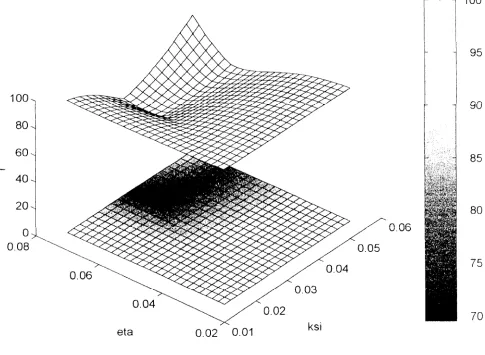
The pre se nt nume rical e xample has also be e n solve d by comput e r minimizat ion of a scalar function r(x) = r(x,h) = ¡f'
Figure 3. The image of the feasible domain in the performance function space.
shows the surface representing function r(x,h) and the shade map of r(x, h). The darkest region of the map refers to the set of the preferred solutions x*.
CONCLUDING REMARKS
Although structural optimization problems are by nature multiple-criteria, they are usually not treat ed as such. D esigners freque ntly reduce them t o single-crit erion one s, choosing most often as the objectives either the maximization
of the structure's strength or the minimization of the structure's cost. The main reason is the relative complexity of the solution procedures for multi-criteria problems.
Figure 4. The surface representing function r(x,h) and shade map of r(x,h).
is especially true when both the number of the obje ct ive funct ions an d t he nu mbe r o f the de sign var iable s are ke p t lo w. Thou gh t he problem pre se nte d here is only bi-crit eria, it take s into account quite e ssential obje ctives such as the maximization of the load factor for t h e st r uct ur e a nd t h e minimizat io n o f t he structure's volume. By formulating the problem in terms of two design variables only, as it was done in t he numerical example, the problem was made amenable to solving by inspection of the contour lines of the objective functions.
An int e r e st ing fe at ure of t he bi-crit e ria
LIST OF SYMBOLS
The following symbols are used in the paper Cross-sectional area of a column
A=
Width of the cruciform cross-section of a column b=
Modulus of elasticity E=
load factor function f1(x)=
structure' volume function f2(x)=
performance function f'1(x)=
performance function f'
2(x)=
i-th constraint function of Problem 1 and Problem 3 gi(x)=
i-th constraint function of Problem 2 g'i(x)=
Length of a column L=
Central load applied to a column P=
torsional buckling load PBP=
flexural buckling load PTB=
yield force PY=
Thickness of the wall of a column t=
Column's volume V=
i-th design variable xi=
Feasible domain D=
Image of feasible domain 2D'=
Vector of design variables
x=
Image of x in the performance function space
x'=
Pareto optimum solution
x*=
image of x* in the performance function space
x*'=
preferred Pareto optimum solution
`x*=
image of the preferredPareto optimu m solu tion
`x*'=
in the performance function space ideal solution
xI=
image of xI in the performance function space
xI'=
t/b=dimensionless quantity
x=
b/l=dimensionless quantity
h=
yield stress.
sY=
REFERENCES
Adali S., "Pareto Optimal D esign of Beams Subjected 1.
t o Su p p o r t M o t io n s", Comp. Struct., 1 6 , ( 1 98 3) ,
297-303.
Brandt A. M. (Ed.), "Fou ndations of Optimal D esign 2.
in C ivil E n g in e e r in g ", M a r t in u s N ij h o f f P u b lis h e r s , PWN-Polish Scientific Publishers, (1989).
Carmichael D. G., "Computation of Pareto Optima in 3.
St r u c t u r a l D e s ign ", Int. J. Numer. Meth. Engng., 15, (1980), 925-929.
E sche n a u e r H ., Ko ski J . a n d O syczka A. ( E ds.) , 4.
"M ulticriteria D esign O ptimization", Springer Verlag, (1990).
H a u g E . J . a n d Ce a J . ( E d s) , "O p t im iza t io n o f 5.
D ist r ib u t e d P a r a m e t e r St r u ct u r e s", Sijt h o ff a n d Noordhoff, (1981).
Koski J., "Tru ss Optimization with Vector Criterion", 6.
T e m per e U nive r sit y of T echnology, D e par t m e nt of Mechanical Engineering Applied Mechanics, Report 6, Tempere, (1979).
Koski J. a n d Silve n no ine n R ., "Pa r et o O pt ima o f 7.
Isosta tic T r u sses", Comput. Mech. Appl. Mech. Engng., 31, (1982), 265-279.
MATLAB: Version 4. User's Guide, The Math Works 8.
Inc., Prentice Hall, (1995).
Mu rthy K. N. and Christiano P, "O ptimal D esign for 9.
Prescribed Buckling Loads", J. Struct. Div. Proc. ASCE, 100, (1974), 2175-2190.
Pietrzak J., "Vector Optimization to Structures Prone 10.
to Instability", Computers & Structures, Vol. 45, No. 4, (1992), 813-816.
Pietrzak J., "Bi-Criteria O ptimization of Stru ctu res 11.
L i a b le t o I n s t a b i lit y" , Structural Optimization, 7, 1/2, (1994), 61-65.
Soares C. A. M. (E d.), "Co mpu ter Aided O ptimu m 12.
D e sign St r u ct u r a l a n d M e c h a n ic a l Syst e m s, Springer-Verlag, (1986).
St a d le r W. ( E d .) , "M u lt icrit e r ia O p t im iza t io n in 13.
E n g i n e e r in g a n d in t h e S ci e n ce s ", P le n u m P r e ss , (1988).
Timoshenko S. T. and Gere, J. M., "Theory of Elastic 14.