i
tif c n
e C
i o
c n
S f
l e
a r
n e
o n
i c
t e
a 2
nr 0
et 1
1
n I
ISC 2011
Proceeding of the International Conference on Advanced Science,
Engineering and Information Technology 2011
Hotel Equatorial Bangi-Putrajaya, Malaysia, 14 - 15 January 2011
ISBN 978-983-42366-4-9
ISC 2011
International Conference on Advanced Science, Engineering and Information Technology ICASEIT 2011
Cutting Edge Sciences for Future Sustainability Hotel Equatorial Bangi-Putrajaya, Malaysia, 14 - 15 January 2011
SR
IE AVI
UN IT NESIE DOKB
IN N
R AG
JA A
L S
A A
E N
P M
N A
A L
U A
T Y
A S
S A I
REPNOI TAI COSSA STNEDUTS NA IENSODN I Organized by Indonesian Students Association Universiti Kebangsaan Malaysia Proceeding of the
Using Structural Equation Modeling and the
Behavioral Sciences Theories in Predicting Helmet
Use
Kamarudin Ambak1*, Rozmi Ismail2, Riza Atiq Abdullah3 and Muhamad Nazri Borhan4 1
Faculty of Civil & Environmental Eng., Universiti Tun Hussein Onn, Batu Pahat, 84600 Johor, MALAYSIA *Correspondence Author: Tel: +6012 7662895, E-mail:[email protected]
2
School of Psychology & Humanities, Universiti Kebangsaan Malaysia, Bangi, 43600, Selangor, MALAYSIA Tel.: +60389213626, E-mail: [email protected]
1,3,4
Department of Civil & Structural Engineering, Universiti Kebangsaan Malaysia, Bangi, 43600, Selangor, MALAYSIA Tel.: +60389214429, E-mail:[email protected], [email protected], [email protected]
________________________________________________________________________________________
Abstract—In Malaysia, according to road accidents data statistics motorcycle users contributes more than 50% of fatalities in traffic accidents, and the major cause due to head injuries. One strategy that can be used to reduce the severity of head injuries is by proper usage of helmet. Although the safety helmet is the best protective equipment to prevents head injury, majority motorcycle user did not use or did not fasten properly. In understanding this problem, the behavioral sciences theory and engineering aspect are needed to provide better explanation and comprehensive insights into solutions. The Theory Planned Behavior (TPB) and Health Belief Model (HBM) were used in predicting the behavioral intention toward proper helmet usage among motorcyclist. While, a new intervention approach were used in Technology Acceptance Model (TAM) that based on the perception of a conceptual system called Safety Helmet Reminder System (SHR). Results show that the constructs variables are reliable and statistically significant with the exogenous and endogenous variables. The full structured models were proposed and tested, thus the significant predictors were identified. A multivariate analysis technique, known as Structural Equation Model (SEM) was used in modeling exercise. Finally, the good-of-fit models were used in interpreting the implication of intervention strategy toward motorcyclist injury prevention program.
Keywords— Behavioral Intervention, Structural Equation Model, Theory of Planned Behavior, Health Belief Model, Technology
Acceptance Model, Helmet use
_________________________________________________________________________________________
I. INTRODUCTION
Road safety is one of major concern in Malaysia and becoming a public health issues, since number of people
killed on the road increased significantly. According to
Royal Malaysian Police (PDRM), more than 6000 people killed in road accidents annually. In 2007 alone, PDRM reported that 6282 of fatalities were recorded in road crashes. Of this figure, the motorcycle users accounted for 50% (or
accidents statistics showed that the most part of body injured lead to fatality is head by 65% [1]. But, safety helmet is only the best protective equipment that can be used to protect motorcycle users’ head from injuries [5, 8, and 9]. Many studies shown that the helmet is effective in preventing and reducing the severity of head injuries by 37% to 72% [10 and 11] or deaths by 20% to 24% [12 and13].
Beside the usefulness of safety helmet, majority motorcycle user did not use or did not fasten properly. There are several studies in developing countries found that the percentage of proper usage of helmet among motorcycle users is considered low [2, 4, 7, 11, 14 and 15]. However,
Radin et al. [5] highlighted that Malaysian government has
taken role of safety concern regarding helmet issue by implementing series of initiatives since early seventies. Beginning with Introduction of Motorcycle Safety Helmet Standard MS1: 1969, Implementation of Helmet Law in 1973, Targeted safety helmet campaign in 1997 to date and newly intervention program is the Community Based Program in 2007 to date. Then, the effectiveness of helmet
initiatives has been evaluated with a few studies. Radin et al.
[5] reported that since 1995, 1998 and 2000, the rates of proper usage of safety helmet were increased by 33%, 41% and 54% respectively. It is seem positively improve but the percentage rate was saturated at 66%. Furthermore, this figure is represents in average for both areas in urban and rural. But, the compliance rate in rural area was considered low at 33% [16] and needs to do extra effort regarding their
safety concerned. Li et al [11] suggested that there is a need
to implement new interventions to increase helmet use. Therefore, the aim of this study is to apply a behavioral sciences theory or model in predicting intention toward proper usage of helmet and to determine a significant predictor that contribute to the behavioral intention of safety helmet usage.
II. STRUCTURAL EQUATION MODEL (SEM)
The development of structural equation modeling (SEM) methods and software has proceeded rapidly since the 1970s [17]. An SEM is an extremely flexible linear-in-parameters multivariate statistical modeling technique and it has been used in modeling travel behavior and values since about 1980s [18]. Structural equation modeling (SEM) is a family of statistical techniques permitting researchers to test such models and as a hybrid of factor analysis and path analysis that researchers can test hypothesized relationships between constructs [19]. Also, SEM is a technique used for specifying and estimating models of linear relationships among variables. Variables in a model may include both measured variables (MVs) and latent variables (LVs). LVs are hypothetical constructs that cannot be directly measured [17]. An SEM is a relatively new method and applied in many areas such as in psychology, sociology, the biological sciences, educational research, political science, market research and travel behavior [18].
An SEM has two primary components: the measurement
model and the structural model. The measurement model
describes the relationships between observed variables (e.g. instruments) and the construct or latent variables are hypothesized to measure. In contrast, the structural model describes interrelationships among constructs. When the measurement model and the structural model are considered together, the model may be called the composite or full structural model [19]. Figure 1 shows a basic example of component in structural equation model.
Figure1: A basic example of SEM component [20]
III. BEHAVIORAL SCIENCES THEORIES
Behavioral and social sciences theories and models have the potential to enhance efforts to reduce unintentional injuries [21]. The behavioral sciences theories such as Theory of Planned Behavior (TPB) by Ajzen [22], Health Belief Model (HBM) by Rosenstock [23] and Technology Acceptance Model (TAM) by Davis [24] provide a potentially fruitful framework to understand in prediction of behavioral intention. For instance, Lajunen & Rasanen [25] were adopted the TPB and HBM in their study to understand why cyclist are so unwilling to use bicycle helmets. Warner & Aberg [26] used the TPB as a conceptual framework in prediction of drivers’ decision to speed. Simsekoglu & Lajunen [27] found that the social psychological theories provide potentially useful yet rarely used tools for explaining how attitudes, beliefs, and values influence seat belt use.
Chen et al [28] used TAM and TPB models to understand
critical antecedents of motorists’ intention toward electronic toll collection (ETC) service adoption. Thus, theories in behavioral sciences can be seen as an integral part of a comprehensive injury prevention strategy and to understand the effectiveness of behavioral interventions change health behavior [29].
A. Theory of Planned Behavior (TPB)
The Theory of Planned Behavior (TPB) is an extension of the Theory of Reasoned Action (TRA). Ajzen [23] extended his earlier work with Fishbein & Ajzen in 1975 to include an explanation of all behaviors, not simply those under voluntary control by including measures of perceived behavioral control [30 and 31]. According to the theory of
planned behavior people’s attitude towards the behavior,
their subjective norm, and their perceived behavioral control
while subjective norm consists of the person’s beliefs about whether significant others think he/she should engage in that behavior [23, 32 and 33]. In addition, perceived behavioral control has both direct and mediated effects (by behavioral intention) on behavior and refers to the person’s perception of control on engaging in that behavior [23, 32 and 33]. Letirand & Delhomme [31] mentioned that behavioral intention, is determined by the combination of attitude toward the behavior, subjective norm (perceived social pressure from important others to perform or not to perform a given behavior), and perceived behavioral control. According to these (TRA & TPB) models, behavioral intention is
influenced by a person’s attitude toward performing a
behavior, and by beliefs about whether individuals who are important to the person approve or disapprove of the behavior (subjective norm) and perceived behavioral control is construct has to do with people’s beliefs that they can control a particular behavior [34].
B. Health Belief Model (HBM)
The HBM was developed in the early 1950s by a group of social psychologists at the U.S. Public Health Service in an attempt to understand “the widespread failure of people to accept disease preventives or screening tests for the early detection of asymptomatic disease” [35]. The basic components of the HBM are derived from a well-established body of psychological and behavioral theory [36]. The concept of the HBM focuses on two aspects of health behavior: threat perception and behavioral evaluation [23].
Threat perception refers to a perceived susceptibility to
illness and a perceived severity of the consequences of such
an illness, whilst behavioral evaluation concerns the
perceived benefit and the perceived barriers to enacting
behavior [37]. Additionally, the HBM proposes cue to action
and health motivation as two other cognitive components
were included to the model [37]. According to McClenahan
et al [38] the HBM is a health-specific model, which suggests
that health behaviors are a result of a set of core beliefs and it has been used to predict many health behaviors. The HBM suggests that the core beliefs should be used to predict the likelihood that a behavior will occur but recently it has been suggested that intention should be included as a mediator between beliefs and health behavior [39].
C. Technology Acceptance Model (TAM)
The Technology Acceptance Model (TAM) is grounded in
both TRA and TPB [24 and 40]. The TAM is perhaps the
most widely applied and most notable is the application of the Technology Acceptance Model (TAM) to the prediction and explanation of end-user reactions to health IT [41 and 42]. TAM was specifically tailored for modeling user acceptance of an information system with the aim of
explaining the behavioral intention to use the system [28].
They added, this model, perceived usefulness and perceived
ease of use were considered as two predecessors affecting
attitude toward a technology, which affects behavioral
intention to use that technology. The TAM model states that
an individual’s system usage is determined by behavioral intention, which is, in turn, determined by two beliefs:
perceived usefulness, the extent to which a person believes
that using the system will improve his or her job
performance, and perceived ease of use, the extent to which a
person believes that using the system will be free of effort [43]. The TAM has been tested by many researchers with different populations of users and IT innovations [44].
Besides this, Hong et al. [45] concluded that TAM is the
most simple and generic model that can be used to study both initial and continued IT adoption.
IV. METHODOLOGY
Since the previous studies show the compliance rate of proper helmet usage in rural area and outside-town area was low, the collections of data were carried out within outside-town centre including country sides, housing estates and residential areas. Selangor state was chosen as location of study due to this state recorded highest road accidents statistical report [1] and Bangi was represents as typical suburban in the state.
A. Data Collection
There are two methods were used in this study. The first method, observation on helmet usage among motorcyclists those using their motorcycles in daily activity such as to sundry shop, working, send children to school, etc. The observation activities were carried-out at six station locations, three in country sides and three in housing estate or residential areas. A week of observation was carried out within half-an hour as early 7.30 a.m. – 8.00 a.m. and rush hour at 5.30 p.m. – 6.00 p.m. This period is normal peak hour that been used in observational activity in the selected stations.
Second method is using face-to-face approached and self-administered questionnaire were used to motorcyclists who not wearing a helmet or untied their helmet. If they refuse to do so, another respondents were approached and prior to giving the questionnaire, the way they using a helmet were noted (either unfastened properly or with-out helmet) and recorded separately. Locations of data collection were divided into six zones. Three zones consist of a group number of section in housing estate and three zones in countryside respectively.
B. Instruments and Sample Size
$WWLWXGH
6XEMHFWLYH1RUP
3HUFHLYHG %HKDYLRUDO &RQWURO
,QWHQWLRQ $77
$77
$77
61
3%&
3%& 61
3URSHUKHOPHW XVH
dropped out for further analysis due to incomplete. This
sample size is reasonably enough to analyze descriptive statistics, multivariate analysis and structural equation model. There are several studies using less than 300 of sample size, such as seatbelt use (N=277) by Simsekoglu & Lajunen [27], motorcyclists’ intention to speed (N=110) by Elliot [46], drivers’ decision speed (N=250) by Warner & Aberg [26]
and truck driver behavior (N=232) by Poulter et al. [47]. The
data were analyzed using the Statistical Package for Social Sciences Software (SPSS) version 18 and Analysis of Moment Structure (AMOS) version 16.
V. RESULT AND ANALYSIS
Based on the observation of 1150 motorcyclists, results show that only 46.9% used helmets properly and 10.8% untied helmet and 42.3% did not use helmet at all (see Table 1).
A. Reliability and Correlation Analysis
The reliability analysis was conducted on specific questionnaire for TPB (with seven items), HBM (with eleven items) and TAM (with seven items) respectively. An Alpha
Cronbach (Į) was used to evaluate the reliability of those
items that used in the instruments. The acceptable for Alpha
Cronbach value is when Į > 0.7 [48]. The results show that
the value of Cronbach’s (Į ), for TPB is 0.738, HBM is 0.778
and TAM is 0.913 respectively, and indicated that the items used in the variables is reliable. Thus, all the variables in TPB and HBM model are viewed as distinct but highly correlated and were found to have significant positive correlations with intentions and behavior toward proper usage of helmet. As well as TAM model, the bivariate correlation shows the variables was significantly correlated with behavioral intention to use SHR (Safety Helmet Reminder System).
B.Structural Equation Modeling (SEM) analysis
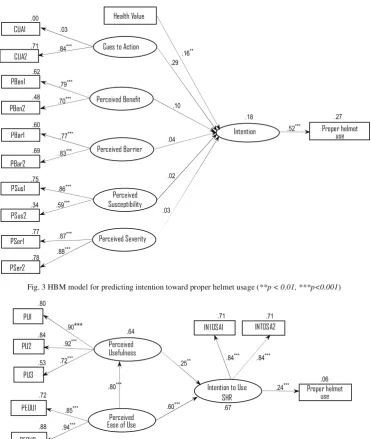
For further analysis and modeling exercise (SEM), the TPB, HBM and TAM models have been adopted to test the relationship of constructs variables between exogenous (intention) and endogenous (behavior) variables. These proposed models have been adapted from [25, 27, 38 and 47] those successful in predicting behavioral intention in their studied.
Models tested are displayed in Figs. 2–4, TPB is presented by seven items and based on results, this model indicate an
excellent fit with Ȥ2 statistic of 27.575 (degrees of freedom =
21, p=0.153), with the Ȥ2 /df ratio having a value of 1.313.
TABLE 1
HELMET USAGE AMONG MOTORCYCLIST AT LOCATION OF STUDY
Location Unhelmeted (%) Untied (%) Helmeted
Properly (%) Total
Co
u
n
tr
y
sid
e
Zone 1 116 (58.9) 25 (12.7) 33 (28.5) 197
Zone 2 85 (51.5) 18 (10.9) 37 (37.6) 165
Zone 3 94 (51.6) 17 (9.3) 55 (39.0) 182
H
ous
ing
E
sta
te Zone 4 73 (33.9) 22 (12.1) 98 (54.0) 215
Zone 5 65 (32.0) 17 (11.8) 95 (56.2) 203
Zone 6 54 (28.8) 11 (7.0) 107 (64.3) 188
Total 487 (42.3) 124 (10.8) 540 (46.9) 1150
3HUFHLYHG 8VHIXOQHVV
3HUFHLYHG (DVHRI8VH
,QWHQWLRQWR8VH
6+5 3URSHUKHOPHWXVH
3(28 3(28 38
38
38
,1726$ ,1726$
+HDOWK9DOXH
&XHVWR$FWLRQ
3HUFHLYHG%HQHILW
,QWHQWLRQ &8$
3%HQ
3%HQ
3URSHUKHOPHW XVH 3HUFHLYHG%DUULHU
3HUFHLYHG 6XVFHSWLELOLW\
3HUFHLYHG6HYHULW\ 3%DU
&8$
3%DU
36XV
36XV
36HU
36HU
Fig. 3 HBM model for predicting intention toward proper helmet usage (**p < 0.01, ***p<0.001)
Fig. 4 TAM model for predicting intention to use SHR toward proper helmet usage (**p < 0.01, ***p<0.001)
Joreskog and Sorbom [51] suggested that it should be between 0 and 3 with smaller values indicating better fit. The goodness fit index (GFI) is 0.979, adjusted goodness of fit index (AGFI) is 0.955, comparative fit index (CFI) is 0.991, and Tucker-Lewis coefficient (TLI) is 0.985. These scores are very close to 1.0 where a value of 1.0 indicates perfect fit [52]. The root mean square error of approximation (RMSEA) is 0.033. Browne and Cudeck [53] proposed that values less than 0.08 indicates good fit, and values high than 0.08 represent reasonable errors of approximation in the population.
For HBM, all indexes except GFI were unacceptably low.
The result of the model indicated a poor fit, Ȥ2/df = 3.808
(p=0.000) with GFI=0.915, AGFI=0.848, CFI=0.875, and
TLI=0.809. RMSEA also show a poor fit with value of 0.098. While, TAM model showed good fit to the data in all indexes GFI (0.995), AGFI (0.975), CFI (0.997) and TLI (0.990) which is more than 0.9 shows excellent fit. Root mean square error approximation (RMSEA) is 0.048 indicates a good fit. The highest variation percentage, R-squared value is 0.67.
VI. DISCUSSION AND CONCLUSION
29%. This finding similar in [16] studied found that 54% of motorcyclists were used safety helmet properly. In fact, their result showed at outside-town centre was only at 33%. Other studies, in Indonesia, [2] reported that only 55% of the riders wore helmets correctly for urban area and compliance behavior in the villages considering lower. In China, based on observational study shows, that the rate of proper helmet use was low, with less than one-third (32.3%) of riders [11]. Hence, present study indicates that the lower rate of compliance of safety helmet issue still occurs, even though Malaysian government concerned on this problem seriously. It seems those helmet initiative programs namely helmet law enforcement, safety helmet campaign and Community Based Program are insufficient to overcome the problem. Therefore, a new approach is needed to be introduced to mitigate current issue as recommended in [49]. They suggested the need to implement new interventions to increase helmet use. Also,
Ambak et al [54] suggested possibility to adapt and apply a
seat belt reminder system into motorcycle as helmet reminder system.
In fact, an interdisciplinary approach that involves behavioral sciences, injury prevention and engineering aspect all together would be better solution. Behavioral science when combined with engineering, epidemiology and other disciplines creates a full picture of the often fragmented injury puzzle and informs comprehensive solutions [50].
Trifiletti et al. [21] stated that the behavioral and social
sciences theories and models have the potential to enhance efforts to reduce unintentional injuries. The applications of such behavior sciences theories or models (TPB, HBM, and TAM) are able to predict and explain the significant predictor (e.g attitude toward behavior). The relationship between construct variable and target behavior also can be determined. Then, the implication of the model analysis would suggest some strategies to be taken onto intervention program.
For instance, in [27] found that the TPB results emphasize the important role of attitudes and subjective norms in developing intentions to use a seat belt. Also, they suggested that seat belt campaigns should be aimed at forming and strengthening positive attitudes towards seat belt use. While, in [25] mentioned that both the HBM (perceived barriers) and TPB (subjective norm) results emphasize the role of parents and peers in a teenager’s intention to use a bicycle helmet. According to the results of their study, bicycle helmet campaigns should aim mainly at changing peers’ and parents’ attitudes. Finally, with regards to these significant approaches, the models (TPB &TAM) to be proposed with a new intervention measure (SHR system) regarding motorcycle safety program, particularly on head injury prevention.
ACKNOWLEDGEMENT
The author would like to thank Universiti Tun Hussein Onn Malaysia (UTHM) and Ministry of Higher Education
(MOHE) of Malaysia who provide a scholarship for Ph.D studies and sponsoring this work.
REFERENCES
[1] Royal Malaysian Police (PDRM), (2009). Statistical Report on Road
Accidents in Malaysia 2007. Traffic Branch, Bukit Aman, Kuala Lumpur.
[2] P. Conrad, Y.S. Bradshaw, R. Lamsudin , N. Kasniyah and C.
Costello. (1996). Helmets, Injuries and cultural definitions: motorcycle injury in urban Indonesia. Accident Analysis and Prevention, 28 (2), 193-200.
[3] G. Barbara, L.R. Khaty, E.H. Richard, C. Magdalena and S. Lorann.
(1995). Relationship of helmet use and head injuries among motorcycle crash victims in El Paso County, Colorado, 1989-1990, Accident Analysis and Prevention, 27(3), 363-369.
[4] S. Kulanthayan, R.S. Umar, H.A. Hariza,M.T. Nasir and S. Harwant.
(2000). Compliance of proper safety helmet usage in motorcyclists. Medical Journal of Malaysia 55 (1), 40–44.
[5] R.S. Radin Umar, K.C. Kulanthayan,T.H. Law, H. Ahmad,A.H. Musa
and N.M.T. Mohd.(2005). Helmet initiative program in Malaysia, Pertanika Journal of Science and Tech. Supplement 13(1), 29-40.
[6] H.K. Shao. (2005). Helmet use and motorcycle fatalities in Taiwan.
Accident Analysis and Prevention, 37, 349–355.
[7] F.A. Zamani, S. Nikami, E. Mohammadi, M. Ali, F. Ghofranipour, F.
Ahmadi and B.S. Hejazi. (2009). Motorcyclists’ reaction to safety helmet law: A qualitative study, BMC Public Health, 9: 393.
[8] National Highway Traffic Safety Administration (NHTSA) 2009. An analysis of motorcycle helmet use in fatal crashes, Annals of Emergency Medicine, 53, 501.
[9] F.M. Shuaeib, A.M.S. Hamouda, R.S. Radin Umar, M.M. Hamdan
and M.S.J. Hashmi. (2002). Motorcycle Helmet Part 1. Biomechanics and computational issues. Journal of Materials Processing Technology, 123, 406-421.
[10] H.J. David J. (2007). Are helmet laws protecting young motorcyclists?. Journal of Safety Research 38, 329-339.
[11] L. Li-Ping, L. Gong-Li, C. Qi-En, L.Z. Anthony and K.L. Sing. (2008). Improper motorcycle helmet use in provincial areas of a developing country. Accident Analysis and Prevention 40, 1937-1942. [12] I. Masao, C. Witaya and M. Eiji. (2003). Effect of the helmet act for motorcyclists in Thailand, Accident Analysis and Prevention 35, 183– 189.
[13] S.D. Thomas. (2009). Motorcycle helmets and traffic safety. Journal of Health Economics, 28, 398–412.
[14] M. Ichikawa, W. Chadbunchachai and E. Marui. (2003). Effect of the helmet act for motorcyclists in Thailand. Accident Analysis and Prevention, 35 (2), 183–189.
[15] D.V. Hung, M.R. Stevenson and R.Q. Ivers. (2006). Prevalence of helmet use among motorcycle riders in vietnam, Injury Prevention, 12: 409-413.
[16] S. Kulanthayan, R.S. Umar, H.A. Hariza and M.T. Nasir. (2001). Modeling of compliance of motorcyclist to proper usage of safety helmet in Malaysia. Journal of Crash Prevention and Injury Control, 2 (3), 239-246.
[17] R.C. Maccallum and J.T. Austin. (2000). Applications of Structural Equation Modeling in psychological research. Annual Reviews Psychology, 51, 201–226.
[18] T.F. Golob. (2003). Structural equation modeling for travel behavior research. Transportation Research Part B, 37, 1-25.
[19] R. Weston and P.A. Gore (Jr). (2006). A brief guide to Structural Equation Modeling. The Counseling Psychologist, 34: 719-751. [20] JY. Lee, JH. Chung and B. Son. (2008). Analysis of traffic accident
size for Korean Highway using Structural Equation Models. Accident Analysis and Prevention, 40, 1955–1963.
[21] L.B. Trifiletti, A.C. Gielen, D.A. Sleet and K. Hopkins. (2005). Behavioral and social sciences theories and models: Are they used in unintentional injury prevention research?. Health Education Research, 20(3), 298-307.
[23] I.M. Rosenstock. (1966). Why people use health services? Milbank Memorial Fund Quarterly, 44, 94– 124.
[24] F.D. Davis. (1989). Perceived Usefulness, Perceived ease of use and user acceptance of Information Technology. MIS Quarterly 13 (3), 319–340.
[25] T. Lajunen and M. Rasanen. (2004). Can social psychological models be used to promote bicycle helmet use among teenagers? A comparison of the Health Belief Model, Theory of Planned Behavior and the Locus of Control. Journal of Safety Research, 35, 115-123. [26] H.W. Warner and L. Abreg. (2006). Drivers’ decision to speed: a
study inspired by The Theory of Planned Behaviour, Transportation Research Part F, 9,427–433.
[27] O. Simsekoglu and T. Lajunen. (2008). Social psychology of seat belt use: a comparison of Theory of Planned Behavior and Health Belief Model, Transportation Research Part F 11,181–191.
[28] C.D. Chen, Y.W. Fan and C.K. Farn. (2007). Predicting electronic toll collection service adoption: An integration of the technology acceptance model and the theory of planned behavior. Tranportation Research Part C. 15, 300-311.
[29] A.C. Gielen and D. Sleet.(2003). Application of behavior-change theories and method to injury prevention. Epidemiologic Reviews, 25, 65-76.
[30] S.E. Johnson and A. Hall. (2005). The prediction of safe lifting behavior: An application of The Theory of Planned Behavior. Journal of Safety Research, 36, 63– 73.
[31] F. Letirand and P. Delhomme. (2005). Speed Behavior as a choice between observing and exceeding the speed limit. Transportation Research Part F, 8, 481–492.
[32 ] I. Ajzen. (1985). From intentions to actions: A theory of planned behavior. In J. Kuhl & J. Beckmann (Eds.), Action control: From cognition to behavior. Berlin, Heidelber, New York: Springer-Verlag. [33] M. Conner and P. Sparks. (1996). The Theory of Planned Behaviour
and health behaviours. In M. Conner, & P. Norman (Eds.), Predicting health behaviour , 121– 162. Buckingham: Open University Press.
[34] National Institutes of Health. (2005) A Guide for Health Promotion
Practice (2nd Edition). U.S. Department of Health and Human Services: Rimer, B., Glanz, K.
[35] N.K. Janz and M.H. Becker. (1984). The Health Belief Model: A decade later. Health Education Quarterly, 11(1), 1-47.
[36] M.H. Becker, L.A. Maiman, J.P. Kirscht, D.P. Haefner and R.H. Drachman. (1977). The Health Belief Model and prediction of dietary compliance: a field experiment. Journal of Health and Social Behavior, 18, 4, 348-366.
[37] P. Sheeran and C. Abraham. (1996). The Health Belief Model. In: Connor M, Norman P (eds). Predicting Health Behavior: Research and Practice with Social Cognition Models. Buckingham, UK: Open University Press.
[38] C. McClenahan, M. Shevlin, G. Adamson, C. Bennett and B. O’Neill. (2007). Testicular self-examination: A test of the Health Belief Model and The Theory of Planned Behavior. Health Education Research, 22(2), 272-284.
[39] L. Quine, D.R. Rutter and L. Arnold.(1998). Predicting and understanding safety helmet use among schoolboy cyclists: a comparison of The Theory of Planned Behaviour and The Health Belief Model. Psychological Health, 13, 251–69.
[40] F.D. Davis, R.P. Bagozzi and P.R. Warshaw. (1989). User acceptance of computer technology: A comparison of two theoretical models. Management Science, 35 (8), 982–1003.
[41] R.J. Holden and B.T. Karsh. (2010).The Technology Acceptance Model: Its past and its future in health care. Journal of Biomedical Informatics, 43, 159–172.
[42] M.Y. Yi, J.D. Jackson, J.S. Park and J.C. Probst. (2006). Understanding Information Technology acceptance by individual professionals: Toward an integrative view. Information Management, 43, 350-63.
[44] G. Polancˇicˇ, M. Hericˇko and I. Rozman. (2010) An empirical examination of application frameworks success based on Technology Acceptance Model. The Journal of Systems and Software, 83, 574-584.
[45] S.J. Hong, J.Y.L. Thong and K.Y. Tam. (2006). Understanding continued information technology usage behavior: a comparison of
three models in the context of mobile internet. Decision Support Systems (3), 1819–1834.
[46] M. A. Elliot. (2010). Predicting Motorcyclists’ intentions to speed: effects of selected cognitions from the Theory of Planned Behaviour, Self-Identity And Social Identity. Accident Analysis and Prevention, 42, 718-725.
[47] R.D. Poulter, P. Chapman, P.A. Bibby, D.D. Clarke and D. Crundall. (2008). An application of the Theory of Planned Behaviour to truck driving behaviour and compliance with regulations. Accident Analysis and Prevention, 40, 2058-2064.
[48] J.M. Bland and D.G. Atlman. (1997). Statistics Notes: Cronbach’s alpha. British Medical Journal, 314, 572.
[49] GL. Li, LP. Li and QE. Cai. (2008). Motorcycle helmet use in
Southern China: An Observational Study, Traffic Injury Prevention 9,
125-128.
[50] F. K. Winston and L. Jacobsohn. (2010). A practical approach for applying best prevention practices in behavioural interventions to injury. Injury Prevention, 16, 107-112.
[51] M.W. Browne and R. Cudeck. (1993). Alternative ways of assessing model fit. In K.A. Bollen and J.S. Long (Eds.).Testing structural equation models. Newbury Park, CA: Sage. 445-455.
[52] K.G. Joreskog and D. Sorbom. (1993). LISREL 8: Structural equation modeling with the SIMPLIS command language. Chicago: Scientific Software International.
[53] P.M. Bentler. (1992). On the fit of models to covariances and
methodology to the Bulletin. Psychological Bulletin, 112, 400-404.