*Corresponding author:Shantha Seelan G ISSN: 0976-3031
Research Article
A DESCRIPTIVE STUDY TO ASSESS THE LEVEL OF DEPRESSION AMONG THE ELDERLY
RESIDING IN SELECTED OLD AGE HOME AT JAMMU
Esha Sharma and Shantha Seelan G*
DOI: http://dx.doi.org/10.24327/ijrsr.2017.0811.1140
ARTICLE INFO ABSTRACT
Background: As per WHO guidelines, people age 60-70 are called elderly, between 75-80 years are called old and 85+ are called old-old. The individual gradually becomes dependent physically, functionally, socially and economically. Sadness or downswings in mood are normal reactions to life’s struggles, setbacks and disappointment’s. Many people use the word ‘Depression’ to explain these kinds of feelings, but depression is much more than just sadness. Some people describe depression as living in “black hole” or having a feeling of impending doom. Depression is a state of low mood and aversion to activity that can affect a person’s thoughts, behavior, feeling and sense of well-being. Depression reflects a range of biological and social factors and it may be difficult to diagnose in older people as its presentation may differ from that of younger people. Older people tend to under-report depressive symptoms and may not acknowledge being sad, down or depressed. Depression first develops in later life usually after 60 years and it more commonly associated with physical health problems that accompany aging. Depression is projected to become the leading contributor to the global burden of the disease by the year 2020. The community based mental health studies in India have estimated the prevalence of depressive disorder among elderly population between 13% and 25%. So, a descriptive study was conducted to assess the level of depression among the elderly residing in selected old age home at Jammu.
Objectives: 1.To assess the level of depression among elderly residing at old age home. 2. To find the association of depression among the elderly residing at old age home with demographic variable. Materials and methods: The research approach used for this study was quantitative approach. The research design is non-experimental, univariant descriptive design. The study was conducted at selected oldage home in Jammu such as Amphalla 22Km away from BEE ENN College Nursing, Chak Bhalwal, Jammu. Purposive sampling method used to select the sample. Sample includes 40 males and females in the age group of 60-80 years from the old age home at Jammu. In the study data collection was done by standardized tool i.e, Geriatric Depression Scale. The data was analyzed in terms of the objectives of the study using descriptive and inferential statistics.
Results: Findings showed that most of the subject’s i.e, 47.5% were mildly depressive, 30.0% had severe depression and remaining 22.5% were normal, with the mean depression score of 15.62 ± 6.331 (Range: 2-25). Chi-square test was used to find the association among various socio demographic variables with the depression score of study subjects. It was shown that the depression score was significantly associated with the age (p = 0.546), sex (p = 0.924), education (p = 0.844), marital status (p = 0.618), perceived health status (p = 0.133), reasons to join old age home (p = 0.105) and duration of stay in old age home (p = 0.298) at the p>0.05.
INTRODUCTION
“Age is the acceptance of a term of year, but maturity is the glory of years”
Aging is the process of becoming older, a process that is genetically determined and environmentally modulated. In most Gerontological literature, people above 60 years of age are considered as old constituting the elderly segment of the population also called senior citizen. As per WHO guidelines, people age 60-70 are called elderly, between 75-80 years are
called old and 85+ are called old-old. The individual gradually becomes dependent physically, functionally, socially and economically. Elder usually exhibit multiple health problem with complex interaction. All these condition affect the mental status of elderly which may sometime leads to dementia and depression. Sadness or downswings in mood are normal reactions to life’s struggles, setbacks and disappointment’s. Many people use the word ‘Depression’ to explain these kinds of feelings, but depression is much more than just sadness. Some people describe depression as living in “black hole” or
Recent Scientific
Research
International Journal of Recent Scientific Research
Vol. 8, Issue, 11, pp. 21781-21785, November, 2017
DOI: 10.24327/IJRSR CODEN: IJRSFP (USA)
Article History:
Received 17th August, 2017
Received in revised form 12th September, 2017
Accepted 04th October, 2017
Published online 28th November, 2017
Key Words: Elderly Old age Depression
Esha Sharma and Shantha Seelan G.,A Descriptive Study to Assess The Level of Depression Among The Elderly Residing In Selected Old Age Home At Jammu
having a feeling of impending doom. Depression is a state of low mood and aversion to activity that can affect a person’s thoughts, behavior, feeling and sense of well-being. People with depressed mood, anxious, hopeless, helpless, worthless, guilty, irritable, ashamed and restless they may lose interest in activities that were once pleasurable, experience of overeating or loss of appetite, have problem in concentrating, remembering the details or making decisions, and may contemplate, attempt /commit suicide. Insomnia, excessive sleeping, fatigue, aches, pains, digestive problem or reduced energy may also present.
Depression reflects a range of biological and social factors and it may be difficult to diagnose in older people as its presentation may differ from that of younger people. Older people tend to under-report depressive symptoms and may not acknowledge being sad, down or depressed. This could be due to age, shame and lack of understanding for the disorder or a belief in not talking about depression or admitting not coping. Too frequently family, friends and doctors interpret these symptoms in that way as well, with the result that depression in old age may go undetected and untreated for a long time.
Depression first develops in later life usually after 60 years and it more commonly associated with physical health problems that accompany aging. An older person in good physical health with no history of episode has a relatively low risk of developing depression at a later age.
The World Health Organization considers depression the fourth leading cause of disability worldwide, and expects it to become the second leading cause in countries with the highest life prevalence of major depression episodes in France, Netherlands, United states (each with over 30% of the population ever experiencing MDE ), and in India( 36%). According to age structure of world population 579 million people are 65 years and over. As estimated by the World health organization (WHO) the overall prevalence rate of depression disorder among the elderly generally varies between 10% and 20%. The number of elderly reached around 76 million in 2001, and it is expected to reach around 120 million by 2031. According to 2011 census, among the state of India Kerala has highest elderly population with 12.6 % followed by Tamil Nadu 10.4%, Punjab with 10.3%, Maharashtra with 9.9% and Andhra Pradesh with 9.8% which is in top 5th place in elderly population. It affects over all 11.5 million people or 1 in 20 every year. In India, depression is found in one to six percentage of general population. According to 2003 census there were 77 million elderly in India representing 7.5% of the country´s total population. Depression is projected to become the leading contributor to the global burden of the disease by the year 2020. The community based mental health studies in India have estimated the prevalence of depressive disorder among elderly population between 13% and 25%. In this dynamic era, where the aging of population rapidly increasing in one hand and the erosion of joint family traditional practice and social values occurring on the other hand, the old age homes concept prove to be helpful for elderly. Presently, there are 1018 geriatric homes in India. Out of which, 427 homes are free of cost while 153 are on payment and stay basis, 146 homes have both free as well as pay and stay facilities and detailed information is not available for 292 homes [Banker,
Prajapati and Kedia, 2011). About 52% of total old age homes in country confined to only four states namely Kerala, Tamil Nadu, Karnataka and Andhra.
Statement of the problem
“A descriptive study to assess the level of depression among the elderly residing in selected old age home at Jammu.”
Objective
1. To assess the level of depression among elderly residing at old age home.
2. To find the association of depression among the elderly residing at old age home with demographic variable.
3. To identify associated risk factors for depression in the elderly.
MATERIALS AND METHODS
The research approach used for this study was quantitative approach. The research design is non-experimental, univariant descriptive design. The study was conducted at selected old age home in Jammu such as Amphalla 22Km away from BEE ENN College Nursing, Chak Bhalwal, Jammu. The target population was male and females residing in old age home. Purposive sampling method used to select the sample. Sample includes 40 males and females in the age group of 60-80 years from the old age home at Jammu. In the study data collection was done by standardized tool i.e, Geriatric Depression Scale. The data was analyzed in terms of the objectives of the study using descriptive and inferential statistics. Reliability of the tool was established through test-retest method. The Karl parson’s coefficient of correlation was computed
RESULTS
Table1 Reveals percentage distribution of study subjects according to various socio demographic variables like age, sex, education, religion, marital status, perceived health status, reason to join old age home and duration of stay in old age home.
It depicts that majority 35% of the subjects were in the age group of 60-65 years followed by 27.5%, 22.5% & 15.0% in the age group of 66-70 years, 76-80 years and 71-75 years respectively with the mean age of 69.275 ± 6 .279 years. Among 40 subjects, 62.5% were males and remaining 37.5% were females.
As per the education, 57.5% (illiterate), 20% (primary school), 15% (schooling) and 7.5% (secondary). In case of religion, all of the study subjects were Hindu i e. 100%.
Table 1 Variables showing socio demographic profile of study subjects
Variables Group (N=40) Frequency(f)
Age (Years)
60-65
66-70
71-75
76-30
*Mean age ± SD, Range: 69.275 ± 6 .279, 60-79
14 11 06 09 Sex
Male
Female
25 15 Education Illiterate Schooling Primary Secondary Graduate
Pre university
23 06 08 03 00 00 Religion
Hindu 40
Marital Status Married Unmarried Widow/widowed Divorcee 09 12 19 00
Perceived health status
Good
Poor
33 07
Reason to join old age home
Nobody to look after in family
Does not wish to stay with family
32 08
Duration of stay in old age home
<6 months
6-12 months
1-2 years
>2 years
02 06 07 25
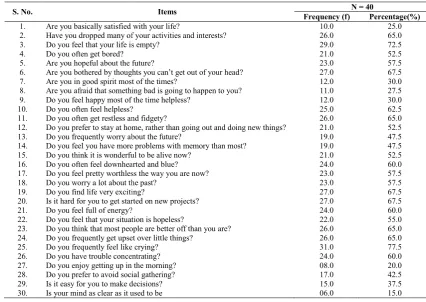
Table 2 Percentage distribution of study subjects as per geriatric depression scale
S. No.
1. Are you basically satisfied with your life?
2. Have you dropped many of your activities and interests? 3. Do you feel that your life is empty?
4. Do you often get bored? 5. Are you hopeful about the future?
6. Are you bothered by thoughts you can’t get out of your head? 7. Are you in good spirit most of the
8. Are you afraid that something bad is going to happen to you? 9. Do you feel happy most of the time helpless?
10. Do you often feel helpless?
11. Do you often get restless and fidgety?
12. Do you prefer to stay at home, rather than going out and doing new things? 13. Do you frequently worry about the future?
14. Do you feel you have more problems with memory than most? 15. Do you think it is wonderful to be
16. Do you often feel downhearted and blue? 17. Do you feel pretty worthless the way you are now? 18. Do you worry a lot about the past?
19. Do you find life very exciting?
20. Is it hard for you to get started on new projects? 21. Do you feel full of energy?
22. Do you feel that your situation is hopeless?
23. Do you think that most people are better off than you are? 24. Do you frequently get upset over little things?
25. Do you frequently feel like crying? 26. Do you have trouble concentrating? 27. Do you enjoy getting up in the morning? 28. Do you prefer to avoid social gathering? 29. Is it easy for you to make decisions? 30. Is your mind as clear as it used to be
80% subjects joined old age home because they had nobody to look after in their families and 20% does not want to stay with family.
Data also showed the duration of stay in old age home. It was found that 62.5% were residing in old age home from more than 2 years, 17.5% for 1-2 years, 15% for 6
rest 5% from less than 6 months.
Figure 1 Classification of study subjects as per Geriatric Depression Scale
*Mean ± SD, Range: 15.62 ± 6.331, 2-25
Figure 1 depicts the classification of study subjects based on their score obtained in Geriatric Depression Scale. It was found that most of the subject’s i.e, 47.5% were mildly depressive, 30.0% had severe depression and remaining 22.5% were normal, with the mean depression score of 15.62 ± 6.331 (Range: 2-25). 0 5 10 15 20 25 30 35 40 45 50
Normal Mild Depressive
22.5% P e r c e n ta g e
Geriatric Depression Scale
Variables showing socio demographic profile of
Group (N=40) Frequency(f) Percentage (%)
35.0 27.5 15.0 22.5 62.5 37.5 57.5 15.0 20.0 7.50 00 00 100 22.5 30.0 47.5 00.0 82.5 17.5 80.0 20.0 05.0 15.0 17.5 62.5
Percentage distribution of study subjects as per geriatric depression scale
Items
Frequency (f)
Are you basically satisfied with your life? 10.0
Have you dropped many of your activities and interests? 26.0
Do you feel that your life is empty? 29.0
21.0
Are you hopeful about the future? 23.0
Are you bothered by thoughts you can’t get out of your head? 27.0
Are you in good spirit most of the times? 12.0
Are you afraid that something bad is going to happen to you? 11.0
Do you feel happy most of the time helpless? 12.0
Do you often feel helpless? 25.0
Do you often get restless and fidgety? 26.0
you prefer to stay at home, rather than going out and doing new things? 21.0
Do you frequently worry about the future? 19.0
Do you feel you have more problems with memory than most? 19.0
Do you think it is wonderful to be alive now? 21.0
Do you often feel downhearted and blue? 24.0
Do you feel pretty worthless the way you are now? 23.0
Do you worry a lot about the past? 23.0
Do you find life very exciting? 27.0
for you to get started on new projects? 27.0
Do you feel full of energy? 24.0
Do you feel that your situation is hopeless? 22.0
Do you think that most people are better off than you are? 26.0
upset over little things? 26.0
Do you frequently feel like crying? 31.0
Do you have trouble concentrating? 24.0
Do you enjoy getting up in the morning? 08.0
Do you prefer to avoid social gathering? 17.0
it easy for you to make decisions? 15.0
Is your mind as clear as it used to be 06.0
80% subjects joined old age home because they had nobody to look after in their families and 20% does not want to stay with
Data also showed the duration of stay in old age home. It was found that 62.5% were residing in old age home from more 2 years, 15% for 6-12 months and rest 5% from less than 6 months.
subjects as per Geriatric Depression Scale
depicts the classification of study subjects based on their score obtained in Geriatric Depression Scale. It was found that most of the subject’s i.e, 47.5% were mildly depressive, 30.0% had severe depression and remaining 22.5% n depression score of 15.62 ± 6.331
Mild Depressive Severe Depressive
47.5%
30.0%
Geriatric Depression Scale
Percentage distribution of study subjects as per geriatric depression scale
N = 40
Esha Sharma and Shantha Seelan G.,A Descriptive Study to Assess The Level of Depression Among The Elderly Residing In Selected Old Age Home At Jammu
All the socio demographic variables expected to be associated with Geriatric Depression Scale were analyzed to find the association between them. Chi-square test was used to find the association among various socio demographic variables with the depression score of study subjects. As per socio demographic data summarized in the Table 4, it was shown that the depression score was significantly associated with the age (p = 0.546), sex (p = 0.924), education (p = 0.844), marital status (p = 0.618), perceived health status (p = 0.133), reasons to join old age home (p = 0.105) and duration of stay in old age home (p = 0.298) at the p>0.05.
DISCUSSION
According to age structure of world population 579 million people are 65 years and over. As estimated by the WHO, the overall prevalence rate of depression disorder among the elderly generally varies between 10% and 20%. Depression will increase in magnitude as the elderly population increased year by year. Hence there is need for considering the emotional states of elderly when they treated for any of physical problem in the hospital, homes or in primary health centers. Later life depression have serious repercussions in increasing mortality and disability, health care utilization and longer hospital stays, yet 63% older adults with a mental health disorder experience an unmet need for mental health services. Elderly have no other option but to live in old age homes, often face loneliness, alienation and depression. Our purpose in this study is to further understanding of the predictors of good quality of life in old age.
The study was conducted to assess the level of depression and quality of life among the elderly residing in selected old age home at Jammu.
The research approach used for this study was quantitative approach and research design was non-experimental, univariant descriptive design. It was conducted at selected oldage home in Jammu such as Amphalla 22Km away from BEE ENN College Nursing, Chak Bhalwal, Jammu. Purposive sampling method was used to select the sample. 40 Old age people in depression residing in old age home were selected who met sampling criteria. In the study data collection was done by structured questionnaire. The questionnaire prepares to assess the level of depression and quality of life among elderly residing in selected old age home. The tool consists of three parts. Part 1: The demographic variables such as age, sex, education, religion, marital status, perceived health status, reason to join the old age home ,duration of stay in the old age home and prior information. Part B: It consists of an assessment based structured questionnaire regarding level of depression with 30. The responses were analyzed through descriptive measures (mean, frequency, percentage, Standard deviation) and inferential statistics (chi-square,‘t’ test). Discussions on the findings are arranged based on the objectives specified in this study.
The first objective of this study was to assess the level of depression among elderly residing at old age home
Classification of study subjects based on their score obtained in Geriatric Depression Scale. It was found that most of the subject’s i.e, 47.5% were mildly depressive, 30.0% had severe Table 4 Association of geriatric depression score with the selected demographic variables
Demographic Variables
GDS
Chi square df p* value Normal
(0-9)
Mild Depressive (10-19)
Severe Depressive
(20-30) Age (Years)
60-65 66-70 71-75 76-80
2 2 1 4
7 6 2 4
5 3 3 1
4.983 6 0.546* Sex
Male Female
6 3
12 7
7 5
0.159 2 0.924* Education
Illiterate Schooling Primary Secondary
6 1 1 1
12 2 4 1
5 3 3 1
2.715 6 0.844* Marital Status
Married Unmarried Widow/widowed
3 2 4
3 5 11
3 5 4
2.652 4 0.618* Perceived health status
Good Poor
9 0
16 03
8 4
4.031 2 0.133* Reason to join old age home
Nobody to look after in family Does not wish to stay with family
5 4
17 2
10 2
4.510 2 0.105* Duration of stay in old age home
<6 months 6-12 months 1-2 years >2 years
0 2 0 7
2 1 4 12
0 3 3 6
7.260 6 0.298*
depression and remaining 22.5% were normal, with the mean depression score of 15.62 ± 6.331 (Range: 2-25).
The second objective of this study to find the association of geriatric depression score with the selected demographic variables
All the socio demographic variables expected to be associated with Geriatric Depression Scale were analyzed to find the association between them. Chi-square test was used to find the association among various socio demographic variables with the depression score of study subjects. As per socio demographic data summarized in the Table 4, it was shown that the depression score was significantly associated with the age (p = 0.546), sex (p = 0.924), education (p = 0.844), marital status (p = 0.618), perceived health status (p = 0.133), reasons to join old age home (p = 0.105) and duration of stay in old age home (p = 0.298) at the p>0.05.
Reference
1. Mary C.T. A textbook of psychiatric mental health nursing .Edition 5th. Jaypee brothers, New Delhi, p:. 485-91.
2. Kristen L.M. A text book of geranatological nursing competencies for care. Jones and Bartlett publishers. p:498-500.
3. Kaplan and sadock’s synopsis of psychiatry. edtion:7th B.I. waverly New Delhi. p:532.
4. Gail W. Principles and practice of psychiatric nursing. Edition: 9th Elsevier New Delhi. p: 283-85.
5. Murray CL, Lopez AD: The global burden of disease. MA: Harvard University Press, 1996
6. Hur JS, Yoo SH: Determinants of depression among elderly persons. Ment Health Soc Work, 2002, 13: 7-35 7. Yoo IY, Lim MK, Yoo WS, et al: A study on
depression, self-reported health status and social support in elderly people. J Korean Gerontol Nurs, 2002, 4: 153-162
8. Seo HS, Jung SD, Kim CS, et al. : Comparison of the depression and anxiety between the elderly in the home for the aged and those in the community. Yeungnam Univ J Med, 1992, 9: 256-268
9. Shamila S.S. Effectiveness of teaching module on practice of caregivers and the satisfaction of the elderly in selected oldage homes. International journals of nursing education and research. 2014 ; 2(1); 58 10. Seda.S. Ageing population and Healthy aging frame
work. The nursing journal of India. 2013 ;2
11. Seda. S. Impact of mindfulness based stress reduction on depression among elderly residing in residential homes.2014 ;6
12. Daharwal. M. A comparative study to assess the level of depression among elderly residing in old age home and with the family. International Journal of nursing education and research.2014 ;2(1)
13. Kirubakaran C. A study to assess the effectiveness of cognitive behavioural therapy in reducing the level of depression among gediartic people in Vellore District. International Journal of recent scientific research .2014.
*******
How to cite this article:
Esha Sharma and Shantha Seelan G.2017, A Descriptive Study to Assess The Level of Depression Among The Elderly Residing In Selected Old Age Home At Jammu. Int J Recent Sci Res. 8(11), pp. 21781-21785.