Please cite this article as: R. ShafaeiandA. Mozdgir, Case Mix Planning using The Technique for Order of Preference by Similarity to Ideal Solution and Robust Estimation: a Case Study, International Journal of Engineering (IJE), TRANSACTIONS C: Aspects Vol. 30, No. 9, (September 2017) 1362-1371
International Journal of Engineering
J o u r n a l H o m e p a g e : w w w . i j e . i rCase Mix Planning using The Technique for Order of Preference by Similarity to
Ideal Solution and Robust Estimation: a Case Study
R. Shafaei*, A. Mozdgir
Department of Industrial Engineering, K. N. Toosi University of Technology, Tehran, Iran
P A P E R I N F O
Paper history:
Received 27 December 2016 Received in revised form 01 May 2017 Accepted 07 July 2017
Keywords:
Case Mix Planning Problem Mathematical Programming Sensitivity Analysis Robust Estimation
A B S T R A C T
Management of surgery units and operating room (OR) play key roles in optimizing the utilization of hospitals. On this line Case Mix Planning (CMP) is normally applied to long term planning of OR. This refers to allocating OR time to each patient’s group. In this paper a mathematical model is applied to optimize the allocation of OR time among surgical groups. In addition, another technique is applied to provide an Order of Preference by Similarity to Ideal Solution (TOPSIS) considering different hospital performance measures. Furthermore, robust estimation approach is used to estimate the models' parameters using real data. The proposed model is solved using GAMS software. The results of the study performed in this paper reveal that the proposed methods results in an increase in total hospital operated “value of patients” by 21.5%. This value is defined according to hospital priority and includes moral and ethical considerations. In addition, for each resource, a sensitivity analysis of the findings to the changes is conducted. The results of the sensitivity analysis indicated that the value of the objective function significantly increased via reallocating OR time to surgical groups and/or enhancing the OR facilities to support more surgical specialties.
doi: 10.5829/idosi.ije.2017.30.09c.09
1. INTRODUCTION1
According to the statistics of the World Health Organization (WHO) published in 2013, per capita total expenditure on health at average exchange rate was 1038 US$ while contributing about 10% of the gross domestic product. In developing countries, health expenditure per capita has been increased by an average of 4 percent annually from 2000 to 2009 [1]. In addition, among different elements of the health systems, hospitals are known as one of the most important components of this sector. On the other hand, OR is known as the main center of costs and revenues of the hospitals [2]. As reported by “Healthcare Financial Management Association”, OR results in an estimated value of about 40% of hospital revenue [3]. Also, it was estimated that about 60% to 70% of hospital admissions require OR [4]. Thus, planning and scheduling of OR is considered as a critical problem in most countries and this has attracted the researcher to
*Corresponding Author’s Email: [email protected] (R. Shafaei)
study this problem. For further details readers are referred to [5, 6]. In Iran, as addressed in WHO reports, a significant portion of the treatment cost is paid by the government. In 2000, this portion was about 37%, while it has recently been increased by 40%. Thus, the need for a proper planning and scheduling in this area is highly important.
Elective surgery planning and scheduling is normally performed in one of the three ways as follows [7]: 1. Block scheduling
2.Open scheduling
3.Modified block scheduling
managerial problems. They classified hospital planning subject into strategic, tactical and operational levels. With respect to the strategic planning, they have considered four areas of planning, namely, medical, resource capacity, material and financial .
The aim of this article is to solve resource capacity planning problem in strategic level which includes determining the type and composition of the patients, i.e. CMP, over a period of time. Many review papers discussed the OR planning and scheduling problems [12, 13]. Recently Hof et al. [1] provided the first comprehensive literature review focusing on the CMPP. Even though CMP is a central issue in the strategic planning of a hospital, it has rarely been studied by the researchers in the past. In contrast, the CMPP has been gained increased attention in the last three decades [1].
The CMPP is frequently modeled as linear programing (LP) and solved with standard software [1]. In the basic version, the CMPP has a structure similar to the product mix problem [14]. The main purpose of the CMP can be divided into financial and non-financial objectives [1].
Milsum et al. [15] emphasized that the mix of patients should be considered as an important factor in
the patient admissions management. Ma and
Demeulemeester [16] proposed a hierarchal integrative approach that consists of three phases, the CMP phase, the MSS phase and the operational phase. Ma et al. [17] developed an integer LP model and deployed a branch-and-price technique to maximize hospital profits under OR blocks and wards’ beds capacity constraints. Hobbs [1] applied LP to the CMP of a hospital and presented the idea of introducing an “emphasis” constraint to assure that a certain percentage of patients is treated in designated departments of the hospital. Meyer et al. [18] determined the optimal mix of three cardiac services and showed how the range of the objective function coefficients with the same optimal solution can be identified. They noted that personal judgments have to be incorporated with outcomes of operations planning.
Rifai and Pecenka [19] discussed the combination of the objective of minimizing facilities idle time and
maximizing profit in the CMPP using goal
programming. They formulated goals of maximizing contribution margin and minimizing idle capacity. Blake and Carter [20] proposed linear goal programming models to allocate resources in Hospital. Their case-mix model identified mix and volume of patients for all surgeons that are economically feasible for both the hospital and its associated providers and comes closest to achieve the surgeons favored mix. Mulholland et al. [21] presented an LP model to optimize financial outcomes for both the hospital and physicians in the department of surgery in the CMPP.
Despite the fact that most studies measure the optimal case mix in monetary units, CMP can also be driven by non-financial objectives [17, 22, 23]. E.g.,
Baligh and Laughhunn [22] maximized “value of patients” in their study. This value is defined according to hospital priority and aim of services and can include moral and ethical considerations, patient mortality rates, or the possibility of being referred to another hospital [1]. According to the governmental nature of Shahid Madani hospital, in this study the most important priority is to cover patients who need the most governmental facilities.
Also, constraints are defined according to Shahid Madani hospital limitations. Furthermore, as OR planning and scheduling decisions affect downstream resources throughout the hospital, it seems to be essential to incorporate these resources, such as ICU or ward beds, in the decision-making process.
With the view of the above-reviewed literature the aim of this study is to solve a case mix planning problem based on the actual data collected from Shahid Madani hospital. The significance of this research is that the developed model consists of more Iranian practical constraints such as sex of patients and gradual minimum capacity for each surgical group in order to meet the medical student training requirements. Furthermore, since the model is based on the actual data collected from Shahid Madani HIS, a robust estimator model is developed for the first time to downweight the effect of outliers and contaminated data.
The rest of the paper is organized as follows. Section 2 provides a brief description regarding Shahid Madani hospital. Problem description and the proposed mathematical model for the CMP is presented in Section 3. Section 4 introduces the robust estimator. Section 5 provides the results and sensitivity analysis of the results. Finally, Section 6 provides conclusions and potential areas for future studies.
2. SHAHID MADANI HOSPITAL
Shahid Madani hospital is a general surgery hospital, located in Karaj, Iran. The surgery divisions consist of 46 surgeons and 10 surgical groups. It is affiliated to Alborz University of Medical Sciences and contains 195 beds.
the following assumptions and restrictions should be considered in the study.
1- Both elective and non-elective patients are taken into account.
2- Certain procedures can be performed in each special OR depending on the size, equipment constraints and managerial aspects.
3- Duration of the CMP is assumed to be one year. 4- OR personnel or surgeons are not bottleneck.
5- The constrained resources considered in this study are capacity of ward, ICU and OR.
6. Lower limits on the number of patients of each surgical group throughout one year are considered in terms of number of available beds in the wards while respecting the hospital general policy.
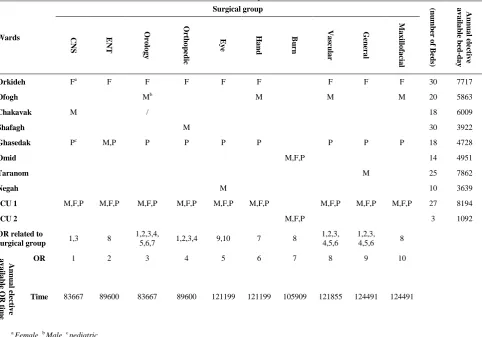
Table 1 represents which operated patients can be stayed in which ward. Also, this table shows which OR is related to each surgical group.
TABLE 1. Shahid Madani hospital characteristics
Wards
Surgical group (nu
mb
er
o
f B
ed
s)
A
n
n
u
a
l e
le
ct
iv
e
a
v
a
ila
b
le
b
ed
-d
a
y
CNS E
N
T
Or
o
lo
g
y
Or
th
o
p
ed
ic
E
y
e
H
a
n
d
B
u
rn
V
a
sc
u
la
r
Ge
n
er
a
l
M
a
x
ill
o
fa
ci
a
l
Orkideh Fa F F F F F F F F 30 7717
Ofogh Mb M M M 20 5863
Chakavak M / 18 6009
Shafagh M 30 3922
Ghasedak Pc M,P P P P P P P P 18 4728
Omid M,F,P 14 4951
Taranom M 25 7862
Negah M 10 3639
ICU 1 M,F,P M,F,P M,F,P M,F,P M,F,P M,F,P M,F,P M,F,P M,F,P 27 8194
ICU 2 M,F,P 3 1092
OR related to
surgical group 1,3 8
1,2,3,4,
5,6,7 1,2,3,4 9,10 7 8
1,2,3, 4,5,6
1,2,3,
4,5,6 8
A
n
n
u
a
l e
le
ct
iv
e
a
v
a
ila
b
le
O
R
ti
m
e
OR 1 2 3 4 5 6 7 8 9 10
Time 83667 89600 83667 89600 121199 121199 105909 121855 124491 124491
a Female, b Male, c pediatric
3. PROBLEM DEFINITION AND CORRESPONDING MATHEMATICAL MODEL
The main purpose of CMP is to determine the optimal patient mix of the hospital. The aim of CMP is to find a resource allocation scheme that induces the optimal case mix. In addition, expensive and scarce resources such as ICU beds shall be included in the solving process.
Here, an LP model is described to determine capacity allocation to surgical groups which is a surrogate for CMPP. Sets, list of the variables and parameters required to model CMPP are as follows:
Sets:
I Set of surgical groups, indexed by i
R Set of ORs, indexed by r
C Set of wards, indexed by c
G Set of patients sex groups (male, female and Pediatrics),
indexed by g
Variables:
i
x OR time which is allocated to surgeon’s group i
ir
x Allocated time of OR r to surgical group i
Parameters:
i
Cap The OR time allocated to surgical group i in the past year
r
h Opening hours of OR r for elective surgeries
i
DY Demand of elective patient’s group i in the year
ir
R If OR r is appropriate for the surgical group i; is set to 1;
otherwise, 0
i
Maximum decrease in the capacity rate of surgical group i
compared with the capacity of the last year
i
x' Allocated capacity to surgical group i in the last year
c
w Capacity of Ward c beds
igc K
If ward c is appropriate for the patient sex group g of surgical
group i; is set to 1; otherwise, 0,
1c igc
k
i
stw Average LOS of surgical group i in the ward
i
stI Average LOS of surgical group i in the ICU
i
T Average duration of the surgery for group i
PNi Value of the patients for surgical group i
Using these variables and parameters, a mathematical programming formulation of the problem is presented:
i r ir h
x r (1)
r i
ir x
x i (2)
ir r
ir h R
x . i,r (3)
burn i
i i
i stI w
T x
10 i (4)
10 w stI T x
i i
i
i=burn (5)
c i i ig
i g
igc stw w
T x
k
c (6)i i
i x
x (1) ' i (7)
i i
i DYT
x . i (8)
Equation (1) ensures that the OR time allocated to a surgical group is not more than the available time. Equation (2) shows the total allocated time of each surgical group. Constraint (3) guarantees that no surgery can be carried out in an inappropriate OR. Note that the available hours of OR defined excludes the emergency surgeries. After a surgery, all patients except burned patients are moved to the general ICU if necessary. Since the probability of infections of burn patients are high, burned patients are transferred to the ICU stationed in the burn ward when needed. Equations (4)
and (5) relate to the capacity constraints of the general ICU and the burn ICU beds, respectively. In Equations (4) and (5), w9 and w10 represent the capacity of general
and burn ICU, respectively. Equation (6) ensures that total LOS of each surgical group do not exceed the corresponding ward capacity. Furthermore, the capacities of wards are calculated based on the fact that a certain portion of the capacities are booked for emergency surgeries. Constrains (7) and (8) determine lower and upper limits of the allocated OR time assigned to each surgical group. It is assumed that in each surgical group, minimum amount of OR time shall be allocated. On the other hand, hospital policy is based on gradual reduction of capacity for the surgical groups. Finally, it is assumed that the allocated time of OR to surgical group i should not exceed its maximum time required, i.e. the demand of surgical group i.
3. OBJECTIVE FUNCTION
In this study, based on the hospital policy, three criteria are considered in calculating “value of patients”. Surgical groups demand is one of the major factors affecting “value of patients”. Furthermore, covering the most required patients as much as possible is the aim of the hospital, especially those surgeries which are not covered in other hospitals in Alborz province. Thus, the patients who have a less chance to be admitted in the other hospitals should be given more value. On the other hand, since the hospital intends to covers all emergency surgeries, the number of surgeons for each surgical group is affected by the rate of the respective emergency surgeries inherently. Therefore, hospital manager tends to give more portions to the surgical groups with higher emergency rates.
So, the “value of patients” should be calculated based on these three criteria. For this purpose TOPSIS technique is applied. TOPSIS ranks alternatives according to their shortest geometric distance from the positive ideal solution (PIS) and the longest geometric distance from the negative ideal solution (NIS) [24]. For more detail about TOPSIS process the readers are referred to Hwang and Yoon [25]. If PNi is considered
as “value of patients” of surgical group i, the objective function can be defined as follows:
max
i i
i i
T x PN.
(9)
4. ROBUST ESTIMATION
usually estimated using classical methods such as maximum likelihood estimation (MLE) [26-28]. In this study, the model parameters are estimated using sample data collected from Shahid Madani HIS. To start with, the content of the data were reviewed. The results revealed that they are contaminated. Thus estimators, called robust estimators, are used to estimate the parameters which are insensitive to the contamination. The details are described below.
4. 1. Maximum Likelihood Estimation of the Parameters The distributions of the random variables in the problem studied are discrete. Let Y
denote the random variable with values 1 to m with the
probabilities of
𝜃1, 𝜃2, … 𝜃𝑚, respectively. Thus, the probability mass
function of Y is defined as follow:
y 1 2 … m
P(Y=y) ϴ1 ϴ2 … ϴm
(10)
The probability mass function of the random variable Y is defined as follow:
𝑃(𝑌 = 𝑦) = 𝑓𝑌(𝑦) = 𝜃1 𝐼(𝑦=1)
𝜃2𝐼(𝑦=2)… 𝜃𝑚𝐼(𝑦=𝑚) (11)
where I(.) is the indicator function.
Let y1,y2,...,ynbe a random sample of size n with a
probability mass function of fy(y). Thus, the likelihood function can be defined as follow:
) ( # ) 2 ( # 2 ) 1 ( # 1 2
1, ,..., ) ...
( my m
y y
m i i
i
L (12)
where #(A) denotes the number of elements of set A.
By defining the sample proportion fi, we have:
n j ji I y i
n f 1 ) ( 1
i=1, 2,…, m (13)
Thus: m nf m nf nf m
L(, ,..., ) 1 2...
2 1 2
1 (14)
By defining L Ln
1
* and l*logL*, we have:
m f m f f m
L(, ,..., ) 1 2...
2 1 2
1
* (15)
) 1 log( ) 1 ( log log ) ,..., ,
(1 2 1 1 2 2 1 2 1 2
*
f f f
f
l m (16)
m i i i m f l 1 2 1*(, ,..., ) log
s.t: 1
1
i m i (17) ) log( ) ,..., , ( 1 2 1 * i m i i i i i im f f
f
l
m i i i i i i i f f f 1 log ) log(
m i i i i i i i f f f 1 log ) log(
m i i i m i i i i ii f f f
f 1 1 log ) log( A f l i m i i i
1 * ( ) (18)where A is the last term which is free of 𝜃1, 𝜃2, … 𝜃𝑚
and
(x)xlogx. So, in order to estimate 𝜃1, 𝜃2, … 𝜃𝑚 the value of A-l* shall be minimized. Thus, the following mathematical programming model must be solved: i m i i i f Q
1 ) ( min St: 1 1
m i i , 0i
i=1,… m
(19)
The Lagrange function of the above defined mathematical programming model can be defined as fallows:
𝑍 = ∑𝑚𝑖=1𝜃𝑖𝜌( 𝑓𝑖
𝜃𝑖) + 𝜆(∑ 𝜃𝑖 𝑚
𝑖=1 − 1) (20)
That is equivalent to:
𝑍 = ∑ 𝜃𝑖𝑓𝜃𝑖
𝑖𝑙𝑜𝑔
𝑚
𝑖=1 (
𝑓𝑖
𝜃𝑖) + 𝜆(∑ 𝜃𝑖 𝑚
𝑖=1 − 1) =
∑𝑚𝑖=1𝑓𝑖𝑙𝑜𝑔( 𝑓𝑖
𝜃𝑖) + 𝜆(∑ 𝜃𝑖 𝑚
𝑖=1 − 1)
(21)
In order to solve the above addressed mathematical programing model, the gradient shall be calculated:
𝜕𝑍
𝜕𝜃= 0 ⇒ 𝑓𝑗= 𝜆𝜃𝑗 (22)
This can also be written as follow:
∑𝑚𝑗=1𝑓𝑗= 𝜆 ∑𝑚𝑗=1𝜃𝑗 (23)
Since ∑𝑚𝑗=1𝑓𝑗= ∑𝑚𝑗=1𝜃𝑗= 1, therefore according to the
Equation (22) the value of λ and the MLE estimator for parameter ϴ are defined as it is shown in Equation (25). Note that fi is sample proportion. So, total sum of fi is equal to 1.
λ=1 (24)
4. 2. Robust Estimation of the Problem Parameters The data used to estimate the model parameters are collected from Shahid Madani HIS. So, it is possible that the collected data includes outliers. Thus, robust estimators may be a good choice to estimate model parameters. Absolutely, the robust estimators of discrete distribution parameters must be used in this study. Ruckstuhl and Welsh in 2001 [29], developed a new class of estimators for the binomial distribution parameter, named as 'E-estimators', and showed that these estimators have a non-standard asymptotic theory which challenges the accepted relationships between robustness concepts. Due to the discreteness nature of the distribution function of the random variables here, this study has been inspired by the methods developed by Ruckstuhl and Welsh [29] to estimate the model parameters robustly.
As shown in Equation (19), the likelihood function of random sample is defined as:
𝑍 = ∑ 𝜃𝑖𝜌 𝑚
𝑖=1
(𝑓𝑖 𝜃𝑖
)
where:
x x
x) log
(
(26)
when the data is not contaminated, it is better to use
𝜌(𝑥) = 𝑥𝑙𝑜𝑔𝑥. But in presence of contamination, it is wise to use other 𝜌(𝑥) function. So, this problem can be defined as an optimization problem in which the 𝜌(𝑥) is a function with special specifications that is not necessarily equal to xlog x.
𝑚𝑖𝑛 𝑍 = ∑𝑚𝑖=1𝜃𝑖𝜌( 𝑓𝑖 𝜃𝑖) St:
∑𝑚𝑖=1𝜃𝑖= 1, 𝜃𝑖≥ 0 ∀ 𝑖 = 1,2, … , 𝑚 which is the
same as writing
𝜃𝑖− 𝑠𝑖2= 0 ∀ 𝑖 = 1,2, … , 𝑚
(27)
The Lagrange function of the above problem can be defined as:
𝑍 = ∑𝑚𝑖=1𝜃𝑖𝜌( 𝑓𝑖
𝜃𝑖) − 𝜆(∑ 𝜃𝑖 𝑚
𝑖=1 − 1) − ∑𝑚𝑖=1𝜇𝑖(𝜃𝑖−
𝑠𝑖2)
(28)
where all the variables are free and 𝛩 is used as decision variable vector, so:
𝛩 = (𝜃1, 𝜃2, … , 𝜃𝑚, 𝜆, 𝜇1, 𝜇2, … , 𝜇𝑚, 𝑠1, 𝑠2, … , 𝑠𝑚)′
(29)
To solve the optimization problem, Equation (28), the gradient must be calculated as follows:
𝐹 =𝜕𝑍
𝜕𝛩 (30)
If:
𝜌(𝑥) = Ψ́
and Ψ(𝑥) = 𝜉(𝑥)́ (31)
Then:
𝐹(Θ)3𝑚+1=
(
ρ(𝑓1
𝜃1)− 𝑓1 𝜃1Ψ(
𝑓1
𝜃1)−𝜆−𝜇1
.. .
ρ(𝑓𝑗
𝜃𝑗)− 𝑓𝑗 𝜃𝑗Ψ(
𝑓𝑗
𝜃𝑗)−𝜆−𝜇𝑗
.. .
ρ(𝑓𝑚
𝜃𝑚)−
𝑓𝑚
𝜃𝑚Ψ(
𝑓𝑚
𝜃𝑚)−𝜆−𝜇𝑚
−(∑𝑚𝑖=1𝜃𝑖−1)
−𝜃1+𝑠12
.. . −𝜃𝑗+𝑠𝑗2
.. .
−𝜃𝑚+𝑠𝑚2
2𝜇1𝑠1 .. . 2𝜇𝑗𝑠𝑗
.. .
2𝜇𝑚𝑠𝑚 )
(32)
In order to solve the above optimization
problem, 𝐹(𝛩) = 0 shall be solved. According to the non-linearity of some equations in the above system of equations, Newton-Rophson method is applied. Thus:
𝛩𝑁= 𝛩𝑂− 𝐽
𝜃𝑂
−1𝐹(𝛩𝑂)
(33)
where 𝛩𝑁 is defined as estimation for new value of the
root while 𝛩𝑂 and J represent the current value of the
root and Jacobian matrix of system of equations, respectively. To form the Jacobian matrix the gradient of F shall be calculated for each variable. So, the Jacobian matrix can be defined as follows:
[
𝑓𝑗2
𝜃𝑗3𝜉 (
𝑓𝑗
𝜃𝑗) 𝐼𝑚×𝑚 −1𝑚×1
−𝐼𝑚×𝑚 0𝑚×𝑚
−11×𝑚
−𝐼𝑚×𝑚
0𝑚×𝑚
01×1
0𝑚×1
0𝑚×1
01×𝑚
0𝑚×𝑚
2𝑠𝑗𝐼𝑚×𝑚
01×𝑚
2𝑠𝑗𝐼𝑚×𝑚
2𝜇𝑗𝐼𝑚×𝑚]
(34)
To define appropriate robust estimator, we use Ruckstuhl and Welsh [29] 𝜌(𝑥) function which defined as follows:
ρ(𝑥) = {
(log(𝑐1+ 1))𝑥 − 𝑐1, 𝑖𝑓 𝑥 < 𝑐1
𝑥𝑙𝑜𝑔(𝑥), 𝑖𝑓 𝑐1≤ 𝑥 ≤ 𝑐2
(log(𝑐2+ 1))𝑥 − 𝑐2, 𝑖𝑓 𝑥 > 𝑐2
(36)
In the above equation, c1 and c2 shall be defined in a
way that the obtained estimators have the highest robustness. The criteria which is used in this section is the asymptotic bias of estimation. This criteria is defined as the deviation between the values of parameters which are estimated from the estimates. Simulation results show that c1=0 and c2=1.7 lead to
appropriate results for the defined robust estimator.
5. RESULTS
the course of March 20, 2014 to July 21, 2015 were collected from Shahid Madani HIS.
The minimum time required for each surgical group is calculated according to the maximum rate of decrease in the capacity of the surgical group i compared with that of the last year’s capacity. The “value of patients”
of surgical groups are calculated applying TOPSIS method. Table 2 shows the values of the estimated parameters of the model. Also, average duration of the surgery time and average LOS in the wards and the ICU are calculated using E robust estimator.
TABLE 2. Value of the required estimated model parameters
TOPSIS method requires priority weights of criteria obtained via interviews with the hospital management team and the medical staff. The weight vector of elective demand, number of covering hospital, and emergency rate is equal to 0.516, 0.297, 188, respectively. Table 3 shows the value of parameters corresponding to PIS, NIS and closeness coefficient denoted by diw, dib and PNi, respectively and the ranking
of the surgical groups.
In order to find the optimal patient mix of the hospital, the LP model is solved using GAMS software and data derived from the developed robust estimator and TOPSIS. The results are summarized in Table 4. Table 4 shows current situation of OR time allocation compared with optimal solution.
TABLE 3. PIS, NIS, PNi and the ranking of surgical group
Surgical group 𝒅𝒊𝝎 𝒅𝒊𝒃 PNi Rank
CNS 0.442 0.079 0.151 8
ENT 0.457 0.074 0.139 9
Orology 0.458 0.044 0.088 10
Orthopedic 0.125 0.467 0.788 1
Eye 0.408 0.094 0.188 7
Hand 0.396 0.159 0.287 3
Burn 0.464 0.161 0.258 4
Vascular 0.459 0.108 0.191 6
General 0.284 0.232 0.450 2
Maxillofacial 0.465 0.161 0.257 5
TABLE 4. Optimal value of CMP for Shahid Madani hospital compared with the current situation
Surgical group Annual required demand time ( i
DY×Ti)
Current situation Optimal solution
allocated time % of deviation from i
DY×Ti allocated time
% of deviation from
i
DY ×Ti
CNS 73600 58965 81 52413 71
ENT 19783 15871 80 19783 100
Orology 33535 27945 83 33535 100
Orthopedic 390770 244634 63 294121 75
Eye 62601 50134 80 62601 100
Hand 86020 71418 83 86020 100
Burn 10944 9749 89 10944 100
Vascular 8112 3561 44 8112 100
General 92925 72565 78 92925 100
Maxillofacial 10504 7451 71 10504 100
Surgical group Capi DYi αi StWi StIi Ti Active Hospital Rate of Emergency
CNS 58965 400 0.2 4.25 2.73 184 5 0.0306
ENT 15871 271 0.2 1.71 1.94 73 5 0.0089
Orology 27945 353 0.2 2.48 0.20 95 7 0.0077
Orthopedic 244634 3398 0.2 3.28 0.20 115 7 0.6211
Eye 50134 813 0.2 0.78 0.01 77 6 0.0032
Hand 71418 748 0.2 2.99 0.16 115 1 0.0659
Burn 9749 114 0.2 8.85 0.13 96 0 0.0023
Vascular 3561 104 0.2 4.23 1.93 78 3 0.0187
General 72565 885 0.2 3.24 0.34 105 9 0.2387
Furthermore, Ti is calculated using the developed E
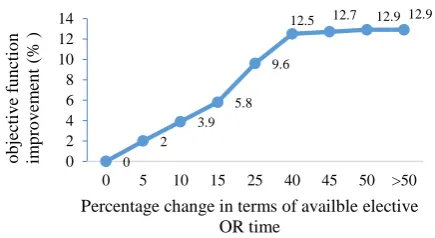
robust estimation. The results indicate that the proposed model obtains better solution, i.e. 21.5% higher than that of the current solution put in practice by the hospital. In addition the results show that in the majority of cases the optimum solution for each surgical group meets the respective demand. In the optimal solution, only 63% of total OR elective capacity is assigned to the surgical groups while for the case of CNS and orthopedic surgical groups they can only cover 71% and 75% of their elective demands, respectively. The reason behind facing with idle capacity of some of the operating rooms while some surgical groups have uncovered demand, may be attributed to the technical restriction on the OR facilities. In order to study the effect of the OR available time on the objective function the proposed model has been solved in different scenarios in terms of available capacity of elective OR time. The results are presented in Figure 1.
As shown in Figure 1, increasing available elective OR time can improve optimum solution up to 12.9%. On the other hand, based on the results, since underutilization of OR capacity occurrs on about 37% of the optimum solution, this provides an opportunity for hospital managers to facilitate their idle operating rooms in order to support CNS and orthopedic surgeries, if it will be possible.
Figure 2 shows the effect of the changes in the maximum decrease rate of capacity of surgical groups on the objective function.
The results indicate that reducing the lower bound of the allocated capacity to surgical groups leads to an improvement in objective function. When the maximum decrease on the rate of the capacity of surgical groups are equal to 0 (-100% change) the objective function is improved by 10.6%. As a result, it can be concluded that in this situation due to the high priority of orthopedic surgical groups, all of the capacity of operating rooms 1, 2, 3 and 4 are assigned to this surgical group and hence no elective OR time is assigned to CNS surgical group.
Figure 1. Objective function improvement against the change in the available elective OR time
Figure 2. Objective function improvement according to change in maximum decrease in the rate of capacity of surgical groups
The results of the sensitivity analysis also reveal that wards and ICU capacity are not a bottleneck in Shahid Madani hospital, and hence the hospital managers shall focus on available OR elective capacity and their elective covering policy to improve the performance of CMP.
6. CONCOLUSION
This paper studied the problem of allocating OR time to surgical groups, considered as a surrogate for the CMPP. For this purpose an LP model is developed to find the optimum case mix of the patients. In order to make the problem as real as possible, the constraints and the parameters' values are defined based on the data collected from Shahid Madani hospital. According to the hospital staff, three performance measures were considered in the CMPP. To tackle with the multi-criteria nature of objective function of CMP, TOPSIS technique was applied. The values of the parameters of the model were estimated using the data collected from
Shahid Madani HIS. In order to overcome
contaminations of the data and down weighting the outlier data, a robust estimator was applied to estimate the values of the model parameters. Having estimated the values of the parameters, the developed LP model was solved using GAMS software. The results revealed that compared with the current situation, the proposed methods results in an increase in total hospital operated “value of patients” by 21.5%. In addition, a sensitivity analysis was conducted. Furthermore, the results of the sensitivity analysis performed indicated that as the available elective OR capacity increases, the value of the objective function is increased by 12.9%. Likewise, the objective function is improved by 10.6% when the change on the minimum rate of each surgical group is increased while ICU and ward beds capacity changes did not affect the CMP. As a further study, it is proposed to study the problem in an uncertain environment in terms of LOS in the wards, ICU or 0
2 3.9
5.8 9.6
12.5 12.7 12.9 12.9
0 2 4 6 8 10 12 14
0 5 10 15 25 40 45 50 >50
o
b
jec
ti
v
e
fu
n
cti
o
n
im
p
ro
v
em
en
t
(%
)
Percentage change in terms of availble elective OR time
10.6 8
5.3 2.6
1.6 1.1 0.5
0 0
2 4 6 8 10 12
-100 -75 -50 -25 -15 -10 -5 0
%
o
f
o
b
je
v
tiv
e f
u
n
ctio
n
im
p
ro
v
em
en
t
operating time. In addition, it is proposed to study on balancing hospital resources while finding optimum solution for the CMPP. Finally, it is supposed to use heuristic or meta-heuristic algorithms such as genetic algorithm [30] or simulated annealing [31] when the problem size will be increased.
7. ACKNOWLEDGEMENT
The authors thank to Shahid Madani hospital managers and staffs for their supports in providing the data required and valuable comments.
8. REFERENCES
1. Hof, S., Fügener, A., Schoenfelder, J. and Brunner, J.O., "Case
mix planning in hospitals: A review and future agenda", Health
Care Management Science, Vol. 20, No. 2, (2017), 207-220.
2. Yahia, Z., Eltawil, A.B. and Harraz, N.A., "The operating room
case-mix problem under uncertainty and nurses capacity
constraints", Health Care Management Science, Vol. 19, No.
4, (2016), 383-394.
3. Association, H.F.M., "Achieving operating room efficiency
through process integration", Healthcare Financial
Management: Journal of the Healthcare Financial
Management Association, Vol. 57, No. 3, (2003), suppl 1.
4. Thirapan, K., "A hospital admission planning model to improve
operating room resource utilization", (2013).
5. Hans, E.W., Van Houdenhoven, M. and Hulshof, P.J., A
framework for healthcare planning and control, in Handbook of healthcare system scheduling. (2012), Springer.303-320.
6. Güler, M.G., İdi, K. and Güler, E.Y., "A goal programming
model for scheduling residents in an anesthesia and reanimation
department", Expert Systems with Applications, Vol. 40, No. 6,
(2013), 2117-2126.
7. Patterson, P., "What makes a well-oiled scheduling system?",
OR Manager, Vol. 12, No. 9, (1996), 19-23.
8. Vacanti, C., Segal, S., Sikka, P. and Urman, R., "Essential
clinical anesthesia, Cambridge University Press, (2011).
9. Roth, A.V. and DIERDONCK, R., "Hospital resource planning:
Concepts, feasibility, and framework", Production and
Operations Management, Vol. 4, No. 1, (1995), 2-29.
10. Vissers, J.M., Bertrand, J. and De Vries, G., "A framework for
production control in health care organizations", Production
Planning & Control, Vol. 12, No. 6, (2001), 591-604.
11. Abdelrasol, Z.Y., Harraz, N. and Eltawil, A., "A proposed solution framework for the operating room scheduling problems", in Proceedings of the world congress on engineering and computer science. Vol. 2, (2013), 23-25.
12. Guerriero, F. and Guido, R., "Operational research in the
management of the operating theatre: A survey", Health Care
Management Science, Vol. 14, No. 1, (2011), 89-114.
13. Cardoen, B., Demeulemeester, E. and Beliën, J., "Operating
room planning and scheduling: A literature review", European
Journal of Operational Research, Vol. 201, No. 3, (2010),
921-932.
14. Robbins, W. and Tuntiwongpiboom, N., "Linear programming a
useful tool in case-mix management", Healthcare financial
Management: Journal of the Healthcare Financial
Management Association, Vol. 43, No. 6, (1989), 114.
15. Milsum, J.H., Turban, E. and Vertinsky, I., "Hospital admission
systems: Their evaluation and management", Management
Science, Vol. 19, No. 6, (1973), 646-666.
16. Ma, G. and Demeulemeester, E., "A multilevel integrative approach to hospital case mix and capacity planning",
Computers & Operations Research, Vol. 40, No. 9, (2013),
2198-2207.
17. Ma, G., Demeulemeester, E. and Wang, L., "Solving the strategic case mix problem optimally by using branch-and-price algorithms", (2009).
18. Meyer, G.C., Taylor, J.W. and Damewood, E.Z., "Using the
operations management modeling technique of linear
programming to determine optimal case mix of three cardiac
services", Journal of Cardiopulmonary Rehabilitation and
Prevention, Vol. 12, No. 6, (1992), 407-412.
19. Rifai, A.K. and Pecenka, J.O., "An application of goal
programming in healthcare planning", International Journal of
Operations & Production Management, Vol. 10, No. 3, (1990),
28-37.
20. Blake, J.T. and Carter, M.W., "A goal programming approach to
strategic resource allocation in acute care hospitals", European
Journal of Operational Research, Vol. 140, No. 3, (2002),
541-561.
21. Mulholland, M.W., Abrahamse, P. and Bahl, V., "Linear programming to optimize performance in a department of
surgery", Journal of the American College of Surgeons, Vol.
200, No. 6, (2005), 861-868.
22. Baligh, H.H. and Laughhunn, D.J., "An economic and linear
model of the hospital", Health Services Research, Vol. 4, No.
4, (1969), 293-305.
23. Rauner, M.S., Schneider, G. and Heidenberger, K.,
"Reimbursement systems and regional inpatient allocation: A
non-linear optimisation model", IMA Journal of Management
Mathematics, Vol. 16, No. 3, (2005), 217-237.
24. Mandic, K., Delibasic, B., Knezevic, S. and Benkovic, S., "Analysis of the financial parameters of serbian banks through
the application of the fuzzy ahp and topsis methods", Economic
Modelling, Vol. 43, No., (2014), 30-37.
25. Hwang, C.-L. and Yoon, K., "Lecture notes in economics and mathematical systems: Multiple attribute decision making: Methods and appllication, Springer Verlag, (1981).
26. Moshiri, B., Asharif, M.R. and HoseinNezhad, R., "A new approach to self-localization for mobile robots using sensor data
fusion", International Journal of Engineering Transactions B,
Vol. 15, No., (2002), 145-156.
27. Sogandi, F. and Amiri, A., "Estimating the time of a step change
in gamma regression profiles using mle approach",
International Journal of Engineering-Transactions B:
Applications, Vol. 28, No. 2, (2014), 224-231.
28. Vakilian, F., Amiri, A. and Sogandi, F., "Isotonic change point estimation in the ar (1) autocorrelated simple linear profiles",
International Journal of Engineering-Transactions A: Basics,
Vol. 28, No. 7, (2015), 1059-1067.
29. Ruckstuhl, A. and Welsh, A., "Robust fitting of the binomial
model", Annals of statistics, (2001), 1117-1136.
30. Tavakkoli-Moghaddam, R., Heydar, M. and Mousavi, S., "A hybrid genetic algorithm for a bi-objective scheduling problem
in a flexible manufacturing cell", International Journal of
Engineering-Transactions A: Basics, Vol. 23, No. 3&4,
(2010), 235-243.
31. Hasani, A., Soltani, R. and Eskandarpour, M., "A hybrid meta-heuristic for the dynamic layout problem with transportation
system design", International Journal of
Engineering-Transactions B: Applications, Vol. 28, No. 8, (2015),
Case Mix Planning using The Technique for Order of Preference by Similarity to
Ideal Solution and Robust Estimation: a Case Study
R. Shafaei, A. Mozdgir
Department of Industrial Engineering, K. N. Toosi University of Technology, Tehran, Iran
P A P E R I N F O
Paper history:
Received 27 December 2016 Received in revised form 01 May 2017 Accepted 07 July 2017
Keywords:
Case Mix Planning Problem Mathematical Programming Sensitivity Analysis Robust Estimation ديكچ ه دم تیری شخب اه ی حارج ی قاتا و اه ی شقن لمع ی لک یدی هب هدافتسا رد هنی
ب زا اهناتسرامی ا رد .دراد نی هلاسم هزوح “ عت نیی کرت بی ب نارامی ” همانرب رد لاومعم ر
یزی قاتا تدم دنلب ه
ا ی سررب دروم لمع ی م رارق ی دریگ ا . نی صخت زا تسترابع هلاسم صی فرظ تی قاتا اه ی هورگ هب لمع اه
ی ب فلتخم امی ا رد .نار نی زا هلاقم کی همانرب لدم ر یزی ر یضای صخت تهج صی هب هنی فرظ تی قاتا اه ی هورگ هب لمع اه
ی حارج فلتخم ی
ب .تسا هدش هدافتسا ه
هولاع ، دنب هبتر شور زا ی
TOPSIS
هبتر روظنم هب دنب
ی
هورگ اه ی حارج فلتخم ی
صخاش ساسا رب اه
ی درکلمع فلتخم ی
ب ناتسرامی هدافتسا هدش نچه .تسا نی ، ر درکیو دروآرب هدننک اه ی اهرتماراپ دروآرب تهج راوتسا ی
هداد ساسا رب هلاسم اه
ی عقاو ی سپس .تسا هتفرگ رارق هدافتسا دروم ،
هعسوت لدم
رازفا مرن طسوت هدش هداد
GAMS درگ لح هدی اتن .تسا جی ب ه لدم لح زا لصاح هدمآ تسد م راکشآ
ی دزاس صخاش هک
ب شزرا نارامی حارج ی عضو هب تبسن هدش ی
لعف ت ی ب ناتسرامی 21.5 % ازفا شی م ی دبای ا . نی ولا ساسا رب صخاش تی یاه ب ناتسرامی رعت فی هدش قلاخا تاظحلام لماش و تسا ی م ی دشاب ب . ه هولاع ، سررب تهج ی ساسح تی غت هب لدم ریی رد عبانم رد
لحت هب ،سرتسد لی
ساسح تی لدم اتن .تسا هدش هتخادرپ جی
لحت زا لصاح لی
ساسح تی ن هتفرگ تروص ناش م ی دهد م هک نازی
ب هلاسم فده عبات ه