I
I
IN
N
N
T
T
T
E
E
E
R
R
R
N
N
N
A
AT
A
T
T
I
I
I
O
ON
O
N
N
A
A
A
L
L
L
J
JO
J
O
OU
U
UR
R
R
N
N
N
A
A
A
L
L
L
O
OF
O
F
F
R
R
R
E
E
E
S
SE
S
E
E
A
A
A
R
R
R
C
C
C
H
H
H
I
IN
I
N
N
C
C
C
O
OM
O
M
M
M
ME
M
E
E
R
R
R
C
C
C
E
E
E
,
,
,
I
I
I
T
T
T
A
A
A
N
N
N
D
D
D
M
MA
M
A
AN
N
N
A
A
A
G
G
G
E
E
E
M
ME
M
E
E
N
N
N
T
T
T
A Monthly Double-Blind Peer Reviewed Refereed Open Access International e-Journal - Included in the International Serial Directories
C
C
C
CONTENTS
ONTENTS
ONTENTS
ONTENTS
Sr.
No.
TITLE & NAME OF THE AUTHOR (S)
Page No.
1
.
INFORMATION TECHNOLOGY AND ITS APPLICATION AMONG USERS & NON-USERS IN IRANDR. ALI BARATI DEVIN
1
2
.
ACADEMIC STAFF’S PERCEPTION OF ADMINISTRATIVE STAFF SERVICES IN ETHIOPIA: A CASE STUDY OF ADI-HAQI CAMPUS, MEKELLE UNIVERSITYDR. TESFATSION SAHLU DESTA
5
3
.
XBRL, THE 21ST CENTURY DATA SOURCE AND DATABASE LEVEL DATA VALIDATIONFABOYEDE, S.O., MUKORO, D. & OLOWE, O.
15
4
.
ORGANISATIONAL CULTURE MANACLES TO EMBARK UPON DURING GLOBAL CONDENSEDR. A. CHANDRA MOHAN, DR. K. VASANTHI KUMARI & DR. P. DEVARAJ
22
5
.
IMPACT OF REFORMS ON THE SOUNDNESS OF INDIAN BANKINGSAHILA CHAUDHARY & DR. SULTAN SINGH
26
6
.
ASSURING QUALITY USING 6 SIGMA TOOL - DMAIC TECHNIQUEANOOP C NAIR
34
7
.
COMMUNITIES OF PRACTICE: THEIR ROLE IN THE CREATION AND TRANSFER OF KNOWLEDGE IN ORGANISATIONSDR. ROOPA T.N. & RAGHAVENDRA A.N.
39
8
.
MAMAGEMENT OF OVERALL PRODUCTIVITY IN SPOT WELDING CARRIED OUT IN WELD DIVISION OF A LIMITED COMPANYDR. G RAJENDRA, AKSHATHA V. M & HARSHA D
43
9
.
A STUDY ON THE PERFORMANCE OF INVENTORY MANAGEMENT IN APSRTCDR. K. SAI KUMAR
48
10
.
IMPACT OF CHANGES IN ENTRY LOAD STRUCTURE OF MUTUAL FUND SCHEMES – EVIDENCE FROM INDIAN MUTUAL FUND INDUSTRYN. VENKATESH KUMAR & DR. ASHWINI KUMAR BJ
56
11
.
A COMPARATIVE ANALYSIS OF MARKET RETURNS AND FUND FLOWS WITH REFERENCE TO MUTUAL FUNDSR. ANITHA, C. RADHAPRIYA & T. DEVASENATHIPATHI
62
12
.
WOMEN EMPOWERMENT AND ENTREPRENEURSHIP THROUGH SHGs - A STUDY OF CHIKKABALLAPUR DISTRICTDR. S. MURALIDHAR, K. SHARADA & NARASAPPA.P.R
67
13
.
ANDHRA PRADESH STATE FINANCIAL CORPORATION FOR THE DEVELOPMENT OF MICRO, SMALL AND MEDIUM ENTERPRISES (MSMEs) - A STUDY OF TIRUPATI BRANCH IN CHITTOOR DISTRICTDR. K. SUDARSAN, DR. V. MURALI KRISHNA, DR. KOTA SREENIVASA MURTHY & DR. D. HIMACHALAM
72
14
.
IMPACT OF SERVICE QUALITY AND CUSTOMER SATISFACTION ON REPURCHASE INTENTIONARUP KUMAR BAKSI & DR. BIVRAJ BHUSAN PARIDA
80
15
.
AN EMPIRICAL RESEARCH ON MOBILE USERS INTENTION AND BEHAVIOUR TOWARDS MOBILE ENTERTAINMENT SERVICES IN INDIA BASED ON THEORY OF PLANNED BEHAVIOUR MODELG N SATISH KUMAR & T. V. JANAKI
86
16
.
RETENTION STRATEGY: THE MAJOR TRENDS THAT CARRIED OUT IN IT SECTORDR. S. CHITRA DEVI & E. LATHA
90
17
.
HUMAN RESOURCE DEVELOPMENT PRACTICES IN INFORMATION TECHNOLOGY INDUSTRY IN INDIADR. DEEPAKSHI GUPTA & DR. NEENA MALHOTRA
95
18
.
ORGANISATIONAL SUPPORT FOR EMPLOYEES’ CAREER MANAGEMENTA. SEEMA, DR. ANITA PRIYA RAJA & DR. S. SUJATHA
109
19
.
A STUDY ON SMALL INVESTOR’S PREFERENCE TOWARDS MUTUAL FUNDS IN SALEM DISTRICT, TAMIL NADUM. GURUSAMY
113
20
.
A STUDY ON ATTRITION IN DOMESTIC FORMULATIONS IN CHENNAI CHEMICALS AND PHARMACEUTICALS LTD.C M MARAN
123
21
.
A STATISTICAL ANALYSIS OF DAILY NIFTY RETURNS, DURING 2001-11SANTANU DUTTA
133
22
.
HEALTH AND SOCIAL PROBLEMS OF INDIAN WOMEN - A STUDYDR. A. S. SHIRALASHETTI
137
23
.
ANTECEDENTS OF CRM IN HIGHER EDUCATIONDR. NARINDER TANWAR
139
24
.
HUMAN CAPITAL MANAGEMENT ISSUES AND POSSIBILITIES OF MSMES - A STUDY ON SELECT UNITS IN BANGALORELAKSHMYPRIYA K. & SUPARNA DAS PURKAYASTHA
142
25
.
GENERATING FUNCTIONS FOR PELL AND PELL-LUCAS NUMBERSDR. NARESH PATEL
152
CHIEF PATRON
CHIEF PATRON
CHIEF PATRON
CHIEF PATRON
PROF. K. K. AGGARWAL
Chancellor, Lingaya’s University, Delhi
Founder Vice-Chancellor, Guru Gobind Singh Indraprastha University, Delhi
Ex. Pro Vice-Chancellor, Guru Jambheshwar University, Hisar
PATRON
PATRON
PATRON
PATRON
SH. RAM BHAJAN AGGARWAL
Ex. State Minister for Home & Tourism, Government of Haryana
Vice-President, Dadri Education Society, Charkhi Dadri
President, Chinar Syntex Ltd. (Textile Mills), Bhiwani
CO
CO
CO
CO----ORDINATOR
ORDINATOR
ORDINATOR
ORDINATOR
AMITA
Faculty, E.C.C., Safidon, Jind
ADVISORS
ADVISORS
ADVISORS
ADVISORS
PROF. M. S. SENAM RAJU
Director A. C. D., School of Management Studies, I.G.N.O.U., New Delhi
PROF. M. N. SHARMA
Chairman, M.B.A., Haryana College of Technology & Management, Kaithal
PROF. S. L. MAHANDRU
Principal (Retd.), Maharaja Agrasen College, Jagadhri
EDITOR
EDITOR
EDITOR
EDITOR
PROF. R. K. SHARMA
Dean (Academics), Tecnia Institute of Advanced Studies, Delhi
CO
CO
CO
CO----EDITOR
EDITOR
EDITOR
EDITOR
DR. BHAVET
Faculty, M. M. Institute of Management, Maharishi Markandeshwar University, Mullana, Ambala, Haryana
EDITORIAL ADVISORY BOARD
EDITORIAL ADVISORY BOARD
EDITORIAL ADVISORY BOARD
EDITORIAL ADVISORY BOARD
DR. AMBIKA ZUTSHI
Faculty, School of Management & Marketing, Deakin University, Australia
DR. VIVEK NATRAJAN
Faculty, Lomar University, U.S.A.
DR. RAJESH MODI
Faculty, Yanbu Industrial College, Kingdom of Saudi Arabia
PROF. SANJIV MITTAL
University School of Management Studies, Guru Gobind Singh I. P. University, Delhi
PROF. ANIL K. SAINI
Chairperson (CRC), Guru Gobind Singh I. P. University, Delhi
DR. KULBHUSHAN CHANDEL
DR. SAMBHAVNA
Faculty, I.I.T.M., Delhi
DR. MOHENDER KUMAR GUPTA
Associate Professor, P. J. L. N. Government College, Faridabad
DR. SHIVAKUMAR DEENE
Asst. Professor, Government F. G. College Chitguppa, Bidar, Karnataka
MOHITA
Faculty, Yamuna Institute of Engineering & Technology, Village Gadholi, P. O. Gadhola, Yamunanagar
ASSOCIATE EDITORS
ASSOCIATE EDITORS
ASSOCIATE EDITORS
ASSOCIATE EDITORS
PROF. NAWAB ALI KHAN
Department of Commerce, Aligarh Muslim University, Aligarh, U.P.
PROF. ABHAY BANSAL
Head, Department of Information Technology, Amity School of Engineering & Technology, Amity University, Noida
PROF. A. SURYANARAYANA
Department of Business Management, Osmania University, Hyderabad
DR. ASHOK KUMAR
Head, Department of Electronics, D. A. V. College (Lahore), Ambala City
DR. JATINDERKUMAR R. SAINI
Head, Department of Computer Science, S. P. College of Engineering, Visnagar, Mehsana, Gujrat
DR. V. SELVAM
Divisional Leader – Commerce SSL, VIT University, Vellore
DR. PARDEEP AHLAWAT
Reader, Institute of Management Studies & Research, Maharshi Dayanand University, Rohtak
S. TABASSUM SULTANA
Asst. Professor, Department of Business Management, Matrusri Institute of P.G. Studies, Hyderabad
TECHNICAL ADVISOR
TECHNICAL ADVISOR
TECHNICAL ADVISOR
TECHNICAL ADVISOR
AMITA
Faculty, E.C.C., Safidon, Jind
MOHITA
Faculty, Yamuna Institute of Engineering & Technology, Village Gadholi, P. O. Gadhola, Yamunanagar
FINANCIAL ADVISORS
FINANCIAL ADVISORS
FINANCIAL ADVISORS
FINANCIAL ADVISORS
DICKIN GOYAL
Advocate & Tax Adviser, Panchkula
NEENA
Investment Consultant, Chambaghat, Solan, Himachal Pradesh
LEGAL ADVISORS
LEGAL ADVISORS
LEGAL ADVISORS
LEGAL ADVISORS
JITENDER S. CHAHAL
Advocate, Punjab & Haryana High Court, Chandigarh U.T.
CHANDER BHUSHAN SHARMA
Advocate & Consultant, District Courts, Yamunanagar at Jagadhri
SUPERINTENDENT
SUPERINTENDENT
SUPERINTENDENT
SUPERINTENDENT
CALL FOR MANUSCRIPTS
CALL FOR MANUSCRIPTS
CALL FOR MANUSCRIPTS
CALL FOR MANUSCRIPTS
We
invite unpublished novel, original, empirical and high quality research work pertaining to recent developments & practices in
the area of Computer, Business, Finance, Marketing, Human Resource Management, General Management, Banking, Insurance,
Corporate Governance and emerging paradigms in allied subjects like Accounting Education; Accounting Information Systems;
Accounting Theory & Practice; Auditing; Behavioral Accounting; Behavioral Economics; Corporate Finance; Cost Accounting;
Econometrics; Economic Development; Economic History; Financial Institutions & Markets; Financial Services; Fiscal Policy;
Government & Non Profit Accounting; Industrial Organization; International Economics & Trade; International Finance; Macro
Economics; Micro Economics; Monetary Policy; Portfolio & Security Analysis; Public Policy Economics; Real Estate; Regional
Economics; Tax Accounting; Advertising & Promotion Management; Business Education; Business Information Systems (MIS);
Business Law, Public Responsibility & Ethics; Communication; Direct Marketing; E-Commerce; Global Business; Health Care
Administration; Labor Relations & Human Resource Management; Marketing Research; Marketing Theory & Applications;
Non-Profit Organizations; Office Administration/Management; Operations Research/Statistics; Organizational Behavior & Theory;
Organizational Development; Production/Operations; Public Administration; Purchasing/Materials Management; Retailing;
Sales/Selling; Services; Small Business Entrepreneurship; Strategic Management Policy; Technology/Innovation; Tourism,
Hospitality & Leisure; Transportation/Physical Distribution; Algorithms; Artificial Intelligence; Compilers & Translation; Computer
Aided Design (CAD); Computer Aided Manufacturing; Computer Graphics; Computer Organization & Architecture; Database
Structures & Systems; Digital Logic; Discrete Structures; Internet; Management Information Systems; Modeling & Simulation;
Multimedia; Neural Systems/Neural Networks; Numerical Analysis/Scientific Computing; Object Oriented Programming;
Operating Systems; Programming Languages; Robotics; Symbolic & Formal Logic; Web Design. The above mentioned tracks are
only indicative, and not exhaustive.
Anybody can submit the soft copy of his/her manuscript
anytime
in M.S. Word format after preparing the same as per our
submission guidelines duly available on our website under the heading guidelines for submission, at the email addresses,
or
.
GUIDELINES FOR SUBMISSION OF MANUSCRIPT
GUIDELINES FOR SUBMISSION OF MANUSCRIPT
GUIDELINES FOR SUBMISSION OF MANUSCRIPT
GUIDELINES FOR SUBMISSION OF MANUSCRIPT
1. COVERING LETTER FOR SUBMISSION:
DATED: _____________
THE EDITOR
IJRCM
Subject:
SUBMISSION OF MANUSCRIPT IN THE AREA OF .
(e.g. Computer/IT/Finance/Marketing/HRM/General Management/other, please specify)
.
DEAR SIR/MADAM
Please find my submission of manuscript titled ‘___________________________________________’ for possible publication in your journal.
I hereby affirm that the contents of this manuscript are original. Furthermore it has neither been published elsewhere in any language fully or partly, nor is it under review for publication anywhere.
I affirm that all author (s) have seen and agreed to the submitted version of the manuscript and their inclusion of name (s) as co-author (s).
Also, if our/my manuscript is accepted, I/We agree to comply with the formalities as given on the website of journal & you are free to publish our contribution to any of your journals.
NAME OF CORRESPONDING AUTHOR:
Designation:
Residential address with Pin Code:
Mobile Number (s):
Landline Number (s):
E-mail Address:
Alternate E-mail Address:
2. INTRODUCTION: Manuscript must be in British English prepared on a standard A4 size paper setting. It must be prepared on a single space and single column with 1” margin set for top, bottom, left and right. It should be typed in 8 point Calibri Font with page numbers at the bottom and centre of the every page.
3. MANUSCRIPT TITLE: The title of the paper should be in a 12 point Calibri Font. It should be bold typed, centered and fully capitalised.
4. AUTHOR NAME(S) & AFFILIATIONS: The author (s) full name, designation, affiliation (s), address, mobile/landline numbers, and email/alternate email address should be in italic & 11-point Calibri Font. It must be centered underneath the title.
5. ABSTRACT: Abstract should be in fully italicized text, not exceeding 250 words. The abstract must be informative and explain the background, aims, methods, results & conclusion in a single para.
6. KEYWORDS: Abstract must be followed by list of keywords, subject to the maximum of five. These should be arranged in alphabetic order separated by commas and full stops at the end.
7. HEADINGS: All the headings should be in a 10 point Calibri Font. These must be bold-faced, aligned left and fully capitalised. Leave a blank line before each heading.
8. SUB-HEADINGS: All the sub-headings should be in a 8 point Calibri Font. These must be bold-faced, aligned left and fully capitalised.
9. MAIN TEXT: The main text should be in a 8 point Calibri Font, single spaced and justified.
10. FIGURES &TABLES: These should be simple, centered, separately numbered & self explained, and titles must be above the tables/figures. Sources of data should be mentioned below the table/figure. It should be ensured that the tables/figures are referred to from the main text.
11. EQUATIONS: These should be consecutively numbered in parentheses, horizontally centered with equation number placed at the right.
12. REFERENCES: The list of all references should be alphabetically arranged. It must be single spaced, and at the end of the manuscript. The author (s) should mention only the actually utilised references in the preparation of manuscript and they are supposed to follow Harvard Style of Referencing. The author (s) are supposed to follow the references as per following:
•
All works cited in the text (including sources for tables and figures) should be listed alphabetically.•
Use (ed.) for one editor, and (ed.s) for multiple editors.•
When listing two or more works by one author, use --- (20xx), such as after Kohl (1997), use --- (2001), etc, in chronologically ascending order.•
Indicate (opening and closing) page numbers for articles in journals and for chapters in books.•
The title of books and journals should be in italics. Double quotation marks are used for titles of journal articles, book chapters, dissertations, reports, working papers, unpublished material, etc.•
For titles in a language other than English, provide an English translation in parentheses.•
The location of endnotes within the text should be indicated by superscript numbers.PLEASE USE THE FOLLOWING FOR STYLE AND PUNCTUATION IN REFERENCES:
BOOKS
•
Bowersox, Donald J., Closs, David J., (1996), "Logistical Management." Tata McGraw, Hill, New Delhi.•
Hunker, H.L. and A.J. Wright (1963), "Factors of Industrial Location in Ohio," Ohio State University.CONTRIBUTIONS TO BOOKS
•
Sharma T., Kwatra, G. (2008) Effectiveness of Social Advertising: A Study of Selected Campaigns, Corporate Social Responsibility, Edited by David Crowther & Nicholas Capaldi, Ashgate Research Companion to Corporate Social Responsibility, Chapter 15, pp 287-303.JOURNAL AND OTHER ARTICLES
•
Schemenner, R.W., Huber, J.C. and Cook, R.L. (1987), "Geographic Differences and the Location of New Manufacturing Facilities," Journal of Urban Economics, Vol. 21, No. 1, pp. 83-104.CONFERENCE PAPERS
•
Garg Sambhav (2011): "Business Ethics" Paper presented at the Annual International Conference for the All India Management Association, New Delhi, India, 19–22 June.UNPUBLISHED DISSERTATIONS AND THESES
•
Kumar S. (2011): "Customer Value: A Comparative Study of Rural and Urban Customers," Thesis, Kurukshetra University, Kurukshetra.ONLINE RESOURCES
•
Always indicate the date that the source was accessed, as online resources are frequently updated or removed.WEBSITE
INFORMATION TECHNOLOGY AND ITS APPLICATION AMONG USERS & NON-USERS IN IRAN
DR. ALI BARATI DEVIN
LECTURER
DEPARTMENT OF MANAGEMENT
UNIVERSITY OF PAYAME NOUR GHOCHAN
IRAN
ABSTRACT
The study at hand namely,"Information Technology and its application among users &non-users in Iran ", deals with the current state of affairs in the field of agribusiness of the traditional crops in Iran, namely pistachio and saffron. It goes to show the current state of affairs as currently being followed by the stakeholders. It has been observed that the aim of the study has been satisfied as there was a clear evidence of positive progress by those who made use of IT tools as against those who kept themselves away from it. There has been found to be wide curiosity and willingness among all the users and non users towards the use and acceptability of the IT tools and also areas for further development have been stated and listed in the study. The main aim of the study, as stated in the objectives of the study was to ascertain the level of benefits derived from the use and it was found that the users did perform better as compared to the non users. Numerically the findings have been proven and the possibility of the same to be that representing the complete population engaged in the trade can be taken as representative as the study was conducted by picking up the sample population by use of simple random sampling. There does exist a vast area of scope for the outcome of the study to be implemented as it would give out a clear difference in the way that things are being done at present and also it would result in qualitative and quantitative improvement in the output. This carries more importance as the country It is with the matter of concern that the topic was selected as the target of study. This is due to the reason that improvement in the area would surely give a boost to the manner in which things are being done and this would in turn result in improvement in the quality and quantity of the output of which the country takes pride to be a leader in the production and availability.
KEYWORDS
IT, Iran.
INTRODUCTION
griculture can be defined as the oldest of all trades known to mankind. It has evolved itself from ancient times to take the shape as we know it today. The activity has taken in its stride many improvements and has improved with experience, modernization and innovation.
AGRICULTURE IN IRAN
Roughly one-third of Iran's total surface area is suitable for farmland, but because of poor soil and lack of adequate water distribution in many areas, most of it has not been brought under cultivation. Only 12% of the total land area is under cultivation (arable land, orchards and vineyards) but less than one-third of the cultivated area is irrigated; the rest is devoted to dry farming. The western and northwestern portions of the country have the most fertile soils due to geographical advantage that they enjoy.
Agricultural activities accounted for about one-fifth of Iran's gross domestic product (GDP) and employed a comparable proportion of the workforce. The size of the farms with poor economic viability, scarcity of water, poor soil conditions, low quality seeds and farming techniques have resulted in poor agricultural yields. The gross value of products in Iran's agricultural sector had reached $25 billion in 1997. As per the government statistics the country has attained 94 percent self-sufficiency in essential agricultural products.
ROLE OF INFORMATION TECHNOLOGY
The market users require information on their activities / functions carried out by them in the process of marketing. This information facilitates them to make decision on what to produce? Where to produce? How much to produce and how to produce in respect of production of agricultural commodities. Similarly, they require information on marketing to take decision on where to sell, how to sell, how much to sell and when to sell. In the absence of such information, the farmers fail to take appropriate decision while producing or selling their commodities. Even the other market users like traders, commission agents, importers exporters, storage operators, processors etc do require information on their functions to make proper decision. Therefore, the information to market users is crucial without which the efficiency of marketing cannot be enhanced. In this direction, IT plays an important role in providing such information to the market users.
Information technology plays an important role in decision making process. The producers can make their decision on both production and marketing activities. Their marketing and production problems can be addressed very easily when accurate information is made available to them on time.
In this direction, Information Technology has become an important tool for providing correct Information to the market users. The answers for the production and marketing questions could be best obtained by the use of improved technology which would be instrumental to solve most of the problems of the farmers in particular and market users in general. This would increase their profit and reduce the unnecessary cost of marketing.
IT IN AGRI-BUSINESS
In order to achieve greater efficiency in agri-business system that is in production and marketing of agricultural commodities, the integrated information on the following is very much required and has to be supplied by the agencies concerned:
• Availability and prices of different inputs.
• Crop cultivation technologies which are agro-ecology specific.
• Information about post-harvest infrastructure such as processing, value addition and storage.
• Agricultural of products demand and supply, prices etc.
• Marketing system cost of marketing, prices of agricultural commodities.
• Import and Export of agricultural commodities, prices at international market demand and supply of Agri – commodities.
• Government policies, programs etc.
NEED FOR THE STUDY
In the recent decade, the introduction of new technology has changed the industrial, agricultural and military sectors in Iran. It is noticed that the emergence of IT in these sectors is of high relevance and most required for the development of the country’s economy. This study would throw light on the growth of IT in agribusiness and its impact on enhancing business activities with increased quality, reduce the cost of marketing and there by increase the producers share in a consumer rupee. This would help the policy makers in framing appropriate policies, programs and to initiate strategies to reduce the gap between the producers and the end users. In this regard, the present study aims to address some of the issues that would emerge in the light of IT revolution in Agribusiness activities.
METHODOLOGY
Methodology gives the details on study area, selection of samples, sources for data, and analytical tools and techniques employed for the study. This study is based on both primary data and secondary data. Primary data relates itself to the market users / participants such as producers, traders, exporters, processors. Such data are obtained from administering a well structured questionnaire to all market functionaries. Secondary data is obtained from the government publications, journals, International reports, FAO publications etc.
The chi-square test is employed for analyzing the obtained responses. As it was thought to be best suitable for the prevalent conditions at the time. The tool got acceptance for the significance due to the fact that the same was recommended by the investigators who came out with the method based on related activities that they have conducted for various and obvious purposes in the past on the subject.
Iranis divided into thirty provinces, with Razavi Khorasan and Kerman being two major provinces in eastern Iran. Pistachios and saffron are the two major commodities cultivated in Razavi Khorasan province (saffron) and Kerman (pistachio). In case of Pistachio, Iran is the World's largest producer with 40% of the world's output in 2005, where it is the second largest export commodity after oil. Iran also the World's largest producer of saffron with 81% of the world's total output.
The research survey covered all the key players of the pistachio and saffron industry such as pistachio and saffron producers, traders, processors, and exporters with different customized questionnaires. The key reasons for this extensive primary survey were to understand and to collect first hand information from the key players in fulfilling the objectives of the study such as the use of Information and Technology in obtaining inputs by the farmers and to fulfill the requirements of the consumers in the domestic as well as in the international markets. The particular reason for covering these major players is to understand the impact of IT in Agri – business activities in the area of study. The current data refers to 2007-2008. The stake holders are stratified into three groups namely Big, Medium and Small. The samples were drawn from all these three groups by using simple random sampling method.
RESEARCH FINDING
Information technology means the use of electronic automation in the area of occupation. The use of computers is widely practiced which facilitates the work as it also goes into preparing work specific software for the purpose. The tools as provided by IT assist in making the work undertaken to be done in a better and more efficient manner keeping the current dynamic and rapidly growing market conditions and extents.
IT & AGRICULTURAL PRODUCTION ACTIVITIES
In the field of agricultural inputs and services, Information Technology can be used for demand and supply monitoring and issues related to the agricultural inputs and the latest scientific information on the agriculture sector. For instance, information related to the seeds, fertilizers, and pesticides can be available to the farmers to help them in speedy procurement of such inputs at lower prices and in appropriate places. Moreover, the latest information on availability of quality planting material, information related to the whether, types of pesticides and the appropriate time of using them, and type of the fertilizers to increase productivity, information on the HYB seeds, and information related to post harvest, i.e., the methods and time of harvesting need to be posted on the appropriate websites regularly. Information Technology can help farmers accomplish all of these tasks appropriately, with least time and costs.
IT & AGRIBUSINESS ACTIVITIES
Advancement in information and communication technology has made the world a smaller place and a larger market at one go. The availability of prompt and reliable market information about what is happening in the market i.e. what quantities are arriving and what prices are quoted for different commodities considerably improve the decision making capability of the farmers and strengthens their bargaining power. For example, accurate and timely information about the market prices of the agricultural commodities is of extreme significance, which can be done by appropriate use of IT. At present, in developing countries like Iran, information is disseminated through various media like radio, newspapers, blackboard display and public address system at market yards. The information provided by these methods is stale and does not help the farmers sufficiently in taking decisions in marketing their produce. The farmers are also not able to know about the prices prevailing in other markets, as the Market Committees are able to disseminate information only in respect of their own markets. The farmers are therefore, left with no alternative but to dispose of their produce in the nearest market, even at un-remunerative prices. Market information is equally needed by other market participants in arriving at optimal trading decisions. To fully utilize the new emerging trade opportunities for the benefit of farming community, agriculture marketing information system in the country needs to be strengthened and Information and Communication Technology has a vital role to play in the process. The existence of a comprehensive database and dissemination of complete and accurate marketing information is the key to achieving both operational and pricing efficiency in agricultural marketing system. In order to improve the present agricultural marketing information system, there should be a link between all important agricultural produce markets.
Based upon the data and interpretations of the data, the crux of the findings, objective wise, is as follows:
METHODS OF INFORMATION TECHNOLOGY USED IN AGRICULTURAL SECTOR
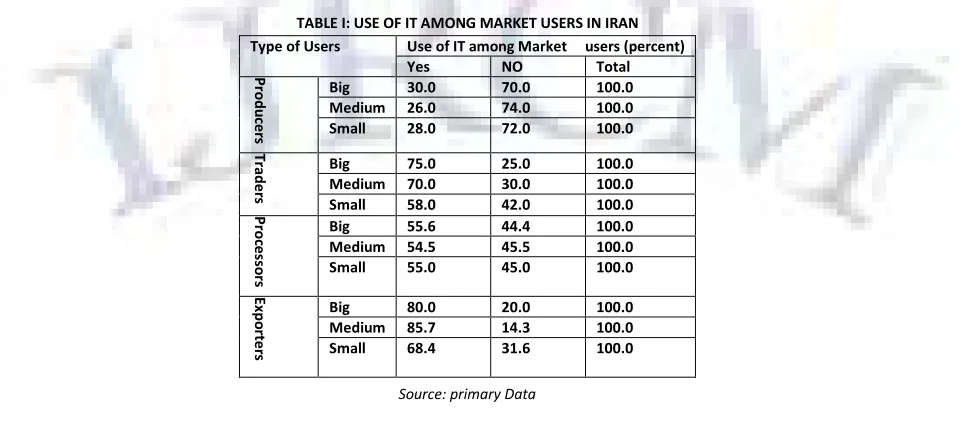
From the various methods of information technology available such as telephone, television, internet, radio, newspapers and government publications, it was found that telephone and the internet are the major means as a source of information among all the categories of the stakeholders.
TABLE I: USE OF IT AMONG MARKET USERS IN IRAN
Source: primary Data
Type of Users Use of IT among Market users (percent) Yes NO Total
P
rod
u
ce
rs
Big 30.0 70.0 100.0 Medium 26.0 74.0 100.0 Small 28.0 72.0 100.0
T
ra
d
e
rs
Big 75.0 25.0 100.0 Medium 70.0 30.0 100.0 Small 58.0 42.0 100.0
P roc e ss o rs
Big 55.6 44.4 100.0 Medium 54.5 45.5 100.0 Small 55.0 45.0 100.0
E x p o rt e rs
GROWTH IN IT AND ITS IMPACT ON DEVELOPMENT OF AGRI-BUSINESS ACTIVITIES
Majority of the stakeholders accept that they do require assistance from IT in their business which goes to show that the study conducted has relevance and would find wide acceptability as it did exhibit the difference of using the assistance of IT in the activity to the non users who have put forth their willingness to accept it in their work.
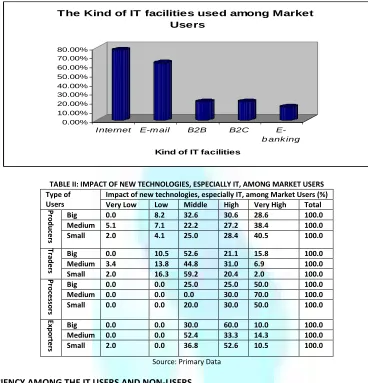
0.00% 10.00% 20.00% 30.00% 40.00% 50.00% 60.00% 70.00% 80.00%
Internet E-m ail B2B B2C
E-b ank ing
Kind of IT facilities
The Kind of IT facilities used among Market Users
TABLE II: IMPACT OF NEW TECHNOLOGIES, ESPECIALLY IT, AMONG MARKET USERS Type of
Users
Impact of new technologies, especially IT, among Market Users (%) Very Low Low Middle High Very High Total
P
rod
u
ce
rs
Big 0.0 8.2 32.6 30.6 28.6 100.0 Medium 5.1 7.1 22.2 27.2 38.4 100.0 Small 2.0 4.1 25.0 28.4 40.5 100.0
T
ra
d
e
rs
Big 0.0 10.5 52.6 21.1 15.8 100.0 Medium 3.4 13.8 44.8 31.0 6.9 100.0 Small 2.0 16.3 59.2 20.4 2.0 100.0
P roc e ss o rs
Big 0.0 0.0 25.0 25.0 50.0 100.0 Medium 0.0 0.0 0.0 30.0 70.0 100.0 Small 0.0 0.0 20.0 30.0 50.0 100.0
E x p o rt e rs
Big 0.0 0.0 30.0 60.0 10.0 100.0 Medium 0.0 0.0 52.4 33.3 14.3 100.0 Small 2.0 0.0 36.8 52.6 10.5 100.0
Source: Primary Data
MARKETING EFFICIENCY AMONG THE IT USERS AND NON-USERS
The tools of IT have helped the stakeholders differently. It has come to the aid of the producers in the search for new markets, time of sale, demand for the commodity, production information and place. For the traders the order of the same changed as the demand descending from markets, business information, time and place. In the case of processors the sequence was as new markets, time of process, demand and process information. The exporters used the same in the sequence of export information, transport information and international price. It has commonly been observed that demand and market were in the list of requirement among all the stakeholders
IT AND DECISION MAKING PROCESS IN AGRIBUSINESS
The effect of IT in the decision making process was seen to be high for producers and the exporters whereas it was found to be commonly at 100% among the traders and processors.
GOVERNMENT POLICIES AND PROGRAM IN PROMOTING IT IN AGRI-BUSINESS IN IRAN
Finally the requirement of further enhancement by all the stakeholders was found to be in the areas of computer knowledge, development of IT facilities and regular orientation programs as put forth by the producers and the traders. The processors called for the improvement of computer knowledge, regular orientation programs and improvement of IT facilities. In the case of the exporters the focus of attention requirement was found to be sequenced as development of IT export facilities, improvement of computer knowledge and regular orientation programs.
POLICY IMPLICATIONS & CONCLUSIONS
Wherein a few insights for improving the situation based on ground realities and flexibility of the system is put forth. It brings out the gist of the entire observation of the study which would give an understanding of the intention and direction of the study thereby bringing out the very reason why the study at hand was carried out. It puts forth the main objective of the purpose which is mainly to bring about modernization in the traditional activity which would bring about marked changes in the way things are being carried out presently and also the way it would be done after the application of the improvement steps where the involvement of the government also shows significance that there seems to exist an amount of collective understanding of the need for the same.
It is the crux of the exercise bringing out the basis and also the direction of the study at hand which would give a glimpse of that which follows in the detailed chapters enclosed in the work and its report.
To summarize the study based on the data obtained from the stakeholders and also from personal field experience, it is a fact that the need of the hour is to imbibe a sense of the need and also the importance of IT and its implication on the traditionally bent community. The results, as the detailed study would put forth would throw light on the amount of its need and also the importance of the study which would flower its fruits on its execution.
activities by the stakeholders. This would really enhance the quality output in agri-business sector.
BIBILIOGRAPHY
Ali Reza Aliahmadi Ph.D. “Information Technology & Application” Edition, 2003, Pp.40-47
Andrew. W. Shepherd, “Making Information services relevant to farmers”, Agricultural Marketing, Jan-Mar 2003, Pp.4-6
Bob Keefe “Internet service in remote spots” The Hindu, Oct 13 2004
Devaraj.M, “Information Technology and Rural Marketing, FICCI, Rural Marketing Summit – 2007, New Delhi.
John D. C Little “INFORMATION TECHNOLOGY IN MARKETING” loan School of Management M.I.T
Rajshekar, M. and Indrajit Gupta "Unlocking rural markets” Business World, Pp .40
Anonymous "MARKETING INFORMATION SYSTEMS IN ASIA" Food and fertilizer technology web site, Internet sources, Undated
Carolyn M. Shrewsbury "Information Technology and Rural Elderly: Policy Issues for American States" Minnesota State University, Mankato
Professor F. Provost Information Technology and Electronic Commerce” http://www.stern.nyu.edu/~fprovost, Internet sources, Undated
Anonymous, “Agricultural Marketing Information: A key step towards globalization of Indian agriculture”, Internet sources, Undated
REQUEST FOR FEEDBACK
Dear Readers
At the very outset, International Journal of Research in Commerce, IT and Management (IJRCM)
acknowledges & appreciates your efforts in showing interest in our present issue under your kind perusal.
I would like to request you to supply your critical comments and suggestions about the material published
in this issue as well as on the journal as a whole, on our E-mails i.e.
or
for further improvements in the interest of research.
If you have any queries please feel free to contact us on our E-mail
.
I am sure that your feedback and deliberations would make future issues better – a result of our joint
effort.
Looking forward an appropriate consideration.
With sincere regards
Thanking you profoundly
Academically yours
Sd/-