Measuring and valuing informal care for economic evaluations of HIV/AIDS interventions: methods and application in Malawi
Levison S. Chiwaula, PhDa,b, Paul Revill, MScc, Deborah Ford, PhDd, Misheck Nkhata, MAa, Travor Mabugu, MSce, James Hakim, MDe, Cissy Kityo, MDf, Adrienne K. Chan, MDa,g, Fabian Cataldo, PhDa, Diana Gibb, MDd, Bernard van
den Berg, PhDh, for the Lablite Project Team
a Dignitas International, Zomba, Malawi; b Department of Economics, University of Malawi, Malawi; c Centre for
Health Economics, University of York, United Kingdom; d MRC Clinical Trials Unit at UCL, London; e University of Zimbabwe Clinical Research Centre, Harare, Zimbabwe; f Joint Clinical Research Centre, Kampala, Uganda; g Division of Infectious Diseases, Department of Medicine, Sunnybrook Health Sciences Centre, University of Toronto, Canada; h Faculty of Economics and Business, University of Groningen, The Netherlands.
Correspondence: Dr. Levison Chiwaula, Department of Economics, Chancellor College, University of Malawi, Zomba, Malawi. Tel: +265 (0)1 525420. Email: [email protected]
Funding source: Funding was received from the Department for International Development (DFID), of the United Kingdom, as part of the Lablite project (www.lablite.org). The views expressed in this paper are not necessarily those of DFID.
Acknowledgements: The authors wish to thank participants in the study and all members of Lablite Project Team. Any errors or omissions are those of the authors.
Keywords: cost-effectiveness, economic evaluation, informal care, HIV/AIDS, Africa
Abstract
Objective: Economic evaluation studies often neglect the impact of disease and ill health on the social networks of people living with HIV (PLHIV) and the wider community. An important concern relates to informal care
requirements which, for some diseases such as HIV/AIDS, can be substantial. This study has measured and valued informal care provided to PLHIV in Malawi.
Methods: A modified diary that divided a day into natural calendar changes was used to measure informal care time. The monetary valuation was undertaken by using four approaches: the opportunity cost method (official minimum wage used to value caregiving time); modified opportunity cost (caregiver’s reservation wage), willingness to pay (amount of money caregiver would pay for care, WTP), and willingness to accept (amount of money caregiver would accept for providing care to someone else, WTA) approaches. Data were collected from 130 caregivers of PLHIV that were accessing antiretroviral therapy (ART) from six facilities in Phalombe district, South-East of Malawi.
Results: 62/130 (48%) caregivers provided informal care in the survey week. On average, caregivers provided care of 8 hours/week. The estimated monetary values of informal care provided per week were US$1.4 (opportunity cost approach), US$2.41 (modified opportunity cost), US$0.40 (WTP), and US$2.07 (WTA).
Introduction
Informal care can be defined as a nonmarket composite commodity consisting of heterogeneous parts produced (paid or unpaid) by one or more members of the social environment of the care recipient as a result of the care demands resulting from ill health1 . Since different healthcare interventions can affect the occurrence and severity of ill health, there have been a number of debates about whether and how informal care effects should be
incorporated into economic evaluation studies [1-2]. Whereas significant methodological advancements have been made in the measurement and valuation of informal care in high [3-5] and middle income contexts 2, little work has been undertaken to examine whether and, if so, how informal care can be measured and valued in low income countries such as those in sub-Saharan Africa.
The informal care impacts associated with HIV/AIDS in Africa warrant special attention given the widespread prevalence and major development challenges associated with the disease. In 2014, 25.8 million people in sub-Saharan Africa were living with HIV, amounting to almost 70% of people living with HIV worldwide3. People living with HIV (PLHIV) in Africa are very reliant on informal caregivers in the form of family and friends as well as on volunteers partly because of the high labour demands placed upon very resource constrained healthcare systems [4-6]. As countries consider how to respond to the recent 2016 World Health Organization (WHO) HIV Treatment Guidelines 4 recommendation to provide antiretroviral therapy (ART) to all PLHIV, the role of informal care provision in program decision-making requires special consideration at the present time.
Carers of PLHIV in Africa are motivated both by intrinsic concern to support PLHIV and also in future some hope of receiving material returns for their labour in future.5 Informal caregiving is, however, associated with negative
The consequences of HIV can therefore extend well beyond the people living with HIV (PLHIV) themselves [11-13]. As such, they should be considered when decisions are made on resource allocation whenever these are likely to result in different informal care consequences, even if they are not formally incorporated within economic evaluation analyses.
The exclusion of informal care effects from economic evaluations would, however, appear to underestimate the benefits of averting HIV infection and disease progression where these are associated with increased informal care burdens. One of the challenges of incorporating informal care effects appears to be a lack of work on the
measurement and valuation of informal care provision in low income settings 8. In this paper, we aim to demonstrate how informal care can be measured and valued in low income settings by estimating informal care provisions for PLHIV in Phalombe district in south-east Malawi.
The Malawian HIV program has pioneered a number of HIV treatment scale up strategies since replicated by other countries, including the ambitious programme to attain universal access to ART started in 20049 and the Option B+ approach to PMTCT which commenced in 201110. Presently, the program in Malawi is implemented through a public and private healthcare system consisting of 724 HIV testing and counselling (HTC) sites and 713
antiretroviral therapy (ART) sites11. HIV treatment follows Malawian national guidelines that were most recently revised in 2014 (Government of Malawi, 2014b). The need for healthcare and in particular HIV treatment is very high with only 71% of adults and 42% of children (<15 years) eligible for HIV treatment accessing ART11. Delivery of HIV/AIDS services is severely hindered by serious financial and human resource constraints 12. To mitigate these Malawi employs community health worker cadres and works in partnership with NGOs to implement a standardized supportive supervision and mentorship program under the guidance of the Ministry of Health national program13. Many community based organisations and support groups support the needs of PLHIV.
from the international literature12. These studies rarely consider informal care effects, however, and it appears such effects are also not considered when determining the EHP.
Methodology
Study design
The study was undertaken in Phalombe district located in the South Eastern Malawi as part of the Lablite ART implementation project13 between November 2013 and August 2014. Data was collected from caregivers of PLHIV who were accessing care at Holy Family Mission Hospital, and five primary care health facilities (Chitekesa, Mpasa, Nkhulambe, Phalombe, and Sukasanje).
We aimed to recruit 50 PLHIV in each of the following categories: patients who had not had a clinical event more serious than those characterized in WHO stages 1 /2 in the last 3 months; patients with a WHO stage 3 event in the last 3 months; and patients with a WHO stage 4 event in the last 3 months. We hypothesized that more serious cases would require more care. A research nurse re-staged PLHIV for whom we did not have information about their WHO stage in the last three months. PLHIV were recruited consecutively in each category until the target numbers were reached. All identified PLHIV were requested to identify their primary caregivers (guardians) who were interviewed at their homes.
The protocol and the data collection tools were approved by the National Health Sciences Research Committee (NHSRC). All individuals consented to participate in the study.
Measuring informal care time
and the challenges of using the diary and recall methods15; we used a modified diary to measure informal care time. The modified diary divided the day into natural time periods (e.g. waking time to sunrise, etc.) and respondents were asked to recall their time allocation to different activities within each of the periods during the previous day. This differs from the standard diary that divides the 24-hour day into equal time periods, such as 15 minutes15. Informal care activities included escorting the PLHIV to the hospital, collecting drugs for the PLHIV, encouraging the PLHIV, collecting water, washing clothes for the PLHIV, preparing meals for the PLHIV and keeping the PLHIV company [17-19]. The Malawi HIV/AIDS program formally expects the guardians/informal carers to support
patients with most of these activities
919
. Respondents were asked on how many of the last 7 days they had spent any time on each activity. Time allocated by an individual carer to an informal care activity in a week was estimated by assuming that the previous day was typical and multiplying hours spent during that day on an activity by the number of days any time had been spent on the same activity in the previous week. Total informal care hours in a week were estimated by summing time allocated to all informal care activities.Valuing informal care
Methods of estimating monetary values of informal care are classified into revealed preference and stated preference 1. Revealed preference methods involve the measurement of informal care time and its valuation by using market wages (opportunity cost method) or the market prices of close substitutes, such as paid care workers (the proxy good
method)
120
. The opportunity cost method is widely used because it is pretty straightforward to apply but its application is challenging in societies that have a high proportion of self-employed individuals such as small scale farmers who don’t have monetary wages. It is also challenging to apply to full time housewives/husbands and retiredminimum wages to bias the opportunity cost of time for individuals that decide not to join the labour market because they perceive the market wage as being lower than their opportunity cost of time. For example, a university graduate that does not accept a job that is offering the official minimum wage would likely have higher opportunity cost of time than the minimum wage. It is reasonable to assume that an individual will accept a job if the wage offer exceeds the reservation wage21. Similarly, if the individual’s education status and assets from which they generate income are very low, their opportunity cost of time may be lower than the official minimum wage. A potential solution would be to use the modified opportunity cost method by using the reservation wage (the wage an individual might expect in line with their qualifications and experience) instead of market wage or official minimum wage 1.
The stated preference methods are used to measure and value respondents’ preferences for nonmarket commodities such as informal care through surveys or interviews (van den Berg, et al., 2004). The contingent valuation method (CVM) is a frequently applied stated preference method. It values informal care by measuring individuals’
willingness to pay (WTP) and/or willingness to accept (WTA)
2223
. These estimate value of informal care provision through asking respondents how much they would pay for care to be provided to a care recipient (WTP) or how much money they would require to be compensated to provide extra care to another individual (WTA). Theoretically, willingness to pay/accept for informal care is expected to be positively related to the wealth of the caregiver and negatively related to the caregiver’s health, but its relationship with the health of the care recipient is ambiguous22.In this study we have valued informal care by using the opportunity cost (minimum wage), modified opportunity cost (reservation wage), WTP and WTA approaches. The official minimum wages in Malawi at the time of the survey was MK16, 530 (~US$40) per month.
Suppose you get a job that is in line with your education, professional qualifications, skills, and
experiences, how much money would you minimally expect to receive in a month?
The WTP values were elicited by asking the following question24:
Suppose you become too busy to provide care to your client and you have found somebody who is willing to
be paid for him/her to provide care to your client. Your current income has not changed and you are still
expected to pay other bills you usually pay, what is the maximum amount of money you would be willing to
pay the individual per month?
The WTA estimates were derived by asking the following question:
Suppose there is a possibility for you to provide care to somebody you are not related to for 1 month and
the government is willing to pay you for the care you will provide. What is the minimum amount of money
you would be willing to accept to provide the care?
The WTA asked the informal carers to value care to a non-related care recipient to address cultural concerns that
you are not supposed to be paid when you provide care within social relationships
823
. Hypothetical payment by the government is consistent with Van den Berg et al. 24 because it seems a plausible scenario within low income contexts.Results
Characteristics of the sample
In total, we interviewed 130 PLHIV (48 in WHO stages 1 and 2, 47 in WHO stage 3, and 35 in WHO stage 4) and their caregivers. The PLHIV were recruited from Sukasanje (39), Mpasa (34), Nkhulambe (26), Chitekesa (11) and Phalombe (6) centres and Holy Family Mission Hospital (14). A summary of characteristics of the caregivers and PLHIV is presented in Table 1.
INSERT TABLE 1
82/130 (63%) of PLHIV and 82/130 (63%) their caregivers were female. The mean ages were 33 years (PLHIV) and 35 years (caregivers). 102/130 (78%) of caregivers were married although only one third 43/130 (33%) were caring for their spouses. Caregivers were also likely to provide care to their siblings 40/130 (31%) and their children 20/130 (15%). 121/130 (93%) of PLHIV and 110/130 (84%) of caregivers did not study beyond primary level education. 82/130 (63%) and 85/130 (65%) of PLHIV and their caregivers respectively were farmers. 52/130 (40%) of caregivers reported that they were HIV positive of which 41/130 (32%) were on ART. 50/130 (38%) reported that they were HIV negative while 28/130 (22%) had unknown HIV status.
Extent of informal care
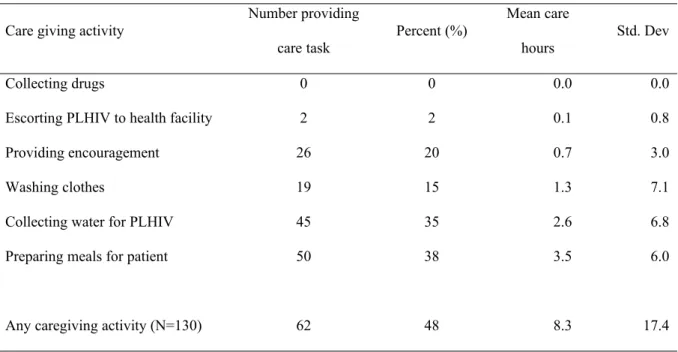
Time that was allocated to escorting the patient to the hospital, collecting drugs for the PLHIV, encouraging the PLHIV, collecting water, washing for the PLHIV, preparing meals for the PLHIV and keeping the PLHIV company by caregivers was estimated and these are presented in Table 2a.
Of the 130 caregivers identified by the PLHIV, 62 (48%) reported spending time on the caregiving tasks during the survey week This raises the question as to whether or not the remainder are really caregivers; we consider them as caregivers because they are recognised as such by the PLHIV. Amongst caregivers that provided care in the survey week 46/62 (74%) were female and 34/62 (55%) were HIV positive.
On average, informal caregivers provided 8.3 hours (mean) of informal care in a week (across all 130 caregivers). About half of this time was allocated to preparing meals for the PLHIV (mean 3.5 hours/week). Caregivers also allocated substantial time to collecting water for the patient (mean 2.6 hours/week) and washing clothes for the patient (mean 1.3 hours/week). Amongst only caregivers who provided care in the survey week, 50/62 (81%) prepared meals for PLHIV and 45/62 (73%) collected water for the PLHIV. No caregivers collected drugs for the PLHIV during the survey week and only 2 escorted the PLHIV to the health facility.
Female caregivers provided more informal care (10.5 hours/week) than male caregivers (4.4 hours/week) (p=0.01); across all caregivers (Table 2b). Informal caregivers that were HIV positive and on ART provided 10.5 hours of informal care compared to 4.7 hours/week provided by caregivers that were HIV positive but not on treatment (p=0.03) and 9.0 hours/week provided by HIV negative informal caregivers (p=0.50). PLHIV in WHO stage 1/2 received 4.7 hours/week of informal care, PLHIV in WHO clinical stage 3 received 13.7 hours/week of informal care while PLHIV in WHO clinical stage 4 received 5.8 hours/week of informal care.
Value of informal care
Using the four approaches discussed above, we valued informal care and the findings are presented in Table 3.
The estimated value of informal care provided to PLHIV in our sample ranged from US$0.40 to US$2.41/week. Estimates from the alternative approaches were similar although notably the lowest values for all patients were from the WTP approach ($0.40) and the highest from the modified opportunity cost approach ($2.41).
Across the stratified patient groups, the values of informal care derived increased and declined as we moved from PLHIV defined by WHO clinical stages 1 and 2 to those with recent clinical stage 3 events and then to those with recent clinical stage 4 events, respectively; although confidence intervals were wide.
Estimates of the value of informal care derived from the modified opportunity cost (reservation wage) approaches are consistently higher than the estimated that were derived from the opportunity cost approaches for all the patient groups.
Discussion and conclusion
We have outlined the available choice of methods and demonstrated their application in the sub-Saharan African context by measuring informal care time and estimating the monetary values of caregiving to a sample of people living with HIV (PLHIV) in Phalombe, a rural district in Malawi.
The gender distribution in the sample is broadly as we would have expected prior to data collection. Most of the caregivers in our sample were female (81%) and this is consistent with the limited available
literature
17188
. It was also found that female caregivers provide more hours of care (10.5 hours/week) than male caregivers (4.4 hours/week). Most of the PLHIV (63%) were also female. This had also been anticipated due to the accelerated roll-out of ‘Option B+’ for the prevention of mother to child HIV transmission of HIV which encourages all HIV positive women that are pregnant/ breastfeeding to receive ART for life irrespective of theirWHO clinical stage or CD4 count at initiation
1019
. This has also been documented in program reports11. We found that less than half of caregivers reported carrying out caring tasks in the previous week. We expect that as ART rolls out with earlier initiation (including through B+) the proportion of PLHIV who require no care is likely to increase. However, for the foreseeable future there will remain significant numbers of PLHIV who do require substantial informal care.We also found that levels of formal education in our sample were very low, with 66% of caregivers having only primarily-level education or below. This provided justification for the modified diary approach, based upon natural changes in the day, for the measurement of informal care rather than use of diaries relying upon clock time. The absence of paid wages was a characteristic of the caregiver population – 65% reported their primary economic activity as being farming (most likely subsistence), only 4% stated they were employed and 17% were business people. This profile of main economic activities, with many being unpaid in cash, makes clear why the use of market and minimum wage in valuing informal care time is limited and may be misleading. In future, further research on the economic lives of PLHIV, caregivers and others in the villages would be of value.
particularly challenging to apply when there is lack of engagement in formal labour markets as with this population. The official minimum wage in Malawi may be a poor proxy that does not necessary well reflect income generating opportunities. We therefore believe that responses to the modified opportunity cost approach, based upon
References
x
1 van den Berg B, Brouwer BBF, Koopmanschap MA. Economic valuation of informal care: an overview of methods and applications. Eur J Health Econ. 2004;5:36-45.
2 Riewbaipoon A, Riewbaipoon W, Ponsoongnern K, Van den Berg B. Economic valuation of informal care in Asia: A case study of care for disabled stroke survivors in Thailand. Soc Sci Med. 2009;69:648-653.
3 UNAIDS. How AIDS changed everything. Switzerland: United Nations Programme on HIV and AIDS.; 2015.
4 WHO. Consolidated guidelines on the use of antiretroviral drugs for treating and preventing HIV infection: Recommendations for public health approach. 2nd ed. Geneva: World Health
Organosation; 2016.
5 Maes K. Volunteerism or labor exploitation? Harnessing the volunteer spirit to sustain AIDS treatment programs in urban Ethiopia. Hum Organ. 2012;71(1):54-64.
6 Akintola O. Defying all odds: coping with the challenges of volunteer caregiving for patients with AIDS in South Africa. Journal of Advanced Nursing. 2008;63(4):357-365.
7 Maes K, Shifferaw S. Cycles of poverty, food insecurity, and pychosocial stress among AIDS care volunteers in urban Ethiopia. Annals of Anthropol Pract. 2011;35(1):98-115.
8 Chimwaza AF, Watkins SC. Giving care to people with symptoms of AIDS in rural sub-Saharan Africa. AIDS care. 2004;6(7):795-807.
9 Government of Malawi. Treatment of AIDS: Guidelines for the use of Anteretroviral Therapy in Malawi. 3rd ed. Lilongwe: Ministry of Health; 2008.
10 Schouten EJ, Jahn A, Midiani D, Makombe SD, Mnthambala A, Chirwa Z, Harries AD, van Oosterhout JJ. Prevention of mother-to-child transmission of HIV and the health-related Millennium
Development Goals: time for a public health approach. Lancet. 2011;378:282–284.
11 Government of Malawi. Integrated HIV program Report April - June 2014. Lilongwe: Ministry of Health; 2014.
Health; 2011.
13 Chan AK, Ford D, Namata H, Muzambi M, Nkhata MJ, Abongomera G, Mambule I, South A, Revill P, Grundy C, et al. The Lablite Project: A cross-sectional mapping survey of decentralized HIV service provision in Malawi, Uganda and Zimbabwe. BMC Health Serv Res. 2014;14(352).
14 Harvey AS, Taylor ME. Time use. In: Grosh M, Glewwe P. Designing household survey questionnaires for developing countries: Lessons of 15 years of Living Standards Measurement Study. Washington DC: The World Bank; 2000. p. 249-272.
15 van den Berg B, Spauwen P. Measurement of informal care: an empirical study into the valid measurement of time spent on informal care. Health Econ. 2006;15:447-460.
16 Government of Malawi. 2014 clinical management of HIV in children and adults. Lilongwe: Ministry of Health; 2014b.
17 van den Berg B, Brouwer W, van Exel J, Koopmanschap M, van den Bos GAM, Rutten F. Economic valuation of informal care: Lessons from the application of the opportunity costs and proxy good methods. Soc Sci Med. 2006;62:835-845.
18 Ama NO, Seloilwe ES. Estimating the cost of care-giving on caregivers for people living with HIV and AIDS in Botswana: a cross-sectional study. J Int AIDS Soc. 2010;13(4).
19 van Ophem H, Hartog J, Berkhout P. Reservation wages and starting wages. IZA Discussion Paper 5435. 2011:1-37.
20 van den Berg B, Bleichrodt H, Eeckhoudt L. The economic value of informal care: a study of informal caregivers and patients willingness to pay and willingness to accept for informal care. Health Econ. 2005a;14:363-376.
21 Chiwaula LS, Chijere-Chirwa G, Cataldo F, Kapito-Tembo A, Hosseinipour MC, van Lettow M, Tweya H, Kayoyo V, Khangamwa-Kaunda B, Kasende F, et al. The value of informal care in the context of option B+ in Malawi: a contingent valuation approach. BMC Health Services Research.
2016;16(136):7pp.
22 van den Berg B, Brouwer W, van Exel J, Koopmanschap M. Economic valuation of informal care: The contingent valuation method applied in informal caregiving. Health Econ. 2005b;14:169-183.
23 Majumdar B, Mazaleni N. The experiences of people living with HIV/AIDS and of their direct informal caregivers in a resource-poor setting. J Int AIDS Soc. 2010;13(20).
Table 1: Characteristics of PLHIV and their caregivers
Characteristics
PLHIV (N=130)
Caregivers (N=130)
n Statistic n Statistic Sex (%)
Male 48 37 48 37
Female 82 63 82 63
Age (Mean, Std Dev) 33 (11) 35 (12) Marital status (%)
Married 65 50 102 78
Widowed 14 11 9 7
Separated 39 30 17 13 Never married 12 9 2 2 Relationship of caregiver to PLHIV (%)
Parent of PLHIV - 20 15 Child of PLHIV - 14 11 Spouse of PLHIV - 43 33 Sibling of PLHIV - 40 31 No relationship - 3 2
Other - 10 8
Education level (%)
No formal 21 16 23 18
Primary 100 77 87 67
Secondary 9 7 17 13
Main Economic Activity (%)
Employed 3 2 5 4
Farmer 82 63 85 65
Business 24 18 22 17
Student 6 5 2 2
House worker 1 1 2 2
Casual work 7 5 2 2
Other 7 5 11 8
Missing 0 0 1 1
Reported HIV Status (%)
HIV Positive
-On ART 41 32
Not on ART 11 8
HIV Negative - 50 38
Table 2: Informal care tasks and time provided to PLHIV in a week Table 2a: Informal care time by care tasks (N=130)
Care giving activity
Number providing
care task Percent (%)
Mean care
hours Std. Dev Collecting drugs 0 0 0.0 0.0 Escorting PLHIV to health facility 2 2 0.1 0.8 Providing encouragement 26 20 0.7 3.0 Washing clothes 19 15 1.3 7.1 Collecting water for PLHIV 45 35 2.6 6.8 Preparing meals for patient 50 38 3.5 6.0
Table 2b: Informal care time by PLHIV and caregiver characteristics
Characteristic Description n
Number providin g care (%)
Mean care hours
Std. Dev
Informal care time by sex of caregiver Male 48 16 (33) 4.4 10.5 Female 82 46 (56) 10.5 20
HIV status of caregiver Positive
On ART 41 29 (71) 10.5 7.5 Not on ART 11 6 (55) 4.7 10.4 Negative 50 18 (36) 9.0 25.2 Not known 28 9 (32) 5.9 9
Table 3: Valuation of informal caregiving using willingness to pay, willingness to accept, opportunity cost,
and modified opportunity cost methods
Valuation of time for all caregivers (US$/month)
WTP WTA Opportunity cost
Modified opportunity cost All PLHIV (n = 130) 21.0 (21.1) 61.2 (66.8) 40.3 60.5 (41.9) Stages 1 & 2 (n=48) 24.4(26.8) 62.9(58.2) 40.3 63.0(48.1) WHO stage 3 (n=47) 18.7(17.6) 47.1(35.4) 40.3 57.8(40.5) WHO Stage 4 (n=35) 19.6(15.9) 77.9(99.9) 40.3 60.6(34.9) Valuation of time for caregivers who provided care (US$/month)
All PLHIV (n = 62) 16.2 (15.6) 54.6(49.7) 40.3 58.7(42.2) Stages 1 & 2 (n=19) 15.5 (15.6) 71.0 (67.0) 40.3 68.2(42.4) WHO stage 3 (n=29) 16.7(15.4) 44.8(35.8) 40.3 58.8(45.9) WHO Stage 4 (n=14) 16.0(17.2) 52.6(45.0) 40.3 45.6(32.0) Informal care values (US$/week)