Volume 2006, Article ID 97492, Pages1–9 DOI 10.1155/ASP/2006/97492
Improving a Single Down-Sampled Image Using
Probability-Filtering-Based Interpolation and Improved
Poisson Maximum A Posteriori Super-Resolution
Min-Cheng Pan
Department of Computer Science and Information Engineering, Tung-Nan Institute of Technology, Shenkeng, Taipei County 222, Taiwan
Received 29 November 2004; Revised 25 March 2005; Accepted 4 May 2005
We present a novel hybrid scheme called “hyper-resolution” that integrates image probability-filtering-based interpolation and improved Poisson maximum a posteriori (MAP) super-resolution to respectively enhance high spatial and spatial-frequency res-olutions of a single down-sampled image. A new approach to interpolation is proposed for simultaneous image interpolation and smoothing by exploiting the probability filter coupled with a pyramidal decomposition and the Poisson MAP super-resolution is improved with the techniques of edge maps and pseudo-blurring. Simulation results demonstrate that this hyper-resolution scheme substantially improves the quality of a single gray-level, color, or noisy image, respectively.
Copyright © 2006 Min-Cheng Pan. This is an open access article distributed under the Creative Commons Attribution License, which permits unrestricted use, distribution, and reproduction in any medium, provided the original work is properly cited.
1. INTRODUCTION
Basically, the quality of an image can be evaluated on its spatial and spatial-frequency resolutions. Image interpola-tion and super-resoluinterpola-tion are perhaps the way to respectively produce high spatial and spatial-frequency resolutions of im-ages especially for a single down-sampled image. For conve-nience, the term “hyper-resolution” used here represents the approach to enhancing the spatial and the spatial-frequency resolutions of an image. Some algorithms have been pro-posed in the literature [1–6], where a high resolution image is reconstructed by combining multiple low resolution im-ages and incorporating with some constraints for the spe-cific purpose. This paper will consider hyper-resolution for a single gray-level or color image without any constraint. Furthermore, hyresolution of a noisy image is also per-formed; generally, the procedure for processing noisy im-ages is shown inFigure 1(a), that is, noise removal, inter-polation, and then super-resolution; whereas the proposed scheme is dealing with interpolation and noise removal si-multaneously, as shown inFigure 1(b).
As known, the process of decimation or down-sampling is an effective way aid often used to reduce image sizes; thus, reducing the amount of information transmitted through the communication channels and the local storage requirements,
while trying to preserve as much as possible the image qual-ity. Conversely, the reverse procedure of this, referred to as interpolation or up-sampling, is useful in restoring the orig-inal high resolution image from its decimated version or for resizing or zooming a digital image. Decimation and inter-polation are used for several purposes in many practical ap-plications, such as progressive image transmission systems, multimedia applications, and so forth. These problems are further aggravated in the case of color images which usually require larger storage capacity and processing time.
A number of conventional interpolation techniques [7–
Noisy image
Noise removal
Image interpolation Interpolation based on probability filter
Image super-resolution
Hyper-resolved image (a)
(b)
Figure1: The block diagram of hyper-resolution for a noisy image. (a) Conventional approach and (b) proposed approach.
simplicity whereas adaptive methods [13–15] aim to avoid these problems by analyzing the local structure of the source image and imposing more accurate models. However, few of them concern the problem of dealing with noisy images.
Following the procedure of interpolation, image super-resolution is perhaps the only way to reduce blurring effects resulting from smoothing or interpolation. In recent years it has become clear that there are credible methods [16–21] for the reconstruction of spatial frequencies of the object that are greater than the diffraction-limit spatial frequency in the im-age. Specifically, processes that attempt to extend the spatial-frequency spectra beyond the image passband are usually re-ferred to as super-resolution algorithms.
This paper first addresses an approach to simultane-ous image interpolation and smoothing by exploiting the probability filter [22] coupled with a pyramidal decompo-sition, thereby extending the conventional applications of the probability filter originally designed for noise removal. Then, the improved Poisson maximum a posteriori (MAP) super-resolution [23] is performed to reconstruct the high spatial-frequency spectrum of the interpolated image. Thus, the hybrid scheme shown in Figure 1(b) is proposed for enhancing the spatial and the spatial-frequency resolutions of down-sampled images. To illustrate the performance of the proposed scheme, this research has studied the resolu-tion enhancement on gray-level, color, and noisy images, re-spectively, and comparisons will be made among the super-resolution coupled with different interpolators.
Following the above introduction, this paper is organized as follows: Section 2 briefly reviews the B-spline interpo-lation including bilinear and cubic spline interpolators in-corporated in the hyper-resolution scheme for comparison.
Section 3details the hyper-resolution scheme proposed here for down-sampled images. Experimental results and evalua-tions are shown inSection 4and finally some conclusions are drawn inSection 5.
2. B-SPLINE INTERPOLATION
Recently, image-resizing algorithms using high-order B-splines have been published [24,25]. The standard interpo-lation procedure is to fit the original data with a continuous model and then resample function on the grid appropriate to the scaling desired [26]. The B-spline interpolation can be modeled as follows:
s(x)= k∈Z
c(k)βn(x−k), (1)
wherec(k) is the coefficient,βn(x) is the B-spline of degree
n. The B-splines are symmetrical, bell-shaped functions con-structed from the (n+l)-fold convolution of a rectangular pulseβ0(x), shown as below:
β0(x)=
⎧ ⎪ ⎪ ⎪ ⎪ ⎪ ⎪ ⎨ ⎪ ⎪ ⎪ ⎪ ⎪ ⎪ ⎩
1, |x|<1
2, 1
2, |x| = 1 2, 0, otherwise,
βn(x)=βn−1⊗β0=β0⊗β0⊗β0⊗ · · · ⊗β0(n+ 1) times.
(2)
Equation (2) shows that all B-splines are positive and have an integral that is equal to one. Among these splines, the cubic spline has been popular in applications due to their mini-mum curvature property. The central spline of degree 3 is given by
β3(x)=
⎧ ⎪ ⎪ ⎪ ⎪ ⎪ ⎪ ⎨ ⎪ ⎪ ⎪ ⎪ ⎪ ⎪ ⎩
2 3− |x|
2+|x|3
2 , 0≤ |x| ≤1,
2− |x|3
6 , 1≤ |x| ≤2,
0, |x| ≤2.
(3)
Usually, lower-order interpolation algorithms are sim-plest and fastest, but they tend to produce artifacts. The B-spline of degree 0, the nearest neighborhood interpolation, selects one of the upper, lower, left, and right four pixels. In case of the B-spline of degree 1, the bilinear interpolation, the weighted average value of the upper, lower, left, and right four pixels is assigned. The B-spline of degree 3, the cubic spline interpolation, produces better outcomes but requires much more computation. Generally, among these interpo-lation algorithms, the bilinear interpointerpo-lation has been widely used in digital still cameras. However, there is a limitation for capturing high quality images since the bilinear interpola-tion method tends to smooth images and result in noticeable color artifacts along edges [27].
3. NOVEL HYPER-RESOLUTION SCHEME
(k, l) (k, l) (k, l) (k, l)
gi,j
gi,j(k, l)
(a)
j−1 j j+ 1 i−1
i
i+ 1
gi−1,j−1 gi−1,j gi−1,j+1
gi,j−1
(−1,−1) (−1,1)
(1,−1) (1,1)
gi,j+1
gi+1,j−1 gi+1,j gi+1,j+1
(b)
gi,j
gi,j(−1,−1) gi,j(−1,1)
gi,j(1,−1) gi,j(1,1)
(c)
Figure2: The pyramidal decomposition for interpolation. (a) Diagram of pyramidal decomposition, (b) the notation and relation of inter-polated and original pixels, and (c)gi,jdecomposed intogi,j(−1,−1),gi,j(−1, 1),gi,j(1,−1), andgi,j(1, 1).
3.1. Interpolation based on the probability filter
Originally, a probability filter [22] is designed for image smoothing or integration with variable weights which are in-terpreted as probabilities of respective pixel values in a local neighborhood of the current estimated pixel. The algorithm of this filter is explained in more detail as follows. f∗(i,j), the restored pixel at (i,j), is defined as
f∗(i,j)= n
k=−n n
l=−n
p(i+k,j+l)g(i+k,j+l), (4)
wherep(i+k,j+l), the probability function of a (2n+ 1) by (2n+ 1) mask, is given as below:
p(i+k,j+l)
=exp −
g(i+k,j+l)−g(i,j)2/2T2 1
Norm 1 ,
k,l= −n,. . .,−1, 0, 1,. . .,n,
Norm 1= n
k=−n n
l=−n exp
−
g(i+k,j+l)−g(i,j)2 2T12
,
(5)
T1=(2n+ 1)−2 n
k=−n n
l=−n
g(i+k,j+l)−g(i,j), (6)
whereg(i,j) andg(i+k,j+l) are the average of all pixels in the mask centered at (i,j) and the gray level of the pixel at
g(i+k,j+l), respectively.
The difference function, (g(i+k,j+l)−g(i,j)), is used in (5) rather than the gray level difference between the
neigh-bor pixel and the center pixel, thereby leading to the pro-posed filter being more suitable for removing impulse noise because it has a rather small probability even as the center pixel is impulse noise. IfT1 is infinite, the probability filter
is identical to the mean filter. From the discussion above, the probability filter employs over a range of behavior between mean-like and median-like filtering. Furthermore, no a pri-ori knowledge is necessary for T1; even in the case of the
image corrupted by unknown noise,T1 can be
straightfor-wardly determined as (6).
For the purpose of image interpolation with noise re-moval, this probability filter is modified as follows. Accord-ing to the pyramidal decomposition shown inFigure 2, the new interpolated pixel,gi,j (k,l), yielded from the original
pixel,gi,j, can be defined as below:
gi,j(k,l)
=
pi,jgi,j+pi+k,jgi+k,j+pi,j+lgi,j+l+pi+k,j+lgi+k,j+l
Norm 2 ,
(7)
where
pi,j=w·exp
−
gi,j−g)2
2T2 2
,
pi+k,j=exp
−
gi+k,j−g
2
2T22
,
pi,j+l=exp
−
gi,j+l−g2 2T22
,
pi+k,j+l=exp
−
gi+k,j+l−g2 2T22
,
Norm 2=pi,j+pi+k,j+pi,j+l+pi+k,j+l,
g=
gi,j+gi+k,j+gi,j+l+gi+k,j+l
4 ,
T2=
gi,j−g+gi+k,j−g+gi,j+l−g+gi+k,j+l−g
4 ,
(8)
andw, a weight number, is chosen to be 1.5 here and (k,l)= (−1,−1), (−1, 1), (1,−1), (1, 1) shown asFigure 2.
Down-sampled
image k
Interpolation
(2×2) Super-resolution
Hyper-resolved image
Figure3: The mechanism of a hyper-resolution loop.
3.2. Improved Poisson MAP super-resolution algorithm
For brief description here, the Poisson MAP [16,17] is given and defined as follows:
fn+1= fnexp
g fn⊗h
−1
∗h
= fnC, (9)
where⊗represents a convolution,∗a correlation, andhthe point spread function (PSF);gis the interpolated image and
f the final hyper-resolved image; f0is defined asg; subscript nis the iteration number; and
C=exp
g fn⊗h−
1
∗h
. (10)
Here,C can be regarded as the correction term during the iterative restoration process. In terms of the operation of the Poisson MAP, it is an iterative algorithm where a successive estimate of the restored image is obtained by multiplication of the current estimate by a quantity close to one. The quan-tity close to one is a function of the interpolated image di-vided by a convolution of the current estimate with the PSF. Following that, the Poisson MAP can be improved by itself by operating upon the edge map with a reblurring technique; that is, thegand fnof the Poisson MAP are replaced by the corresponding gradients of theg⊗hand fnalong with the integrated PSF (h⊗h). Mathematically, it is shown that
fn+1
= f
nexp
(g⊗h)
fn⊗(h⊗h)−1
∗(h⊗h)
.
(11)
Thus, the final hyper-resolved image f can be obtained by integrating (fn+1). The whole process of this improved
Poisson MAP includes reblurring, differentiation, restora-tion, integrarestora-tion, and then correction for a DC offset. More details about this algorithm can be found in the author’s pre-vious work [23].
3.3. Analysis of the hyper-resolution scheme
As discussed in the previous subsections, the filter originally designed for image smoothing can be extended for image interpolation. With the comparison between B-spline and probability-filtering-based interpolation, it can be found that bilinear or cubic spline interpolation performs on an im-age as weighted mean filtering while the probability-filtering-based interpolation acts as an adaptive filtering useful for preserving image features in addition to image interpolation;
that is because the former creates interpolated pixels simply by averaging their own neighborhood pixels and the latter analyzes the characteristics of surrounding pixels prior to in-terpolating pixels. This analysis of image features is based on the probability of gray-level values and thus features such as edges are of higher probabilities than flat regions around fea-tures; furthermore, noisy images containing impulse noise can be removed completely since a single high or low gray-level pixel has a low probability. Therefore, image super-resolution will perform on the interpolated image using the probability-filtering method more effectively than using the bilinear or cubic spline method.
4. EXPERIMENTAL RESULTS AND EVALUATIONS
To assess the performance of our proposed hyper-resolution scheme, the resolution enhancement of gray-level, color, and noisy images is considered. In illustrated examples, a gray-level image of clown with the size of 200×320 pixels and a color image of lotus with the size of 100×100 pixels were rect-angular decimated with a factor of 1/22k. Therefore, the inter-polation was done with a factor of 22for each cycle; then, the
super-resolution procedure of the proposed hyper-resolution scheme, shown inFigure 3, adopted 25 iterations and the PSF with a standard deviation of 1 pixel because of the pyrami-dal decomposition used here, conversely, four neighboring pixels in the interpolated image mainly contributing to one pixel in its own decimated image. Thus, the proposed hyper-resolution scheme can magnify the size of an image by any factor that is a power of two along each dimension where this resizing scheme consists of two steps: the first step is to inter-polate the down-sampled image using bilinear, cubic spline, or the novel proposed probability-filtering-based interpola-tion and the second step is to super-resolve the interpolated image. The implementations of bilinear and cubic spline in-terpolation are taken from Matlab 5.3. In the following, it can be seen that hyper-resolved images derived from the con-ventional interpolators still have blocky, jagged lines, and are blurred whereas the proposed method appears to suppress these artifacts, preserve the edges, and retain the image de-tails better.
In experiments, the peak signal-to-noise ratio (PSNR) was used to compare the image qualities quantitatively and is defined as follows:
PSNR(dB)
=10 log10
2552
(1/MN)Mi=−01Nj=−01O(i,j)−H(i,j)2
,
5 10 15 20 25
10 20 30 40
(a)
50 100 150 200
50 100 150 200 250 300 (b)
50 100 150 200
50 100 150 200 250 300 (c)
50 100 150 200
50 100 150 200 250 300 (d)
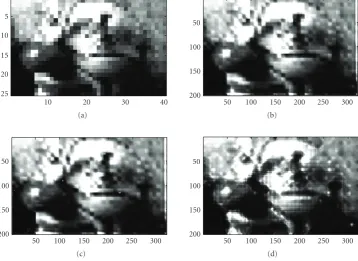
Figure4: Demonstration of hyper-resolution for a single down-sampled gray-level image. (a) Down-sampled image, (b) hyper-resolved im-age incorporated with bilinear interpolation, (c) hyper-resolved imim-age incorporated with cubic spline interpolation, and (d) hyper-resolved image incorporated with probability-filtering-based interpolation.
where [M,N] is the image size, 255 is the maximum value that a pixel can have for an 8-bit image.O(i,j) andH(i,j) are an original image and a hyper-resolved image, respectively.
4.1. Resolution enhancement of gray-level images
To compare the hyper-resolution effect, the down-sampled image was hyper-resolved repeatedly for resizing it to its ini-tial dimension. As an example, considerFigure 4where a sin-gle down-sampled image, Figure 4(a), was hyper-resolved. This image presents a great challenge to hyper-resolution in-corporated with different interpolation algorithms since it has many edges and unlike textures, bad hyper-resolution re-sults are immediately evident. Figures4(b),4(c), and4(d)are hyper-resolved where bilinear, cubic spline, and probability-filtering-based interpolation were applied, respectively. Note that the edges in the magnified image are sharp yet lack jaggedness, especially forFigure 4(d).
The PSNRs of the hyper-resolution scheme are 23.91 dB, 24.94 dB, and 25.80 dB using bilinear, cubic spline, and probability-filtering-based interpolation, respectively. As can be seen, the hyper-resolution incorporated with the proba-bility-filtering-based interpolation generally provides a bet-ter image quality.
The second case applied the proposed hyper-resolution scheme to a single down-sampled image shown in Fig-ure 5(a). It can be seen that a highly down-sampled im-age shows serious blocking artifacts. To solve this prob-lem, this down-sampled image was hyper-resolved using
our proposed scheme where hyper-resolution was performed three times for comparison; these three hyper-resolved im-ages are shown in Figures5(b),5(c), and5(d), respectively. Obviously, blocking artifacts are further reduced, especially for the case of which interpolation with the factor 23×23,
shown inFigure 5(d)in which the pupils of the clown are clearly identified.
4.2. Resolution enhancement of color images
The results presented here show good performance, although printed here in gray-levels, using the simple approach to ap-plying the hyper-resolution scheme to the red, green, and blue planes independently and then combining the results into a single color image.
Figure 6 illustrates the performance comparison of hyper-resolution with the bilinear, cubic spline, and prob-ability-filtering-based interpolation methods for a color im-age. In the bilinear or cubic spline case, Figures6(b)and6(c), the aliasing effects are much more apparent and the edges are blurred where the jagged lines are quite pronounced.
The proposed scheme eliminates this problem as shown inFigure 6(d), and performs quite well as it preserves quite lots of image details with a higher contrast and sharper edges than the other two hyper-resolved images.
The PSNRs of the hyper-resolution results forFigure 6
5 10 15 20 25
10 20 30 40
(a)
10 20 30 40 50
20 40 60 80
(b)
20 40 60 80 100
50 100 150
(c)
50 100 150 200
50 100 150 200 250 300 (d)
Figure5: Demonstration of hyper-resolution for a single down-sampled gray-level image. (a) Down-sampled image, (b) hyper-resolved image with a factor 2×2, (c) hyper-resolved image with a factor 22×22, and (d) hyper-resolved image with a factor 23×23.
5
10
15
20
25
5 10 15 20 25
(a)
20
40
60
80
100
20 40 60 80 100
(b)
20
40
60
80
100
20 40 60 80 100
(c)
20
40
60
80
100
20 40 60 80 100
(d)
5
10
15
20
25
5 10 15 20 25
(a)
10
20
30
40
50
10 20 30 40 50
(b)
20
40
60
80
100
20 40 60 80 100
(c)
50
100
150
200
50 100 150 200
(d)
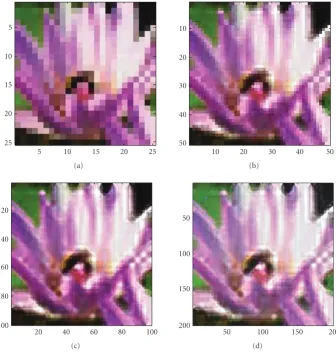
Figure7: Demonstration of hyper-resolution for a single down-sampled color image. (a) Down-sampled image, (b) hyper-resolved image with a factor 2×2, (c) hyper-resolved image with a factor 22×22, and (d) hyper-resolved image with a factor 23×23.
provides generally better image quality, the PSNR of which being equal to 19.28 dB and outperforming 10.89 dB and 8.37 dB over the hyper-resolution using bilinear and cubic spline interpolation, respectively.
As the case of Figure 7, this down-sampled color im-age with serious blocking artifacts, Figure 7(a), was hyper-resolved three times using our proposed method; thus, three hyper-resolved images are shown in Figures7(b),7(c), and
7(d), respectively. Apparently, the proposed algorithm gen-erates hyper-resolved images with a higher visual quality, es-pecially for the case of 23 ×23 hyper-resolution shown in Figure 7(d).
4.3. Resolution enhancement of noisy images
Figure 8 shows an example of the image of a clown with Gaussian white and impulse noise.Figure 8(a) is the noisy image with the size of 50×80 pixels originally corrupted by Gaussian white noise at a PSNR equal to 16 dB and im-pulse noise at 2.5% density level; Figures8(b)and8(c)are the hyper-resolved images where bilinear and cubic spline inter-polators were used, respectively. It is easy to see that the noise effect of such hyper-resolved images still exists, especially for
the region around the eyes.Figure 8(d)illustrates the eff ec-tiveness of using the proposed hyper-resolution scheme with the probability-filtering-based interpolation. Noise effect re-mains in the image where bilinear or cubic spline interpola-tion was used, but is reduced by using the proposed method.
5. CONCLUSIONS
In this paper, we have developed a hyper-resolution algo-rithm for enhancing image resolutions based on the hybrid scheme of the probability-filtering-based interpolation and the improved Poisson MAP super-resolution algorithm.
10 20 30 40 50
20 40 60 80
(a)
20 40 60 80 100
50 100 150
(b)
20 40 60 80 100
50 100 150
(c)
20 40 60 80 100
50 100 150
(d)
Figure8: Demonstration of resolution for a single down-sampled noisy gray-level image. (a) Down-sampled image, (b) hyper-resolved image incorporated with bilinear interpolation, (c) hyper-hyper-resolved image incorporated with cubic spline interpolation, and (d) hyper-resolved image incorporated with probability-filtering-based interpolation.
image interpolation and smoothing. It is anticipated that such scheme can also provide very promising reconstruction quality in demosaicing problems. Although intercorrelations among the red, green, blue colors have not been exploited in this paper, a hyper-resolution utilizing such intercorrelations would significantly improve the performance. Therefore, fu-ture work in this area will further extend the adaptive capa-bility by incorporating image characteristics.
ACKNOWLEDGMENT
This research is substantially supported by a grant from the National Science Council in Taiwan (Project no. NSC 92-2213-E-236-004).
REFERENCES
[1] R. H. Chan, T. F. Chan, L. Shen, and Z. Shen, “Wavelet algo-rithms for high-resolution image reconstruction,”SIAM Jour-nal on Scientific Computing, vol. 24, no. 4, pp. 1408–1432, 2003.
[2] R. R. Schultz and R. L. Stevenson, “Extraction of high-resolution frames from video sequences,”IEEE Transactions on Image Processing, vol. 5, no. 6, pp. 996–1011, 1996.
[3] M. Elad and R. Feuer, “Super-resolution reconstruction of im-age sequences,”IEEE Transactions on Pattern Analysis and Ma-chine Intelligence, vol. 21, no. 9, pp. 817–834, 1999.
[4] R. C. Hardie, K. J. Barnard, and E. E. Armstrong, “Joint MAP registration and high-resolution image estimation using a sequence of undersampled images,”IEEE Transactions on Im-age Processing, vol. 6, no. 12, pp. 1621–1633, 1997.
[5] C. Liu, H.-Y. Shum, and C.-S. Zhang, “A two-step approach to hallucinating faces: global parametric model and local non-parametric model,” inProceedings of IEEE Computer Society Conference on Computer Vision and Pattern Recognition (CVPR ’01), vol. 1, pp. I-192–I-198, Kauai, Hawaii, USA, December 2001.
[6] S. Baker and T. Kanade, “Limits on super-resolution and how to break them,” inProceedings of IEEE Computer Society Con-ference on Computer Vision and Pattern Recognition (CVPR ’00), vol. 2, pp. 372–379, Hilton Head Island, SC, USA, June 2000.
[7] H. Hou and H. Andrews, “Cubic splines for image interpo-lation and digital filtering,” IEEE Transactions on Acoustics, Speech, and Signal Processing, vol. 26, no. 6, pp. 508–517, 1978. [8] A. K. Jain,Fundamentals of Digital image Processing,
Prentice-Hall, Englewood Cliffs, NJ, USA, 1989.
[9] R. Keys, “Cubic convolution interpolation for digital image processing,”IEEE Transactions on Acoustics, Speech, and Signal Processing, vol. 29, no. 6, pp. 1153–1160, 1981.
[10] K. P. Hong, J. K. Paik, H. J. Kim, and C. H. Lee, “An edge-preserving image interpolation system for a digital cam-corder,”IEEE Transactions on Consumer Electronics, vol. 42, no. 3, pp. 279–284, 1996.
[11] G. C. Gurski, M. T. Orchard, and A. W. Hull, “Optimal linear filters for pyramidal decomposition,” inProceedings of IEEE International Conference on Acoustics, Speech, and Signal Pro-cessing (ICASSP ’92), vol. 4, pp. 633–636, San Francisco, Calif, USA, March 1992.
[13] S. Carrato, G. Ramponi, and S. Marsi, “A simple edge-sensitive image interpolation filter,” inProceedings of International Con-ference on Image Processing (ICIP ’96), vol. 3, pp. 711–714, Lau-sanne, Switzerland, September 1996.
[14] X. Li and M. T. Orchard, “New edge directed interpolation,” inProceedings of International Conference on Image Processing (ICIP ’00), vol. 2, pp. 311–314, Vancouver, British Columbia, Canada, September 2000.
[15] B. Ayazifar and J. S. Lim, “PEL-adaptive model-based interpo-lation of spatially subsampled images,” inProceedings of IEEE International Conference on Acoustics, Speech, and Signal Pro-cessing (ICASSP ’92), vol. 3, pp. 181–184, San Francisco, Calif, USA, March 1992.
[16] B. R. Hunt and P. J. Sementilli, “Description of a Poisson im-agery super-resolution algorithm,” inAstronomical Data Anal-ysis Software and System I, D. M. Worrall, C. Biemserfer, and J. Barnes, Eds., vol. 25, pp. 196–199, Astronomical Society of the Pacific, San Francisco, Calif, USA, 1992.
[17] P. J. Sementilli, M. S. Nadar, and B. R. Hunt, “Poisson MAP super-resolution estimator with smoothness constraint,” in Neural and Stochastic Methods in Image and Signal Processing II, vol. 2032 ofProceedings of SPIE, pp. 2–13, San Diego, Calif, USA, July 1993.
[18] L. B. Lucy, “An iterative technique for the rectification of ob-served distributions,”The Astronomical Journal, vol. 79, no. 6, pp. 745–765, 1974.
[19] W. H. Richardson, “Bayesian-based iterative method of image restoration,”Journal of the Optical Society of America, vol. 62, no. 1, pp. 55–59, 1972.
[20] B. R. Frieden, “Restoring with maximum likelihood and max-imum entropy,” Journal of the Optical Society of America, vol. 62, no. 4, pp. 511–518, 1972.
[21] M. I. Sezan and A. M. Tekalp, “Iterative image restoration with ringing suppression using themethod of POCS,” inProceedings of IEEE International Conference on Acoustics, Speech, and Sig-nal Processing (ICASSP ’88), vol. 2, pp. 1300–1303, New York, NY, USA, April 1988.
[22] M.-C. Pan and A. H. Lettington, “Smoothing images by a probability filter,” in Proceedings of IEEE International Joint Symposia on Intelligence and Systems (IJSIS ’98), pp. 343–346, Rockville, Md, USA, May 1998.
[23] M.-C. Pan, “A novel blind super-resolution technique based on the improved Poisson maximum a posteriori algorithm,” International Journal of Imaging Systems and Technology, vol. 12, no. 6, pp. 239–246, 2002.
[24] M. Unser, A. Aldroubi, and M. Eden, “B-spline signal process-ing. I. Theory,”IEEE Transactions on Signal Processing, vol. 41, no. 2, pp. 821–833, 1993.
[25] C. Lee, M. Eden, and M. Unser, “High-quality image resizing using oblique projection operators,”IEEE Transactions on Im-age Processing, vol. 7, no. 5, pp. 679–692, 1998.
[26] M. Unser, “Splines: a perfect fit for signal and image process-ing,”IEEE Signal Processing Magazine, vol. 16, no. 6, pp. 22–38, 1999.
[27] R. Kimmel, “Demosaicing: image reconstruction from color CCD samples,”IEEE Transactions on Image Processing, vol. 8, no. 9, pp. 1221–1228, 1999.
Min-Cheng Pan was born in Kaohsiung, Taiwan, on September 19, 1966. He received the B.Eng. and M.S. degrees from National Chiao Tung University and National Taiwan University in 1988 and 1990, respectively, and the Ph.D. degree in the Applied Optics Group of Department of Physics from The University of Reading, England, in 1999. He is currently an Associate Professor in the Department of Computer Science and