THE PATTERNS OF MALAYSIAN UNDERGRADUATE ENGINEERIG STUDENTS’ INTELLECTUAL DEVELOPMENT
NORHAYATI BINTI AHMAD
A thesis submitted in fulfilment of the requirement for the award of the degree of
Master of Philosophy
School of Graduate Studies Universiti Teknologi Malaysia
DEDICATION
To my beloved family….husband, Azfarizal Amid; mother Kamariah Hj. Roslan;
father, Ahmad Sadimin; and children, Aisyah Nurkhairina and Muhammad Zikir
Iman.
ACKNOWLEDGEMENT
In the name of Allah, the Most Beneficient, the Most Merciful.
I would like to express sincere appreciation to those who have made this research and the completion of this thesis possible. First, I would like to thank my supervisors, Prof Madya Dr. Khairiyah Mohd Yusof and Dr. Azlina Mohd Kosnin for their encouragement, supervision and support. Their helpful feedback greatly facilitated my progress. Special thank to my friend Azlinda Azmi for proofreading and editing the thesis thoroughly.
ABSTRACT
Knowing students’ intellectual development is important to improve the
quality of engineering education. Before this, most studies explored intellectual
development in the context of western countries. This study explores the patterns of Universiti Teknologi Malaysia (UTM) undergraduate engineering students’ intellectual development. The respondents were from two engineering faculties across different academic years. The intellectual development theory was based on ‘Perry’s Model of Intellectual and Ethical Development in College Year: A Scheme’,
which described intellectual development of students in higher education institution. The adapted Perry Developmental Questionnaire (El-Farargy, 2010) was used to assess students’ intellectual development levels based on Perry model which contains
18 items. From the model, the questionnaire consists the constructs such as teaching method, learning influences, students perceptions, and curriculum structure. Therefore the model determined these constructs influence students’ intellectual
development. A total number of 515 engineering undergraduates were selected from two engineering faculties across different academic years. The objective of this study was to capture the patterns of intellectual development levels (dualistic, multiplicity, commitment in relativism) among Malaysian undergraduate engineering students in relation to their perceptions of learning experiences in different engineering faculties. The analyses of the data showed that there was a significant difference between the patterns of students’ intellectual development between dualistic, and multiplist level
among first year and third year undergraduates in engineering faculties. There was also significant difference between genders in the patterns of students’ intellectual development levels (dualistic, multiplicity, commitment in relativism) in different
ABSTRAK
Mengenali kematangan pelajar terhadap perkembangan intelek diperlukan untuk meningkatkan kualiti pendidikan kejuruteraan. Banyak kajian lepas yang dilaksanakan dikaji dalam konteks negara barat. Kajian ini mengenal pasti corak kematangan intelektual di kalangan pelajar sarjana muda kejuruteraan di salah sebuah universiti di UTM. Responden kajian melibatkan pelajar setiap tahun pengajian di dua fakulti kejuruteraan. Teori kematangan intelektual yang digunakan adalah berdasarkan Model Perry ‘Intellectual And Ethical Development In College Year: A Scheme’. Teori ini menerangkan kematangan pelajar kejuruteraan di institusi pengajian tinggi. Soal selidik ‘Perry Developmental Questionnaire’ (El-Farargy,
2010) diadaptasi untuk disesuaikan demi menilai perkembangan intelektual pelajar berdasarkan tahap dalam Model Perry yang mengandungi 18 item. Dari model, soal selidik yang terdiri daripada konstruk seperti kaedah pengajaran, pengaruh pembelajaran, pelajar persepsi, dan struktur kurikulum. Oleh itu model yang
TABLE OF CONTENTS
CHAPTER TITLE
DECLARATION
PAGE
ii
DEDICATION ii
ACKNOWLEDGEMENTS iv
ABSTRACT v
ABSTRAK vi
TABLE OF CONTENTS vii
LIST OF TABLES xii
LIST OF FIGURES xiv
LIST OF APPENDIXS xvi
1 INTRODUCTION 1
1.1 Introduction 1
1.2 Background of Study 4
1.3 Problem Statement 6
1.4 Objective and Research Questions of Study 7
1.5 Hyphotesis 8
1.6 Scope of Study 9
1.7 Significance of Study 9
1.8 Theoretical Framework 10
1.9 Conceptual Framework 15
1.10 Definition of Terms 16
2 LITERATURE REVIEW 19
2.1 Introduction 19
2.2 Epistemological and Understanding the Learners 19 2.2.1 Individual’s Epistemological Perspective
On Learning 20
2.2.2 Understanding learners 21
2.3 Development Models Related To Study Of
Intellectual Development 22
2.3.1 Origins 23
2.3.2 Perry’s Research On Student Development 23
2.3.3 Previous Research Using Perry Scheme Of
Intellectual Development 26
2.3.4 Belenky’s Model Of Intellectual
Development 28
2.3.5 Reflective Judgement (RJ) Model by King
and Kithhener 30
2.3.6 Epistemological Reflection Models 31
2.3.7 The Skills Of Argument 32
2.4 Summaries And Common Trend Of The
Developmental Models 32
2.5 Types Of Learners Based On Learner Experience 33 2.6 Relationship Between Skills Acquisition And
Intellectual Development 34
2.7 Previous And Existing Measurements 36
2.8 Summary 37
3 METHODOLOGY 39
3.1 Introduction 39
3.2 Research Design 39
3.3 Operational Framework 42
3.4 Research Sample 43
3.6 Instrument Adaptation 45
3.6.1 Content Validity 46
3.6.2 Estimating Reliability 46
3.6.3 Pilot Study 46
3.7 Instrument Adaptation Process 47
3.7.1 Pilot Study Result 49
3.8 Method Of Data Analysis 51
3.8.1 Quantitative Data Analysis 51
3.9 Research Limitation 52
3.10 Research Assumption 53
3.11 Summary 53
4 ANALYSIS OF DATA 54
4.1 Introduction 54
4.2 Demographics Analysis 54
4.2.1 Gender Of The Sample In Chemical
Engineering And Civil Engineering Faculty 55 4.2.2 Age Distribution Of The Sample 55 4.2.3 Year Of Study Distribution Of The Sample
In Each Engineering Faculty 56
4.2.4 Ethnicity Distribution Of The Sample In
Each Engineering Faculty 57
4.3 Overall Descriptive Analysis Of Intellectual Development Based On Three Stages From Perry
Developmental Questionnaire 58
4.3.1 Descriptive Analyses Based On Students’
Perception In Dualist Stage 59
4.3.2 Descriptive Analyses Based On Students’
Perception In Multiplist Stage 61 4.3.3 Descriptive Analyses Based On Students’
Based On Objective 1 65
4.4.1 Research Question 1 66
4.4.2 Research Question 2 and 3
4.4.3 Research Question 4 75
4.5 Result Summary 84
5 CONCLUSION, DISCUSSION AND
RECOMMENDATIONS 86
5.1 Introduction 86
5.2 Summary Of Findings 86
5.2.1 The Summary Of Demographics Analysis 87 5.2.3 The summary of objective based on each
research questions 87
5.3 Discussion 89
5.3.1 Pattern Of Malaysian Undergraduate Engineering Students’ Intellectual
Development 89
5.3.1.1 Pattern Of Undergraduate
Engineering Students’ Intellectual
Development Levels Against Every
Cohort In Engineering Faculties 90 5.3.1.2 Pattern Of Undergraduate
Engineering Students’ Intellectual
Development Levels Against
Gender In Engineering Faculties 92
5.4 Implications 94
5.5 Recommendations For Further Research 96
5.6 Conclusion 97
REFERENCES 99
LIST OF TABLES
TABLE NO. TITLE PAGES
1.1 The Parallel of Intellectual Development Level with
the Revised Stages of Bloom Taxonomy 13
2.1 Different Approaches to Learning 22
2.2 Perry’s Model of Intellectual Development as Applied
to the Learning Situation 25
2.3 Several Models of Intellectual Development 33 3.1 Items to Test the Intellectual Development from
Existing Instrument. 43
3.2 Construct With the Items Obtained In Original Perry
Developmental Questionnaire 44
3.3 Descriptive Information of the Perry Developmental Questionnaire Scales that followed with the in the first
Modification 47
3.4 Summary of Instrument Development Process 48 3.5 Cronbach Alpha Reliability Coefficient Analysis 49 3.6 Final Construct with the Items Obtained in the Second
Modification of Perry Developmental Questionnaire
after Test-Retest 50
4.1 Gender Distribution of Sample 54
4.2 Age Distribution of Sample 55
4.3 Year of Study Distribution of Sample 56
4.4 Ethnicity Distribution of Sample 57
4.5 Items Divided Of Each Stage in the Perry
4.6 Frequency and Percentage Analyses of Students’
Perception by Dualistic Stages. 59
4.7 Frequency and Percentage Analyses of Students’
Perception by Multiplist Stage. 62
4.8 Frequency and Percentage Analyses of Students’
Perception by Commitment in Relativism Stage. 64
4.9 Descriptive Statistics(RQ1) 65
4.10 Multivariates Test(RQ1) 66
4.11 Test of Between-Subject Effects(RQ1) 67
4.12 Multiple Comparisons Tukey HSD between the Levels
of Intellectual Development against Every Cohorts. 67
4.13 Descriptive Statistics(RQ2 and RQ3) 70
4.14 Multivariate Test(RQ2 and RQ3) 71
4.15 Result of ANOVA Analysis Tests of Between-Subjects
Effects 73
4.16 Interpretation Result for Group Statistics Based on the
Levels of Intellectual Development between Genders. 75 4.17 Independent Samples Test based Levene's Test for
Equality of Variances for the Levels ofIntellectual
Development between Genders. 76
4.18 Descriptive Statistics (RQ4) 77
4.19 Box's Test of Equality of Covariance Matrices 78
4.20 Multivariate Tests (RQ4) 79
4.21 Result of ANOVA Analysis Test of Between-Subject
Effects 80
4.22 Gender Estimated Marginal Means 80
LIST OF FIGURES
FIGURE NO. TITLE PAGES
1.1 Summary of Perry Scheme of Intellectual
Development for Views on Students’ Development 11
1.2 The Relationships of Theoretical Frameworks That Related To Describe Students’ Intellectual
Development 14
1.3 Conceptual Framework for Assessing Students’
Intellectual Development 15
2.1 Perry’s Model of Intellectual Development 24
3.1 The Flow of Cross-Structional Study That Apply In
This Research 40
3.2 Operational Framework 41
4.1 EstimatedMarginal Means Pattern of Intellectual Development Levels among Undergraduate
Engineering Students in Malaysia in Every Cohort
(RQ1) 68
4.2 Interaction Effect Between The Groups In
Independent Variable That Not Significant With The Dependent Variables Of Intellectual
Development(RQ2 and RQ3) 72
4.3 Different Pattern of Intellectual Development between
4.4 EstimatedMarginal Means Pattern of Intellectual Development Levels among Undergraduate
Engineering Students between Genders (RQ4) 76 4.5 Interaction Effect between the Groups in Independent
Variable That Significance with the Dependent
Variables of Intellectual Development(RQ4) 82 5.1 Patterns of Undergraduate Engineering Students’
Intellectual Development Levels that found In UTM 91 5.2 Gender Patterns of Undergraduate Engineering
LIST OF APPENDICES
APPENDIX TITLE PAGES
A Sample of Original Perry Developmental
Questionnaire 109
B Sample of Modified Perry Developmental
CHAPTER 1
INTRODUCTION
1.1 Introduction
In the 21st century, characteristics, needs and preferences of students evolve with the rapidly changing world around them (Ginkel, 2006). Educating students today in engineering is a far more different and complex proposition than it has been in the past. Following the current and future requirements, the Washington Accord
(WA) and the Malaysian Engineering Accreditation Council (EAC, 2012) which is one of the WA members, emphasizes that engineering students develop a multitude
of outcomes in their four years of learning before they graduate. EAC also stresses the importance of having an in-depth understanding on the range of complex problem-solving and engineering activities, which indicate students‟ intellectual maturity. Therefore students should apply these skills in an efficient and organized manner and should be able to adapt in different situations.
developed comprehension of scientific principle and engineering theory.
Malaysia aims to become a developed and high-income nation by 2020. With this objective in mind, Malaysia needs to develop its human capital, and the country must place emphasis on a few important areas to ensure change happens (National Economic Advisory Council Malaysia, 2010). One of the major changes is
to mainstream quality technical education and vocational training, which allows more people to have access to this type of education. In addition, competency levels
of university graduates need to be raised to prepare them for entering the workforce (Ministry of Higher Education, 2006). Therefore, it is crucial for educators of higher education institutions to take up the challenge to instill and develop instructional practices that will produce engineering students with the required skills and intellectual maturity.
According to Perry (1970 & 1999), the emphasis on higher education should be on the development of an individual to be a thinker and someone who is matured. Science and engineering graduates are expected to have higher order thinking skill based on their intellectual development level. Therefore, students‟ achievement on cognitive development serves as a useful indicator of students‟
maturity as a way to improve the quality of engineering education. To understand students‟ intellectual development, several theories of cognitive development by
Perry (1970, 1990), Magolda (1992) and Piaget (1972) may help in understanding students‟ progression in intellectual development.
The intellectual development in general as mentioned in the synopses of Perry‟s
model shows on the tendencies of growth. The directions that people take as they move from less to more reasoning that are complex. However, it is always different between individuals (Perry, 1970 & 1981). In these cases, the progression of intellectual development among undergraduate engineering students in different year of study, faculties or between gender is important to measure and identify the difference to show the development on their abilities to think logically and critically to be a good engineer (Olds, Miller and Pavelich, 2000).
Magolda (1992) conducted a review on intellectual development among
college students. She mentioned that many students enter university assuming that the university educators can provide the right answers to most of their questions, and the role of students is to acquire this information. It is important to note that students use these assumptions to guide their learning. Piaget (1972) concluded the theory of cognitive development is about the development of human intelligence and about the mental process because of biological maturation. He said that students constantly interact and develop their maturity with the world around them. In other word, knowledge is actually invented and continually reinvented. Therefore, development as argued by Piaget (1972) can influence every other aspect of human development, such as emotional, social, and moral aspects. Consequently, these assumptions, which are used by students in their learning, enable educators to understand how students learn and acquire new knowledge.
Perry (1970 & 1981) adopted an epistemological approach pioneered by Piaget (1952) in his theory that is aimed in tracing the development on ways of reasoning among American engineering university students. Similar to Piaget‟s (1952) theory of cognitive development, Perry‟s (1970 & 1981) intellectual development models focuses on how students think but not on what students think (Zhang, 2002). This theory specially was constructed to understand the cognitive development of university students.
improve future scientists and engineers that can provide effective solutions to cater social needs through various scientific tools and engineering designs (Sheppard, 2003). To understand how an individual progresses in their intellectual development and finally achieves intellectual maturity, it is important to understand the pattern of their progression in intellectual development at different levels based on their previous learning experiences.
1.2 Background of Study
High achievement in many professional skills is greatly facilitated by the concurrent growth in intellectual development. This is where the independence in learning, commitment to ethics, willingness to lead and show the initiative are the hallmarks of the relativistic thinker. Therefore, the engineer with lower thinking skills which means slow achievement from the dualistic to multiple stages of
intellectual development, and also still dependent to the authority for the direction and decision making will not score highly on professional skills that may cause them to be unattractive to employers (Duffy, 2011). Based on the employers‟ needs, today‟s higher education is now facing new challenges in preparing matured
engineers as envisaged in vision 2020 that for status of an industrialized nation by 2020. This is a big challenge for universities to improve the quality education system in Malaysia in preparing future intellectually matured students. Therefore, all engineering programs are expected to develop students intellectually in addition to acquire knowledge and skills in specific engineering discipline (Old, Miller and Pavelich, 2000).
This study is relevant with UTM because of its status as the premier accredited technology-based university in Malaysia. Therefore, there is a need to measure students‟ level of intellectual development across the year of engineering students‟ as the first action as indicator to get a better understanding on engineering
This study is based on Perry‟s Model (1970). This is among the earliest model on intellectual development among engineering undergraduates during their study in university. The model was developed through a longitudinal research. In general, Perry‟s Model (1970) is valid and the theory that described the cognitive development plays an important role in students‟ academic performance (e.g., Ryan, 1984a, 1984b; Schommer, 1990, 1993; Schommer, Calvert, Gariglietti, & Bajaj, 1997; Schommer, Crouse, & Rhodes, 1992; and Carmel-Gilfilen, 2012). All the stages define by Perry (1970) are highly relevant in order to show university students‟ intellectual development progress (Norhayati, Khairiyah, Azlina, &Daniel, 2012). Furthermore, there have suggested the validity of Perry‟s theory by
researchers of cross-cultural studies (e.g., Durham, Hays, & Martinez, 1994; Zhang, 1999a) given that cultural factors have been proven to have strong impact on cognitive development (e.g., Mwamwenda, 1992; Rogoff & Chavajay, 1995; Slone, Dixon, & Bokhorst, 1993).
Perry‟s model measures male students of Harvard University. Through self-reports, students‟ experiences and development throughout the years in university were investigated. Perry found those students‟ presumptions as well as expectations
of teaching and learning change over time. He stated that, freshmen are usually at dualism (right versus wrong) stage and students will progress to the relativism stage when they are in their senior year. In one of his earlier studies, Perry (1970) demonstrated that there are nine developmental positions for university students‟
conceptions of knowledge, from the absolute position that views knowledge‟s exactness to the view that all knowledge are relativist. From the research done by Perry (1970), he found that most students were in Position 1, which is dualistic thinker when they entered the university. He also found that most students whom he taught reached Position 6 which is had the commitment and independent thought by the time they graduated. Students achieved Positions 7 to 9 when they were in the employment.
intellectual development done by above-mentioned researchers were constructed for Western students. All these models are used to measure students‟ position along the levels constructed hierarchy to view or show students‟ progress in understanding knowledge, solving complex problems, and solving open-ended problems during their university studies (Felder and Brent, 2004). However, there is a lack of studies done on students‟ intellectual development in Malaysian context especially in
engineering. One of the studies, done by Suhaida (2012), identifies intellectual
development levels of education students in the education faculty at UTM. Research by Nadila (2009) studies the effect of learning environment in technical and vocational education students‟ intellectual development. Meanwhile, Daniel (2012)
studied on the differences between intellectual maturity and genders through active learning among university students.
Therefore, attention should be paid to the intellectual development of undergraduates throughout the programme by assessing their progression from dualistic to relativistic thinking. The progression of thinking can be explained by knowing the pattern of intellectual development levels, among engineering undergraduates. This knowledge will assist engineering academics to understand their learners and help them to improve their teaching strategies. Other than that, the pattern of students‟ intellectual development level also acts as an indicator on the impact of engineering program in developing students‟ maturity on their higher order
thinking skills, problem solving skills, and lifelong learning.
1.3 Problem Statement
Because of UTM first higher learning institutions that major in engineering field that focuses on students‟ knowledge, skills and value, it is important to make sure that all engineering students able developed their maturity especially in intellectual development in order to be a good professional engineer. However it is noted that there is a lack of research on students‟ intellectual development in Malaysian context especially in engineering. Where, there are numerous studies on intellectual development proposed by previous researchers in Western country.
Therefore, the purpose of this study is to capture the patterns‟ of intellectual
development level among UTM engineering undergraduates in order to understand the learners. This study utilizes Perrys‟ Model as measurement method in assessing the level of intellectual development in every year of study. The findings of the study will be able to provide highly relevant information of UTM engineering undergraduates‟ intellectual development. This study focuses on students in different
year of study, and all of them are from two different faculties in UTM which is from
Civil Engineering Faculty and Chemical Engineering Faculty.
1.4 Objective and Research Questions of Study
The objective of this research is:
1. To capture the patterns of intellectual development levels (dualistic, multiplicity, commitment in relativism) among different academic years in UTM engineering undergraduates in relation to their perceptions of learning experiences in engineering faculties.
The research questions of the objective are:
multiplicity, relativism)?
3. Are there significant differences in intellectual development levels (dualistic, multiplicity, relativism) between chemical and civil engineering undergraduates‟ across different academic years?
4. Are there significant differences in intellectual development levels (dualistic,
multiplicity, relativism)among undergraduates from engineering faculties across different academic years?
1.5 Hypothesis
Based on research objective and research question, there are four null hypothesis outlined as below:
Null hypothesis 1: There is no significant difference in intellectual development level (dualistic, multiplicity, relativism) among undergraduates from engineering faculties.
Null hypothesis 2: There is no significant difference in intellectual development levels (dualistic, multiplicity, relativism) among undergraduates from chemical and civil faculties.
Null hypothesis 4: There is no significant difference in intellectual development levels (dualistic, multiplicity, relativism)between genders among undergraduates from engineering faculties across different academic years.
1.6 Scope of the study
The general scope of this study is to capture the patterns of intellectual development level among UTM engineering undergraduates based on the model of Perry‟s Scheme of Intellectual Development (1970), because it has a valid
framework developed by the longitudinal research and wide used in several study in
different study areas. The sample involved in this study are engineering undergraduates in different year of study at two different Faculties in UTM who are enrolled on 2013/2014 in semester one. The study is conducted in Faculty of Chemical Engineering and Faculty of Civil Engineering. This research is using a survey of Perry Developmental Questionnaire, which is adapted from El-Farargy (2010).
1.7 Significance of Study
The main purpose of this research is to capture the pattern of intellectual development levels among engineering undergraduates in different year of study.
The findings of this study can serve as a guide for engineering educators to understand their learners in concerning their progression of maturity in three levels of intellectual development from their learning experience. This knowledge will enable educators to implement better instructional practices.
intellectual development, it can help them to know their thinking ability. This is based on their ways of learning and knowing the knowledge.
The findings are also beneficial to know whether todays‟ teaching and learning can help the students to increase their intellectual development. Therefore the findings will be ableto help in providing feedback for Continues Quality Improvement (CQI) in teaching and learning for engineering undergraduates nowadays. This is because each engineering programme has its own accreditation system.
This study would also benefit the Ministry Of Higher Education in Malaysia (MOHE) to produce new generation of engineers and change teaching methods with awareness of students‟ maturity in intellectual for theuse in the 21st century. The study can be use as guideline or reference as widely by the lecturers or universities to assess all the engineering students‟ intellectual development inUTM context.Therefore, this can helplecturers in using appropriate teaching methods as their first step to make learning become more interactive. Student‟s progression in intellectual development will be increase parallely through out their long learning journey.
1.8 Theoretical framework
The level in the intellectual development of undergraduates is based on their cognitive performance. Therefore, the progression of intellectual development level among students will be developed during their undergraduate studies at university (Moore, 1989). In this research, the researcher attempts to identify the pattern of intellectual development levels (Dualistic, Multiplicity and Relativism) that are more predominant among engineering undergraduates across year of study
A number of conceptual frameworks of intellectual development in universities were examined for their utilization in this study (Belenky, Clinchy, Goldberger, and Tarule, 1986; King and Kitchener, 1994; Magolda, 1992; and Perry, 1970). In this study, the researcher used Perry‟s Model Scheme where there are nine stages of students‟ intellectual development adopted by many universities educators
(Kloss, 1993).This model was choosing Perry Model because it has a valid framework based on the longitudinal study that has been done.
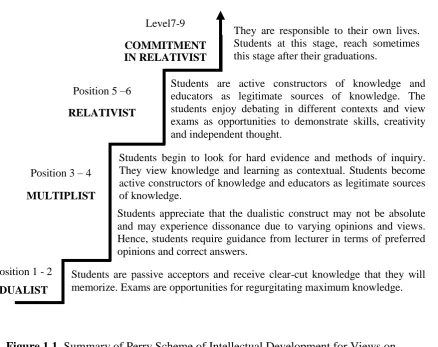
Figure 1.1 Summary of Perry Scheme of Intellectual Development for Views on Students‟ Development
However, it was judged too complex for easy recall. Therefore, in this study, Perry‟s Scheme was classified into three broad stages, which are Dualist,
Multiplist and Relativist. Figure 1 below shows the summary of the scheme of intellectual development characteristics based on the work of a few previous researchers.
Position 1 - 2 Students are passive acceptors and receive clear-cut knowledge that they will memorize. Exams are opportunities for regurgitating maximum knowledge.
Students are active constructors of knowledge and educators as legitimate sources of knowledge. The students enjoy debating in different contexts and view exams as opportunities to demonstrate skills, creativity and independent thought.
Students begin to look for hard evidence and methods of inquiry. They view knowledge and learning as contextual. Students become active constructors of knowledge and educators as legitimate sources of knowledge.
Position 5 –6 RELATIVIST
Position 3 – 4 MULTIPLIST
Students appreciate that the dualistic construct may not be absolute and may experience dissonance due to varying opinions and views. Hence, students require guidance from lecturer in terms of preferred opinions and correct answers.
DUALIST
Level7-9 COMMITMENT IN RELATIVIST
students can change their perspectives on knowledge and learning qualitatively in predictable ways as they proceed through the challenges of higher education. The Perry‟s model has range of “position” from 1 to 9, that conceptualised the
development of higher cognitive skill on the level of intellectual development.Essentially, the nine positions on Perry‟s Model can generally be classified into three stages (Palmer, Marra, Wise, & Litzinger, 2003) as shown in Figure 1.1. In general, students are usually begin from dualist stage which is “right versus wrong” idealogy, when they entered university (Position 1 – 2)as absolute
thinkers (Kuhn, 1991). Dualist students think that the authorities have all the answers and view all things as right or wrong.
The future progress students mostly achieve into the second stage of Multiplist (Position 3 – 4). In this stage, all things are seen as to be having potentially
equal value and correctness to students. Relativistic students use evidence, but without trust, where knowledge is understood based on their own opinions. Therefore, educators are expected to encourage exploration of knowledge from variety perspectives. However, all opinions are equally valid.
Finally, students reach in to the third stage of Relativism (Position 5 – 6).In this stage, students can make commitment and decisions within the relativistic context. Means that, students start to use evidence to explore the alternatives by finding a better or best answer in that particular context. Students in this stage start using their own value system.
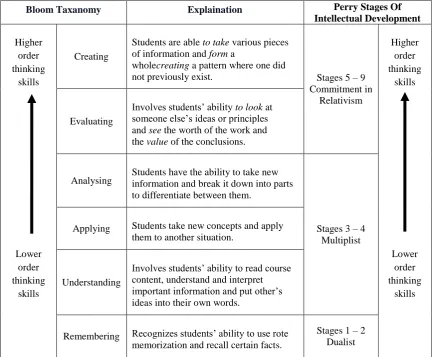
Table 1.1 The Parallel of Intellectual Development Level with the Revised Stages of Bloom Taxonomy
Bloom Taxanomy Explaination Perry Stages Of
Intellectual Development Higher order thinking skills Lower order thinking skills Creating
Students are able to take various pieces of information and form a
wholecreating a pattern where one did
not previously exist. Stages 5 – 9
Commitment in Relativism Higher order thinking skills Lower order thinking skills Evaluating
Involves students‟ ability to look at someone else‟s ideas or principles and see the worth of the work and the value of the conclusions.
Analysing Students have the ability to take new information and break it down into parts to differentiate between them.
Stages 3 – 4 Multiplist Applying Students take new concepts and apply
them to another situation.
Understanding
Involves students‟ ability to read course content, understand and interpret important information and put other‟s ideas into their own words.
Remembering Recognizes students‟ ability to use rote memorization and recall certain facts.
Stages 1 – 2 Dualist
The theory of cognitive constructivism can also be related in this study, to understand the learners‟ learning process based on their existing cognitive structure.
The cognitive constructivism is the work by Jean Piaget (1926, 1936) that describes about what students can and cannot understand the learning at different stages by construct their knowledge through experiences. The cognitive development is able to explain the cognitive activities that contribute to students‟ intellectual development
developmental level. The way of instruction needs to be consistent and parallel with the developmental level of learner (Wood, Smith & Grossniklaus, 2011). Therefore, it is important to capture the patterns of students‟ intellectual development in order to
guide the instructors in planning suitable instructional by understanding students‟ learning. Also to differentiate learners‟ developmental level from less mature to
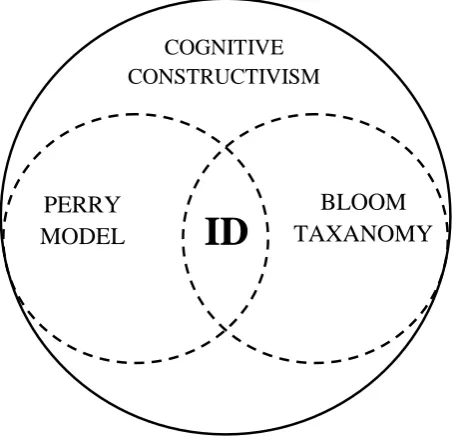
advance mature understanding learners. In these cases, researcher believes that all these theories are suitable to be taken as a guide in this study. The relationships of
the theories are view in the Figure 1.2 below:
Figure 1.2 The Relationships of Theoretical Frameworks That Related To Describe Students‟ Intellectual Development
ID
BLOOM TAXANOMY PERRY
MODEL
1.9 Conceptual Framework
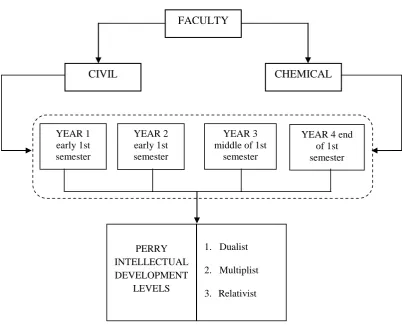
The aim of the conceptual framework (Figure 1.3) of this research is to show the flow in gaining the result to capture the patterns of intellectual development level among UTM undergraduate engineering students. The results serve as feedback for educators, accreditation of engineering programme for their Continues Quality Improvement (CQI), for students itself, and for Ministry of Higher Education (MOHE).Consequently, the conceptual framework is needed based on the method of analysis concept (Najib, 2003).
Figure 1.3 Conceptual Framework for Assessing Students‟ Intellectual Development YEAR 1
early 1st semester
YEAR 2 early 1st semester
YEAR 3 middle of 1st
semester
YEAR 4 end of 1st semester
PERRY INTELLECTUAL DEVELOPMENT
LEVELS
1. Dualist
2. Multiplist
3. Relativist FACULTY
Below is the list of words often used in this study with their definitions:
i. Intellectual development
Intellectual development of an individual is the maturity of their cognitive process that occurs at different rates and in different areas of their lives. Piaget
(1972) concluded that intellectual development is the result of interaction between heredity and environmental factors. Kroll (1992) describes intellectual growth as the development from naive certainty to intelligent confusion. Students who choose engineering as their first degree mostly are at the stage of ignorant certainty. Intellectual development can be defined as the intellectual growth of students in such a way that they become capable of understanding, analyzing and evaluating a concept to make sense of the world around them.
ii. Dualist
Dualist as a term means that the division of something conceptually in to two conflicting or compared aspects, or the state of being (Oxford, 2012).Perry (1970 & 1999) defines dualist students as those who are usually among first-year students, where they view all knowledge as either right or wrong. They think that the authorities or educators have all the answers. Learning is an information exchange between student and educator.
iii. Multiplist
Students in these positions are receptive to others students‟ point of view. Therefore,
they improve in their analytical thinking skill (Lavis, 2005).
iv. Relativism
Relativism is the principle that the existing of knowledge, truth and morality in relation to culture, society or historical context and are not absolute (Oxford, 2012).According to Perry (1970 & 1999), relativism is in position five and six. Students in relativism stage start to recognize the need to support their opinions, where not all opinions are equally valid. Knowledge is viewed more qualitatively.
v. Perry‟s Scheme
Perry‟s Scheme is a theory of intellectual and ethical development that has nine stages in hierarchical structure of thought. This can be grouped into three stages of the ways of thinking (Dualism, Multiplicity and Commitment in Relativism) (Perry, 1970 & 1999).
vi. Undergraduates
The purpose of this study is to capture the patterns of intellectual development level among UTM undergraduate engineering students in order to understand the learners. The modified instrument by adapting the Perry Developmental Questionnaire (Nancy, 2010) is expected to be relevant for determining UTM engineering undergraduates‟ intellectual development in different year of study in relation to their learning experience. The instrument will be used to track intellectual development among engineering undergraduates as defined by Perry‟s Scheme of Intellectual Development. This investigation could aid to describe
the development in university students‟ thinking, from simple to complex. The patterns of students‟ development depend on how they view their surroundings.
Researchers of previous studies had assessed the intellectual development of university students. However, there is not much research on intellectual development specifically focusing on UTM undergraduate engineering students, which can be applied to UTM students.
REFERENCES
ABET, (2010).Technological Progress through Accreditation. Annual Report for Fiscal Year 2009-2010.Retrieved on 9 Mei 2012
at http://www.abet.org/uploadedFiles/Publications/Annual_Report/abet-2010-annual-report.pdf
Anderson, L. W. (Ed.), Krathwohl, D. R. (Ed.), Airasian, P. W., Cruikshank, K. A., Mayer, R. R., Pintrich, P. R., Raths, J., & Wittrock, M. C. (2001). A taxonomy for learning, teaching and assessing: A revision of Bloom’s Taxonomy of
Educational Objectives (Complete edition). New York: Longman.
Al-Qasmi, A.S., (2006).Problem Solving In Biology at University Level. Ph.D. Thesis. University of Glasgow, Glasgow.
Babbie, E. (2001). The Practice of Social Research: 9th Edition. Belmont, CA: Wadsworth Thomson.
Bartlett M. S., (1954).A Further Note on the Multiplying Factors for Various x2 Approximations in Factor Analysis. J. R. Stat Soc (ser A) 16: 296-298.
Baxter Malgolda, M. B. (1992). Knowing and Reasoning In College: Gender Related Patterns in Students‟ Intellectual Development. Jossey-Bass, San Francisco.
Belenky, M.F., B.M. Clinchy, N.R. Goldberger, and J.M. Tarule, (1986). Women‟s
Ways of Knowing: The Development of Self, Voice, and Mind. New York: Basic Books
Biggs, J. (1978). Individual and Group Differences in Study Processes. British Journal of Educational Psychology, 48,266–279.
University.
Broughton, J. M. (1978). Development of Concepts of Self, Mind Reality, and Knowledge. In Damon, W. (ed.), Social Cognition, Vol. 1, Jossey-Bass, San Francisco.
Carmel-Gilfilen, C., (2012). Uncovering Pathways of Design Thinking and Learning: Inquiry on Intellectual Development and Learning Style Preferences. Journal of Interior Design, 37(3), 47-66.
Carmel-Gilfilen, C., and Portillo M., (2010a).Creating Mature Thinkers in Interior Design: Pathway of Intellectual Development. Journal of Interior Design, 35(3), 1-20.
Culver, R. S. And Hackos, J. T., (1982). Perry‟s Model of Intellectual Development.
Engineering education, (vol. 73), (pp. 221).
Chapple, S. (1999).Understanding Student Learning. In K. Martin, N. Stanley and N. Davison (Eds), Teaching in the Disciplines/ Learning in Context, 67-71.
Proceedings of the 8th Annual Teaching Learning Forum, the University of Western Australia, February 1999. Perth: UWA.
Christiansen F. and Quimby J., (2010).Rich Environment for Active Learning (REAL) – A Definition.Active Learning Strategies.Vol.2.Issue 9.
Clarkeburn, H.M., Downie, J.R., Gray, C., Matthew, R.G.S., (2003). Measuring ethical development in life sciences students: a study using Perry‟s
developmental model. Stud. High. Educ. 28 (4), 443–446.
Creswell, J.W., Plano Clark, V. L., Gutmann, M., and Hanson, W. (2003). Advanced Mixed Method Rsearch Designs. In A Tashakkori and C. Teddlie (Eds),
Handbook On Mixed Methods In Social And Behavioral Research (pp. 209-240). Thousand Oaks, CA:Sage.
Daniel Su Kai Min, (2012).Differences between Intellectual Maturity and Genders
Edwards, S. & Kuhlman, W. (2007). “Culturally Responsive Teaching: Do We Walk Our Talk?”.Multicultural Education, Summer 2007
Ehrenberg R. G., Brewer D. J., Gamaron A., and Willms J. D., (2001). Class Size and Student Achievement.Psychological Science in the Public Interest.Vol.2, No. 1.American Psychological Society.
Engineering Accreditation Council, (2012).Engineering Programme Accreditation Manual 2012.
El-Farargy N., (2009).Epistemological Beliefs and Intellectual Development in the Physical Sciences. Greenock: UK
El-Farargy N., (2010).Evaluation of a Chemistry Curriculum Intervention Using the
Perry Model of Intellectual Development.Chemistry Education Research and Practice. Vol. 11: 98-106.
Entwistle, N. (1984). Contrasting Perspectives on Learning. In Marton, F, Hounsell, D. & Entwistle, N. (eds), The Experience of Learning. Edinburgh, Scottish Universities Press.
Erickson B. L, Peter B., Strommer D. W., (2006). Teaching First-Year College Students: Revised And Expanded Edition Of Teaching College Freshmen. United States: Jossey-Bass.
Evans, N., Forney, D., & Guido-DiBrito, F. (1998). Student Development in College: Theory Research and Practice. San Francisco: Jossey-Bass.Jossey-Bass.
Felder, R. M., and Brent, R., (2004). The Intellectual Development of Science and Engineering Students. 1. Models and Challenges. Journal of Engineering Education, Vol. 93, No. 4.
Felder, R. M., and Brent, R., (2005). Understanding Student Differences. JournalOf Engineering Education, Vol. 94 (1), p 57-72.
First word, (2012). Teaching and Learning: Understanding How Students Learn. Retrieved on 12 June 2012
Instruction.Vol. 5 (2), 114-118.
Ginkel, V.H. (2006). Responsibilities, Challenges, Opportunities and Governance-Rethinking the University for the 21st Century. Rethinking the University for the 21st Century. Palgrave Macmillan
Ginkel, H.J.A., and Dias, M.A.R. (2007).Higher Education in the World 2007 Accreditation for Quality Assurance: Institutional and Political Challenges of
Accreditation at the International Level.Global University Network for Innovation. Palgrave Macmillan.
Haluan Malaysia, (2013).Pertubuhan Himpunan Lepasan Institusi Pendidikan Malaysia.Kualiti Pendidikan Dalam Melahiran Modal Insan Negara.Retrieved on 27 Nov 2013 at http://www.haluan.org.my/v5/index.php/topik-pilihan/modal-insan/559-kualiti-pendidikan-dalam-melahirkan-modal-insan-negara
Hammil G., (2005). Mixing and Managing For Generating Of Employees. Retrieved on 8 Mei 2012 at http://www.fdu.edu/newspubs/magazine/05ws/generations.htm
Hixson, J. (1991). Multicultural contexts for teacher education: Meeting the challenge of student diversity. Paper presented at the meeting of the American Educational Research Association, Chicago, Il.
Ho, E. S., Holmes, P., & Cooper, J. (2004). Harmonizing diversities via emphasizing
similarities: A Study of multicultural classrooms in New Zealand. Paper presented at the Third Biennial International Conference on Intercultural Research, Taipei.
Hofer B. K., (2000).Dimensionality and Disciplinary Differences in Personal Epistemology. Contemp. Educ. Psychol. 25 (4), p 378-405.
Hofer B. K. and Pintrich P. R. (1999). Knowing and Believing: Personal
Epistemology and Classroom Context. Paper presented at the annual meeting of the American Educational Research Association. Montreal.
Hofer, B. K. & P. R. Pintrich. (1997). The development Of Epistemological Theories: Beliefs About Knowledge And Knowing And Their Relation To Learning. Review of Educational Research (Spring).
Kaiser H. F., (1974). An Index of Factorial Simplicity.Psychometrika 39: 31-36.
Kardash, C. M., and Howell, K. L. (2000). Effect of Epistemological Beliefs and Topic-Specific Beliefs on Undergraduates‟ Cognitive And Strategic Processing
Of Dual-Positional Text. J. Educ. Psychol. 92: 524-535.
Karambelas, D. (2013).Study: Students Prefer Real Classrooms Over Virtual. USA Today.Retrieved on November 2013
from http://www.usatoday.com/story/news/nation/2013/06/11/real-classrooms-better-than-virtual/2412401/
Katung, M., Johnstone, A.H., Downie, J.R., (1999). Monitoring Attitude Change In Students To Teaching And Learning In A University Setting: A Study Using Perry‟s Developmental Model. Teach. High. Educ. Vol. 4 (1), 43–59.
King, P. M. (1992). How do we know? Why do we believe? Learning To Make Reflective Judgments. Lib. Educ. 78(1):2-9.
King, P. M., and Kitchener, K. S. (1994). Developing Reflective Judgment: Understanding And Promoting Intellectual Growth And Critical Thinking In Adolescents And Adults, Jossey-Bass, San Francisco.
King, P. M. (2000). Learning to Make Reflective Judgments.In M. B. Magolda (Ed.). Teaching To Promote Intellectual And Personal Maturity: Incorporating
Students‟ World Views And Identities Into The Learning Process. New
Directions for Teaching and Learning, No. 82, 15-26. San Francisco: Jossey-Bass
Kohlberg, L., (1969). Stage and Sequence: The Cognitive Development Approach to Socialization. In Goslin, D. (ed.), Handbook of Socialization Theory and
Research, Rand-McNally, New York, pp. 347-480.
Kolb, A. Y., and Kolb, D. A., (2005).The Kolb Learning Style Inventory- Version 3.1 2005 Technical Specifications. Boston, MA: Hay Group.
Kuhn, D. (1991). The Skills of Argument. Cambridge University Press, Cambridge.
Kuhn, D., and Weinstock, M. (2002). What is Epistemological Thinking and Why
Does It Matter? In Hofer, B. K., and Pintrich, P. R. (eds), Personal
Epistemology: The Psychology Of Beliefs About Knowledge And Knowing,
Erlbaum, Mahwah: NJ.
Kroll, B. M., (1992). Teaching Heart And Minds: College Students Reflect On The Vietnam War In Literature. Carbondale, IL: Southern Illinois University Press.
Kloss, R. J., (1993). Stay in touch, won't you?: Using the one-minute paper. College Teaching 41 (2: Spring): 60-63.Knowles, M. (1984). The Adult Learner: A Neglected Species, 3rd Edition. Houston, Gulf Publishing.
Lavis, C. C., (2005). Evaluating Intellectual Development Of Horticultural Students: The Impact of Two Teaching Approaches Using Perry‟s Scheme of Intellectual Development as Measured by The Learning Environment
Preference.Dissertation Doctor of Philosophy. Kansas State University: Manhattan, Kansas.
Likert R., (1932). A Technique for Measuring Attitudes. Arch Psychol., 140, 5-53.
Littlewood W. (2000).Do Asian Students Really Want to Listen and Obey? ELT Journal 54//1, 31-35.
Lix L. (2006). Observational Epidemiology: Design and Analysis of Longitudinal Data. Lecture Notes. University of Manitoba.
Love, P. G. and Guthrie V. L., (1999).Understanding and Applying Cognitive Development Theory.New Directions for Student Services.No. 88, pp 1-15. San Francisco: Jossey-Bass.
Liu, Hsin-Tsai, 2009, "Earnings Quality and Information Transfers", Doctoral Dissertation, Purdue University.
Marra, R. M., Palmer, B., Litzinger, T. A., (2000). The Effective of a First Year Engineering Design Course on Student Intellectual Development As Measured By the Perry Scheme.Journal of Engineering Education, vol. 89, pp. 39-45.
Marra, R. M., and Palmer, B., (2004). Encouraging Intellectual Growth: Senior
College Student Profiles.Journal of Adult Development, Vol. 11, No. 2, Plenum Publishing Corporation.
Marton, F. & Saljo (1976). On Qualitative Differences in Learning - 1: Outcomes and Process. British Journal of Educational Psychology, 46, 4-11.
Mumtaz, S. (2000). Factors affecting teachers‟ use of information and
communications technology: A review of the literature. Journal of Information Technology for Teacher Education, 9(3), 319-342.
Merriam, S. B. (1998). Qualitative Research and Case Study Applications in Education. SanFrancisco: Jossey-Bass.
Ministerial Council on Education, Employment, Training and Youth Affairs
[MCEETYA].(2008). Melbourne Declaration on Educational Goals for Young Australians.
Ministry of Higher Education (2006).The Future of Engineering Education in Malaysia.Perpustakaan Negara Malaysia.
Moore, W. S., (1989). The learning Environment Preferences: Exploring the
Construct Validity of an Objective Measure of the Perry Scheme of Intellectual Development. Journal of College Student Development. Vol. 30: 504-514.
National Science Board (2007).Moving Forward to Improve Engineering Education.Information DisseminationBranch.
National Economic Advisory Council, (2010).New Economic Model for Malaysia, Part 1, also available at
http://www.pmo.gov.my/dokumenattached/NEM_Report_1.pdf
Netemeyer, R. G., W. O. Bearden, and S. Sharma, (2003). Scaling Procedures: Issues and Applications. Thounsand Oaks, CA: Sage Publications, Inc.
Norhayati A., (2012). Comparison between Two Models of Engineering Students‟
Intellectual Development.Regional conference On Engineering Education (RHED). Negeri Sembilan: Seremban.
Olds, B.M.; Miller, R.L. and Pavelich, M.J. (2000).Measuring The Intellectual Development Of Students Using Intelligent Assessment Software. Frontiers in Education Conference. FIE 2000. 30th Annual. Liberal Arts & Int. Studies Dept., Colorado Sch. of Mines, Golden, CO.
Osgood C. E., (1952). The Nature and Measurement of Meaning.Psycho. Bull., 49, 197-237.
Oxfort Dictionary (2012), Knowledge. Oxfort University Press. Retrieved on 4 June 2012 at http://oxforddictionaries.com/definition/knowledge#m_en_us1261368
Palmer, B., Marra, R. M., Wise, J. c., and Litzinger T. A. (2000). Longitudinal Study Of Intellectual Development Of Engineering Students: What Really Counts In Our Curriculum? 30th ASEE/IEEE Frontier in Education Conference. Cansas City, MO
Parker, J. C., (1984). The Preliminary Investigation of the Validity and Reliability of The Parker Cognitive Development Inventory. Unpublished Doctoral
Thesis.University of Iowa City.
Pavelich, M.J., and W.S. Moore (1996) “Measuring the Effect of Experiential Education Using the Perry Model,” Journal of Engineering Education, Vol. 85,
Pavelich, M.J., R.L. Miller, and B.M. Olds, (2002). Software for Measuring the Intellectual Development of Students: Advantages and Limitations.
Proceedings, 2002 ASEE Annual Conference, American Society for Engineering
Education. Washington, DC
Pascarella, E. T., and Terenzini, P. T. (2005). How College Affects Students: A Third Decade Of Research. San Francisco: Jossey-Bass.
Perry, W.G., (1970). Forms of Intellectual and Ethical Development in the College Years: A Scheme, San Francisco: Jossey-Bass Publishers.
Perry, W. G. (1999). Forms of Intellectual and Ethical Development in the College
Years: A Scheme. San Francisco: Jossey-Bass Publishers.
Piaget, J. (1950). Introduction anEpistemology Genetique.Presses Univ. de France, Paris.
Piaget, J. (1954). The Construction of Reality In The Child (Cook, M., Trans.), Basic Books. New York.
Piaget, J. (1972). Intellectual Evolution from Adolescence to Adulthood. Human Development, [vol. 15(1)], (pp. 1-12).
Qian, G., and Alvermann, D. (2000).Relationship between Epistemological Beliefs and Conceptual Change Learning. Reading Writing Q. 16: 59-74.
Ravid, R., (1994). Practical Statistics for Educators. MD: University Press of America.
Richmond, J.E.D. (2007) Bringing critical thinking to the education of developing country professionals. International Education Journal.8(1).1-29.
Richter T. & Schmid S. (2009) Epistemological beliefs and epistemic strategies on self-regulated learning. Metacognition Learning, DOI. 10.1007/s11409-009-9038-4.
ReadMore: http://journals.heacademy.ac.uk/doi/full/10.11120/ndir.2009.000500 01
Robson, L. S., Shannon, H. S., Goldenhar, L. M., and Hale, A. R., (2001).Chapter
Of Health And Human Services. No. 2001-119, pp. 67-76. Columbia Parkway: DHHS (NIOSH) Publication.
Schommer, M., Crouse, A., and Rhodes, N. (1992). Epistemological Beliefs and Mathematical Text Comprehension: Believing It as Simple Does Not Make It So. J. Educ. Psychol. 82: 435-443.
Schommer-Aikens, M., & Easter, M. (2006). Ways of Knowing and Epistemological Beliefs: Combined Effect on Academic Performance. Educational Psychology, 26(3), 411–423. doi:10.1080/01443410500341304.
Sheppard, S.D., (2003). A Description of Engineering: An Essential Backdrop for Interpreting Engineering Education. Proceedings (CD), Mudd Design Workshop IV. Claremont, Cal.: Harvey Mudd College.
Suhaida, S., (2012).Perkembangan Intelektual Pelajar Pendidikan UTM Berdasarkan Model Perry.Ijazah Sarjana Psikologi Pendidikan.Fakulti Pendidikan: Universiti Teknologi Malaysia.
Willing K., (1988).Learning Styles in Adult Migrant Education. Adelaide, Australia: NCRC Research Series.
Wood, P. K., P.M. King, K.S. Kitchener, and C.L. Lynch, (1994).Technical Manual for the Reflective Thinking Appraisal, Columbia, MO: University of Missouri.