A
Computationally Efficient
Algorithm for Characterizing the
Superposition of Multiple
Heterogeneous Interrupted
Bernoulli Processes
K. M.
Elsayed
H.
G. Perras
Center for Communications and Signal Processing
Department of Computer Science
"North Carolina State University
/TR-94j14
A
COlnputationally Efficient
Algorithm
for
Characterizing the Superposition of Multiple
Heterogeneous Interrupted Bernoulli Processes
*
Khaled M. Elsayed
Harry G. Perros
Department of Computer Science
and
Center for Communications and Signal Processing
North Carolina State University
Raleigh, NC 27695-8207
June 10, 1994
Abstract
A computationally efficient algorithm for characterizing the superposition process of N heterogeneous and independent Interrupted Bernoulli Processes isintroduced. The algorithm is then used to analyze a statistical multiplexer with finite buffer. Finally, numerical examples highlighting the algorithm accuracy are given.
"Supported in partbyBelJSouth, GTE Corporation, and NSF and DARPA under cooperative agreement
1
Introductioll
In an ATM environment many types of traffic, such as voice, data, and video, are to be
efficiently transported by the same network. An ATM mulliplexer receives cells (fixed size
packets of 53 octets length) from a number of different incoming links and then transmits
them out onto a single outgoing link. A finile buffer is provided in the multiplexer to
accomodate the multiple arrivals of cells. Each arrival stream is modeled by a bursty and
possibly a correlated process. The service time is deterministic and is equal to one slot of
the outgoing link which is assumed to be long enough to transmit one cell.
The analysis of such a queueing system is quite complex due to the large number of
arrival processes. A possible method for approximately analyzing the queue is to first
characterize the superposition process of all arrival prrocesses, and then analysze the
queue with a single arrival process. In this paper, we consider the case when the arrival
processes are modeled as multiple independent heterogeneous Interrupted Bernoulli
Pro-cesses (IBP). The IBP and its variants are popular models for bursty traffic sources in an
ATM environment.
The problem of characterizing the superposition process of a set of arrival processes has
been addressed extensively in the literature. One approach for obtaining the superposition
process is to approximate it by a renewal process, see Albin [1], Whitt [16], Sriram and
Whitt [12], and also Perros and Onvural [11]. An insightful discussion of the various
time-scales affecting the accuracy of the approximate superposition of packet voice sources
(modeled as a variant of IBP) was provided in [12]. Heffes and Lucantoni [6]considered
the superposition process of packet voice sources modeled as an IBP where arrivals occur periodically. They approximate the superposition by a Markov Modulated Poisson
Process (MMPP). The accuracy of the superposition is reasonable when the average delay
in the multiplexer is the amount of paramount importance. However, the superposition
does not provide a good estimate for the probability of loss. Several other authors (see [3,
10, 15]) considered the same problem and suggested alternative methods for characterizing
the superposition process as an MMPP. The main objective of these papers was to improve
the accuracy with regards to calculation of the cell loss probability. Heffes [5] obtained an
MMPP
approximation to the superposition of different MMPP arrival processes using aAllalternative method to model ATM multiplexers is the Uniform Arrival and Service
(VAS) model (also known as fluid flow). In this case an on/ off process produces a uniform
flow of bits when in the all slate. Cell departures are modeled as a uniform flow out of
the queue. Anick, Mitra, and Sondhi [2] evaluated the system performance using elegant
simple expressions for a multiplexer with infinite buffer space and homogeneous arrivals.
Tucker[14] considered the finite buffer case. TIle methodology was generalized to tile case
of heterogneous Markov Modulated Rate Processes illa series of papers [13, 4].
The work presented ill this paper is related to the methodology presented Hong, Perros,
and Yamashita [7] and Makharnreh, McDonald and Ceorganas [9]. In [7], the authors used
an aggregation method for approximating the superposition process. They first obtained
the exact probability transition matrix of the Markov chain of the superposition process.
This Markov chain has a dimension which is exponential in the number of input sources.
Subsequently, the Markov chain was aggregated in order to obtain a superposition process
with a small number of states (linear function of the number of sources). The method
is limited to a small number of input sources. In [9], the authors used an aggregation
method to analyze an output-buffered ATM switch with correlated imbalanced traffic.
In this paper, we present an efficient algorithm for characterizing the superposition
process of multiple heterogeneous IBP's. The algorithm is based on a step-wise
aggrega-tion scheme. It can be used to construct the superposiaggrega-tion of a large number of IBP sources.
The space complexity of the algorithm is O(N), while the computational complexity is
O(N4 ), where N is the number of superimposed IBP's. TIle superposition algorithm is
then used to study the performance of a statistical multiplexer with finite buffer. Finally,
we present a brief study of the range of parameters of the superimposed IBPs for which
the accuracy of the algorithm is acceptable.
The rest of this paper is organized as follows. In section 2, we briefly describe the IBP
model and discuss some of its statistical properties. III section 3, we discuss the step-wise
aggregation algorithm for characterizing the superposition process. Section 4 presents
the analysis of the statistical multiplexer and numerical results and a discussion of the
Figure 1: TIle Interrupted Bernoulli Process.
2
The
IBP Source Model
We consider a source that alternates between active and idle states according to a Markov
chain (see figure 1). Arrivals occur in a Bernoulli fashion with probability 1 only when
the source is ill the active state. No arrivals occur when the source is in the idle state. The
transitions between active and idle states occur in a mernoryless fashion. Let us assume
that at the end of slot k the process is in the active (or idle) state. Then, in the next slot
k
+
1 it will remain in the active (or idle) state with probability a (or (3), or it will changeto idle (or active) state with probability 1 - a (or 1 - (3).
The inter-arrival time mean
I
and coefficient of variation CV2are givell by:t =
(1 - a)+
(1 -(3),
CV2=
1+
I [ (1 - a)(a+
(3)
-
1].,(I -
(3)
[(1 - a)+
(1 - (3)]2The triplet
(Q,
(J,,) completely characterizes an IBP process.3
The
Approximation Algorithm
We now present an efficient algorithm that can be used to characterize the superposition
of N ~ 2 heterogeneous IBP sources. We assume that the sources can be divided into G
groups, where the sources within each group are identical. In practice, specially when N
is large, this assumption is valid because traffic sources of a specific traffic type (e.g. data
or voice source) would tend to have similar or even identical characteristics. TIle number
of sources in groupi is given by
Ni,
where 1 ~ N, ~ NandL
N,=
N.ap-proximation algorithm is to characterize the superposition of sources in group i, where
N,
>
I, in terms of a stochastic process with N,+
1 states. The superposition process isdescribed in terms of the probability transition matrix between the N
+
1states, and theprobability distribution of the number of arrivals per slot at each state.
The superposition process of N similar!BP'
s
with descriptor(0',
f3,,)
is a Markov chainwith state spaceX
=
{n,n=
0, 1, · · ·N} which denotes the number of sources in the activestate (or alternatively in the idle state). Let A
=
[a(nJ,n2)), nl, n2 E X be the probabilitytransition matrix governing the transitions between the states of the superposition. Also,
let
b(
n,i) be the probability that i arrivals occur when the superposition is in staten, whereo
~ i ~ n. Consider two states nj and n2. Assume that in slot k the Markov chain isin state nt· The probability that in tile next slot k
+
I, the Markov chain would be instate n2 is equal to the probability that I,0 ~ I ~ nI, of the nI sources in the active state
make a transition to idle state and thatm, 0 ~ m ~ N - nl, of the sources in the idle
state make a transition to active state, and that nl - I
+
m=
»»
The probability of thefirst event to occur is given by the binomial distribution (~I)(1
-
O')'O'n
l-'.
Similarly, theprobability that the second event occurs is given by (n~~~~,)(1-
f3t2-nl+'f3N-n2-'
whereo
S
n2 - nl+
lS
N - nt and N - n2 - I2::
o.
We then have:a(nl,n2)
=
Lr~o [(~I)(1
-
O')'O'n
l-'
(n~~7~,)(1-
f3t2-nl+'f3N-n2-'
I(n2 -
nJ+
I:2
0) I(N -
»:-I:2
O)J
where
I(
x)
==
1 iff logical expressionx
is true and 0 otherwise.When there are n sources each with probability f of emitting a cell in a given slot,
the the probability of having v arrivals is given by the binomial distribution b(n, v)
==
(:),v(1 -
f)n-v,
0~
v
~
n. For notational convenience, the quantitiesb(
n,v)
are referredto by the lower triangular matrix B == [b(n, v)].
11-The Combined Superposition Process of two Groups of Sources:Oncethe superpo-sition of two or more separate groups of sources is constructed as described above, itis
necessary to combine them in order to get the overall superposition process. Let us as-sume that the superposition process of two arbitrary groups, say groups 1 and 2, has been
where n; is the state of component process i. The number of states in the superposition
process is equal to (N]
+
1)(N2+
1). The probability transition matrix of the superpositionwill be givell by A == A10 A2where 0 is tile Kroencker product operation of two matrices.
One of theuseful properties of the Kroencker product operation is thatif,the invariant
probability vector of A,is givell by
7rl
®7f2
whereii
is invariant probability vector of Ai.This saves us from solving a system of linear equations for finding the invariant of P
which is more time consuming than solving for
7ft
and7f2
individually.Note that the above discussion is also valid for more than two groups of sources.
However, we focus here on the case of two groups since the approximation algorithm always superposes two processes at a time.
111-Aggregation of the Superposition Process: TIle above Markov chain which
charac-terizes the superposition process of two groups of IBP sources is exact. However, the
dimensionality of the resulting process may not be practical for studying the performance
of amultiplexer with alarge buffer. The dimensionality of the superposition process can
be reduced by lumping all thest~tes (nl'n2)of thesuperposition, wherenl
+
n2==
n, to a single state n. The Markov chain resulting from this aggregation represents what we callthe
compact
superposition process.Let the probability transition matrix of the compact process be
A
=
[ii(n, m)]' We thenhave
The remaining step is to find the probability distribution function of the number of
arrivals in a particular state. This can be calculated from Bi ,i
=
1,2as follows:(2)
The resulting superposition process has a characterization identical to that of its
IV-The Approximation Algorithm: Consider N heterogeneous IBP sources divided
into G groups each having Ni,i
=
1,2" · ·G, identical sources. Then, we have thealgo-rithm outline as follows:
oFind Aj , ifj andB, for all grollps j, j == 1,··.,G
o Let Aa == Al and B/J == ill
oForj
==
2 toG doo A' == A/J ® Aj
-II -I -I
01r ==1r/J0 7rj
o Aggregate A' into A,(use equation 1)
o Calculate B/J (use equation2)
o Find1r/J satisfying1f/JA/J == i/J'
Ei
-rr/J(i) == 1End
It can be shown that the computational complexity of the algorithm is O(N4 ) (The
calculation of the Kroencker product of two matrices and the solution of a linear system
of equations are the dominant factors.)
Hong, Perros, and Yamashita [7] tackled the same problem. However, their proposed
algorithm constructs the complete probability transition matrix of the superposition
pro-cess and then performs the aggregation. This causes tile computational complexity and
storage requirements of their method to be O(2N ) . This precludes the execution of the
algorithm on a conventional computer. Even for a nominal value ofN, sayN
==
20, it maynot be possible to construct the superposition even using a supercomputer. Our method
has the same accuracy but it is considerably more efficient.
4
Analysis of the Multiplexer Model
Consider a FIFO finite buffer multiplexer servingN ~ 2 IBP sources as depicted in figure 2.
The multiplexer has S
2
1 servers and can accommodate a total of B ~ S cells at any timeinstant including those in service. The service time for all cells is constant and is equal to
o
SI
~
0
S2~
•
.
SN~ Finite Buffcr Queue (B-S)
Traffic Sources
0
I Slot Service (S Servers)
Figure 2: The Statistical Multiplexer with Sservers and B total waiting capacity.
State Transition
/ArriVal
---1
I
k /k+l
Service Completion
k+2 k+3
Time Slot
Figure 3: Timing of events in the early arrival model.
otherwise no queue will ever form in the multiplexer and the problem will be trivial to handle.
We seek the steady state probabilities, 1r(n), 0 ~ n ~ B - S, that there are n cells in
the multiplexer's queue. From this, we can obtain other measures of interest such as the
mean queue length, the probability of full buffer and the cell loss probability.
Let us first discuss the timing of events ill our system. We follow an
early arrival
timing model as defined by Hunt [8]. That is, during all arbitrary time slot, the following
sequence of events is possible: potential state transition in the superposition occurs,
followed immediately by cell arrivals (if any), which is followed by service of waiting
cells if there are any, and finally departure of cells that received service. This is shown
in figure 3. If an arbitrary cell sees one or more empty servers UpOll its arrival, it is
immediately admitted to one of the available servers without waiting till the next slot.
Hence, the multiplexer is effectively of the cut-through type.
The system state is described by the pair
(n, h)
wheren
is the number of customersprocess at the current slot.
We first characterize the superposition process of the N IBP sources as described in
the previous section. Then, the probability transition matrix of the Markov chain (n,
h)
is generated. Let p[(nl,hI) ---+ (n2,h 2)] be the probability that the Markov Chain (n,h)
makes a transition from state
(nt, hJ)
in slot kto state(n2, h2)in slotk+
1.Thenv
wheren2
=
(min( nl+
v), B) -st
andv,0 ~ v ~ hI,is the random variable representingthe number of arrivals when the superposition process is in state h-: Finally, we solve
for the invariant probability vector of P
=
[p[(nl,hJ) ---+ (n2,h2)]] from which variousperformance metrics can be obtained. We used the Gauss-Seidel method when using a
workstation, and the parallelized LAPACK routines for LU decomposition when using a KSR-l parallel machine at the NorthCarolina SupercomputerCenter.
5
Validation and Numerical Examples
The approximation algorithm was validated bycomparingitagainst simulation. The effect of the heterogeneity of the sources on the accuracy of the algorithm was investigated and metrics were defined to determine how heterogeneous a given set of sources is. These metrics can be used to determine in advance whether the superposition will be accurate or not.
In all the validation examples, we fixIi, the probability that sourcej emits a cell while in the active state, to be 1. This simplifies the fitting procedure for characterizing an IBP
from the first two moments of the inter-arrival time. TIle following additional notation is used.
Pi= Source throughput for a source in group i.
Rp
=
max{Pi} /min{Pi} is ameasure of heterogeneity of the throughput of the input sources.Rcu2
=
max{CVi2}jmin{Cl/?}is a measure of heterogeneity of the CV2of the input sources.A
=
I:f=l
Nio,
= Total throughput.B
=
Total buffer size.In all examples, the number of serversill the multiplexerwas set to 1.
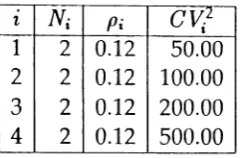
Example 1: In the first example, we have G == 4 and B == 24 and we use the input
sources with parameters given in table 1.
1, N· Pi CV2
I I
1 2 0.12 50.00
2 2 0.12 100.00
3 2 0.12 200.00
4 2 0.12 500.00
Table 1: Parameters for the first example.
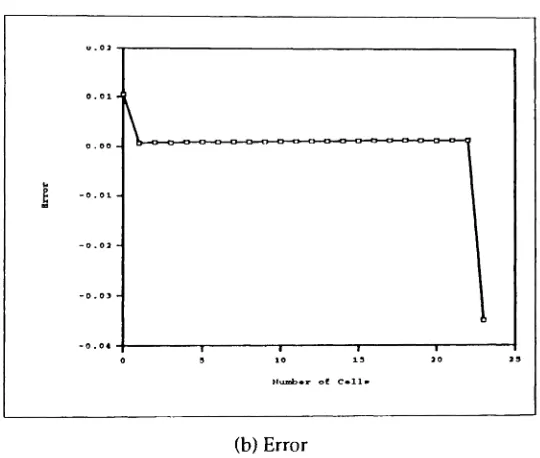
In figure 4(a), we plot the distribution of the number of cells in the queue which is
obtained from simulation and the approximation algorithm. The difference between the
numerical and simulation values is shown in figure 4(b). The reason why we give the
difference and not the relative error is that some of the calculated quantities are very small
(in the order of 10-3) which makes the relative error to be large, despite the fact that the
overall accuracy is still acceptable. The probability distribution has two peaks, the first
is for the probability that queue is full and the second peak for the probability that the
queue is empty. This a well-knownbehavior ill queues with bursty correlated input with
a moderate to a high input traffic intensity. We note that the magnitude of error of the
steady-state probability of a full buffer is high, This causes an underestimation of the
cell loss probability. However, it should be stated thatfor this example theinput sources
are quite heterogeneous. The value of Rcv2is 10, which is fairly large as it will be shown
below.
Example2: In the second example, we use the inputsources with parameters given in
table 2, withRcv 2 == 4. We first obtain the superposition process, and subsequently use it to
generate the probability transition matrix for buffer sizes in the set {10,20,30,40,50,60, 70}.
The cell loss probability and the mean queue length are shown in figures 5(a) and 5(b)
0.5
O ••
t 0.]
-~ ~ ~
0.1
0.0
I
5
I
10
I
15
- j
I
:10
- 0 -AnAlytio • • -0 . . .81mulation
(a) Probability distribution of the number of cells
0.01
-0.02
- 0 . 0 '
l
-0.ot~ - - ~ - - - r - - - r - - - - f
1~
)lumb.r of C . l l .
(b) Error
Figure 4: Probability distribution of the number of cells and associated error, B
==
24.I . N
i I Pi
cvl
1- I
1 2 0.1 10.00 2 2 0.1 20.00 3 2 0.1 30.00
4 2 0.1 40.00
good while that of the cell loss probability is less accurate. This is due to the smoothing
effect of the aggregation algorithm. It constructs a less bursty and correlated process than
the actual superposition, which leads to underestimating the probability of observing a
full buffer. However, we noted that the aggregation algorithm provides an upper-bound
on the probability of having an empty buffer. Thus a balancing effect takes place and the
overall meanqueue length predicted by the simulation and numerical solution is close.
We also investigated the effect of increasing the Humber of sources in a group while
keeping the overall grollp throughput fixed. TIle parameters of table 2were modified as
follows. N, is increased to 4, Pi is halved to 0.05, for all i == 1",·,4 and the values of
Clii
remained the same. For this new set of parameters, the probability of loss and meanqueue length slightly increased over the values plotted in figure 5. The accuracy remained
the same.
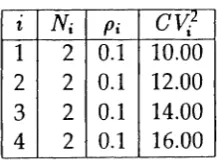
Example 3: The third example is in essence similar to the second one. We letRcv 2
==
1.6and the parameters of the input sources are given by table 3.
The probability of loss and the mean queue length are shown in figures 6(a) and 6(b)
respectively. We note here that the accuracy of the approximation algorithm is very good.
This is due to the fact that the amount of heterogeneity in the input sources is small as
indicated by the relatively small value of Rcv 2 .
t Ni Pi
ev?
11 2 0.1 10.00
2 2 0.1 12.00
3 2 0.1 14.00
4 2 0.1 16.00
Table 3: Parameters for the third example.
We also conducted a set of experiments to study the effect of the variation in IBP source
throughput and coefficient of variation on the accuracy of the approximation algorithm.
We know in advance that the more heterogeneous the sources are, the worse the accuracy
of the iterative aggregation algorithm would become. However, we wanted to find out
the regions for the parameters of the sources in which the accuracy of the algorithm
is acceptable. The conclusion of this study was that Rcv2 is a major deciding factor in
I---~--- - - - . - - - _
- 0 -I\n'-lI;-I:ICI'lI • • -0 • • •Sjmul'-Itie-n
~,
\
...
••
'~""",
"l:l
<,
.. '0 ...
.... 0 O. 20
I-~---u.15
!II .~
~ u. 10 .Q f
u.05
0.00- r - - - r - - - r - - y - - - , r - - - - , . - - - J
10 20 )0 40 SO 60 70 80
(a) Probability of loss
2 0 . , - - - _
15
!II .-f
~ ~
~ 10
§
~
~ ):
- - - 0 - - -Analyt ic • • -0 • • •Sim.Jletion
10 20 )0 40 50 60 70 80
Buf r",r slz"
(b) Mean number of cells
o.~O. , - - - - _
o15
~ 0.10 .0
~
o05
- - - 0 . -I\na IytIr~l
•• -0 . . .SimulatIon
u .00-r--r--~-r---..,r----,.---I
10 20 )0 40 50 60 70 80
Bufr~[" slz~
(a) Probability of loss
16
1tI
12 {II
..-4 ..-4 ~ ~ 10
'-t
.8
~
c:
~ 1I
~
10 20 )0 40 50 60 70 80 B'J [r4>r S17,.,
(b) Mean number of cells
- - 0 - -I\nalyticl')}
• • -0 • • •Simulation
Example 4: In this example, we discuss the effect of the variation in the squared
coef-ficient of variation of the inter-arrival time of the input sources on the accuracy. We
con-structed an input of four groups each having two sources, and fixed the source throughput
to be0.1. We vary the Rc tJ2 to take values from the set {I, 1.5,2,2.5,3,3.5,4,4.5,5}
respec-tively. We assume that
ell?
=
10.0,and for each value ofR
c tJ2 , we find the remainingev?
by solving the following eqllalions:
cv
2ev~
=
(J, i=
2,3,41-1
where () is set equal to
\I
Rcu 2 •We plotted the cell loss probability, obtained from the approximation algorithm and
simulation, and the percentile error as a function of Rcv 2 in figures 7(a) and 7(b)
respec-tively. We note that the relative error is an increasing pseudo-linear function of Reu2 • We
observed that in general if Rcv 2
>
3, then the approximation algorithm does not performsatisfactorily. This seems to hold true independent of the maximum or minimum values
of C~2. In some cases, the accuracy actually improves when the minimum and maximum value of the C~2 are increased, while keeping the value of Rcu2 fixed. This may be in contrast to what one would initially conjecture that the larger the absolute values of C~2 the worse the algorithm would perform.
Example 5: In this example, we discuss the effect of variation in the throughput of the
inputsources, We consider four groups of sources each having a single source. The total
throughput is fixed at 0.8 and each source has a squared coefficient of variation equal to
20. We let
R;
take values from the set {l, 10,20,30,40,50}. The throughput of a singlesourcepi,i
==
1,· · ·4 is calcula ted by solving4
~
=
(J,i=
2,3,4,L
Pi=
0.8Pi-l i=l
where0 =
fi4.
We plotted the cell loss probability, obtained from the approximation algorithm and
simulation, and the percentile error as a function of
R;
in figures 8(a) and 8(b) respectively.throughput by many orders of magnitude than Ole coefficient of variation. Even for very
large values of Rp , say 40, tile relative error is about 100/0. In addition, we have observed
that the algorithm becomes less sensitive to R; when there are more than one source in a
g~vengroup. In other words, the case of one source per group is an extreme case in which the effect of heterogeneity in tile throughput of the input sources is large.
6
Concl
USiOllSA computationally efficient algorithm for characterizing the superposition process of
multiple possibly-heterogeneous groups of IBP sources was introduced. Tile accuracy of
the algorithm depends to a large extent on the degree of heterogeneity of the sources. We
found out that a good measure of the heterogeneity of the sources is the ratio of the largest
to the smallest coefficient of variation of tile inter-arrival time. This ratio can be used to
forecast the accuracy of the algorithm without the need to conlpare with simulation. A
good rule of thumb is to use the algorithm for cases when this ratio is in the range
[0,2.5].
This, however, still needs further testing for large buffer sizes and under various ratios
between the buffer size and the largest average on period of the sources (note that this
ratio plays a major role in affecting system performance.)
An interesting study would be to compare our method with other approaches that
characterize the superposition process as a 2-state MMPP, e.g. the work in [3, 10, 15]. We
plan to use the results of this model in studying call admission control and comparing the
different methodologies and bounds available in the literature.
References
[1] S. L. Albin. Approximating a point process by a renewal process, 2: Superposition
of arrival processes to queues.
Operations Research,
32:1133-1162, 1984.[2] D. Anick, D. Mitra, and M. M. Sondhi. Stochastic theory of a data-handling system
0 . 0 8 , - - _
0.06
III
.3
~
g
0.04~.o ~
0.02
- G -1\nolytic • • -0 • • •slmulfttlon
0.00-.---y----r__--_----J
(a) Probability of loss
35
25
20
1 S
10
»>:
.>
~/
V
/
.}/
7
V
(b) Percentile relative error
- - - .
u.045
0.010
III
.3 0.0)5
~
g
I
0 0)0 0.0250.020 ,,
.".
.
",
....Q" ....
....
...
-''''-- -''''-- -''''-- 0 -''''-- -''''--I\nl!lllyt 1c
• • -0 • • •sim.Jletion
10 20 )0 4 0 so
15.0
12.5
10.0
s .0
2.5
(a) Probability of loss
---- ---.
/
/
/
-:
./
V
/
10 20 30 40 50
(b) Percentile relative error
[3] A. Baiocchi, N. B. Melazzi, M. Listani, A. Roveri, and R. Winkler. Loss Performance
Analysis of an ATM Multiplexer Loaded with High-Speed On-Off Sources.
IEEE
Journal on Selected Areas in Communications,
9:388-393, 1991.[4] A.I.Elwalid, D. Mitra, andT.E. Stern. Statistical multiplexing of Markov modulated
sources: Theory and computational algorithms. In
Proceedings of 13th International
Teletraffic Congress,
pages 495-500, Copenhagen, June 1991.[5] H. Heffes. A class of data traffic process: covariance function characterization and
related queueing results.
Bell Sys. Tech.
j., 59:897-929, 1980.[6] H. Heffes and D. M. Lucantoni. A Markov Modulated Characterization of Packetized
Voice and Data Traffic and Related Statistical Multiplexer Performance.
IEEE Journal
on Selected Areas in Communications,
4:856-867, 1986.[7] S. Hong, H. G. Perros, and H. Yamashita. A discrete-time queueing model of the
shared buffer ATM switch with bursty arrivals.
Telecommunication Systems,
2:1-20,1993.
[8] J. Hunter.
Mathematical Techniques ofApplied Probability. Volume
2:Discrete Time Models:
Techniques and Applications,
chapter 9. Academic Press, 1983.[9] I. I. Makhamreh, D. McDonald, and N. D. Georganas. Aanlysis of an Output-Buffered ATM Switch with Imbedded Bursty Traffic. Submitted for publication, 1994.
[10] R.Nagarajan,
J.
F.Kurose, and D. Towsley. Approximation Techniques for ComputingPacket Loss in Finite-Buffered Voice Multiplexers. IEEE
Journal on Selected Areas
illCommunications,
9:368-377, 1991.[11] H. G. Perros and R. Onvural. On the superposition of arrival processes for voice
and data. In
Fourth International Conference
011Data Communication Syste1ns and Their
Performance,
pages 341-357, Barcelona, June 1990.[12] K. Sriram and W. Whitt. Characterizing Superposition Arrival Processes in Packet
Multiplexers for Voice and Data.
IEEE Journal
011Selected Areas in Communications,
6:833-846, 1986.
[13] T. E. Stern and A. I. Elwalid. Analysis of separable Markov-modulated rate models
for information-handling systems.
Adv. Appl. Prob.,
23:105-139, 1991.[14] R. C. F. Tucker. Accurate method for analysis of a packet-speech multiplexer with
limited delay.
IEEE Transactions on Communications,
36:479-483, 1988.[15] S. S. Wang and
J.
A. Silvester. A Fast Performance Model for Real-Time MultimediaCommunication. In
Proceedings of the Fifth International Conference on Data
Communi-cation Systems and Their Performance,
Raleigh, NC, October 1993.[16] W. Whitt. Approximation of a point process by a renewal process, 1: Two basic